
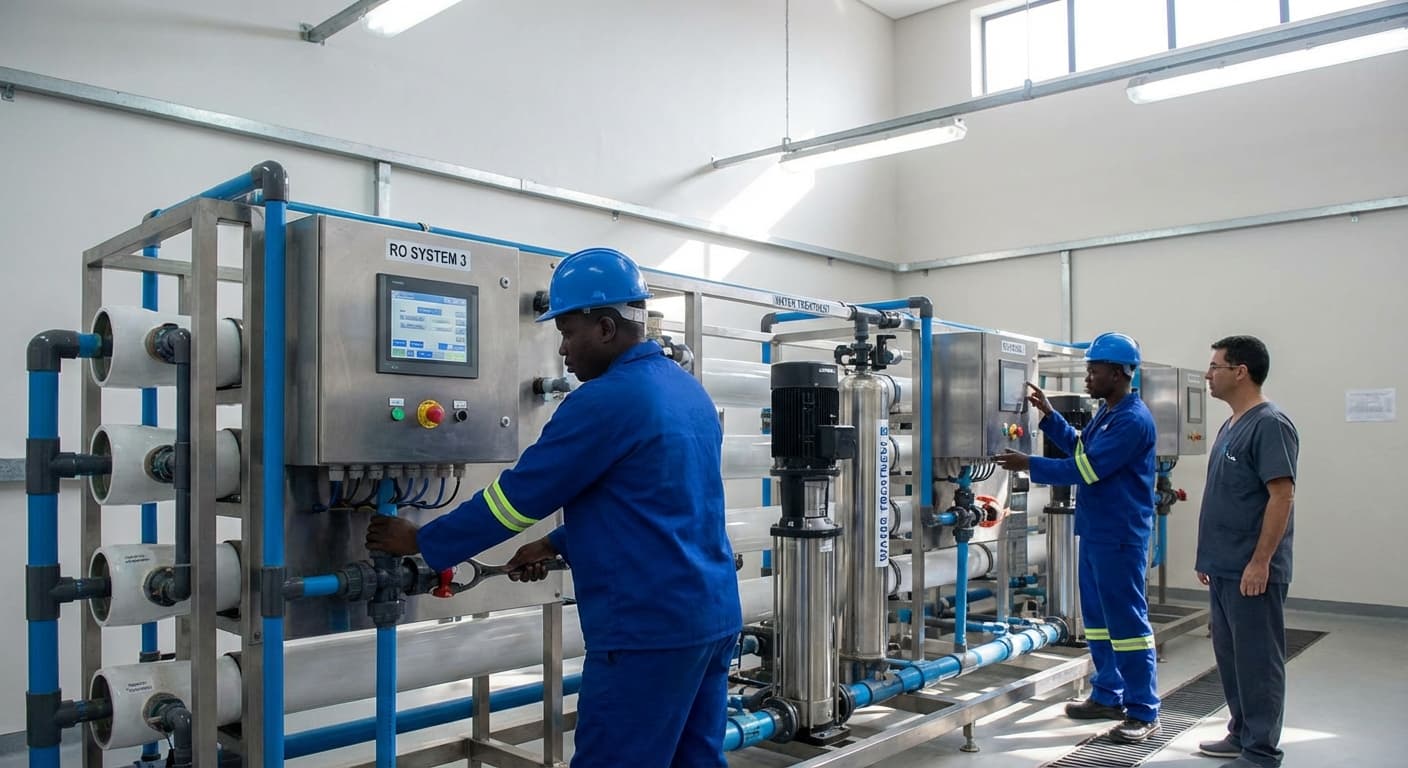
Dialysis RO/Water Treatment Plant Installation Service in Cameroon
Engineering Excellence & Technical Support
Dialysis RO/Water Treatment Plant Installation Service High-standard technical execution following OEM protocols and local regulatory frameworks.
Optimized RO System Design & Installation
We deliver bespoke Reverse Osmosis (RO) water treatment solutions tailored for dialysis centers in Cameroon, ensuring high-purity water meeting international dialysis standards. Our expert engineers meticulously design and install systems that maximize efficiency and minimize water wastage, crucial for resource-conscious healthcare facilities.
Robust Pre-treatment & Filtration
Our installations incorporate advanced pre-treatment stages, including multi-media filtration, activated carbon, and softening, to effectively remove impurities, chlorine, and hardness from raw water sources. This safeguards RO membranes and guarantees the consistent production of safe, potable water essential for patient hemodialysis.
Seamless Integration & Commissioning
We provide comprehensive installation services, including plumbing, electrical connections, and system commissioning. Our team ensures a smooth transition to operation, with thorough testing and operator training to guarantee optimal performance and longevity of your dialysis water treatment plant in Cameroon.
What Is Dialysis Ro/water Treatment Plant Installation Service In Cameroon?
Dialysis RO/Water Treatment Plant Installation Service in Cameroon refers to the specialized process of designing, procuring, assembling, and commissioning Reverse Osmosis (RO) and other water purification systems specifically engineered to meet the stringent water quality requirements for hemodialysis and peritoneal dialysis in healthcare facilities within Cameroon. This service ensures the provision of ultra-pure water, critical for patient safety and the efficacy of dialysis treatments, by removing dissolved solids, contaminants, microorganisms, and endotoxins.
| Who Needs the Service | Typical Use Cases | |||
|---|---|---|---|---|
| Hospitals and Clinics: Healthcare institutions offering hemodialysis and peritoneal dialysis services, both public and private. | Renal Dialysis Centers: Dedicated facilities specializing in providing dialysis treatment to patients with end-stage renal disease (ESRD). | Medical Research Facilities: Institutions requiring ultrapure water for related medical research involving cell cultures or sensitive assays. | Government Health Initiatives: Public health programs aimed at expanding access to renal care in underserved regions. | Existing Dialysis Facilities: Facilities with aging or non-compliant water treatment systems requiring upgrades or replacements. |
| Hemodialysis Water Production: Generating medical-grade water for hemodialysis machines to remove waste products from the blood of patients with kidney failure. | Peritoneal Dialysis Solution Preparation: Ensuring the purity of water used in the preparation of sterile peritoneal dialysis solutions. | Water Quality Monitoring and Compliance: Maintaining continuous monitoring of water quality parameters to meet national and international regulatory standards for dialysis. | Preventing Dialysis-Related Complications: Minimizing the risk of patient infections, pyrogenic reactions, and other adverse events caused by contaminated or inadequately purified water. | System Reliability and Uptime: Ensuring the consistent availability of safe and effective dialysis treatment by maintaining the integrity and performance of the water treatment plant. |
Key Components and Stages of the Service
- Needs Assessment and System Design: Evaluating existing water sources (municipal supply, well water), water quality analysis, and determining the optimal RO system capacity, flow rates, and pre-treatment stages based on patient volume and facility requirements.
- Equipment Procurement and Sourcing: Identifying and acquiring high-quality RO membranes, pre-filters (sediment, carbon), post-filters (polishing filters, UV sterilizers), pumps, storage tanks, piping, control systems, and monitoring instrumentation, adhering to international standards (e.g., AAMI, ISO).
- On-site Installation and Integration: Physically installing all system components, including plumbing, electrical connections, and control panel integration, ensuring proper structural support and accessibility for maintenance.
- Commissioning and Validation: Rigorous testing of the installed system to verify performance against design specifications and regulatory standards. This includes flow rate verification, pressure testing, conductivity measurement, microbial challenge testing, and endotoxin assessment.
- Operator Training: Providing comprehensive training to facility biomedical engineers, technicians, and nursing staff on system operation, routine maintenance, water quality monitoring protocols, and troubleshooting.
- Post-Installation Support and Maintenance: Offering ongoing technical support, scheduled preventative maintenance, spare parts management, and performance monitoring to ensure sustained optimal operation and compliance.
Who Needs Dialysis Ro/water Treatment Plant Installation Service In Cameroon?
The installation of dialysis Reverse Osmosis (RO) and water treatment plants is a critical service for ensuring the availability of safe and purified water essential for hemodialysis procedures. In Cameroon, this service is vital for healthcare facilities and organizations committed to providing quality renal care. The proper functioning of dialysis machines is directly dependent on the purity of the water used, making robust water treatment solutions indispensable.
| Customer Type | Relevant Departments | Key Needs/Considerations |
|---|---|---|
| Hospitals & Healthcare Centers | Nephrology Department, Dialysis Unit, Biomedical Engineering Department, Facilities Management | Reliable, high-purity water supply; compliance with international standards; system maintenance and support; energy efficiency. |
| Public Health Institutions | Ministry of Public Health (Procurement & Planning), Hospital Administration, Biomedical Engineering | Cost-effectiveness; scalability; long-term sustainability; training for local staff; robust and durable systems. |
| Private Clinics & Dialysis Centers | Clinic Management, Technical Operations, Procurement | State-of-the-art technology; quick installation; ongoing technical support; patient safety protocols; regulatory adherence. |
| NGOs & Charities | Project Management, Procurement, Healthcare Division | Impactful and sustainable solutions; budget adherence; community benefit; capacity building for local healthcare providers. |
| Medical Equipment Suppliers | Sales Department, Technical Support, Service Division | Seamless integration with dialysis machines; reliable partner for installations; after-sales service coordination; comprehensive solution offering. |
| Research & Educational Institutions | Medical Faculty, Research Labs, Hospital Affiliations | Consistent water quality for research protocols; training facilities for students and professionals; advanced system features for specific research needs. |
Target Customers and Departments for Dialysis RO/Water Treatment Plant Installation in Cameroon
- {"title":"Hospitals and Healthcare Centers","description":"These are the primary recipients of dialysis RO/water treatment plant installation services. They directly operate dialysis units and require a constant supply of purified water to treat patients with kidney failure."}
- {"title":"Public Health Institutions","description":"Government-funded health facilities, including major referral hospitals and regional health centers, often have dialysis units and require reliable water treatment solutions to serve a larger patient population."}
- {"title":"Private Clinics and Dialysis Centers","description":"Specialized private clinics and dedicated dialysis centers are increasingly being established in Cameroon. These facilities need to invest in high-quality water treatment systems to ensure patient safety and regulatory compliance."}
- {"title":"Non-Governmental Organizations (NGOs) and Charities","description":"Organizations focused on improving healthcare access and quality in Cameroon may fund or operate dialysis units, requiring installation services for their projects."}
- {"title":"Medical Equipment Suppliers and Distributors","description":"Companies that supply dialysis machines often partner with or recommend water treatment plant installation services to provide a complete solution to their clients."}
- {"title":"Research and Educational Institutions (with clinical affiliations)","description":"Academic institutions that have affiliated hospitals or conduct medical research involving dialysis may also require these services for their training and research facilities."}
Dialysis Ro/water Treatment Plant Installation Service Process In Cameroon
This document outlines the comprehensive service process for installing Dialysis Reverse Osmosis (RO) and Water Treatment Plants in Cameroon, covering every stage from the initial client inquiry to the final execution and handover. Our aim is to ensure a seamless and efficient installation, delivering high-quality water treatment solutions tailored to the specific needs of healthcare facilities.
| Phase | Stage/Activity | Description | Key Deliverables/Outcomes | Typical Timeline (Indicative) |
|---|---|---|---|---|
| 1: Inquiry & Consultation | Initial Inquiry | Client contacts us with a requirement for a Dialysis RO/Water Treatment Plant. This can be through phone, email, or our website. | Understanding of client's basic needs and location. | 1-3 Business Days |
| Needs Assessment & Preliminary Discussion | A detailed discussion to understand the facility's current water source, water quality, intended use (e.g., number of dialysis stations), budget, and any specific regulatory requirements. | Gathered information, initial understanding of project scope. | 3-7 Business Days | |
| Technical Consultation | Our water treatment specialists provide expert advice on suitable technologies, system configurations, and potential challenges specific to Cameroon's environment. | Recommendations on technology and preliminary system type. | Part of Needs Assessment | |
| 2: Site Assessment & System Design | Site Survey (On-site) | Our technical team visits the facility to conduct a thorough assessment of the installation site, including space availability, power supply, plumbing, drainage, and existing infrastructure. | Detailed site report, confirmation of installation feasibility. | 7-14 Business Days (including travel) |
| Water Quality Analysis | Sampling and testing of the raw water source to determine its composition, impurities, and suitability for dialysis treatment. This is crucial for designing the appropriate treatment stages. | Comprehensive water analysis report. | 7-14 Business Days (depending on lab turnaround) | |
| System Design & Engineering | Based on site assessment and water analysis, a customized RO/Water Treatment Plant system is designed, specifying components, flow rates, treatment stages, and layout. | Detailed system design schematics, Bill of Materials (BOM). | 10-20 Business Days | |
| 3: Quotation & Contract | Proforma Invoice & Quotation | A detailed quotation is provided, outlining the cost of equipment, installation, commissioning, training, and any applicable warranties. This includes a breakdown of all components and services. | Comprehensive and transparent quotation. | 3-5 Business Days after design finalization |
| Contract Negotiation & Signing | Review and negotiation of contract terms, including payment schedules, timelines, warranty, and service level agreements. Upon agreement, the contract is signed. | Signed contract, mutual understanding of project terms. | 5-10 Business Days | |
| 4: Procurement & Logistics | Equipment Procurement | All specified components and materials for the RO/Water Treatment Plant are sourced from reputable manufacturers and suppliers. | Procured and quality-checked equipment and materials. | Varies (4-12 Weeks, depending on availability and lead times) |
| Logistics & Shipping | Arrangement of secure transportation and customs clearance for all equipment and materials from the point of origin to the installation site in Cameroon. | On-time delivery of all project components to site. | Integrated with procurement timeline | |
| 5: Installation & Commissioning | Site Preparation | Any necessary civil works, pipe laying, and electrical connections are completed at the site as per the design. | Ready installation environment. | Integrated with site assessment and logistics |
| Plant Assembly & Installation | Our skilled technicians meticulously assemble and install the RO/Water Treatment Plant system on-site, adhering to strict quality and safety standards. | Physically installed and connected RO/Water Treatment Plant. | 7-21 Business Days (depending on system complexity) | |
| System Commissioning & Testing | The installed system is thoroughly tested and commissioned to ensure all components function optimally. Water quality is tested against stringent dialysis standards. | Fully operational and certified RO/Water Treatment Plant, confirmed water quality. | 5-10 Business Days | |
| 6: Training & Handover | Operator Training | Comprehensive training is provided to the facility's technical staff on the operation, basic maintenance, and troubleshooting of the RO/Water Treatment Plant. | Competent and trained operational staff. | 2-5 Business Days |
| Documentation & Handover | All relevant documentation, including operation manuals, maintenance guides, and test reports, is provided to the client. The plant is formally handed over. | Complete documentation package, client acceptance of the system. | 1-2 Business Days | |
| 7: Post-Installation Support & Maintenance | Warranty Period | The RO/Water Treatment Plant is covered by a warranty, ensuring support and repair for any defects. | Peace of mind, guaranteed system performance. | As per contract terms (e.g., 12-24 months) |
| Preventive Maintenance | Optional preventive maintenance contracts are offered to ensure long-term optimal performance and to minimize downtime through regular checks and servicing. | Extended system lifespan, consistent water quality. | Ongoing, as per service agreement | |
| Spare Parts & Technical Support | We provide access to genuine spare parts and ongoing technical support to address any issues that may arise. | Minimized downtime, continued operational efficiency. | As needed |
Dialysis RO/Water Treatment Plant Installation Service Process in Cameroon
- Phase 1: Inquiry & Consultation
- Phase 2: Site Assessment & System Design
- Phase 3: Quotation & Contract
- Phase 4: Procurement & Logistics
- Phase 5: Installation & Commissioning
- Phase 6: Training & Handover
- Phase 7: Post-Installation Support & Maintenance
Dialysis Ro/water Treatment Plant Installation Service Cost In Cameroon
Installing a Reverse Osmosis (RO) and Water Treatment Plant for dialysis in Cameroon involves a range of costs influenced by several critical factors. The primary purpose of such a plant is to purify water to the stringent standards required for hemodialysis, ensuring patient safety and the longevity of dialysis equipment. The pricing in local currency (Cameroonian Franc - XAF) can vary significantly depending on the scale of the operation, the quality and complexity of the chosen technology, the specific site requirements, and the chosen service provider.
| System Size/Capacity (Liters/Hour) | Estimated Installation Cost Range (XAF) | Typical Components Included |
|---|---|---|
Key Pricing Factors for Dialysis RO/Water Treatment Plant Installation in Cameroon:
- {"title":"Plant Capacity and Scale","description":"The volume of purified water required per day directly impacts the size and complexity of the RO system and associated treatment stages. Larger capacities necessitate bigger membranes, more powerful pumps, and larger tanks, all contributing to higher costs."}
- {"title":"Water Source Quality","description":"The initial quality of the raw water source (e.g., municipal supply, borehole, river) is a major determinant. Water with high levels of impurities, dissolved solids, bacteria, or specific contaminants will require more advanced pre-treatment stages (sediment filtration, activated carbon, UV sterilization, chemical dosing), increasing the overall system cost."}
- {"title":"Technology and Equipment Brands","description":"The choice of RO membranes, pumps, filtration media, control systems, and sterilization units significantly influences price. Reputable international brands known for their reliability and performance often come at a premium compared to generic alternatives. The level of automation and sophistication of the control system also plays a role."}
- {"title":"Number of Treatment Stages","description":"While RO is the core component, a comprehensive dialysis water treatment system often includes multiple stages. These can include: pre-filtration (sediment, carbon), softening, deionization, UV disinfection, ultrafiltration, and final polishing filters. Each stage adds to the material and installation costs."}
- {"title":"Installation Complexity and Site Preparation","description":"The physical location of the installation, accessibility, existing infrastructure (power, plumbing), and the need for structural modifications or dedicated housing for the plant will impact labor and material costs for installation."}
- {"title":"Service Provider and Expertise","description":"The experience, reputation, and overhead of the installation company are reflected in their pricing. Companies with specialized expertise in medical water treatment and a proven track record may charge more but offer greater assurance of quality and compliance."}
- {"title":"Testing, Commissioning, and Training","description":"The cost of rigorous testing to ensure water quality meets dialysis standards, system commissioning, and training for facility staff on operation and maintenance are integral parts of the service and contribute to the overall expense."}
- {"title":"Permits and Regulatory Compliance","description":"Obtaining necessary permits and ensuring the system complies with local health and environmental regulations may involve fees and additional work, impacting the final cost."}
- {"title":"Warranty and After-Sales Support","description":"The duration and scope of warranty offered, along with the availability and cost of ongoing maintenance and spare parts, should be considered when evaluating the total cost of ownership."}
Affordable Dialysis Ro/water Treatment Plant Installation Service Options
Finding affordable dialysis RO/water treatment plant installation services is crucial for healthcare facilities aiming to provide safe and effective dialysis while managing operational costs. This involves understanding value bundles and implementing smart cost-saving strategies. Value bundles typically combine installation, equipment, and maintenance into a single package, offering predictable budgeting and often better pricing than procuring services separately. Cost-saving strategies extend beyond initial installation to encompass operational efficiency, energy conservation, and smart purchasing decisions.
| Bundle Component | Description | Cost-Saving Potential |
|---|---|---|
| Comprehensive Installation Package | Includes site assessment, system design, equipment procurement, installation, and initial commissioning. | Streamlined project management, potential bulk purchasing discounts on equipment, reduced coordination overhead. |
| Equipment Leasing/Financing Options | Instead of outright purchase, facilities can lease or finance RO systems, spreading costs over time. | Lower upfront capital expenditure, predictable monthly payments, often includes maintenance as part of the lease. |
| Service & Maintenance Contracts | Bundled agreements covering routine maintenance, filter replacements, and emergency service. | Prevents costly breakdowns, extends equipment lifespan, allows for budgeted operational expenses, ensures water quality compliance. |
| Energy-Efficient System Integration | Incorporating energy-saving pumps, efficient membrane technology, and smart controls into the bundle. | Reduces electricity consumption, a major operational cost for RO plants, leading to long-term savings. |
| Water Recycling & Recovery Systems | Bundled solutions that treat and reuse rejected water from the RO process. | Significantly reduces water consumption, lowering utility bills, especially in water-scarce regions. |
| Modular or Scalable Designs | Systems designed to be easily expanded or upgraded as patient needs grow. | Avoids the need for complete system replacement, saving on future capital investments. |
| Bulk Purchasing & Long-Term Contracts | Negotiating discounts for larger installations or committing to longer-term service agreements. | Leverages economies of scale for better pricing on equipment and services. |
| Preventive Maintenance & Monitoring | Proactive maintenance schedules and remote monitoring to detect issues early. | Minimizes downtime, prevents catastrophic failures, and optimizes system performance, leading to cost avoidance. |
| Staff Training & Optimization | Bundles that include training for facility staff on operation and basic maintenance. | Empowers staff to handle minor issues, reduces reliance on external technicians for routine tasks, improving efficiency. |
| Compare Multiple Vendor Quotes | Obtain detailed proposals from several reputable installation companies. | Ensures competitive pricing and allows for evaluation of different service offerings and technologies. |
| Consider Refurbished or Certified Pre-Owned Equipment | For certain components or less critical systems, explore high-quality refurbished options. | Significant cost reduction on initial equipment purchase, while still ensuring reliability if certified and warrantied. |
| Negotiate Payment Terms | Discuss flexible payment schedules or milestone-based payments. | Improves cash flow management and can sometimes lead to better overall deal terms. |
Value Bundles and Cost-Saving Strategies for Dialysis RO/Water Treatment Plant Installation
- {"title":"Understanding Value Bundles","description":"Value bundles are designed to offer comprehensive solutions at a potentially reduced cost compared to individual service purchases. They often include a combination of the following elements:"}
- {"title":"Benefits of Value Bundles","description":"Opting for value bundles can lead to significant advantages:"}
- {"title":"Cost-Saving Strategies During Installation and Operation","description":"Beyond bundles, several strategic approaches can minimize costs throughout the lifecycle of your dialysis RO/water treatment plant:"}
Verified Providers In Cameroon
In Cameroon's evolving healthcare landscape, identifying trustworthy and competent medical providers is paramount. Franance Health stands out as a leading credentialing body, meticulously verifying healthcare professionals and facilities to ensure the highest standards of care. Their rigorous vetting process and commitment to quality make their certified providers the best choice for patients seeking reliable and effective medical services. This commitment translates to a healthcare experience where safety, expertise, and patient well-being are consistently prioritized.
| Category of Provider | What Franance Health Verifies | Benefits for Patients |
|---|---|---|
| Doctors (Specialists & General Practitioners) | Medical degrees, board certifications, residency completion, active licenses, malpractice history, peer reviews. | Access to board-certified specialists and experienced general practitioners with proven track records. |
| Nurses (RNs, ENs, etc.) | Nursing degrees/diplomas, licensure, specialized certifications, continuing education. | Confidence in the qualifications and competency of nursing staff providing direct patient care. |
| Hospitals & Clinics | Accreditation status, facility infrastructure, adherence to hygiene and safety protocols, availability of essential equipment, qualified medical staff. | Assurance of receiving care in a safe, well-equipped, and professionally managed healthcare setting. |
| Laboratories & Diagnostic Centers | Accreditation, quality control measures, staff qualifications, accuracy and reliability of test results. | Trustworthy and accurate diagnostic results essential for effective treatment. |
| Pharmacies | Pharmacy licenses, pharmacist qualifications, drug sourcing and storage practices, dispensing accuracy. | Reliable access to legitimate medications dispensed by qualified professionals. |
Why Franance Health Credentials Matter:
- Rigorous Verification Process: Franance Health employs a multi-faceted approach to credentialing, examining educational qualifications, licensing, professional experience, and adherence to ethical guidelines.
- Commitment to Quality Assurance: Beyond initial verification, Franance Health often includes ongoing monitoring and evaluation mechanisms to ensure continued adherence to their standards.
- Patient Safety First: The core of Franance Health's mission is to protect patients by identifying and promoting providers who have demonstrated a strong commitment to safe medical practices.
- Enhanced Trust and Confidence: A Franance Health credential provides patients with a clear indicator of a provider's verified competence, fostering trust and reducing the anxiety associated with seeking medical care.
- Access to Expertise: By vetting specialists and general practitioners across various disciplines, Franance Health helps patients find qualified professionals best suited to their specific health needs.
- Promoting Ethical Practice: Franance Health's standards encompass ethical conduct, ensuring that verified providers operate with integrity and prioritize patient interests.
Scope Of Work For Dialysis Ro/water Treatment Plant Installation Service
This Scope of Work (SOW) outlines the services required for the installation of a Dialysis Reverse Osmosis (RO) and Water Treatment Plant. It details the technical deliverables and standard specifications to ensure a functional, safe, and compliant system meeting the highest quality standards for dialysis water.
| Category | Item | Description | Standard Specification / Reference |
|---|---|---|---|
| RO/Water Treatment Plant | Reverse Osmosis Membrane | High rejection rate, low fouling, suitable for medical grade water production. | ASME, ISO, or equivalent medical device standards; manufacturer's specifications. |
| RO/Water Treatment Plant | Pre-treatment Filters | Sediment filters, activated carbon filters to protect RO membranes from particulate matter and chlorine. | Micron ratings as per design; NSF certified materials. |
| RO/Water Treatment Plant | Post-treatment | UV sterilizer or equivalent for microbial control; remineralization if required. | FDA approved UV lamps; NSF certified materials. |
| RO/Water Treatment Plant | Pumps | High-pressure feed pump, circulation pump suitable for continuous operation. | ANSI/API standards; variable frequency drives (VFD) for energy efficiency. |
| RO/Water Treatment Plant | Control System | Programmable Logic Controller (PLC) based with user-friendly interface, alarms, and data logging. | IEC 61131-3 programming standards; cybersecurity measures. |
| Piping and Fittings | Materials | Sanitary grade, corrosion-resistant materials suitable for purified water. | ASTM D1785 (PVC), ASTM F439 (CPVC), SS316L for critical components; NSF/ANSI 61. |
| Piping and Fittings | Installation | Smooth internal surfaces, minimal dead legs, proper slope for drainage. | Good Engineering Practices; ASME B31.3 for process piping. |
| Electrical | Wiring | Properly sized, insulated, and protected wiring to meet electrical codes. | NEC (National Electrical Code) or local equivalent; UL listed components. |
| Electrical | Grounding | Effective grounding for all electrical components to prevent static discharge and ensure safety. | NEC Article 250 or local equivalent. |
| Water Quality | Treated Water | Meeting AAMI standards for dialysis water quality (TOC, conductivity, microbial load, endotoxins). | Association for the Advancement of Medical Instrumentation (AAMI) standards; ISO 13485. |
| Water Quality | Testing | Regular testing during commissioning and post-installation for key parameters. | Standard methods for water analysis (e.g., EPA methods); AAMI guidelines. |
| Safety | System Design | Incorporating safety features like pressure relief valves, emergency stop buttons. | OSHA regulations; manufacturer's safety guidelines. |
| Documentation | Manuals | Operation, maintenance, and troubleshooting manuals. | Clear, concise language; manufacturer's standard. |
| Documentation | As-Built Drawings | Detailed drawings of the installed system. | Industry standard CAD formats. |
Key Activities
- Site assessment and survey to determine optimal placement and infrastructure requirements.
- Procurement and delivery of all necessary RO/Water Treatment plant components, consumables, and accessories.
- Pre-installation verification of site readiness, including electrical, plumbing, and drainage provisions.
- Assembly and installation of the RO/Water Treatment plant unit according to manufacturer's specifications and best practices.
- Integration of the plant with existing site infrastructure (water inlet, power, drainage).
- Installation of all required piping, valves, fittings, and instrumentation for water distribution and monitoring.
- Electrical wiring and connection of the RO/Water Treatment plant and its control systems.
- Initial system startup, flushing, and purging to remove contaminants and debris.
- Performance testing and commissioning of the RO/Water Treatment plant to verify operational parameters.
- Water quality testing and analysis at various stages of the treatment process to ensure compliance with dialysis standards.
- Operator training on the operation, maintenance, and basic troubleshooting of the RO/Water Treatment plant.
- Handover of the fully installed and commissioned RO/Water Treatment plant with all relevant documentation.
- Post-installation support and warranty period as per agreed terms.
Service Level Agreement For Dialysis Ro/water Treatment Plant Installation Service
This Service Level Agreement (SLA) outlines the performance standards and guarantees for the installation services of Dialysis Reverse Osmosis (RO) / Water Treatment Plants. It defines the expected response times for critical issues and the guaranteed uptime of the installed system post-commissioning. The primary objective is to ensure minimal disruption to dialysis operations and patient care.
| Service Level | Severity Level | Response Time Target | Resolution Time Target | Uptime Guarantee (during Warranty) |
|---|---|---|---|---|
| Installation & Commissioning Support | Critical (System Failure impacting all dialysis treatments) | 1 Hour (acknowledgement) | 4-8 Business Hours (initiation of resolution) | N/A (focus on installation success) |
| Installation & Commissioning Support | High (Partial system failure impacting some dialysis treatments) | 2 Business Hours (acknowledgement) | 8-12 Business Hours (initiation of resolution) | N/A (focus on installation success) |
| Post-Installation Warranty Support | Critical (Complete RO/Water Treatment Plant failure) | 1 Hour (acknowledgement) | 4 Business Hours (on-site technician dispatch) | 98.5% |
| Post-Installation Warranty Support | High (Significant performance degradation impacting water quality) | 4 Business Hours (acknowledgement) | 12 Business Hours (on-site technician dispatch) | 98.5% |
| Post-Installation Warranty Support | Medium (Minor operational issues, alarms, or non-critical component failures) | 8 Business Hours (acknowledgement) | 24-48 Business Hours (scheduled remote or on-site support) | 98.5% |
| Post-Installation Warranty Support | Low (General inquiries, performance monitoring checks) | 24 Business Hours (acknowledgement) | As agreed, or scheduled follow-up | 98.5% |
Key Performance Indicators (KPIs) and Guarantees
- Response Time: The time taken by the service provider to acknowledge and initiate troubleshooting for a reported issue.
- Resolution Time: The time taken by the service provider to resolve a reported issue to the client's satisfaction.
- System Uptime: The percentage of time the installed RO/Water Treatment Plant is operational and performing within specified parameters during the warranty period.
Frequently Asked Questions

Ready when you are
Let's scope your Dialysis RO/Water Treatment Plant Installation Service in Cameroon project in Cameroon.

Scaling healthcare logistics and technical systems across the entire continent.