
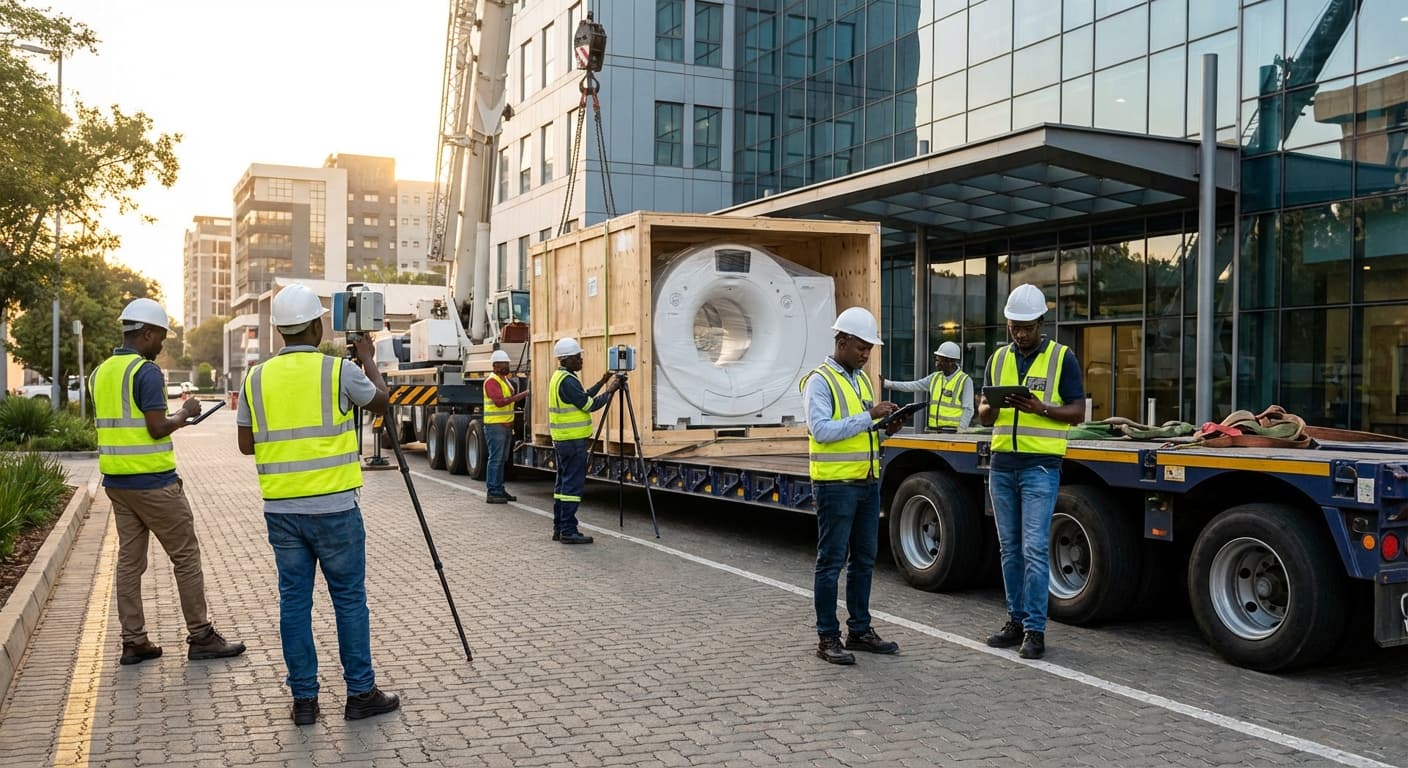
Route Survey & Rigging Plan Service for Heavy Medical Equipment in Cameroon
Engineering Excellence & Technical Support
Route Survey & Rigging Plan Service for Heavy Medical Equipment High-standard technical execution following OEM protocols and local regulatory frameworks.
Optimized Logistics & Route Assessment
Leveraging advanced GIS and traffic data, we meticulously plan the most efficient and safest routes for heavy medical equipment transport in Cameroon, considering road conditions, bridge load capacities, and potential logistical bottlenecks to minimize transit times and risks.
Precision Rigging & Lift Planning
Our certified rigging engineers design and execute meticulous lift plans for ultra-heavy medical equipment, utilizing specialized lifting gear and adhering to stringent international safety standards to ensure secure and controlled movements, even in challenging site environments.
Comprehensive Risk Mitigation & Site Surveys
We conduct in-depth site surveys to identify and proactively address potential hazards, including access limitations, overhead obstructions, and ground stability. Our risk assessment framework ensures all potential challenges are mitigated through bespoke engineering solutions and robust contingency planning.
What Is Route Survey & Rigging Plan Service For Heavy Medical Equipment In Cameroon?
Route Survey & Rigging Plan Service for Heavy Medical Equipment in Cameroon refers to a specialized logistical undertaking focused on the meticulous planning and execution of transporting and installing exceptionally large, heavy, and often sensitive medical apparatus within Cameroon. This service encompasses a comprehensive assessment of the entire journey, from the point of origin (e.g., port of entry, manufacturing site) to the final installation location within a healthcare facility. The process involves detailed site inspections, route feasibility studies, risk assessments, and the development of precise rigging and lifting strategies. The objective is to ensure the safe, efficient, and damage-free delivery and placement of these critical medical assets, adhering to stringent safety standards and operational constraints.
| Who Needs This Service? | Typical Use Cases | |||||
|---|---|---|---|---|---|---|
| Healthcare Facilities: Hospitals, specialized clinics, diagnostic centers, and research institutions in Cameroon requiring the installation of new or replacement heavy medical equipment. | Medical Equipment Manufacturers & Suppliers: Companies delivering and installing large-scale medical devices to their clients within Cameroon. | Project Management Firms: Companies overseeing the development or expansion of healthcare infrastructure in Cameroon. | Government Agencies: Ministries of Health or other public bodies responsible for equipping healthcare facilities. | |||
| Magnetic Resonance Imaging (MRI) Scanners: Requiring significant structural considerations for delivery and installation due to weight and size. | Computed Tomography (CT) Scanners: Similar to MRI, these units are large, heavy, and require precise placement. | Linear Accelerators (LINACs): Used in radiotherapy, these are substantial and often require specialized shielding and installation environments. | Angiography Suites & Cardiac Catheterization Labs: Complex systems involving heavy imaging equipment and associated infrastructure. | Large-Scale Laboratory Equipment: Such as industrial-grade centrifuges, automated analyzers, or specialized research apparatus. | Modular Operating Theatre Systems: Pre-fabricated units that require careful transport and integration. | Heavy Diagnostic Imaging Equipment: Including X-ray machines with substantial gantry systems and patient tables. |
Key Components of Route Survey & Rigging Plan Service:
- Route Feasibility Study: Comprehensive analysis of all potential transportation routes, considering factors such as road infrastructure (width, height clearances, weight limits, turning radii), bridge load capacities, potential obstacles (power lines, traffic signals, existing infrastructure), traffic patterns, and permits required for oversized/overweight loads.
- Site Assessment: Detailed evaluation of both the origin and destination sites, including access points, internal pathways, floor load capacities, ceiling heights, door dimensions, elevator specifications (if applicable), and any potential structural limitations. This also includes assessing the ground condition for any temporary support structures required.
- Equipment Characterization: Thorough understanding of the dimensions, weight distribution, center of gravity, fragility, and any specific handling requirements of the medical equipment. This includes identifying lifting points and any sensitive components that require specialized protection.
- Risk Assessment and Mitigation: Identification of potential hazards and challenges throughout the route and at the sites. Development of strategies to mitigate these risks, including contingency planning for unforeseen events (e.g., equipment failure, weather disruptions, road closures).
- Rigging and Lifting Plan Development: Creation of detailed technical drawings and procedures for the safe lifting, maneuvering, and positioning of the equipment. This includes specifying the types of lifting equipment (cranes, gantries, forklifts, jacks), rigging gear (slings, shackles, spreader bars), and skilled personnel required.
- Method Statements and Work Procedures: Formal documentation outlining the step-by-step execution of each phase of the operation, including safety protocols, communication plans, and quality control measures.
- Permitting and Regulatory Compliance: Assistance with obtaining all necessary permits and authorizations from local and national authorities for oversized transport, road usage, and specialized lifting operations in Cameroon.
- Logistical Coordination: Management of all transportation assets, crew scheduling, and coordination with relevant stakeholders, including port authorities, customs agencies, local authorities, and the end-user healthcare facility.
Who Needs Route Survey & Rigging Plan Service For Heavy Medical Equipment In Cameroon?
This document outlines the critical need for specialized Route Survey & Rigging Plan Services when transporting and installing heavy medical equipment in Cameroon. The unique logistical challenges and infrastructure limitations necessitate expert planning to ensure the safe and successful delivery and setup of these vital medical assets. This service is indispensable for organizations undertaking such projects, mitigating risks of damage, delays, and cost overruns.
| Target Customer Type | Key Departments / Stakeholders | Specific Needs Addressed |
|---|---|---|
| Hospitals and Healthcare Facilities | Procurement Department, Facilities Management, Biomedical Engineering Department, Clinical Departments (e.g., Radiology, Surgery) | Ensuring equipment can physically reach its intended location within the facility, proper installation access, minimizing disruption to patient care during delivery and installation. |
| Ministry of Health and Government Health Agencies | Procurement Unit, Logistics Department, Planning and Infrastructure Division | Coordinating large-scale equipment deployments across multiple facilities, ensuring adherence to national standards, optimizing resource allocation for transportation and installation. |
| Non-Governmental Organizations (NGOs) | Program Managers, Logistics Officers, Project Coordinators | Navigating remote or underserved areas, securing safe passage for equipment in challenging terrain, managing limited budgets for logistics and installation. |
| International Aid Organizations | Logistics Department, Project Managers, Technical Specialists | Facilitating large-volume imports, understanding local infrastructure capabilities and limitations, ensuring compliance with international donor requirements for equipment handling. |
| Medical Equipment Suppliers/Manufacturers | Logistics Department, Sales & Technical Support, Project Management | Ensuring the integrity of their products during transit to the end-user, providing pre-installation site assessments for their equipment, offering a complete service package to their clients. |
| Construction & Engineering Firms | Project Managers, Site Engineers, Logistics Coordinators | Integrating heavy equipment delivery and installation into broader construction timelines, ensuring site readiness and accessibility for specialized rigging operations, coordinating with building design for equipment placement. |
| Research Institutions/Universities | Research Leads, Procurement Officers, Facilities Management | Transporting sensitive and often large-scale research equipment, ensuring minimal downtime for research activities, planning for specialized laboratory installations. |
Target Customers for Route Survey & Rigging Plan Service in Cameroon
- Hospitals and Healthcare Facilities (Public & Private)
- Ministry of Health and Government Health Agencies
- Non-Governmental Organizations (NGOs) involved in healthcare provision
- International Aid Organizations and Development Agencies
- Medical Equipment Suppliers and Manufacturers
- Construction and Engineering Firms involved in healthcare infrastructure projects
- Research Institutions and Universities with medical faculties
Route Survey & Rigging Plan Service For Heavy Medical Equipment Process In Cameroon
This document outlines the comprehensive workflow for our Route Survey & Rigging Plan Service, specifically tailored for the transportation and installation of heavy medical equipment in Cameroon. Our service ensures a safe, efficient, and compliant process, from the initial client inquiry to the successful execution of the rigging and placement of your valuable medical assets.
| Stage | Description | Key Activities | Deliverables/Outcomes | Timeline (Estimated) |
|---|---|---|---|---|
| The initial stage where clients express their need for our specialized services. We gather all essential information about the equipment and project. | Client contact, detailed equipment specifications (weight, dimensions, fragility), origin & destination, desired installation timeline, budget indications. | Understanding of project scope, preliminary feasibility assessment, initial quotation. | 1-3 Business Days |
| Our expert team conducts thorough on-site surveys at both the origin and destination, and along the proposed transport route. | Physical inspection of access points, internal pathways, doorways, floor load capacity, crane/lifting points, road conditions, bridge clearances, tunnel limitations, potential obstacles, power line heights, traffic flow, community impact assessment. | Detailed route maps, photographic documentation, site condition reports, identification of potential route challenges. | 3-7 Business Days (depending on route complexity & number of sites) |
| A critical step to identify potential hazards and develop strategies to minimize risks associated with transporting and rigging heavy equipment. | Identification of mechanical, logistical, environmental, and human-related risks; assessment of likelihood and impact; development of contingency plans, safety protocols, and emergency procedures. | Comprehensive risk assessment report, safety management plan, emergency response protocols. | 2-4 Business Days |
| Based on site survey data and risk assessment, a detailed and precise rigging plan is formulated. | Selection of appropriate lifting equipment (cranes, forklifts, gantries), rigging gear (slings, shackles, spreader bars), detailed lifting procedures, weight distribution analysis, center of gravity calculations, installation sequence, personnel roles and responsibilities. | Detailed rigging plan document with diagrams, equipment specifications, lifting calculations, and safe working load (SWL) analysis. | 5-10 Business Days (depending on equipment complexity) |
| We manage all necessary permits and approvals from relevant authorities in Cameroon. | Liaison with local authorities (transportation ministries, municipal councils), submission of all required documentation, obtaining permits for road closures, special transport, and site access. | All necessary permits and legal authorizations for the operation. | Varies significantly based on local regulations and authority responsiveness (typically 5-20 Business Days) |
| Ensuring all required personnel, equipment, and materials are in place for the execution phase. | Procurement or rental of specialized lifting and transport equipment, mobilization of skilled rigging crews, technicians, safety officers, and drivers, sourcing of appropriate rigging accessories, staging of necessary safety equipment. | Mobilized and ready-to-deploy resources. | 3-7 Business Days |
| The actual implementation of the transport and rigging plan, ensuring safety and precision. | Supervised transportation of equipment along the surveyed route, controlled lifting and positioning of equipment at the destination, adherence to the developed rigging plan and safety protocols, real-time monitoring and communication. | Successful and safe transport and rigging of the medical equipment in its designated location. | 1-5 Business Days (depending on distance, complexity, and number of lifts) |
| Concluding the service with a thorough review and formal handover to the client. | Final inspection of the installed equipment, site cleanup, debriefing with the client, submission of a final project report, confirmation of client satisfaction, demobilization of resources. | Completed project documentation, client sign-off, final report, confirmation of successful service delivery. | 1-2 Business Days |
Workflow Stages
- Inquiry & Needs Assessment
- Site Survey & Route Planning
- Risk Assessment & Mitigation
- Rigging Plan Development
- Permitting & Approvals
- Resource Mobilization
- Execution (Transport & Rigging)
- Post-Execution & Handover
Route Survey & Rigging Plan Service For Heavy Medical Equipment Cost In Cameroon
Estimating the precise cost for Route Survey & Rigging Plan Services for heavy medical equipment in Cameroon requires a detailed understanding of several influencing factors. These services are critical for ensuring the safe and efficient transport and installation of specialized, often sensitive, and exceptionally heavy medical machinery. The pricing can vary significantly based on the complexity of the route, the weight and dimensions of the equipment, the accessibility of the final destination, and the specific expertise required. Local market conditions, prevailing rates for specialized labor, and the availability of suitable equipment also play a significant role in determining the final cost. It's important to engage with reputable service providers who can conduct a thorough assessment to provide an accurate quotation.
| Service Component | Estimated Cost Range (XAF) | Notes |
|---|---|---|
| Route Survey (Comprehensive) | 150,000 - 500,000 | Includes site visits, road assessments, obstacle identification, traffic analysis, and preliminary risk evaluation. |
| Rigging Plan Development (Detailed) | 200,000 - 750,000 | Encompasses equipment handling procedures, lifting points, safety protocols, equipment selection, and detailed drawings/schematics. |
| Basic Rigging Labor (Per day, per technician) | 30,000 - 75,000 | For standard rigging tasks with less complex equipment. Highly skilled technicians may command higher rates. |
| Specialized Rigging Labor (Per day, per technician) | 60,000 - 150,000+ | For operating heavy machinery, complex lifts, or working with extremely sensitive equipment. Rates increase with experience and specialization. |
| Crane/Heavy Equipment Rental (Per day) | 100,000 - 1,000,000+ | Varies significantly based on crane capacity, type, and rental duration. Crawler cranes or larger mobile cranes are at the higher end. |
| Specialized Transport (Per km or fixed fee) | 50,000 - 300,000+ (plus transport) | For oversized or overweight loads, involving specialized trailers and potentially escort vehicles. This is often additional to standard transport costs. |
| Project Management & Supervision | 50,000 - 200,000 per day | For overseeing the entire operation, ensuring adherence to the plan and safety standards. |
| Site Preparation (Minor adjustments) | Varies widely (e.g., 50,000 - 500,000) | May involve minor structural modifications or temporary ramp construction. Highly dependent on site conditions. |
| Contingency & Risk Mitigation | 5% - 15% of total project cost | A buffer for unforeseen challenges and ensuring successful execution. |
Key Pricing Factors for Route Survey & Rigging Plan Services:
- Equipment Specifications (Weight, Dimensions, Sensitivity): Heavier, larger, or more delicate equipment will necessitate more specialized rigging gear and increased labor, thus higher costs.
- Route Complexity and Distance: Longer distances and routes with challenging terrain (e.g., steep inclines, narrow roads, unpaved sections) require more planning, time, and potentially specialized transport vehicles.
- Site Accessibility and Preparation: Difficult access to the installation site (e.g., multi-story buildings without adequate elevators, tight building entrances) can add significant complexity and cost due to the need for specialized lifting equipment and potential structural modifications.
- Rigging Requirements (Cranes, Forklifts, Hoists): The type and capacity of lifting equipment needed directly impacts costs. Higher capacity cranes or specialized forklifts will be more expensive to hire.
- Labor Requirements and Expertise: The number of skilled technicians, riggers, and project managers involved, along with their experience with specific medical equipment, influences labor costs.
- Time Constraints and Urgency: Expedited services or tight deadlines may incur premium charges.
- Permits and Approvals: Obtaining necessary permits for oversized loads or working in restricted areas can add administrative costs.
- Contingency Planning and Risk Assessment: Thorough risk assessments and contingency planning are part of the service, and the perceived risk can influence pricing.
- Insurance Coverage: Adequate insurance for the transport and rigging operations is essential and factored into the overall cost.
Affordable Route Survey & Rigging Plan Service For Heavy Medical Equipment Options
Moving heavy medical equipment requires meticulous planning, precise execution, and a deep understanding of both route surveying and rigging. Our 'Affordable Route Survey & Rigging Plan Service' is designed to provide cost-effective solutions for healthcare facilities, research institutions, and medical equipment manufacturers. We specialize in ensuring the safe and efficient relocation of your valuable assets, minimizing downtime and preventing costly damage. Our services encompass comprehensive site assessments, detailed route planning, load calculations, and the development of bespoke rigging strategies tailored to the unique needs of each piece of equipment.
| Value Bundle Name | Included Services | Ideal For | Cost-Saving Strategies Employed | Estimated Price Range (USD) |
|---|---|---|---|---|
| Basic Route & Rigging Assessment | Initial site survey for one piece of equipment, basic route identification, preliminary rigging considerations. | Single, straightforward equipment moves; budget-conscious clients needing foundational planning. | Reduced scope of work, faster turnaround time, client involvement in minor decisions. | $500 - $1,500 |
| Standard Comprehensive Package | Detailed route survey (multiple options), detailed rigging plan, equipment specification analysis, risk assessment report. | Standard medical equipment relocation (e.g., MRI, CT scanners), multiple pieces of equipment with moderate complexity. | Bundled pricing, standardized checklists, efficient data collection and analysis, optimized equipment selection. | $1,500 - $3,500 |
| Premium Integrated Solution | Full-scale route survey and planning, advanced rigging engineering, on-site supervision during critical phases, contingency planning, post-move review. | Complex, high-value, or oversized equipment; sensitive environments; large-scale hospital or clinic relocations. | Proactive problem-solving, optimized resource allocation, prevention of costly errors, potential for phased deployment. | $3,500 - $7,000+ |
| Custom Project Scope | Tailored to specific client needs, can include consultation on logistics, specialized transport considerations, and project management support. | Unique or highly specialized projects; ongoing logistical support requirements. | Flexible service delivery, focus on client's exact needs, avoidance of unnecessary services. | Quoted per project |
Key Benefits of Our Affordable Service:
- Expert Route Planning: Identifying the safest and most efficient pathways, considering all potential obstacles and access points.
- Detailed Rigging Plans: Custom-designed strategies for lifting, securing, and transporting heavy equipment, accounting for weight, dimensions, and fragility.
- Risk Mitigation: Proactive identification and mitigation of potential hazards to prevent damage to equipment and infrastructure.
- Cost Optimization: Streamlined planning and execution to reduce labor, equipment rental, and potential insurance claims.
- Compliance Assurance: Ensuring all rigging and transportation adhere to relevant safety regulations and industry best practices.
- Minimized Downtime: Efficient planning to reduce the operational impact of equipment relocation.
- Peace of Mind: Our experienced team handles the complexities, allowing you to focus on your core operations.
Verified Providers In Cameroon
In Cameroon, identifying reliable healthcare providers is paramount for ensuring quality care and peace of mind. Verified providers, particularly those with credentials from reputable organizations like Franance Health, stand out as the best choice. This verification process signifies a commitment to rigorous standards, ethical practices, and demonstrable competence, offering patients a higher degree of confidence in the services they receive.
| Feature | Benefit for Patients | Franance Health's Role |
|---|---|---|
| Comprehensive Credentialing | Ensures providers possess the necessary skills, knowledge, and ethical framework. | Franance Health's detailed evaluation process confirms these essential qualifications. |
| Quality Assurance | Guarantees a higher standard of care and patient safety protocols. | Franance Health's accreditation signifies adherence to established quality benchmarks. |
| Professional Integrity | Provides assurance of ethical conduct and trustworthy medical practice. | Franance Health verifies credentials and monitors for ongoing professional responsibility. |
| Reduced Risk | Minimizes the chance of receiving inadequate or potentially harmful medical treatment. | Choosing a Franance Health verified provider offers a significant reduction in healthcare-related risks. |
| Peace of Mind | Allows patients to focus on recovery and well-being, knowing they are in capable hands. | Franance Health's verification system fosters confidence and reduces patient anxiety. |
Why Franance Health Credentials Represent the Best Choice for Verified Providers in Cameroon:
- Rigorous Vetting and Validation: Franance Health employs a comprehensive vetting process that goes beyond basic licensing. This includes scrutinizing educational backgrounds, professional experience, certifications, and adherence to ethical guidelines.
- Commitment to Quality and Safety: Credentials from Franance Health indicate that providers have met specific benchmarks for patient safety, infection control, and the delivery of evidence-based medical practices.
- Enhanced Patient Trust and Confidence: A Franance Health verified provider logo or certificate offers tangible proof of a provider's commitment to excellence, empowering patients to make informed decisions and fostering trust.
- Access to Best Practices and Continuous Improvement: Franance Health often partners with leading medical institutions and regulatory bodies, ensuring that its accredited providers are up-to-date with the latest advancements and best practices in healthcare.
- Professional Accountability: Verified providers are typically held to higher standards of professional conduct and are subject to ongoing monitoring, providing an additional layer of accountability for patients.
- Facilitating Informed Healthcare Decisions: By clearly identifying verified providers, Franance Health simplifies the process for individuals seeking quality healthcare, reducing the risk of encountering substandard services.
Scope Of Work For Route Survey & Rigging Plan Service For Heavy Medical Equipment
This Scope of Work (SOW) outlines the services required for conducting a comprehensive route survey and developing a detailed rigging plan for the safe and efficient transportation and installation of heavy medical equipment at the designated client facility. The objective is to identify potential route obstructions, assess structural integrity, determine lifting and handling requirements, and provide a safe and cost-effective installation strategy, adhering to industry best practices and regulatory standards.
| Phase | Activity | Deliverables | Standard Specifications / Notes |
|---|---|---|---|
| Initial Site Visit and Information Gathering | Site Visit Report (including preliminary route assessment, facility layout drawings, equipment specifications) | Gather all available facility blueprints, equipment manufacturer specifications (dimensions, weight, center of gravity), and site access information. |
| Detailed Obstruction Identification and Measurement | Route Survey Report (with detailed measurements, photographs, and obstacle mapping) | Utilize laser measuring devices, digital cameras, and detailed sketching. Document all critical dimensions (e.g., door widths, corridor clearances, ceiling heights). |
| Floor Load Capacity Assessment | Floor Load Capacity Report | Consult facility engineers or use specialized equipment to determine load-bearing capacity along the route and at the installation site. Reference relevant building codes. |
| Elevator/Stairway Assessment (if applicable) | Elevator/Stairway Suitability Report | Verify dimensions, weight limits, and operational procedures. Document any required modifications or safety precautions. |
| Equipment Lifting Point Identification and Verification | Rigging Plan Document (including lifting points, equipment specifications) | Refer to manufacturer's installation manual. Confirm the integrity and suitability of identified lifting points. |
| Selection of Lifting and Rigging Equipment | Rigging Plan Document (including recommended lifting devices, slings, shackles, etc.) | Specify appropriate cranes, gantry systems, forklifts, pallet jacks, rigging hardware (rated for load and environment). Adhere to industry standards like ASME B30 series. |
| Development of Lifting Procedures and Sequence | Rigging Plan Document (step-by-step lifting and placement procedures) | Detail the sequence of operations, including counterweights, outrigger placement, and personnel roles. Include fall arrest systems and PPE requirements. |
| Risk Assessment and Mitigation Strategy | Rigging Plan Document (risk assessment matrix and mitigation measures) | Identify potential hazards (e.g., equipment tipping, dropped loads, personnel injury) and outline preventative measures. Incorporate contingency plans. |
| Final Installation Plan | Rigging Plan Document (including final placement and anchoring details) | Specify exact positioning, leveling, and any necessary anchoring or fastening procedures. |
| Comprehensive Route Survey Report | Detailed Report with maps, photographs, measurements, and obstacle analysis. | Clear and concise language, high-resolution images, accurate scale drawings. |
| Detailed Rigging Plan | Document outlining all lifting and rigging procedures, equipment, safety measures, and risk assessments. | Includes diagrams, equipment specifications, load calculations, and emergency procedures. |
| Final Presentation/Briefing (Optional) | Presentation slides summarizing key findings and the rigging plan. | To be delivered to the client's project management team and relevant stakeholders. |
Key Objectives
- To meticulously survey all potential transport routes from the point of arrival at the facility to the final installation location.
- To identify and document all potential obstacles, including but not limited to, doorways, corridors, elevators, stairs, ceiling obstructions, and floor load capacities.
- To determine precise dimensions and weight of the medical equipment to inform rigging and handling strategies.
- To develop a detailed rigging plan specifying lifting equipment, rigging gear, attachment points, lifting points, and safety procedures.
- To assess the structural integrity of floors, walls, and ceilings at the installation point to ensure they can support the equipment and any associated loads.
- To produce comprehensive technical deliverables that provide clear guidance for all parties involved in the transportation and installation process.
- To ensure compliance with all relevant safety regulations, manufacturer guidelines, and client-specific requirements.
Service Level Agreement For Route Survey & Rigging Plan Service For Heavy Medical Equipment
This Service Level Agreement (SLA) outlines the guaranteed response times and uptime for the Route Survey & Rigging Plan Service for Heavy Medical Equipment provided by [Your Company Name] to [Client Name]. This SLA aims to ensure timely and reliable service delivery for critical medical equipment installations and relocations.
| Incident Severity Level | Initial Response Time | Resolution Target Time | Communication Frequency |
|---|---|---|---|
| Critical Incident | 1 Hour (from notification) | 4 Hours (to define mitigation strategy) | Within 30 minutes of initial response, then every 1 hour |
| Major Incident | 2 Hours (from notification) | 12 Hours (to provide revised plan/solution) | Within 1 hour of initial response, then every 4 hours |
| Minor Incident | 4 Business Hours (from notification) | 2 Business Days (to provide revised plan/solution) | Within 1 Business Day of initial response, then as needed |
Key Service Level Objectives
- Service Description: The Service includes detailed route surveys for transporting heavy medical equipment, development of comprehensive rigging plans for lifting and maneuvering, risk assessment, and on-site supervision during critical phases as agreed upon.
- Service Hours: Services are available 24 hours a day, 7 days a week, including weekends and public holidays.
- Defined Incident Severity Levels:
- Critical Incident: A situation that renders the primary function of the heavy medical equipment completely unavailable, or poses an immediate safety risk during the survey or rigging process. This includes, but is not limited to, inability to access a critical area due to unaddressed route obstructions or a structural failure during rigging.
- Major Incident: A situation that significantly impedes the planned operations or causes a delay of more than 24 hours in the project timeline, but does not render the equipment completely unavailable or pose an immediate safety risk. This could include discovery of a significant route obstacle requiring substantial redesign or a rigging component issue that necessitates significant rework.
- Minor Incident: A situation that causes inconvenience or a minor delay of less than 24 hours but does not impact the overall project critical path or safety.
- Uptime Guarantee: This service is project-based. Uptime guarantees are measured by the availability of our planning and support personnel during agreed-upon project execution windows. A 99.5% availability is guaranteed for planned project execution times.
- Exclusions: This SLA does not cover delays or issues caused by client-provided information inaccuracies, unforeseen external factors beyond our control (e.g., natural disasters, civil unrest, strikes), or modifications to the scope of work after the initial agreement.
Frequently Asked Questions

Ready when you are
Let's scope your Route Survey & Rigging Plan Service for Heavy Medical Equipment in Cameroon project in Cameroon.

Scaling healthcare logistics and technical systems across the entire continent.