
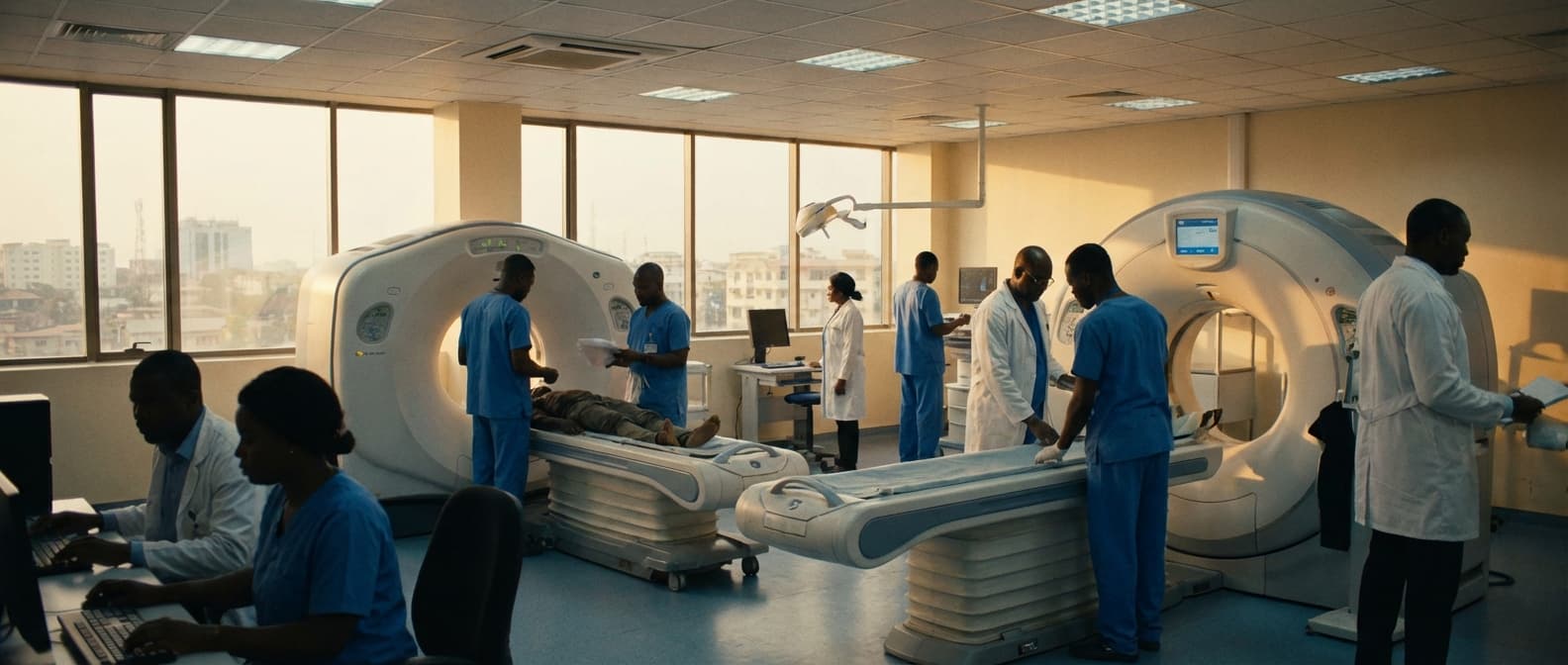
Imaging Acceptance Testing & QA in Cameroon
Engineering Excellence & Technical Support
Commissioning and periodic QA for CT/MRI/X‑ray/US/Mammo. High-standard technical execution following OEM protocols and local regulatory frameworks.
Rigorous Image Quality Assurance Protocols
Implementing comprehensive QA checks for medical imaging equipment in Cameroon, ensuring diagnostic accuracy and adherence to international standards through meticulous calibration, phantom testing, and protocol verification.
Acceptance Testing for New Imaging Modalities
Conducting thorough acceptance testing on newly installed radiology equipment (e.g., CT, MRI, X-ray) across Cameroonian healthcare facilities, validating performance, safety, and integration before clinical deployment.
Root Cause Analysis & Problem Resolution
Expertly identifying and resolving image artifacts and performance issues in Cameroonian medical imaging systems, utilizing advanced troubleshooting techniques to minimize downtime and improve patient care quality.
What Is Imaging Acceptance Testing & Qa In Cameroon?
Imaging Acceptance Testing & Quality Assurance (QA) in Cameroon refers to a systematic process of verifying and validating that imaging systems and their associated software meet predefined functional, performance, and regulatory requirements before deployment and throughout their operational lifecycle. This service is critical for ensuring the reliability, accuracy, and safety of diagnostic and therapeutic imaging modalities within healthcare facilities. It encompasses a range of tests to confirm that images are acquired, processed, displayed, stored, and transmitted according to established standards and best practices, thereby mitigating risks of misdiagnosis, suboptimal treatment, and operational inefficiencies. The ultimate goal is to ensure that imaging equipment performs as intended, providing high-quality diagnostic information to clinicians and contributing to improved patient outcomes.
| Who Needs Imaging Acceptance Testing & QA? | Typical Use Cases |
|---|---|
| Hospitals and Clinics: Both public and private healthcare institutions acquiring new imaging equipment (e.g., MRI, CT scanners, X-ray machines, ultrasound, mammography units) or upgrading existing systems. | Procurement of New Imaging Equipment: Verifying that newly purchased systems meet contractual specifications and performance requirements before final payment and operational use. |
| Radiology Departments: Ensuring consistent image quality and system performance for daily diagnostic operations and to support clinical decision-making. | Regular Quality Control (QC) Programs: Implementing scheduled testing and calibration to maintain optimal image quality and system reliability over time. |
| Medical Device Manufacturers and Distributors: As part of their product lifecycle management and to comply with regulatory requirements prior to selling and installing equipment in Cameroon. | Post-Installation Verification: Confirming that equipment has been correctly installed and calibrated and is functioning as per manufacturer's specifications. |
| Regulatory Bodies and Health Authorities: To ensure that healthcare facilities are compliant with national medical device regulations, safety standards, and quality benchmarks. | Routine Performance Monitoring: Periodic checks to identify any degradation in image quality or system performance that may impact diagnostic accuracy. |
| Third-Party Service Providers: Companies offering specialized imaging QA services to healthcare facilities. | Troubleshooting and Root Cause Analysis: Investigating recurring equipment failures or image quality issues to identify and resolve underlying problems. |
| Research Institutions: When utilizing imaging equipment for research purposes, ensuring data integrity and reproducibility. | Software Updates and Upgrades: Testing the impact of software patches, firmware updates, or major system upgrades on system performance and image quality. |
| Accreditation Bodies: Facilities seeking accreditation (e.g., Joint Commission International equivalent) often require robust QA programs for imaging services. | Radiation Dose Optimization Studies: Verifying that imaging protocols are optimized to deliver the lowest possible radiation dose to patients while maintaining diagnostic image quality. |
Key Components of Imaging Acceptance Testing & QA
- System Calibration and Verification: Ensuring that imaging parameters (e.g., kVp, mA, exposure time, contrast, resolution) are accurately set and consistently reproducible.
- Image Quality Assessment: Evaluating image fidelity, signal-to-noise ratio (SNR), contrast-to-noise ratio (CNR), spatial resolution, artifact reduction, and geometric accuracy using phantoms and clinical images.
- Performance Benchmarking: Measuring system throughput, scan times, processing speeds, and dose utilization against specified benchmarks.
- Software Functionality Testing: Verifying the correct operation of user interfaces, image acquisition protocols, reconstruction algorithms, post-processing tools, and PACS/RIS integration.
- Safety and Radiation Protection Compliance: Confirming adherence to national and international radiation safety standards, including dose monitoring and interlock system functionality.
- Interoperability and Data Integrity: Testing the seamless exchange of images and data with Picture Archiving and Communication Systems (PACS), Radiology Information Systems (RIS), and other medical devices.
- User Training and Documentation Review: Ensuring that end-users are adequately trained and that operational and maintenance documentation is comprehensive and accurate.
Who Needs Imaging Acceptance Testing & Qa In Cameroon?
Imaging Acceptance Testing & QA (Quality Assurance) are crucial for ensuring the reliability, accuracy, and performance of medical imaging systems and their associated software. In Cameroon, as healthcare infrastructure grows and technological adoption increases, these processes become indispensable for a range of customers and departments.
| Customer/Department | Key Needs & Benefits of Imaging Acceptance Testing & QA | Specific Systems/Areas of Focus |
|---|---|---|
| Hospitals (Public & Private) | Needs: Ensuring diagnostic accuracy, patient safety, efficient workflow, compliance with international standards, reducing downtime and costly errors. Benefits: Improved diagnostic confidence, better patient outcomes, enhanced operational efficiency, reduced risk of litigation, optimized resource utilization. | X-ray machines, CT scanners, MRI scanners, Ultrasound machines, PACS (Picture Archiving and Communication System), RIS (Radiology Information System), DICOM compliance, image processing software, radiation dose monitoring. |
| Clinics & Diagnostic Centers | Needs: Reliable equipment for routine diagnostics, cost-effectiveness, maintaining a good reputation for accurate diagnoses, efficient turnaround times. Benefits: Consistent diagnostic quality, patient trust, competitive advantage, minimized re-scans and associated costs. | Portable X-ray units, digital radiography systems, ultrasound machines, basic PACS integration, mammography units (where applicable). |
| Research Institutions | Needs: High-quality imaging for research studies, reproducibility of results, data integrity, advanced imaging techniques validation. Benefits: Credible research findings, ability to publish in reputable journals, advancement of medical knowledge, accurate analysis of experimental data. | Advanced MRI/CT for research, specialized imaging software, quantitative imaging techniques, data archiving and retrieval for long-term studies. |
| Government Health Ministries & Regulatory Bodies | Needs: Setting and enforcing quality standards, ensuring public safety, evaluating new technologies before widespread adoption, monitoring radiation safety protocols. Benefits: Public health protection, standardization of healthcare services, informed policy-making, efficient allocation of resources for medical technology. | National imaging guidelines, accreditation processes for imaging facilities, radiation protection regulations, evaluation of imported medical equipment. |
| Medical Equipment Vendors & Service Providers | Needs: Verifying correct installation and calibration of new equipment, ensuring service contracts deliver promised performance, troubleshooting and validating fixes, meeting manufacturer specifications. Benefits: Customer satisfaction, reduced callbacks and warranty claims, maintaining a competitive edge in service delivery, building trust with clients. | Installation verification, calibration checks, performance validation after repairs, software updates testing, adherence to manufacturer's acceptance criteria. |
| Radiology Departments | Needs: Optimal image quality for diagnosis, efficient workflow, interoperability of systems, compliance with imaging protocols, staff training on new equipment. Benefits: Streamlined reporting, reduced misinterpretations, increased radiologist productivity, improved patient care pathways. | All imaging modalities, PACS/RIS functionalities, AI-powered image analysis tools, radiomics software. |
| IT Departments (in Healthcare Facilities) | Needs: Seamless integration of imaging systems with hospital networks, data security and privacy, PACS/RIS performance and reliability, network bandwidth for image transfer. Benefits: Stable IT infrastructure, secure patient data, efficient information flow across the hospital, reduced IT support burden. | PACS/RIS server performance, network speeds, data backup and recovery, cybersecurity of imaging data. |
Target Customers and Departments for Imaging Acceptance Testing & QA in Cameroon:
- Hospitals (Public and Private)
- Clinics and Diagnostic Centers
- Research Institutions
- Government Health Ministries and Regulatory Bodies
- Medical Equipment Vendors and Service Providers
Imaging Acceptance Testing & Qa Process In Cameroon
This document outlines the typical Imaging Acceptance Testing (IAT) and Quality Assurance (QA) process for imaging solutions in Cameroon. The workflow begins with an initial inquiry and progresses through detailed testing and final acceptance, ensuring the deployed imaging technology meets the client's requirements and industry standards.
| Stage | Description | Key Activities | Deliverables/Outcomes | Responsibility (Typical) |
|---|---|---|---|---|
| The process starts with a client expressing interest in an imaging solution and defining their needs and expectations. | Initial client meetings, understanding existing workflows, identifying specific imaging requirements (e.g., type of imaging, resolution, throughput, integration needs), defining budget and timeline. | Detailed Requirement Document, Use Cases, Project Scope. | Client, Imaging Vendor/Solution Provider |
| Based on the gathered requirements, a tailored imaging solution is designed and proposed to the client. | Technical design of the imaging system, hardware and software selection, integration planning, cost estimation, development of a detailed proposal. | Technical Proposal, Bill of Materials (BOM), Project Plan, Pricing. | Imaging Vendor/Solution Provider |
| Once the proposal is approved, the necessary imaging equipment and software are procured and installed at the client's site. | Ordering of hardware and software, logistics and shipping, site preparation, physical installation of equipment, initial software setup. | Installed Imaging System Hardware and Software, Installation Report. | Imaging Vendor/Solution Provider, Client (for site preparation) |
| Before formal acceptance testing, the system undergoes initial checks and configurations to ensure basic functionality. | System power-on, basic connectivity checks, initial software configuration, driver installation, verification of essential components. | Configured System, Preliminary Functionality Report. | Imaging Vendor/Solution Provider |
| This is a critical phase where the client actively tests the imaging solution against pre-defined criteria to ensure it meets their specified requirements. | Execution of test cases covering functionality, performance, accuracy, usability, and integration. Testing is performed by the client with support from the vendor. | Test Case Execution Reports, Initial Defect Log, IAT Report. | Client (Primary Tester), Imaging Vendor/Solution Provider (Support) |
| QA complements IAT by ensuring the solution adheres to best practices, security standards, and overall quality benchmarks, often focusing on areas not directly covered by client-specific use cases. | Systematic review of system stability, security vulnerabilities, performance under load, error handling, and documentation quality. May involve independent QA specialists. | QA Test Reports, Security Audit Findings, Performance Benchmarks. | Imaging Vendor/Solution Provider (Internal QA), Independent QA Specialists (Optional) |
| Any issues or bugs identified during IAT and QA are logged, prioritized, and resolved, followed by retesting to confirm fixes. | Defect logging, root cause analysis, development of fixes, retesting of corrected modules, regression testing. | Updated Defect Log, Resolved Defects, Retesting Reports. | Imaging Vendor/Solution Provider (Development/Fixes), Client (Retesting) |
| Once the system is deemed stable and functional, end-users are trained on its operation, and the system is formally handed over. | Development of training materials, conducting user training sessions, providing system documentation, handover of all system components and access. | Trained Users, User Manuals, System Documentation, Handover Certificate. | Imaging Vendor/Solution Provider (Training), Client (User Participation) |
| The client formally accepts the imaging solution after all testing and training requirements are met. | Review of all testing and QA reports, confirmation of defect resolution, final client approval. | Signed Acceptance Certificate, Project Closure Report. | Client (Final Authority), Imaging Vendor/Solution Provider |
Key Stages of the Imaging Acceptance Testing & QA Process
- Inquiry and Requirement Gathering
- Solution Design and Proposal
- Procurement and Installation
- Pre-Testing and Configuration
- Acceptance Testing (IAT)
- Quality Assurance (QA)
- Defect Management and Retesting
- User Training and Handover
- Final Acceptance and Sign-off
Imaging Acceptance Testing & Qa Cost In Cameroon
Imaging Acceptance Testing & Quality Assurance (QA) costs in Cameroon are influenced by several factors, including the complexity and volume of imaging data, the specific testing methodologies employed, the expertise of the QA team, and the chosen service provider. Acceptance testing ensures that imaging systems, software, or data pipelines function as intended and meet predefined quality standards before being deployed or accepted by stakeholders. QA is an ongoing process to maintain and improve the quality of imaging outputs and workflows.
| Service/Activity | Estimated Price Range (XAF - Cameroonian Francs) | Notes |
|---|---|---|
| Basic Imaging Data Validation (e.g., format checks, metadata verification) | 50,000 - 250,000 | Per dataset or batch, depending on volume and complexity. |
| Functional Acceptance Testing of Imaging Software/PACS | 200,000 - 1,500,000 | Per module or system. Includes test case design, execution, and defect reporting. |
| Performance and Load Testing of Imaging Workflows | 300,000 - 2,000,000 | Depends on the number of concurrent users, data throughput, and testing duration. |
| Usability Testing of Imaging Interfaces | 100,000 - 750,000 | Per user study session or scenario. |
| Integration Testing of Imaging Systems (e.g., with EMRs) | 250,000 - 1,800,000 | Per integration point. Requires understanding of multiple system interfaces. |
| Daily Rate for Experienced QA Engineer (Local) | 30,000 - 100,000 | Can vary based on specialization (e.g., medical imaging expert). |
| Project-Based QA Consultancy (Small to Medium Project) | 750,000 - 4,000,000+ | Includes planning, execution, and reporting. Highly variable. |
| Development of Automated Test Scripts for Imaging | 500,000 - 3,000,000+ | One-time setup cost, can reduce long-term testing costs. |
Key Pricing Factors for Imaging Acceptance Testing & QA in Cameroon:
- Volume and Complexity of Imaging Data: Larger datasets or more complex imaging modalities (e.g., 3D reconstructions, multi-spectral imaging) will generally incur higher testing costs due to the increased time and resources required for verification.
- Scope of Testing: This includes functional testing, performance testing, usability testing, security testing, and integration testing. A broader scope of testing demands more comprehensive effort.
- Testing Methodology and Tools: The adoption of automated testing tools can sometimes reduce manual effort but might involve upfront software licensing or setup costs. Manual testing, while potentially more flexible, can be labor-intensive.
- Expertise and Experience of QA Team: Highly skilled and experienced QA engineers, particularly those with specialized knowledge in medical imaging (DICOM, PACS, etc.) or specific imaging software, command higher rates.
- Project Timeline and Urgency: Tight deadlines or urgent testing requirements may lead to premium pricing due to the need for expedited resource allocation.
- Provider Type: Costs can vary between independent QA consultancies, in-house QA departments, or outsourced service providers. Local Cameroonian providers might offer more competitive rates compared to international firms.
- Reporting and Documentation Requirements: The level of detail and formality required for test reports and documentation will influence the time spent by the QA team.
- Travel and Logistics: If the testing requires on-site presence at different locations within Cameroon, travel and accommodation expenses will add to the overall cost.
- Regulatory Compliance: If the imaging system or data needs to comply with specific healthcare or data privacy regulations, the QA process might involve additional validation steps.
Affordable Imaging Acceptance Testing & Qa Options
Acceptance testing and Quality Assurance (QA) for imaging systems are crucial for ensuring accuracy, reliability, and compliance. However, these processes can be resource-intensive. This document outlines affordable options, focusing on value bundles and cost-saving strategies for imaging technology providers and healthcare facilities alike.
| Strategy | Description | Cost-Saving Benefit | Value Bundle Example |
|---|---|---|---|
| Value Bundling | Packaging core QA services (e.g., functional testing, performance testing, security testing) into tiered packages at a reduced cost compared to individual service procurement. | Provides predictable costs and access to a comprehensive suite of services at a better price point. Encourages a holistic approach to QA. | 'Basic Verification Bundle': Includes functional testing of core imaging modalities, basic performance checks, and initial documentation review. <br> 'Comprehensive Assurance Bundle': Expands on Basic with advanced performance metrics, security vulnerability scans, user scenario testing, and integration testing. |
| Outsourced Specialized Testing | Engaging third-party QA experts for specific, complex, or high-volume testing tasks that may be difficult or expensive to perform in-house. | Reduces the need for specialized in-house hires and equipment. Access to expertise on demand. Pay only for services rendered. | A facility might bundle its internal UAT with an external provider's specialized medical device security testing or advanced DICOM conformance testing. |
| Phased & Agile Testing | Breaking down the QA process into smaller, manageable sprints or phases, testing core functionalities first and iteratively adding more complex features. | Allows for early detection of critical issues, reducing costly rework later. Enables faster time-to-market for essential features. Reduces the upfront investment in comprehensive testing. | A vendor could offer a 'Module-Specific QA Package' for each new feature or imaging protocol being implemented, rather than a single, large end-to-end test. |
| Automated Testing Integration | Implementing automated scripts for regression testing, load testing, and routine functional checks, freeing up human testers for more complex exploratory and usability testing. | Significantly reduces manual labor costs for repetitive tasks, improves test coverage, and speeds up the testing cycle. Higher initial setup cost, but significant long-term savings. | A 'Continuous Integration/Continuous Deployment (CI/CD) QA Enabler' bundle could include setting up automated test frameworks and initial script development for common imaging workflows. |
| Risk-Based Prioritization | Focusing QA efforts on the most critical functionalities and highest-risk areas of the imaging system, as determined by potential impact on patient safety, clinical workflow, and regulatory compliance. | Ensures that resources are allocated effectively, maximizing the impact of QA activities. Avoids over-testing low-risk areas. | A 'Critical Workflow Assurance' bundle could focus exclusively on testing the pathways for image acquisition, primary diagnosis, and reporting, while deferring less critical features to later phases. |
Key Considerations for Affordable Imaging QA
- Defining clear acceptance criteria upfront to avoid scope creep.
- Leveraging existing internal resources where possible.
- Prioritizing testing efforts based on criticality and risk.
- Utilizing automated testing tools for repetitive tasks.
- Exploring partnerships with specialized QA vendors for targeted services.
- Adopting a phased approach to testing, releasing incrementally.
- Focusing on user acceptance testing (UAT) from end-users.
Verified Providers In Cameroon
In Cameroon, ensuring access to quality healthcare is paramount. When seeking medical services, it's crucial to identify 'Verified Providers' – healthcare professionals and facilities that meet stringent standards for competence, safety, and ethical practice. Franance Health has emerged as a leading force in this regard, rigorously credentialing providers to offer a higher level of assurance to patients. Their commitment to verification signifies a dedication to excellence and patient well-being, making Franance Health-credentialed providers the optimal choice for reliable healthcare.
| Benefit for Patients | Why Franance Health Excels |
|---|---|
| Increased Trust and Confidence | Franance Health's rigorous vetting process eliminates guesswork, providing peace of mind that you are receiving care from qualified and reputable professionals. |
| Higher Quality of Care | Verification ensures that providers possess the necessary skills, knowledge, and experience, leading to more accurate diagnoses and effective treatments. |
| Enhanced Patient Safety | Franance Health screens for adherence to safety protocols and ethical practices, minimizing risks and ensuring a secure healthcare experience. |
| Access to Specialized Expertise | The credentialing process often highlights specific areas of expertise, helping patients find the right specialist for their unique needs. |
| Improved Patient Outcomes | By connecting patients with verified, high-caliber providers, Franance Health contributes to better health results and overall patient satisfaction. |
| Streamlined Healthcare Navigation | Franance Health acts as a trusted intermediary, simplifying the often-complex process of finding reliable healthcare in Cameroon. |
What Franance Health Verification Entails:
- Comprehensive background checks on medical professionals.
- Validation of academic qualifications and medical licenses.
- Assessment of clinical experience and areas of specialization.
- Review of adherence to ethical medical practices and patient care standards.
- Ongoing monitoring of provider performance and patient feedback.
- Ensuring compliance with national healthcare regulations.
Scope Of Work For Imaging Acceptance Testing & Qa
This Scope of Work (SOW) outlines the requirements for comprehensive Imaging Acceptance Testing (IAT) and Quality Assurance (QA) to ensure the delivered imaging system meets all functional, performance, and technical specifications. The objective is to verify the system's ability to acquire, process, store, and retrieve medical images reliably and efficiently, adhering to established industry standards and regulatory requirements.
| Category | Technical Deliverable | Standard Specification / Reference | Acceptance Criteria | Testing Method |
|---|---|---|---|---|
| Image Acquisition | Acquisition Console Functionality | Manufacturer's specifications, DICOM Part 14 (Grayscale Standard Display Function) | All acquisition controls function as expected; image parameters are correctly set and saved. | Manual operation and verification of all acquisition controls. |
| Image Acquisition | Image Quality - Spatial Resolution | Phantoms (e.g., ACR CT Phantom, IQM Mammography Phantom), DICOM Part 14 | Achieve specified resolution targets for each modality; visible detail meets diagnostic requirements. | Image analysis using phantoms and visual inspection by qualified personnel. |
| Image Acquisition | Image Quality - Contrast Resolution | Phantoms (e.g., low contrast detectability phantoms), DICOM Part 14 | Detect specified low contrast objects at defined depths; diagnostic quality maintained. | Image analysis using phantoms and visual inspection by qualified personnel. |
| Image Acquisition | Image Quality - Noise Levels | Manufacturer's specifications, ACR guidelines | Noise levels are within acceptable diagnostic thresholds for each modality. | Quantitative image analysis and visual inspection. |
| Image Acquisition | Artifacts | Clinical imaging studies, phantom images | Absence of clinically significant artifacts or artifacts are identifiable and correctable. | Visual inspection of clinical and phantom images. |
| Image Processing | Image Enhancement Tools | Manufacturer's specifications | All enhancement filters (e.g., edge enhancement, smoothing) function correctly and produce expected results. | Application of filters to test images and qualitative assessment. |
| Image Processing | Image Reconstruction Algorithms | Manufacturer's specifications | Reconstruction parameters can be adjusted and produce clinically acceptable images. | Varying reconstruction parameters and evaluating image output. |
| Image Processing | Measurement Tools | Manufacturer's specifications | Distance, angle, and area measurements are accurate and consistent. | Performing measurements on test images and verifying against known values. |
| Data Management | DICOM Conformance | DICOM Part 3 (Information Object Definitions), Part 4 (Service Class Specifications) | System correctly generates, receives, and stores DICOM compliant images and metadata. | DICOM conformance testing tools, verification of DICOM tags. |
| Data Management | PACS Integration | DICOM Part 11 (Media Storage and File Format), HL7 standards | Seamless transfer of images from acquisition to PACS; correct association with patient studies. | Simulated image transfers, verification of PACS records. |
| Data Management | EHR Integration | HL7 standards (e.g., ADT, ORM, ORU messages) | Correct patient demographic and study information is exchanged with EHR. | Simulated patient registration and study ordering; verification of EHR data. |
| Data Management | Storage Capacity & Performance | System specifications, anticipated daily/monthly imaging volume | System meets specified storage capacity; image retrieval times are within acceptable limits. | Load testing, simulated retrieval of large datasets. |
| Data Management | Archival and Retrieval | System specifications, archiving policies | Images are successfully archived and can be retrieved within specified timeframes. | Simulated archival and retrieval operations over an extended period. |
| System Performance | System Availability & Uptime | System specifications, operational requirements | System operates continuously without unplanned downtime during specified operational hours. | Continuous monitoring and logging of system status. |
| System Performance | Response Times | Manufacturer's specifications | User interface and system operations respond within defined acceptable timeframes. | Performance profiling and timed operation of key functions. |
| Security | Access Control & User Authentication | Organizational security policies, HIPAA Security Rule | Only authorized users can access the system and patient data; appropriate role-based access is enforced. | Testing of login credentials, role-based access verification. |
| Security | Data Encryption (if applicable) | Organizational security policies, industry best practices | Data is encrypted in transit and at rest according to specified standards. | Verification of encryption implementation and configuration. |
| Usability | User Interface (UI) & Workflow | User requirements, best practice UI design principles | Intuitive and efficient user interface; workflow supports clinical needs and minimizes manual steps. | User feedback sessions, observation of clinical users performing tasks. |
| Documentation | Test Plan & Procedures | Internal QA standards | Comprehensive and detailed test plan with clear procedures and expected outcomes. | Review and approval of test documentation. |
| Documentation | Test Results & Defect Reports | Internal QA standards | Accurate and timely reporting of all test results, including identified defects and their resolution status. | Review and logging of test execution records. |
| Documentation | Acceptance Report | Contractual requirements | Formal document summarizing test outcomes, deviations, and recommendations for acceptance. | Creation and review of the final acceptance report. |
Key Objectives of Imaging Acceptance Testing & QA
- Verify functionality of all imaging modalities and associated hardware.
- Validate image acquisition parameters and quality.
- Confirm image processing and enhancement capabilities.
- Assess data storage, retrieval, and archival performance.
- Ensure integration with existing Picture Archiving and Communication System (PACS) and Electronic Health Record (EHR).
- Evaluate user interface and workflow efficiency.
- Test security features and compliance with data privacy regulations (e.g., HIPAA).
- Confirm system stability and reliability under various load conditions.
- Validate adherence to DICOM standards and other relevant medical imaging protocols.
- Document all test results and any identified issues.
Service Level Agreement For Imaging Acceptance Testing & Qa
This Service Level Agreement (SLA) outlines the performance standards for Imaging Acceptance Testing & Quality Assurance (QA) services. It defines the guaranteed response times for reported issues and the required uptime for the imaging acceptance testing platform and associated QA tools.
| Service Component | Response Time Guarantee | Uptime Guarantee | Notes |
|---|---|---|---|
| Imaging Acceptance Testing Platform (Web UI/API) | Critical Issues: 2 hours | 99.5% | Downtime impacting testing cannot exceed 1.5 hours per month. |
| QA Tools (e.g., defect tracking system, image viewers) | High Priority Issues: 4 business hours | 99.0% | Downtime impacting QA activities cannot exceed 3.5 hours per month. |
| Support for Ingestion & Processing Systems (during testing) | Medium Priority Issues: 8 business hours | N/A | Focus is on resolving issues that prevent testing; direct uptime of these systems is managed by their respective SLAs. |
| Reporting & Analytics Dashboard | Low Priority Issues: 24 business hours | 98.0% | Downtime impacting access to reports cannot exceed 7.2 hours per month. |
Scope of Services
- Imaging Acceptance Testing: Verification of image quality, integrity, and adherence to specified standards for all submitted imaging data.
- Quality Assurance (QA): Comprehensive testing of the imaging workflow, including ingestion, processing, storage, and retrieval.
- Defect Tracking & Reporting: Systematic logging, categorization, and reporting of all identified defects.
- Resolution Support: Collaborative efforts with development and operations teams to resolve reported issues.
Frequently Asked Questions

Ready when you are
Let's scope your Imaging Acceptance Testing & QA in Cameroon project in Cameroon.

Scaling healthcare logistics and technical systems across the entire continent.