
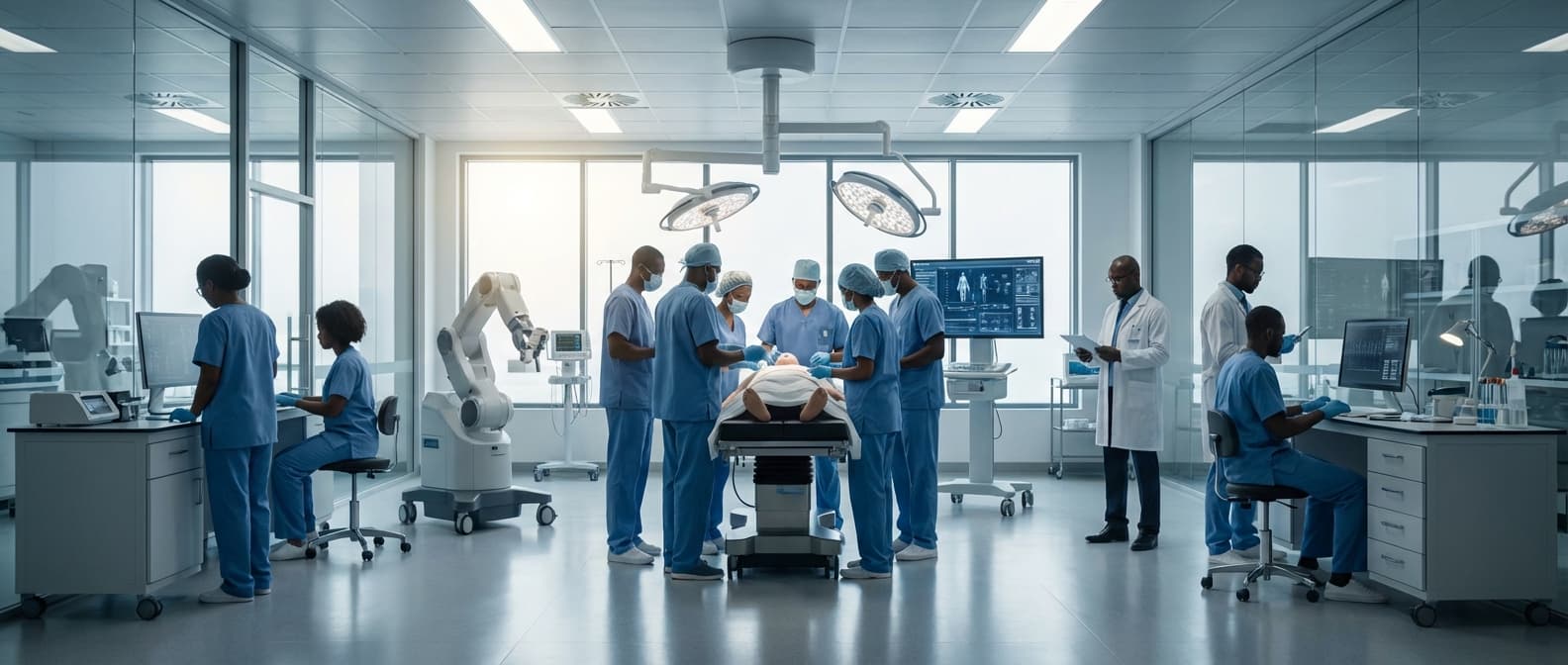
Managed Equipment Service (MES) in Cameroon
Engineering Excellence & Technical Support
Long‑term equipment provision with uptime SLAs and lifecycle management. High-standard technical execution following OEM protocols and local regulatory frameworks.
Optimized Medical Equipment Uptime
Our MES solution leverages predictive maintenance and rapid response protocols to ensure critical medical equipment in Cameroonian healthcare facilities operates at peak performance, minimizing costly downtime and ensuring continuous patient care.
Streamlined Equipment Lifecycle Management
We offer end-to-end management of medical equipment, from procurement and installation to calibration, repair, and responsible decommissioning, providing Cameroonian hospitals with a cost-effective and efficient approach to their entire equipment portfolio.
Data-Driven Performance & Cost Savings
Our MES platform provides real-time data analytics on equipment usage, maintenance history, and expenditures. This empowers Cameroonian healthcare providers with actionable insights to optimize resource allocation, reduce operational costs, and make informed investment decisions.
What Is Managed Equipment Service (Mes) In Cameroon?
Managed Equipment Service (MES) in Cameroon refers to a comprehensive outsourced service model for the procurement, installation, maintenance, and management of specialized equipment, primarily within the healthcare sector. This model shifts the responsibility and risk of equipment ownership and operation from the healthcare provider to a third-party MES provider. The provider assumes control over the entire equipment lifecycle, from initial acquisition and deployment through to end-of-life disposal, ensuring operational readiness, optimal performance, and cost predictability. MES contracts are typically structured as an all-inclusive fee, often on a per-use or per-bed basis, encompassing capital costs, consumables, spare parts, technical support, and staff training.
| Who Needs MES? | Typical Use Cases in Cameroon | ||||||
|---|---|---|---|---|---|---|---|
| Public Hospitals and Clinics: Especially those with limited capital for direct equipment acquisition and a need for reliable, modern medical technology to improve patient care and diagnostic capabilities. This includes regional and district health facilities. | Diagnostic Imaging Departments: Implementing and maintaining CT scanners, MRI machines, X-ray units, and ultrasound devices. This ensures high-quality imaging services are consistently available. | Surgical Suites: Provision and upkeep of anesthesia machines, surgical lighting, electrosurgical units, and patient monitoring systems to support complex surgical procedures. | Intensive Care Units (ICUs) and Critical Care: Deployment and management of ventilators, defibrillators, continuous patient monitors, and infusion pumps, critical for life support. | Laboratories and Blood Banks: Installation and maintenance of advanced laboratory analyzers, centrifuges, incubators, and blood refrigerators, ensuring accurate and timely diagnostic results and safe blood storage. | Private Hospitals and Specialized Medical Centers: Facilities seeking to upgrade their technological infrastructure without significant upfront investment and desiring predictable operational costs. This can include specialized areas like cardiology, oncology, or ophthalmology. | Non-Governmental Organizations (NGOs) and Humanitarian Health Initiatives: Organizations operating in resource-constrained environments that require access to essential medical equipment and reliable maintenance services for their health programs. | Medical Training Institutions: Equipping teaching hospitals and simulation centers with state-of-the-art equipment and ensuring its availability for training future healthcare professionals. |
Key Components of Managed Equipment Service (MES) in Cameroon
- Equipment Sourcing and Procurement: Identifying, selecting, and acquiring the most appropriate medical technology aligned with institutional needs and budgetary constraints.
- Installation and Commissioning: Professional setup, calibration, and testing of new equipment to ensure full operational capacity and compliance with regulatory standards.
- Preventive and Corrective Maintenance: Proactive scheduled servicing to minimize downtime and reactive repairs to address equipment malfunctions and failures.
- Consumables and Spare Parts Management: Efficient inventory control and timely provision of essential consumables and replacement parts.
- Technical Support and Training: Access to skilled biomedical engineers and technicians for troubleshooting, and comprehensive training for clinical staff on equipment operation and basic maintenance.
- Asset Management and Lifecycle Planning: Tracking equipment utilization, performance, and planning for upgrades or replacements based on technological advancements and service life.
- Performance Monitoring and Reporting: Continuous oversight of equipment functionality and delivery of detailed performance reports to the client.
- Risk Transfer: Shifting the financial and operational risks associated with equipment obsolescence, breakdown, and obsolescence to the MES provider.
Who Needs Managed Equipment Service (Mes) In Cameroon?
Managed Equipment Service (MES) offers a comprehensive solution for organizations in Cameroon struggling with the procurement, maintenance, and lifecycle management of critical medical equipment. Instead of capital-intensive upfront purchases and the burden of in-house technical expertise, MES providers take on these responsibilities, ensuring operational continuity, cost predictability, and access to the latest technology. This allows healthcare facilities to focus on their core mission: patient care.
| Target Customer | Key Departments Benefiting from MES |
|---|---|
| Public Hospitals & Regional Hospitals | Radiology, Cardiology, Oncology, Intensive Care Units (ICU), Operating Theatres (OT), Laboratories, Emergency Departments. |
| University Teaching Hospitals | All clinical departments for advanced diagnostics and research, Biomedical Engineering, Procurement. |
| Private Clinics & Diagnostic Centers | Radiology, Pathology, Cardiology, Gynecology, Urology, General Practice. |
| Maternity & Pediatric Hospitals | Neonatal Intensive Care Units (NICU), Pediatric Wards, Operating Theatres, Imaging Departments. |
| Ministry of Public Health (and its regional/district offices) | Procurement, Planning, Health Infrastructure Development, Equipment Management & Maintenance Units. |
| Non-Governmental Organizations (NGOs) operating healthcare facilities | Clinical departments, Project management, Finance & Administration. |
| Mining, Oil & Gas Companies (with on-site medical facilities) | Occupational Health Clinics, Emergency Response Teams, General Medical Services. |
Who Needs Managed Equipment Service (MES) in Cameroon?
- Healthcare facilities seeking to upgrade their medical technology without significant capital expenditure.
- Organizations aiming to reduce the operational burden and costs associated with equipment maintenance and repair.
- Hospitals and clinics looking to ensure consistent availability and optimal performance of their medical equipment.
- Government and public health initiatives focused on improving healthcare access and quality across the nation.
- Private healthcare providers wanting to offer advanced diagnostic and treatment services.
- New healthcare infrastructure projects requiring a complete and integrated equipment solution.
Managed Equipment Service (Mes) Process In Cameroon
The Managed Equipment Service (MES) process in Cameroon outlines a comprehensive workflow for procuring, installing, maintaining, and eventually replacing medical equipment in healthcare facilities. This service model aims to provide high-quality medical technology without the burden of direct ownership and complex management for the healthcare provider. The process typically begins with an inquiry from a healthcare institution and culminates in the successful execution of the MES agreement, ensuring the equipment remains operational and technologically relevant.
| Phase | Key Activities | Involved Parties | Deliverables/Outcomes |
|---|---|---|---|
| Healthcare facility identifies equipment needs. MES provider receives inquiry. Joint assessment of required equipment, specifications, and budget. | Healthcare Facility (Ministry of Health, Hospitals), Potential MES Provider | Detailed list of required equipment, preliminary budget, identified service gaps. |
| Formal tender process initiated by the contracting authority. MES providers submit detailed technical and financial proposals. | Contracting Authority (e.g., Ministry of Health), MES Providers | Submitted tender documents with technical specifications, pricing, service plans, and financial models. |
| Tender committee evaluates proposals based on predefined criteria (technical capability, experience, financial viability, proposed service levels). | Tender Evaluation Committee, Ministry of Health officials | Shortlisted providers, recommendation for contract award. |
| Negotiation of contract terms, including Service Level Agreements (SLAs), pricing, payment schedules, warranties, and performance metrics. Contract is formally awarded. | Contracting Authority, Selected MES Provider | Signed MES contract, detailed Service Level Agreements (SLAs). |
| MES provider procures and imports the specified medical equipment, adhering to Cameroonian regulations and standards. | MES Provider, Customs and Excise Department, Ministry of Health | Imported and cleared medical equipment at the designated healthcare facility. |
| Expert technicians install and commission the equipment. Rigorous testing to ensure functionality and compliance with safety standards. | MES Provider Technicians, Healthcare Facility Staff | Fully installed, tested, and operational medical equipment. |
| Comprehensive training for healthcare professionals on the operation and basic maintenance of the equipment. Training on relevant IT systems. | MES Provider Trainers, Healthcare Facility Staff (Doctors, Nurses, Technicians) | Skilled healthcare personnel proficient in using and maintaining the equipment. |
| Continuous provision of preventive and corrective maintenance services. Supply of consumables and spare parts. 24/7 technical support. | MES Provider (Technical Team, Support Staff), Healthcare Facility | High equipment uptime, timely repairs, readily available consumables and spares. |
| Regular monitoring of equipment performance against SLAs. Provision of performance reports to the contracting authority. Regular meetings for feedback and adjustments. | MES Provider, Contracting Authority, Healthcare Facility Management | Performance reports, analysis of equipment utilization and reliability, identification of areas for improvement. |
| Periodic review of equipment technology. Proactive replacement or upgrade of obsolete equipment to ensure technological relevance and optimal patient care. | MES Provider, Contracting Authority, Healthcare Facility | Upgraded and state-of-the-art medical equipment in service. |
| Safe and environmentally sound decommissioning and disposal of end-of-life equipment in accordance with regulations. | MES Provider, Environmental Agencies, Ministry of Health | Responsible disposal of outdated equipment, adherence to environmental regulations. |
Managed Equipment Service (MES) Process Workflow in Cameroon
- Inquiry and Needs Assessment
- Tender and Proposal Submission
- Evaluation and Selection
- Contract Negotiation and Award
- Procurement and Importation
- Installation and Commissioning
- Training and Capacity Building
- Operation and Maintenance (O&M)
- Performance Monitoring and Reporting
- Equipment Upgrades and Replacements
- Decommissioning and Disposal
Managed Equipment Service (Mes) Cost In Cameroon
Managed Equipment Service (MES) in Cameroon offers a comprehensive solution for healthcare providers to access, maintain, and upgrade medical equipment without the burden of direct ownership. This service typically involves a third-party provider taking responsibility for all aspects of equipment management, from procurement and installation to maintenance, repair, and eventual replacement. The cost of MES in Cameroon is influenced by a multitude of factors, leading to a considerable range in pricing. These factors can be broadly categorized into equipment-specific, service-level, and contract-duration-related elements.
| Equipment Category | Estimated Monthly MES Cost (XAF) | Notes |
|---|---|---|
| Basic Diagnostic Equipment (e.g., ECG, Ultrasound - entry-level) | 150,000 - 400,000 | Covers routine maintenance, basic repairs, and consumables. Excludes major part replacements. |
| Mid-Range Imaging (e.g., X-ray, Ultrasound - advanced) | 400,000 - 1,500,000 | Includes comprehensive preventative maintenance, rapid response repair, and common spare parts. May include software updates. |
| Advanced Imaging (e.g., CT Scanner, MRI - entry/mid-level) | 1,500,000 - 5,000,000+ | Critical uptime SLAs, full parts and labor coverage, 24/7 support, and regular service engineer visits. Technology refresh cycles can significantly impact this range. |
| Surgical Equipment (e.g., Basic Operating Theatre setup) | 300,000 - 1,000,000 | Focus on instrument maintenance, sterilization equipment support, and minor repairs. Robotic surgery would be significantly higher. |
| Laboratory Equipment (e.g., Automated Analyzers) | 200,000 - 800,000 | Includes calibration, reagent management (sometimes), and breakdown maintenance. Volume of tests can be a factor. |
| General Hospital Furniture & Beds (Integrated MES) | 50,000 - 200,000 | Covers repair, upholstery, and replacement of wear-and-tear items for a fleet of furniture and beds. |
Key Pricing Factors for MES in Cameroon
- {"title":"Type and Complexity of Equipment","description":"High-end, specialized, and technologically advanced equipment (e.g., MRI machines, CT scanners, advanced surgical robots) will inherently have higher MES costs due to the initial purchase price, specialized maintenance requirements, and the need for highly skilled technicians. Basic equipment like examination tables or stethoscopes will be significantly less expensive."}
- {"title":"Quantity of Equipment","description":"The total number of equipment units included in the MES contract directly impacts the overall cost. Larger deployments generally offer some economies of scale, but the sheer volume will increase the base price."}
- {"title":"Service Level Agreements (SLAs)","description":"The criticality of uptime and responsiveness dictates the SLA. Premium SLAs with guaranteed rapid response times, extended warranty periods, and comprehensive preventative maintenance schedules will command higher prices than basic maintenance contracts."}
- {"title":"Included Services","description":"The scope of services covered is a major determinant. This includes: procurement and installation, routine preventative maintenance, unscheduled repairs and parts, consumables, training for medical staff, software updates, and eventual decommissioning and replacement. Contracts offering a wider range of included services will be more expensive."}
- {"title":"Contract Duration","description":"Longer contract durations often lead to lower annual or monthly costs, as providers can amortize their investment over a longer period and negotiate better terms. Shorter-term contracts may carry a premium."}
- {"title":"Provider's Expertise and Reputation","description":"Established MES providers with a proven track record, a strong network of technicians, and robust logistical capabilities might charge more due to their reliability and quality of service."}
- {"title":"Geographic Location and Accessibility","description":"For facilities in remote or less accessible areas of Cameroon, the cost might be higher to account for increased travel time and logistical challenges for technicians and equipment transport."}
- {"title":"Technology Refresh Cycles","description":"Contracts that include regular technology upgrades or replacements within the service period will naturally be priced higher than those that focus solely on maintenance of existing equipment."}
- {"title":"Financing and Payment Terms","description":"The structure of payment (e.g., upfront payments, staggered installments, performance-based payments) can influence the overall cost, with flexible or tailored financing options sometimes incurring a slight premium."}
Affordable Managed Equipment Service (Mes) Options
Securing reliable and cost-effective Managed Equipment Services (MES) is crucial for businesses looking to optimize their operations without incurring prohibitive upfront costs. MES providers offer a flexible alternative to outright ownership, encompassing the procurement, installation, maintenance, and eventual disposal of necessary equipment. The key to achieving affordability lies in understanding value bundles and implementing strategic cost-saving measures.
| Cost-Saving Strategy | Description | Impact on MES Affordability |
|---|---|---|
| Negotiate Long-Term Contracts | Committing to a longer contract duration (e.g., 3-5 years) often results in lower monthly rates as providers can better forecast demand and amortize costs. | Lower per-unit equipment and service costs over the contract's life. |
| Leverage Off-Lease or Refurbished Equipment Options | For non-critical or less demanding applications, consider equipment that has been previously leased and refurbished. These often come with significant discounts. | Reduced capital expenditure and lower monthly lease payments. |
| Optimize Equipment Utilization | Ensure the equipment you are leasing is being used efficiently. Avoid over-provisioning and underutilizing assets, which leads to unnecessary costs. | Eliminates paying for unused capacity and reduces potential for unnecessary upgrades. |
| Bundle Services Strategically | Choose a value bundle that precisely matches your needs. Avoid paying for services or features you won't utilize. Customization is key. | Prevents overspending on premium services that aren't required. |
| Benchmark and Compare Providers | Obtain quotes from multiple MES providers. Thoroughly compare their offerings, service level agreements (SLAs), and pricing structures to identify the most competitive option. | Ensures you are getting the best market value for your MES investment. |
| Consider Usage-Based Pricing Models | For certain types of equipment (e.g., printers, copiers), usage-based models can be more cost-effective if your consumption is consistent and predictable. | You only pay for what you use, avoiding fixed costs associated with underutilization. |
| Inquire About Tiered Support Levels | Understand the different support tiers offered. Basic support might be sufficient for some equipment, while mission-critical assets may warrant premium support. | Aligns support costs with the criticality of the equipment, avoiding overspending on less important items. |
| Plan for Scalability | While focusing on affordability, ensure your MES contract allows for easy scaling up or down of equipment and services as your business needs evolve. This avoids costly penalties or the need for new contracts. | Avoids future expenses associated with reactive scaling or contract renegotiations. |
Understanding Value Bundles in MES
- {"title":"Core Service Bundle","description":"This is the foundational offering, typically including the lease or rental of essential equipment, standard maintenance and repair services, and sometimes basic technical support. It's designed to cover the fundamental needs of most businesses."}
- {"title":"Performance-Optimized Bundle","description":"Builds upon the core bundle by adding proactive monitoring, predictive maintenance, and performance tuning to ensure equipment operates at peak efficiency. This can reduce downtime and improve productivity."}
- {"title":"Comprehensive Support Bundle","description":"This bundle offers an all-encompassing solution, including everything in the performance bundle, plus dedicated account management, advanced troubleshooting, software updates, and potentially training for your staff. It's ideal for businesses requiring a high level of service and minimal internal IT burden."}
- {"title":"Customizable Bundles","description":"Many MES providers allow for tailored packages where you can select specific services and equipment tiers to match your precise requirements and budget. This offers the most flexibility and potential for cost optimization."}
Verified Providers In Cameroon
In Cameroon's growing healthcare landscape, identifying trustworthy and competent medical service providers is paramount. Franance Health has emerged as a beacon of reliability, meticulously vetting and credentialing healthcare professionals and facilities. Their rigorous evaluation process ensures that individuals seeking medical attention can have confidence in the quality of care they receive. This commitment to verification not only safeguards patient well-being but also elevates the overall standard of healthcare services available in Cameroon.
| Credential Type | What it Verifies | Benefit to Patients |
|---|---|---|
| Medical License Verification | Ensures the provider is legally authorized to practice medicine in Cameroon. | Guarantees adherence to regulatory standards and protects against unlicensed practitioners. |
| Specialization Accreditation | Confirms the provider's expertise in a specific medical field (e.g., cardiology, pediatrics). | Ensures patients are treated by specialists with the most relevant knowledge and skills. |
| Continuing Medical Education (CME) Compliance | Verifies that the provider actively participates in ongoing training and stays updated with medical advancements. | Indicates a commitment to delivering modern and evidence-based medical care. |
| Reputation and Peer Review | Gathers feedback from other medical professionals and potentially patients (with privacy safeguards). | Provides insights into a provider's professional conduct, effectiveness, and patient satisfaction. |
| Facility Standards (if applicable) | Assesses the quality of infrastructure, equipment, and hygiene in medical facilities. | Ensures a safe, clean, and well-equipped environment for medical procedures and consultations. |
Why Franance Health Credentials Represent the Best Choice:
- Rigorous Verification Process: Franance Health employs a multi-faceted approach to credentialing, scrutinizing educational background, professional licenses, specialized training, and peer reviews. This thoroughness minimizes the risk of unqualified practitioners.
- Commitment to Ethical Practice: Beyond technical skills, Franance Health assesses a provider's adherence to ethical guidelines and patient-centered care principles. This ensures compassionate and respectful treatment.
- Focus on Continuous Improvement: Verified providers are often encouraged to engage in ongoing professional development, keeping them abreast of the latest medical advancements and best practices.
- Enhanced Patient Safety: By choosing a Franance Health-verified provider, patients gain an added layer of assurance regarding the safety and efficacy of the medical services they receive.
- Streamlined Access to Quality Care: Franance Health acts as a trusted intermediary, simplifying the process for patients to find and access high-quality healthcare professionals and facilities across Cameroon.
Scope Of Work For Managed Equipment Service (Mes)
This document outlines the Scope of Work (SOW) for a Managed Equipment Service (MES) agreement. It details the technical deliverables expected from the MES provider and defines the standard specifications against which the service will be measured. The MES will encompass the provision, installation, maintenance, and eventual disposal of a specified range of medical equipment, ensuring optimal functionality, uptime, and compliance throughout the contract lifecycle.
| Technical Deliverable Category | Description of Deliverable | Standard Specification/KPI | Measurement Method | Reporting Frequency |
|---|---|---|---|---|
| Equipment Provision & Installation | Supply, installation, and commissioning of specified medical equipment. | 100% adherence to agreed-upon equipment models and configurations; installation completed within agreed timelines (e.g., X days from order). | Project management logs, installation reports, client acceptance sign-off. | Per installation event. |
| Preventive Maintenance (PM) | Scheduled and routine maintenance to ensure equipment optimal performance and longevity. | 100% completion of scheduled PMs within manufacturer's recommendations or contractual window (e.g., +/- 10% of scheduled date); PM completion rate of 98%. | Service reports, maintenance logs, asset management system data. | Monthly. |
| Corrective Maintenance (CM) / Breakdown Response | On-demand repair services for equipment failures. | Response time to reported issues (e.g., < X hours for critical equipment, < Y hours for standard equipment); Repair completion time (e.g., < Z hours for critical equipment, < W hours for standard equipment); First-time fix rate of 90%. | Service desk ticketing system, engineer's site reports, uptime monitoring tools. | Weekly for critical issues, Monthly for overall performance. |
| Equipment Uptime | Percentage of time equipment is available for clinical use. | Guaranteed uptime levels per equipment category (e.g., 99% for critical imaging, 95% for standard diagnostics). | Uptime monitoring software, incident logs, client usage data. | Monthly. |
| Calibration and Performance Verification | Ensuring equipment accuracy and compliance with performance standards. | 100% completion of scheduled calibrations and verifications as per manufacturer and regulatory requirements. | Calibration certificates, performance test reports, compliance documentation. | As per schedule (e.g., Annual, Bi-annual) and per incident if required. |
| Decommissioning & Disposal | Safe and environmentally compliant removal and disposal of retired equipment. | 100% compliance with WEEE directives and other relevant environmental regulations; certified disposal documentation provided. | Waste transfer notes, disposal certificates, audit trails. | Per disposal event. |
| Training & Competency | Providing training to clinical staff on equipment operation and basic troubleshooting. | User competency assessments; training needs analysis; provision of training materials. | Training attendance records, competency assessment results, user feedback surveys. | Quarterly and ad-hoc as needed. |
| Asset Management & Reporting | Maintaining a comprehensive inventory of all managed equipment and providing performance reports. | Accurate and up-to-date asset register; provision of monthly performance reports covering uptime, maintenance activities, costs, etc. | Asset management system, financial reports, performance dashboards. | Monthly. |
| Software Updates & Upgrades | Managing and implementing necessary software updates and upgrades. | Updates applied within agreed SLAs; minimal disruption to clinical operations. | Change control logs, update reports, client sign-off. | As and when required, with prior client notification. |
| Contingency & Replacement Planning | Ensuring availability of replacement equipment or backup solutions. | Availability of loaner equipment for critical items; proactive replacement planning based on lifecycle analysis. | Equipment inventory, loaner pool management, lifecycle cost analysis reports. | Quarterly. |
Key Objectives of Managed Equipment Service (MES)
- Ensure high equipment availability and reliability to support clinical operations.
- Minimize equipment downtime through proactive maintenance and rapid response.
- Optimize equipment utilization and lifecycle management.
- Control and manage equipment costs effectively.
- Ensure compliance with all relevant regulatory and safety standards.
- Provide access to up-to-date technology and innovation where appropriate.
- Streamline equipment management processes and reduce administrative burden on the client.
- Provide comprehensive training and support for clinical staff.
Service Level Agreement For Managed Equipment Service (Mes)
This Service Level Agreement (SLA) outlines the guaranteed response times and uptime for the Managed Equipment Service (MES) provided by [Your Company Name] to [Client Name]. This SLA is an integral part of the Master Services Agreement (MSA) dated [Date of MSA].
| Service Component | Response Time Guarantee | Resolution Time Target | Uptime Guarantee |
|---|---|---|---|
| Critical Equipment Failures (e.g., complete system shutdown) | Within 1 hour of notification | Within 4 hours of notification (may require on-site technician) | 99.5% |
| Major Equipment Malfunctions (e.g., significant performance degradation, partial system outage) | Within 2 hours of notification | Within 8 hours of notification | 99.0% |
| Minor Equipment Issues (e.g., performance anomalies, non-critical component failure) | Within 4 business hours of notification | Within 24 business hours of notification | 98.0% |
| Preventative Maintenance & Scheduled Services | As per agreed schedule | As per agreed schedule | 100% (for scheduled downtime) |
Key Service Objectives
- Ensure timely and effective resolution of reported incidents.
- Maintain a high level of equipment availability and operational readiness.
- Provide clear and consistent communication regarding service status and performance.
Frequently Asked Questions

Ready when you are
Let's scope your Managed Equipment Service (MES) in Cameroon project in Cameroon.

Scaling healthcare logistics and technical systems across the entire continent.