
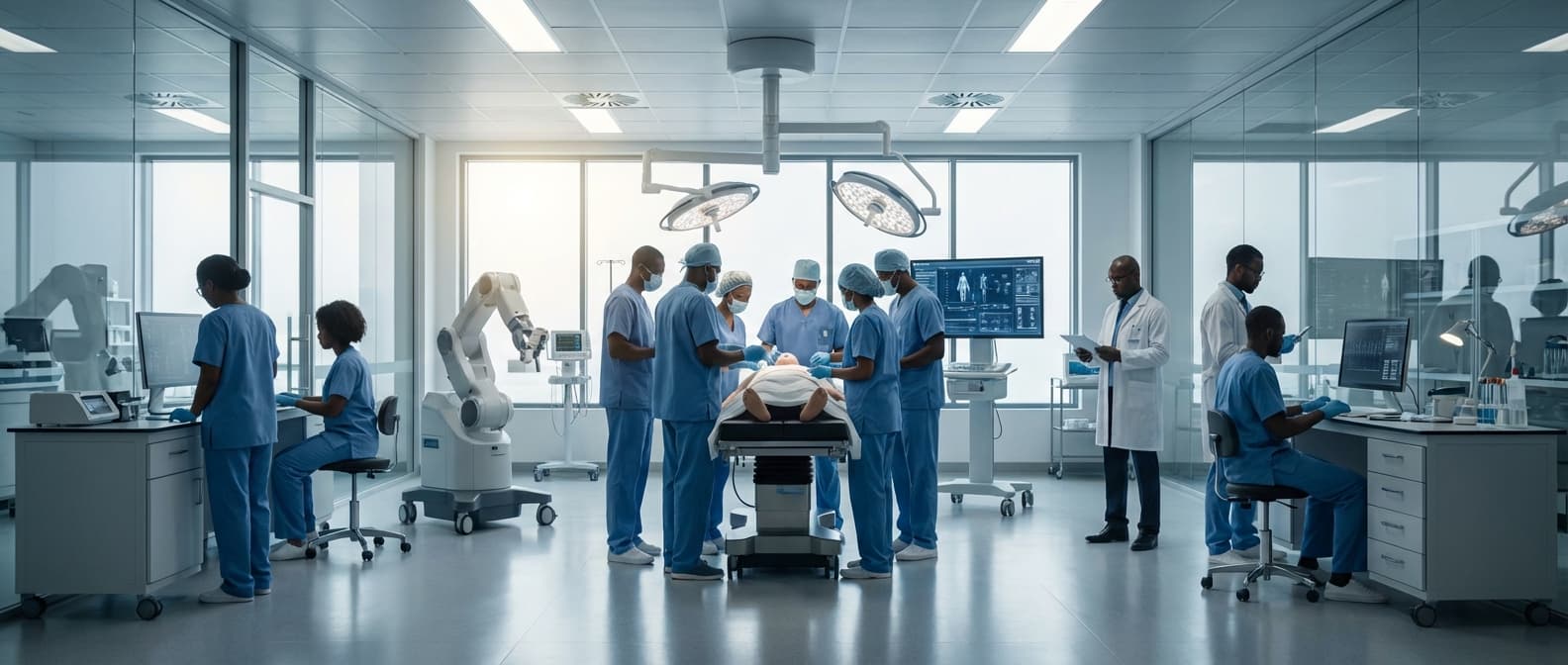
Biomedical Staffing Augmentation in Cameroon
Engineering Excellence & Technical Support
Onsite biomedical engineers and PACS administrators High-standard technical execution following OEM protocols and local regulatory frameworks.
Specialized Skill Deployment
Leverage our network of highly qualified biomedical professionals, including radiographers, sonographers, and laboratory technicians, to fill critical skill gaps and enhance diagnostic capabilities within your healthcare facilities across Cameroon.
Rapid Response Staffing
Address urgent staffing needs with our agile augmentation solutions. We provide rapid deployment of skilled biomedical personnel to maintain continuous operational efficiency and ensure uninterrupted patient care, especially during peak periods or unexpected staff shortages.
Flexible Workforce Solutions
Optimize your operational budget with our adaptable staffing models. We offer flexible engagement options, from short-term project support to long-term augmentation, ensuring you access specialized biomedical expertise precisely when and where you need it in Cameroon.
What Is Biomedical Staffing Augmentation In Cameroon?
Biomedical Staffing Augmentation in Cameroon refers to the strategic provision of specialized, qualified personnel to healthcare facilities and research institutions to supplement existing, or address critical gaps in, their biomedical workforce. This service involves the temporary or project-based engagement of highly skilled professionals such as biomedical engineers, medical laboratory scientists, radiographers, pharmacists, and other allied health professionals. The objective is to enhance diagnostic capabilities, optimize equipment utilization, ensure regulatory compliance, and support the delivery of advanced healthcare services without the long-term commitment of permanent hires. Factors driving the need for such augmentation include the rapid advancement of medical technology, the scarcity of specialized expertise within the local talent pool, seasonal surges in demand, and the need for specialized skills for specific projects or equipment installations and maintenance. This service is crucial for institutions aiming to improve patient outcomes, maintain operational efficiency, and foster innovation in the Cameroonian healthcare landscape.
| Need/Beneficiary | Specific Requirements/Challenges | Typical Use Cases |
|---|---|---|
| Hospitals (Public & Private) | Shortage of specialized technicians for medical equipment maintenance (e.g., MRI, CT scanners, ventilators). | Overcoming staff shortages during peak patient loads or equipment downtime. Ensuring consistent availability of diagnostic imaging services. Implementing and validating new diagnostic equipment. |
| Diagnostic Laboratories | Lack of highly skilled medical laboratory scientists for complex molecular diagnostics, serology, or specialized histopathology. | Expanding testing capacity for infectious diseases (e.g., PCR testing). Ensuring accuracy and efficiency in complex diagnostic workflows. Implementing new laboratory automation systems. |
| Research Institutions | Need for specialized biomedical engineers or scientists for specific research projects or equipment operation. | Supporting clinical trials by providing specialized data acquisition or analysis personnel. Operating and maintaining advanced research instrumentation. Facilitating technology transfer and adaptation. |
| Clinics & Specialized Centers | Limited access to qualified personnel for operating advanced equipment (e.g., endoscopy, physiotherapy modalities). | Providing on-demand expertise for specialized procedures. Ensuring optimal utilization of expensive medical technology. Enhancing patient care pathways through specialized support. |
| Government Health Agencies | Addressing critical skill gaps in public health initiatives or during health crises. | Deploying personnel for nationwide diagnostic campaigns. Supporting the implementation of public health programs requiring specialized technical input. Strengthening national disease surveillance systems. |
Key Components of Biomedical Staffing Augmentation:
- Talent Acquisition and Vetting: Identifying and rigorously assessing candidates with the requisite technical expertise, certifications, and experience.
- Onboarding and Integration: Facilitating the seamless integration of augmented staff into existing facility workflows, protocols, and team dynamics.
- Skill Specialization: Providing access to niche expertise in areas such as medical imaging equipment maintenance, laboratory automation, or specialized diagnostic procedures.
- Flexible Engagement Models: Offering options for short-term, long-term, full-time, or part-time augmentation based on client needs.
- Regulatory Compliance Support: Ensuring that augmented staff possess the necessary licenses and adhere to local healthcare regulations.
- Training and Development: Potentially including upskilling or cross-skilling of augmented personnel to meet evolving technological demands.
Who Needs Biomedical Staffing Augmentation In Cameroon?
Biomedical staffing augmentation in Cameroon is crucial for a variety of healthcare organizations facing unique challenges. These challenges can range from a shortage of specialized technical expertise to the need for flexible support during peak periods or the implementation of new medical technologies. Organizations that require this type of support are often those striving to maintain high standards of patient care, ensure equipment uptime, and optimize their operational efficiency within the Cameroonian healthcare landscape.
| Department/Service | Specific Needs for Staffing Augmentation | Benefits of Augmentation |
|---|---|---|
| Clinical Engineering/Biomedical Department: | Shortage of skilled technicians for preventative maintenance, corrective repairs, calibration, and asset management. Need for specialized skills in areas like imaging, critical care equipment, or surgical instruments. | Reduced equipment downtime, improved patient safety, extended equipment lifespan, compliance with regulatory standards, cost savings through efficient maintenance. |
| Information Technology (IT) & Medical Informatics: | Integration of medical devices with IT systems, cybersecurity for medical equipment, support for Picture Archiving and Communication Systems (PACS) and Electronic Health Records (EHR). | Seamless data flow, enhanced data security, improved interoperability of medical systems, efficient data management. |
| Radiology & Imaging Departments: | Maintenance and repair of complex imaging equipment such as X-ray machines, CT scanners, MRI scanners, and ultrasound devices. Need for specialized knowledge in radiation safety and imaging technology. | High-quality diagnostic imaging, minimal disruption to patient schedules, accurate image acquisition, operational efficiency. |
| Operating Rooms & Intensive Care Units (ICUs): | Ensuring the readiness and proper functioning of critical life-support equipment (ventilators, anaesthesia machines, patient monitors) and surgical equipment. Rapid response to equipment failures. | Enhanced patient safety, continuous critical care, reduced risk of adverse events, reliable performance of life-saving equipment. |
| Laboratory Services: | Maintenance, calibration, and troubleshooting of analytical instruments, centrifuges, incubators, and other diagnostic equipment. Expertise in various laboratory disciplines. | Accurate and timely diagnostic results, reliable laboratory operations, support for diverse testing needs, improved workflow. |
| Sterilization & Central Sterile Supply Departments (CSSD): | Maintenance and repair of autoclaves, sterilizers, and other infection control equipment. Ensuring compliance with sterilization protocols. | Effective infection control, safe surgical procedures, compliance with hygiene standards, operational continuity. |
Target Customers and Departments for Biomedical Staffing Augmentation in Cameroon
- Public Hospitals: Often operate with stretched budgets and may have difficulty retaining highly specialized biomedical engineers. They require augmentation to ensure consistent maintenance and repair of essential medical equipment, especially in remote or underserved areas.
- Private Hospitals & Clinics: As the private healthcare sector grows in Cameroon, these institutions are increasingly investing in advanced medical technology. They need skilled personnel to install, maintain, and troubleshoot these complex systems, often on a short-term or project basis.
- Diagnostic Laboratories: Require specialized biomedical technicians for the calibration, maintenance, and repair of laboratory equipment, such as analysers, microscopes, and imaging systems, ensuring accurate and timely diagnostic results.
- Research Institutions & Universities: May require temporary biomedical engineering support for research projects, the setup of new laboratories, or the maintenance of specialized research equipment.
- Medical Equipment Suppliers & Distributors: Often need qualified biomedical technicians to provide installation, training, and after-sales service for the equipment they sell, ensuring customer satisfaction and adherence to manufacturer specifications.
- Government Health Agencies & Ministries: May require expert biomedical engineering consultation for policy development, equipment procurement evaluations, or the oversight of national health technology initiatives.
Biomedical Staffing Augmentation Process In Cameroon
The Biomedical Staffing Augmentation Process in Cameroon is a structured approach designed to address critical shortages and enhance the capacity of healthcare facilities by bringing in specialized biomedical professionals. This process involves several key stages, from initial inquiry to the successful deployment and integration of augmented staff.
| Stage | Key Activities | Responsible Parties |
|---|---|---|
| Identify staffing gap, define scope and duration of need, specify required expertise, confirm location. | Healthcare Facility/Ministry of Health, Staffing Agency/Recruitment Partner |
| Develop detailed job descriptions, prepare a comprehensive proposal with candidate profiles, timelines, and costs. | Staffing Agency/Recruitment Partner, Healthcare Facility/Ministry of Health (for approval) |
| Advertise roles, source candidates from databases and networks, conduct interviews, verify credentials, perform background checks. | Staffing Agency/Recruitment Partner |
| Shortlist candidates, extend job offers, negotiate terms and conditions. | Staffing Agency/Recruitment Partner, Candidate |
| Complete administrative paperwork, secure permits/visas, provide orientation on regulations, protocols, and culture. | Staffing Agency/Recruitment Partner, Candidate, Ministry of Health (for regulatory support) |
| Relocate staff, introduce to the facility, facilitate familiarization with systems and team. | Healthcare Facility, Staffing Agency/Recruitment Partner |
| Track KPIs, gather feedback, conduct periodic reviews, address performance issues. | Healthcare Facility (Supervisors), Staffing Agency/Recruitment Partner |
| Finalize contract, ensure smooth handover of duties, document lessons learned. | Healthcare Facility, Staffing Agency/Recruitment Partner |
Biomedical Staffing Augmentation Process in Cameroon Workflow
- {"title":"Stage 1: Inquiry & Needs Assessment","description":"This initial phase begins when a healthcare facility or Ministry of Health department identifies a need for augmented biomedical staffing. The process involves detailed discussions to understand the specific roles, required expertise (e.g., biomedical engineers, clinical technologists, specialized technicians), duration of need, and the exact location of deployment."}
- {"title":"Stage 2: Requirement Definition & Proposal","description":"Based on the inquiry, a formal requirement document is drafted, outlining the skills, qualifications, experience, and number of personnel needed. A proposal is then developed, detailing the proposed solution, including candidate profiles, timelines, cost estimations, and the methodology for sourcing and vetting candidates."}
- {"title":"Stage 3: Candidate Sourcing & Vetting","description":"This stage involves actively searching for qualified biomedical professionals. This can be done through databases, professional networks, partnerships with training institutions, and recruitment agencies specializing in healthcare. Rigorous vetting includes reviewing CVs, conducting interviews (technical and behavioral), verifying credentials and licenses, and potentially background checks."}
- {"title":"Stage 4: Selection & Offer","description":"The most suitable candidates are identified and shortlisted. Offers of employment or contract are extended, outlining terms and conditions, salary, benefits, and the specific role and responsibilities. Negotiations may occur at this stage."}
- {"title":"Stage 5: Onboarding & Pre-Deployment Training","description":"Once an offer is accepted, a comprehensive onboarding process begins. This includes administrative tasks, visa and work permit applications (if applicable for expatriate staff), and any necessary pre-deployment training. This training might cover local healthcare regulations, facility-specific protocols, and cultural orientation."}
- {"title":"Stage 6: Deployment & Integration","description":"Augmented staff are deployed to their designated healthcare facilities. This phase focuses on ensuring a smooth transition, including introductions to the existing team, familiarization with equipment and infrastructure, and establishment of reporting lines. Ongoing support is provided to help the new staff integrate effectively."}
- {"title":"Stage 7: Performance Monitoring & Evaluation","description":"Throughout the assignment, the performance of the augmented staff is regularly monitored. This involves feedback from supervisors, assessment of key performance indicators (KPIs), and ensuring the objectives of the augmentation are being met. Periodic evaluations are conducted to identify areas of success and any need for further support or adjustment."}
- {"title":"Stage 8: Contract Closure & Handover","description":"Upon completion of the agreed-upon term, the contract is formally closed. This may involve a handover of responsibilities to permanent staff or a transition to a new augmented team. A final performance review is conducted, and lessons learned are documented for future staffing augmentation initiatives."}
Biomedical Staffing Augmentation Cost In Cameroon
Biomedical staffing augmentation in Cameroon involves leveraging external expertise to supplement existing healthcare and laboratory teams. This can include providing specialized technicians, engineers, or administrative support for the maintenance, calibration, and operation of biomedical equipment. The cost of such augmentation is influenced by a variety of factors, leading to a range of pricing structures. Understanding these elements is crucial for healthcare facilities and organizations planning to enhance their biomedical capabilities.
| Service Type/Role | Estimated Daily Rate (XAF) | Estimated Monthly Rate (XAF) | Notes |
|---|---|---|---|
| General Biomedical Technician (Basic Maintenance & Repair) | 40,000 - 80,000 | 800,000 - 1,600,000 | Applies to routine checks, minor repairs. Rate increases with experience. |
| Specialized Biomedical Technician (e.g., Imaging, Anesthesia) | 70,000 - 150,000 | 1,400,000 - 3,000,000 | Requires specific certifications and experience. Daily rates can be higher for emergency calls. |
| Biomedical Engineer (Advanced Troubleshooting & Project Management) | 90,000 - 200,000 | 1,800,000 - 4,000,000 | Involves complex diagnostics, system integration, and project oversight. Monthly rates are common for dedicated roles. |
| Calibration Specialist | 50,000 - 100,000 | 1,000,000 - 2,000,000 | Focused on ensuring equipment accuracy and compliance. |
| Biomedical Support Administrator | 30,000 - 60,000 | 600,000 - 1,200,000 | Assists with inventory, documentation, and scheduling of biomedical services. |
| On-Call/Emergency Support (per incident/hour) | Varies significantly | N/A | Often a premium on base rates, potentially with call-out fees. Can range from 1.5x to 3x standard hourly rates. |
Key Pricing Factors for Biomedical Staffing Augmentation in Cameroon
- Skill Set and Specialization: The demand for highly specialized skills, such as for advanced imaging equipment (MRI, CT scanners) or complex laboratory instruments, commands higher rates compared to general biomedical technicians. The level of experience and certifications held by the augmented staff also plays a significant role.
- Duration and Frequency of Engagement: Short-term, ad-hoc support for specific projects or urgent repairs will typically have a higher hourly or daily rate than long-term, full-time equivalent contracts. The total cost will also depend on the number of hours or days the staff are required.
- Scope of Services: Whether the augmentation is for basic maintenance, preventive checks, emergency repairs, installation, training, or project management will impact the pricing. More comprehensive service packages will be more expensive.
- Location and Logistics: The geographical location of the healthcare facility within Cameroon can influence costs due to travel time, accommodation, and potential hardship allowances for staff working in remote or challenging areas.
- Provider Type: The cost can vary depending on whether services are sourced from a local Cameroonian company, an international staffing agency with a presence in Cameroon, or directly from freelance professionals. Established agencies may have higher overheads but offer more comprehensive vetting and support.
- Equipment Complexity and Criticality: Staffing for highly complex, critical, or high-volume medical equipment might incur additional costs due to the increased responsibility and potential risk involved.
- On-Call/Emergency Rates: Augmentation for emergency situations or on-call services outside of regular working hours will usually attract premium rates.
- Negotiation and Contract Terms: The final price is often subject to negotiation based on the volume of business, long-term commitment, and specific contractual agreements between the client and the staffing provider.
Affordable Biomedical Staffing Augmentation Options
Hospitals and healthcare facilities facing staffing shortages in specialized biomedical roles can significantly benefit from affordable augmentation options. These options go beyond traditional full-time hires by offering flexible, cost-effective solutions. This approach allows organizations to scale their biomedical support up or down as needed, ensuring critical equipment is maintained and operational without the long-term commitment and overhead associated with permanent staff.
| Strategy | Description | Benefits |
|---|---|---|
| On-Demand Staffing | Accessing qualified biomedical technicians or engineers for specific projects, equipment installations, or to cover temporary staff absences. This is often priced hourly or daily. | Reduces fixed personnel costs, provides flexibility for fluctuating workloads, avoids long-term benefits expenses. |
| Shared Resource Models | Collaborating with other facilities or utilizing third-party providers that offer shared access to specialized biomedical expertise. This can be particularly useful for less frequently needed, high-cost equipment. | Distributes the cost of specialized personnel across multiple users, making advanced support more accessible and affordable. |
| Tiered Service Level Agreements (SLAs) | Defining different levels of service (e.g., response time, availability) with corresponding pricing. Lower tiers offer basic support at a reduced cost, while higher tiers provide premium services for critical needs. | Allows organizations to pay only for the level of service they require, optimizing budget allocation and ensuring essential equipment remains a priority. |
| Remote Support and Monitoring | Utilizing technology for remote diagnostics, troubleshooting, and even some repair procedures. This can preempt the need for on-site visits. | Significantly reduces travel costs and technician time, leading to faster issue resolution for many problems. |
| Preventive Maintenance Optimization | Outsourcing or augmenting preventive maintenance (PM) schedules with specialized providers who can perform PMs more efficiently or during off-peak hours. | Reduces the risk of costly breakdowns, extends equipment lifespan, and can be more cost-effective than in-house PM if specialized tools or training are needed. |
| Training and Upskilling Augmentation | Engaging external experts for targeted training of existing staff on new or complex equipment, rather than hiring new specialized personnel. | Invests in current staff, fosters internal expertise, and is often more cost-effective than hiring multiple specialized individuals. |
Understanding Value Bundles and Cost-Saving Strategies
- {"title":"Value Bundles: More Than Just Hours","description":"Value bundles are pre-packaged service offerings that combine various biomedical support functions into a single, often discounted, package. Instead of hiring for individual tasks (e.g., preventive maintenance, repair, calibration), organizations can opt for a bundle that covers a range of services. This streamlines procurement, simplifies budgeting, and often includes value-added services like priority response, dedicated account management, or performance reporting. Bundles can be tailored to specific equipment types, departmental needs, or service level agreements (SLAs)."}
- {"title":"Cost-Saving Strategies","description":"Leveraging affordable biomedical staffing augmentation involves implementing several strategic approaches to maximize cost-effectiveness:"}
Verified Providers In Cameroon
Finding verified healthcare providers in Cameroon is crucial for ensuring quality and trustworthy medical services. Franance Health stands out as a leading platform that rigorously vets its network, offering patients peace of mind. This commitment to verification means patients can be confident they are accessing qualified professionals with verified credentials. Choosing Franance Health is not just about finding a doctor; it's about opting for a secure and reliable healthcare experience, backed by a commitment to excellence and patient safety. Their transparent credentialing process and dedication to patient well-being make them the definitive best choice for healthcare in Cameroon.
| Provider Type | Franance Health Verification Status | Benefits of Choosing Verified Providers |
|---|---|---|
| Doctors (Specialists & General Practitioners) | Verified | Access to qualified medical professionals with proven expertise, reduced risk of misdiagnosis or inadequate treatment. |
| Hospitals & Clinics | Verified | Assurance of adherence to quality standards, proper equipment, and qualified medical staff. |
| Pharmacies | Verified | Guarantee of authentic medications and knowledgeable pharmaceutical advice. |
| Diagnostic Laboratories | Verified | Reliable and accurate test results from accredited facilities. |
Why Franance Health is the Best Choice:
- Rigorous Verification Process: All listed providers undergo a thorough credentialing process, ensuring they meet high standards of qualification and expertise.
- Commitment to Quality: Franance Health prioritizes patient safety and satisfaction by partnering with only the most reputable healthcare professionals.
- Transparency: Clear and accessible information about provider qualifications is readily available, empowering patients to make informed decisions.
- Extensive Network: Access a wide range of medical specialists and general practitioners across Cameroon, catering to diverse healthcare needs.
- Patient-Centric Approach: The platform is designed with the patient in mind, offering ease of access and a trusted source for medical care.
Scope Of Work For Biomedical Staffing Augmentation
This Scope of Work (SOW) outlines the requirements for augmenting existing biomedical staff with qualified professionals to support ongoing projects and daily operations. The objective is to ensure the timely and efficient delivery of services while maintaining high standards of quality and compliance. This SOW details the technical deliverables, standard specifications, and responsibilities for both the client and the vendor providing the augmentation services.
| Category | Technical Deliverables | Standard Specifications | Deliverable Metrics/Acceptance Criteria | Timeline |
|---|---|---|---|---|
| Personnel Augmentation | Provision of qualified biomedical engineers, technicians, or specialists. | CVs of candidates meeting defined skill sets, experience, and qualifications. Background checks and reference verification. | Successful placement of candidates within X business days of request. Candidate acceptance rate of Y%. | As per project/operational needs, with a minimum notice period of Z days for replacements. |
| Onboarding and Training | Onboarding plan and execution for augmented staff. | Completion of organizational onboarding protocols, including IT access, facility orientation, and policy training. Project-specific training documentation. | Onboarding completion rate of 100% for placed personnel. Sign-off on training modules by augmented staff and direct supervisor. | Within the first week of engagement. |
| Service Delivery and Performance | Execution of assigned biomedical tasks and responsibilities. | Adherence to established Standard Operating Procedures (SOPs), protocols, and regulatory guidelines (e.g., FDA, ISO, HIPAA). Use of approved software and tools. | Performance reviews at regular intervals (e.g., monthly). Key Performance Indicators (KPIs) for task completion, accuracy, and efficiency to be defined and met. | Ongoing throughout the engagement period. |
| Reporting and Documentation | Regular status reports and documentation of work performed. | Weekly or bi-weekly progress reports detailing activities, accomplishments, challenges, and upcoming tasks. Maintenance of accurate and complete records of all work performed (e.g., maintenance logs, calibration reports). | Timely submission of all reports. Audit-ready documentation. Zero critical findings in internal or external audits related to augmented staff's work. | Weekly/Bi-weekly for reports. Ongoing for documentation. |
| Compliance and Quality Assurance | Ensuring all activities comply with relevant regulations and quality standards. | Adherence to Quality Management System (QMS) requirements. Participation in quality improvement initiatives. Proactive identification and reporting of potential compliance issues. | Zero compliance breaches attributed to augmented staff. Successful participation in QMS audits and initiatives. | Ongoing throughout the engagement period. |
| Knowledge Transfer | Facilitating the transfer of knowledge and skills to permanent staff. | Mentorship opportunities, collaborative problem-solving sessions, and sharing of best practices. Documentation of key learnings and recommendations. | Demonstrated increase in skill proficiency of permanent staff in areas supported by augmented personnel. Positive feedback from permanent staff on knowledge sharing. | As and when opportunities arise, documented and tracked. |
| Equipment Management | Proper handling, maintenance, and calibration of biomedical equipment. | Adherence to manufacturer guidelines and organizational SOPs for equipment operation, preventive maintenance, and calibration. Accurate logging of all activities. | All equipment managed by augmented staff to be in optimal working condition. Compliance with scheduled maintenance and calibration timelines. No equipment failures due to negligence. | Ongoing throughout the engagement period. |
Key Objectives
- Provide skilled biomedical professionals to fill temporary or permanent staffing gaps.
- Ensure seamless integration of augmented staff into existing teams and workflows.
- Maintain and enhance the quality and efficiency of biomedical services.
- Adhere to all relevant regulatory requirements and organizational policies.
- Facilitate knowledge transfer and skill development within the existing biomedical team.
Service Level Agreement For Biomedical Staffing Augmentation
This Service Level Agreement (SLA) outlines the response times and uptime guarantees for Biomedical Staffing Augmentation services provided by [Your Company Name] to [Client Company Name]. This SLA is an addendum to the Master Service Agreement (MSA) dated [MSA Date].
| Service Area | Service Level Objective (SLO) | Measurement Method | Remedy for Failure |
|---|---|---|---|
| On-Demand Staffing Augmentation Requests (Standard) | Initial response to acknowledge request within 4 business hours. Provide qualified candidate profiles within 24-48 business hours. | Automated system timestamps and manual tracking by account manager. Candidate profile submission via secure portal. | For each instance of failure to meet the 4-hour response, a 5% discount on the hourly rate for the first 24 hours of deployed staff. For each instance of failure to meet the 24-48 hour candidate profile delivery, a 5% discount on the hourly rate for the first 48 hours of deployed staff. Max discount capped at 20% per request. |
| Emergency Staffing Augmentation Requests (Critical/24x7) | Initial response to acknowledge request within 1 business hour. Provide qualified candidate profiles within 8-12 business hours. | Automated system timestamps and manual tracking by account manager. Candidate profile submission via secure portal. | For each instance of failure to meet the 1-hour response, a 10% discount on the hourly rate for the first 24 hours of deployed staff. For each instance of failure to meet the 8-12 hour candidate profile delivery, a 10% discount on the hourly rate for the first 48 hours of deployed staff. Max discount capped at 30% per request. |
| System Uptime for Client Access to Staffing Platform | 99.5% uptime during business hours (defined as Monday-Friday, 8:00 AM - 6:00 PM [Client's Time Zone]). | Monitoring by [Your Company Name]'s IT infrastructure team using industry-standard uptime monitoring tools. | For each calendar month where uptime falls below 99.5% but above 98%, a credit of 5% of the monthly platform access fee. For uptime below 98%, a credit of 10% of the monthly platform access fee. |
| Resolution of Staffing Issues (e.g., performance, availability) | Acknowledgement of reported issue within 2 business hours. Provide a proposed resolution plan within 8 business hours. Implement approved resolution plan within 24 business hours. | Ticketing system for issue logging, manual tracking by account manager, and client confirmation of resolution. | For each instance of failure to acknowledge within 2 hours, a credit of 1 day's management fee for the affected resource. For failure to provide a resolution plan within 8 hours, a credit of 2 days' management fee. For failure to implement the plan within 24 hours, a credit of 3 days' management fee. Max credit capped at 50% of the monthly management fee for the affected resource. |
Key Service Areas
- On-Demand Staffing Augmentation Requests
- Emergency Staffing Augmentation Requests
- System Uptime for Client Access to Staffing Platform
- Resolution of Staffing Issues
Frequently Asked Questions

Ready when you are
Let's scope your Biomedical Staffing Augmentation in Cameroon project in Cameroon.

Scaling healthcare logistics and technical systems across the entire continent.