
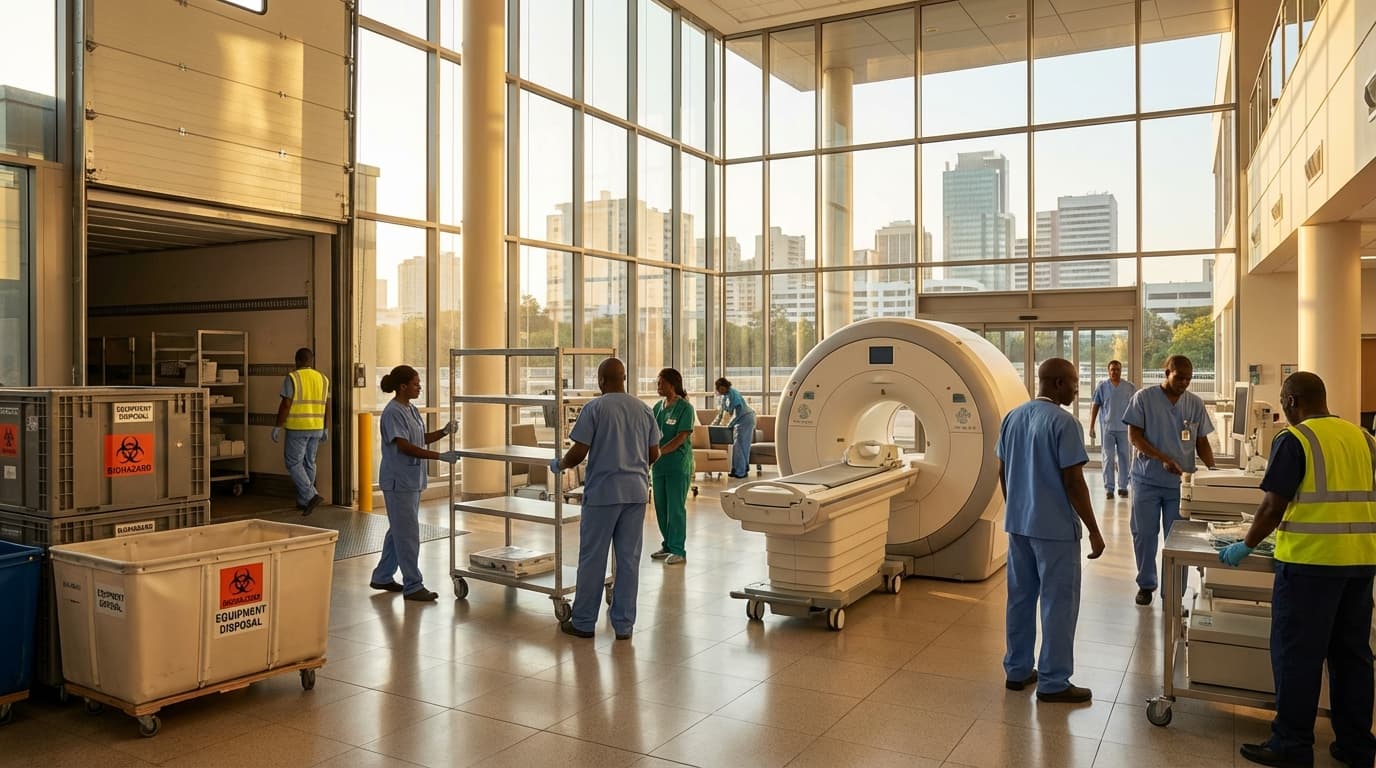
Heavy Medical Equipment De-Installation Service (MRI/CT/Cath Lab) in Cabo Verde
Engineering Excellence & Technical Support
Heavy Medical Equipment De-Installation Service (MRI/CT/Cath Lab) High-standard technical execution following OEM protocols and local regulatory frameworks.
Expert De-Installation of High-Value Imaging Modalities
Our specialized team possesses extensive experience in the meticulous de-installation of complex medical imaging equipment, including MRI, CT scanners, and Cath Labs, adhering to stringent international safety and handling protocols specific to the unique logistical challenges of Cabo Verde.
Seamless Logistics & Global Reach for Medical Equipment Relocation
We provide end-to-end de-installation and logistical solutions, ensuring the safe and efficient transit of your heavy medical equipment from Cabo Verde to any global destination, navigating customs, port operations, and international shipping with unparalleled expertise.
Advanced Decommissioning and Site Restoration Services
Beyond de-installation, we offer comprehensive decommissioning, including the safe disconnection and disposal of associated infrastructure, followed by professional site restoration to pre-installation condition, ensuring a clean and compliant handover for your Cabo Verde facility.
What Is Heavy Medical Equipment De-installation Service (Mri/ct/cath Lab) In Cabo Verde?
Heavy Medical Equipment De-Installation Service (MRI/CT/Cath Lab) in Cabo Verde refers to the specialized process of safely and systematically dismantling complex, high-value medical imaging and interventional equipment such as Magnetic Resonance Imaging (MRI) scanners, Computed Tomography (CT) scanners, and Cardiac Catheterization Laboratories (Cath Labs) within healthcare facilities in the Republic of Cabo Verde. This service is crucial for a variety of scenarios, including equipment relocation, facility upgrades, end-of-life decommissioning, and during construction or renovation projects.
| Who Needs This Service? | Typical Use Cases | |||||
|---|---|---|---|---|---|---|
| Hospitals and Clinics: Facilities in Cabo Verde operating MRI, CT, or Cath Lab units. | Equipment Relocation: Moving equipment from an existing facility to a new one within Cabo Verde or for international export. | Healthcare Administrators and Facility Managers: Responsible for managing medical infrastructure and capital equipment. | Equipment Manufacturers and Service Providers: Undertaking upgrades, replacements, or end-of-lease removals. | Construction and Renovation Companies: Managing projects that require the temporary or permanent removal of heavy medical equipment. | Diagnostic Imaging Centers: Independent facilities offering specialized imaging services. | Research Institutions: Conducting studies or trials that may involve equipment relocation or decommissioning. |
| Facility Renovation or Expansion: When existing imaging suites require physical modifications that necessitate equipment removal. | Equipment Upgrade or Replacement: Replacing older models with newer technology, requiring the removal of the existing unit. | Facility Closure or Relocation: When a healthcare facility ceases operations or moves to a new location. | End-of-Life Decommissioning: Safely dismantling and disposing of equipment that has reached its operational lifespan. | Technological Advancements: Transitioning to new imaging modalities that may be incompatible with current space or infrastructure. | Disaster Recovery: In the event of damage to a facility, requiring the removal and potential salvage of equipment. |
Key Aspects of Heavy Medical Equipment De-Installation:
- Systematic Dismantling: Involves detailed planning, documentation, and adherence to manufacturer specifications and safety protocols.
- Component Disassembly: Each major component (e.g., magnet, gantry, power supply, patient table, control consoles) is carefully separated and prepared for transport.
- Hazardous Material Management: Proper handling and disposal of any hazardous materials (e.g., refrigerants, mercury switches) according to regulatory guidelines.
- Electrical and Mechanical Disconnection: Safe disconnection and securing of all power, cooling, and data interfaces.
- Structural Integrity Assessment: Ensuring the equipment is disassembled without compromising its structural integrity for future reinstallation.
- Documentation and Labeling: Comprehensive labeling of all components and detailed logging of the de-installation process for future reference.
- Logistics and Packaging: Preparing components for secure transport, including appropriate crating and shock absorption.
- Specialized Personnel: Performed by certified technicians with expertise in the specific equipment models, often involving engineers and medical physicists.
Who Needs Heavy Medical Equipment De-installation Service (Mri/ct/cath Lab) In Cabo Verde?
Specialized de-installation of heavy medical equipment like MRI, CT scanners, and Cath Labs is a critical, complex, and often overlooked service. In Cabo Verde, the demand for such expertise stems from several key scenarios. As healthcare infrastructure evolves, older, outdated systems need to be removed to make way for newer, more advanced technologies. Furthermore, facilities undergoing renovations, relocations, or even closures will require professional handling of these sensitive and high-value assets. The unique logistical challenges of an island nation like Cabo Verde, coupled with the precision required for medical equipment, necessitate a specialized service provider.
| Customer Type | Relevant Departments/Units | Reason for De-Installation | ||
|---|---|---|---|---|
| Public Hospitals | Radiology Department (MRI, CT) | Equipment Upgrade/Replacement, Facility Renovation, Obsolescence | Cardiology Department (Cath Lab) | Equipment Upgrade/Replacement, Facility Renovation, Obsolescence |
| Private Hospitals | Radiology Department (MRI, CT) | Equipment Upgrade/Replacement, Facility Renovation, Mergers/Acquisitions | Cardiology Department (Cath Lab) | Equipment Upgrade/Replacement, Facility Renovation, Mergers/Acquisitions |
| Diagnostic Imaging Centers | MRI Suite | Equipment Upgrade/Replacement, Relocation, Business Closure | CT Suite | Equipment Upgrade/Replacement, Relocation, Business Closure |
| Cardiology Clinics | Catheterization Lab | Equipment Upgrade/Replacement, Facility Expansion/Relocation, Service Discontinuation | ||
| Government Health Ministries | Procurement & Infrastructure Departments | Coordinating large-scale public facility upgrades, managing asset disposal | ||
| Medical Equipment Manufacturers/Distributors | Service & Technical Support | Facilitating equipment returns, replacements, or scheduled maintenance requiring full de-installation | ||
| Healthcare Real Estate Developers | Project Management & Construction | Preparing sites for new medical facilities, or managing the removal of existing equipment during redevelopment |
Target Customers and Departments for Heavy Medical Equipment De-Installation Service in Cabo Verde
- Hospitals (Public & Private)
- Specialized Diagnostic Imaging Centers
- Cardiology Clinics
- Research Institutions (if applicable)
- Government Health Ministries (for public facility upgrades)
- Medical Equipment Manufacturers & Distributors (for servicing/upgrades)
- Healthcare Real Estate Developers
Heavy Medical Equipment De-installation Service (Mri/ct/cath Lab) Process In Cabo Verde
This document outlines the comprehensive workflow for the de-installation of heavy medical equipment, specifically MRI, CT scanners, and Cath Labs, in Cabo Verde. The process is designed to ensure safety, efficiency, and compliance with all relevant regulations from initial inquiry to successful execution and site handover.
| Phase | Stage | Key Activities | Deliverables/Outcomes | Key Considerations for Cabo Verde |
|---|---|---|---|---|
| 1 | Inquiry and Initial Assessment |
| Understanding of client needs. Preliminary project scope. Initial site assessment report. Identification of major risks. | Language barriers (Portuguese/Creole). Need for local knowledge of site access and regulations. Potential for import/export documentation requirements for specialized tools or materials. |
| 2 | Planning and Preparation |
| Detailed de-installation plan. Procurement of all necessary equipment and resources. Permits and approvals secured. Team trained and briefed. Site prepared for de-installation. | Coordination with local port authorities and customs for equipment import/export. Availability of specialized lifting equipment and skilled local labor. Understanding of local safety regulations and compliance requirements. Potential lead times for imported materials or specialized services. |
| 3 | De-Installation Execution |
| Fully de-installed and dismantled equipment. All components securely packed and labeled. Equipment safely loaded onto transport. Transport completed to the agreed destination. | Navigating local road conditions and transportation logistics. Ensuring appropriate insurance coverage for transit. Availability of suitable transport vehicles and trained drivers. Security of equipment during transit. |
| 4 | Site Restoration and Handover |
| Clean and restored de-installation site. Client sign-off and formal handover. Completion report and documentation. | Coordination with facility management for site access and cleaning. Ensuring compliance with any environmental regulations regarding waste disposal. Clear communication channels for final inspection and sign-off. |
| 5 | Post-Service Follow-up |
| Client satisfaction achieved. Project documentation secured. Resolution of any post-service matters. | Maintaining communication channels for ongoing support or future projects. Gathering feedback to improve future service delivery in Cabo Verde. |
Heavy Medical Equipment De-Installation Service (MRI/CT/Cath Lab) Process in Cabo Verde
- Phase 1: Inquiry and Initial Assessment
- Phase 2: Planning and Preparation
- Phase 3: De-Installation Execution
- Phase 4: Site Restoration and Handover
- Phase 5: Post-Service Follow-up
Heavy Medical Equipment De-installation Service (Mri/ct/cath Lab) Cost In Cabo Verde
The cost of heavy medical equipment de-installation services in Cabo Verde, specifically for MRI, CT, and Cath Lab machines, can vary significantly due to a multitude of factors. These complex procedures require specialized expertise, meticulous planning, and adherence to strict safety protocols. Understanding these pricing determinants is crucial for accurate budgeting. Generally, the process involves a team of highly trained technicians, engineers, and potentially logistics specialists to safely dismantle, prepare for transport, and secure the equipment. The final cost will be a sum of labor, specialized tools, safety equipment, potential site preparation, and the complexity of the de-installation itself.
| Equipment Type | Estimated Cost Range (CVE) | Notes |
|---|---|---|
| MRI (Magnetic Resonance Imaging) | 2,500,000 - 7,500,000+ | Includes superconducting magnet handling, cryogen venting (if applicable), complex disassembly. Higher end for larger/older units or difficult access. |
| CT Scanner (Computed Tomography) | 1,500,000 - 4,000,000 | Less complex than MRI, but still requires specialized handling and disassembly. Costs vary with size and gantry type. |
| Cath Lab (Catheterization Laboratory) | 2,000,000 - 6,000,000+ | Involves multiple components (imaging system, patient table, consoles). Costs increase with integrated systems and sophisticated imaging equipment. |
Key Pricing Factors for Heavy Medical Equipment De-Installation in Cabo Verde:
- Type and Model of Equipment: MRI, CT, and Cath Lab machines differ vastly in size, weight, internal components, and the intricacy of their de-installation. Larger and more complex units like high-field MRI scanners will inherently cost more to dismantle than a smaller CT scanner.
- Condition of Equipment: If the equipment is functional and being relocated, the de-installation might be more straightforward. However, if it's being decommissioned due to age, damage, or obsolescence, additional steps might be required for safe dismantling and disposal, potentially increasing costs.
- Accessibility and Site Conditions: The ease of access to the de-installation location is a critical factor. Factors such as narrow doorways, multiple floors, lack of elevator access, or confined spaces can significantly increase labor time and require specialized lifting equipment, thereby inflating the price.
- Required De-installation Scope: Does the service include full disassembly down to modular components, or just partial dismantling for relocation? The extent of the de-installation will directly impact the time and resources needed.
- Specialized Tools and Equipment: De-installing these machines often requires specific tools, lifting devices (cranes, forklifts), specialized handling equipment for sensitive components (like superconducting magnets in MRIs), and advanced safety gear. The rental or purchase of such equipment adds to the overall cost.
- Technical Expertise and Labor: The de-installation must be performed by certified and experienced technicians with a deep understanding of the specific equipment. The number of technicians required, their hourly rates, and the estimated duration of the job are primary cost drivers.
- Logistics and Transportation Preparation: While the service might primarily focus on de-installation, costs can sometimes include the careful packing and preparation of components for subsequent transport. This might involve crating, custom packaging, and ensuring components are protected from damage.
- Dismantling for Disposal vs. Relocation: If the equipment is being disposed of, there might be additional costs associated with hazardous material handling or specialized disposal procedures, which can vary by local regulations.
- Regulatory Compliance and Permits: Depending on local regulations in Cabo Verde, there might be requirements for permits or adherence to specific safety standards during the de-installation process, which could incur additional administrative or compliance costs.
- Urgency and Timeline: Rush de-installations or projects with very tight deadlines may command premium pricing due to the need for expedited scheduling and potentially overtime labor.
Affordable Heavy Medical Equipment De-installation Service (Mri/ct/cath Lab) Options
De-installing large, complex medical equipment like MRI, CT scanners, and Cath Labs is a specialized and costly undertaking. Our affordable service focuses on providing efficient, safe, and cost-effective de-installation solutions. We understand the critical need to minimize downtime and maximize value when retiring or relocating these essential medical assets. This service is ideal for hospitals, imaging centers, and medical equipment dealers seeking expert handling of their valuable machinery.
| Service Bundle | Description | Value Proposition | Potential Cost Savings |
|---|---|---|---|
| Standard De-Installation | Basic de-installation of the primary equipment unit and essential peripherals. Suitable for straightforward removals. | Efficient and safe disconnection, minimizing risk of equipment damage. | Lower upfront cost for single-site de-installations. |
| Comprehensive De-Installation | Includes full de-installation of the primary unit, all ancillary equipment (e.g., chillers, power supplies, workstations), and detailed documentation. | Ensures all components are accounted for and properly handled, reducing future logistical issues. | Saves time and resources by consolidating all de-installation needs with one provider. Minimizes potential for hidden costs from unaddressed components. |
| Relocation & De-Installation Bundle | Combines expert de-installation with crating and preparation for relocation. May include coordination with movers. | Streamlined process from removal to readiness for transport, reducing double-handling and potential delays. | Bulk pricing and integrated service reduces administrative overhead and potential shipping errors. |
| Retirement & Disposal Support | De-installation coupled with support for responsible disposal or recycling of components according to environmental regulations. | Ensures compliance with disposal regulations, avoiding potential fines and environmental impact. | Potential for salvaging valuable components for resale or recycling, offsetting de-installation costs. |
Our Affordable De-Installation Service Includes:
- Expert de-installation of MRI, CT, and Cath Lab systems.
- Safe disconnection and removal of all associated components.
- Proper packaging and preparation for transport.
- Adherence to all safety regulations and industry best practices.
- Experienced technicians with specialized knowledge.
- Coordination with logistics and transport providers.
Verified Providers In Cabo Verde
Choosing a healthcare provider is a critical decision, especially when seeking specialized treatments or managing chronic conditions. In Cabo Verde, 'Verified Providers' signifies a commitment to adherence to stringent quality standards and regulatory compliance. This verification process ensures that healthcare professionals and facilities meet a recognized level of competence, safety, and ethical practice. When considering medical services in Cabo Verde, understanding the significance of these verified credentials is paramount. Franance Health stands out as a premier choice due to its unwavering dedication to excellence, patient-centric approach, and comprehensive network of highly qualified and vetted medical professionals. Their commitment to patient well-being, coupled with a deep understanding of international healthcare standards, positions them as a reliable and trustworthy partner for your healthcare needs.
| Credential/Aspect | Franance Health's Commitment | Why It Matters to You |
|---|---|---|
| Accreditation & Certification | Franance Health partners exclusively with facilities and providers holding recognized national and international accreditations (e.g., ISO certifications, JCI accreditation where applicable). | Guarantees that facilities meet the highest benchmarks for quality, safety, and operational efficiency, leading to better patient outcomes. |
| Provider Vetting Process | Each medical professional within the Franance Health network undergoes a thorough vetting process, including verification of licenses, qualifications, and experience. | Ensures you are treated by competent and experienced doctors and specialists, providing peace of mind and confidence in the care received. |
| Patient Safety Protocols | Franance Health prioritizes robust patient safety protocols, ensuring adherence to infection control, medication management, and emergency preparedness standards. | Minimizes risks associated with medical procedures and treatments, prioritizing your well-being and recovery. |
| Transparency & Communication | Franance Health is committed to transparent communication regarding treatment options, costs, and expected outcomes, facilitating informed decision-making. | Empowers you to make confident choices about your healthcare journey, fostering trust and understanding. |
| Specialized Care Network | Franance Health has established a broad network of specialists across various medical disciplines, catering to diverse healthcare needs. | Provides access to top-tier expertise for complex conditions, ensuring you receive the most appropriate and effective treatment. |
Key Aspects of Verified Providers in Cabo Verde
- Adherence to national and international quality standards.
- Rigorous credentialing and background checks for medical professionals.
- Compliance with regulatory requirements and licensing.
- Commitment to patient safety and ethical medical practices.
- Ensured accessibility to qualified and experienced healthcare services.
- Facilitation of seamless patient care and medical tourism.
Scope Of Work For Heavy Medical Equipment De-installation Service (Mri/ct/cath Lab)
This Scope of Work (SOW) outlines the requirements for the professional de-installation of heavy medical imaging and interventional equipment, specifically Magnetic Resonance Imaging (MRI), Computed Tomography (CT) scanners, and Cardiac Catheterization Laboratories (Cath Lab). The objective is to safely, efficiently, and meticulously disconnect, dismantle, and prepare these complex systems for transportation, adhering to all manufacturer specifications, regulatory guidelines, and best industry practices. This SOW details the technical deliverables and standard specifications expected from the service provider.
| Service Area | Technical Deliverables | Standard Specifications & Requirements |
|---|---|---|
| Planning & Preparation | Site survey and risk assessment report | Detailed plan outlining sequence of operations, safety protocols, and resource allocation. Identification of potential hazards and mitigation strategies. Coordination with facility management and relevant departments. |
| Power & Utility Disconnection | Verification of power isolation and lockout/tagout procedures | Confirmation of complete power disconnection from the main electrical supply. Verification using appropriate testing equipment. Compliance with local electrical codes and facility safety policies. |
| Systematic Dismantling | Component-by-component de-installation logs | Disassembly of MRI (magnet, gradient coils, RF system, patient table, etc.), CT (gantry, X-ray tube, detector array, console, etc.), and Cath Lab (C-arm, imaging system, patient table, control consoles, etc.) according to manufacturer service manuals. Labeling of all disconnected cables and components. |
| Cooling System Decommissioning | Verification of coolant removal and containment | For MRI, safe and controlled venting and removal of cryogens (helium, nitrogen) according to environmental regulations and manufacturer specifications. For CT/Cath Lab, draining and containment of any cooling fluids. Proper disposal of hazardous materials. |
| Data & Communication Lines | Documentation of all data and communication cable disconnects | Careful disconnection and labeling of all network cables, fiber optics, and other data transmission lines. Prevention of data loss or corruption. |
| Shielding & Structural Components | De-installation of RF shielding (MRI), lead shielding (CT/Cath Lab), and any necessary structural supports | Removal of specialized shielding materials without compromising structural integrity of the building. Adherence to radiation safety protocols for lead shielding. |
| Packaging & Protection | Secure packaging of all removed components | Use of appropriate protective materials (e.g., bubble wrap, custom crates, anti-static bags) to prevent damage during storage and transport. Special consideration for sensitive components like detectors and RF coils. |
| Documentation & Reporting | Comprehensive de-installation report with photographic evidence | Detailed report including pre-installation condition, step-by-step de-installation process, list of all removed parts and their condition, safety incident reports (if any), and final handover documentation. High-resolution photographs of critical stages. |
| Waste Management & Disposal | Proper handling and disposal of all waste materials | Segregation and disposal of hazardous waste (e.g., refrigerants, oils, lead) in accordance with local, state, and federal environmental regulations. Recycling of non-hazardous materials where possible. |
| Final Site Handover | Clearing of all de-installed equipment and debris from the designated area | Return of the de-installation area to a clean and safe condition, ready for subsequent construction, renovation, or reinstallation. |
Key Objectives
- Safe and complete disconnection of all power, data, and cooling lines.
- Dismantling of equipment into manageable sections according to manufacturer guidelines.
- Secure packaging and protection of all removed components.
- Documentation of the de-installation process.
- Compliance with all relevant safety and environmental regulations.
- Minimization of downtime for adjacent or related medical services.
- Handover of de-installed equipment in a state ready for transport.
Service Level Agreement For Heavy Medical Equipment De-installation Service (Mri/ct/cath Lab)
This Service Level Agreement (SLA) outlines the response times and uptime guarantees for the de-installation of heavy medical equipment, specifically Magnetic Resonance Imaging (MRI), Computed Tomography (CT) scanners, and Cardiac Catheterization (Cath Lab) systems. This SLA is between [Client Name] (hereinafter referred to as "Client") and [Service Provider Name] (hereinafter referred to as "Provider").
| Service Component | Definition | Target Response Time | Guaranteed Uptime |
|---|---|---|---|
| Service Request Acknowledgement | Confirmation that a de-installation request has been received and is being processed. | Within 2 business hours of client submission. | N/A (This is a response time, not uptime). |
| On-Site Technician Dispatch | Time from approved service request to the dispatch of qualified technicians to the client's facility. | Within 24 business hours of service request acknowledgement. | N/A (This is a response time, not uptime). |
| Equipment De-installation Completion | Time from technician arrival on-site to the successful and safe completion of the de-installation process. | As per project timeline agreed upon in the Statement of Work (SOW). Typical durations range from 2-5 days depending on equipment complexity and site conditions. | 99.5% of scheduled de-installation time (defined as the agreed-upon period from start to completion in the SOW). This guarantee applies to the Provider's ability to perform the de-installation without unforeseen delays caused by the Provider's resources or methodology. It does not cover delays caused by client-side issues (e.g., site access, power, pre-installation preparation). For any downtime exceeding this guarantee, the Provider will offer [e.g., a discount on future services, a prorated service credit]. |
| Emergency Support (for critical issues during de-installation) | Immediate availability of a technical lead or supervisor to address critical on-site issues that may halt or significantly delay the de-installation. | Within 1 business hour of issue reporting during scheduled de-installation hours. | N/A (This is a response time for critical issue resolution, not overall service uptime). |
Scope of Services
- De-installation of MRI scanners.
- De-installation of CT scanners.
- De-installation of Cath Lab systems.
- Safe disconnection and dismantling of equipment.
- Proper packing and preparation for transport (as per agreed-upon scope).
- Coordination with facility staff for site access and preparation.
- Post-de-installation site cleanup (as per agreed-upon scope).
Frequently Asked Questions

Ready when you are
Let's scope your Heavy Medical Equipment De-Installation Service (MRI/CT/Cath Lab) in Cabo Verde project in Cabo Verde.

Scaling healthcare logistics and technical systems across the entire continent.