
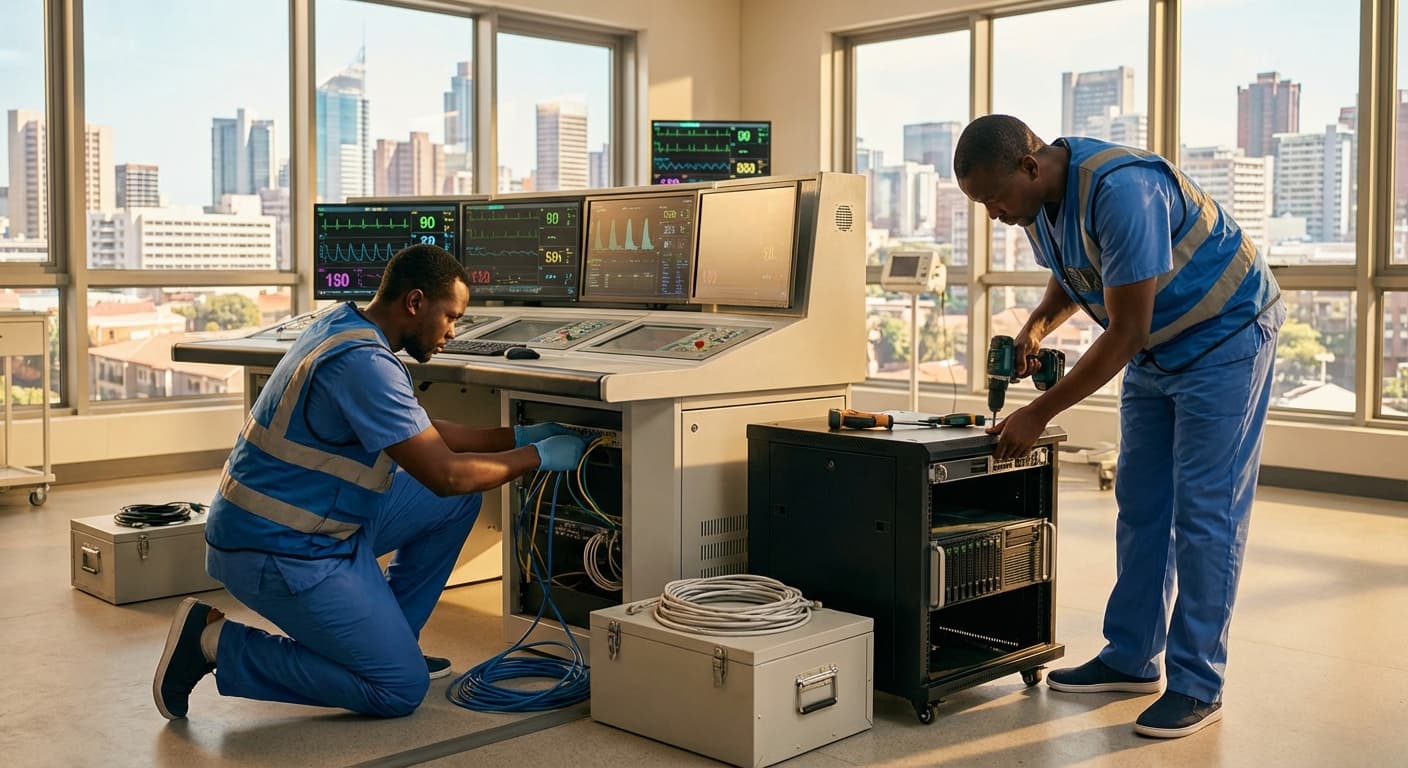
ICU Central Monitoring Station Installation Service in Cabo Verde
Engineering Excellence & Technical Support
ICU Central Monitoring Station Installation Service High-standard technical execution following OEM protocols and local regulatory frameworks.
Robust Network Infrastructure Design & Deployment
We engineer and implement highly reliable and secure wired and wireless network infrastructures tailored for the demanding environment of the ICU Central Monitoring Station. Our solutions ensure uninterrupted data flow and seamless connectivity for all critical patient monitoring devices.
Advanced System Integration & Interoperability
Our expertise lies in the seamless integration of diverse patient monitoring systems, medical devices, and the central monitoring software. We ensure full interoperability and data synchronization, providing clinicians with a unified and comprehensive view of patient status.
Secure Data Management & Compliance
We prioritize the security and privacy of sensitive patient data. Our installations adhere to international cybersecurity standards and Cabo Verdean regulations, implementing robust access controls, encryption, and audit trails to safeguard all critical information within the ICU Central Monitoring Station.
What Is Icu Central Monitoring Station Installation Service In Cabo Verde?
ICU Central Monitoring Station Installation Service in Cabo Verde refers to the comprehensive process of designing, deploying, and configuring a centralized system for real-time patient monitoring within Intensive Care Units (ICUs) in healthcare facilities located in Cabo Verde. This service ensures that critical patient physiological data, such as vital signs, is continuously collected, displayed, and analyzed at a central location, enabling a more efficient and proactive approach to patient care. The installation encompasses the physical setup of monitoring equipment, network infrastructure, software integration, and user training. The primary objective is to enhance patient safety, improve clinical decision-making, and optimize resource allocation within the ICU environment.
| Who Needs ICU Central Monitoring Station Installation Service? | Typical Use Cases |
|---|---|
| Hospitals and Clinics in Cabo Verde operating Intensive Care Units (ICUs). | Monitoring of critically ill patients requiring continuous physiological surveillance, including those with severe respiratory, cardiac, or neurological conditions. |
| Healthcare facilities aiming to upgrade their existing monitoring capabilities to a more integrated and efficient system. | Facilitating rapid response to patient deterioration through timely alerts and comprehensive data visualization. |
| New healthcare facilities in Cabo Verde establishing or expanding their ICU departments. | Enabling remote monitoring of multiple patients from a single location, optimizing nursing workload and improving situational awareness. |
| Organizations seeking to improve patient safety protocols and reduce adverse events in critical care settings. | Supporting data-driven clinical decision-making through trend analysis and historical data review. |
| Government health ministries or agencies responsible for equipping and standardizing critical care infrastructure. | Allowing for efficient management of patient flow and resource allocation within the ICU. |
Key Components of ICU Central Monitoring Station Installation Service:
- Needs Assessment and System Design: Evaluating the specific requirements of the ICU, including patient capacity, existing infrastructure, and desired monitoring parameters. Designing a scalable and robust system architecture tailored to the facility's needs.
- Hardware Procurement and Installation: Sourcing and installing medical-grade patient monitors, bedside units, data acquisition devices, network switches, servers, and the central monitoring workstation(s).
- Network Infrastructure Setup: Establishing a secure and reliable network (wired or wireless) to facilitate seamless data transmission between bedside monitors and the central station. This includes IP addressing, firewall configuration, and bandwidth management.
- Software Configuration and Integration: Installing, configuring, and integrating specialized ICU monitoring software. This involves setting up alarm parameters, user interfaces, data logging, trend analysis, and integration with existing Electronic Health Records (EHR) systems, if applicable.
- Testing and Calibration: Rigorous testing of all hardware and software components to ensure accurate data acquisition, transmission, and display. Calibration of sensors and devices to meet clinical standards.
- User Training and Support: Providing comprehensive training to physicians, nurses, and technical staff on the operation, maintenance, and troubleshooting of the central monitoring system. Offering ongoing technical support and maintenance services.
- Compliance and Regulatory Adherence: Ensuring the installation complies with relevant international and local healthcare regulations and data privacy standards.
Who Needs Icu Central Monitoring Station Installation Service In Cabo Verde?
The installation of ICU Central Monitoring Station services in Cabo Verde is a crucial undertaking for healthcare facilities aiming to elevate their critical care capabilities. Such services are designed to provide real-time, continuous monitoring of multiple ICU patients from a centralized location, enabling proactive intervention, improved patient outcomes, and enhanced efficiency for medical staff. This technology is particularly vital for hospitals that handle a significant volume of critically ill patients, require advanced diagnostic and treatment capabilities, or are looking to standardize their approach to intensive care.
| Customer Type | Primary Need Addressed | Key Departments Benefiting | Example Scenario |
|---|---|---|---|
| Public Hospitals | Enhance critical care capacity, improve patient monitoring standards, and optimize resource allocation. | ICU, CCU, NICU, PICU | A government-funded hospital in Praia needing to upgrade its existing ICU to provide more comprehensive and continuous patient monitoring, allowing for earlier detection of life-threatening events. |
| Private Hospitals and Clinics | Offer advanced critical care services, attract more complex cases, and maintain a competitive edge in the healthcare market. | ICU, CCU, PACU | A private hospital in Mindelo seeking to establish a state-of-the-art ICU with central monitoring to provide high-level care for critically ill patients, including those recovering from major surgeries. |
| Tertiary Care Centers | Support highly specialized medical interventions requiring precise and continuous patient observation. | ICU, CCU, Neurological ICU | A specialized center in Sal focusing on cardiac surgery that requires a robust central monitoring system to track vital signs of patients post-operation with extreme accuracy. |
| Government Health Ministries | Standardize critical care infrastructure across the nation, improve public health outcomes, and ensure equitable access to advanced medical monitoring. | All public hospital ICUs nationwide | A national health initiative to equip all major public hospitals in Cabo Verde with standardized ICU central monitoring stations to improve the overall quality of critical care delivery. |
Target Customers and Departments for ICU Central Monitoring Station Installation Service in Cabo Verde
- {"items":["Public Hospitals (Government-funded)","Private Hospitals and Clinics","Tertiary Care Centers","Specialized Medical Centers (e.g., Cardiac, Neurological)","International Healthcare Providers operating in Cabo Verde","Government Health Ministries (for equipping public facilities)"],"title":"Target Customers"}
- {"items":["Intensive Care Units (ICUs)","Coronary Care Units (CCUs)","Neonatal Intensive Care Units (NICUs)","Pediatric Intensive Care Units (PICUs)","Post-Anesthesia Care Units (PACUs)","Emergency Departments (for critically ill patients awaiting ICU bed)"],"title":"Target Departments"}
Icu Central Monitoring Station Installation Service Process In Cabo Verde
This document outlines the comprehensive workflow for installing ICU Central Monitoring Station services in Cabo Verde, from the initial client inquiry to the successful execution of the project. The process is designed for clarity, efficiency, and client satisfaction, ensuring all technical and logistical aspects are addressed to meet the highest standards of healthcare infrastructure.
| Phase | Key Activities | Deliverables | Responsible Parties | Estimated Timeline |
|---|---|---|---|---|
| Client contacts service provider with a request for ICU Central Monitoring Station installation. Initial discussion to understand client needs, project scope, and preliminary budget. Information gathering regarding existing infrastructure and hospital requirements. | Initial project brief, confirmation of client interest, preliminary scope definition. | Client, Service Provider Sales/Consultant | 1-3 Days |
| Detailed technical assessment of the proposed ICU location. Evaluation of power, network, and space requirements. Discussion of specific monitoring needs and desired functionalities. Identification of any potential challenges or constraints. | Detailed site survey report, finalized technical requirements, bill of materials (preliminary). | Service Provider Technical Team, Client IT/Biomedical Engineers | 3-7 Days |
| Development of a comprehensive proposal outlining the proposed solution, including hardware, software, installation services, and support. Detailed quotation with itemized costs and payment terms. Presentation of the proposal to the client. | Formal proposal document, detailed quotation, project timeline overview. | Service Provider Sales/Technical Team | 5-10 Days |
| Review and negotiation of the proposal and contract terms. Agreement on scope, pricing, payment schedule, warranties, and service level agreements (SLAs). Formal signing of the contract. | Signed service contract, agreed-upon payment schedule. | Client Legal/Procurement, Service Provider Management/Legal | 7-14 Days |
| Detailed project planning, including resource allocation, scheduling of activities, and risk management. Final system design and network architecture. Development of installation and configuration plans. | Detailed project plan, system design documentation, installation and configuration checklists. | Service Provider Project Manager, Technical Lead | 7-14 Days |
| Ordering of all necessary hardware and software components. Arrangement of shipping and customs clearance to Cabo Verde. Coordination of delivery to the hospital site. | Procurement orders, shipping manifests, customs documentation, delivered equipment. | Service Provider Procurement Team, Logistics Partner | Varies based on supplier lead times (typically 2-8 weeks) |
| On-site installation of central monitoring station hardware (servers, workstations, displays). Configuration of software and network settings. Integration with existing hospital IT infrastructure and medical devices. Physical cabling and power setup. | Installed and connected central monitoring station hardware and software. | Service Provider Installation Engineers, Network Engineers | 5-15 Days (depending on complexity) |
| Thorough testing of all system functionalities, including data acquisition, display, alarming, and reporting. Validation of system performance and reliability. Simulated patient monitoring scenarios. User acceptance testing (UAT). | System test reports, commissioning certificate, UAT sign-off. | Service Provider QA Team, Client Biomedical Engineers/IT | 3-7 Days |
| Comprehensive training for hospital staff (nurses, doctors, biomedical engineers, IT personnel) on system operation, maintenance, and troubleshooting. Formal handover of the installed system and documentation. | Training materials, user manuals, administrator guides, system handover documentation. | Service Provider Trainers, Client Staff | 2-5 Days |
| Provision of ongoing technical support, software updates, and hardware maintenance as per the service contract. Regular system performance monitoring and proactive issue resolution. Emergency support availability. | Active support tickets (if any), maintenance logs, performance reports. | Service Provider Support Team, Service Provider Maintenance Technicians | Ongoing |
ICU Central Monitoring Station Installation Service Process in Cabo Verde
- Inquiry & Initial Consultation
- Needs Assessment & Site Survey
- Proposal & Quotation
- Contract Negotiation & Signing
- Project Planning & Design
- Procurement & Logistics
- Installation & Configuration
- Testing & Commissioning
- Training & Handover
- Post-Installation Support & Maintenance
Icu Central Monitoring Station Installation Service Cost In Cabo Verde
Installing an ICU central monitoring station in Cabo Verde involves a range of costs influenced by several key factors. These include the complexity of the system, the number of beds to be monitored, the specific functionalities required (e.g., advanced waveform analysis, integration with EMR systems), the brand and model of equipment chosen, and the installation expertise of the service provider. Local infrastructure, such as power stability and network connectivity, can also play a role in the overall project scope and cost. Customization to meet specific hospital protocols and training for medical staff are additional considerations that impact the final price. The installation service typically encompasses site assessment, system design, hardware setup, software configuration, network integration, testing, and user training. The pricing can vary significantly, and obtaining detailed quotes from multiple reputable vendors is crucial for accurate budgeting.
| Cost Component | Estimated Range (CVE - Cabo Verdean Escudo) | Notes |
|---|---|---|
| Initial System Purchase (Hardware & Software) | 1,500,000 - 10,000,000+ | Highly dependent on the number of beds, brand, and advanced features. Includes monitors, central station, sensors, and software licenses. |
| Professional Installation & Configuration Service | 300,000 - 1,500,000 | Covers site assessment, physical installation, network integration, software setup, and initial testing. |
| Network Infrastructure Upgrades (if needed) | 50,000 - 500,000 | May be required for robust connectivity and data transfer, depending on existing hospital infrastructure. |
| User Training | 100,000 - 400,000 | Essential for effective utilization by medical staff. Can be a per-session or comprehensive package. |
| Contingency/Miscellaneous | 100,000 - 300,000 | Covers unforeseen issues, minor adjustments, and additional supplies. |
| Total Estimated Installation Project Cost | 2,050,000 - 12,700,000+ | This is a broad estimate and can vary significantly based on the specific project scope and chosen vendor. |
Key Factors Influencing ICU Central Monitoring Station Installation Costs in Cabo Verde:
- System Complexity and Scalability (Number of Beds)
- Required Functionalities (Basic vs. Advanced Monitoring, EMR Integration)
- Brand and Model of Monitoring Equipment
- Software Licensing and Customization
- Hardware Installation and Cabling
- Network Infrastructure and Integration
- Site Assessment and Preparation
- Testing and Calibration
- User Training and Support
- Vendor's Reputation and Expertise
- Geographical Location within Cabo Verde (Accessibility)
- Post-Installation Maintenance and Service Agreements
Affordable Icu Central Monitoring Station Installation Service Options
Setting up an Intensive Care Unit (ICU) Central Monitoring Station (CMS) is a critical investment for any healthcare facility. This technology allows for continuous, real-time observation of multiple patients' vital signs, enabling faster response to critical events and improving patient outcomes. However, the cost associated with installation and equipment can be substantial. This guide explores affordable service options, value bundles, and effective cost-saving strategies to make this essential upgrade more accessible.
| Service Option | Description | Value Proposition | Cost-Saving Potential |
|---|---|---|---|
| Basic CMS Package | Includes essential monitoring hardware for a defined number of beds, a central workstation, and foundational software for data display and alarm management. | Provides core CMS functionality at a lower entry price point. Ideal for facilities with budget constraints or a need for a foundational system. | Lower initial hardware and software investment. Simplifies installation and training requirements. |
| Integrated CMS Solution | Combines CMS with interoperability features, allowing seamless data flow to Electronic Health Records (EHRs), bedside monitors, and other hospital information systems. | Enhances clinical workflow efficiency, reduces manual data entry, and improves data accuracy. Offers a more comprehensive patient view. | May incur higher upfront costs but can lead to long-term savings through reduced administrative burden and improved error prevention. |
| Modular CMS Upgrade | Allows facilities to start with a basic system and add features or capacity as budget allows. This can include additional monitoring modules, advanced analytics, or increased bed capacity. | Provides flexibility and scalability, allowing organizations to grow their CMS capabilities over time without a massive initial outlay. | Spreads the investment over time, making it more manageable. Avoids over-purchasing features that may not be immediately needed. |
| Refurbished Equipment Programs | Offers high-quality, pre-owned CMS hardware and software that has been professionally inspected, tested, and often comes with a warranty. | Significantly reduces the capital expenditure for CMS equipment while still providing reliable functionality. | Can offer savings of 30-60% compared to new equipment. Excellent for budget-conscious institutions or for expanding existing systems. |
| Managed Service Contracts (Bundled) | Includes installation, ongoing maintenance, software updates, and technical support as part of a comprehensive package. | Provides predictable costs, proactive maintenance to prevent downtime, and access to expert support, ensuring optimal system performance. | Can offer better overall value than purchasing services piecemeal. Predictable budgeting and reduced risk of unexpected repair costs. |
Key Considerations for Affordable ICU CMS Installation
- Understanding the scope of your needs: Before seeking quotes, clearly define the number of patient beds to be monitored, the types of parameters required (ECG, SpO2, NIBP, respiration, temperature, etc.), and the desired level of integration with existing hospital systems (EHR, PACS).
- Exploring different vendor tiers: Not all CMS solutions are created equal. Consider options from established medical equipment manufacturers, as well as specialized providers or even refurbished equipment options for significant savings.
- Assessing the importance of advanced features: Identify which advanced features are truly essential for your clinical workflow versus those that are 'nice-to-have' but add considerable cost.
- Long-term maintenance and support: Factor in ongoing service contracts, software updates, and training costs, as these can significantly impact the total cost of ownership.
Verified Providers In Cabo Verde
Ensuring access to reliable and high-quality healthcare is paramount for anyone traveling or residing in Cabo Verde. When it comes to choosing healthcare providers, particularly those offering specialized services like financial and health management, Franance Health stands out. This document outlines the verified credentials of Franance Health and explains why they represent the best choice for comprehensive health and financial well-being in Cabo Verde.
| Credential Type | Verification Process | Franance Health's Assurance | Benefit to Patients |
|---|---|---|---|
| Medical Licenses & Certifications | All affiliated medical professionals undergo stringent checks of their national and international licenses and certifications. | Franance Health validates each credential to ensure up-to-date qualifications and adherence to regulatory standards. | Guarantees that you are receiving care from legally recognized and competent practitioners. |
| Specialist Qualifications | Verification of specific training, residencies, and board certifications for all specialists. | Franance Health confirms the depth and breadth of a specialist's expertise in their respective field. | Ensures access to the most qualified professionals for specific medical needs. |
| Professional Experience & Track Record | Review of past professional roles, hospital affiliations, and any disciplinary actions. | Franance Health assesses the practical experience and professional history of each provider. | Provides confidence in the provider's ability to handle diverse medical situations effectively. |
| Insurance & Malpractice Coverage | Confirmation of active and appropriate medical malpractice insurance. | Franance Health ensures all providers are adequately insured, protecting patients. | Offers financial security and recourse in the unlikely event of an adverse outcome. |
| Financial Health Advisor Credentials | Verification of relevant financial planning certifications and regulatory compliance. | Franance Health validates the expertise and ethical standing of their financial advisors. | Provides assurance that financial advice is sound, compliant, and tailored to your needs. |
| Commitment to Ethical Practices | Assessment of adherence to ethical codes of conduct and patient confidentiality. | Franance Health actively promotes and monitors ethical behavior within its network. | Ensures a respectful, trustworthy, and confidential healthcare experience. |
Why Franance Health is the Premier Choice for Verified Healthcare in Cabo Verde
- Unwavering Commitment to Quality: Franance Health is dedicated to providing exceptional healthcare services, adhering to the highest international standards. Their commitment is reflected in their rigorous vetting process for all affiliated providers.
- Comprehensive Service Offering: Beyond standard medical care, Franance Health integrates financial health management, offering a unique and holistic approach to well-being.
- Expertise and Experience: Their team comprises highly qualified and experienced healthcare professionals and financial advisors, ensuring you receive expert guidance and treatment.
- Patient-Centric Approach: Franance Health prioritizes individual needs, offering personalized care plans tailored to each patient's unique circumstances.
- Seamless Integration of Health and Finance: A key differentiator is their ability to bridge the gap between health concerns and financial planning, providing peace of mind and practical solutions.
- Trusted Network of Providers: Through a meticulous selection process, Franance Health has established a trusted network of verified medical practitioners and specialists across Cabo Verde.
Scope Of Work For Icu Central Monitoring Station Installation Service
This Scope of Work (SOW) outlines the requirements for the installation services of a new ICU Central Monitoring Station. It details the technical deliverables, standard specifications, and project phases necessary for a successful implementation. The objective is to ensure seamless integration of the central monitoring system with existing ICU infrastructure, providing real-time patient data for enhanced clinical decision-making and patient care.
| Technical Deliverable | Description | Standard Specification |
|---|---|---|
| Central Monitoring Workstation(s) | High-performance workstations designed to receive, display, and manage patient data from bedside monitors. | Minimum of 24-inch high-resolution displays (1920x1080 or higher), Intel Core i7 (or equivalent) processor, 16GB RAM, 512GB SSD. Latest stable operating system (e.g., Windows 10/11 Pro) with all security patches. DICOM compatibility for imaging data. |
| Network Infrastructure Assessment and Upgrade | Evaluation of existing network for capacity, bandwidth, and security to support real-time data streaming. | Assessment report including network topology, bandwidth utilization analysis, and recommended upgrades. Implementation of necessary network switches, cabling (Cat6a or higher), and firewall configurations to meet data throughput and latency requirements (e.g., <50ms latency for critical data). |
| Server Hardware and Software | Dedicated server(s) for data aggregation, storage, and management of the central monitoring system. | Rack-mountable server(s) with redundant power supplies, ECC RAM (minimum 64GB), enterprise-grade SSD storage (RAID 1 or higher), latest stable server OS (e.g., Windows Server 2019/2022), and database software. Compliance with cybersecurity standards (e.g., HIPAA, GDPR). |
| Bedside Monitor Integration Module/Gateway | Hardware or software components that facilitate data acquisition and transmission from bedside monitors to the central station. | Compatibility with existing bedside monitor models (specified in vendor documentation). Secure data transmission protocols (e.g., TLS 1.2 or higher). Ability to handle multiple data streams simultaneously. |
| Cabling and Wiring | Installation of all necessary network, power, and data cables for the central monitoring station and integration points. | Adherence to hospital IT and electrical safety standards. Use of plenum-rated cabling where required. Proper cable management with labeling and termination. Compliance with relevant electrical codes (e.g., NEC). |
| System Configuration and Customization | Setting up user profiles, alarm thresholds, display layouts, and integration with other hospital systems (e.g., EMR/HIS). | Configuration based on hospital-defined protocols and clinical workflows. User role-based access control. Integration APIs and protocols (HL7, DICOM) to be configured as per system specifications. |
| Data Archiving and Backup Solution | Implementation of a robust system for long-term data storage and retrieval, including regular backups. | Automated daily/weekly backups to a secure, offsite location or redundant on-site storage. Data retention policies to meet regulatory requirements. Full system restore capability verification. |
| User Manuals and Documentation | Comprehensive documentation for system administrators and end-users. | Detailed installation guides, configuration manuals, user guides for operators and clinical staff, troubleshooting guides. Documentation to be provided in digital (PDF) and/or hardcopy format. |
| Training Sessions | On-site training for IT staff and key clinical personnel on system operation, maintenance, and troubleshooting. | Tailored training modules for different user groups. Hands-on practice sessions. Training materials to be provided. Post-training assessment for understanding. |
| System Performance Report | Documentation of system performance after installation and validation, including latency, throughput, and uptime. | Benchmark testing results, stress test reports, and validation of all critical functionalities. Report to be signed off by both parties. |
Project Phases
- Phase 1: Planning and Design
- Phase 2: Procurement and Staging
- Phase 3: Installation and Cabling
- Phase 4: Configuration and Integration
- Phase 5: Testing and Validation
- Phase 6: Training and Handover
- Phase 7: Post-Installation Support
Service Level Agreement For Icu Central Monitoring Station Installation Service
This Service Level Agreement (SLA) outlines the response times and uptime guarantees for the installation services of the ICU Central Monitoring Station (CMS). This SLA is effective from the date of contract signing and applies to all approved installation projects.
| Incident Type | Response Time (Business Hours) | Resolution Time Target (Business Hours) | Uptime Guarantee (during Installation Period) | Notes |
|---|---|---|---|---|
| Critical Incident | 1 Hour | 4 Hours | 99.5% | 24/7 availability for reporting. Resolution time is a target; actual resolution may depend on complexity and parts availability. |
| Non-Critical Incident | 4 Business Hours | 12 Business Hours | N/A (covered by Critical Incident Uptime) | Issues impacting non-essential features or performance. |
| Scheduled Maintenance | Advance Notification (minimum 48 hours) | N/A | N/A | Agreed upon in advance with the client, ideally during off-peak hours. |
Key Definitions
- CMS Installation Service: Refers to the end-to-end process of setting up, configuring, and testing a new ICU Central Monitoring Station at the client's facility.
- Critical Incident: Any failure of the CMS installation that prevents the collection, display, or transmission of patient vital signs from connected bedside monitors to the central station, or any incident that poses an immediate risk to patient safety due to the installation.
- Non-Critical Incident: Any issue during the CMS installation that does not immediately impact patient vital sign monitoring or patient safety, but affects functionality, performance, or aesthetics.
- Response Time: The maximum time allowed for the service provider to acknowledge a reported incident and begin troubleshooting.
- Resolution Time: The maximum time allowed for the service provider to resolve a reported incident to a functional state, as defined by the project scope.
- Uptime Guarantee: The percentage of time the CMS installation service is expected to be fully operational and meeting the defined performance standards during the installation period.
- Scheduled Maintenance: Planned downtime for system updates, upgrades, or preventative maintenance, which will be communicated in advance to the client.
Frequently Asked Questions

Ready when you are
Let's scope your ICU Central Monitoring Station Installation Service in Cabo Verde project in Cabo Verde.

Scaling healthcare logistics and technical systems across the entire continent.