
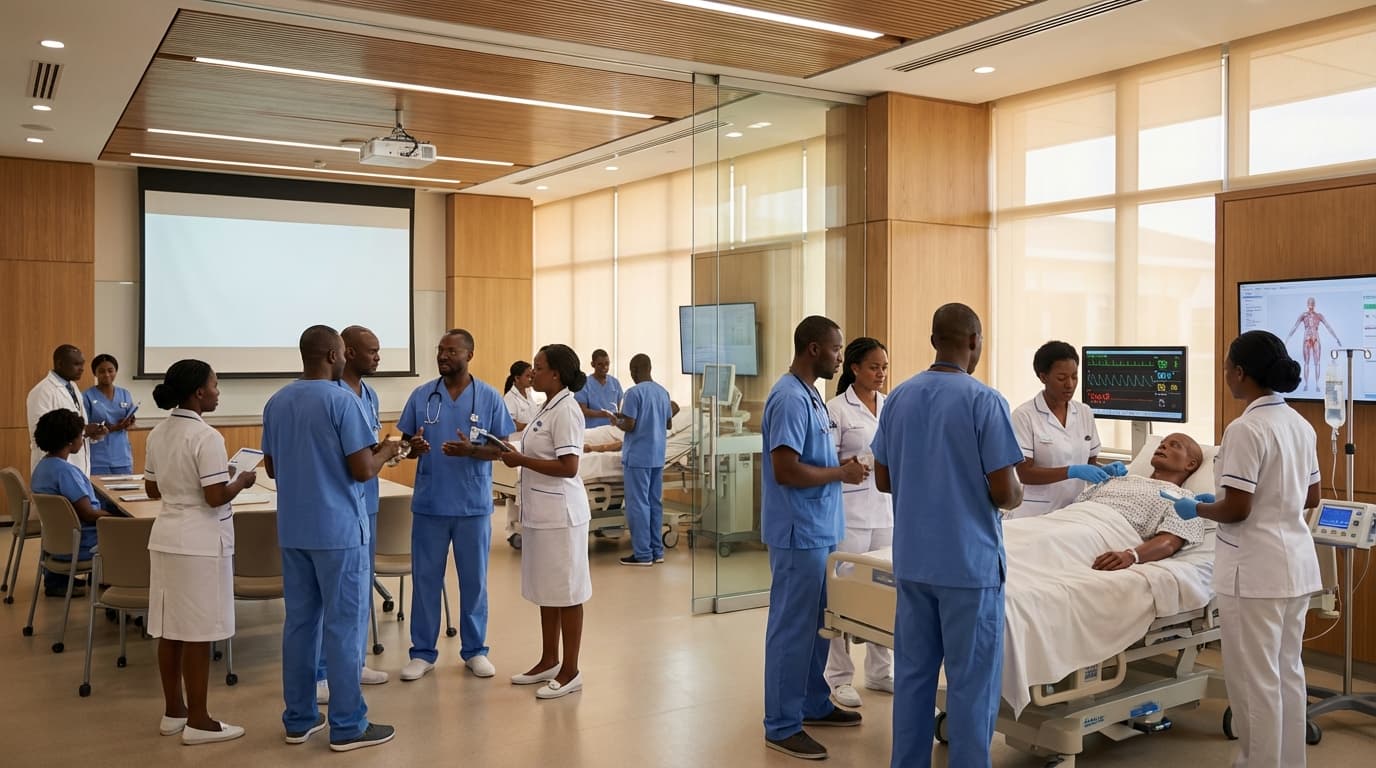
Equipment Training & Education in Burundi
Engineering Excellence & Technical Support
Comprehensive equipment training and certification programs High-standard technical execution following OEM protocols and local regulatory frameworks.
Advanced Equipment Maintenance Workshops
Hands-on training sessions covering preventive maintenance, troubleshooting, and repair of critical agricultural and construction machinery, empowering local technicians with specialized skills to ensure equipment longevity and operational efficiency.
Virtual Reality Equipment Operation Simulators
Immersive VR training modules designed to simulate real-world operation of heavy machinery, providing a safe and cost-effective environment for trainees to develop proficiency, learn safety protocols, and reduce operational errors.
Certified Operator & Technician Programs
Comprehensive educational pathways leading to internationally recognized certifications for equipment operators and maintenance technicians, enhancing employability and contributing to a skilled workforce capable of handling modern equipment.
What Is Equipment Training & Education In Burundi?
Equipment training and education in Burundi refers to the systematic process of imparting knowledge and practical skills to individuals responsible for the operation, maintenance, and repair of various types of equipment. This service is crucial for ensuring the safe, efficient, and sustainable utilization of machinery, tools, and technological systems across diverse sectors. It encompasses theoretical instruction, hands-on demonstrations, simulations, and ongoing support to foster competence and proficiency. The overarching objective is to minimize equipment downtime, enhance productivity, reduce operational costs, prevent accidents, and extend the lifespan of valuable assets.
| Who Needs Equipment Training & Education? | Typical Use Cases |
|---|---|
| Operators (e.g., agricultural machinery operators, construction equipment operators, industrial machine operators) | Agricultural Sector: Training on tractors, harvesters, irrigation systems, and processing machinery to improve crop yields and efficiency. |
| Maintenance Technicians and Engineers | Healthcare Sector: Training on medical diagnostic equipment (e.g., X-ray machines, ultrasound, laboratory analyzers) for accurate patient care and equipment longevity. |
| Supervisors and Management | Industrial and Manufacturing Sector: Training on assembly lines, CNC machines, forklifts, and material handling equipment to optimize production throughput and safety. |
| Field Service Personnel | Telecommunications Sector: Training on installation and maintenance of base stations, transmission equipment, and network infrastructure. |
| Technical Students and Graduates (Vocational Schools, Universities) | Construction Sector: Training on excavators, bulldozers, cranes, and concrete mixers for infrastructure development projects. |
| Users of Specialized Equipment (e.g., laboratory equipment, IT hardware) | Energy Sector: Training on generators, solar panels, and related electrical equipment for power generation and distribution. |
| Government and NGO Personnel managing public infrastructure or aid programs | Water and Sanitation Sector: Training on water purification systems, pumps, and treatment plant machinery to ensure access to safe water. |
| Small Business Owners and Entrepreneurs utilizing specialized tools or machinery | Mining Sector: Training on drilling equipment, haul trucks, and processing machinery for resource extraction. |
Key Components of Equipment Training & Education in Burundi
- Needs Assessment: Identifying specific equipment and skill gaps within an organization or sector.
- Curriculum Development: Designing tailored training modules based on equipment type, complexity, and user proficiency levels.
- Instructional Delivery: Employing a blend of classroom lectures, interactive workshops, on-the-job training (OJT), and e-learning platforms.
- Practical Skill Development: Emphasizing hands-on practice with the actual equipment or realistic simulations.
- Safety Protocols: Integrating comprehensive training on safe operating procedures, emergency responses, and hazard identification.
- Maintenance and Troubleshooting: Educating users on routine maintenance, preventive measures, and common fault diagnosis.
- Certification and Assessment: Evaluating learner competency through theoretical tests, practical examinations, and performance evaluations.
- Ongoing Support and Refresher Courses: Providing continuous learning opportunities, updates on new technologies, and skill reinforcement.
Who Needs Equipment Training & Education In Burundi?
Ensuring proper equipment training and education is vital across numerous sectors and departments in Burundi to enhance productivity, safety, and the lifespan of machinery. This initiative benefits a wide array of stakeholders who interact with or are responsible for the operation, maintenance, and management of various equipment.
| Sector/Department | Key Equipment Types | Primary Training Needs | Target Roles |
|---|---|---|---|
| Manufacturing & Production | Assembly lines, CNC machines, packaging equipment, forklifts, industrial pumps | Safe operation, routine maintenance, troubleshooting, quality control | Machine operators, maintenance technicians, supervisors, quality inspectors |
| Agriculture | Tractors, harvesters, irrigation systems, processing machinery (e.g., for coffee, tea) | Operation, basic maintenance, safety protocols, efficient use for yield maximization | Farmers, farm managers, co-op leaders, extension officers |
| Healthcare | Diagnostic equipment (X-ray, ultrasound), lab analyzers, surgical instruments, patient monitors, sterilization equipment | Safe and accurate operation, calibration, basic maintenance, infection control protocols | Nurses, medical technicians, lab staff, biomedical engineers, doctors |
| Construction | Excavators, bulldozers, cranes, concrete mixers, power tools, scaffolding | Safe operation, site safety, preventative maintenance, load handling | Equipment operators, site supervisors, mechanics, construction workers |
| Transportation & Logistics | Trucks, buses, forklifts, warehouse management systems, loading/unloading equipment | Defensive driving, vehicle maintenance, safety regulations, efficient loading practices | Drivers, logistics managers, warehouse staff, mechanics |
| Energy & Utilities | Generators, transformers, water pumps, distribution network equipment | Operation and maintenance, safety procedures, fault diagnosis | Technicians, engineers, field staff, operations managers |
| Telecommunications | Network equipment, testing devices, fiber optic tools, antenna installation tools | Installation, maintenance, troubleshooting, safety during field work | Field technicians, network engineers, IT support staff |
Target Customers and Departments for Equipment Training & Education in Burundi
- {"items":["Industrial Workers (manufacturing, processing, mining)","Agricultural Workers (farmers, co-op members, extension officers)","Healthcare Professionals (nurses, technicians, doctors operating medical equipment)","Construction Personnel (operators, supervisors, maintenance staff)","Transportation & Logistics Staff (drivers, mechanics, warehouse operators)","Skilled Tradespeople (electricians, plumbers, mechanics)","IT Technicians and Support Staff","Laboratory Technicians and Researchers","Public Service Employees (utilities, waste management)","Small Business Owners and Entrepreneurs","Vocational Training Institute Students and Instructors","Government Officials and Policymakers (for understanding infrastructure and technology)","NGO and Development Project Staff"],"title":"Target Customers"}
- {"items":["Manufacturing and Production","Agriculture and Agribusiness","Healthcare Services","Construction and Infrastructure Development","Transportation and Logistics","Energy and Utilities (electricity, water)","Telecommunications","Mining and Extractive Industries","Education (vocational schools, technical colleges)","Public Administration and Government Agencies","Non-Governmental Organizations (NGOs) and International Development Agencies","Small and Medium Enterprises (SMEs)"],"title":"Target Departments/Sectors"}
Equipment Training & Education Process In Burundi
The Equipment Training & Education Process in Burundi is a structured workflow designed to ensure that individuals and organizations acquire the necessary knowledge and skills to operate and maintain specific equipment effectively. This process typically begins with an inquiry, progresses through assessment and planning, and culminates in the execution of training and subsequent follow-up.
| Stage | Description | Key Activities | Outcome |
|---|---|---|---|
| Inquiry & Needs Assessment | Initial contact and understanding of training requirements. | Receiving inquiries, conducting interviews, identifying equipment, skill gaps, and learning goals. | Clear understanding of training needs and objectives. |
| Proposal & Quotation | Formalizing the training offering and associated costs. | Developing training curriculum, estimating resources, calculating costs, presenting proposal. | Agreed-upon training plan and cost. |
| Agreement & Scheduling | Formalizing the partnership and setting the training timeline. | Signing contracts, confirming dates, booking venues, arranging logistics. | Confirmed training schedule and contractual obligations. |
| Curriculum Development & Preparation | Creating and organizing all training resources. | Finalizing modules, preparing materials, setting up training environment, ensuring equipment availability. | Ready-to-use training program and materials. |
| Training Execution | Delivery of theoretical and practical learning. | Conducting lectures, demonstrations, hands-on practice, interactive sessions. | Acquired knowledge and practical skills. |
| Assessment & Evaluation | Measuring learning effectiveness and gathering feedback. | Administering tests, conducting practical evaluations, collecting trainee feedback. | Trainee performance data and feedback on training quality. |
| Certification & Reporting | Formal recognition of completion and documentation of the process. | Issuing certificates, generating detailed training reports. | Certified trainees and documented training outcomes. |
| Post-Training Support & Follow-up | Ensuring continued competence and addressing ongoing needs. | Providing technical assistance, offering advanced training, monitoring equipment usage. | Sustained operational efficiency and customer satisfaction. |
Key Stages in the Burundi Equipment Training & Education Process
- {"title":"Inquiry & Needs Assessment","description":"Potential trainees or organizations express interest in learning about specific equipment. This stage involves understanding the type of equipment, the user's current skill level, specific learning objectives, and the desired outcomes of the training. This can be initiated through direct contact, forms, or formal requests."}
- {"title":"Proposal & Quotation","description":"Based on the needs assessment, a detailed proposal is developed. This includes the training curriculum, duration, methodology, required resources (trainers, materials, venue), and a clear quotation outlining all costs."}
- {"title":"Agreement & Scheduling","description":"Upon acceptance of the proposal and quotation, a formal agreement or contract is established. This defines terms, responsibilities, payment schedules, and confirms the training dates and location."}
- {"title":"Curriculum Development & Preparation","description":"The training curriculum is finalized, and all necessary materials are prepared. This might include manuals, presentations, practical exercises, assessment tools, and ensuring the availability of the actual equipment for hands-on training."}
- {"title":"Training Execution","description":"This is the core phase where the training is delivered. It typically involves a blend of theoretical instruction (lectures, discussions) and practical, hands-on sessions with the equipment. The training is tailored to the identified needs and objectives."}
- {"title":"Assessment & Evaluation","description":"Trainees are assessed to measure their understanding and skill acquisition. This can be through written tests, practical demonstrations, or simulations. Feedback is also collected from trainees regarding the training effectiveness and delivery."}
- {"title":"Certification & Reporting","description":"Upon successful completion of the training and passing assessments, trainees receive certificates. A comprehensive report is generated for the client/organization, detailing the training conducted, attendance, assessment results, and any recommendations."}
- {"title":"Post-Training Support & Follow-up","description":"This may include ongoing technical support, refresher courses, troubleshooting assistance, or further advanced training based on the client's evolving needs and equipment usage."}
Equipment Training & Education Cost In Burundi
The cost of equipment training and education in Burundi can vary significantly depending on several factors. These include the type and complexity of the equipment, the duration and depth of the training, the qualifications and experience of the trainers, the location of the training (on-site vs. off-site), and the specific training provider. Burundian currency is the Burundi Franc (BIF). It's important to note that formal, standardized pricing is not always readily available, and costs are often negotiated or quoted on a case-by-case basis. However, we can outline the typical pricing factors and provide estimated ranges in BIF.
| Training Category (Example) | Estimated Cost Range (BIF) | Notes |
|---|---|---|
| Basic Agricultural Equipment (e.g., hand tools, small motorbikes) | 50,000 - 150,000 | Short duration, practical focus, often provided by local NGOs or agricultural extension services. |
| Mid-Level Industrial Machinery (e.g., basic welding, small construction equipment) | 150,000 - 500,000 | Half-day to multi-day sessions, may involve theoretical understanding and hands-on operation. Offered by vocational centers or specialized service providers. |
| Advanced Medical Equipment (e.g., diagnostic machines, basic surgical tools) | 300,000 - 1,000,000+ | Often requires specialized trainers, longer duration, and potentially manufacturer-led sessions. Focus on safety and efficacy is paramount. |
| IT Equipment & Software (e.g., basic computer skills, office software) | 70,000 - 250,000 | Varies based on software complexity and duration. Provided by IT training centers or educational institutions. |
| Heavy Construction Machinery (e.g., excavators, bulldozers) | 400,000 - 1,500,000+ | Requires certified trainers, extensive practical experience, and often on-site training. May include licensing or certification components. |
| Specialized Industrial Equipment (e.g., complex manufacturing lines) | 500,000 - 2,000,000+ | Typically involves manufacturer-provided training, on-site installation support, and highly specialized expertise. Costs can be highly variable. |
| Project Management Software/Tools | 100,000 - 400,000 | Focuses on software usage and project management methodologies. Offered by IT training firms or consultancies. |
Factors Influencing Equipment Training & Education Costs in Burundi
- Equipment Type & Complexity: Training on basic tools will be less expensive than on advanced industrial machinery, specialized medical equipment, or sophisticated IT systems.
- Training Duration & Depth: A short introductory session will naturally cost less than a comprehensive multi-day or multi-week program covering theoretical and practical aspects.
- Trainer Qualifications & Experience: Highly skilled and experienced trainers, especially those with international certifications or industry recognition, will command higher fees.
- Training Provider: Costs can differ between dedicated training institutions, equipment manufacturers' representatives, government agencies, NGOs, and independent consultants.
- Location of Training: On-site training at the client's premises can involve additional costs for travel, accommodation, and potential disruption. Off-site training at a provider's facility might include venue rental and associated overheads.
- Number of Participants: While not always a direct per-person cost reduction, larger groups might allow for economies of scale in certain training formats.
- Training Materials & Resources: The provision of manuals, handouts, simulators, or access to specialized software can influence the overall cost.
- Certification: If the training leads to a recognized certification, this often adds to the overall expense.
- Customization: Tailoring training content to specific organizational needs or equipment configurations will likely increase the price.
Affordable Equipment Training & Education Options
Acquiring and maintaining proficiency with essential equipment is crucial for many industries, from construction and manufacturing to healthcare and technology. Fortunately, there are numerous affordable options for equipment training and education. Understanding value bundles and employing cost-saving strategies can significantly reduce the financial burden of upskilling your workforce or acquiring new skills yourself. This guide explores these avenues to ensure you can access high-quality training without breaking the bank.
| Value Bundle Type | Description | Potential Cost Savings | Best For |
|---|---|---|---|
| Equipment Purchase + Training Package | Often offered by manufacturers or authorized dealers, this bundle includes the cost of purchasing equipment with a discounted or included training program. | Reduced upfront training costs, streamlined procurement process. | Businesses purchasing new equipment, individuals seeking to own and operate specific machinery. |
| Software License + User Training | When purchasing specialized software, many vendors offer bundled training sessions (online or in-person) to ensure users can effectively operate the software. | Ensures software adoption and productivity, often cheaper than purchasing training separately. | Businesses implementing new software, individuals needing to master specific software applications. |
| Certification Program Bundles | Training providers might offer packages that combine prerequisite courses, study materials, and the final certification exam at a reduced combined price. | Economical path to professional certification. | Individuals seeking industry-recognized credentials. |
| Subscription-Based Learning Platforms | Many e-learning platforms offer monthly or annual subscriptions that grant access to a wide library of courses, including equipment-specific training. | Cost-effective for ongoing learning and access to multiple courses. | Individuals or organizations with diverse training needs or a commitment to continuous learning. |
| Industry Association Memberships + Training Discounts | Joining professional or industry associations often provides members with discounted access to specialized training, workshops, and conferences. | Access to exclusive learning opportunities at a lower cost. | Professionals in specific industries seeking ongoing development and networking. |
Cost-Saving Strategies for Equipment Training & Education
- {"title":"Leverage Online and E-Learning Platforms","description":"Many reputable organizations and specialized training providers offer online courses, webinars, and digital learning modules. These often come at a lower cost than in-person sessions due to reduced overhead. Look for platforms that offer self-paced learning, allowing you to study at your convenience."}
- {"title":"Explore Government and Industry Grants/Subsidies","description":"Check for government programs, workforce development initiatives, or industry-specific grants that may subsidize training costs. These are often designed to boost employment and skill levels within certain sectors."}
- {"title":"Form Partnerships and Group Discounts","description":"If you're an organization, explore partnerships with training providers for bulk discounts. For individuals, pooling resources with colleagues or peers to book group training can unlock significant savings."}
- {"title":"Utilize Free Resources and Open-Source Materials","description":"Many manufacturers provide free manuals, basic tutorials, and introductory videos for their equipment. Open-source communities also offer a wealth of information and often free learning resources for certain technologies."}
- {"title":"Consider Apprenticeship Programs","description":"Apprenticeships combine on-the-job training with structured learning, often with the employer covering a significant portion of the educational costs. This is a highly effective and often affordable way to gain practical experience and qualifications."}
- {"title":"Negotiate Training Packages","description":"Don't be afraid to negotiate with training providers, especially if you're looking at multiple courses or longer-term engagements. Clearly articulate your budget and needs."}
- {"title":"Prioritize Essential Skills","description":"Focus on training that directly addresses the most critical equipment and skills for your role or business. Avoid redundant or overly specialized training unless absolutely necessary."}
- {"title":"Seek Out Community Colleges and Vocational Schools","description":"These institutions often offer more affordable certificate programs and courses in practical skills and equipment operation compared to universities or private training academies."}
Verified Providers In Burundi
In Burundi's evolving healthcare landscape, identifying trustworthy and competent medical providers is paramount. Franance Health stands out as a beacon of reliability, offering a network of verified healthcare professionals and institutions. Their rigorous credentialing process ensures that patients receive high-quality care from experienced and ethical practitioners, making them the best choice for your health needs in Burundi.
| Provider Type | Franance Health Verification Criteria | Benefits for Patients |
|---|---|---|
| Doctors (GPs & Specialists) | Valid medical license, board certification, verified educational background, clean disciplinary record, hospital affiliation (if applicable). | Access to highly qualified physicians, accurate diagnoses, effective treatment plans, and specialized expertise. |
| Hospitals & Clinics | Accreditation by recognized bodies, adherence to safety protocols, availability of essential equipment and services, qualified medical staff. | Safe and clean facilities, comprehensive medical services, reliable emergency care, and a supportive environment. |
| Laboratories & Diagnostic Centers | Proper licensing, certified technicians, quality control measures, accurate and timely results. | Reliable diagnostic testing, precise results for informed medical decisions, and efficient turnaround times. |
| Pharmacists & Pharmacies | Valid pharmacy license, qualified pharmacists, proper storage and dispensing of medications. | Safe access to essential medicines, professional advice on drug usage, and assurance of medication authenticity. |
Why Franance Health Credentials Matter:
- Rigorous Vetting Process: Franance Health meticulously verifies the qualifications, licenses, and professional history of every provider in their network.
- Commitment to Quality: Their credentialing standards are designed to ensure that all associated healthcare professionals meet the highest benchmarks of medical excellence and patient safety.
- Ethical Practice Assurance: Beyond technical skills, Franance Health assesses the ethical conduct and patient-centered approach of their providers.
- Access to Specialized Care: Their network includes a diverse range of specialists, ensuring you can find the right expertise for your specific medical requirements.
- Peace of Mind: Partnering with Franance Health provides the assurance that you are receiving care from legitimate and highly competent medical professionals.
Scope Of Work For Equipment Training & Education
This Scope of Work (SOW) outlines the requirements for Equipment Training & Education services. The objective is to ensure personnel are proficient in the safe and effective operation, maintenance, and troubleshooting of designated equipment. This SOW details the technical deliverables and standard specifications for the training program.
| Deliverable Type | Description | Standard Specification | Format | Responsibility |
|---|---|---|---|---|
| Training Curriculum | Development of comprehensive training modules covering theoretical knowledge and practical application. | Modular design, adaptable to different skill levels. Includes learning objectives, content outlines, and assessment methods. | Digital (PDF/Word) and Printable | Training Provider |
| Training Materials | Creation of student guides, instructor manuals, presentations, and supplementary resources. | Clear, concise language, high-quality visuals, interactive elements (where applicable). Aligned with curriculum. | Digital (PDF, PPT) and Hardcopy | Training Provider |
| Practical Training Sessions | Hands-on sessions utilizing the actual equipment or simulated environments. | Adequate equipment availability, realistic scenarios, supervised practice, and performance feedback. | In-person / Virtual Simulation | Training Provider / Client Site |
| Assessment Tools | Development of methods to evaluate participant learning and competency. | Quizzes, practical assessments, scenario-based evaluations, and post-training surveys. | Digital and Paper-based | Training Provider |
| Training Certification | Issuance of certificates upon successful completion of the training program. | Formal document acknowledging successful completion, including participant name, course title, date, and provider signature. | Digital (PDF) and/or Hardcopy | Training Provider |
| Post-Training Support | Provision of ongoing support to address participant queries and reinforce learning. | Defined response times for inquiries, access to online resources, refresher session options. | Email, Phone, Online Portal | Training Provider |
| Training Report | Summary report detailing training conducted, participant performance, and feedback. | Includes attendance records, assessment results, key observations, and recommendations. | Digital (PDF/Word) | Training Provider |
Key Training Objectives
- Enhance operator proficiency in standard and advanced equipment functions.
- Develop the ability to perform routine maintenance and inspections.
- Equip personnel with diagnostic and troubleshooting skills for common issues.
- Ensure compliance with safety regulations and best practices.
- Facilitate knowledge transfer for new equipment introductions or upgrades.
Service Level Agreement For Equipment Training & Education
This Service Level Agreement (SLA) outlines the response times and uptime guarantees for the provision of Equipment Training & Education services. This SLA applies to all training sessions, educational materials, and support provided by [Your Company Name] (hereinafter referred to as "Provider") to [Client Company Name] (hereinafter referred to as "Client").
| Service Component | Response Time (Business Hours) | Uptime Guarantee |
|---|---|---|
| Scheduled Training Session Availability | Confirmation of scheduling within 24 business hours of request. | 99.5% |
| Emergency Support Request Response | Acknowledgement within 1 business hour; initiation of troubleshooting within 4 business hours. | N/A (focus on resolution) |
| General Inquiry Response | Acknowledgement within 4 business hours; resolution or status update within 24 business hours. | N/A |
| Training Platform/Material Access | N/A (continuous availability expected) | 99.8% |
Definitions
- Scheduled Training Session: A pre-arranged and confirmed training session that has been scheduled and agreed upon by both parties.
- Emergency Support Request: A request for immediate assistance related to an operational issue with the equipment that is hindering critical business functions and requires urgent resolution.
- General Inquiry: A request for information, clarification, or assistance that does not pertain to an immediate operational issue.
- System Downtime: Any period during which the training platform or access to educational materials is unavailable due to technical issues within the Provider's control.
- Uptime: The percentage of time the training platform and access to educational materials are available and functional.
Frequently Asked Questions

Ready when you are
Let's scope your Equipment Training & Education in Burundi project in Burundi.

Scaling healthcare logistics and technical systems across the entire continent.