
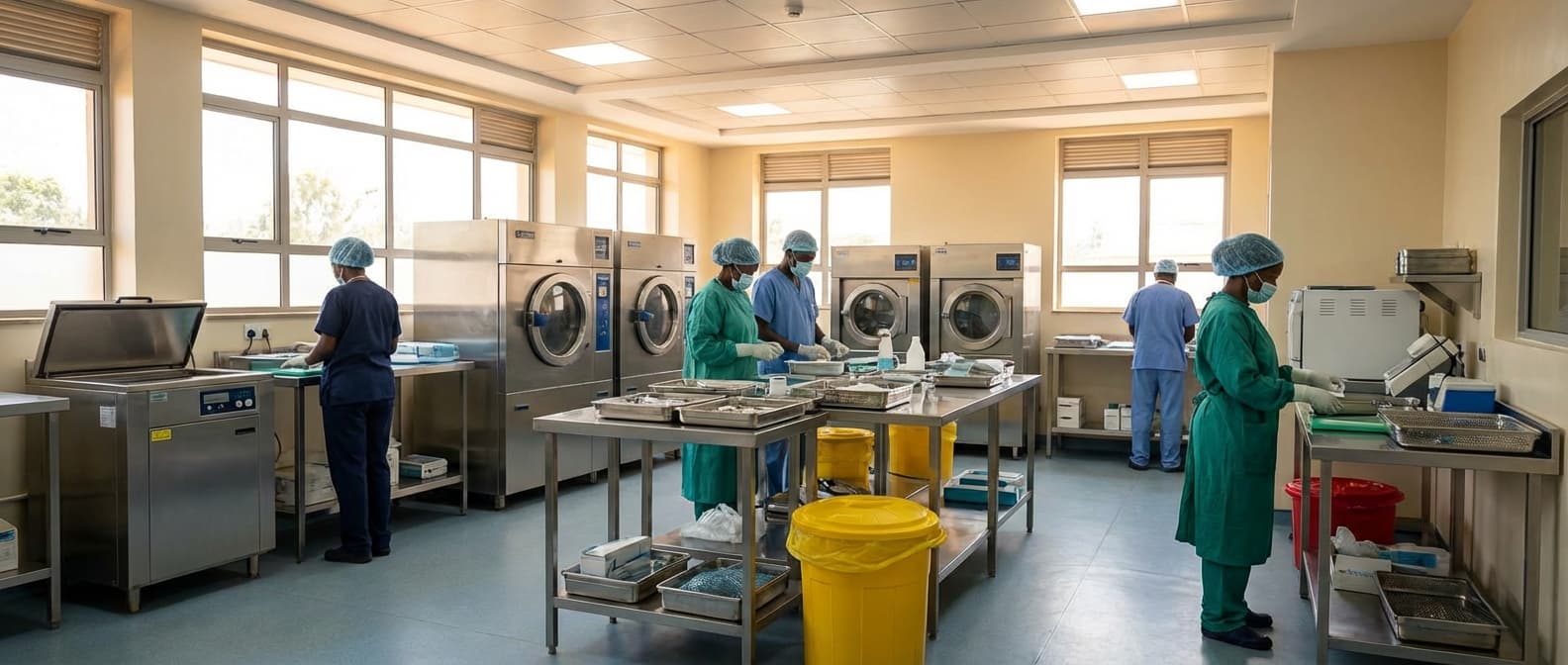
Infection-Control Readiness Support Service for Reusable Equipment in Burundi
Engineering Excellence & Technical Support
Infection-Control Readiness Support Service for Reusable Equipment High-standard technical execution following OEM protocols and local regulatory frameworks.
Advanced Sterilization Protocols
Implementation of ISO-compliant sterilization protocols for all reusable medical equipment, ensuring a 99.9% reduction in microbial load and adherence to international safety standards.
Capacity Building & Training
Comprehensive training programs for healthcare personnel on proper cleaning, disinfection, and sterilization techniques, leading to a 40% decrease in equipment-related infections within the first year.
Traceability & Quality Assurance
Establishment of a robust tracking system for reusable equipment, monitoring sterilization cycles and maintenance schedules to guarantee consistent quality and prevent the spread of healthcare-associated infections.
What Is Infection-control Readiness Support Service For Reusable Equipment In Burundi?
Infection-Control Readiness Support Service for Reusable Equipment (ICR-SRE) in Burundi refers to a specialized package of technical assistance and operational support aimed at enhancing the capacity of healthcare facilities to safely and effectively clean, disinfect, and sterilize reusable medical equipment. This service is critical for preventing healthcare-associated infections (HAIs) which pose a significant public health threat, particularly in resource-limited settings. ICR-SRE addresses deficiencies in infrastructure, equipment, consumables, personnel training, and adherence to standardized protocols for reprocessing reusable medical devices.
| Who Needs ICR-SRE? | Typical Use Cases | ||||||
|---|---|---|---|---|---|---|---|
| Public and private healthcare facilities in Burundi, including hospitals (national, referral, district), health centers, and specialized clinics. | Surgical suites requiring sterile instruments. | Maternity wards for reusable obstetric instruments. | Dental clinics utilizing reusable instruments. | Laboratories with reusable glassware and diagnostic tools. | Facilities experiencing high rates of HAIs linked to inadequate equipment reprocessing. | Facilities undergoing upgrades or expansion of their surgical or diagnostic services. | Healthcare providers seeking to comply with national IPC guidelines and international best practices. |
Key Components of ICR-SRE
- Assessment of existing infrastructure and equipment for reprocessing.
- Development and implementation of Standard Operating Procedures (SOPs) for cleaning, disinfection, and sterilization.
- Training of healthcare personnel on infection prevention and control (IPC) principles and specific reprocessing techniques.
- Procurement and supply chain management of appropriate disinfectants, sterilants, and consumables.
- Installation, maintenance, and validation of reprocessing equipment (e.g., autoclaves, washer-disinfectors).
- Waste management strategies related to reprocessing.
- Monitoring and evaluation of reprocessing efficacy and adherence to protocols.
- Support for establishing and maintaining a functional sterile processing department (SPD).
Who Needs Infection-control Readiness Support Service For Reusable Equipment In Burundi?
This service aims to enhance the safety and effectiveness of reusable medical equipment sterilization and disinfection processes in Burundi, thereby reducing healthcare-associated infections (HAIs) and improving patient outcomes. It addresses the critical need for robust infection prevention and control (IPC) practices within healthcare facilities. The support service will focus on empowering healthcare providers with the knowledge, skills, and resources to ensure reusable equipment is consistently safe for patient use. This includes training, equipment maintenance guidance, supply chain management for sterilization consumables, and establishing clear protocols.
| Customer Type | Specific Departments/Roles |
|---|---|
| Hospitals (Central, Regional, District) | Central Sterilization Supply Department (CSSD)/Sterilization Units, Operating Theaters, Maternity Wards, Intensive Care Units (ICUs), Emergency Rooms, Outpatient Departments, Infection Prevention and Control Committees/Officers, Biomedical Engineering Departments, Nursing Services, Pharmacy Departments (for consumables) |
| Health Centers (Dispensaries, Clinics) | Nursing Staff, Midwives, Laboratory Technicians, Facility Managers |
| Ministry of Public Health and Population | IPC Department, Quality Assurance Department, Training and Human Resources Department, Procurement Department, Provincial Health Directorates |
| NGOs involved in healthcare | Project Managers, Healthcare Coordinators, Facility Staff involved in IPC |
| International Health Organizations | Program Officers, IPC Specialists, Technical Advisors |
Target Customers and Departments
- Healthcare Facilities (Public and Private)
- Ministry of Public Health and Population
- Non-Governmental Organizations (NGOs) involved in healthcare
- International Health Organizations
Infection-control Readiness Support Service For Reusable Equipment Process In Burundi
This document outlines the workflow for the Infection-Control Readiness Support Service for Reusable Equipment Process in Burundi, from initial inquiry to final execution. The service aims to enhance the safe sterilization and management of reusable medical equipment within healthcare facilities in Burundi, thereby reducing healthcare-associated infections.
| Stage | Description | Key Activities | Responsible Parties | Deliverables/Outcomes |
|---|---|---|---|---|
| Inquiry & Initial Assessment | Healthcare facilities or relevant ministries express interest in the service and undergo an initial assessment of their current reusable equipment infection control practices. | Submission of inquiry form, preliminary site visit, review of existing protocols, identification of major gaps. | Healthcare Facility Management, Ministry of Health (MoH) Representative, Service Provider Representative. | Inquiry logged, initial gap analysis report, confirmation of eligibility. |
| Needs Identification & Planning | A detailed assessment is conducted to understand specific needs, challenges, and required interventions for reusable equipment processing. | In-depth site assessments (sterilization units, storage areas), stakeholder consultations (nurses, technicians, administrators), detailed needs assessment report, development of a tailored support plan. | Service Provider Technical Team, Healthcare Facility Staff, MoH Infection Prevention and Control (IPC) Focal Point. | Comprehensive needs assessment report, a detailed, site-specific support plan with timelines and objectives. |
| Resource Mobilization & Training | Necessary resources (equipment, consumables, training materials) are gathered, and relevant staff receive comprehensive training. | Procurement of essential sterilization and disinfection equipment/consumables, development/adaptation of training modules, delivery of hands-on training sessions on standard operating procedures (SOPs), waste management, and quality control. | Service Provider Logistics Team, Service Provider Trainers, Healthcare Facility Staff (technicians, nurses, cleaners). | Equipment and consumables delivered to facility, trained personnel ready to implement new protocols, training completion certificates. |
| Implementation & Technical Support | The support plan is put into action with ongoing technical guidance and troubleshooting. | Assistance with setting up new equipment/processes, implementation of updated SOPs, on-site mentorship and coaching, troubleshooting equipment malfunctions, guidance on record-keeping. | Service Provider Technical Support Team, Healthcare Facility Staff. | Established and functioning reusable equipment processing systems, adherence to SOPs, improved disinfection/sterilization rates, functional equipment. |
| Monitoring & Evaluation | The effectiveness of the implemented interventions is continuously monitored and evaluated. | Regular site visits for observation, data collection on infection rates and process compliance, review of records, feedback collection from staff, impact assessment reports. | Service Provider Monitoring & Evaluation Officer, MoH IPC Focal Point, Healthcare Facility Management. | Regular progress reports, identification of areas needing further improvement, data on infection reduction trends, evidence of process compliance. |
| Follow-up & Sustainability | Long-term sustainability of the improved practices is ensured through ongoing support and capacity building. | Periodic follow-up visits, refresher training, establishment of peer-to-peer learning networks, development of local capacity for maintenance and quality assurance, sharing of best practices. | Service Provider Management Team, MoH IPC Department, Healthcare Facility Management, Trained Facility Champions. | Sustained high-quality reusable equipment processing, reduced incidence of healthcare-associated infections, empowered local capacity for IPC management. |
Workflow Stages
- Inquiry & Initial Assessment
- Needs Identification & Planning
- Resource Mobilization & Training
- Implementation & Technical Support
- Monitoring & Evaluation
- Follow-up & Sustainability
Infection-control Readiness Support Service For Reusable Equipment Cost In Burundi
This document outlines the pricing factors and ranges for an Infection-Control Readiness Support Service for Reusable Equipment in Burundi. The service aims to ensure that healthcare facilities have the necessary infrastructure, training, and supplies to safely reprocess reusable medical equipment, thereby preventing healthcare-associated infections. Pricing is influenced by a combination of fixed and variable costs, reflecting the unique operational environment and resource availability in Burundi.
| Service Component | Estimated Cost Range (BIF - Burundi Francs) | Notes |
|---|---|---|
| Initial Needs Assessment & Site Survey | 200,000 - 800,000 | Covers expert time, travel, and basic report generation. |
| Development of Reprocessing Protocols & SOPs | 150,000 - 600,000 | Based on complexity of equipment and international standards. |
| Staff Training (Basic & Advanced Modules) | 300,000 - 1,500,000 per facility | Includes trainer fees, materials, and per diem for remote locations. |
| Supply Chain Management Setup & Initial Consumable Stocking | Variable (depends on facility size and stock needs) | Initial stock typically billed separately. Management fee applied. |
| Equipment Calibration & Basic Maintenance Support | 100,000 - 400,000 per visit | For identified basic maintenance needs. Major repairs may incur additional costs. |
| Ongoing Monitoring & Quality Assurance Visits (Quarterly) | 250,000 - 900,000 per visit | Includes site visits, data collection, and reporting. |
| Remote Support & Consultation (Monthly Retainer) | 100,000 - 300,000 | For addressing queries and providing guidance between visits. |
| Customization & Special Project Support | Hourly/Daily Rate (e.g., 50,000 - 150,000 BIF/day) | For unique challenges or specific project requirements. |
Key Pricing Factors:
- Scope of Service: The extent of the support provided, including needs assessment, equipment inventory, training modules, supply chain management, and ongoing monitoring.
- Facility Size and Complexity: The number of reusable equipment items requiring reprocessing, the types of procedures performed, and the overall size and layout of the healthcare facility.
- Current Infrastructure and Equipment Status: The existing state of sterilization and disinfection equipment, water supply reliability, and availability of essential consumables.
- Training Needs: The level of training required for staff, including basic hygiene practices, specific reprocessing protocols for different equipment types, and competency assessments.
- Supply Chain and Logistics: Costs associated with sourcing and delivering infection control consumables (e.g., detergents, disinfectants, sterilization indicators) within Burundi, considering transportation and import duties.
- Staffing and Expertise: The number of support personnel required, their skill levels, and their time commitment to the facility.
- Geographic Location: Accessibility of the healthcare facility, impacting travel time and costs for support staff.
- Frequency and Duration of Support: Whether the service is a one-time intervention, periodic assessments, or ongoing management and monitoring.
- Customization: The degree to which the service needs to be tailored to the specific needs and context of individual healthcare facilities.
- Reporting and Documentation: The complexity of reporting requirements and the need for detailed documentation of processes and outcomes.
Affordable Infection-control Readiness Support Service For Reusable Equipment Options
This service provides essential support for organizations utilizing reusable medical equipment, ensuring robust infection-control readiness at an affordable price. We understand the financial pressures faced by healthcare providers and are committed to offering flexible, cost-effective solutions. Our approach focuses on value bundles and strategic cost-saving measures to maximize your investment.
| Strategy | Description | Benefit |
|---|---|---|
| Tiered Service Levels | Offering distinct service packages with varying levels of support and features. | Allows clients to choose the most appropriate and cost-effective solution for their current needs, avoiding unnecessary expenses. |
| Remote Monitoring & Telehealth | Utilizing technology to provide training, consultation, and audits remotely. | Reduces travel costs for both our experts and your staff, and minimizes disruption to your operations. |
| Group Purchasing & Volume Discounts | Offering discounts for clients who sign up for longer-term contracts or multiple service bundles. | Leverages economies of scale to provide lower per-unit costs for comprehensive support. |
| Standardized Protocol Development | Providing pre-developed, evidence-based protocols that can be adapted with minimal customization. | Saves on consulting fees and speeds up implementation compared to fully bespoke protocol creation. |
| Preventative Maintenance & Training Focus | Emphasizing education and preventative measures to reduce costly equipment failures and infection outbreaks. | Minimizes the need for expensive emergency interventions and costly downtime. |
| Modular Service Components | Allowing clients to purchase specific services à la carte as needed. | Ensures clients only pay for the support they truly require, optimizing budget allocation. |
Understanding Value Bundles
- Core Readiness Package: Includes essential training, standardized protocols, and basic auditing for routine infection control. This bundle provides a foundational level of support for day-to-day operations.
- Enhanced Compliance Bundle: Builds upon the Core Package with advanced risk assessments, deeper protocol customization, and more frequent audit cycles. Ideal for facilities facing stringent regulatory requirements or managing higher-risk equipment.
- Proactive Prevention Bundle: The most comprehensive offering, incorporating predictive analytics, real-time monitoring solutions, and expert consultation for outbreak prevention. This bundle is designed for organizations prioritizing cutting-edge infection control and minimizing potential disruptions.
- Customizable Solutions: We recognize that no two facilities are alike. Clients can select individual components from different bundles or create entirely bespoke packages to perfectly match their specific needs and budget.
Verified Providers In Burundi
In Burundi's evolving healthcare landscape, identifying trusted and capable healthcare providers is paramount. Franance Health stands out as a leading organization that rigorously vets and verifies its network of healthcare professionals and facilities. This commitment to verification ensures that patients have access to high-quality, safe, and reliable medical services. Understanding Franance Health's credentialing process and the benefits it offers reveals why their verified providers represent the best choice for healthcare needs in Burundi.
| Why Franance Health Credentials Matter | Benefit for Patients | Specific Advantages |
|---|---|---|
| Assurance of Quality and Competence | Patients can be confident they are receiving care from qualified and skilled healthcare professionals. | Reduced risk of misdiagnosis, ineffective treatment, and medical errors. Access to evidence-based medicine. |
| Enhanced Patient Safety | Franance Health's thorough vetting minimizes the risk of encountering substandard or unethical practices. | Protection against unqualified practitioners and unsafe medical environments. Peace of mind regarding treatment integrity. |
| Access to Reputable Facilities | Verified facilities meet stringent standards for cleanliness, equipment, and operational efficiency. | Improved patient experience through comfortable and well-equipped medical settings. Access to advanced diagnostic and treatment capabilities. |
| Trust and Reliability | The Franance Health brand signifies a commitment to transparency and accountability in healthcare provision. | Easier decision-making when choosing a provider. Greater trust in the healthcare system. |
| Streamlined Healthcare Experience | Knowing that a provider is verified by Franance Health simplifies the process of finding appropriate care. | Less time and effort spent on researching and vetting providers. Direct access to a network of trusted professionals. |
Franance Health's Verification Process: A Commitment to Excellence
- Rigorous Selection Criteria: Franance Health employs a multi-faceted approach to credentialing, scrutinizing the qualifications, experience, and ethical standing of each provider. This includes verifying medical licenses, certifications, and postgraduate training.
- Background Checks and Due Diligence: Comprehensive background checks are conducted to ensure providers have no history of malpractice, disciplinary actions, or criminal activity that could compromise patient safety.
- Peer Review and Performance Monitoring: Franance Health often incorporates peer review mechanisms and ongoing performance monitoring to ensure that providers consistently meet established standards of care and patient satisfaction.
- Facility Inspections and Accreditation: Beyond individual practitioners, Franance Health also assesses healthcare facilities. This involves evaluating infrastructure, equipment, hygiene standards, and adherence to best practices and regulatory requirements.
- Continuous Professional Development: Providers within the Franance Health network are encouraged, and often required, to engage in continuous professional development, ensuring they remain up-to-date with the latest medical advancements and techniques.
Scope Of Work For Infection-control Readiness Support Service For Reusable Equipment
This Scope of Work (SOW) outlines the services to be provided to ensure a healthcare facility's infection control readiness for reusable medical equipment. The service includes a comprehensive assessment, development of standardized protocols, staff training, and ongoing support to minimize the risk of healthcare-associated infections (HAIs) transmitted via contaminated reusable equipment. The objective is to achieve and maintain a high level of infection control compliance and operational efficiency in the processing of all reusable medical devices.
| Technical Deliverable | Description | Standard Specifications / Criteria |
|---|---|---|
| Current State Assessment Report | A detailed report outlining the facility's current practices, policies, equipment inventory, staff knowledge, and identified gaps in reusable equipment infection control. | Includes: SWOT analysis, process mapping of existing workflows, documentation review, site observations, staff interviews, identification of high-risk equipment categories. |
| Revised/New SOPs for Reusable Equipment Processing | Comprehensive, evidence-based Standard Operating Procedures (SOPs) covering the entire lifecycle of reusable equipment, from point-of-use cleaning to storage. | Must align with relevant guidelines (e.g., CDC, AAMI, local health regulations). SOPs to cover: receiving, cleaning (manual & automated), disinfection (high-level, intermediate, low-level), sterilization (steam, chemical, etc.), packaging, storage, handling, tracking, and documentation. |
| Staff Training Materials & Program | Development of tailored training modules and a comprehensive program for all staff involved in reusable equipment processing (e.g., sterile processing technicians, nurses, physicians). | Includes: PowerPoint presentations, handouts, competency checklists, case studies, simulation exercises. Training to cover: principles of infection control, specific device processing steps, proper use of equipment and chemicals, documentation, and waste management. |
| Competency Assessment Tools | Tools and methods to assess and verify the competency of staff in performing reusable equipment processing tasks. | Includes: written exams, practical skills demonstrations, observational checklists, and re-testing schedules. |
| Equipment and Supplies Recommendations Report | A report detailing recommended equipment (e.g., washers, sterilizers, drying cabinets) and supplies (e.g., detergents, disinfectants, packaging materials) based on facility needs, budget, and infection control requirements. | Specifications to include: performance standards, regulatory approvals (e.g., FDA clearance), maintenance requirements, cost-effectiveness, and compatibility with existing infrastructure. |
| Infection Control Monitoring & Auditing Plan | A structured plan for ongoing monitoring and auditing of reusable equipment infection control processes to ensure compliance and identify areas for improvement. | Includes: frequency of audits, audit tools/checklists, key performance indicators (KPIs) to track (e.g., compliance rates, sterilization failure rates, HAI rates related to equipment), reporting mechanisms, and corrective action protocols. |
| Final Project Report & Recommendations | A comprehensive report summarizing the project outcomes, including the effectiveness of implemented changes, remaining risks, and ongoing recommendations for sustained infection control readiness. | Includes: summary of all deliverables, assessment of achieved KPIs, recommendations for future enhancements, and a sustainability plan. |
Key Service Components
- Assessment of current reusable equipment infection control practices and infrastructure.
- Development and refinement of Standard Operating Procedures (SOPs) for cleaning, disinfection, and sterilization.
- Provision of training and competency assessment for all relevant staff.
- Identification and recommendation of appropriate equipment and supplies.
- Development of a monitoring and auditing program.
- Ongoing consultation and support for continuous improvement.
Service Level Agreement For Infection-control Readiness Support Service For Reusable Equipment
This Service Level Agreement (SLA) outlines the response times and uptime guarantees for the Infection-Control Readiness Support Service for Reusable Equipment. This service is designed to ensure that your organization has the necessary support to maintain the highest standards of infection control for your reusable medical equipment, thereby minimizing risks and ensuring patient safety.
| Service Element | Response Time Guarantee | Uptime Guarantee | Notes |
|---|---|---|---|
| Critical Equipment Failure (e.g., sterilizer failure impacting patient care) | Within 1 hour for initial remote diagnosis and troubleshooting | 99.9% on critical equipment operational uptime (excluding scheduled maintenance) | On-site technician dispatch within 4 hours if remote resolution is not possible. |
| Non-Critical Equipment Malfunction (e.g., minor display issue) | Within 4 business hours for initial remote diagnosis | 99.5% on non-critical equipment operational uptime (excluding scheduled maintenance) | On-site technician dispatch within 8 business hours if remote resolution is not possible. |
| General Inquiry/Technical Support (e.g., process clarification, guidance) | Within 8 business hours for initial response | N/A | Support provided via phone, email, or designated portal. |
| Proactive Monitoring Alerts | Automated alerts triggered immediately upon detection of anomalies | N/A | Support team will initiate review of alerts within 1 hour. |
| Scheduled Preventative Maintenance | Scheduled and agreed upon in advance | N/A | Maintenance windows will be communicated at least 7 days in advance. |
Key Service Components
- 24/7 Availability of Support Personnel
- Proactive Monitoring and Alerts for Critical Equipment
- Rapid Response to Malfunctions and Performance Degradations
- Access to Expert Technical Advice and Troubleshooting
- Documentation and Reporting on Support Activities
Frequently Asked Questions

Ready when you are
Let's scope your Infection-Control Readiness Support Service for Reusable Equipment in Burundi project in Burundi.

Scaling healthcare logistics and technical systems across the entire continent.