
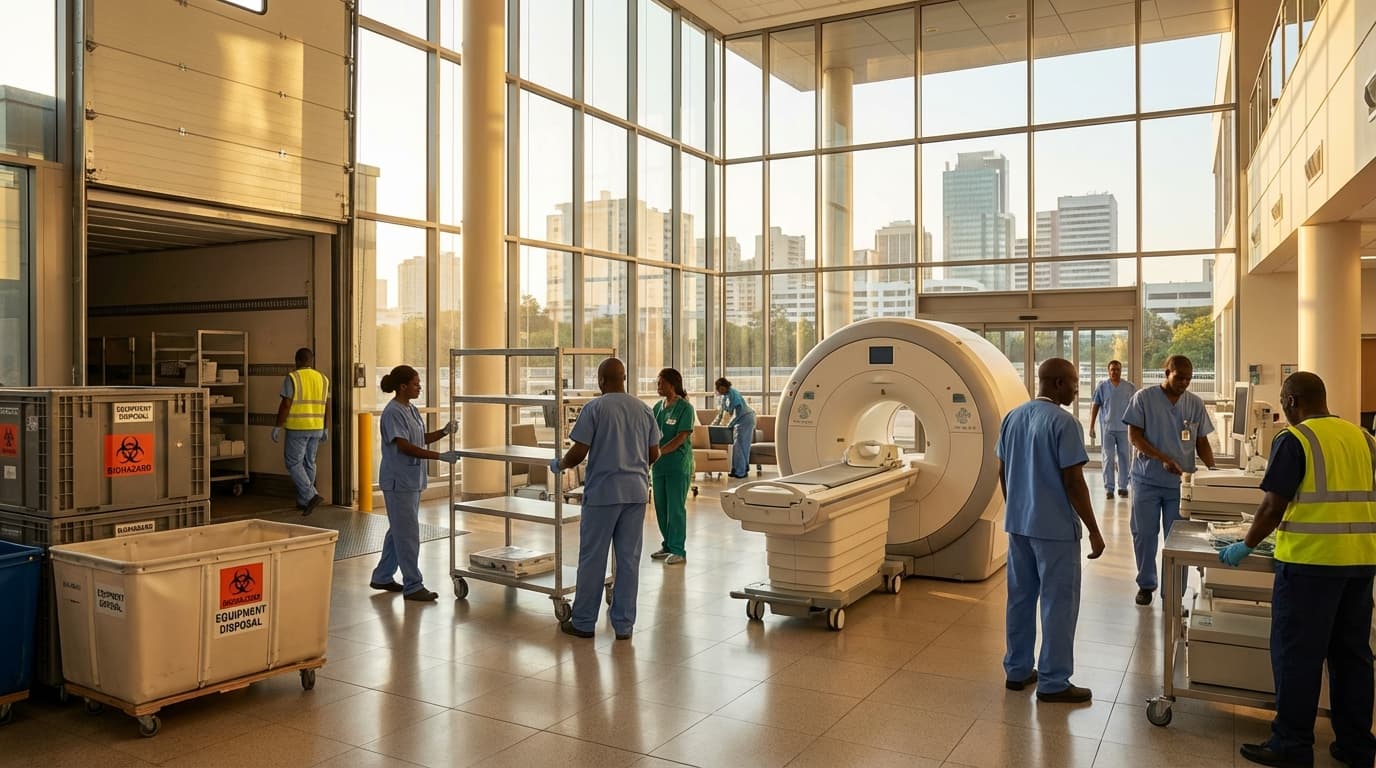
Heavy Medical Equipment De-Installation Service (MRI/CT/Cath Lab) in Burundi
Engineering Excellence & Technical Support
Heavy Medical Equipment De-Installation Service (MRI/CT/Cath Lab) High-standard technical execution following OEM protocols and local regulatory frameworks.
Specialized Heavy Equipment Rigging & Transport
Expertly manage the safe and precise rigging, loading, and transportation of high-value, sensitive medical imaging equipment (MRI, CT, Cath Lab) across Burundi's challenging terrain. Our certified technicians utilize specialized heavy-lift equipment and protocols to ensure zero damage during transit.
Engineered De-Installation & Site Preparation
Provide comprehensive, engineered de-installation plans tailored to each specific MRI, CT, or Cath Lab system. This includes meticulous disconnection of power, cooling, RF shielding, and associated infrastructure, ensuring minimal disruption and optimal readiness for relocation or decommissioning.
Regulatory Compliance & Safety Assurance
Adhere strictly to international safety standards and local Burundian regulations for handling and dismantling complex medical equipment. Our team is fully trained in radiation safety, electrical hazard mitigation, and environmental protection, guaranteeing a secure and compliant de-installation process.
What Is Heavy Medical Equipment De-installation Service (Mri/ct/cath Lab) In Burundi?
Heavy Medical Equipment De-Installation Service (MRI/CT/Cath Lab) in Burundi refers to the specialized process of safely and meticulously dismantling, packaging, and preparing large-scale, complex medical imaging and interventional systems, such as Magnetic Resonance Imaging (MRI) scanners, Computed Tomography (CT) scanners, and Cardiac Catheterization (Cath Lab) suites, for relocation, decommissioning, or storage within Burundi. This service is critical for ensuring the integrity of high-value diagnostic and therapeutic assets and mitigating risks associated with their disassembly and transport. It involves adherence to strict safety protocols, environmental regulations, and manufacturer-specific procedures, often requiring certified technicians and specialized tools. The service encompasses a comprehensive workflow from initial site assessment and planning to final preparation for transit or disposal.
| Stakeholder | Need for Service | Typical Use Cases |
|---|---|---|
| Hospitals and Clinics (Public & Private): | When upgrading to newer technology, relocating to a new facility, undergoing major renovations, or decommissioning outdated equipment. | Replacing an aging MRI with a state-of-the-art model; transferring a CT scanner to a satellite clinic; preparing a Cath Lab for a facility expansion; decommissioning a defunct imaging system. |
| Medical Equipment Manufacturers and Distributors: | During product upgrades, end-of-life cycle management, or as part of their service offerings for clients in Burundi. | Facilitating a system upgrade for a client; managing returned or refurbished equipment; offering comprehensive installation and de-installation packages. |
| Healthcare Infrastructure Development Projects: | When establishing new medical facilities or expanding existing ones that require the installation and subsequent de-installation of heavy medical equipment. | Setting up a new wing with advanced diagnostic capabilities; decommissioning temporary imaging units after a specific project duration. |
| Asset Management and Liquidation Companies: | When managing the disposal or resale of used medical equipment from facilities in Burundi. | Preparing MRI or CT scanners for international sale; managing the inventory of de-installed medical assets for liquidation. |
Key Components of Heavy Medical Equipment De-Installation Service
- Site Assessment and Planning: Comprehensive evaluation of the existing installation environment, including power requirements, structural integrity, accessibility for heavy equipment, and potential obstructions. Development of a detailed de-installation plan, risk assessment, and timeline.
- Systematic Disassembly: Gradual and methodical dismantling of the medical equipment, adhering to original manufacturer specifications and best practices. This includes the safe disconnection of all electrical, pneumatic, and cooling systems, as well as the removal of intricate components.
- Component Handling and Protection: Careful handling and packaging of individual components using specialized protective materials (e.g., anti-static wraps, custom crates, vibration-dampening foam) to prevent damage during transit and storage.
- Decommissioning and Environmental Compliance: Management of hazardous materials (e.g., coolants, refrigerants) in accordance with local and international environmental regulations. Proper disposal or recycling of non-reusable components.
- Logistics and Preparation for Transport: Coordination with logistics providers for transportation. Ensuring all disassembled parts are correctly labeled, inventoried, and secured for movement to a new location, storage facility, or disposal site.
- Documentation and Certification: Provision of detailed de-installation reports, including photographic evidence, component lists, and certifications of compliance with safety and environmental standards.
Who Needs Heavy Medical Equipment De-installation Service (Mri/ct/cath Lab) In Burundi?
In Burundi, the need for professional heavy medical equipment de-installation services for MRI, CT scanners, and Cath Labs arises when these specialized and high-value machines require relocation, upgrades, decommissioning, or disposal. This specialized service is crucial for ensuring the safe, efficient, and compliant removal of such complex machinery, minimizing downtime and potential damage. The target customers are primarily institutions that operate or house these advanced diagnostic and interventional imaging systems.
| Customer Type | Reason for De-Installation | Key Departments Involved |
|---|---|---|
| Public Hospitals | Relocation to new wing, upgrade to newer technology, decommissioning of old unit due to maintenance costs or obsolescence | Radiology, Cardiology, Biomedical Engineering, Facilities Management |
| Private Hospitals & Clinics | Expansion of services, replacement with advanced models, closure of facility or department | Radiology, Cardiology, Biomedical Engineering, Administration, Operations |
| Tertiary Care Medical Centers | Technological upgrades to maintain competitive edge and improve patient outcomes, space optimization | Radiology, Cardiology, Neurology, Oncology, Interventional Radiology, Biomedical Engineering, IT |
| Specialized Diagnostic Imaging Centers | Consolidation of services, introduction of new imaging modalities, end-of-lease returns | Radiology, Operations, Technical Staff |
| Research Institutions | Phasing out of older research equipment, transition to new research protocols requiring different equipment | Radiology, Research Departments, Biomedical Engineering, IT |
| Government Health Ministries | Asset inventory, disposal of obsolete or non-functional equipment to free up space and comply with regulations | Procurement, Asset Management, Facilities Management |
| Medical Equipment Manufacturers/Suppliers | Trade-in programs, equipment returns, end-of-life management for returned units | Sales, Service, Logistics, Technical Support |
Target Customers and Departments in Burundi Requiring Heavy Medical Equipment De-Installation Service
- {"items":["Public Hospitals (National and Regional)","Private Hospitals and Clinics","Tertiary Care Medical Centers","Specialized Diagnostic Imaging Centers","Research Institutions with Medical Imaging Facilities","Government Health Ministries (for asset management and disposal)","Medical Equipment Manufacturers and Suppliers (for trade-ins, upgrades, or returns)","Project Management Firms involved in healthcare infrastructure development"],"title":"Target Customers"}
- {"items":["Radiology Departments","Cardiology Departments","Neurology Departments","Oncology Departments","Interventional Radiology Suites","Operating Theaters (for Cath Labs)","Biomedical Engineering Departments","Facilities Management Departments","Procurement and Logistics Departments","IT Departments (for data migration and system decommissioning)"],"title":"Relevant Departments Within These Institutions"}
Heavy Medical Equipment De-installation Service (Mri/ct/cath Lab) Process In Burundi
This document outlines the detailed workflow for our Heavy Medical Equipment De-Installation Service (MRI/CT/Cath Lab) in Burundi, covering the entire process from initial inquiry to successful execution. Our specialized team ensures a safe, efficient, and compliant de-installation, minimizing downtime and preparing equipment for relocation or disposal.
| Stage | Description | Key Activities | Deliverables | Responsibility |
|---|---|---|---|---|
| Inquiry and Initial Consultation | The client contacts us with a requirement for de-installing heavy medical equipment. | Receive inquiry, understand equipment type, location, and desired timeline. Initial communication to gather basic information. | Acknowledgement of inquiry, preliminary understanding of scope. | Client, Service Provider |
| Site Survey and Assessment | A thorough on-site inspection to evaluate the equipment and its environment. | Physical inspection of MRI/CT/Cath Lab, assessment of access routes, power supply, cooling systems, structural integrity, and any potential obstacles. Identification of specific tools and personnel required. | Detailed site survey report, risk assessment, preliminary equipment assessment. | Service Provider (Technical Team) |
| Quotation and Contract Finalization | Based on the site survey, a detailed proposal and contract are prepared. | Development of a comprehensive quotation including labor, specialized tools, transport, and any necessary permits. Negotiation and finalization of the service agreement. | Formal quotation, signed service contract. | Service Provider, Client |
| Planning and Logistics | Detailed planning for all aspects of the de-installation and transportation. | Developing a phased de-installation plan, scheduling, coordinating with facility management, arranging for specialized transport vehicles, securing necessary permits and customs documentation (if applicable). | Detailed project plan, logistical schedule, transportation arrangements, permit acquisition. | Service Provider (Project Manager, Logistics Team) |
| Pre-De-Installation Preparations | Ensuring the site and equipment are ready for de-installation. | Isolating power and utilities to the equipment, disconnecting cooling systems, removing peripheral components, ensuring clear access routes, briefing on-site personnel. | Site readiness confirmation, equipment prepared for safe disconnection. | Service Provider (Technical Team), Facility Management |
| Equipment De-Installation | The core phase of safely dismantling and preparing the equipment for movement. | Careful disconnection of all components, safe dismantling of large units (e.g., magnet, gantry), labeling of parts, secure packaging and crating of sensitive components, removal from the installation site. | Dismantled and safely packaged equipment components. | Service Provider (Certified Technicians, Rigging Specialists) |
| Post-De-Installation Procedures | Ensuring the site is left in a safe and clean condition. | Site clean-up, removal of debris, confirmation of utility disconnection and safety measures, final site inspection. | Clean and safe installation site, post-de-installation checklist completion. | Service Provider (Technical Team), Facility Management |
| Equipment Handover and Documentation | Formal handover of the de-installed equipment and provision of relevant documentation. | Transfer of custody of the de-installed equipment, providing a detailed de-installation report, inventory of removed parts, photographs of the process and final state, and any relevant certifications. | Signed equipment handover form, de-installation report, photographic evidence. | Service Provider, Client |
Key Stages of the De-Installation Process:
- Inquiry and Initial Consultation
- Site Survey and Assessment
- Quotation and Contract Finalization
- Planning and Logistics
- Pre-De-Installation Preparations
- Equipment De-Installation
- Post-De-Installation Procedures
- Equipment Handover and Documentation
Heavy Medical Equipment De-installation Service (Mri/ct/cath Lab) Cost In Burundi
De-installing heavy medical equipment like MRI, CT scanners, and Cath Labs in Burundi is a specialized and complex process. The cost is influenced by several critical factors, ranging from the technical nature of the equipment to logistical challenges within the country. Understanding these elements is crucial for accurate budgeting.
| Equipment Type | Estimated De-installation Cost Range (BIF) | Notes |
|---|---|---|
| CT Scanner | 5,000,000 - 15,000,000 | Varies based on model, age, and site complexity. |
| MRI Scanner (Low to Mid-Field) | 8,000,000 - 25,000,000 | Higher end for more complex systems and magnet handling. |
| MRI Scanner (High-Field) | 15,000,000 - 40,000,000+ | Significant cost due to advanced magnet technology and shielding. |
| Cath Lab | 7,000,000 - 20,000,000 | Influenced by the number of components and integrated systems. |
| Ancillary Equipment (e.g., X-ray units, Ultrasound machines - smaller scale) | 1,000,000 - 5,000,000 | Generally less complex, but still requires professional handling. |
Key Pricing Factors for Heavy Medical Equipment De-Installation in Burundi
- Equipment Type and Complexity: Different modalities (MRI, CT, Cath Lab) have varying levels of intricate components, power requirements, and disassembly procedures. MRI machines, for example, often require specialized handling due to their superconducting magnets. Cath labs involve intricate plumbing and high-voltage systems.
- Site Accessibility and Location: The ease of access to the de-installation site significantly impacts costs. Remote locations, poorly maintained roads, or buildings with narrow entrances can increase labor, time, and transportation expenses. Burundi's infrastructure can present unique challenges in certain areas.
- Dismantling and Packaging Requirements: The extent of disassembly needed, the fragility of components, and the required packaging for safe transport will dictate labor hours and material costs. Specialized crating or protective coverings might be necessary.
- Specialized Tools and Equipment: De-installation often requires specific tools, lifting gear, and potentially even temporary power supplies or climate control. The cost of acquiring, renting, or transporting these resources adds to the overall expense.
- Labor Expertise and Manpower: This is a highly skilled job requiring certified technicians with experience in handling medical imaging and interventional radiology equipment. The number of technicians needed, their daily rates, and the duration of the project will be a primary cost driver.
- Disposal or Relocation Plan: Whether the equipment is being relocated within Burundi, exported, or decommissioned and disposed of will affect the scope of the service. Transportation, customs duties (if exporting), or specialized disposal methods all have associated costs.
- Safety and Regulatory Compliance: Adhering to stringent safety protocols during de-installation and ensuring compliance with any local regulations or environmental guidelines contributes to the overall service cost.
- Timeframe and Urgency: Expedited de-installation services may incur premium charges due to the need for rapid mobilization and potentially overtime labor.
- Service Provider's Overhead and Profit Margin: Established service providers with specialized expertise, insurance, and a proven track record will factor in their operational costs and desired profit margin.
Affordable Heavy Medical Equipment De-installation Service (Mri/ct/cath Lab) Options
Navigating the de-installation of heavy medical equipment like MRI, CT, and Cath Lab machines can be a significant logistical and financial undertaking. This service involves specialized expertise, meticulous planning, and often complex logistics to ensure safe and compliant removal. Finding affordable options without compromising on quality is crucial for healthcare facilities. This guide outlines how to approach de-installation services, explains the value of different service bundles, and details cost-saving strategies.
| Value Bundle Option | Description | Key Benefits | Potential Cost Considerations |
|---|---|---|---|
| Basic De-installation | Includes the core dismantling of the equipment, disconnection of utilities, and preparation for transport (e.g., securing components). | Most cost-effective for facilities with internal logistics/transportation capabilities. | May require separate arrangements and costs for crating, shipping, and site restoration. |
| Standard De-installation & Basic Logistics | Includes basic de-installation plus basic logistical support such as internal movement within the facility or to a designated staging area. | Good balance of service and cost for moderate logistical needs. | Excludes long-distance transportation, specialized crating, or complex site remediation. |
| Full-Service De-installation & Relocation | Comprehensive service from de-installation, careful crating/packaging, specialized transportation (nationwide or international), and potentially site restoration. | Turnkey solution, minimizing client oversight and risk. | Highest upfront cost but can be cost-effective by avoiding multiple vendor management and potential delays. |
| De-installation for Resale/Donation | Tailored service focusing on preparing equipment for sale or donation, often including condition assessment and documentation. | Optimizes equipment value for resale or successful donation. | Costs may vary based on the level of assessment and documentation required. |
| De-installation for Recycling/Scrapping | Focuses on environmentally responsible dismantling and disposal of obsolete equipment. | Ensures compliance with hazardous material disposal regulations. | May include revenue sharing if valuable materials can be recovered. |
Understanding Heavy Medical Equipment De-Installation Services
- What is De-installation? De-installation is the process of safely and meticulously dismantling, disconnecting, and preparing large, complex medical imaging and diagnostic equipment for relocation, disposal, or storage. This includes MRI scanners, CT scanners, Cath Labs, and other high-value, heavy machinery.
- Why Professional De-installation is Crucial:
- Safety: These machines contain powerful magnets (MRI), high-voltage components (CT), and complex fluid systems (Cath Lab) that pose significant risks if handled improperly. Professionals have the training and equipment to mitigate these dangers.
- Compliance: De-installation must adhere to stringent environmental, safety, and regulatory standards. Improper removal can lead to fines and legal liabilities.
- Equipment Integrity: Incorrect dismantling can damage expensive components, leading to costly repairs or rendering the equipment irreparable.
- Logistical Complexity: Moving heavy medical equipment requires specialized rigging, transportation, and often structural considerations (e.g., crane access, doorway modifications).
- Common Equipment De-installed: MRI scanners, CT scanners, X-ray machines, C-arms, Cath Labs, PET scanners, Linear Accelerators, and ultrasound machines.
Verified Providers In Burundi
In Burundi's evolving healthcare landscape, identifying reliable and credentialed providers is paramount for ensuring quality patient care. Franance Health stands out as a beacon of trust, meticulously vetting its network of healthcare professionals and facilities. This rigorous credentialing process is not merely a formality; it's a deep commitment to patient safety, ethical practice, and superior medical outcomes. By choosing Franance Health-verified providers, individuals gain access to a curated selection of the finest medical expertise the country has to offer, backed by a proven track record of excellence and adherence to the highest international standards.
| Provider Type | Franance Health Verification Criteria | Benefits to Patients |
|---|---|---|
| Doctors (Specialists & General Practitioners) | Valid medical license, verified degrees and certifications, clean professional record, continuing medical education compliance. | Access to experienced and qualified medical professionals, accurate diagnoses, effective treatment plans, and specialized care. |
| Hospitals & Clinics | Accreditation status, adherence to safety protocols, availability of essential equipment and services, qualified medical staff, patient feedback analysis. | Safe and well-equipped medical facilities, comprehensive range of services, reduced risk of hospital-acquired infections, positive patient experiences. |
| Diagnostic Laboratories | Proper licensing, certified technicians, calibrated equipment, adherence to quality control measures, timely and accurate results. | Reliable diagnostic testing, precise lab results crucial for diagnosis and treatment, confidence in laboratory findings. |
| Pharmacies | Valid operating license, qualified pharmacists, proper storage of medications, authentic pharmaceutical products. | Access to safe and genuine medications, expert advice on drug usage, secure dispensing of prescriptions. |
Why Franance Health Credentials Matter:
- Rigorous Verification Process: Franance Health employs a multi-stage verification system that scrutinizes educational backgrounds, professional licenses, work history, and adherence to ethical guidelines of all affiliated providers.
- Commitment to Quality Care: Verified providers demonstrate a consistent dedication to delivering high-quality medical services, prioritizing patient well-being and satisfaction.
- Enhanced Patient Safety: The credentialing process includes checks for any past disciplinary actions or malpractice claims, ensuring patients are in safe hands.
- Access to Expertise: Franance Health partners with specialists and general practitioners who possess proven expertise in their respective fields, offering a wide range of medical services.
- International Standards: Franance Health aligns its verification protocols with recognized international healthcare standards, guaranteeing a level of care that meets global benchmarks.
- Peace of Mind: Entrusting your health to a Franance Health-verified provider offers invaluable peace of mind, knowing you are receiving care from professionals who have met stringent quality requirements.
Scope Of Work For Heavy Medical Equipment De-installation Service (Mri/ct/cath Lab)
This Scope of Work (SOW) outlines the requirements for the safe and efficient de-installation of heavy medical equipment, specifically Magnetic Resonance Imaging (MRI) scanners, Computed Tomography (CT) scanners, and Cardiac Catheterization (Cath Lab) systems. The service provider is responsible for all aspects of de-installation, from initial site assessment and preparation to the secure removal and staging of equipment for transportation. This SOW details the technical deliverables and standard specifications that must be adhered to throughout the project.
| Category | Specific Task/Deliverable | Standard Specifications / Requirements |
|---|---|---|
| Planning & Preparation | De-installation Plan Submission | Must include phased approach, timelines, resource allocation, risk mitigation, and emergency procedures. Must be approved by client prior to commencement. |
| Planning & Preparation | Pre-De-installation Site Survey | Comprehensive assessment of access routes, power requirements, HVAC, structural integrity, safety hazards, and necessary modifications. Report to be submitted and approved by client. |
| De-installation Execution | MRI De-installation | Includes safe powering down, helium venting (if applicable), magnet quench procedures (if applicable), cryogen removal (if applicable), RF coil disconnection, gradient coil disconnection, console and workstation removal, patient table extraction, and structural component dismantling. Adherence to manufacturer's guidelines is mandatory. |
| De-installation Execution | CT Scanner De-installation | Includes safe powering down, gantry disassembly, tube removal, detector array disconnection, console and workstation removal, patient table extraction, and any necessary structural dismantling. Adherence to manufacturer's guidelines is mandatory. |
| De-installation Execution | Cath Lab De-installation | Includes safe powering down, C-arm dismantling, X-ray generator removal, imaging acquisition system disconnection, patient table extraction, console and workstation removal, and any associated ancillary equipment. Adherence to manufacturer's guidelines is mandatory. |
| De-installation Execution | Component Disconnection & Labeling | All cables, hoses, and mechanical connections must be meticulously disconnected and clearly labeled with equipment and port identification for ease of re-installation. |
| De-installation Execution | Structural Component Removal | Any built-in structural components supporting the equipment (e.g., shielded rooms, heavy floor mounts) will be dismantled and removed as specified in the de-installation plan. |
| Packaging & Staging | Equipment Packaging and Crating | As per client's requirement and agreed upon in the de-installation plan. Must protect equipment from damage during transit. Use of approved anti-static, anti-vibration, and environmental protection materials. |
| Packaging & Staging | Equipment Staging | Organized staging of de-installed equipment in a designated area on-site, ready for collection by the designated transportation provider. Clear inventory and labeling of all staged items. |
| Documentation & Handover | Equipment Handover Documentation | Formal sign-off by client acknowledging successful de-installation and staging of equipment. Includes a detailed inventory of all de-installed components. |
| Documentation & Handover | Post-De-installation Site Verification | Confirmation that the site is returned to a safe and agreed-upon condition post-removal. Includes verification of no residual hazards and completion of any agreed-upon remediation. |
| Waste Management | Consumables and Waste Disposal | Responsible for the proper disposal of all consumables (e.g., lubricants, cleaning agents, packaging materials) in accordance with environmental regulations. Disposal certificates to be provided. |
| Safety & Compliance | Adherence to Safety Standards | Strict adherence to all relevant occupational health and safety regulations (e.g., OSHA in the US, local equivalents), manufacturer's safety guidelines, and site-specific safety protocols. Comprehensive risk assessment and method statements (RAMS) for all high-risk activities. |
| Safety & Compliance | Environmental Controls | Management of environmental factors during de-installation, including temperature, humidity, and dust control, to protect sensitive equipment components. |
| Personnel & Equipment | Qualified Personnel | All personnel involved in de-installation must be trained, experienced, and certified in handling heavy medical equipment and specific manufacturer models. This includes technicians, engineers, and rigging specialists. |
| Personnel & Equipment | Specialized Tools and Equipment | Provider must possess and utilize all necessary specialized tools, lifting equipment (cranes, hoists, dollies), and safety equipment required for the safe and efficient de-installation of MRI, CT, and Cath Lab systems. |
Key Deliverables
- Detailed De-installation Plan
- Pre-De-installation Site Survey Report
- Completed De-installation of Specified Equipment
- Safe Disconnection and Labeling of All Components
- Secure Packaging and Crating of Equipment (if specified)
- Equipment Staging and Handover Documentation
- Post-De-installation Site Verification Report
- Waste Disposal Plan and Certificates (for consumables)
Service Level Agreement For Heavy Medical Equipment De-installation Service (Mri/ct/cath Lab)
This Service Level Agreement (SLA) outlines the response times and uptime guarantees for the de-installation of heavy medical equipment, specifically Magnetic Resonance Imaging (MRI) scanners, Computed Tomography (CT) scanners, and Cardiac Catheterization (Cath Lab) systems. This SLA aims to ensure minimal disruption and efficient project completion for the Client by the Service Provider.
| Service Level | Definition | Service Level Objective (SLO) | Measurement Method | Remedy for Failure |
|---|---|---|---|---|
| On-site Response Time | Time from Client's notification of service requirement (e.g., commencement of de-installation project) until Service Provider personnel arrive on-site and are ready to begin work. | Within 4 business hours of confirmed booking for de-installation commencement. Within 2 business hours for urgent issues during active de-installation. | Timestamp of Client's official notification (email/portal) vs. Timestamp of Service Provider personnel arrival on-site (sign-in log/representative confirmation). | For delays exceeding the SLO, a service credit of 5% of the monthly service fee for each instance of delay. |
| De-installation Completion Time | The total time taken from the commencement of de-installation to the final sign-off by the Client's representative, indicating successful and complete removal of the specified equipment and basic site remediation. | As per mutually agreed project timeline and schedule. Guaranteed completion within 5 business days for standard MRI/CT and 7 business days for standard Cath Lab, excluding any Client-imposed delays or external site access issues. | Project start date and time vs. Project completion date and time (Client sign-off). | For delays exceeding the agreed timeline (excluding Client/external factors), a service credit of 10% of the total project cost for each full business day of delay. |
| Safety Compliance | Adherence to all relevant safety regulations, manufacturer guidelines, and industry best practices during the de-installation process. | 100% compliance throughout the de-installation project. Zero reportable safety incidents. | Site safety audits, incident reports, and adherence to documented safety protocols. | In case of a safety incident attributable to the Service Provider, immediate halt of work, investigation, and implementation of corrective actions. Potential for project delay with no additional cost to the Client for the downtime due to the incident. In severe cases, potential termination of the agreement. |
| Equipment Condition Post-De-installation | The state of the de-installed equipment and the site post-removal. Equipment should be handled with care to prevent damage, and the site should be left clean and free of debris. | Zero damage to critical components during de-installation. Site left clean and safe, free from significant debris. | Visual inspection and client sign-off. photographic evidence of site condition. | If damage to equipment is identified as Service Provider's fault, responsibility for repair or replacement costs (as per contract terms). If site is not left clean, a credit of 1% of the monthly service fee for each instance. |
Scope of Service
- De-installation of specified MRI, CT, and Cath Lab equipment.
- Safe disconnection and dismantling of all components.
- Packaging and preparation for transport of all removed equipment.
- Site clean-up post-de-installation to a safe and tidy state.
Frequently Asked Questions

Ready when you are
Let's scope your Heavy Medical Equipment De-Installation Service (MRI/CT/Cath Lab) in Burundi project in Burundi.

Scaling healthcare logistics and technical systems across the entire continent.