
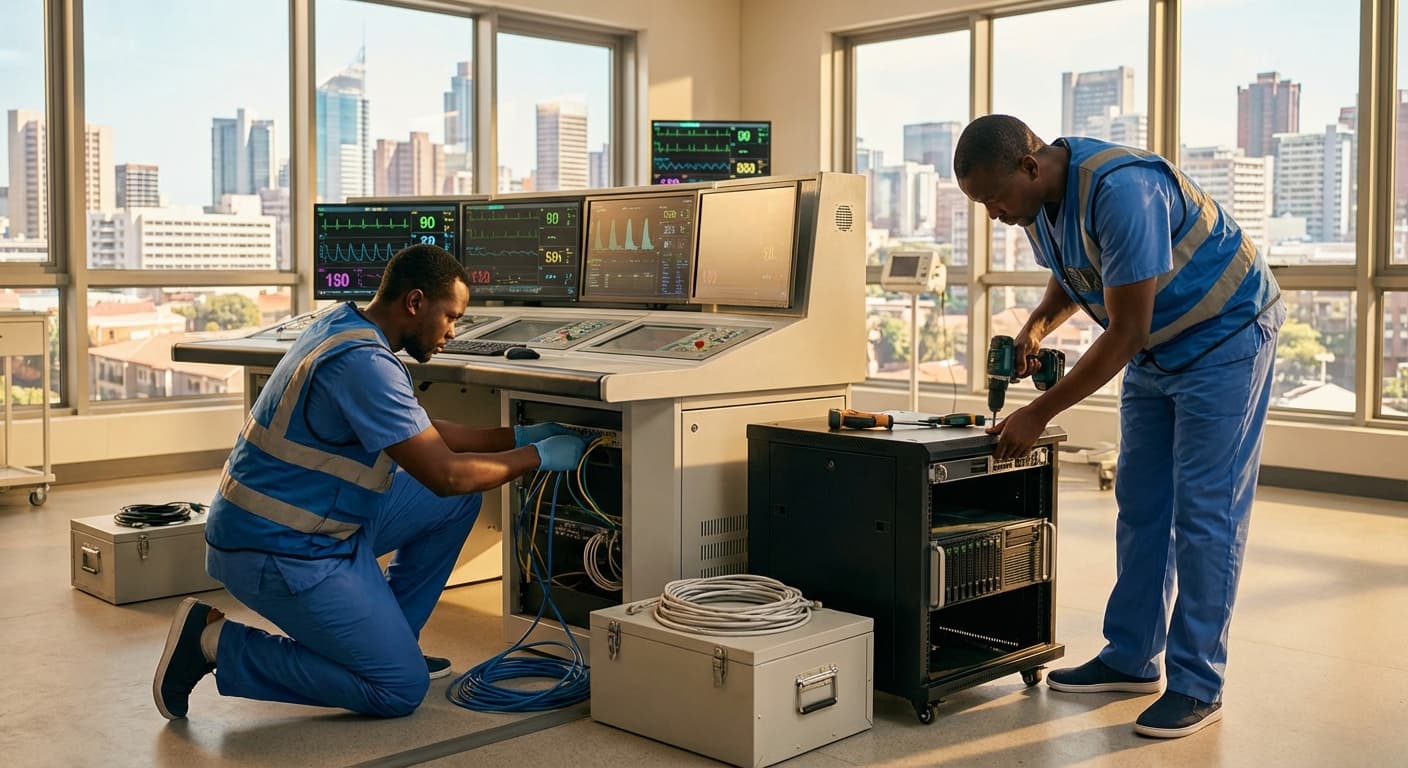
ICU Central Monitoring Station Installation Service in Burundi
Engineering Excellence & Technical Support
ICU Central Monitoring Station Installation Service High-standard technical execution following OEM protocols and local regulatory frameworks.
Advanced Centralized Patient Monitoring Systems
We implement state-of-the-art ICU central monitoring stations, integrating real-time data from various bedside devices (ECG, SpO2, BP, etc.) into a unified, high-resolution display. This ensures immediate clinical visibility, rapid response to critical changes, and enhanced patient safety for critical care in Burundi.
Robust Network Infrastructure and Data Security
Our installations prioritize secure, high-speed network connectivity, ensuring reliable data transmission from all ICU beds to the central station. We employ robust cybersecurity measures to protect sensitive patient data in compliance with international standards, vital for healthcare infrastructure in Burundi.
Seamless Integration and Customization for Burundi's Healthcare Needs
We offer tailored installation services, meticulously integrating the central monitoring system with existing hospital IT infrastructure and workflows. Our experienced technicians provide comprehensive training and ongoing support, ensuring optimal performance and adaptability to the specific demands of healthcare facilities in Burundi.
What Is Icu Central Monitoring Station Installation Service In Burundi?
ICU Central Monitoring Station Installation Service in Burundi refers to the comprehensive process of designing, procuring, installing, configuring, and commissioning a centralized monitoring system for Intensive Care Units (ICUs) within healthcare facilities located in Burundi. This service ensures that vital patient data from multiple ICU beds is aggregated, displayed, and analyzed in a single, accessible location, enabling healthcare professionals to provide more effective and timely critical care. The service encompasses the integration of bedside patient monitors (e.g., ECG, SpO2, NIBP, EtCO2, invasive pressures, temperature), ventilators, and potentially other critical care devices with a central server and display consoles. It involves network infrastructure setup (wired and/or wireless), software installation and customization, system validation, and end-user training. The primary objective is to enhance patient safety, optimize resource utilization, and improve clinical decision-making in high-acuity care settings.
| Who Needs ICU Central Monitoring Station Installation Service in Burundi? | Typical Use Cases | ||||||
|---|---|---|---|---|---|---|---|
| Hospitals and Healthcare Facilities with Intensive Care Units (ICUs): Public and private hospitals, university medical centers, and specialized critical care facilities requiring advanced patient monitoring capabilities. | Continuous Patient Surveillance: Real-time monitoring of multiple critically ill patients from a central location, allowing for immediate detection of adverse events and trends. | Enhanced Alarm Management: Centralized alarm notifications and management to reduce alarm fatigue and ensure timely response to critical patient conditions. | Data Aggregation and Analysis: Collection, storage, and analysis of patient physiological data for trend identification, treatment effectiveness evaluation, and research purposes. | Improved Staff Workflow and Efficiency: Reducing the need for constant bedside checks by providing a consolidated view of patient status, freeing up clinical staff for direct patient care. | Remote Monitoring and Telemedicine Integration: Facilitating remote oversight of ICU patients by specialists or enabling telemedicine consultations. | Disaster Preparedness and Surge Capacity: Enabling efficient management of increased patient loads during public health emergencies or disasters. | Training and Education: Providing a platform for training medical staff on critical care monitoring and decision-making. |
| Government Health Ministries and Public Health Agencies: Responsible for overseeing and improving the quality of critical care services across the nation. | Non-Governmental Organizations (NGOs) and International Aid Organizations: Involved in healthcare infrastructure development and capacity building in Burundi. | New Hospital Construction Projects: Incorporating advanced monitoring systems from the initial design phase. | Existing ICU Upgrades and Modernization Projects: Replacing outdated or inadequate monitoring systems with state-of-the-art solutions. |
Key Components of ICU Central Monitoring Station Installation Service:
- Site Assessment and Requirements Analysis: Evaluating existing infrastructure, power supply, network capabilities, and specific clinical needs of the ICU.
- System Design and Architecture: Developing a robust and scalable architecture for the central monitoring system, including network topology, server requirements, and display console placement.
- Hardware Procurement and Installation: Sourcing and physically installing patient monitoring devices, network hardware, servers, and display units.
- Software Deployment and Configuration: Installing and configuring the central monitoring software, including alarm management, data logging, trending, and reporting functionalities.
- Network Integration: Establishing secure and reliable network connectivity between bedside devices and the central monitoring station, adhering to relevant cybersecurity protocols.
- System Calibration and Validation: Performing rigorous testing and calibration of all integrated devices and software to ensure data accuracy and system integrity.
- Alarm Management Configuration: Setting up customized alarm parameters and escalation protocols to alert staff to critical changes in patient status.
- Data Security and Privacy Implementation: Ensuring compliance with data protection regulations and implementing measures to safeguard patient information.
- User Training and Support: Providing comprehensive training to physicians, nurses, and biomedical engineers on the operation, maintenance, and troubleshooting of the central monitoring system.
- Post-Installation Support and Maintenance: Offering ongoing technical support, software updates, and maintenance services.
Who Needs Icu Central Monitoring Station Installation Service In Burundi?
ICU Central Monitoring Station installation services are crucial for healthcare facilities in Burundi aiming to enhance patient care, optimize resource allocation, and improve overall operational efficiency within their Intensive Care Units (ICUs). These services are particularly vital for hospitals and clinics that are either establishing new ICUs or upgrading existing ones to meet modern healthcare standards.
| Department/Unit | Key Needs Addressed by Central Monitoring | Specific Examples/Scenarios |
|---|---|---|
| Intensive Care Unit (ICU) | Real-time patient data aggregation, continuous vital sign monitoring, alarm management, early detection of patient deterioration, improved communication among care teams. | Monitoring multiple ventilated patients, cardiac arrest response, sepsis management, post-operative critical care. |
| High Dependency Unit (HDU) / Step-down Unit | Gradual transition of critically ill patients, continued close observation, prevention of readmission to ICU, efficient staff allocation. | Patients recovering from severe illness, post-ICU monitoring, management of less severe but critical conditions. |
| Emergency Department (ED) / Casualty | Initial stabilization of critically ill patients, rapid assessment and transfer to ICU, continuous monitoring during critical interventions. | Trauma patients, acute myocardial infarction, stroke, severe infections, multi-organ failure. |
| Operating Room (OR) / Surgical Suites | Intra-operative patient monitoring, anesthesia management, early identification of complications during and immediately after surgery. | Complex surgeries, prolonged anesthesia, patients with pre-existing critical conditions. |
| Neonatal Intensive Care Unit (NICU) | Monitoring fragile newborns, specialized vital sign tracking (e.g., SpO2, heart rate), apnea detection, temperature regulation. | Premature infants, low birth weight infants, neonates with congenital anomalies or birth complications. |
| Cardiac Care Unit (CCU) / Coronary Care Unit | Continuous ECG monitoring, invasive hemodynamic monitoring, rapid response to cardiac events. | Patients with acute coronary syndromes, arrhythmias, heart failure, post-cardiac surgery. |
| Nursing Station / Command Center | Centralized overview of all monitored patients, efficient staff delegation, coordinated response to alarms, data logging and retrieval for audits and research. | Managing a large ICU with many beds, coordinating a rapid response team, ensuring compliance with monitoring protocols. |
Target Customers and Departments in Burundi Requiring ICU Central Monitoring Station Installation Services
- {"title":"Government Hospitals","description":"These are the primary facilities often serving a large patient population and facing the greatest need for upgraded critical care infrastructure. They include national referral hospitals and regional general hospitals."}
- {"title":"Private Hospitals and Clinics","description":"While often having more resources, private facilities also require advanced monitoring to offer competitive and high-quality critical care services to their clientele."}
- {"title":"Non-Governmental Organization (NGO) Healthcare Facilities","description":"NGOs operating hospitals or clinics, especially those focused on specialized care or serving underserved populations, often seek robust and reliable monitoring solutions."}
- {"title":"University Teaching Hospitals","description":"These institutions require state-of-the-art technology not only for patient care but also for training medical professionals and conducting research."}
- {"title":"Tertiary Care Centers","description":"Facilities specializing in complex medical conditions and procedures naturally need advanced monitoring to manage critically ill patients."}
Icu Central Monitoring Station Installation Service Process In Burundi
This document outlines the detailed workflow for the Installation Service Process of ICU Central Monitoring Stations in Burundi, covering the journey from initial customer inquiry to the successful completion and handover of the project. The process is designed to be comprehensive, efficient, and client-centric, ensuring a smooth and professional installation experience.
| Phase | Key Activities | Deliverables | Responsible Parties |
|---|---|---|---|
| Inquiry and Pre-Assessment | Receive inquiry, gather initial requirements, conduct preliminary needs assessment. | Preliminary Proposal, Understanding of client needs. | Client, Service Provider Sales/Technical Team |
| Detailed Planning and Site Survey | Site survey, detailed technical assessment, finalize BOM, contract negotiation. | Detailed Proposal, Signed Contract, Finalized BOM, Site Survey Report. | Service Provider Technical Team, Client Stakeholders |
| Procurement and Logistics | Procure, quality check, pre-configure, ship, and clear customs for equipment. | Shipped Equipment, Customs Clearance Documents, Pre-configured System. | Service Provider Procurement & Logistics Team, Client (for necessary import coordination) |
| Installation and Configuration | Site prep, hardware/software installation, network setup, device integration, testing. | Installed & Configured Central Monitoring Station, Integrated Devices, Tested System. | Service Provider Installation Team, Client IT/Biomedical Staff (for access & collaboration) |
| Training and Handover | User training, documentation, FAT, project sign-off. | Trained Staff, User Manuals, Project Sign-off Document, Completed Training Records. | Service Provider Trainers & Project Manager, Client End-Users & Management |
| Post-Installation Support and Maintenance | Ongoing remote/on-site support, updates, maintenance, spare parts management. | Service Level Agreement (SLA) Fulfilled, System Uptime, Support Tickets Resolved. | Service Provider Support Team, Client IT/Biomedical Staff |
ICU Central Monitoring Station Installation Service Process in Burundi
- {"items":["Initial Contact & Inquiry Reception: Customer expresses interest in ICU Central Monitoring Station installation services via phone, email, or inquiry form.","Information Gathering: Project details, hospital/clinic requirements, existing infrastructure (if any), location, and desired timeline are collected.","Preliminary Needs Assessment: A brief discussion to understand the scale of the installation, number of beds to be monitored, and specific functional requirements.","Proposal Generation: Based on the initial information, a preliminary proposal outlining the scope of work, estimated costs, and potential timelines is prepared and submitted.","Client Review & Feedback: The client reviews the proposal and provides feedback or requests modifications."],"title":"Phase 1: Inquiry and Pre-Assessment"}
- {"items":["Site Survey Scheduling: Upon acceptance of the preliminary proposal, a site survey is scheduled with the client.","On-Site Technical Assessment: Our technical team visits the installation site in Burundi to conduct a thorough assessment of the physical space, existing network infrastructure, power supply, environmental conditions (temperature, humidity), and accessibility.","Detailed Requirements Elicitation: In-depth discussions with hospital IT, biomedical engineering, and clinical staff to finalize system specifications, integration needs, and user interface preferences.","Bill of Materials (BOM) Finalization: A precise list of all necessary hardware, software, cabling, mounting accessories, and any other components is created.","Revised Proposal & Contract Negotiation: An updated proposal reflecting the detailed site assessment and finalized BOM is presented. Contract terms, payment schedules, and service level agreements (SLAs) are negotiated.","Contract Signing & Advance Payment: Formal agreement is signed by both parties, and the initial advance payment is processed as per the contract."],"title":"Phase 2: Detailed Planning and Site Survey"}
- {"items":["Procurement of Equipment: All specified equipment and materials are procured from authorized vendors.","Quality Control & Pre-configuration: Equipment undergoes rigorous quality checks. Software is pre-configured and tested at our facility to ensure compatibility and optimal performance.","Logistics and Shipping: All materials are packaged securely and arrangements are made for international shipping to Burundi, including customs clearance and transportation to the site.","Customs Clearance & Local Logistics: Managing import duties, taxes, and local transportation to the hospital/clinic in Burundi."],"title":"Phase 3: Procurement and Logistics"}
- {"items":["Site Preparation: Ensuring the installation area is ready, including any necessary structural modifications, power outlet installation, and network point setup.","Hardware Installation: Physical installation of the central monitoring station servers, workstations, network switches, and related hardware.","Cable Laying & Network Setup: Professional installation of network cabling, ensuring proper routing and labeling. Configuration of network devices for seamless data flow.","Software Installation & Configuration: Installation of the central monitoring software and its configuration according to the finalized specifications and client preferences.","Device Integration: Connecting and configuring patient monitors, ventilators, and other bedside devices to the central monitoring system.","System Testing & Calibration: Comprehensive testing of all system components, data transmission, alarm functions, and integration with other hospital systems (e.g., HIS, EMR). Calibration of sensors and devices.","User Interface Customization: Adjusting display layouts, alarm thresholds, and user roles as per the client's requirements."],"title":"Phase 4: Installation and Configuration"}
- {"items":["User Training: Conducting comprehensive training sessions for clinical staff (nurses, doctors) and technical staff (biomedical engineers, IT personnel) on operating and maintaining the central monitoring system.","Documentation & Handover: Providing detailed user manuals, technical documentation, warranty information, and system configuration details to the client.","Final Acceptance Testing (FAT): Client performs a final review and testing of the installed system to confirm it meets all agreed-upon specifications and requirements.","Project Sign-off & Final Payment: Upon successful FAT and client satisfaction, the project is formally signed off, and the final payment is processed.","Post-Installation Support Commencement: Transition to the agreed-upon post-installation support and maintenance phase."],"title":"Phase 5: Training and Handover"}
- {"items":["Remote Monitoring & Troubleshooting: Providing ongoing remote support to diagnose and resolve any issues.","On-Site Support (as per SLA): Dispatching technicians for on-site troubleshooting and maintenance as stipulated in the service agreement.","Software Updates & Upgrades: Managing and implementing necessary software updates and system upgrades.","Preventive Maintenance: Scheduling and performing regular preventive maintenance checks to ensure optimal system performance and longevity.","Spare Parts Management: Ensuring availability of critical spare parts for timely replacement."],"title":"Phase 6: Post-Installation Support and Maintenance"}
Icu Central Monitoring Station Installation Service Cost In Burundi
Installing an ICU Central Monitoring Station in Burundi involves a complex process with varying costs. Several factors influence the final price, making it difficult to provide a single, definitive figure. These factors range from the sophistication of the equipment chosen to the specific needs and infrastructure of the healthcare facility. Understanding these elements is crucial for accurate budgeting and procurement.
| Component/Service Category | Estimated Range (Burundian Francs - BIF) | Notes |
|---|---|---|
| Basic ICU Bedside Monitor (per unit) | 2,000,000 - 8,000,000+ | Varies by brand, features (e.g., non-invasive BP, SpO2, ECG, temp), and whether it's a new purchase or part of a package. |
| Advanced ICU Bedside Monitor (per unit) | 6,000,000 - 15,000,000+ | Includes invasive BP, capnography, advanced ECG analysis, etc. |
| Central Monitoring Workstation (Server & Software) | 15,000,000 - 50,000,000+ | Depends on the number of beds supported, software features, and display configurations. |
| Network Infrastructure & Cabling | 3,000,000 - 15,000,000+ | Highly variable based on existing infrastructure and the scale of the installation. |
| Installation & Configuration (Biomedical & IT) | 5,000,000 - 20,000,000+ | Reflects the complexity of the system and the expertise required. |
| Training (Staff) | 2,000,000 - 8,000,000+ | Based on the number of staff and the training duration/depth. |
| Import Duties & Taxes | Highly variable | Depends on the total value of imported goods and current tariff rates. |
| Annual Maintenance Contract (AMC) - first year | 10% - 20% of initial equipment cost | Covers routine checks, software updates, and often priority support. |
Key Pricing Factors for ICU Central Monitoring Station Installation in Burundi:
- Type and Brand of Monitoring Equipment: The core of the system, vital signs monitors (for ECG, SpO2, NIBP, respiration, temperature), invasive pressure monitors, and potentially advanced modules like capnography or cardiac output, will vary significantly in price based on brand reputation, technological features, and origin of manufacture.
- Number of Patient Bedside Units: The more ICU beds that need to be monitored, the higher the cost of the bedside monitors and their associated installation.
- Central Workstation and Software: The central monitoring station itself, including powerful computers, large displays, and specialized software for data aggregation, analysis, and alarm management, represents a substantial investment.
- Network Infrastructure and Cabling: Integrating the monitoring system into the hospital's existing network requires robust cabling, switches, and potentially wireless access points. The complexity of the hospital layout and the extent of new infrastructure needed will impact costs.
- Installation and Configuration Expertise: Skilled technicians are required for the physical installation of equipment, the configuration of software, and the integration with other hospital systems (e.g., Electronic Health Records). The availability and cost of specialized IT and biomedical engineers in Burundi will play a role.
- Training for Medical and Technical Staff: Comprehensive training for nurses, doctors, and biomedical technicians on operating and maintaining the system is essential. The duration and depth of this training can affect the overall cost.
- After-Sales Support and Maintenance Contracts: Ongoing support, software updates, and preventative maintenance are crucial for the longevity and reliability of the system. Annual maintenance contracts can add a recurring cost.
- Import Duties and Taxes: As many components will likely be imported, Burundi's import duties, taxes, and customs clearance fees will add to the overall expenditure.
- Geographic Location within Burundi: While less of a primary driver for equipment cost, accessibility to the installation site, particularly in remote areas, might influence transportation and labor costs for the installation team.
- Warranty and Service Level Agreements (SLAs): The length and terms of the warranty, as well as any desired SLAs for response times and repairs, can impact the initial purchase price or maintenance contract costs.
Affordable Icu Central Monitoring Station Installation Service Options
This guide outlines affordable options for installing ICU Central Monitoring Station (CMS) systems, focusing on value bundles and cost-saving strategies. A well-implemented CMS is crucial for efficient patient care in intensive care units, providing real-time patient data to a centralized location. However, the initial investment and installation can be significant. This document aims to empower healthcare facilities with practical approaches to manage these costs without compromising on essential functionality and reliability.
| Value Bundle Type | Typical Inclusions | Cost-Saving Benefits | Considerations |
|---|---|---|---|
| Basic Monitoring Bundle | Central server, basic patient monitoring software, network infrastructure for a limited number of beds, initial installation, and standard training. | Lower upfront cost, ideal for smaller ICUs or those with limited budgets. Focuses on core monitoring functionalities. | May lack advanced features or scalability. Ensure it meets current regulatory requirements. |
| Comprehensive Integration Bundle | Advanced central server, comprehensive patient monitoring software, integration with EMR/EHR systems, vital sign data acquisition modules, networking for a larger number of beds, extended installation, and in-depth staff training. | Potentially higher upfront cost but offers long-term efficiency gains through data integration. Streamlines workflows and reduces manual data entry. | Requires careful planning for EMR/EHR integration. May involve additional IT support. |
| Refurbished Systems Package | Certified refurbished central monitoring station hardware, refurbished patient monitors, software licenses (new or refurbished), installation, and basic warranty. | Significant cost reduction on hardware. Still provides reliable functionality for critical monitoring. | Thoroughly vet the refurbishment process and warranty. Ensure compatibility with current medical device standards. |
| Phased Rollout Package | Initial installation of core CMS infrastructure, monitoring software for a subset of beds, with an agreement for future expansion of hardware and software at pre-negotiated rates. | Spreads the cost over time. Allows for early deployment of essential monitoring capabilities. | Requires a clear plan for future expansion and commitment from the vendor for future pricing. |
Key Considerations for Affordable ICU CMS Installation
- Needs Assessment: Accurately define the required functionalities, number of beds to monitor, and integration needs with existing hospital IT infrastructure. Over-specifying can lead to unnecessary costs.
- Phased Implementation: Consider installing the CMS in phases, prioritizing critical areas or functionalities first, and expanding as budget allows. This allows for immediate benefits while deferring larger expenses.
- Refurbished Equipment: Explore the option of high-quality, certified refurbished monitoring equipment and CMS hardware. This can offer significant savings compared to brand-new components.
- Open-Source Software Options: Investigate if open-source solutions can meet your basic monitoring and data management needs, potentially reducing software licensing fees. However, ensure adequate support and training are available.
- Vendor Negotiation: Thoroughly research and negotiate with multiple vendors. Look for bundled packages that offer discounts for purchasing hardware, software, and installation services together.
- Training and Support Packages: Evaluate different training and ongoing support packages. Opt for packages that provide essential training for your IT and clinical staff, and explore tiered support options to match your budget.
- Scalability: Choose a system that is scalable. This allows you to start with a smaller, more affordable setup and expand it later as your needs grow, avoiding the cost of a complete system replacement.
Verified Providers In Burundi
In Burundi's evolving healthcare landscape, access to reliable and verified medical professionals is paramount. Franance Health stands as a beacon of trust, rigorously vetting its network of providers to ensure they meet the highest standards of care. This commitment to quality translates into tangible benefits for patients seeking medical services. By choosing a Franance Health verified provider, individuals are assured of receiving competent, ethical, and up-to-date medical attention. Their stringent credentialing process examines qualifications, experience, and adherence to best practices, offering peace of mind and a significantly improved healthcare experience.
| Category | Franance Health Verification Benefits | Patient Impact |
|---|---|---|
| Qualifications & Expertise | Verified academic degrees, certifications, and specialized training. | Assurance of receiving care from competent and knowledgeable professionals. |
| Experience & Track Record | Scrutiny of past performance and practice history. | Confidence in providers with proven ability to manage various medical conditions. |
| Ethical Standards & Compliance | Adherence to national medical ethics guidelines and regulatory requirements. | Trust in receiving transparent, patient-centered care without compromise. |
| Continuing Professional Development | Confirmation of ongoing learning and skill enhancement. | Access to the latest advancements in medical diagnosis and treatment. |
| Patient Feedback & Reviews | Consideration of patient satisfaction and testimonials (where applicable). | Informed choice based on positive experiences of others. |
Why Franance Health Verified Providers are the Best Choice:
- Rigorous credentialing process ensuring high standards.
- Focus on qualified and experienced medical professionals.
- Commitment to ethical medical practices.
- Access to up-to-date medical knowledge and techniques.
- Enhanced patient safety and trust.
- Streamlined access to quality healthcare services.
Scope Of Work For Icu Central Monitoring Station Installation Service
This Scope of Work (SOW) outlines the requirements for the installation of an Intensive Care Unit (ICU) Central Monitoring Station (CMS) service. The project encompasses the entire lifecycle of the CMS installation, from initial site assessment to final system handover and commissioning. The objective is to establish a robust and reliable central monitoring system that enhances patient care by providing real-time physiological data to clinical staff. This SOW details the technical deliverables, standard specifications, and activities required to achieve a successful implementation. The service provider will be responsible for the supply, installation, configuration, testing, and commissioning of all hardware, software, and network components associated with the ICU CMS.
| Technical Deliverable | Description | Standard Specification/Requirement | Acceptance Criteria |
|---|---|---|---|
| Central Monitoring Workstation(s) | High-performance workstations for displaying patient data, alarms, and trends. | Minimum 16GB RAM, SSD storage, Intel Core i5 or equivalent processor, dual high-resolution displays (24-inch minimum), running a supported operating system (e.g., Windows 10/11 Pro). | Workstations boot within 60 seconds. Display resolution is set to native. Operating system is activated and up-to-date. |
| Central Server(s) | Server(s) to host CMS software, database, and manage data acquisition and storage. | Redundant power supplies, hot-swappable drives, enterprise-grade CPUs (e.g., Intel Xeon), minimum 64GB ECC RAM, RAID configuration for storage, network interfaces (1Gbps minimum). | Server uptime of 99.9% during operational hours. Data backup configured and tested successfully. |
| Networking Infrastructure | Cabling, switches, routers, and firewalls to connect bedside monitors to the CMS. | Category 6A or higher Ethernet cabling, managed PoE-enabled network switches with sufficient port density, secure network segmentation with firewall rules. | All network drops tested for connectivity and speed (1Gbps minimum). Network latency between bedside monitors and CMS < 10ms. |
| Bedside Monitor Integration Modules | Hardware/software modules to interface with existing or new ICU bedside monitors. | Compatibility with specified bedside monitor models (e.g., Philips IntelliVue, GE CARESCAPE). Secure data transmission protocols (e.g., HL7, FHIR). | Successful bidirectional data flow from at least 95% of connected bedside monitors to the CMS. |
| CMS Software Suite | Software for data acquisition, display, alarm management, trending, and reporting. | User-friendly interface, customizable alarm thresholds, configurable display layouts, audit trails, secure access controls, integration capabilities. | Software installation and configuration completed as per vendor specifications. Key functionalities (data display, alarm generation) are verified. |
| Power Distribution and UPS | Reliable power supply for all CMS components, including Uninterruptible Power Supply (UPS) for critical systems. | Dedicated power circuits for servers and workstations. UPS with sufficient runtime (e.g., 30 minutes minimum) for all CMS hardware during power outages. | UPS successfully tested to provide backup power for the specified duration. |
| System Documentation | Comprehensive documentation including installation guides, configuration manuals, user manuals, and troubleshooting guides. | Clearly written, accurate, and up-to-date. Includes network diagrams, hardware inventory, software licenses, and maintenance procedures. | All documentation delivered in electronic format (PDF) and reviewed for completeness and accuracy. |
| Training Materials | Materials for training clinical staff and IT administrators on CMS operation and maintenance. | Includes presentations, hands-on exercises, and quick reference guides. | Training sessions conducted successfully with positive feedback from participants. |
| Commissioning Report | Formal report detailing the testing, validation, and successful implementation of the CMS. | Includes test results, configuration settings, and sign-off by relevant stakeholders. | Report signed and approved by the hospital's IT department and clinical lead. |
Key Project Phases and Activities
- Site Survey and Assessment
- System Design and Planning
- Hardware Procurement and Delivery
- Infrastructure Preparation (Cabling, Power, Network)
- Hardware Installation and Configuration
- Software Installation and Configuration
- System Integration and Interoperability Testing
- User Training
- System Commissioning and Validation
- Handover and Documentation
- Post-Installation Support and Warranty
Service Level Agreement For Icu Central Monitoring Station Installation Service
This Service Level Agreement (SLA) outlines the response times and uptime guarantees for the installation services provided by [Your Company Name] for the ICU Central Monitoring Station (CMS). This SLA is an addendum to the Master Service Agreement (MSA) between [Your Company Name] and [Client Name].
| Service Impact Level | Response Time Target | Resolution Time Target (Best Effort) | Uptime Guarantee |
|---|---|---|---|
| Critical Incident | 30 minutes | 4 hours | 99.9% (excluding scheduled maintenance) |
| Major Incident | 2 hours | 8 business hours | 99.9% (excluding scheduled maintenance) |
| Minor Incident | 4 business hours | 24 business hours | N/A (focused on incident resolution) |
Key Definitions
- Installation Service: The end-to-end process of setting up, configuring, testing, and commissioning the ICU Central Monitoring Station as per the agreed-upon project scope and specifications.
- Service Request: A formal communication from the Client to [Your Company Name] requesting support or reporting an issue related to the installed ICU CMS.
- Critical Incident: An event that renders the entire ICU CMS non-operational, significantly impacting patient care monitoring within the ICU.
- Major Incident: An event that impacts a substantial portion of the ICU CMS functionality or a significant number of monitored patients, but does not render the entire system inoperable.
- Minor Incident: An event that affects a single or limited number of functionalities or monitored patients, with workarounds available.
- Uptime: The percentage of time the ICU CMS is operational and performing its intended functions, excluding scheduled maintenance and client-induced issues.
- Response Time: The maximum time elapsed from the receipt of a Service Request by [Your Company Name] until an initial response (acknowledgment and assessment) is provided.
- Resolution Time: The maximum time elapsed from the receipt of a Service Request until the issue is resolved and the ICU CMS is fully operational again.
- Scheduled Maintenance: Pre-planned periods of downtime for system updates, upgrades, or preventative maintenance, communicated to the Client in advance.
Frequently Asked Questions

Ready when you are
Let's scope your ICU Central Monitoring Station Installation Service in Burundi project in Burundi.

Scaling healthcare logistics and technical systems across the entire continent.