
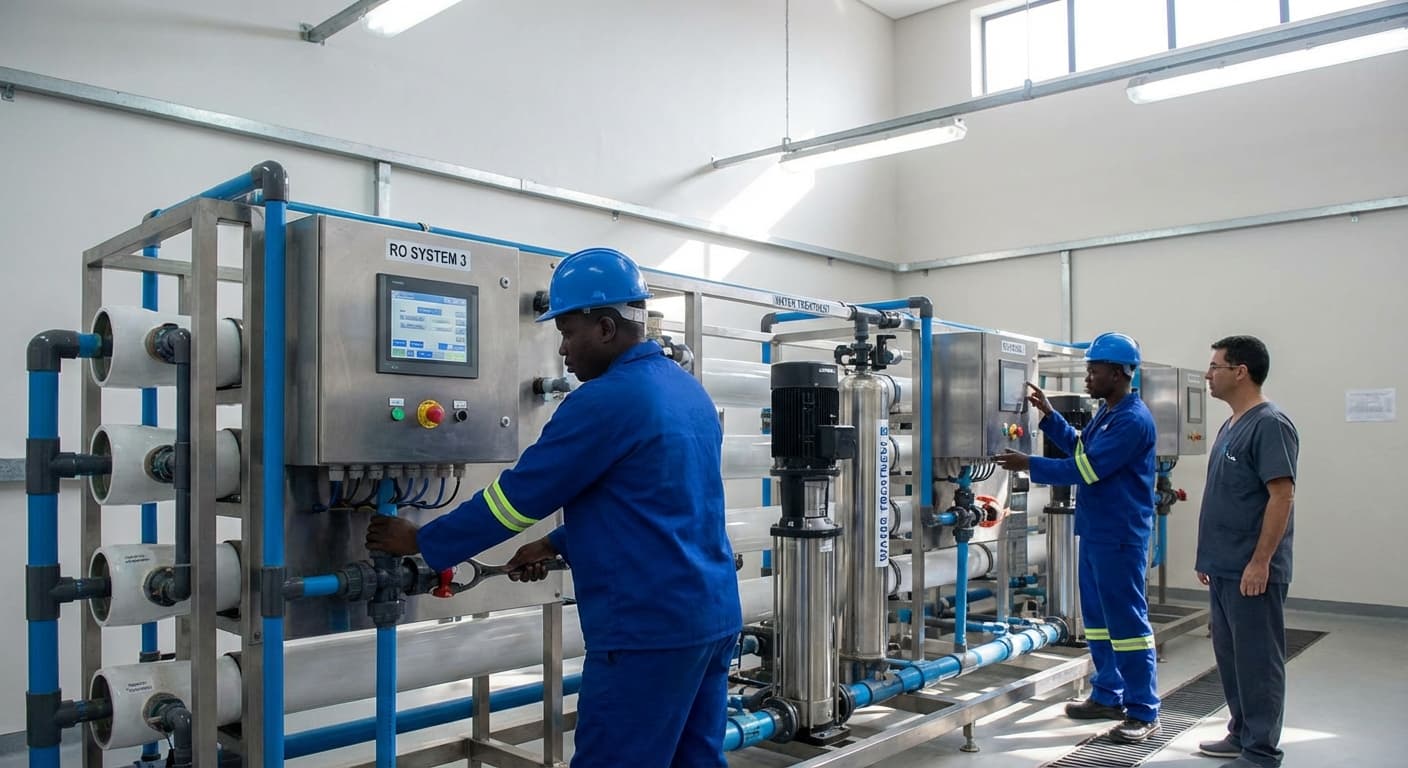
Dialysis RO/Water Treatment Plant Installation Service in Burundi
Engineering Excellence & Technical Support
Dialysis RO/Water Treatment Plant Installation Service High-standard technical execution following OEM protocols and local regulatory frameworks.
Customized RO System Design & Integration
Leveraging deep understanding of Burundi's unique water profiles, we engineer and install bespoke Reverse Osmosis (RO) systems. Our solutions are optimized for reliable, high-purity water production, minimizing scaling and maximizing membrane lifespan, even with challenging feedwater.
Robust Equipment Sourcing & Commissioning
We meticulously select and procure durable, high-performance RO and water treatment equipment from leading global manufacturers, prioritizing longevity and ease of maintenance. Our expert technicians ensure seamless integration and rigorous commissioning, guaranteeing optimal plant performance from day one.
On-Site Training & Local Capacity Building
Beyond installation, we empower local healthcare facilities with comprehensive on-site training for their technical staff. This ensures efficient operation, routine maintenance, and swift troubleshooting, fostering self-sufficiency and long-term operational excellence for dialysis water treatment in Burundi.
What Is Dialysis Ro/water Treatment Plant Installation Service In Burundi?
Dialysis RO/Water Treatment Plant Installation Service in Burundi refers to the comprehensive process of designing, procuring, installing, commissioning, and providing ongoing support for Reverse Osmosis (RO) and associated water treatment systems specifically for dialysis facilities in Burundi. These systems are critical for producing ultrapure water, essential for hemodialysis treatments to remove waste products and excess fluid from the blood of patients with kidney failure. The service ensures that the water meets stringent medical-grade standards, preventing complications for patients and maintaining the operational integrity of dialysis machines. It encompasses all technical aspects from site assessment and system selection to plumbing, electrical integration, testing, and operator training.
| Who Needs This Service? | Typical Use Cases | ||||
|---|---|---|---|---|---|
| Dialysis Centers/Clinics in Burundi: Any facility providing hemodialysis treatments requires a reliable source of ultrapure water. This is the primary and most critical user group. | Establishment of New Dialysis Facilities: For newly constructed or planned dialysis centers, this service is essential from the initial design phase to ensure compliant and efficient water treatment infrastructure is in place. | Existing Dialysis Centers Requiring Upgrades or Replacements: Facilities with aging or underperforming water treatment systems that no longer meet current standards or patient demands. | Expansion of Existing Dialysis Services: When a dialysis center increases its capacity (more machines or patient throughput), their water treatment system may need to be expanded or upgraded. | Governmental Health Institutions and Public Hospitals: Public healthcare facilities offering dialysis services will require this installation service to maintain and operate their dialysis units. | Non-Governmental Organizations (NGOs) and Humanitarian Aid Organizations: Organizations involved in providing healthcare services, including dialysis, in Burundi. |
| Routine Hemodialysis: The most common use case, ensuring the continuous supply of ultrapure water for daily dialysis treatments for patients with end-stage renal disease (ESRD). | Peritoneal Dialysis (PD) Water Treatment: While less common for large-scale RO plants, some PD solutions may require specific water treatment for preparation, though typically on a smaller scale. | Water Quality Assurance and Compliance: To meet national and international medical water quality standards, preventing dialysis-related complications such as pyrogenic reactions or infections. | Operational Efficiency and Cost-Effectiveness: A properly designed and installed system minimizes downtime, reduces water wastage, and optimizes energy consumption. | Disease Prevention and Patient Safety: The primary objective is to safeguard patient health by eliminating contaminants, endotoxins, and microorganisms from the dialysate water. | Disaster Relief and Emergency Medical Support: In situations requiring rapid deployment of dialysis capabilities, pre-designed and installable RO systems are crucial. |
Key Components of Dialysis RO/Water Treatment Plant Installation Service:
- Site Assessment and Requirements Analysis: Evaluating the existing water source (municipal, well, etc.), water quality parameters, available infrastructure (power, space), and the specific needs of the dialysis center (number of machines, patient volume).
- System Design and Engineering: Developing a customized treatment train, including pre-treatment (sediment filtration, carbon filtration, water softening), Reverse Osmosis membranes, post-treatment (UV sterilization, bacterial filters), and storage tanks, all engineered to meet the required water purity standards (e.g., AAMI, ISO standards).
- Equipment Procurement and Logistics: Sourcing and acquiring all necessary components, including RO units, pumps, filters, membranes, piping, valves, instrumentation, and control systems, and managing their transportation and delivery to the installation site in Burundi.
- Installation and Integration: Physically installing the treatment plant components, connecting piping and electrical systems, integrating control panels, and ensuring proper mechanical and electrical connections. This includes adherence to plumbing and electrical codes applicable in Burundi.
- System Commissioning and Validation: Rigorous testing of the installed system to verify operational parameters, performance, and water quality. This involves water analysis to confirm compliance with medical-grade standards and validation of the system's ability to consistently produce ultrapure water.
- Operator Training: Providing comprehensive training to dialysis center staff on the operation, routine maintenance, troubleshooting, and monitoring of the RO/water treatment plant to ensure safe and efficient long-term operation.
- Documentation and Handover: Providing detailed technical documentation, including design schematics, operational manuals, maintenance logs, and warranty information, upon completion of the installation and commissioning.
- Post-Installation Support and Maintenance: Offering ongoing technical support, planned preventive maintenance services, and emergency repair services to ensure continuous optimal performance of the water treatment system.
Who Needs Dialysis Ro/water Treatment Plant Installation Service In Burundi?
Access to clean and reliable water is paramount for healthcare facilities, particularly those providing life-sustaining treatments like dialysis. In Burundi, where healthcare infrastructure is continuously developing, the demand for advanced water treatment solutions, specifically Reverse Osmosis (RO) and associated water purification systems for dialysis, is growing. These specialized plants are crucial for ensuring the safety and efficacy of dialysis treatments by removing impurities, contaminants, and microorganisms from the water used in the process. This service caters to a specific and critical need within the Burundian healthcare sector, directly impacting patient outcomes and the operational capacity of dialysis units.
| Customer Type | Specific Need/Role | Key Decision-Maker/Influencer |
|---|---|---|
| Government Hospitals | Provide essential dialysis services to a large patient population; often facing budget constraints and seeking reliable, cost-effective solutions. | Ministry of Health Officials, Hospital Directors, Chief Medical Officers, Biomedical Engineering Heads |
| Private Hospitals | Offer premium healthcare services, including dialysis; focus on advanced technology and patient comfort; may have more flexible budgets. | Hospital Owners/CEOs, Medical Directors, Heads of Nephrology, Procurement Managers |
| Specialized Kidney Centers/Dialysis Clinics | Solely focused on kidney disease treatment; require highly specialized and consistent water quality; often operate with a dedicated focus on dialysis technology. | Clinic Directors, Lead Nephrologists, Operations Managers, Technical Supervisors |
| International NGOs | Implement healthcare projects in underserved areas; may require turnkey solutions and training; often partner with local healthcare providers. | Project Managers, Healthcare Program Directors, Procurement Officers |
| Large Medical Complexes | Integrate dialysis services as part of a broader healthcare offering; require seamless integration with existing infrastructure and services. | Facility Managers, Biomedical Engineering Directors, Department Heads |
Target Customers and Departments for Dialysis RO/Water Treatment Plant Installation Service in Burundi
- {"items":["Government Hospitals (National and Provincial)","Private Hospitals","Specialized Kidney Centers/Dialysis Clinics","International NGOs operating healthcare facilities","Large medical complexes with dialysis units","Future healthcare projects and expansions"],"title":"Target Customers"}
- {"items":["Nephrology Department","Dialysis Unit","Biomedical Engineering Department","Procurement Department","Hospital Administration/Management","Infection Control Department"],"title":"Key Departments within Target Institutions"}
Dialysis Ro/water Treatment Plant Installation Service Process In Burundi
This document outlines the comprehensive workflow for the installation service of Dialysis Reverse Osmosis (RO)/Water Treatment Plants in Burundi, covering the entire process from initial inquiry to successful execution and handover. It details each stage, highlighting key activities, responsibilities, and deliverables to ensure a smooth and efficient project.
| Stage | Description | Key Activities | Deliverables/Outcomes | Responsible Party |
|---|---|---|---|---|
| Inquiry and Initial Consultation | The process begins when a healthcare facility or organization in Burundi expresses interest in a Dialysis RO/Water Treatment Plant. | Receive and acknowledge inquiry, understand client's immediate needs, discuss general plant requirements and capabilities, schedule initial meetings. | Confirmation of receipt of inquiry, understanding of preliminary client needs. | Client, Service Provider Sales Team |
| Site Assessment and Requirements Gathering | A detailed evaluation of the installation site and a thorough understanding of specific operational requirements. | Conduct on-site visit, assess available space, power supply, water source quality and quantity, existing infrastructure, and regulatory requirements. Detailed discussion with clinical and technical staff to define specific RO plant capacity, water quality standards (e.g., AAMI, ISO), redundancy needs, and future expansion plans. | Detailed Site Assessment Report, Comprehensive Requirements Specification Document. | Service Provider Technical Team, Client Representatives |
| Proposal Generation and Contract Finalization | Development of a tailored proposal based on the gathered requirements, followed by contract negotiation and signing. | Prepare detailed technical proposal (including plant specifications, flow diagrams, component list, performance guarantees), financial proposal (including equipment cost, installation, training, warranty, and optional maintenance packages), present proposal to client, negotiate terms and conditions, finalize contract agreement. | Approved Technical and Financial Proposal, Signed Contract Agreement. | Service Provider Sales and Technical Teams, Client Representatives |
| Procurement and Logistics | Ordering of components and managing their transportation to Burundi. | Place orders with manufacturers/suppliers for all necessary RO plant components, filters, membranes, pumps, control systems, piping, electrical supplies, etc. Arrange for import duties, customs clearance, and secure freight forwarding and logistics for delivery to Burundi. | Procurement Orders, Shipping Documentation, Customs Clearance Approvals. | Service Provider Procurement and Logistics Teams |
| Plant Fabrication and Pre-Assembly (if applicable) | Manufacturing or assembly of the RO plant at the service provider's facility before shipment. (May vary based on plant type and complexity). | Fabricate or assemble the RO plant according to approved design specifications. Conduct factory acceptance testing (FAT) to ensure all components function as intended. Prepare for disassembly and packaging for shipping. | Completed RO Plant Modules, Factory Acceptance Test (FAT) Report. | Service Provider Manufacturing/Engineering Team |
| Site Preparation | Ensuring the installation site is ready to receive and house the RO plant. | Prepare the designated installation area, including civil works (e.g., concrete flooring, mounting points), electrical wiring and connections, plumbing connections for incoming water and outgoing treated water, and ventilation requirements. Ensure adequate safety measures are in place. | Ready Installation Site, Completed Civil and Utility Works. | Client, Local Contractors (if applicable), Service Provider Site Supervisor |
| Transportation and Delivery | Safe and secure movement of the RO plant components from the point of origin to the installation site in Burundi. | Coordinate with logistics partners for the secure transportation of plant modules and components. Oversee unloading at the client's facility and ensure all items are accounted for and free from damage. | Delivered RO Plant Components, Delivery Confirmation. | Service Provider Logistics Team, Client Representatives |
| Installation and Commissioning | The physical assembly of the RO plant on-site and bringing it to full operational status. | Assemble plant modules, connect piping and electrical systems, install filters and membranes. Conduct rigorous testing and calibration of all components and systems. Perform initial water quality testing and adjust parameters to meet specifications. Full system commissioning and performance validation. | Installed and Functioning RO/Water Treatment Plant, Commissioning Report, Water Quality Analysis Reports. | Service Provider Installation and Commissioning Engineers |
| Training and Handover | Equipping the client's staff with the knowledge to operate and maintain the plant. | Provide comprehensive training to the client's biomedical engineers, technicians, and nursing staff on plant operation, routine maintenance, troubleshooting, water quality monitoring, and safety procedures. Formal handover of the plant with all relevant documentation. | Trained Client Staff, Operations and Maintenance Manuals, Spare Parts List, Warranty Certificates, Formal Handover Document. | Service Provider Commissioning Engineers, Client Staff |
| Post-Installation Support and Maintenance | Ongoing support to ensure sustained optimal performance of the RO plant. | Provide scheduled preventive maintenance services, on-call technical support for troubleshooting, supply of spare parts and consumables, and warranty claims processing. Offer long-term maintenance contracts. | Ongoing Plant Reliability and Performance, Reduced Downtime, Continued Support. | Service Provider Technical Support and Maintenance Teams |
Key Stages of Dialysis RO/Water Treatment Plant Installation Service
- Inquiry and Initial Consultation
- Site Assessment and Requirements Gathering
- Proposal Generation and Contract Finalization
- Procurement and Logistics
- Plant Fabrication and Pre-Assembly (if applicable)
- Site Preparation
- Transportation and Delivery
- Installation and Commissioning
- Training and Handover
- Post-Installation Support and Maintenance
Dialysis Ro/water Treatment Plant Installation Service Cost In Burundi
Installing a Reverse Osmosis (RO) and water treatment plant for dialysis in Burundi involves a complex process with varying costs. The price is influenced by several key factors, from the scale of the operation to the specific technologies employed. Understanding these elements is crucial for accurate budgeting.
| Cost Component | Estimated Range (Burundian Francs - BIF) | Notes |
|---|---|---|
| Small to Medium Scale Plant (e.g., serving 5-10 dialysis stations) | 15,000,000 - 40,000,000 BIF | Basic pre-treatment, standard RO membranes, essential monitoring. |
| Medium to Large Scale Plant (e.g., serving 10-20+ dialysis stations) | 40,000,000 - 100,000,000+ BIF | More advanced pre-treatment, potentially double-pass RO, advanced disinfection (UV/Ozone), more comprehensive monitoring and automation. |
| Pre-treatment System (depending on water source) | 3,000,000 - 15,000,000 BIF | Includes sediment filters, activated carbon filters, water softeners, potentially iron removal filters. |
| RO Unit & Membranes | 5,000,000 - 25,000,000 BIF | Single or double-pass RO, membrane quality and capacity. |
| Post-treatment and Disinfection (e.g., UV, Electrodeionization) | 2,000,000 - 10,000,000 BIF | Ensuring microbial safety and high purity water. |
| Storage Tanks and Distribution System | 2,000,000 - 8,000,000 BIF | Material (e.g., stainless steel), size, and complexity of piping. |
| Installation, Commissioning & Training | 5,000,000 - 20,000,000 BIF | Labor, engineering, site preparation, testing, and operator training. |
| Ancillary Equipment (monitoring, alarms, spare parts) | 1,000,000 - 5,000,000 BIF | Water quality meters, flow meters, pressure gauges, initial spare parts. |
| Transportation & Logistics | 1,000,000 - 5,000,000 BIF | Varies significantly based on location and import duties. |
| Permits & Approvals | 500,000 - 2,000,000 BIF | Government fees and potential consulting costs. |
Key Factors Influencing Dialysis RO/Water Treatment Plant Installation Costs in Burundi:
- Plant Capacity and Scale: The volume of purified water required per day directly impacts the size and complexity of the RO system, filtration stages, and storage capacity, thus affecting the overall cost.
- Water Source Quality: The initial quality of the raw water (e.g., tap water, well water, surface water) dictates the pre-treatment stages needed. Highly contaminated sources require more advanced and expensive filtration and purification methods.
- Technology and Components: The type and brand of RO membranes, pumps, filters (e.g., sediment, carbon, UV sterilizers), water softeners, and monitoring equipment significantly influence the price. Higher-end, more durable, or specialized components will be more expensive.
- Number of Dialysis Stations: The plant's capacity needs to align with the number of dialysis stations it will serve. More stations generally imply a higher demand for purified water and thus a larger, more robust system.
- Installation Labor and Expertise: The cost of skilled technicians, engineers, and project managers for site assessment, design, installation, commissioning, and initial training varies. Local expertise may differ in cost from international specialists.
- Site Preparation and Infrastructure: This includes civil works, plumbing modifications, electrical connections, and potentially building a dedicated space for the plant. Costs depend on the existing infrastructure at the facility.
- Permits and Approvals: Obtaining necessary regulatory permits and approvals from local health and environmental authorities can incur fees.
- Transportation and Logistics: Moving heavy equipment and components to the installation site in Burundi, especially if it's in a remote area, adds to the cost.
- Warranty and Maintenance Services: The duration and scope of warranty and ongoing maintenance contracts will be factored into the initial investment.
- Brand and Supplier: Reputable brands and suppliers, while potentially offering higher quality and better support, may also come with a premium price tag.
- Contingency Planning: It's advisable to include a contingency budget for unforeseen issues that may arise during the installation process.
Affordable Dialysis Ro/water Treatment Plant Installation Service Options
Seeking affordable dialysis RO/water treatment plant installation services? This guide outlines valuable service options, emphasizes the benefits of cost-saving strategies, and explores flexible value bundles designed to meet your budgetary and operational needs. We'll help you understand how to make an informed decision for reliable and cost-effective water purification for dialysis.
| Value Bundle Option | Key Inclusions | Cost-Saving Strategies & Benefits | Ideal For |
|---|---|---|---|
| Basic Installation Package | RO Plant unit, essential pre-treatment filters (sediment, carbon), basic plumbing and electrical connections, initial system testing. | Leaner upfront investment. Minimizes expenditure on non-essential components. Focuses on core functionality. | Smaller clinics, start-ups, or facilities with existing basic water pre-treatment. |
| Standard Comprehensive Package | RO Plant unit, advanced pre-treatment (e.g., softener, multi-media filter), UF/MF membrane integration, UV disinfection, all necessary plumbing and electrical, comprehensive installation and commissioning, basic operational training. | Optimized performance and longevity. Better water quality reduces membrane fouling and prolongs lifespan. Reduces risk of equipment failure. | Medium-sized dialysis centers, facilities prioritizing consistent water quality. |
| Premium Integrated Solutions | State-of-the-art RO plant with advanced automation, remote monitoring capabilities, redundant systems, integrated softeners and demineralizers, advanced disinfection (e.g., ozone), comprehensive installation, detailed operational and maintenance training, extended warranty, optional annual service contract. | Maximized efficiency and minimized downtime. Advanced features reduce manual intervention and enable proactive maintenance. Long-term cost reduction through high reliability and reduced operational oversight. | Larger hospital-based dialysis units, facilities with high patient volume and strict uptime requirements. |
| Customized Solutions | Tailored to specific site conditions, water analysis, and patient volume. Can combine elements from different packages. | Cost-effective by design. Avoids paying for features not needed. Addresses unique challenges precisely, preventing future upgrades or workarounds. | Unique site requirements, existing infrastructure limitations, specialized water quality needs. |
Key Considerations for Affordable Dialysis RO/Water Treatment Plant Installation
- System Sizing and Capacity: Correctly sizing your RO plant avoids overspending on unnecessary capacity or facing limitations with an undersized system.
- Technology Selection: Choosing appropriate RO membrane technology, pre-treatment methods, and post-treatment options impacts both initial cost and ongoing operational expenses.
- Brand and Manufacturer Reputation: Opting for reputable brands often translates to better durability, readily available spare parts, and more efficient performance, reducing long-term repair costs.
- Installation Expertise: Professional installation by experienced technicians minimizes the risk of errors, ensuring optimal system performance and longevity.
- Maintenance and Servicing Contracts: Understanding the ongoing maintenance requirements and costs associated with service agreements is crucial for budgeting.
- Water Quality Testing and Compliance: Ensuring the installed system meets stringent dialysis water quality standards is paramount and can prevent costly non-compliance issues.
Verified Providers In Burundi
Ensuring access to quality healthcare is paramount, and in Burundi, identifying verified providers is crucial for patient safety and trust. Franance Health stands out as a leader in this regard, offering a rigorous credentialing process that guarantees the competence and ethical standards of its affiliated healthcare professionals. This commitment to verification makes Franance Health the premier choice for individuals seeking reliable and high-quality medical services.
| Provider Type | Franance Health Verification Criteria | Benefits for Patients |
|---|---|---|
| Doctors | Medical Degree & License Verification, Specialty Board Certification, Practicing Experience Assessment, Peer References, Criminal Background Checks, Ethical Conduct Review | Access to highly qualified specialists, assurance of up-to-date medical knowledge, reliable diagnoses and treatments. |
| Nurses | Nursing Diploma/Degree & License Verification, Clinical Experience Assessment, Continuing Education Proof, Background Checks, Professional References | Skilled and compassionate nursing care, adherence to best practice protocols, patient comfort and support. |
| Specialists (e.g., Surgeons, Cardiologists, Pediatricians) | All Doctor Criteria Plus: Specialty Board Certification, Fellowship Training Verification, Surgical Case Log Review (where applicable), Professional Memberships | Expertise in specific medical fields, advanced surgical procedures, specialized diagnostic capabilities. |
| Pharmacists | Pharmacy Degree & License Verification, Retail/Hospital Pharmacy Experience, Drug Dispensing Protocol Adherence, Continuing Education | Accurate and safe medication dispensing, expert advice on prescriptions and drug interactions, access to genuine pharmaceuticals. |
| Diagnostic Technicians (e.g., Radiologists, Lab Technicians) | Relevant Technical Diploma/Degree & License, Practical Skills Assessment, Equipment Proficiency, Quality Control Adherence | Accurate and reliable diagnostic imaging and laboratory results, timely and precise test interpretation. |
Why Franance Health Credentials Matter:
- Rigorous Verification Process: Franance Health employs a multi-faceted approach to vet its providers, going beyond basic licensing to include education, experience, peer reviews, and adherence to ethical guidelines.
- Commitment to Patient Safety: By ensuring all affiliated practitioners meet stringent standards, Franance Health prioritizes the well-being and safety of every patient.
- Enhanced Trust and Reliability: Patients can have greater confidence in the care they receive from Franance Health-credentialed providers, knowing they have been thoroughly vetted.
- Access to Top Talent: The credentialing process identifies and attracts highly skilled and dedicated healthcare professionals, providing access to the best medical expertise available in Burundi.
- Continuous Quality Improvement: Franance Health's commitment extends to ongoing monitoring and evaluation of its providers, fostering a culture of continuous learning and improvement.
- Transparency and Accountability: The credentialing framework promotes transparency in the healthcare system and ensures providers are held accountable for their practice.
Scope Of Work For Dialysis Ro/water Treatment Plant Installation Service
This Scope of Work (SOW) outlines the requirements for the installation services of a Dialysis Reverse Osmosis (RO) and Water Treatment Plant. It covers all technical deliverables, standard specifications, and responsibilities to ensure the successful and compliant commissioning of the facility.
The primary objective is to provide a fully functional and reliable water treatment system that meets the stringent quality standards required for dialysis treatment, adhering to relevant international and local health regulations. This includes the supply, installation, testing, and commissioning of all components comprising the RO and water treatment plant.
| Technical Deliverable | Standard Specification / Requirement | Acceptance Criteria |
|---|---|---|
| Design Drawings and P&ID Approval | Accurate and detailed engineering drawings including P&IDs, equipment layout, and electrical schematics. All materials specified must be compliant with medical-grade standards. | Signed approval of all design documents by the client and/or their appointed consultant, confirming adherence to SOW and regulatory requirements. |
| Equipment Installation | All equipment installed according to manufacturer’s specifications, best engineering practices, and site-specific conditions. Proper anchoring and alignment of all components. | Visual inspection confirming correct installation. No physical damage to any component. All connections are secure and properly sealed. |
| Piping and Plumbing Installation | Use of approved materials (e.g., SS 316L, PEX, or equivalent for medical applications). All joints to be leak-proof and hygienic. Minimum pipe diameters and flow rates as per design. | Hydrostatic pressure testing of all pipelines at 1.5 times the working pressure for a specified duration without any pressure drop. Visual inspection for leaks. |
| Electrical and Instrumentation Installation | All electrical components to be UL/CE certified. Wiring to be in accordance with local electrical codes and standards. Instrumentation calibrated and functioning correctly. | Verification of continuity, insulation resistance, and proper grounding. Functional testing of all control systems, sensors, and alarms. |
| System Flushing and Sanitization | Complete flushing and sanitization of the entire system using approved methods and chemicals to remove any debris and microbial contaminants. | Water samples taken post-flushing and sanitization to confirm absence of residual chemicals and microbial load, meeting predefined limits. |
| Performance Testing | Demonstrated achievement of design flow rates, pressure, and water recovery percentage for the RO system. Pre-treatment and post-treatment units functioning as per specifications. | Measured flow rates, pressures, and recovery percentages within ±5% of design parameters. Successful operation of all system stages. |
| Treated Water Quality | Treated water to meet or exceed specified parameters for conductivity (e.g., < 2 µS/cm at 25°C), TOC, bacterial count (< 10 CFU/mL), and endotoxin levels (< 0.25 EU/mL), as per AAMI/ISO standards or client requirements. | Certified laboratory reports from an accredited third-party laboratory confirming compliance with all specified water quality parameters. Online monitoring data verification. |
| Operator Training | Comprehensive training covering daily operations, routine maintenance, basic troubleshooting, and safety procedures for at least two designated client personnel. | Training attendance records. Post-training assessment of trainee understanding of critical operational and maintenance procedures. |
| As-Built Documentation | Accurate 'as-built' drawings reflecting the final installed configuration, including any modifications made during installation. Complete operation and maintenance manuals for all components. | Submission of complete, accurate, and clearly legible documentation package. Client sign-off confirming receipt and acceptance of all documentation. |
| Warranty Certificate | Valid warranty certificate covering all installed equipment and workmanship for the agreed period. | Issuance of a duly signed warranty certificate upon successful completion of the project. |
Key Phases of the Installation Service
- 1. Design Review and Validation: Thorough review of the submitted design drawings, P&ID (Piping and Instrumentation Diagrams), and equipment specifications to ensure compliance with SOW requirements and site conditions.
- 2. Site Preparation and Civil Works: Assessment and preparation of the designated installation area, including any necessary civil modifications (e.g., floor reinforcement, drainage, power outlets, water supply points) as per design specifications.
- 3. Equipment Delivery and Storage: Safe and timely delivery of all specified RO and water treatment plant components to the site. Proper handling and storage to prevent damage or contamination.
- 4. Installation and Assembly: Professional installation and assembly of all plant components, including pre-treatment modules, RO membranes, post-treatment units, storage tanks, pumps, piping, valves, and electrical systems. This includes precise alignment, secure connections, and adherence to manufacturer guidelines.
- 5. Piping and Plumbing: Installation of all necessary inlet, outlet, and drain piping with appropriate materials (e.g., SS 316L, food-grade PVC) and jointing techniques. Pressure testing of all piping to ensure leak-free operation.
- 6. Electrical and Instrumentation Installation: Installation of all electrical components, including control panels, wiring, sensors, and instrumentation. Proper grounding and adherence to electrical safety standards.
- 7. System Testing and Commissioning: Comprehensive testing of individual components and the entire system. This includes flushing, sanitization, pressure testing, flow rate verification, and functional checks.
- 8. Water Quality Testing: Rigorous testing of the treated water at various stages to ensure it meets or exceeds the specified quality parameters (e.g., conductivity, TOC, bacterial counts, endotoxins). Independent third-party testing may be required.
- 9. Training: Provision of comprehensive training to the client's designated personnel on the operation, maintenance, and troubleshooting of the RO and water treatment plant.
- 10. Documentation and Handover: Submission of all relevant documentation, including as-built drawings, operation and maintenance manuals, testing reports, certificates of conformity, and warranty information. Formal handover of the installed system.
Service Level Agreement For Dialysis Ro/water Treatment Plant Installation Service
This Service Level Agreement (SLA) outlines the response times and uptime guarantees for the installation services of Dialysis Reverse Osmosis (RO)/Water Treatment Plants. This agreement is between [Client Name] (hereinafter referred to as "Client") and [Provider Name] (hereinafter referred to as "Provider").
| Service Component | Response Time | Resolution Target | Uptime Guarantee | Notes |
|---|---|---|---|---|
| Site Survey & Planning | Within 3 business days of request | N/A | N/A | To confirm site readiness and finalize installation plan. |
| Pre-Installation Equipment Delivery & Inspection | Within 2 business days of arrival at client site | N/A | N/A | To ensure equipment integrity and completeness. |
| Installation Commencement | Within 10 business days of confirmed site readiness and equipment availability | N/A | N/A | Actual installation timeframe will vary based on system complexity and site conditions. |
| Critical Installation Issues (e.g., major equipment malfunction during setup) | 1 business hour for initial contact, 4 business hours for on-site presence (if required) | Within 24 business hours | N/A | Applies during the active installation and commissioning phase. |
| Non-Critical Installation Issues (e.g., minor component adjustment) | 4 business hours for initial contact, 8 business hours for on-site presence (if required) | Within 48 business hours | N/A | Applies during the active installation and commissioning phase. |
| System Commissioning & Testing | As per agreed project schedule, with a dedicated technician available throughout | N/A | N/A | Comprehensive testing to ensure system meets specifications. |
| Post-Installation Support (initial 7 days) | 2 business hours for critical issues, 8 business hours for non-critical issues | Within 12 business hours (critical), 24 business hours (non-critical) | N/A | Covers immediate operational queries and minor adjustments post-handover. |
| Dialysis RO/Water Treatment Plant Uptime (post-successful commissioning) | N/A | N/A | 99.5% during the warranty period (defined in separate warranty document) | Excludes scheduled maintenance, client-caused damage, and force majeure events. |
Scope of Service
- Installation of new Dialysis RO/Water Treatment Plants.
- Decommissioning of existing Dialysis RO/Water Treatment Plants (if applicable).
- Integration with existing hospital/clinic infrastructure.
- Initial testing and commissioning of the installed system.
Frequently Asked Questions

Ready when you are
Let's scope your Dialysis RO/Water Treatment Plant Installation Service in Burundi project in Burundi.

Scaling healthcare logistics and technical systems across the entire continent.