
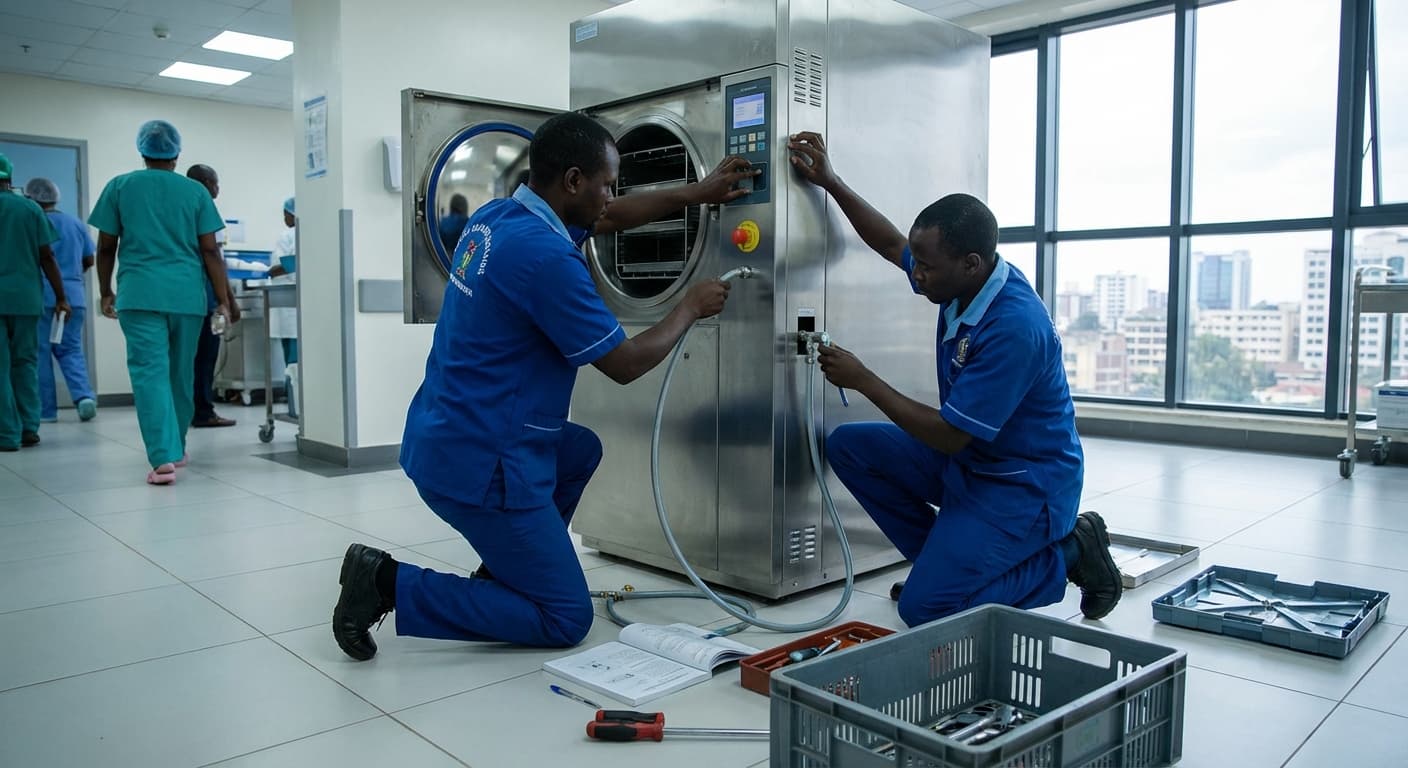
Autoclave & Sterilizer Installation Service in Burundi
Engineering Excellence & Technical Support
Autoclave & Sterilizer Installation Service High-standard technical execution following OEM protocols and local regulatory frameworks.
Certified Autoclave & Sterilizer Installation
Our technicians are certified and experienced in the precise installation of various autoclave and sterilizer models, ensuring optimal performance and compliance with international sterilization standards for healthcare facilities in Burundi.
Comprehensive System Integration & Validation
We provide end-to-end installation, including seamless integration with existing medical infrastructure and rigorous validation testing to guarantee your autoclave and sterilizer system functions flawlessly and reliably for critical sterilization processes.
Expert Calibration & Initial Performance Checks
Post-installation, our services include expert calibration of all parameters and thorough initial performance checks. This ensures immediate and consistent efficacy, vital for preventing cross-contamination and safeguarding patient health in Burundi's healthcare sector.
What Is Autoclave & Sterilizer Installation Service In Burundi?
Autoclave & Sterilizer Installation Service in Burundi refers to the comprehensive process of setting up, connecting, calibrating, and commissioning steam sterilizers (autoclaves) and other sterilization equipment within healthcare facilities, laboratories, and industrial settings in Burundi. This service ensures that these critical pieces of equipment function optimally and safely, meeting regulatory standards for effective microbial inactivation and material sterilization.
| Who Needs Autoclave & Sterilizer Installation Service? | Typical Use Cases | |||
|---|---|---|---|---|
| Healthcare Facilities (Hospitals, Clinics, Dental Offices, Surgical Centers): Essential for sterilizing surgical instruments, medical devices, glassware, and other reusable materials to prevent healthcare-associated infections (HAAs). | Sterilization of surgical instruments (scalpels, forceps, retractors, etc.) | Disinfection of laboratory equipment and glassware | Sterilization of diagnostic kits and consumables | Processing of linen and patient care items |
| Laboratories (Research, Diagnostic, Industrial): Required for sterilizing culture media, laboratory glassware, instruments, and waste materials to maintain aseptic conditions and prevent contamination. | Sterilization of culture media and growth media | Decontamination of laboratory waste (biohazardous materials) | Sterilization of filtration units and sampling equipment | |
| Pharmaceutical and Biotechnology Companies: Critical for sterilizing manufacturing equipment, packaging materials, and components in a controlled environment to ensure product integrity and safety. | Sterilization of vials, stoppers, and syringes | Sterilization of production equipment and pipelines | Decontamination of cleanroom components | |
| Veterinary Clinics and Animal Research Facilities: For sterilizing surgical instruments and equipment used in animal care and research. | Sterilization of veterinary surgical instruments | Processing of animal husbandry equipment | ||
| Cosmetic and Tattooing Facilities: To ensure hygiene and prevent the transmission of infections through reusable equipment. | Sterilization of tattooing needles and equipment | Sterilization of piercing instruments |
Scope of Autoclave & Sterilizer Installation Service:
- Site assessment and preparation: Evaluating the installation location for suitability regarding space, power supply, water access, drainage, ventilation, and structural integrity.
- Equipment delivery and positioning: Safely transporting the autoclave/sterilizer to the site and precisely placing it in its designated operational area.
- Utility connections: Connecting the unit to essential services including electricity (ensuring correct voltage and amperage), clean water supply (often requiring filtration), steam lines (if applicable), and wastewater drainage systems.
- Ventilation and exhaust management: Installing and verifying proper ventilation to dissipate steam and heat, and connecting exhaust systems if required by the equipment model.
- Electrical and plumbing integration: Ensuring secure and compliant electrical wiring and plumbing connections, adhering to local electrical codes and plumbing standards.
- Pre-installation testing and checks: Verifying the physical integrity of the equipment and its components prior to full operational testing.
- Operational testing and calibration: Conducting a series of tests to confirm all functions (e.g., temperature, pressure, cycle times, vacuum) are operating within specified parameters. This includes initial calibration of sensors and control systems.
- Safety feature verification: Ensuring all safety interlocks, pressure relief valves, and emergency stops are functioning correctly.
- Operator training: Providing comprehensive training to facility staff on the safe and effective operation, routine maintenance, and basic troubleshooting of the installed equipment.
- Documentation and handover: Providing all necessary manuals, warranty information, installation reports, and calibration certificates to the client.
- Post-installation support: Offering initial on-site support and guidance after the formal handover.
Who Needs Autoclave & Sterilizer Installation Service In Burundi?
The installation of autoclaves and sterilizers is a critical service for ensuring the highest standards of hygiene and safety in environments where sterile equipment is paramount. In Burundi, like in many developing nations, access to reliable and properly functioning sterilization equipment is essential for public health and well-being. This service is not a luxury but a necessity for a range of organizations and institutions.
| Customer Type | Key Departments/Functions | Why Installation is Crucial |
|---|---|---|
| Hospitals and Clinics | Operating Theatres, Intensive Care Units (ICUs), Emergency Rooms, Maternity Wards, Outpatient Departments (OPDs), Dental Clinics, Sterilization Units | Preventing Healthcare-Associated Infections (HAIs), ensuring patient safety during surgical procedures and medical treatments, maintaining the integrity of medical instruments. |
| Diagnostic and Research Laboratories | Microbiology Labs, Pathology Labs, Clinical Chemistry Labs, Research & Development (R&D) Labs, Blood Banks | Ensuring accurate and reliable test results by eliminating microbial contamination, maintaining sterile environments for sensitive experiments, safe handling of biological samples. |
| Food and Beverage Processing Plants | Production Lines, Quality Control Departments, Packaging Facilities | Preventing spoilage and contamination of food products, ensuring food safety and compliance with national and international regulations, extending shelf life. |
| Pharmaceutical and Cosmetic Manufacturers | Production Lines, Quality Assurance (QA) and Quality Control (QC) Departments, Clean Rooms | Sterilizing equipment and packaging materials to prevent product contamination, maintaining sterile manufacturing environments, ensuring product safety and efficacy for consumers. |
| Veterinary Hospitals and Clinics | Surgical Suites, Diagnostic Labs, Treatment Areas | Preventing the spread of zoonotic diseases, ensuring the safety of animals undergoing medical procedures, sterilizing surgical instruments and diagnostic equipment. |
| Government Health Agencies and Public Health Institutions | Public health laboratories, vaccination centers, emergency response units | Supporting public health initiatives, ensuring the sterility of equipment used in disease surveillance and control programs, facilitating rapid response to outbreaks. |
| Non-Governmental Organizations (NGOs) and International Aid Organizations | Mobile clinics, health outreach programs, community health centers | Providing essential healthcare services in remote areas, ensuring the safe and effective use of medical equipment in resource-limited settings. |
Target Customers and Departments Requiring Autoclave & Sterilizer Installation Service in Burundi
- Healthcare Facilities
- Laboratories
- Food and Beverage Industry
- Cosmetic and Pharmaceutical Manufacturing
- Veterinary Clinics
Autoclave & Sterilizer Installation Service Process In Burundi
This document outlines the comprehensive workflow for Autoclave and Sterilizer Installation Services in Burundi, guiding clients from their initial inquiry to the successful execution of the installation. Our process is designed for clarity, efficiency, and to ensure all client needs are met with the highest standards of professionalism and safety. We prioritize understanding your specific requirements to deliver a tailored and effective solution.
| Phase | Step | Description | Key Activities | Deliverables |
|---|---|---|---|---|
| 1: Inquiry & Consultation | 1.1 Initial Contact | The client expresses interest in autoclave/sterilizer installation services. | Phone call, email, website inquiry form submission, in-person meeting. | Acknowledgement of inquiry, initial understanding of client needs. |
| 1: Inquiry & Consultation | 1.2 Needs Assessment & Information Gathering | We gather detailed information about the client's requirements, facility, and existing infrastructure. | Discussion on type of equipment, intended use, space availability, power requirements, water supply, existing utilities, budget, desired timeline. | Comprehensive understanding of project scope and client expectations. |
| 2: Site Assessment & Planning | 2.1 Site Visit (if required) | A technical team visits the client's location to evaluate the installation site. | Measurement of space, assessment of electrical and plumbing points, ventilation, accessibility for equipment delivery, identification of potential challenges. | Detailed site survey report, identification of any site modifications needed. |
| 2: Site Assessment & Planning | 2.2 Technical Planning & Design | Based on gathered information, a detailed installation plan is developed. | Engineering drawings, utility connection schematics, equipment placement layout, safety protocols, timeline scheduling. | Approved installation plan, technical specifications. |
| 3: Quotation & Agreement | 3.1 Proposal Generation | A comprehensive quotation outlining all costs and services is prepared. | Itemized breakdown of equipment costs (if applicable), labor, materials, permits, travel, contingency. Clear scope of work and exclusions. | Formal quotation/proposal. |
| 3: Inquiry & Consultation | 3.2 Contract & Agreement | Upon client acceptance of the quotation, a formal service agreement is drafted and signed. | Legal review of terms and conditions, payment schedule, warranty information, responsibilities of both parties. | Signed service agreement/contract. |
| 4: Procurement & Logistics | 4.1 Equipment Sourcing (if applicable) | If the client has not provided the equipment, we source it from reputable suppliers. | Procurement process, quality checks, supplier negotiation. | Procured and verified equipment. |
| 4: Procurement & Logistics | 4.2 Material & Tool Preparation | All necessary installation materials, tools, and safety equipment are gathered. | Inventory check, procurement of consumables (pipes, fittings, wires), calibration of tools. | All required materials and tools ready on-site. |
| 4: Procurement & Logistics | 4.3 Logistics & Transportation | Arrangement for safe and timely delivery of equipment and materials to the installation site. | Coordination of transport, insurance, customs clearance (if applicable). | Equipment and materials successfully delivered to site. |
| 5: Pre-Installation Preparation | 5.1 Site Preparation | The installation area is prepared according to the approved plan. | Clearing the area, minor structural modifications (if necessary), ensuring utilities are accessible and functional. | Site ready for installation commencement. |
| 5: Pre-Installation Preparation | 5.2 Utility Connections | Ensuring all required utilities (electricity, water, drainage) are ready for connection. | Verification of voltage, pressure, and flow rates. Pre-installation of junction boxes, piping. | Utilities ready for connection to the equipment. |
| 6: Installation & Commissioning | 6.1 Equipment Installation | Skilled technicians install the autoclave/sterilizer according to manufacturer guidelines and best practices. | Unpacking, positioning, structural mounting, connection to utilities, wiring, plumbing. | Equipment physically installed in its designated location. |
| 6: Installation & Commissioning | 6.2 System Testing & Calibration | Thorough testing of all equipment functions and calibration to ensure optimal performance. | Functional checks of all cycles, temperature and pressure verification, safety feature testing, data logging setup. | Fully functional and calibrated equipment. |
| 6: Installation & Commissioning | 6.3 Commissioning & Validation | Formal commissioning process to certify the equipment is operating as per specifications and standards. | Performance qualification (PQ), operational qualification (OQ), process validation (if required by client). | Certified and validated installation. |
| 7: Training & Handover | 7.1 Operator Training | Comprehensive training provided to the client's staff on the operation, maintenance, and safety of the equipment. | Demonstration of operating procedures, cycle selection, loading/unloading techniques, basic troubleshooting, cleaning protocols. | Trained personnel capable of operating the equipment safely and effectively. |
| 7: Training & Handover | 7.2 Documentation Handover | All relevant documentation is provided to the client. | User manuals, maintenance logs, warranty certificates, test reports, commissioning certificates, as-built drawings. | Complete set of project documentation. |
| 7: Training & Handover | 7.3 Final Walkthrough & Acceptance | A final walkthrough of the installation with the client to ensure satisfaction and obtain formal acceptance. | Review of work performed, addressing any final questions or concerns. | Client sign-off and formal project acceptance. |
| 8: Post-Installation Support & Follow-up | 8.1 Warranty Support | Providing support during the warranty period as per the service agreement. | Troubleshooting, repairs, and replacement of parts as needed. | Assistance during the warranty period. |
| 8: Post-Installation Support & Follow-up | 8.2 Maintenance Services | Offering scheduled preventive maintenance services to ensure long-term reliability. | Routine inspections, cleaning, calibration, and part replacement recommendations. | Ongoing maintenance plans. |
| 8: Post-Installation Support & Follow-up | 8.3 Customer Feedback & Relationship Management | Gathering feedback to continuously improve services and maintain client relationships. | Post-installation surveys, follow-up calls. | Client satisfaction and ongoing partnership. |
Autoclave & Sterilizer Installation Service Process
- Phase 1: Inquiry & Consultation
- Phase 2: Site Assessment & Planning
- Phase 3: Quotation & Agreement
- Phase 4: Procurement & Logistics
- Phase 5: Pre-Installation Preparation
- Phase 6: Installation & Commissioning
- Phase 7: Training & Handover
- Phase 8: Post-Installation Support & Follow-up
Autoclave & Sterilizer Installation Service Cost In Burundi
The cost of installing an autoclave or sterilizer in Burundi can vary significantly based on several factors. These include the type and size of the sterilizer, the complexity of the installation (e.g., need for plumbing, electrical upgrades, ventilation), the chosen service provider, and the geographic location within Burundi. It's crucial to obtain detailed quotes from reputable service providers to get an accurate estimate for your specific needs. Local currency for Burundi is the Burundian Franc (BIF).
| Installation Type/Complexity | Estimated Cost Range (BIF) | Notes |
|---|---|---|
| Basic Installation (simple plug-and-play, no major modifications) | 200,000 - 500,000 BIF | Assumes existing suitable power and water supply. Primarily labor and basic connection. |
| Standard Installation (minor plumbing/electrical adjustments) | 500,000 - 1,500,000 BIF | May involve extending electrical circuits, minor pipework for water or drainage. Includes materials and labor. |
| Complex Installation (significant electrical upgrades, new plumbing, ventilation) | 1,500,000 - 5,000,000+ BIF | Requires substantial modifications, potentially involving construction, new piping, dedicated circuits, and ventilation systems. Cost is highly variable. |
| Installation of Large Industrial Autoclaves | 5,000,000+ BIF | These often require specialized engineering, structural considerations, and extensive utility hookups. Prices are custom quoted. |
Key Pricing Factors for Autoclave & Sterilizer Installation in Burundi:
- Type of Sterilizer: Steam autoclaves, chemical sterilizers, and dry heat sterilizers have different installation requirements.
- Size and Capacity: Larger units may require more robust infrastructure and specialized handling.
- Location of Installation: Accessibility to the site and proximity to urban centers can influence labor and transportation costs.
- Existing Infrastructure: The need for new electrical wiring, plumbing connections, water supply, drainage, or specialized ventilation systems will impact the overall cost.
- Service Provider Reputation and Expertise: Highly experienced and certified technicians may command higher fees.
- Brand and Model of Sterilizer: Some brands may have specific installation protocols or require authorized installers.
- Ancillary Services: This could include initial calibration, user training, and waste disposal arrangements.
- Geographic Region within Burundi: Costs might differ between major cities like Bujumbura and more remote areas.
Affordable Autoclave & Sterilizer Installation Service Options
Investing in a reliable autoclave or sterilizer is crucial for many industries, including healthcare, laboratories, and veterinary clinics. Our installation service ensures your equipment is set up correctly, safely, and efficiently, minimizing downtime and maximizing operational effectiveness. We offer a range of flexible installation options, from basic setup to comprehensive project management, designed to meet your specific needs and budget. Explore our value bundles and cost-saving strategies to find the most economical solution for your facility.
| Value Bundle Name | Included Services | Key Benefits | Ideal For | Estimated Cost Range (Excludes Equipment) |
|---|---|---|---|---|
| Basic Setup & Commissioning | On-site installation, basic connectivity (power, water if applicable), initial system check, and functional test. | Quickest setup, essential for straightforward installations. | Smaller clinics, basic laboratory setups, single-unit installations. | $500 - $1,200 |
| Standard Installation Package | Includes Basic Setup plus: Site preparation assessment, utility connection verification, system calibration, operator training (basic level). | Ensures a more thorough installation and empowers staff with initial knowledge. | Medium-sized practices, multi-unit installations, facilities needing basic operator guidance. | $900 - $2,500 |
| Comprehensive Project Management | Includes Standard Package plus: Pre-installation site survey, coordination with other trades (plumbing, electrical), custom integration planning, full operator and maintenance training, post-installation support (e.g., 30-day follow-up). | Seamless integration, minimizes disruption, comprehensive training for long-term success. | Hospitals, large research facilities, multi-departmental clinics, complex installations requiring specialized integration. | $1,800 - $5,000+ |
Why Choose Professional Autoclave & Sterilizer Installation?
- Ensures proper calibration and functionality from day one.
- Reduces the risk of equipment damage or premature failure due to incorrect installation.
- Complies with safety regulations and manufacturer warranties.
- Minimizes downtime, allowing your operations to resume quickly.
- Provides peace of mind knowing your critical equipment is installed by experts.
Verified Providers In Burundi
In Burundi's healthcare landscape, identifying reliable and high-quality medical services is paramount for individuals and organizations alike. Verified providers, those who meet stringent accreditation and quality standards, offer a crucial assurance of safety and efficacy. Franance Health stands out as a leading entity in this domain, meticulously vetting and endorsing healthcare facilities and practitioners. Their rigorous credentialing process not only validates the technical expertise and ethical conduct of providers but also ensures adherence to best practices in patient care and operational management. This commitment to excellence makes Franance Health-verified providers the superior choice for anyone seeking dependable healthcare solutions in Burundi.
| Provider Category | Franance Health Verification Criteria | Why it Matters for Patients |
|---|---|---|
| Hospitals & Clinics | Accreditation in clinical governance, patient care pathways, and infection control; adherence to medical best practices. | Ensures access to safe, effective, and well-managed medical treatment with minimized risks. |
| Specialist Doctors | Validation of medical degrees, specialty certifications, board registrations, and ethical conduct. | Guarantees consultation and treatment from highly qualified and trustworthy medical experts. |
| Diagnostic Laboratories | Compliance with quality management systems (e.g., ISO standards), calibration of equipment, and proficiency testing. | Provides accurate and reliable diagnostic results essential for effective treatment planning. |
| Pharmaceutical Services | Verification of drug sourcing, storage, dispensing protocols, and pharmacist licensing. | Ensures the provision of safe, authentic, and correctly administered medications. |
Key Benefits of Choosing Franance Health Verified Providers:
- Uncompromising Quality Standards: Providers undergo rigorous assessment of their facilities, equipment, and medical protocols.
- Expert Medical Professionals: Verification confirms the qualifications, experience, and licensing of all healthcare staff.
- Patient Safety Focus: Emphasis on adherence to international safety guidelines and infection control measures.
- Ethical Practice Assurance: Commitment to transparent pricing, informed consent, and patient confidentiality.
- Continuous Improvement: Verified providers are dedicated to ongoing professional development and service enhancement.
- Reputation and Trust: Association with Franance Health signifies a proven track record of reliable and compassionate care.
Scope Of Work For Autoclave & Sterilizer Installation Service
This Scope of Work (SOW) outlines the requirements for the professional installation of an autoclave and sterilizer at [Client Facility Name and Address]. The service includes all necessary labor, materials, and project management to ensure a safe, compliant, and fully functional installation. This SOW also details the technical deliverables and standard specifications expected for this project.
| Phase/Activity | Description | Deliverables | Standard Specifications/Requirements |
|---|---|---|---|
| Detailed assessment of the installation site, including space, access, power, water, drainage, and ventilation requirements. Review of manufacturer's installation manual. Finalization of installation plan. | Site survey report. Approved installation plan. Risk assessment. Finalized equipment placement drawing. | Compliance with manufacturer's minimum clearance requirements. Adequate power supply (voltage, amperage, circuit breaker rating). Accessible water supply (pressure, type). Sufficient drainage capacity and slope. Appropriate ventilation for heat and steam dissipation. Accessibility for equipment delivery and maintenance. Adherence to local building codes and electrical safety standards. |
| Coordination of equipment delivery to the site. Inspection of equipment for any shipping damage. Careful unpacking and staging of the unit(s) in the designated installation area. | Confirmation of equipment delivery. Damaged goods report (if applicable). Unpacked and staged unit(s). | Secure and careful handling of equipment. Documentation of any visible damage with photographic evidence. Protection of surrounding areas from damage. |
| Execution of any necessary modifications to the site, including minor structural changes, electrical wiring, plumbing connections, and ventilation ductwork. | Completed site modifications. Installed electrical, plumbing, and ventilation infrastructure. | Electrical: Installation of dedicated circuits with appropriate breakers, grounding, and conduit. Compliance with NEC/local electrical codes. Plumbing: Connection to potable water supply with backflow prevention. Installation of appropriate drainage lines with traps and vents. Compliance with local plumbing codes. Ventilation: Installation of exhaust ductwork to safely vent steam and heat away from the area, meeting manufacturer's requirements and local codes. |
| Positioning and securing of the autoclave/sterilizer unit(s) in the final location. Connection to prepared electrical, plumbing, and ventilation systems. | Installed and secured unit(s). Connected to site utilities. | Level and stable installation. Secure anchoring if required by manufacturer or local codes. Watertight and leak-free plumbing connections. Secure electrical connections. Proper fitting of ventilation ductwork. |
| Performance of initial system checks, leak tests, operational tests, and full commissioning cycles according to manufacturer's specifications and relevant standards. | Completed test logs. Commissioning report. Calibration certificates (if applicable). | Successful completion of all manufacturer-recommended test cycles. Verification of operating parameters (temperature, pressure, time). Validation of safety features. No water or steam leaks detected. All control systems functioning as designed. Calibration of critical sensors to within manufacturer tolerances. |
| Provision of all necessary installation documentation, user manuals, and operation/maintenance training for client personnel. Handover of keys and access codes. | Complete installation documentation package. User and maintenance manuals. Training session attendance records. Signed handover certificate. | Documentation includes: as-built drawings, electrical schematics, plumbing diagrams, test reports, commissioning reports, warranty information. Training covers: daily operation, basic troubleshooting, preventive maintenance procedures, emergency shutdown procedures. |
| Final site cleanup, removal of debris, and formal acceptance of the completed installation by the client. | Cleaned installation area. Signed project acceptance form. | All installation-related waste and packaging materials removed from the site. Site left in a clean and orderly condition. Client confirmation of satisfactory installation. |
Project Objectives
- To safely and securely install the procured autoclave/sterilizer unit(s).
- To ensure the installation adheres to all relevant local, national, and industry-specific codes and regulations (e.g., plumbing, electrical, ventilation, safety standards).
- To integrate the unit(s) with existing site infrastructure (e.g., water supply, drainage, power, ventilation) as required.
- To provide comprehensive testing and commissioning of the installed unit(s).
- To deliver all required documentation, training, and certification upon completion.
- To minimize disruption to client operations during the installation process.
Service Level Agreement For Autoclave & Sterilizer Installation Service
This Service Level Agreement (SLA) outlines the standards of service, response times, and uptime guarantees for the Autoclave & Sterilizer Installation Service provided by [Your Company Name] to [Client Name]. This SLA aims to ensure the successful and timely installation of autoclaves and sterilizers, minimizing downtime and maximizing operational efficiency for the client.
| Service Component | Response Time Guarantee | Resolution Time Target | Uptime Guarantee |
|---|---|---|---|
| Initial Site Assessment & Quotation | Within 2 business days of request | N/A | N/A |
| Installation Scheduling | Within 3 business days of agreement sign-off | N/A | N/A |
| On-site Installation Commencement | As per agreed schedule (typically within 5-10 business days of scheduling, dependent on equipment availability and client site readiness) | N/A | N/A |
| Critical Issues During Installation (e.g., major equipment malfunction, safety hazard) | Immediate on-site or remote response (within 2 hours) | Strive for resolution within 8 business hours | N/A |
| Non-Critical Issues During Installation (e.g., minor calibration adjustment, documentation query) | Within 4 business hours | Strive for resolution within 1 business day | N/A |
| Post-Installation Support (first 30 days) | Remote support: Within 4 business hours. On-site support: Within 1 business day for critical issues, 2 business days for non-critical. | Strive for resolution within 8 business hours (remote critical), 2 business days (on-site critical) | 99.5% (for critical system operational status during the 30-day post-installation period, excluding scheduled maintenance or client-induced issues) |
Scope of Service
- On-site assessment and consultation for autoclave/sterilizer installation.
- Procurement and delivery of specified autoclave/sterilizer units and required accessories.
- Professional installation of autoclave/sterilizer units according to manufacturer specifications and relevant safety standards.
- Integration with existing facility infrastructure (plumbing, electrical, ventilation, etc.).
- Initial system testing, calibration, and validation.
- User training on operation and basic maintenance.
- Post-installation support for a defined period.
Frequently Asked Questions

Ready when you are
Let's scope your Autoclave & Sterilizer Installation Service in Burundi project in Burundi.

Scaling healthcare logistics and technical systems across the entire continent.