
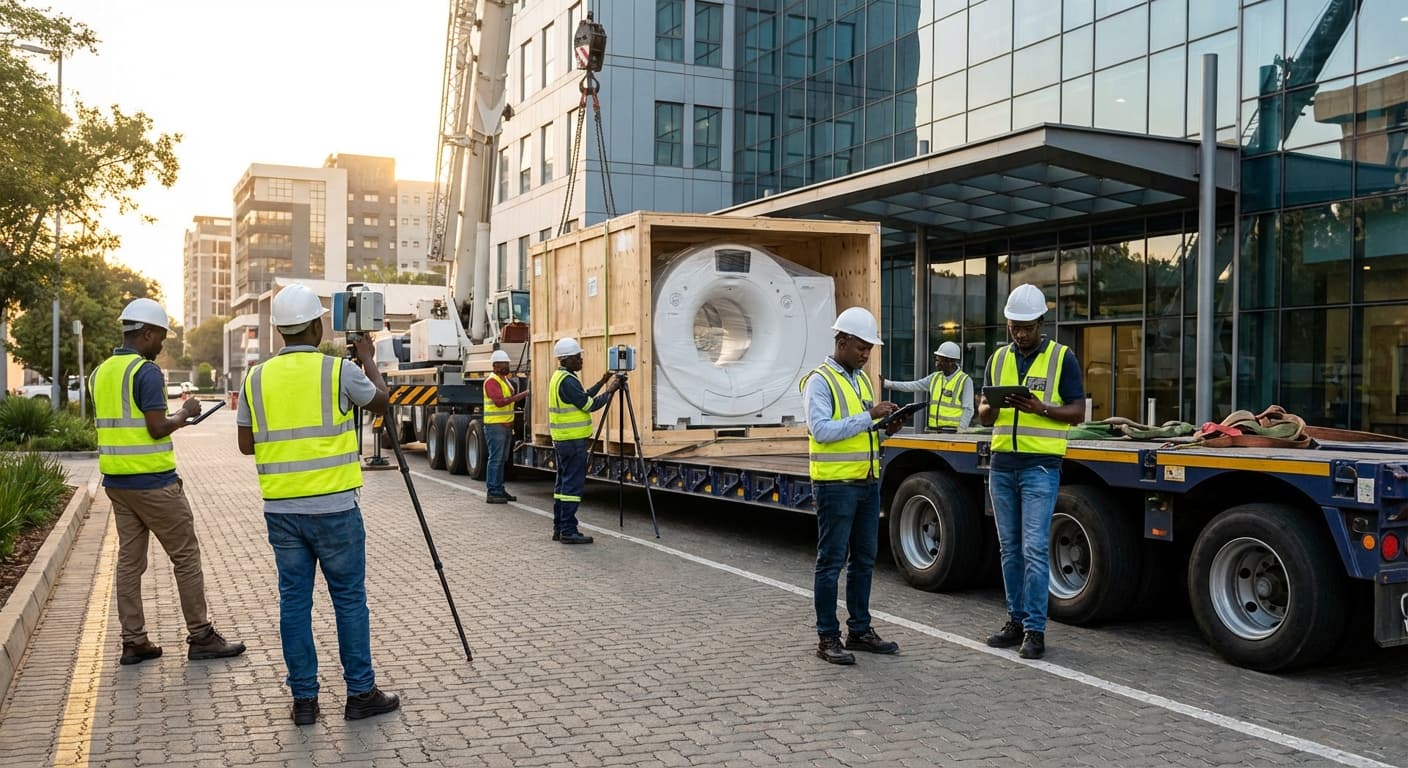
Route Survey & Rigging Plan Service for Heavy Medical Equipment in Burundi
Engineering Excellence & Technical Support
Route Survey & Rigging Plan Service for Heavy Medical Equipment High-standard technical execution following OEM protocols and local regulatory frameworks.
Precise Route Mapping & Obstacle Analysis
Leveraging advanced GPS and LiDAR technology, we conduct meticulous route surveys to identify all potential obstacles (e.g., bridge load capacities, narrow streets, overhead clearances, terrain gradients) along the proposed transport path for heavy medical equipment in Burundi. Our detailed reports ensure the safest and most efficient movement of critical healthcare assets.
Customized Rigging & Lift Plan Development
Our certified rigging engineers design bespoke rigging and lift plans tailored to the specific weight, dimensions, and fragility of each medical equipment piece. We account for local environmental conditions and available infrastructure in Burundi, ensuring secure lifting, transportation, and placement with minimal risk of damage.
Regulatory Adherence & Risk Mitigation Strategy
We navigate and ensure compliance with all relevant local and international regulations pertaining to the transport of specialized heavy equipment within Burundi. Our comprehensive risk mitigation strategies, developed through expert route surveys and rigging plans, guarantee operational safety, asset integrity, and timely delivery for vital medical equipment.
What Is Route Survey & Rigging Plan Service For Heavy Medical Equipment In Burundi?
Route Survey & Rigging Plan Service for Heavy Medical Equipment in Burundi is a specialized logistical and engineering service focused on the safe, efficient, and compliant transportation and installation of exceptionally large, heavy, and sensitive medical apparatus within Burundi. This service encompasses a multi-faceted approach, integrating meticulous planning with practical execution to mitigate risks associated with moving and positioning equipment that often exceeds standard logistical capabilities. It necessitates detailed site assessments, structural integrity evaluations, route optimization considering local infrastructure constraints, and the development of precise rigging and lifting methodologies tailored to the specific equipment and the Burundian environment. The service aims to ensure the equipment reaches its intended operational location without damage, and is installed to manufacturer specifications, adhering to all relevant safety and regulatory frameworks.
| Service Recipient | Need for Service | Typical Use Cases |
|---|---|---|
| Hospitals and Healthcare Facilities (Public and Private) | Acquisition of large-scale diagnostic imaging equipment (e.g., MRI, CT scanners), radiotherapy units, surgical suites, or modular medical units. Requires precise planning for delivery through challenging urban or rural infrastructure and safe installation within existing or new building structures. | Delivery and installation of a new MRI scanner into a provincial hospital with narrow access roads and limited interior space. Transportation and rigging of a modular radiotherapy bunker into a major city hospital where existing infrastructure may not be suitable for direct equipment placement. Relocation of heavy surgical equipment within a multi-story medical complex. |
| Medical Equipment Manufacturers and Suppliers | Ensuring their high-value, sensitive equipment is delivered to the end-user in Burundi without damage, adhering to installation timelines, and meeting contractual obligations. This service acts as a crucial extension of their supply chain and installation capabilities. | Overseeing the 'last mile' delivery and installation of a complex laboratory analysis system to a research institute. Coordinating the entire logistical chain for a fleet of new diagnostic X-ray machines to be deployed across various healthcare centers. Managing the import and final placement of advanced anesthesia machines for a major surgical center. |
| Government Health Ministries and Agencies | Facilitating the deployment of critical medical infrastructure, especially in remote or underserved areas, often involving large capital investments. Requires efficient and cost-effective logistics to maximize public health impact. | Strategic deployment of mobile diagnostic units to remote regions. Establishing new specialized medical departments within existing government hospitals that require significant heavy equipment installation. Procurement and installation of large-scale sterilization equipment for national health facilities. |
| International Aid Organizations and NGOs | Implementing healthcare projects in Burundi, often involving the delivery of essential heavy medical equipment to areas with underdeveloped infrastructure and limited technical expertise for handling such items. | Delivery and setup of an ultrasound machine and related equipment to a clinic in a rural community with unpaved roads. Installation of critical care equipment in a temporary medical facility established after a natural disaster. Deploying specialized surgical equipment to support outreach medical programs. |
Key Components of Route Survey & Rigging Plan Service:
- Pre-Survey and Feasibility Study: Initial assessment of equipment specifications, weight, dimensions, and preliminary route identification.
- Detailed Route Survey: Comprehensive on-site inspection of proposed transportation routes, identifying potential obstructions (e.g., bridges, tunnels, overhead lines, narrow roads, turning radii), load-bearing capacities of infrastructure, and traffic management requirements.
- Site Assessment (Origin and Destination): Evaluation of loading and unloading points, including site access, ground stability, space constraints, and existing infrastructure at both the source and destination facilities.
- Structural Integrity Analysis: Assessment of the structural capacity of floors, foundations, and mounting points at the destination to support the weight and operational stresses of the medical equipment.
- Rigging and Lifting Plan Development: Engineering design of lifting and rigging procedures, including selection of appropriate cranes, lifting gear, slings, and bracing. This plan details the sequence of operations, load calculations, safety protocols, and required personnel expertise.
- Transportation Planning: Optimization of the transport mode (e.g., specialized trucks, trailers), route finalization, and coordination with local authorities for permits, escorts, and traffic control.
- Risk Assessment and Mitigation: Identification of potential hazards throughout the process (e.g., weather, equipment failure, environmental factors, local conditions) and development of contingency plans.
- Installation and Commissioning Support: On-site supervision and technical assistance during the rigging, placement, and initial setup of the medical equipment.
- Documentation and Reporting: Creation of detailed reports, including survey findings, route maps, rigging plans, risk assessments, and post-operation summaries.
- Regulatory Compliance: Ensuring adherence to all local Burundian regulations, safety standards, and international best practices for heavy lifting and transportation.
Who Needs Route Survey & Rigging Plan Service For Heavy Medical Equipment In Burundi?
Specialized route survey and rigging plan services are crucial for the safe and efficient transportation and installation of heavy medical equipment in Burundi. This ensures that delicate, high-value equipment reaches its destination without damage and can be properly integrated into healthcare facilities. These services are particularly vital due to Burundi's infrastructure challenges, including varying road conditions, potential for difficult terrain, and the need for precise handling of complex machinery.
| Target Customer/Organization Type | Primary Need | Relevant Departments/Roles |
|---|---|---|
| Hospitals & Clinics (Public & Private) | Safe delivery & installation of MRI, CT scanners, X-ray machines, etc.; relocation planning. | Procurement, Facilities Management, Biomedical Engineering, Administration |
| Ministry of Health | Nationwide equipment deployment, upgrades, and infrastructure projects. | National Health Directorate, Procurement, Planning |
| International NGOs (e.g., MSF, WHO partners) | Logistical support for medical aid projects, equipment deployment in remote areas. | Program Management, Logistics, Technical Teams |
| Medical Equipment Manufacturers/Distributors | Ensuring successful installation and client satisfaction; risk mitigation during transport. | Logistics, Field Service, Project Management |
| Construction Companies (Healthcare Projects) | Site access planning, material handling for large equipment during construction/renovation. | Project Management, Site Operations |
Target Customers and Departments for Route Survey & Rigging Plan Services for Heavy Medical Equipment in Burundi:
- {"title":"Healthcare Providers & Institutions","departments":["Procurement Department","Facilities Management/Engineering Department","Biomedical Engineering Department","Hospital Administration"],"description":"Hospitals, clinics, and diagnostic centers are the primary recipients of heavy medical equipment. They need these services to ensure new acquisitions are successfully delivered and installed, and to plan for the relocation or decommissioning of existing large-scale equipment."}
- {"title":"Government Ministries & Agencies","departments":["Ministry of Public Health and Fight against AIDS (The) (MTSP)","Ministry of Finance, Budget and Economic Planning","National Health Directorate","Public Procurement Regulatory Authority (ARMP)"],"description":"Government bodies responsible for healthcare infrastructure development, public health initiatives, and the management of public hospitals require these services for nationwide equipment procurements and upgrades."}
- {"title":"Non-Governmental Organizations (NGOs) & International Aid Organizations","departments":["Program Management","Logistics and Supply Chain Management","Technical Operations","Project Implementation Teams"],"description":"Many NGOs and international aid agencies fund and implement healthcare projects in Burundi, often involving the donation or installation of advanced medical equipment. They rely on these specialized services to ensure their investments are impactful and well-executed."}
- {"title":"Medical Equipment Manufacturers & Suppliers","departments":["Logistics Department","Field Service Engineering","Sales and Project Management"],"description":"Companies that manufacture or supply heavy medical equipment often outsource route survey and rigging services to ensure a seamless and secure delivery and installation process for their clients in Burundi. This is a crucial part of their after-sales service."}
- {"title":"Construction & Infrastructure Development Companies","departments":["Project Management","Logistics and Site Management"],"description":"When new healthcare facilities are being built or existing ones are being expanded, construction companies may engage route survey and rigging services to ensure the safe transport of equipment to construction sites and for the integration of large equipment within the building structure."}
Route Survey & Rigging Plan Service For Heavy Medical Equipment Process In Burundi
Our Route Survey & Rigging Plan Service for Heavy Medical Equipment Process in Burundi is designed to ensure the safe and efficient transportation and installation of critical medical devices. This comprehensive service addresses the unique logistical challenges present in Burundi, from initial inquiry to final handover. We meticulously plan every step to mitigate risks, optimize routes, and guarantee the integrity of the equipment throughout its journey and placement.
| Stage | Description | Key Activities | Deliverables | Burundi Specific Considerations |
|---|---|---|---|---|
| Inquiry & Initial Consultation | Understanding client's needs, equipment specifications, and project timeline. | Receive inquiry, schedule initial meeting, gather preliminary information. | Project brief, preliminary scope of work, quotation. | Understanding of local customs and business etiquette is crucial. |
| Site Assessment & Route Survey | Detailed evaluation of the destination site and the optimal route for transportation. | On-site visits, measurement of doorways/hallways, assessment of terrain, identification of road conditions, bridge load capacities, turning radii, overhead obstructions, and potential access points. | Route feasibility report, site survey report, photographic documentation, GPS coordinates of key points. | Poor road infrastructure, unpaved sections, potential for seasonal impassability (rainy season), limited availability of detailed maps, need for local guides/interpreters. |
| Risk Assessment & Mitigation Strategy Development | Identifying potential hazards and developing proactive strategies to manage them. | Hazard identification (e.g., weather, security, equipment damage, site access), development of contingency plans, safety protocols, and emergency response procedures. | Risk assessment report, mitigation plan, emergency contact list. | Potential for political instability, limited emergency services, and specific health risks requiring tailored safety measures. |
| Rigging Plan Design & Equipment Specification | Developing precise methods for lifting, maneuvering, and positioning the heavy medical equipment. | Determining lifting points, selecting appropriate rigging gear (e.g., cranes, hoists, specialized dollies), calculating load capacities, designing lifting configurations, specifying bracing and securing methods. | Detailed rigging plan drawings, equipment specifications, lifting calculations, method statements. | Availability and condition of specialized rigging equipment locally might be limited; potential need for importing or specialized local partnerships. |
| Permitting & Approvals | Securing necessary permissions from local authorities for transportation and site access. | Liaising with government agencies, obtaining road permits, traffic management approvals, site access permits. | Approved permits and documentation. | Bureaucratic processes can be lengthy and complex; requires local knowledge and relationships. |
| Pre-Operation Briefing & Team Mobilization | Ensuring all stakeholders are informed and the team is ready for execution. | Briefing of the operational team, site personnel, and client representatives; ensuring all equipment and personnel are on-site and ready. | Pre-operation briefing notes, team roster, equipment readiness checklist. | Need for cultural sensitivity training for the team; clear communication protocols are essential. |
| Transportation & Logistics Execution | The physical movement of the medical equipment from origin to the destination. | Loading, transportation using specialized vehicles, convoy management, escort services (if required), real-time tracking. | Transportation log, delivery confirmation. | Potential for checkpoints, need for robust vehicle maintenance, and planning for fuel availability. |
| Rigging & Installation | Careful lifting, maneuvering, and positioning of the equipment at its final location. | Execution of the rigging plan, precise placement of equipment, securing of the equipment. | Installation report, photographic evidence of successful rigging. | Ensuring proper anchoring and foundation based on site assessment; potential for power supply issues during installation. |
| Post-Installation Verification & Handover | Confirming the equipment is correctly installed and ready for use. | Inspection of the installed equipment, functional testing (as per manufacturer's guidelines), client sign-off on installation. | Handover certificate, final installation report, client acceptance. | Ensuring client personnel are trained on basic operational aspects if included in scope. |
| Project Closure & Reporting | Finalizing all project documentation and client communication. | Compilation of all project documentation, final client report, invoicing, lessons learned analysis. | Final project report, financial reconciliation. | Maintaining open communication channels for any post-project queries. |
Workflow Stages
- Inquiry & Initial Consultation
- Site Assessment & Route Survey
- Risk Assessment & Mitigation Strategy Development
- Rigging Plan Design & Equipment Specification
- Permitting & Approvals
- Pre-Operation Briefing & Team Mobilization
- Transportation & Logistics Execution
- Rigging & Installation
- Post-Installation Verification & Handover
- Project Closure & Reporting
Route Survey & Rigging Plan Service For Heavy Medical Equipment Cost In Burundi
The cost of a route survey and rigging plan service for heavy medical equipment in Burundi is influenced by several key factors. These include the complexity and weight of the equipment, the specific route to be surveyed (urban vs. rural, road conditions, access points), the number of personnel and specialized equipment required for the rigging, the duration of the survey and rigging operations, and any necessary permits or security arrangements. Given the developing infrastructure and potential logistical challenges in Burundi, these services often require meticulous planning and execution to ensure the safe and efficient transportation and installation of sensitive medical equipment. It's crucial for clients to obtain detailed quotes that break down these cost components. Local pricing is generally negotiated on a case-by-case basis, but we can provide estimated ranges. Please note that these are approximate and can vary significantly.
| Service Component | Estimated Cost Range (BIF - Burundi Francs) | Notes |
|---|---|---|
| Route Survey (Basic - urban, good roads) | 1,500,000 - 3,000,000 BIF | Covers initial assessment, basic mapping, and potential road condition checks. |
| Route Survey (Complex - rural, poor roads, multiple access points) | 3,000,000 - 7,000,000 BIF | Includes detailed reconnaissance, obstacle identification, and detailed route planning. |
| Rigging Plan Development | 1,000,000 - 2,500,000 BIF | Technical drawings, risk assessment, and step-by-step procedural planning. |
| Basic Rigging Crew (per day, 2-3 specialists) | 800,000 - 1,500,000 BIF | Excludes specialized equipment rental. |
| Heavy-Duty Rigging Crew (per day, 4+ specialists, complex tasks) | 1,500,000 - 4,000,000 BIF | For heavier equipment and more challenging maneuvers. |
| Specialized Equipment Rental (e.g., crane, forklift - daily) | 1,000,000 - 5,000,000+ BIF | Highly dependent on equipment type, size, and rental duration. |
| Permits & Administrative Fees | 200,000 - 1,000,000 BIF | Variable based on local regulations and number of permits required. |
| Contingency/Mobilization Fees | 5% - 15% of total project cost | To cover unforeseen circumstances and initial setup. |
| Total Estimated Cost (for moderate complexity, 2-3 day project) | 8,000,000 - 25,000,000 BIF | This is a broad estimate and can increase significantly for highly specialized or large-scale projects. |
Key Pricing Factors for Route Survey & Rigging Plan Services in Burundi
- Equipment characteristics (weight, dimensions, fragility)
- Route complexity (distance, road quality, obstacles, terrain)
- Access to installation site (doorways, elevator capacity, building structure)
- Number of rigging specialists and support crew
- Specialized rigging equipment (cranes, lifts, dollies, specialized tools)
- Duration of survey and rigging operations
- Permits, licenses, and administrative fees
- Security arrangements and escort services
- Contingency planning and risk assessment
- Insurance coverage
Affordable Route Survey & Rigging Plan Service For Heavy Medical Equipment Options
Our Affordable Route Survey & Rigging Plan Service is designed to provide comprehensive and cost-effective solutions for the safe and efficient transport and installation of heavy medical equipment. We understand the unique challenges and high stakes involved in moving sensitive and bulky machinery. Our service goes beyond a simple survey, offering a complete rigging plan that anticipates potential obstacles and ensures regulatory compliance. We leverage our expertise to identify the most efficient and safest routes, meticulously planning every step of the rigging process, from lifting points and specialized equipment to crew requirements and logistical coordination. This proactive approach minimizes risks, prevents costly delays, and safeguards your valuable medical assets. We offer flexible value bundles and implement strategic cost-saving measures to make our services accessible to a wide range of healthcare providers and equipment manufacturers.
| Cost-Saving Strategy | Description | Benefit |
|---|---|---|
| Early Engagement | Involving our team in the early stages of planning allows for optimal route selection and the identification of potential issues before they become costly problems. | Minimizes last-minute changes, potential delays, and emergency equipment rentals. |
| Standardized Planning Templates | We utilize pre-developed, adaptable templates for route surveys and rigging plans, ensuring efficiency without compromising quality. | Reduces planning time and associated labor costs. |
| Leveraging Existing Infrastructure | Where possible, we assess and propose utilizing existing infrastructure or common lifting equipment, rather than requiring specialized, high-cost rentals. | Lowers equipment rental expenses. |
| Virtual Survey Options | For less complex scenarios, we offer virtual route assessment and plan development using client-provided data and remote collaboration tools. | Reduces travel expenses and on-site time. |
| Bulk Purchasing & Partnerships | Through established relationships with rigging equipment suppliers and transportation providers, we secure favorable rates that we pass on to our clients. | Provides access to cost-effective resources. |
| Risk Mitigation Focus | Our detailed planning prioritizes safety and risk reduction, directly preventing costly accidents, equipment damage, or operational downtime. | Avoids expensive repair, replacement, or downtime costs. |
Value Bundles
- Basic Route Survey & General Rigging Outline: Ideal for standard equipment and straightforward moves. Includes route feasibility assessment and a high-level rigging strategy.
- Standard Route Survey & Detailed Rigging Plan: Our most popular option. Comprehensive route analysis, including traffic considerations and access surveys, coupled with a detailed rigging plan with equipment specifications and safety protocols.
- Premium Equipment Rigging & Logistics Package: For highly specialized or extremely heavy equipment. Includes advanced route planning with contingency measures, detailed 3D rigging simulations, on-site supervision, and comprehensive logistics coordination.
- Multi-Equipment / Multi-Site Discount: For organizations requiring services for multiple pieces of equipment or at various locations, we offer significant discounts.
- Retainer & Long-Term Partnership: For ongoing equipment deployment needs, our retainer model provides consistent support at a reduced hourly rate and priority scheduling.
Verified Providers In Burundi
When seeking healthcare services in Burundi, particularly those involving specialized or advanced treatments, it's crucial to ensure you are engaging with verified and reputable providers. Franance Health stands out as a leader in this regard, offering a network of highly credentialed professionals and facilities. Their rigorous vetting process guarantees that patients receive care of the highest standard, prioritizing safety, efficacy, and patient well-being. This commitment to excellence makes Franance Health the optimal choice for individuals seeking reliable and superior healthcare solutions in Burundi.
| Category | Franance Health Advantage | Why it Matters for Patients |
|---|---|---|
| Provider Credentials | Rigorous verification of medical licenses, specializations, and professional experience. | Ensures you are treated by qualified and experienced medical experts, minimizing risks. |
| Facility Standards | Partnerships with accredited and well-equipped medical centers. | Provides access to modern technology and hygienic environments for effective treatment. |
| Treatment Protocols | Adherence to international best practices and evidence-based medicine. | Guarantees that treatments are safe, effective, and up-to-date with global standards. |
| Patient Safety & Ethics | Strict protocols for patient safety, privacy, and ethical conduct. | Your well-being and confidentiality are paramount, fostering trust and security. |
| Accessibility | Streamlined access to a comprehensive network of specialists across Burundi. | Simplifies the process of finding the right doctor or facility for your specific needs. |
Why Choose Franance Health for Verified Providers in Burundi?
- Uncompromising credential verification for all affiliated healthcare professionals.
- Access to state-of-the-art medical facilities and advanced treatment options.
- A patient-centric approach focused on personalized care and satisfaction.
- Commitment to ethical practices and transparent billing.
- Extensive network ensuring a wide range of medical specialties are covered.
Scope Of Work For Route Survey & Rigging Plan Service For Heavy Medical Equipment
This Scope of Work (SOW) outlines the requirements for comprehensive route survey and rigging plan services for the transportation and installation of heavy medical equipment. The objective is to ensure safe, efficient, and compliant movement of the equipment from its origin to its final installation site. This includes detailed analysis of the transport route, identification of potential obstacles, and development of a precise rigging plan for lifting and placement.
| Task Description | Scope of Work Details | Technical Deliverables | Standard Specifications |
|---|---|---|---|
| Route Survey | Detailed survey of the entire transport path from origin to final installation site, including public roads, private accessways, and internal building pathways. | Comprehensive Route Survey Report (see details below). | Adherence to relevant road transport regulations, dimensional clearance requirements, and structural load capacities. Minimum survey resolution of 10cm for critical dimensions. |
| Obstacle Identification & Mitigation | Identification of all potential physical obstructions (e.g., bridges, overhead wires, narrow passages, turning radii, building entrances, internal corridors, elevators, stairwells). | Detailed mapping of identified obstacles with photographic evidence and proposed mitigation strategies (e.g., temporary removal of signage, traffic management, route modifications). | Compliance with local traffic laws and regulations. Mitigation strategies must be safe and approved by relevant authorities. |
| Weight & Dimensional Analysis | Accurate measurement of the equipment's weight, dimensions (length, width, height), and center of gravity. | Inclusion of all dimensional data and weight distribution in the Route Survey Report and Rigging Plan. | Accuracy to within +/- 2% for weight and +/- 1cm for dimensions. Verification of manufacturer's specifications. |
| Site Assessment (Installation Area) | Detailed assessment of the final installation location, including floor loading capacity, access points, ceiling height, and any existing obstructions. | Floor loading capacity report, elevator/crane access feasibility study, and detailed site drawings. | Compliance with building codes and structural engineering standards. Minimum floor loading capacity as per manufacturer's recommendations or building structural assessment. |
| Rigging Plan Development | Development of a detailed plan for lifting, maneuvering, and positioning the equipment at the installation site. | Comprehensive Rigging Plan document (see details below). | Adherence to relevant rigging standards (e.g., ASME B30 series, LOLER in the UK). All rigging equipment must be certified and within its inspection period. |
| Equipment Selection (Rigging) | Selection of appropriate lifting and rigging equipment (cranes, forklifts, gantries, slings, shackles, etc.) based on equipment weight, dimensions, and site constraints. | Detailed list of required rigging equipment with specifications, capacities, and certifications. | Equipment capacity to be at least 1.5 times the anticipated load (safety factor of 1.5). |
| Methodology & Procedures | Definition of step-by-step lifting and placement procedures, including sequence of operations, communication protocols, and contingency plans. | Detailed operational procedures with diagrams and illustrations. | Clear communication protocols, including radio channels and hand signals. Emergency procedures clearly defined. |
| Safety Plan & Risk Assessment | Identification of all potential hazards during rigging operations and development of a comprehensive safety plan. | Job Safety Analysis (JSA) or Risk Assessment Report, including control measures and emergency response procedures. | Compliance with all relevant health and safety regulations (e.g., OSHA in the US). All personnel involved must be certified and trained. |
| Permits & Approvals | Identification and procurement of all necessary permits and approvals for route access, road closures, and crane operations. | Copies of all obtained permits and approvals. | Compliance with local municipal and governmental regulations. Permits to be secured at least 7 days prior to commencement of work. |
| As-Built Documentation | Recording of any deviations from the original plan and final installation details. | Final report with any 'as-built' drawings or notes. | Accuracy of 'as-built' documentation is critical for future maintenance and relocation. |
Key Objectives:
- To identify and mitigate all potential risks associated with the transportation and installation of heavy medical equipment.
- To develop a detailed and accurate route survey report, including all relevant measurements and assessments.
- To create a comprehensive rigging plan, specifying all necessary equipment, methodologies, and safety procedures.
- To ensure compliance with all relevant industry standards, regulations, and client-specific requirements.
- To provide clear and actionable documentation for all involved parties.
Service Level Agreement For Route Survey & Rigging Plan Service For Heavy Medical Equipment
This Service Level Agreement (SLA) outlines the guaranteed response times and uptime for the Route Survey & Rigging Plan Service provided for the delivery and installation of heavy medical equipment. This SLA aims to ensure timely and efficient execution of critical project phases, minimizing disruption and potential delays.
| Service Component | Response Time Guarantee (Business Hours) | Uptime Guarantee |
|---|---|---|
| Initial Route Survey Report Submission | Within 48 hours of confirmed site access and equipment specifications receipt. | N/A (One-time service) |
| Initial Rigging Plan Submission | Within 72 hours of approved route survey and detailed equipment dimensions receipt. | N/A (One-time service) |
| On-site Verification & Plan Adjustment (if required) | Within 24 hours of requested on-site visit. | N/A (One-time service) |
| Emergency Consultation (Urgent Plan Modifications/Troubleshooting during rigging) | Within 2 business hours during scheduled rigging operations. | N/A (On-demand support during active rigging) |
| Availability of Service Support (for scheduling and inquiries) | 9:00 AM - 5:00 PM Local Time, Monday - Friday (excluding public holidays). | 99.5% availability during business hours for communication and scheduling. |
Scope of Service
- Comprehensive route survey for heavy medical equipment, including identification of access points, path clearance, gradient analysis, and potential obstructions.
- Development of detailed rigging plans, specifying lifting techniques, equipment requirements, safety protocols, and load calculations.
- On-site verification and adjustments to the rigging plan as necessitated by site-specific conditions.
- Coordination with relevant stakeholders (e.g., site management, logistics providers) to ensure seamless execution.
Frequently Asked Questions

Ready when you are
Let's scope your Route Survey & Rigging Plan Service for Heavy Medical Equipment in Burundi project in Burundi.

Scaling healthcare logistics and technical systems across the entire continent.