
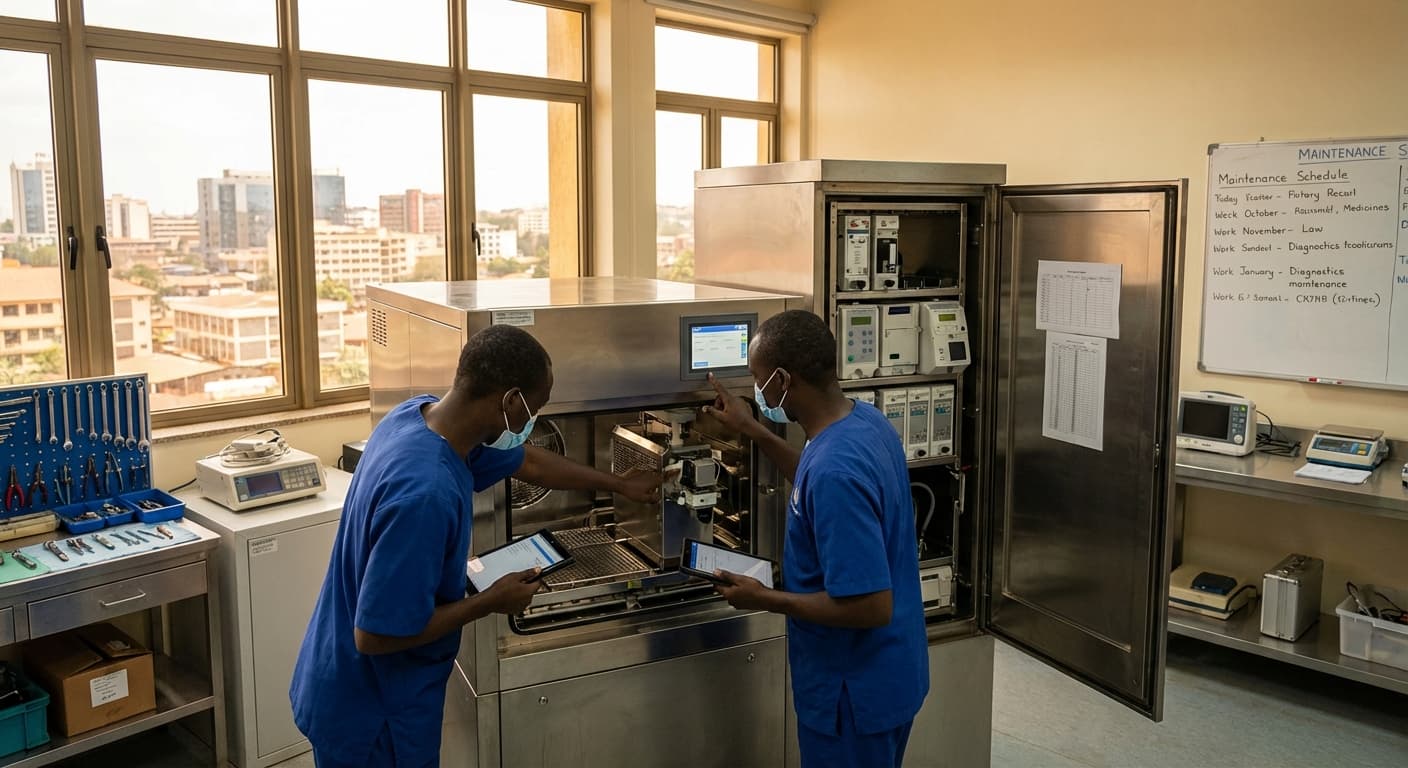
Total Cost of Ownership (TCO) & Lifecycle Budgeting Service in Burundi
Engineering Excellence & Technical Support
Total Cost of Ownership (TCO) & Lifecycle Budgeting Service High-standard technical execution following OEM protocols and local regulatory frameworks.
Optimized Capital Expenditure Planning
Leverage our TCO analysis to strategically forecast and allocate capital for infrastructure and equipment procurement in Burundi. We identify the most cost-effective acquisition strategies, factoring in import duties, local taxes, and anticipated maintenance needs, ensuring your initial investments yield maximum long-term value and align with your financial objectives.
Predictive Maintenance & Operational Efficiency
Our lifecycle budgeting service integrates predictive maintenance models, crucial for Burundi's unique operational environment. We analyze historical data and industry best practices to forecast maintenance schedules, spare parts requirements, and potential downtime costs. This proactive approach minimizes unexpected expenses and maximizes asset uptime, directly impacting your operational budget and overall profitability.
Long-Term Contract & Vendor Negotiation
Gain a competitive edge in Burundi with our TCO-driven contract negotiation expertise. We provide data-backed insights to inform the terms of your service, maintenance, and supply contracts. By understanding the full lifecycle costs associated with vendor agreements, we empower you to negotiate more favorable terms, secure long-term cost predictability, and mitigate risks of escalating operational expenses.
What Is Total Cost Of Ownership (Tco) & Lifecycle Budgeting Service In Burundi?
Total Cost of Ownership (TCO) and Lifecycle Budgeting services in Burundi are analytical frameworks and advisory offerings designed to quantify, project, and manage all direct and indirect costs associated with an asset, system, or project throughout its entire lifespan. TCO encompasses not only the initial acquisition cost but also operational expenditures (e.g., energy, maintenance, labor), support costs, training, decommissioning, and disposal. Lifecycle Budgeting integrates these TCO considerations into financial planning and capital allocation processes, ensuring that future financial commitments are accurately anticipated and provisioned. These services are crucial for strategic decision-making, enabling organizations to make informed choices regarding investment, procurement, and operational efficiency within the Burundian economic and regulatory context.
| Who Needs TCO & Lifecycle Budgeting Services? | Typical Use Cases |
|---|---|
| Government Agencies and Public Sector Entities (e.g., Ministry of Finance, Ministry of Infrastructure, local authorities) seeking to optimize public spending, manage infrastructure projects, and ensure fiscal responsibility. | Procurement of major public assets (e.g., vehicles, IT infrastructure, industrial equipment, energy generation facilities) to select options with the lowest long-term economic impact, not just initial purchase price. |
| Large Corporations and Private Enterprises (e.g., manufacturing, telecommunications, mining, agriculture) aiming to enhance profitability, manage capital expenditures effectively, and reduce operational expenses. | Investment decisions for new production lines, fleet management, enterprise resource planning (ERP) systems, or significant infrastructure upgrades. |
| Non-Governmental Organizations (NGOs) and Development Partners requiring transparent and accountable management of project funds, ensuring sustainability of interventions. | Planning and budgeting for development projects involving assets like water treatment plants, educational facilities, or agricultural machinery, with a focus on long-term operational viability. |
| Financial Institutions and Investors evaluating the economic viability and risk profile of projects and assets. | Due diligence for mergers and acquisitions, assessment of loan collateral, and project finance structuring where long-term asset performance is critical. |
| Utilities (e.g., electricity, water) responsible for significant capital investments and long-term operational planning. | Planning for the replacement and upgrades of critical infrastructure, energy efficiency initiatives, and renewable energy project development. |
Key Components of TCO & Lifecycle Budgeting Services
- Cost Identification and Categorization: Systematic enumeration of all cost elements across acquisition, operation, maintenance, and disposal phases.
- Data Collection and Validation: Gathering empirical data on historical costs, market benchmarks, and projected future expenses.
- Financial Modeling and Projection: Development of sophisticated models to forecast costs over the asset's lifecycle, incorporating inflation, technological obsolescence, and depreciation.
- Risk Assessment and Sensitivity Analysis: Identification of potential cost overruns and evaluation of their impact under various scenarios.
- Optimization Strategies: Development of recommendations for cost reduction and efficiency improvement.
- Lifecycle Cost Management Framework Implementation: Establishing processes and controls for ongoing monitoring and management of lifecycle costs.
- Capital Planning and Budgetary Integration: Aligning TCO projections with organizational strategic objectives and financial planning cycles.
- Reporting and Visualization: Clear and concise presentation of TCO analyses and lifecycle budget forecasts.
Who Needs Total Cost Of Ownership (Tco) & Lifecycle Budgeting Service In Burundi?
In Burundi, Total Cost of Ownership (TCO) and Lifecycle Budgeting services are crucial for optimizing financial decisions and ensuring long-term sustainability for organizations. These services go beyond initial purchase prices to consider all costs associated with an asset or project throughout its entire lifespan, from acquisition and operation to maintenance and eventual disposal. This holistic approach is particularly vital in an economic environment where efficient resource allocation and strategic investment are paramount. By understanding the true cost of ownership, businesses and institutions can make informed choices, avoid hidden expenses, and maximize the return on their investments.
| Customer Type | Why TCO & Lifecycle Budgeting is Crucial | Example Applications |
|---|---|---|
| Government Ministries and Agencies | Ensuring efficient public spending, long-term asset sustainability, and transparent budgeting for public services. | Procurement of infrastructure (roads, buildings), IT systems, vehicles, and essential public service equipment. |
| Large Corporations | Optimizing investment decisions, managing operational risks, improving profitability, and achieving competitive advantage through cost control. | Acquisition of machinery, fleet management, IT infrastructure upgrades, real estate development, and energy efficiency projects. |
| Non-Governmental Organizations (NGOs) | Maximizing the impact of limited donor funds, ensuring the longevity and effectiveness of program assets, and demonstrating accountability. | Purchasing vehicles for field operations, procuring medical equipment, investing in renewable energy solutions for remote communities, and IT infrastructure for program management. |
| International Development Agencies | Ensuring the sustainability of development projects beyond initial funding, promoting cost-effective solutions, and facilitating local capacity building. | Funding for infrastructure projects, procurement of agricultural equipment, educational resources, and health sector investments. |
| Public Utilities (Water, Electricity) | Long-term planning for infrastructure maintenance and replacement, ensuring service reliability, and managing capital expenditure effectively. | Investment in power generation facilities, water treatment plants, distribution networks, and smart metering technologies. |
| Financial Institutions | Managing the cost of technology investments, operational expenses for branches, and risk assessment of asset-backed loans. | Branch network expansion, IT system upgrades, ATM deployments, and investment in cybersecurity. |
Who Needs TCO & Lifecycle Budgeting Services in Burundi? - Target Customers and Departments
- {"items":["Government Ministries and Agencies","Large Corporations (Local and International)","Non-Governmental Organizations (NGOs)","International Development Agencies","Public Utilities","Financial Institutions","Mining and Extractive Industries","Agricultural Cooperatives and Large-Scale Farms","Infrastructure Development Companies"],"title":"Target Customer Types"}
- {"items":["Finance and Accounting Departments","Procurement and Supply Chain Management","Operations and Maintenance Departments","Asset Management Teams","Project Management Offices (PMOs)","IT Departments (for software and hardware investments)","Facilities Management","Strategic Planning and Investment Divisions","Sustainability and Environmental Compliance Teams"],"title":"Key Departments Benefiting from TCO & Lifecycle Budgeting"}
Total Cost Of Ownership (Tco) & Lifecycle Budgeting Service Process In Burundi
The Total Cost of Ownership (TCO) & Lifecycle Budgeting service process in Burundi aims to provide organizations with a comprehensive understanding of the long-term financial implications of their assets and projects. This structured workflow ensures that all costs, from acquisition to disposal, are identified, analyzed, and incorporated into strategic budgeting and decision-making. The process begins with an initial inquiry and culminates in the delivery of actionable insights and reports.
| Stage | Key Activities | Deliverables/Outcomes | Typical Duration |
|---|---|---|---|
| Inquiry & Needs Assessment | Initial contact, understanding client requirements, defining project scope. | Clear understanding of client needs, preliminary scope definition. | 1-2 days |
| Proposal Development & Agreement | Drafting proposal, negotiation, contract signing. | Signed service agreement, detailed proposal. | 2-5 days |
| Data Collection & Scoping | Gathering financial records, operational data, asset inventories, market research. | Organized and validated dataset for analysis. | 1-3 weeks (depending on complexity) |
| TCO & Lifecycle Cost Modeling | Applying TCO models, forecasting future costs, building financial projections. | Detailed TCO models, lifecycle cost projections. | 1-2 weeks |
| Risk Assessment & Sensitivity Analysis | Identifying potential risks, quantifying their impact, running 'what-if' scenarios. | Risk register, sensitivity analysis reports. | 2-4 days |
| Reporting & Presentation | Compiling reports, creating presentations, delivering findings to stakeholders. | Comprehensive TCO reports, executive presentations, actionable recommendations. | 3-5 days |
| Implementation Support & Monitoring (Optional) | Assisting with implementing recommendations, setting up tracking systems, performance reviews. | Implemented recommendations, established monitoring frameworks. | Ongoing (client-dependent) |
| Project Closure & Feedback | Finalizing documentation, obtaining client sign-off, collecting feedback. | Project completion confirmation, client feedback. | 1-2 days |
Workflow Stages:
- Inquiry & Needs Assessment: Potential clients express interest in TCO & Lifecycle Budgeting services. This stage involves understanding their specific needs, the assets or projects they wish to analyze, their current financial reporting practices, and their desired outcomes.
- Proposal Development & Agreement: Based on the needs assessment, a detailed proposal is prepared. This outlines the scope of work, methodology, deliverables, timelines, and associated costs. Upon agreement, a formal contract is established.
- Data Collection & Scoping: This critical phase involves gathering all relevant financial and operational data related to the assets or projects. This includes purchase prices, operational expenses (maintenance, energy, labor), upgrade costs, end-of-life costs (disposal, decommissioning), and any potential revenue streams or cost savings.
- TCO & Lifecycle Cost Modeling: The collected data is analyzed and modeled using established TCO and lifecycle budgeting methodologies. This involves projecting costs over the entire lifespan of the asset or project, considering factors like inflation, depreciation, and potential technological advancements.
- Risk Assessment & Sensitivity Analysis: Potential risks that could impact the TCO are identified and analyzed. Sensitivity analysis is performed to understand how changes in key variables (e.g., energy prices, maintenance costs) might affect the overall cost projections.
- Reporting & Presentation: Comprehensive reports are generated, detailing the TCO and lifecycle budget for the analyzed assets/projects. These reports typically include executive summaries, detailed cost breakdowns, risk assessments, and strategic recommendations. Findings are then presented to the client's stakeholders.
- Implementation Support & Monitoring (Optional): Clients may opt for ongoing support to implement recommendations derived from the TCO analysis or to establish internal processes for continuous lifecycle budgeting. This can include setting up tracking mechanisms and regular performance reviews.
- Project Closure & Feedback: The engagement is formally closed once all deliverables are met and accepted by the client. Feedback is collected to refine the service process and ensure client satisfaction.
Total Cost Of Ownership (Tco) & Lifecycle Budgeting Service Cost In Burundi
The Total Cost of Ownership (TCO) and Lifecycle Budgeting services in Burundi are crucial for organizations seeking to understand the full financial implications of acquiring, operating, and eventually divesting assets. These services move beyond simple purchase price to encompass all direct and indirect costs over the entire lifespan of an asset or project. Factors influencing the pricing of these services in Burundi are multifaceted, reflecting the local economic landscape, the complexity of the engagement, and the expertise of the service provider. The pricing is typically presented in Burundi Francs (BIF).
| Service Component / Engagement Type | Typical Pricing Factor | Estimated Price Range (BIF per engagement/hour) |
|---|---|---|
| Initial TCO Assessment (e.g., for a single asset) | Based on complexity and data availability | 2,000,000 - 8,000,000 BIF |
| Comprehensive Lifecycle Budgeting (e.g., for a multi-year project) | Projected expenditure over the asset/project lifecycle | 5,000,000 - 25,000,000+ BIF (depending on scale) |
| Consultant Hourly Rate (for ad-hoc advice or specific analysis) | Seniority and specialization of the consultant | 150,000 - 500,000 BIF per hour |
| Data Collection and Validation Support | Volume and accessibility of data | 1,000,000 - 7,000,000 BIF (per project phase) |
| Risk Assessment and Mitigation Strategy Development | Complexity of identified risks | 2,500,000 - 12,000,000 BIF |
| Development of Capital vs. Operating Expense Models | Number of assets/components and operational complexity | 3,000,000 - 15,000,000 BIF |
| Training and Capacity Building for Internal Teams | Number of participants and training duration | 2,000,000 - 10,000,000 BIF |
| Post-Implementation Review and Refinement | Frequency and depth of review | 1,500,000 - 6,000,000 BIF |
Key Pricing Factors for TCO & Lifecycle Budgeting Services in Burundi:
- Scope and Complexity of the Project/Asset:
- Duration of the Lifecycle Being Analyzed:
- Data Availability and Quality:
- Provider Expertise and Reputation:
- Level of Detail Required:
- On-site vs. Remote Service Delivery:
- Customization Needs:
- Reporting and Documentation Requirements:
- Market Demand and Competition:
- Economic Conditions in Burundi (inflation, exchange rates, etc.):
- Regulatory and Compliance Considerations:
Affordable Total Cost Of Ownership (Tco) & Lifecycle Budgeting Service Options
Our Affordable Total Cost of Ownership (TCO) & Lifecycle Budgeting services provide a comprehensive approach to managing your assets and investments. We help you understand the true cost of ownership beyond the initial purchase price, encompassing all expenses throughout the lifecycle of an asset, from acquisition to disposal. This strategic budgeting ensures predictable costs, minimizes unexpected expenses, and maximizes your return on investment. We offer flexible value bundles tailored to your specific needs and implement proven cost-saving strategies to optimize your financial outlays.
| Value Bundle | Description | Key Benefits | Pricing Model |
|---|---|---|---|
| Essential TCO Assessment | Covers core TCO elements like acquisition, operation, and maintenance for a defined asset class. | Basic understanding of long-term costs, improved budgeting accuracy, identification of immediate savings opportunities. | Project-based fee or tiered monthly retainer |
| Comprehensive Lifecycle Management | Includes detailed analysis of the entire asset lifecycle, including disposal, risk, and strategic upgrades. | Proactive cost management, optimized asset utilization, extended asset lifespan, reduced total expenditure, enhanced strategic decision-making. | Customized project fee based on scope, or annual subscription with ongoing support |
| Strategic Budgeting & Optimization | Focuses on developing long-term, integrated budgets and implementing advanced cost-saving strategies across multiple asset categories. | Significant cost reductions, improved capital allocation, competitive advantage through efficiency, enhanced financial resilience. | Performance-based fee with guaranteed savings, or premium annual subscription |
Key Components of Our TCO & Lifecycle Budgeting Services
- Initial Acquisition Cost Analysis
- Operating and Maintenance Cost Forecasting
- Repair and Replacement Planning
- Downtime and Productivity Impact Assessment
- Disposal and Decommissioning Cost Estimation
- Risk Assessment and Contingency Planning
- Technology Refresh and Upgrade Strategies
- Energy Consumption and Environmental Impact Analysis
Verified Providers In Burundi
In Burundi's evolving healthcare landscape, discerning reliable and high-quality medical services is paramount. This is where the importance of verified providers and trusted credentials, such as those offered by Franance Health, comes to the forefront. Franance Health is committed to ensuring that all its affiliated healthcare professionals and facilities meet rigorous standards of quality, safety, and ethical practice. Choosing a Franance Health-verified provider means opting for assurance, expertise, and a patient-centered approach to care. Their accreditation process scrutinizes factors like medical expertise, patient feedback, regulatory compliance, and the availability of essential medical infrastructure. This dedication to verification translates into a superior healthcare experience for patients, offering peace of mind and confidence in the medical decisions made.
| Credential Component | Franance Health Verification Focus | Patient Benefit |
|---|---|---|
| Medical Licensing & Certification | Confirms current and valid professional licenses and specialized certifications. | Ensures providers possess the legally required qualifications and expertise. |
| Clinical Experience & Specialization | Evaluates the breadth and depth of a provider's practical experience and areas of specialization. | Connects patients with specialists best suited for their specific medical needs. |
| Facility Standards & Equipment | Assesses the cleanliness, safety, and technological capabilities of healthcare facilities. | Guarantees access to a safe environment with appropriate diagnostic and treatment tools. |
| Patient Feedback & Satisfaction | Incorporates patient reviews and satisfaction scores into the accreditation process. | Promotes providers who consistently deliver positive patient experiences and high levels of care. |
| Adherence to Ethical Guidelines | Ensures providers follow strict ethical codes of conduct and patient rights principles. | Fosters a respectful, trustworthy, and patient-centered healthcare relationship. |
| Regulatory Compliance | Verifies compliance with all relevant national health regulations and standards. | Provides assurance that providers operate within legal and safety frameworks. |
Why Franance Health Credentials Matter in Burundi
- Uncompromising Quality Standards: Franance Health enforces stringent criteria for all its accredited providers, ensuring they meet international benchmarks for healthcare delivery.
- Patient Safety First: Verification includes a thorough review of safety protocols and infection control measures, prioritizing your well-being.
- Expert Medical Professionals: Access to a network of highly qualified and experienced doctors, nurses, and specialists.
- Ethical Practice Assurance: Franance Health champions ethical medical conduct, guaranteeing respectful and transparent patient interactions.
- Reliable Infrastructure: Accredited facilities are equipped with modern medical technology and resources necessary for effective treatment.
- Enhanced Patient Trust: The Franance Health seal of approval provides a clear indicator of a provider's commitment to excellence, fostering trust and confidence.
- Streamlined Access to Care: A verified network simplifies the process of finding and accessing the right medical services when you need them most.
Scope Of Work For Total Cost Of Ownership (Tco) & Lifecycle Budgeting Service
This Scope of Work (SOW) outlines the services provided for a comprehensive Total Cost of Ownership (TCO) and Lifecycle Budgeting analysis. The objective is to establish a robust framework for understanding and managing all costs associated with an asset, system, or project throughout its entire lifespan, from acquisition to disposal. This includes defining the scope, methodology, and expected deliverables.
| Phase | Activities | Key Deliverables | Standard Specifications |
|---|---|---|---|
| Phase 1: Project Initiation & Planning | Define scope and boundaries of TCO analysis (e.g., specific asset, system, or project). Identify stakeholders and their requirements. Establish project team roles and responsibilities. Develop detailed project plan and timeline. Define assumptions, exclusions, and critical success factors. | Project Charter. Stakeholder Register. Detailed Project Plan. Scope Definition Document. Communication Plan. | All documents to be in English, version-controlled, and approved by key stakeholders. Project plan to adhere to established project management methodologies (e.g., Agile, Waterfall). Assumptions to be clearly documented and justifiable. |
| Phase 2: Data Collection & Analysis | Gather historical and projected cost data across all lifecycle stages (acquisition, operation, maintenance, support, upgrade, disposal). Identify and analyze cost drivers for each category. Conduct benchmarking against industry standards or similar assets/systems. Validate data accuracy and completeness. | Cost Data Repository. Cost Driver Analysis Report. Benchmarking Report. Data Validation Summary. | Data to be collected from authoritative sources (e.g., financial records, vendor quotes, maintenance logs, expert interviews). Analysis to utilize appropriate quantitative and qualitative methods. Benchmarking criteria to be clearly defined and justified. |
| Phase 3: TCO Modeling & Calculation | Develop a TCO model based on collected data and defined assumptions. Calculate TCO for various scenarios and sensitivity analyses. Determine lifecycle budget components and forecasts. | TCO Model (spreadsheet or dedicated software). TCO Calculation Report. Lifecycle Budget Forecast. | TCO model to be transparent, auditable, and capable of scenario planning. Calculations to follow established financial principles (e.g., Net Present Value, Discounted Cash Flow). Lifecycle budget to include all identified cost categories with clear timelines. |
| Phase 4: Reporting & Recommendations | Prepare comprehensive TCO and lifecycle budgeting reports. Provide actionable recommendations for cost optimization, risk mitigation, and strategic decision-making. Present findings and recommendations to stakeholders. | Final TCO & Lifecycle Budgeting Report. Executive Summary. Recommendations Document. Presentation Deck. | Reports to be clear, concise, and tailored to the audience. Recommendations to be specific, measurable, achievable, relevant, and time-bound (SMART). Presentation to include visual aids and Q&A session. |
| Phase 5: Knowledge Transfer & Closeout | Conduct knowledge transfer sessions to ensure internal understanding of the TCO methodology and model. Archive project documentation. Obtain final stakeholder acceptance. Conduct project post-mortem. | Knowledge Transfer Documentation. Project Archive. Stakeholder Acceptance Form. Lessons Learned Report. | Knowledge transfer materials to be comprehensive and accessible. Project archive to be organized and secure. Lessons learned to inform future projects and processes. |
Project Objectives
- Quantify all direct and indirect costs over the lifecycle of the asset/system/project.
- Identify cost drivers and areas for potential savings.
- Develop a dynamic lifecycle budget for informed financial planning and decision-making.
- Provide a standardized methodology for future TCO/lifecycle budgeting exercises.
- Support strategic asset management and investment decisions.
- Enhance financial transparency and accountability.
Service Level Agreement For Total Cost Of Ownership (Tco) & Lifecycle Budgeting Service
This Service Level Agreement (SLA) outlines the guaranteed response times and uptime for the Total Cost of Ownership (TCO) & Lifecycle Budgeting Service provided by [Your Company Name] to [Client Name]. This SLA is an integral part of the Master Service Agreement (MSA) between the parties.
| Service Component | Uptime Guarantee | Response Time (Critical) | Response Time (High) | Response Time (Medium) | Response Time (Low) |
|---|---|---|---|---|---|
| TCO & Lifecycle Budgeting Platform Availability | 99.9% Monthly Uptime | N/A | N/A | N/A | N/A |
| Platform Performance | N/A | Within 2 hours | Within 4 business hours | Within 8 business hours | Within 24 business hours |
| Support Ticket Resolution | N/A | Within 4 hours | Within 8 business hours | Within 16 business hours | Within 48 business hours |
| Scheduled Maintenance Notifications | N/A | N/A | N/A | N/A | Minimum 7 days in advance |
Service Scope
- Provision of TCO & Lifecycle Budgeting software platform.
- Regular software updates and maintenance.
- Access to dedicated support resources.
- Data analysis and reporting capabilities as per agreed scope.
Frequently Asked Questions

Ready when you are
Let's scope your Total Cost of Ownership (TCO) & Lifecycle Budgeting Service in Burundi project in Burundi.

Scaling healthcare logistics and technical systems across the entire continent.