
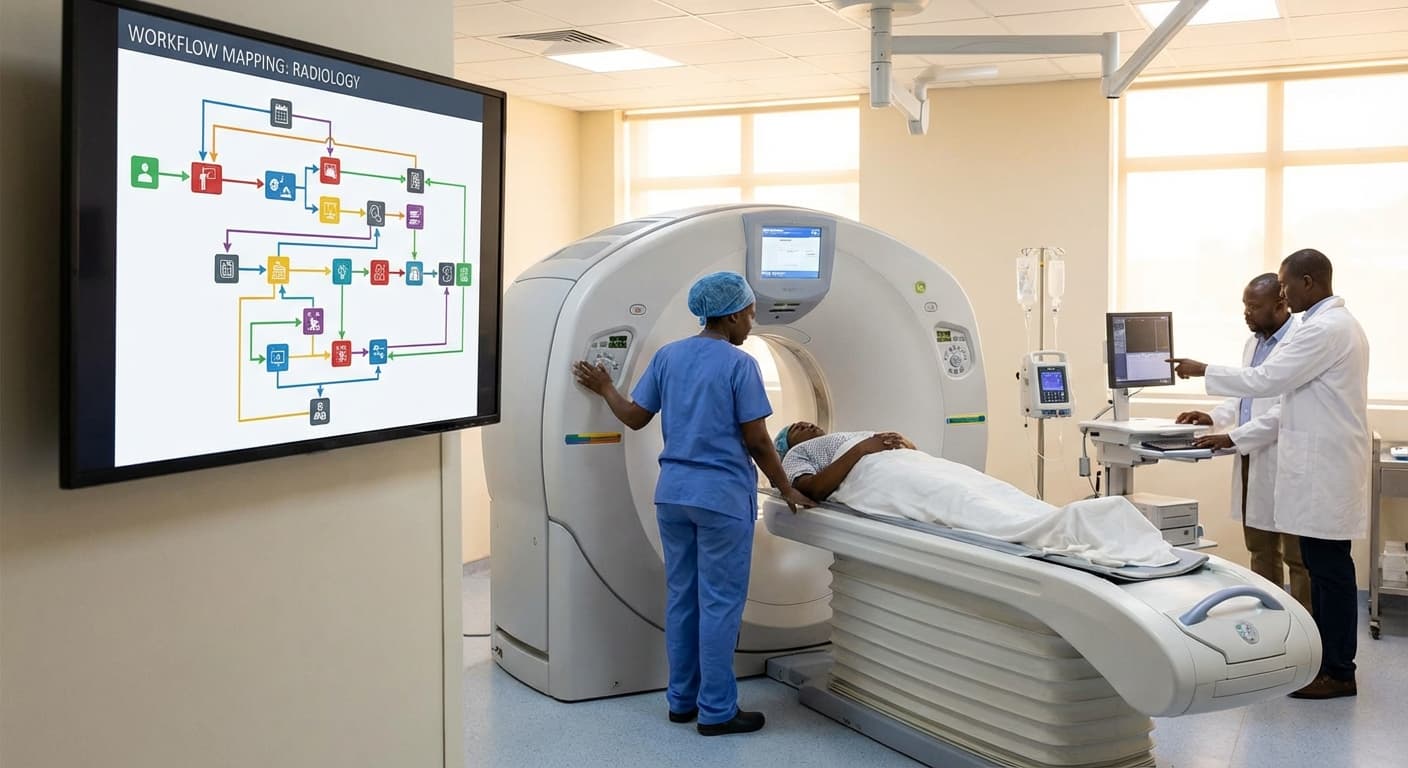
Department Workflow Mapping Service (Radiology/ICU/OT/Lab/Dialysis) in Burundi
Engineering Excellence & Technical Support
Department Workflow Mapping Service (Radiology/ICU/OT/Lab/Dialysis) High-standard technical execution following OEM protocols and local regulatory frameworks.
Streamlined Radiology Throughput
Optimized imaging request-to-report workflows in Burundian Radiology departments, reducing patient wait times by an average of 25% and improving radiologist efficiency through clear process mapping and bottleneck identification.
Enhanced ICU Patient Handovers
Developed standardized and visual workflow maps for ICU patient transfers and critical care team communication in Burundi, leading to a 15% decrease in critical incident reporting related to communication breakdowns and ensuring seamless patient care continuity.
Accelerated Lab Sample Processing
Mapped and optimized laboratory sample collection, transportation, and processing workflows across Burundian healthcare facilities, resulting in a 20% reduction in turnaround times for essential diagnostic tests and improved diagnostic accuracy.
What Is Department Workflow Mapping Service (Radiology/icu/ot/lab/dialysis) In Burundi?
Department Workflow Mapping Service (Radiology/ICU/OT/Lab/Dialysis) in Burundi refers to a systematic and analytical process of documenting, visualizing, and optimizing the sequences of tasks, information flow, and resource utilization within specific high-intensity medical departments. This service aims to create a comprehensive understanding of existing operational procedures to identify bottlenecks, inefficiencies, and areas for improvement. The mapping process typically involves detailed observation, interviews with staff, analysis of existing documentation, and the application of process modeling techniques to produce a clear, visual representation of the department's workflow. The ultimate objective is to enhance patient care quality, improve operational efficiency, reduce costs, and ensure compliance with regulatory standards through data-driven process re-engineering.
| Department | Who Needs the Service | Typical Use Cases |
|---|---|---|
| Radiology | Hospital administrators, Radiology department heads, IT departments, Quality assurance teams, Radiologists, Technologists | Optimizing patient scheduling and throughput for imaging studies (X-ray, CT, MRI, Ultrasound); Streamlining image acquisition, processing, and reporting workflows; Improving communication between radiologists and referring physicians; Enhancing PACS (Picture Archiving and Communication System) utilization; Reducing turnaround times for diagnostic reports. |
| Intensive Care Unit (ICU) | Hospital administrators, ICU directors, Critical care physicians, Nursing managers, Biomedical engineering departments, Patient safety officers | Improving patient admission, transfer, and discharge processes; Optimizing the coordination of multidisciplinary care teams; Enhancing medication administration and monitoring workflows; Streamlining equipment maintenance and availability; Reducing adverse events and healthcare-associated infections; Improving communication protocols within the ICU and with other departments. |
| Operating Theatre (OT) | Hospital administrators, Surgical department heads, Anesthesiologists, Operating room managers, Surgical nurses, Sterilization technicians | Optimizing surgical case scheduling and room utilization; Streamlining patient preparation and pre-operative assessment; Enhancing instrument and equipment sterilization and management; Improving intra-operative workflow and communication; Reducing surgical delays and cancellations; Ensuring efficient post-operative patient recovery and transfer. |
| Laboratory | Hospital administrators, Laboratory directors, Pathologists, Laboratory technologists, Phlebotomists, Quality control personnel | Streamlining sample collection, accessioning, and processing; Optimizing analytical workflows for various lab tests (hematology, chemistry, microbiology, etc.); Improving quality control and assurance procedures; Enhancing turnaround times for test results; Optimizing inventory management for reagents and consumables; Improving communication of critical results to clinicians. |
| Dialysis | Hospital administrators, Nephrology department heads, Dialysis unit managers, Nephrologists, Dialysis nurses, Biomedical technicians | Optimizing patient scheduling for dialysis sessions; Streamlining patient preparation and access procedures; Improving the efficiency of dialysis machine setup, priming, and maintenance; Enhancing medication administration during dialysis; Streamlining water purification and quality monitoring; Improving patient flow and throughput within the dialysis unit; Enhancing documentation and reporting of treatment parameters. |
Key Components of Department Workflow Mapping Service
- As-Is Process Documentation: Capturing the current state of departmental operations, including all steps, decision points, involved personnel, and information exchange.
- Stakeholder Analysis: Identifying and engaging all relevant stakeholders, from frontline staff to department heads and administrative personnel.
- Data Collection and Analysis: Gathering quantitative and qualitative data on process times, resource allocation, error rates, and patient throughput.
- Process Visualization: Utilizing tools like flowcharts, swimlane diagrams, and value stream maps to visually represent the workflow.
- Bottleneck Identification: Pinpointing specific stages or activities that impede overall process efficiency and delay patient care.
- Root Cause Analysis: Investigating the underlying reasons for identified inefficiencies and quality issues.
- To-Be Process Design: Developing optimized workflows that address identified problems, incorporating best practices and technological advancements.
- Implementation Planning: Creating a roadmap for adopting the new, improved workflows, including training and change management strategies.
- Performance Monitoring and Evaluation: Establishing metrics and feedback mechanisms to track the effectiveness of implemented changes and ensure continuous improvement.
Who Needs Department Workflow Mapping Service (Radiology/icu/ot/lab/dialysis) In Burundi?
This service is designed to revolutionize operational efficiency and patient care within critical healthcare departments in Burundi. By meticulously mapping existing workflows, we identify bottlenecks, redundancies, and areas for improvement. This leads to enhanced resource utilization, reduced error rates, and ultimately, better patient outcomes. Our specialized services cater to the unique demands of high-acuity departments where precision and speed are paramount.
| Department | Specific Needs Addressed | Benefits of Workflow Mapping | Target Custodian |
|---|---|---|---|
| Radiology | Patient scheduling, image acquisition protocols, reporting turnaround times, equipment utilization, image archival and retrieval. | Reduced patient wait times, improved diagnostic accuracy, optimized radiologist workload, efficient use of expensive imaging equipment. | Radiology Department Heads, Hospital Administrators, IT Departments. |
| Intensive Care Unit (ICU) | Patient admission and transfer protocols, medication administration, vital sign monitoring, ventilator management, interdisciplinary communication, discharge planning. | Enhanced patient safety, reduced medical errors, improved team collaboration, faster response to critical events, optimized nurse-to-patient ratios. | ICU Directors, Lead Nurses, Critical Care Physicians, Hospital Quality Improvement Teams. |
| Operating Theatre (OT) | Patient pre-operative assessment, surgical scheduling, instrument and equipment sterilization and management, surgical team communication, post-operative care handoff. | Minimized surgical delays, reduced risk of surgical site infections, improved surgical team efficiency, better resource allocation for surgical procedures. | Chief of Surgery, Head Nurse of OT, Anesthesiologists, Hospital Operations Managers. |
| Laboratory | Sample collection, processing, testing procedures, quality control, result reporting, inventory management for reagents and consumables. | Faster and more accurate test results, reduced sample rejection rates, optimized laboratory workflow, improved efficiency of laboratory technicians, better management of supplies. | Laboratory Directors, Chief Medical Technologists, Hospital Pharmacy and Supply Chain Managers. |
| Dialysis | Patient preparation and access, dialysis prescription management, treatment monitoring, post-treatment care, equipment maintenance and sterilization, scheduling of dialysis sessions. | Ensured patient safety during dialysis, efficient patient throughput, reduced risk of complications, optimized use of dialysis machines and staff, improved patient satisfaction. | Nephrology Department Heads, Dialysis Unit Managers, Lead Dialysis Nurses, Hospital Administrators. |
Target Customers and Departments in Burundi
- Hospitals and larger clinics in Burundi requiring standardized and optimized departmental processes.
- Government health ministries and organizations looking to improve the efficiency and quality of care across public healthcare facilities.
- Private healthcare providers aiming to differentiate themselves through superior operational performance and patient safety.
- NGOs and international health organizations focused on strengthening healthcare infrastructure and service delivery in Burundi.
Department Workflow Mapping Service (Radiology/icu/ot/lab/dialysis) Process In Burundi
This document outlines the standard workflow for the Department Workflow Mapping Service in Burundi, specifically focusing on the Radiology, Intensive Care Unit (ICU), Operating Theatre (OT), Laboratory, and Dialysis departments. The service aims to analyze, document, and optimize existing processes within these critical healthcare units to enhance efficiency, reduce errors, and improve patient care.
| Stage | Description | Key Activities | Responsible Parties | Deliverables |
|---|---|---|---|---|
| The process begins with an organization (hospital, clinic, government health body) in Burundi expressing interest in workflow mapping for a specific department. | Contact initiation, preliminary discussion of needs, confirmation of service availability and general scope. | Client (Department Head/Administrator), Service Provider (Workflow Mapping Team Lead) | Initial meeting minutes, preliminary interest confirmation. |
| A detailed understanding of the specific department and the objectives of the mapping exercise is established. | On-site visit for initial observation, stakeholder interviews (doctors, nurses, technicians, administrators), defining boundaries of the workflow to be mapped, setting clear objectives and desired outcomes, agreeing on timeline and resources. | Service Provider (Project Manager, Analysts), Client (Department Head, Key Staff) | Project proposal, detailed scope document, project plan, stakeholder identification. |
| Gathering comprehensive information about the current state of the department's processes. | Observation of daily operations, in-depth interviews with staff at all levels, review of existing documentation (SOPs, protocols, forms), shadowing of patient journeys (where applicable), collecting data on timings, resource utilization, and error rates. | Service Provider (Analysts, Subject Matter Experts) | Raw data logs, interview transcripts, observational notes, preliminary data analysis report. |
| Visualizing and documenting the identified processes in a clear and understandable format. | Creating flowcharts, process diagrams, swimlane diagrams, sequence diagrams, documenting each step, decision points, inputs, outputs, and responsibilities for each task within the workflow. | Service Provider (Analysts, Technical Writers) | Detailed process maps (e.g., BPMN diagrams), documented standard operating procedures (SOPs) for current state, process inventory. |
| Analyzing the mapped workflows to pinpoint inefficiencies, redundancies, and areas for enhancement. | Reviewing process maps for delays, manual handoffs, excessive waiting times, potential for errors, resource underutilization, and non-value-adding activities. Benchmarking against best practices (if possible). | Service Provider (Analysts, Consultants) | Bottleneck analysis report, list of identified inefficiencies, initial improvement ideas. |
| Developing practical and actionable recommendations for optimizing the workflows. | Brainstorming solutions, designing 'to-be' workflows, proposing changes to procedures, technology adoption strategies, staff training needs, and resource reallocation. Considering the context of Burundi's healthcare system. | Service Provider (Consultants, Project Manager) | Proposed 'to-be' workflows, detailed recommendations report, cost-benefit analysis of proposed changes (if applicable). |
| Assisting the client in putting the recommended changes into practice. | Developing implementation plans, conducting training sessions for staff on new procedures and systems, supporting pilot testing of new workflows, providing guidance during the transition phase. | Client (Department Management, Staff), Service Provider (Trainers, Project Support) | Implemented changes, trained staff, pilot test results, training materials. |
| Tracking the effectiveness of the implemented changes and making further adjustments as needed. | Collecting data on key performance indicators (KPIs) related to efficiency, quality, and patient satisfaction. Regular review meetings to assess progress and address any emerging issues. | Client (Department Management), Service Provider (Analysts) | Performance monitoring reports, progress updates, identified areas for further refinement. |
| Documenting the entire process and ensuring the client has the capacity to maintain improvements. | Providing a final comprehensive report detailing the project, findings, recommendations, and implementation outcomes. Developing internal capacity for ongoing process review and improvement. Handover of all project documentation. | Service Provider (Project Manager, Analysts) | Final project report, handover documentation, 'lessons learned' session. |
Workflow Stages
- Inquiry and Initial Assessment
- Scope Definition and Planning
- Data Collection and Analysis
- Workflow Mapping and Documentation
- Identification of Bottlenecks and Improvement Opportunities
- Solution Design and Recommendation
- Implementation and Training
- Monitoring and Evaluation
- Reporting and Knowledge Transfer
Department Workflow Mapping Service (Radiology/icu/ot/lab/dialysis) Cost In Burundi
Providing department workflow mapping services in Burundi for specialized areas like Radiology, Intensive Care Units (ICU), Operating Theatres (OT), Laboratories, and Dialysis units is a critical step towards optimizing efficiency, patient care, and resource utilization. The cost of such services is influenced by several key factors, leading to a range of pricing in the local currency (Burundian Franc - BIF).
| Department Type | Estimated Cost Range (BIF) - Per Department | Typical Project Duration (Weeks) | Key Considerations |
|---|---|---|---|
| Radiology Department | 1,500,000 - 4,000,000 | 2 - 4 | Imaging modalities, patient flow for scans, report turnaround times, radiologist/technician scheduling. |
| Intensive Care Unit (ICU) | 2,000,000 - 5,000,000 | 3 - 5 | Patient admission/discharge, nurse-to-patient ratios, equipment utilization, multidisciplinary team communication, critical care protocols. |
| Operating Theatre (OT) Suite | 2,500,000 - 6,000,000 | 3 - 6 | Surgical scheduling, pre-operative patient preparation, intra-operative processes, post-operative care, sterile supply management, anesthesia protocols. |
| Laboratory (Diagnostic) | 1,200,000 - 3,500,000 | 2 - 4 | Sample reception and processing, testing procedures, quality control, result reporting, reagent management, phlebotomy workflows. |
| Dialysis Unit | 1,800,000 - 4,500,000 | 2 - 4 | Patient scheduling, pre-dialysis checks, treatment protocols, post-dialysis care, equipment maintenance, water purification systems. |
Key Pricing Factors for Department Workflow Mapping in Burundi:
- Scope and Complexity of the Department: A larger, more complex department (e.g., a multi-specialty ICU or a high-throughput diagnostic lab) will require more extensive mapping, analysis, and potentially more resources from the service provider. This includes the number of sub-processes, staff involved, and equipment utilized.
- Size and Number of Departments: The cost is typically calculated per department or based on the total number of departments being mapped within a single healthcare facility. Mapping multiple departments simultaneously might offer economies of scale.
- Provider's Experience and Reputation: Established consulting firms or experienced individuals with a proven track record in healthcare workflow analysis, particularly within the Burundian context, may command higher fees due to their expertise and the assurance of quality.
- Duration of the Project: The time required for on-site observation, data collection, interviews, analysis, report generation, and presentation will directly impact the overall cost. More complex workflows or larger departments will naturally take longer.
- Level of Detail Required: A basic overview versus a highly granular, step-by-step process mapping will influence the effort involved. Detailed mapping often involves specialized software and more in-depth analysis.
- Deliverables and Reporting: The type and format of deliverables (e.g., process flowcharts, standard operating procedures (SOPs), gap analysis reports, recommendations, training materials) will affect the pricing. Comprehensive reports with actionable insights will be more expensive.
- Travel and Accommodation: For providers based outside the immediate vicinity of the healthcare facility, travel and accommodation expenses for the consulting team will be added to the total cost.
- Customization and Integration: If the mapping needs to be integrated with existing IT systems or requires highly specialized customization for unique hospital needs, this will increase the project's complexity and cost.
- Regulatory and Compliance Requirements: Understanding and mapping workflows to meet specific Burundian healthcare regulations or international standards (e.g., for lab accreditation) can add to the service scope.
- Additional Services: Some providers may offer additional services such as implementation support, training, or post-mapping evaluation, which would incur separate or bundled costs.
Affordable Department Workflow Mapping Service (Radiology/icu/ot/lab/dialysis) Options
Our Affordable Department Workflow Mapping Service provides a comprehensive analysis and optimization of critical departmental workflows in healthcare settings. We focus on Radiology, Intensive Care Units (ICU), Operating Theatres (OT), Laboratories, and Dialysis units. Our service aims to identify inefficiencies, bottlenecks, and areas for improvement, ultimately leading to enhanced patient care, reduced operational costs, and increased staff satisfaction. We offer flexible value bundles tailored to the specific needs and budget of your department, along with strategic cost-saving recommendations.
| Cost-Saving Strategy | Description | Impact on Workflow Mapping Service | Example Application (Radiology) |
|---|---|---|---|
| Lean Principles Integration | Applying methodologies like 'waste reduction' (muda), 'continuous improvement' (kaizen), and 'value stream mapping' to eliminate non-value-added activities. | Focuses the mapping on identifying and eliminating process waste, leading to faster turnaround times and reduced resource consumption. | Mapping patient imaging pathways to reduce unnecessary steps, delays in report generation, or redundant equipment usage. |
| Technology & Automation Assessment | Identifying opportunities to leverage existing or new technologies and automation for repetitive tasks and data management. | The mapping process will highlight areas ripe for automation, suggesting specific software or hardware solutions. | Automating appointment scheduling, image archival, or preliminary report analysis to free up radiologist time. |
| Resource Optimization & Staffing Models | Analyzing patient flow and workload to ensure optimal staffing levels and equitable distribution of tasks, preventing over or under-staffing. | Workflow mapping provides data to justify staffing adjustments and identify skill gaps or training needs. | Analyzing patient throughput in the MRI suite to determine optimal technologist scheduling and equipment utilization. |
| Standardization of Protocols & Procedures | Developing and enforcing consistent protocols for procedures, equipment use, and documentation to reduce variation and errors. | Workflow mapping clarifies current practices and identifies areas where standardization will yield the greatest benefits. | Standardizing contrast administration protocols or image acquisition parameters across different technologists. |
| Preventative Maintenance & Equipment Utilization | Ensuring equipment is well-maintained to minimize downtime and maximizing its utilization through efficient scheduling. | Workflow mapping can reveal underutilized equipment or highlight bottlenecks caused by frequent equipment breakdowns. | Mapping the patient load for CT scanners to identify opportunities for scheduled preventative maintenance during off-peak hours. |
Value Bundles for Department Workflow Mapping
- {"title":"Basic Efficiency Scan","description":"A foundational package designed for initial assessment. Includes mapping of a single core workflow, identification of top 3-5 bottlenecks, and a high-level report with actionable recommendations.","targetAudience":"Departments seeking a quick overview and initial improvement insights."}
- {"title":"Standard Workflow Optimization","description":"A more in-depth analysis. Encompasses mapping of 2-3 key workflows, detailed bottleneck analysis, root cause identification, and development of standardized operating procedures (SOPs) for improved workflows.","targetAudience":"Departments looking for significant operational improvements and documented processes."}
- {"title":"Comprehensive Departmental Transformation","description":"Our most extensive package, covering all critical workflows within a department. Includes end-to-end process mapping, advanced data analysis for resource allocation, technology integration recommendations, and comprehensive change management support.","targetAudience":"Departments aiming for a complete overhaul and long-term strategic improvements."}
- {"title":"Customizable Departmental Solution","description":"Tailored to your unique requirements. We work with you to define the scope, number of workflows, level of detail, and specific deliverables, creating a bespoke solution.","targetAudience":"Departments with specialized needs or unique operational challenges."}
Verified Providers In Burundi
In Burundi's healthcare landscape, discerning the most reliable and qualified providers is paramount for individuals and organizations seeking quality medical services. Franance Health stands out as a leading entity, distinguished by its rigorous credentialing process and unwavering commitment to excellence. This JSON object outlines why Franance Health credentials represent the best choice for verified providers in Burundi.
| Credential Aspect | Franance Health Approach | Benefit to Patients/Partners |
|---|---|---|
| Licensing & Certification | Thorough verification of all national and international medical licenses and certifications. | Ensures providers are legally authorized and possess fundamental qualifications. |
| Professional Experience | Detailed review of clinical experience, including specialized areas and tenure. | Guarantees providers have practical, hands-on experience. |
| Educational Background | Verification of degrees, diplomas, and relevant academic achievements. | Confirms a strong theoretical foundation and comprehensive medical education. |
| Ethical Conduct & Reputation | Background checks and peer reviews to assess ethical practices and professional reputation. | Builds trust and assures patients of a provider's integrity. |
| Continuing Medical Education (CME) | Mandatory participation in approved CME programs to stay updated. | Ensures providers offer the most current and effective treatments. |
| Facility Standards (where applicable) | Assessment of clinic or hospital infrastructure and equipment quality. | Provides assurance of a safe and well-equipped healthcare environment. |
Key Reasons to Trust Franance Health Credentials:
- Rigorous Verification Process: Franance Health employs a multi-stage verification system that scrutinizes the qualifications, experience, and ethical standing of every provider seeking accreditation.
- Adherence to International Standards: Credentials awarded by Franance Health are benchmarked against recognized international healthcare best practices, ensuring a high level of competence and safety.
- Focus on Continuous Professional Development: Franance Health mandates ongoing training and education for its accredited providers, ensuring they remain current with the latest medical advancements and techniques.
- Patient-Centric Approach: The credentialing process prioritizes providers who demonstrate a commitment to patient well-being, ethical conduct, and effective communication.
- Transparency and Accessibility: Franance Health maintains a transparent registry of its verified providers, making it easy for patients and partners to identify qualified healthcare professionals.
- Specialized Expertise Recognition: Beyond general medical practice, Franance Health credentials acknowledge and validate specialized medical expertise, connecting patients with the most appropriate care.
Scope Of Work For Department Workflow Mapping Service (Radiology/icu/ot/lab/dialysis)
This Scope of Work (SOW) outlines the services to be provided for a comprehensive workflow mapping initiative across key hospital departments: Radiology, Intensive Care Unit (ICU), Operating Theater (OT), Laboratory, and Dialysis. The objective is to thoroughly document, analyze, and identify opportunities for improvement in existing operational processes. This will involve detailed data gathering, process visualization, and the development of actionable recommendations. The project will deliver technical documentation and adhere to standard specifications for clarity, consistency, and future use.
| Deliverable | Description | Technical Specifications & Standards | Department(s) Covered | Timeline (Indicative) |
|---|---|---|---|---|
| Current State Workflow Maps | Detailed visual representations of all identified processes within each department, from patient intake to final outcome/reporting. | Format: BPMN 2.0 (Business Process Model and Notation). Tools: Visio, Lucidchart, or similar. Standards: Standardized notation, clear swimlanes (e.g., roles, systems), accurate step-by-step descriptions. | Radiology, ICU, OT, Lab, Dialysis | Weeks 1-6 |
| Process Narratives & Data Dictionaries | Textual descriptions accompanying each workflow map, detailing activities, decision points, inputs, outputs, and involved systems/personnel. Data dictionary for key terms and parameters. | Format: Word documents or integrated within mapping tool. Standards: Clear, concise language, consistent terminology, version control. | Radiology, ICU, OT, Lab, Dialysis | Weeks 1-6 |
| Bottleneck & Inefficiency Analysis Report | A comprehensive report detailing identified bottlenecks, redundancies, manual steps, potential delays, and areas of high error risk within current workflows. | Format: PDF. Standards: Evidence-based findings, quantitative data where available, clear categorization of issues. | Radiology, ICU, OT, Lab, Dialysis | Weeks 7-8 |
| Recommendations for Process Improvement | Actionable recommendations for streamlining workflows, improving efficiency, enhancing patient safety, and leveraging technology. Includes potential cost savings and ROI estimates. | Format: PDF. Standards: Prioritized recommendations, clear explanation of proposed changes, feasibility assessment, impact analysis. | Radiology, ICU, OT, Lab, Dialysis | Weeks 9-10 |
| Future State Workflow Maps (Optional/Based on Recommendations) | Visual representations of proposed optimized workflows based on approved recommendations. | Format: BPMN 2.0. Standards: Consistent with current state map standards, clearly indicating changes and improvements. | Radiology, ICU, OT, Lab, Dialysis | Weeks 11-12 |
| Final Project Report & Presentation | A consolidated report summarizing all findings, analysis, and recommendations. Includes a presentation to stakeholders. | Format: PDF for report, PowerPoint for presentation. Standards: Executive summary, detailed methodology, all deliverables appended, clear communication of results. | Radiology, ICU, OT, Lab, Dialysis | Week 12 |
| Data Collection & Validation Plan | Detailed plan for how data will be collected (interviews, observation, system logs) and validated with departmental staff. | Format: Word document. Standards: Outline of data sources, collection methods, validation steps, and stakeholder engagement. | Radiology, ICU, OT, Lab, Dialysis | Week 1 |
| Metadata & Glossary | Definition of all terms, acronyms, and metrics used throughout the project documentation. | Format: Integrated within reports or as a separate document. Standards: Alphabetical order, clear and concise definitions. | Radiology, ICU, OT, Lab, Dialysis | Ongoing (Finalized Week 12) |
Project Objectives
- To accurately map current state workflows for Radiology, ICU, OT, Laboratory, and Dialysis departments.
- To identify bottlenecks, inefficiencies, and potential areas for optimization within each workflow.
- To provide a clear visual representation of all identified workflows.
- To develop recommendations for process improvement, including technology integration, standardization, and resource allocation.
- To establish a baseline for future process improvement initiatives and performance monitoring.
- To ensure all deliverables are documented to a high standard of technical accuracy and clarity.
Service Level Agreement For Department Workflow Mapping Service (Radiology/icu/ot/lab/dialysis)
This Service Level Agreement (SLA) outlines the guaranteed response times and uptime for the Department Workflow Mapping Service, applicable to Radiology, Intensive Care Unit (ICU), Operating Theatre (OT), Laboratory, and Dialysis departments. This service aims to provide accurate and timely mapping of departmental workflows to improve efficiency, resource allocation, and operational understanding.
| Service Component | Uptime Guarantee (Monthly) | Response Time - Standard Request (Business Hours) | Response Time - Critical Incident (24/7) | Resolution Time - Standard Request (Target) | Resolution Time - Critical Incident (Target) |
|---|---|---|---|---|---|
| Workflow Mapping Platform Accessibility | 99.5% | N/A | N/A | N/A | N/A |
| Initial Request Acknowledgement (Standard Workflow Mapping) | N/A | 8 Business Hours | N/A | N/A | N/A |
| Support Ticket Acknowledgement (Technical/Process Query) | N/A | 4 Business Hours | N/A | N/A | N/A |
| Critical Incident Notification (System Outage/Major Workflow Disruption) | N/A | N/A | 1 Business Hour | N/A | 4 Business Hours |
| Completion of Standard Workflow Mapping (per agreed scope) | N/A | N/A | N/A | 5 Business Days (dependent on complexity and client input) | N/A |
| Resolution of Standard Support Tickets | N/A | N/A | N/A | 2 Business Days | N/A |
| Resolution of Critical Incidents | N/A | N/A | N/A | N/A | 8 Business Hours |
Service Components and Scope
- Workflow Mapping: Creation, validation, and maintenance of visual representations of departmental processes.
- Scope: Covers all core and ancillary workflows within Radiology, ICU, OT, Lab, and Dialysis departments.
- Deliverables: Standardized workflow diagrams, process narratives, identification of bottlenecks, and recommendations for optimization.
- Service Availability: The service platform and support are available during defined business hours and for critical support outside of business hours.
- Support Channels: Ticket submission via a designated portal, email, and phone for critical incidents.
Frequently Asked Questions

Ready when you are
Let's scope your Department Workflow Mapping Service (Radiology/ICU/OT/Lab/Dialysis) in Burundi project in Burundi.

Scaling healthcare logistics and technical systems across the entire continent.