
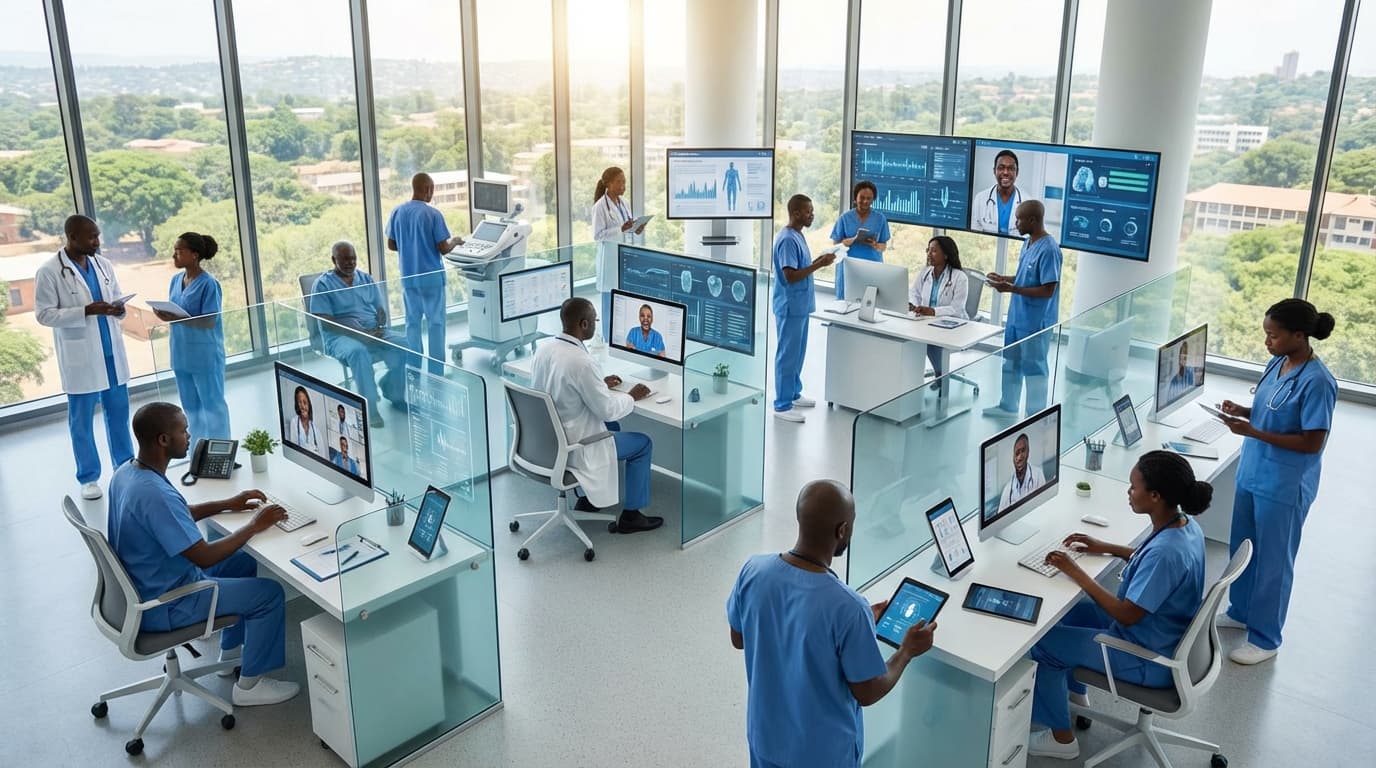
PACS/RIS Migration & Integration in Burundi
Engineering Excellence & Technical Support
Data migration, interoperability and workflow integration for imaging IT. High-standard technical execution following OEM protocols and local regulatory frameworks.
Scalable Cloud Infrastructure Deployment
Engineered and deployed a robust, cloud-based PACS/RIS solution leveraging scalable infrastructure to accommodate Burundian healthcare facilities' growing data needs and ensure high availability across diverse geographic locations.
Seamless Data Migration & Interoperability Framework
Developed and implemented a secure, phased data migration strategy, ensuring minimal disruption to clinical workflows. Established an interoperability framework to facilitate seamless data exchange between the new PACS/RIS and existing hospital information systems, including legacy DICOM archives.
Enhanced Data Security & Compliance
Implemented industry-leading security protocols, including encryption at rest and in transit, granular access controls, and comprehensive audit trails, to safeguard sensitive patient data and ensure compliance with evolving healthcare data regulations within Burundi.
What Is Pacs/ris Migration & Integration In Burundi?
PACS/RIS Migration & Integration in Burundi refers to the process of transferring and interlinking Picture Archiving and Communication Systems (PACS) and Radiology Information Systems (RIS) within healthcare facilities in Burundi. This service is crucial for modernizing radiology workflows, improving data accessibility, and enhancing diagnostic capabilities. PACS are responsible for storing, retrieving, and distributing medical images, while RIS manages patient demographics, scheduling, billing, and reporting for radiological examinations. Migration involves moving existing data and functionalities from legacy systems (which may be outdated, disparate, or on-premise) to new, often cloud-based or more robust on-premise solutions. Integration ensures seamless data flow and interoperability between PACS, RIS, Electronic Health Records (EHRs), and other healthcare IT systems. This facilitates a unified view of patient information, streamlines operational efficiency, and supports evidence-based decision-making in a resource-constrained environment like Burundi.
| Service Aspect | Description | Relevance to Burundi |
|---|---|---|
| Data Migration | Transferring historical imaging studies and patient records from existing systems to a new, consolidated PACS/RIS platform. | Addresses data fragmentation, enables longitudinal patient care, and reduces reliance on physical film archives, which are costly and prone to degradation. |
| System Integration | Establishing bidirectional communication between PACS/RIS and other healthcare IT systems (EHR, LIS, billing) to create a unified patient information ecosystem. | Enables a holistic view of the patient's health, reduces manual data entry, improves clinical decision-making by providing contextual information, and streamlines administrative processes in a limited resource setting. |
| Workflow Automation | Leveraging the integrated PACS/RIS to automate routine tasks such as study routing, report generation, and image retrieval. | Enhances operational efficiency, reduces turnaround times for diagnoses, and optimizes the utilization of scarce radiology personnel. |
| Network and Infrastructure | Assessing and upgrading the IT infrastructure (network bandwidth, storage, servers) to support the demands of a modern PACS/RIS. | Crucial for enabling reliable access to images and data, especially in areas with potentially less developed network infrastructure, ensuring system performance and availability. |
| Training and Change Management | Educating healthcare professionals on the new systems and managing the organizational transition. | Ensures user adoption, maximizes system benefits, and minimizes disruption to clinical operations, critical for successful implementation in diverse healthcare settings. |
Key Components of PACS/RIS Migration & Integration
- Data Extraction and Transformation: Extracting data from legacy PACS/RIS and transforming it into a compatible format for the new system. This includes DICOM images, patient metadata, reports, and scheduling information.
- System Deployment and Configuration: Installing and configuring the new PACS and RIS software, ensuring adherence to DICOM standards, HL7 messaging protocols, and local regulatory requirements.
- Network Infrastructure Assessment and Upgrade: Evaluating existing network capabilities to support high-volume image transfer and real-time data access, recommending and implementing necessary upgrades.
- Interoperability Development: Establishing secure and standardized connections (e.g., HL7, FHIR) between PACS/RIS and other hospital information systems like EHRs, Laboratory Information Systems (LIS), and billing systems.
- User Training and Support: Providing comprehensive training to radiologists, technicians, IT staff, and administrative personnel on the new system's functionalities and best practices.
- Data Validation and Quality Assurance: Rigorous testing to ensure data integrity, accuracy, and completeness post-migration.
- Go-Live Support and Post-Implementation Monitoring: Providing on-site or remote assistance during the transition phase and ongoing support to address any emergent issues.
- Security and Compliance Implementation: Ensuring robust data security measures, access controls, and compliance with relevant data privacy regulations.
- Disaster Recovery and Business Continuity Planning: Establishing protocols for data backup, recovery, and system resilience.
- Workflow Optimization: Analyzing and re-engineering existing radiology workflows to leverage the capabilities of the integrated PACS/RIS.
Who Needs Pacs/ris Migration & Integration In Burundi?
The need for PACS (Picture Archiving and Communication System) and RIS (Radiology Information System) migration and integration in Burundi is driven by the evolving demands of modern healthcare. As the country aims to enhance diagnostic accuracy, improve patient care, and streamline workflows, adopting these advanced systems becomes crucial. This technological leap is not just about acquiring new software; it's about creating a connected and efficient ecosystem for medical imaging and radiology services. The benefits extend from reduced manual processes and faster report turnaround times to improved data security and the potential for remote consultations and advanced analytics. For Burundi's healthcare sector, this migration represents a significant step towards achieving international standards in diagnostic imaging and patient management.
| Target Customer Type | Key Departments Benefiting | Primary Needs & Benefits |
|---|---|---|
| Public Hospitals | Radiology, Cardiology, Oncology, Neurology, Emergency Departments, General Medicine | Improved diagnostic turnaround, reduced manual work, better data archiving, enhanced collaboration, support for telemedicine. |
| Private Hospitals & Clinics | Radiology, Imaging Departments, Surgical Units, Outpatient Services | Competitive edge, enhanced patient experience, efficient workflow, revenue cycle management, data security. |
| Specialized Diagnostic Centers | Radiology, Imaging Specialists, Technologists | Streamlined image acquisition and interpretation, optimized storage, efficient reporting, interdisciplinary communication. |
| Tertiary Referral Centers | All imaging-dependent specialties, Interventional Radiology, Multidisciplinary Teams | Advanced image analysis capabilities, long-term data retention for research, seamless integration with EMR/EHR, support for complex procedures. |
| Medical Training & Research Institutions | Radiology Departments, Medical Libraries, Research Divisions | Educational case archives, support for clinical trials, data for research publications, remote learning capabilities. |
| Government Health Ministries & Agencies | Health Information Management, Public Health Surveillance, Policy Development | Aggregate data for health trends, national imaging registry development, resource allocation optimization, quality control. |
Target Customers & Departments for PACS/RIS Migration & Integration in Burundi
- Public Hospitals: These are often the largest healthcare providers and serve a significant portion of the population. Upgrading their PACS/RIS infrastructure can dramatically improve the efficiency and quality of care delivered to a wide range of patients.
- Private Hospitals & Clinics: As the private healthcare sector grows in Burundi, these institutions are increasingly seeking to offer advanced diagnostic services and competitive patient care. PACS/RIS adoption is a key differentiator.
- Specialized Diagnostic Centers: Centers focusing solely on radiology or specific imaging modalities will benefit immensely from integrated PACS/RIS solutions for optimized workflow and data management.
- Tertiary Referral Centers: These facilities handle complex cases and require robust systems for managing large volumes of imaging data and facilitating collaboration among specialists.
- Medical Training & Research Institutions: For teaching hospitals and research facilities, PACS/RIS integration is vital for educational purposes, case review, and supporting research initiatives.
- Government Health Ministries & Agencies: For national health planning, data collection, and public health initiatives, having access to centralized and standardized imaging data through PACS/RIS is invaluable.
- Remote Healthcare Facilities (with connectivity): While challenging, facilities in remote areas that can establish reliable connectivity can leverage PACS/RIS for remote diagnostics and consultations, bridging geographical barriers.
Pacs/ris Migration & Integration Process In Burundi
This document outlines the workflow for PACS/RIS migration and integration projects in Burundi, detailing the process from initial inquiry to successful execution. The process is structured to ensure a phased approach, minimizing disruption and maximizing the benefits of the new system.
| Phase | Stage | Description | Key Activities | Deliverables/Outcomes | Responsible Parties |
|---|---|---|---|---|---|
| Phase 1: Planning & Assessment | Inquiry & Initial Consultation | Receiving and understanding the client's initial interest and preliminary requirements. | Initial contact, understanding the client's motivation for migration/integration, identifying primary pain points. | Understanding of client's objectives, preliminary needs assessment report. | Client (Healthcare Facility), Vendor/Consultant |
| Phase 1: Planning & Assessment | Detailed Needs Analysis & Site Survey | In-depth assessment of current infrastructure, workflows, and specific system requirements. | On-site visit (if applicable), interviews with stakeholders (radiologists, technicians, IT), inventory of existing hardware and software, network assessment, data volume analysis. | Detailed requirements document, technical specifications, gap analysis report, proposed solution architecture. | Vendor/Consultant, Client IT and Clinical Staff |
| Phase 1: Planning & Assessment | Solution Design & Proposal | Developing a tailored PACS/RIS solution based on the needs analysis and creating a comprehensive project proposal. | Designing the system architecture, selecting hardware and software components, defining integration points with existing EMR/HIS, creating a detailed project plan (timeline, resources, budget). | Detailed system design document, formal project proposal with cost breakdown and timeline, contract agreement. | Vendor/Consultant, Client Management |
| Phase 2: Procurement & Preparation | Procurement of Hardware & Software | Acquiring all necessary hardware and software licenses for the new PACS/RIS. | Placing orders, managing supplier relationships, customs clearance and importation procedures (specific to Burundi). | All procured hardware and software delivered to the site. | Vendor/Consultant, Client Procurement Department |
| Phase 2: Procurement & Preparation | Infrastructure Setup & Configuration | Preparing the IT infrastructure to support the new PACS/RIS. | Network upgrades, server installation and configuration, cybersecurity setup, workstation deployment and configuration. | Ready IT infrastructure, network connectivity established. | Client IT Department, Vendor/Consultant |
| Phase 3: Implementation & Integration | System Installation & Configuration | Installing and configuring the PACS and RIS software according to the design. | Software installation, database setup, user role and permission configuration, DICOM conformance testing. | Installed and baseline configured PACS/RIS. | Vendor/Consultant |
| Phase 3: Implementation & Integration | Data Migration (if applicable) | Transferring existing patient imaging studies and RIS data to the new system. | Developing a data migration strategy, data cleansing, performing test migrations, executing full data migration, data validation. | Migrated historical data accessible in the new system. | Vendor/Consultant, Client IT and Data Management Staff |
| Phase 3: Implementation & Integration | Integration with Existing Systems | Connecting the PACS/RIS with other hospital information systems (HIS, EMR) for seamless data flow. | Developing and testing HL7 interfaces, API integrations, ensuring bidirectional data exchange. | Interfaced and integrated PACS/RIS with HIS/EMR. | Vendor/Consultant, Client IT and EMR/HIS Support |
| Phase 4: Testing & Training | User Acceptance Testing (UAT) | Allowing end-users to test the system and validate that it meets their operational needs. | Developing UAT test cases, executing test scenarios, documenting bugs and issues, resolving identified issues. | Signed UAT documentation, list of resolved issues. | Client End-Users (Radiologists, Technicians, Administrators), Vendor/Consultant |
| Phase 4: Testing & Training | End-User Training | Providing comprehensive training to all relevant staff on how to use the new PACS/RIS. | Developing training materials, conducting hands-on training sessions (on-site or remote), providing post-training support. | Trained end-users, training manuals and guides. | Vendor/Consultant, Client Training Department |
| Phase 4: Testing & Training | Go-Live Readiness Assessment | Final evaluation to ensure all aspects are ready for the system to be fully operational. | Reviewing testing results, training completion, infrastructure readiness, and operational procedures. | Go-live readiness checklist completed and approved. | Project Manager, Client Management, Vendor/Consultant |
| Phase 5: Deployment & Support | Go-Live | Launching the new PACS/RIS into the production environment. | Final system checks, activating all functionalities, deactivating old systems (if applicable). | New PACS/RIS is fully operational. | Vendor/Consultant, Client IT and Operations Staff |
| Phase 5: Deployment & Support | Post-Go-Live Support | Providing immediate assistance and troubleshooting after the system goes live. | On-site or remote support, addressing emergent issues, performance monitoring. | Stable system operation, resolution of immediate post-go-live issues. | Vendor/Consultant, Client IT Support |
| Phase 5: Deployment & Support | Ongoing Maintenance & Optimization | Ensuring the system continues to function optimally and providing continuous improvement. | Regular system maintenance, software updates, performance tuning, user feedback collection, potential future enhancements. | Long-term system stability, client satisfaction, optimized workflow. | Vendor/Consultant, Client IT and Clinical Leadership |
PACS/RIS Migration & Integration Workflow in Burundi
- The workflow begins with an initial inquiry from a healthcare facility or organization in Burundi seeking to implement or migrate their Picture Archiving and Communication System (PACS) and Radiology Information System (RIS).
- This inquiry triggers a series of steps designed to comprehensively assess needs, plan the project, and execute the migration and integration.
- Successful completion involves thorough testing, training, and ongoing support to ensure the new PACS/RIS operates efficiently and effectively within the Burundian healthcare context.
Pacs/ris Migration & Integration Cost In Burundi
Migrating and integrating Picture Archiving and Communication Systems (PACS) and Radiology Information Systems (RIS) in Burundi is a significant undertaking with a complex cost structure. Several factors influence the overall expense, ranging from the initial hardware and software procurement to ongoing maintenance and training. It's crucial for healthcare facilities to conduct a thorough needs assessment and obtain detailed quotes from vendors familiar with the Burundian market to establish a realistic budget.
| Cost Component | Estimated Range (BIF) | Notes |
|---|---|---|
| Small-Scale PACS/RIS (Limited Modalities, Few Users) | 15,000,000 - 40,000,000 | Basic functionality, on-premise deployment, potentially refurbished hardware. |
| Medium-Scale PACS/RIS (Multiple Modalities, Moderate Users) | 40,000,000 - 100,000,000 | More comprehensive features, better hardware, integration with HIS, on-site training. |
| Large-Scale/Enterprise PACS/RIS (Numerous Modalities, High User Count, Advanced Features) | 100,000,000+ | Full integration, advanced visualization, potential for cloud deployment, extensive customization and training. |
| Hardware (Servers, Storage, Workstations) | 5,000,000 - 30,000,000+ | Highly variable based on specifications, capacity, and vendor. |
| Software Licensing (PACS & RIS) | 7,000,000 - 50,000,000+ | Depends on vendor, modules, and user licenses. Annual fees apply. |
| Data Migration Services | 2,000,000 - 15,000,000 | Based on data volume, complexity, and required tools. |
| Integration Services | 3,000,000 - 20,000,000 | Complexity of integration with other hospital systems. |
| Implementation & Configuration | 3,000,000 - 15,000,000 | Vendor professional services fees. |
| Training | 1,000,000 - 10,000,000 | On-site vs. remote, duration, and number of participants. |
| Annual Support & Maintenance | 1,000,000 - 10,000,000+ | Typically 15-20% of initial software cost per year. |
| Contingency (10-15%) | Add 10-15% to the total estimated cost. | Crucial for managing unforeseen expenses. |
| Customization | Variable (potentially 5-20% of software cost) | Depends on the extent of modifications required. |
Key Pricing Factors for PACS/RIS Migration & Integration in Burundi
- System Scope and Complexity: The number of departments, imaging modalities (X-ray, CT, MRI, Ultrasound, etc.), user count, and the required level of integration with existing hospital information systems (HIS) will directly impact costs.
- Vendor Selection: Different vendors offer varying pricing models, feature sets, and support levels. Local Burundian IT companies or regional vendors with a presence in Burundi may offer more competitive pricing than international giants.
- Hardware Infrastructure: This includes servers, storage devices (RAID arrays, NAS, SAN), workstations for radiologists and referring physicians, network upgrades (switches, cabling), and potentially dedicated PACS/RIS workstations.
- Software Licensing: Costs for PACS software (image viewing, archiving, and retrieval), RIS software (patient registration, scheduling, reporting, billing), and any necessary modules (e.g., advanced visualization, AI integration) are a major component.
- Data Migration: The volume and format of existing medical images and patient data to be migrated, along with the complexity of the migration process, will affect costs. This can involve specialized tools and significant labor.
- Integration Services: Connecting the PACS/RIS with other hospital systems like HIS, EMR, and billing systems requires specialized integration expertise and can incur substantial costs.
- Implementation and Configuration: Setting up the systems, configuring workflows, user profiles, and custom templates requires skilled personnel and contributes to the overall expense.
- Training: Comprehensive training for radiologists, technicians, IT staff, and administrative personnel is essential for successful adoption and ongoing use. This can involve on-site or remote training sessions.
- Support and Maintenance: Ongoing annual support contracts, software updates, hardware maintenance, and technical assistance are recurring costs.
- Customization: Any specific customization requirements to meet unique hospital workflows or regulatory needs will add to the cost.
- Project Management: Effective project management is critical for a successful migration and integration, and the associated costs should be factored in.
- Contingency: It is advisable to include a contingency budget (typically 10-15%) to account for unforeseen challenges or scope changes.
- Local Taxes and Duties: Import duties and local taxes on hardware and software can significantly influence the final price.
- Currency Exchange Rates: Fluctuations in currency exchange rates can impact the cost of imported hardware and software.
Affordable Pacs/ris Migration & Integration Options
Migrating and integrating a Picture Archiving and Communication System (PACS) and Radiology Information System (RIS) can be a significant undertaking, often perceived as expensive. However, several affordable options and cost-saving strategies exist. Understanding value bundles and leveraging phased approaches are key to a successful and budget-conscious implementation. This document outlines such options, focusing on maximizing value while minimizing expenditure.
| Value Bundle Type | Description | Cost-Saving Benefits | Considerations |
|---|---|---|---|
| Core PACS/RIS Integration Bundle | Combines essential PACS (image viewing, storage) and RIS (patient scheduling, reporting) functionalities. Often includes basic integration with EMR/EHR. | Reduced licensing fees for bundled products, streamlined implementation process, dedicated support for integrated components. | Ensure the bundle meets all your current and foreseeable needs. Assess the level of customization offered. |
| Cloud-Native PACS/RIS Subscription | A subscription-based model where PACS/RIS software and data are hosted in the cloud. Includes software access, storage, and often maintenance/updates. | Lower upfront capital expenditure, predictable monthly/annual costs, scalability to match demand, reduced IT infrastructure burden. | Evaluate internet bandwidth requirements, data security protocols of the cloud provider, and potential long-term subscription costs. |
| Archiving & Long-Term Storage Add-on | A bundled service for long-term storage of medical images and reports, often integrated with the primary PACS. This can include on-premise or cloud-based archiving solutions. | Cost-effective solution for managing growing data volumes, compliance with retention policies, reduced burden on primary PACS storage, potentially lower cost per TB for archived data. | Understand the retrieval times for archived studies, data accessibility, and the cost of accessing historical data. |
| Interoperability & Gateway Services | Bundles that focus on facilitating seamless data exchange between PACS/RIS and other healthcare systems (EMR/EHR, billing systems) using standards like HL7 and FHIR. | Avoids costly custom interface development, ensures data consistency across systems, improves workflow efficiency, supports regulatory compliance. | Verify the vendor's adherence to interoperability standards and their experience integrating with your specific existing systems. |
| Basic Reporting & Dictation Integration | Includes core reporting tools within the RIS and integration with basic dictation software (e.g., speech recognition). | Streamlines report generation, reduces manual data entry, potentially lower licensing for integrated dictation software. | Assess the quality and features of the integrated dictation solution; may require separate investment for advanced speech recognition. |
Key Considerations for Affordable PACS/RIS Migration & Integration
- Define Clear Scope and Objectives: Avoid scope creep by precisely identifying essential functionalities and future needs. A well-defined scope prevents unnecessary expenses on features not immediately required.
- Leverage Cloud-Based Solutions: Cloud PACS/RIS offers scalability, reduced upfront hardware costs, and predictable subscription-based pricing, often proving more cost-effective than on-premise solutions for smaller to medium-sized practices.
- Explore Open-Source or Low-Cost Software: While requiring more in-house expertise, open-source PACS/RIS options can drastically reduce licensing fees. Carefully evaluate the total cost of ownership, including support and maintenance.
- Phased Implementation: Instead of a complete overhaul, consider a phased migration. This allows for gradual integration of modules, spreading costs over time and enabling staff to adapt more easily.
- Interoperability and Standards: Prioritize solutions that adhere to industry standards like DICOM and HL7. This ensures seamless integration with existing and future systems, avoiding costly custom interfaces.
- Vendor Negotiation and Bundling: Actively negotiate with vendors. Inquire about value bundles that combine PACS, RIS, and potentially other services (e.g., disaster recovery, archiving) at a discounted rate.
- Data Migration Strategy: Plan data migration meticulously. Bulk migration can be costly. Consider archiving older studies and migrating only active or recent data, with a strategy for accessing archived information when needed.
- Training and Support: Factor in the cost of training. Opt for vendors offering comprehensive training packages or explore train-the-trainer models to empower internal staff.
- Third-Party Integration Specialists: For complex integrations, consider specialized third-party integrators who may offer more competitive pricing than system vendors for specific tasks.
- Evaluate Existing Infrastructure: Assess your current IT infrastructure. Can existing hardware be repurposed? Minimizing new hardware purchases can lead to substantial savings.
Verified Providers In Burundi
In Burundi's evolving healthcare landscape, identifying trusted and competent medical professionals is paramount for patient well-being. Verified providers, particularly those with credentials from reputable organizations like Franance Health, offer a critical layer of assurance. This document outlines why these verified providers stand out as the best choice for your healthcare needs in Burundi, detailing their rigorous vetting process and the benefits they bring.
| Feature | Franance Health Verified Providers | Unverified Providers |
|---|---|---|
| Credential Verification | Rigorous and independent verification of degrees, licenses, and certifications. | May rely on self-attestation or limited checks, potentially leaving gaps in assurance. |
| Professional Experience | In-depth review of practice history and specialized training. | Limited or no formal assessment of experience beyond basic claims. |
| Patient Safety Standards | Adherence to stringent safety protocols and ethical guidelines are assessed. | No guaranteed adherence to specific patient safety benchmarks. |
| Continuing Education | Evidence of ongoing professional development and skill enhancement is required. | May not require or verify ongoing training, potentially leading to outdated practices. |
| Reputation & Trust | Benefit from the trust associated with Franance Health's established reputation for quality assurance. | Reputation can be inconsistent and difficult to independently assess. |
| Patient Confidence | High level of confidence due to transparent and thorough vetting. | May lead to uncertainty and hesitation for patients. |
What are Verified Providers?
- Verified providers are healthcare professionals who have undergone a comprehensive and independent credentialing process.
- This process typically involves a thorough review of their educational qualifications, professional licenses, training, experience, and any disciplinary actions.
- Verification confirms that the provider meets established standards of competence, ethics, and patient safety.
Scope Of Work For Pacs/ris Migration & Integration
This document outlines the Scope of Work (SOW) for the PACS/RIS Migration & Integration project. It details the project's objectives, key activities, deliverables, and standard technical specifications to ensure a successful transition and seamless integration of the Picture Archiving and Communication System (PACS) and Radiology Information System (RIS).
| Phase | Key Activities | Technical Deliverables | Standard Specifications |
|---|---|---|---|
| System assessment, data profiling, architecture design, workflow analysis, hardware/software requirements definition, security policy definition, testing strategy development. | Detailed System Architecture Document, Data Migration Plan, Integration Design Document, Security Plan, Test Plan. | HL7 v2.x/v3 standards for integration, DICOM standards for imaging, IHE profiles (e.g., PCC, PDQ, XDS-I), HIPAA/HITECH compliance, industry-standard encryption protocols (e.g., TLS 1.2+). |
| Procurement and installation of hardware (servers, storage, workstations), installation and configuration of PACS/RIS software, network configuration, security hardening. | Installed and Configured PACS/RIS Environment, Network Connectivity Documentation, Security Configuration Report. | Server hardware conforming to vendor specifications, High-availability storage solutions (e.g., RAID, SAN), Redundant network infrastructure, Operating system hardening standards. |
| Data extraction from legacy systems, data cleansing and transformation, data validation, data loading into the new PACS/RIS, post-migration data verification. | Migrated Image Data (DICOM), Migrated RIS Data, Data Migration Report, Data Validation Logs. | DICOM standards for image data, Data transformation rules defined in the Data Migration Plan, Data deduplication algorithms, Audit trails for all migration activities. |
| Integration with EHR (e.g., ADT, ORM, ORU messages), Modality integration (DICOM connectivity), Integration with other hospital systems (e.g., LIS, Billing), testing of integrated workflows. | Integrated EHR System, Connected Modalities, Integrated RIS/PACS Functionality, Integration Test Reports. | HL7 v2.x/v3 for inter-system communication, DICOM Conformance Statements from modalities and PACS/RIS, IHE profile compliance where applicable, Robust error handling mechanisms. |
| Unit testing, integration testing, user acceptance testing (UAT), performance testing, security testing, go-live readiness assessment. | Test Cases & Scripts, Test Execution Reports, Defect Tracking Logs, UAT Sign-off Document, Performance Benchmark Report. | Defined test scenarios covering all critical workflows, Measurable performance metrics (e.g., query response time, image load time), Security vulnerability assessment reports. |
| Final system configuration, user training, system deployment, go-live support, post-go-live monitoring. | Live PACS/RIS System, Trained User Base, Go-Live Support Plan, Post-Go-Live Monitoring Report. | Scheduled downtime minimized, Rollback plan defined, Comprehensive user training materials, System health monitoring tools. |
| System monitoring, performance tuning, user feedback collection, ongoing maintenance and support, system documentation updates. | System Performance Reports, User Feedback Summary, Maintenance Plan, Updated System Documentation. | Regular system performance reviews, Proactive issue identification and resolution, Knowledge base for troubleshooting, Version control for all documentation. |
Project Objectives
- To successfully migrate all existing patient imaging data and associated RIS information from the current system(s) to the new, unified PACS/RIS platform.
- To integrate the new PACS/RIS with existing hospital IT infrastructure, including the Electronic Health Record (EHR) system, modalities (MRI, CT, X-ray, etc.), and other relevant systems.
- To ensure data integrity, security, and accessibility throughout and after the migration process.
- To provide comprehensive training and support to all relevant stakeholders for the new PACS/RIS platform.
- To achieve optimal system performance and user satisfaction with the new PACS/RIS solution.
Service Level Agreement For Pacs/ris Migration & Integration
This Service Level Agreement (SLA) outlines the response times and uptime guarantees for the PACS/RIS Migration & Integration services provided by [Your Company Name] to [Client Name]. This agreement is effective as of [Start Date] and will remain in effect until [End Date] or as otherwise terminated by mutual written agreement. The scope of services includes the migration of existing PACS/RIS data and the integration of new PACS/RIS solutions.
| Service Component | Severity Level | Response Time Guarantee | Resolution Time Target | Uptime Guarantee |
|---|---|---|---|---|
| PACS/RIS System (Core Functionality) | Critical (System Unavailability, Major Data Corruption) | 15 minutes | 4 hours | 99.8% |
| PACS/RIS System (Core Functionality) | High (Significant Performance Degradation, Intermittent Access Issues) | 30 minutes | 8 hours | 99.8% |
| PACS/RIS System (Core Functionality) | Medium (Minor Functionality Impairment, Non-critical Feature Failure) | 2 hours | 24 hours | 99.8% |
| PACS/RIS System (Core Functionality) | Low (Cosmetic Issues, Minor Configuration Adjustments) | 4 hours | 48 hours | 99.8% |
| Data Migration Process (Active Phase) | Critical (Migration Halting, Data Loss) | 30 minutes | 6 hours (per incident) | N/A (monitored during active migration) |
| Integration Points (e.g., HL7 interfaces, EMR integration) | Critical (Complete Interface Failure) | 30 minutes | 4 hours | 99.5% (per interface) |
| Integration Points (e.g., HL7 interfaces, EMR integration) | High (Partial Interface Failure, Slow Data Transfer) | 1 hour | 8 hours | 99.5% (per interface) |
Key Performance Indicators (KPIs)
- Response Time: The maximum allowable time for [Your Company Name] to acknowledge and begin addressing a reported incident or request.
- Resolution Time: The maximum allowable time for [Your Company Name] to fully resolve a reported incident or request, restoring the service to its expected operational state.
- Uptime Guarantee: The percentage of time the PACS/RIS system is expected to be available and fully functional.
- Availability: The PACS/RIS system shall be considered available when users can access and utilize core functionalities, including image viewing, reporting, and data retrieval.
- Downtime: Any period during which the PACS/RIS system is unavailable for use, excluding scheduled maintenance.
Frequently Asked Questions

Ready when you are
Let's scope your PACS/RIS Migration & Integration in Burundi project in Burundi.

Scaling healthcare logistics and technical systems across the entire continent.