
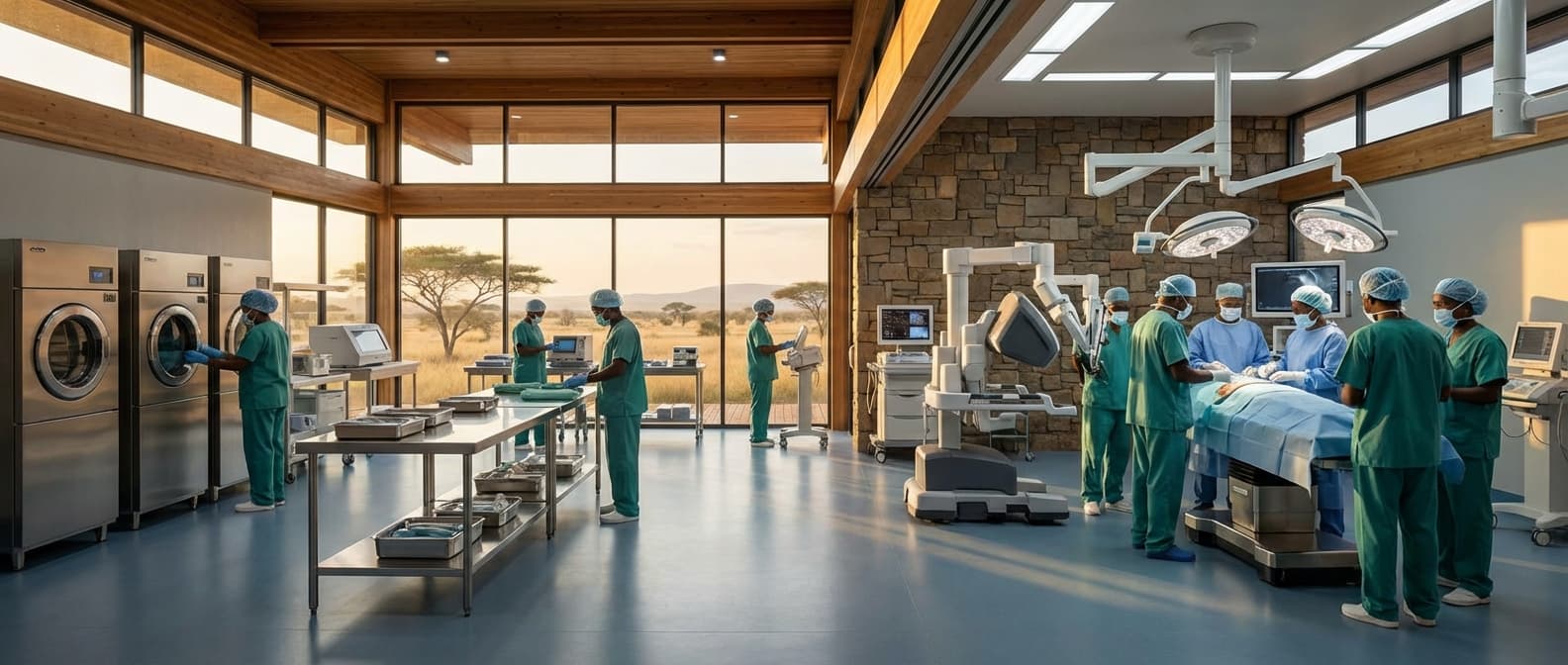
CSSD Design & Validation in Burundi
Engineering Excellence & Technical Support
CSSD workflow design, validation and process development High-standard technical execution following OEM protocols and local regulatory frameworks.
CSSD Autoclave Performance Validation
Ensured optimal sterilization efficacy for critical medical instruments through rigorous validation of CSSD autoclaves, adhering to international standards (e.g., ISO 17665-1). This included detailed cycle parameter monitoring, Bowie-Dick testing, and biological indicator challenges to guarantee validated, repeatable sterilization cycles.
Sterile Processing Area Design & Workflow Optimization
Architected and validated the layout and workflow for a new Central Sterile Supply Department (CSSD) in Burundi. Focused on creating a unidirectional flow to prevent cross-contamination, optimizing instrument reprocessing stages (cleaning, disinfection, sterilization, sterile storage) for efficiency and safety, and ensuring compliance with relevant healthcare facility design guidelines.
Instrument Traceability & Quality Assurance System Implementation
Designed and validated a robust instrument tracking and quality assurance system for the CSSD. This involved implementing barcoding solutions and documentation protocols to ensure full traceability of instruments from point of use through sterilization and back to patient care, minimizing the risk of instrument mix-ups and ensuring quality control.
What Is Cssd Design & Validation In Burundi?
Central Sterile Supply Department (CSSD) design and validation in Burundi refers to the systematic planning, configuration, and subsequent verification of facilities and processes dedicated to the decontamination and sterilization of medical devices. This service ensures that reusable medical instruments are rendered safe for patient use, preventing healthcare-associated infections (HAIs). The design phase involves architectural layout, workflow optimization, equipment selection, and adherence to international and national standards for sterile processing. Validation is the documented process of confirming that the designed system consistently performs as intended and meets predefined quality and safety objectives.
| Service Component | Description | Key Considerations for Burundi |
|---|---|---|
| Needs Assessment | Determining the required capacity, scope of services, and types of medical devices to be processed based on the facility's operational profile. | Understanding the prevalent types of surgical procedures and associated instrumentation; assessing existing infrastructure limitations. |
| Architectural Design & Layout | Planning the physical space to ensure unidirectional workflow (dirty to clean to sterile), segregation of activities, adequate ventilation, and appropriate material handling. | Considering local building codes, availability of construction materials, and power/water supply reliability. |
| Equipment Specification & Selection | Identifying and specifying appropriate sterilization equipment (e.g., autoclaves, low-temperature sterilizers), washer-disinfectors, drying cabinets, and sterile packaging systems. | Prioritizing durable, energy-efficient, and easily maintainable equipment; investigating local support and spare parts availability. |
| Workflow & Process Design | Defining standard operating procedures (SOPs) for receiving, cleaning, disinfection, inspection, assembly, packaging, sterilization, storage, and distribution. | Developing SOPs that are easily understood and implemented by local staff, with consideration for literacy levels and language barriers. |
| Environmental Controls | Designing HVAC systems to maintain appropriate air changes, temperature, and humidity in different zones (e.g., clean room, sterile storage). | Evaluating the feasibility and cost-effectiveness of advanced HVAC systems given local climate and infrastructure. |
| Validation Protocols | Developing protocols for installation qualification (IQ), operational qualification (OQ), and performance qualification (PQ) of equipment and processes. | Ensuring validation methods are practical and can be performed with locally available resources and expertise. |
| Staff Training & Competency | Designing training programs for CSSD personnel on aseptic techniques, equipment operation, maintenance, and quality control. | Developing culturally appropriate training materials and delivery methods; identifying needs for ongoing professional development. |
| Quality Management System (QMS) Integration | Establishing a QMS that includes documentation, record-keeping, internal audits, and corrective/preventive actions (CAPA) for continuous improvement. | Simplifying QMS implementation to ensure sustainability and effective adoption by staff. |
Who Needs CSSD Design & Validation in Burundi?
- Hospitals (public and private)
- Surgical centers
- Clinics with surgical capacities
- Dental clinics performing invasive procedures
- Specialized medical facilities requiring sterile instrumentation
Who Needs Cssd Design & Validation In Burundi?
Central Sterile Services Department (CSSD) design and validation are critical for ensuring patient safety and preventing healthcare-associated infections. In Burundi, like any nation striving to improve its healthcare infrastructure, these services are essential for facilities that handle surgical instruments and reusable medical devices. Effective CSSD design optimizes workflow, reduces contamination risks, and ensures instruments are properly sterilized and ready for reuse. Validation confirms that sterilization processes are consistently effective, meeting international standards. Therefore, any healthcare institution in Burundi that performs procedures requiring sterile instruments is a potential beneficiary.
| Customer Type | Primary Departments Involved | Key Needs Addressed by CSSD Design & Validation |
|---|---|---|
| Public Hospitals | Operating Rooms, Intensive Care Units (ICUs), Emergency Departments, Outpatient Clinics, Central Sterile Supply Department (CSSD) | Standardization of sterilization processes, infection control compliance, efficient instrument turnaround, training for staff, capital investment planning, regulatory adherence. |
| Private Hospitals/Clinics | Operating Rooms, Surgical Suites, CSSD, Various Speciality Departments | High-quality patient care, reputation management, operational efficiency, cost-effectiveness, advanced sterilization technologies, client satisfaction. |
| Surgical Centers | Operating Rooms, Pre-operative Areas, Post-operative Areas, CSSD | Rapid instrument processing, optimized workflow for high patient volume, compliance with safety protocols, reduction of infection rates. |
| Specialty Clinics (e.g., Dental, Ophthalmology) | Treatment Rooms, Procedure Rooms, CSSD | Ensuring sterility of specialized instruments, preventing cross-contamination, adherence to specific guidelines for instrument reprocessing, patient confidence. |
Target Customers and Departments in Burundi Requiring CSSD Design & Validation
- Hospitals (Public and Private)
- Surgical Centers
- Specialty Clinics (e.g., Dental, Ophthalmology)
- Maternity Wards
- Outpatient Surgery Units
- Any healthcare facility with a central sterile processing function.
Cssd Design & Validation Process In Burundi
The design and validation process for a Central Sterile Supply Department (CSSD) in Burundi is a multi-stage workflow ensuring that the facility meets international standards for infection control and operational efficiency. This process begins with an initial inquiry and culminates in a fully operational and validated CSSD. The workflow is structured to address the specific needs and regulatory landscape within Burundi, often involving collaboration with healthcare professionals, engineering firms, and regulatory bodies.
| Stage | Description | Key Activities | Key Stakeholders | Deliverables |
|---|---|---|---|---|
| Initial Inquiry & Needs Assessment | The process begins with a client (hospital, clinic, government health agency) expressing interest in establishing or upgrading a CSSD. A thorough understanding of the current situation, future needs, and available resources is established. | Site visit, interview with stakeholders, assessment of current sterilization practices, identification of service volume and types of instruments, preliminary budget discussion. | Hospital Administration, Clinical Staff (Surgeons, Nurses), Facility Manager, Potential CSSD Manager. | Needs assessment report, preliminary scope of work, initial budget estimate. |
| Conceptual Design & Feasibility Study | Based on the needs assessment, a high-level conceptual design is developed, outlining the functional areas, flow of materials, and estimated space requirements. A feasibility study assesses the technical and financial viability. | Developing schematic layouts, identifying key equipment categories, estimating space requirements for each zone (decontamination, packing, sterilization, storage), initial cost estimation, risk assessment. | CSSD Consultants, Architects, Engineers, Hospital Administration. | Conceptual design drawings, feasibility report, preliminary budget and timeline. |
| Detailed Design & Engineering | This stage involves the creation of detailed architectural, mechanical, electrical, and plumbing (MEP) drawings. It also includes specifying all equipment, materials, and finishes. | Developing detailed floor plans, section drawings, and elevations; MEP system design (ventilation, water supply, drainage, power); specifying materials and finishes for walls, floors, and ceilings; detailed equipment specifications; creation of Bill of Quantities (BOQ). | Architects, MEP Engineers, Structural Engineers, CSSD Consultants, Procurement Specialists. | Full set of detailed architectural and MEP drawings, equipment specifications, BOQ, construction schedule. |
| Procurement & Construction/Renovation | Tendering for construction or renovation work and procurement of all specified equipment. This stage involves building or modifying the physical space according to the detailed design. | Tendering and awarding construction contracts, site preparation, construction or renovation activities, procurement of CSSD equipment (autoclaves, washer-disinfectors, ultrasonic cleaners, packaging materials, etc.). | Construction Company, Equipment Suppliers, Project Manager, Hospital Administration. | Completed construction/renovation, installed and delivered equipment. |
| Equipment Installation & Commissioning | Ensuring all procured equipment is correctly installed and tested to ensure it functions as per manufacturer specifications. | Supervising equipment installation, connecting utilities, initial power-up and testing of individual equipment, calibration of critical parameters. | Equipment Suppliers, Service Engineers, CSSD Manager, Project Manager. | Installed and functional equipment, preliminary test reports. |
| Validation & Qualification | A critical stage that confirms the CSSD design, installation, and operational performance meet predetermined standards and regulatory requirements for safe and effective sterile processing. This typically involves IQ, OQ, and PQ. | Installation Qualification (IQ): Verifying equipment is installed correctly. Operational Qualification (OQ): Testing equipment functions across its operating range. Performance Qualification (PQ): Demonstrating the CSSD can consistently produce sterile items under normal operating conditions using simulated or actual loads. | Validation Engineers, Microbiologists, CSSD Manager, Quality Assurance Personnel, Regulatory Inspectors (if applicable). | IQ, OQ, and PQ protocols and reports, validation certificates. |
| Training & Handover | Comprehensive training of CSSD staff on all aspects of CSSD operations, including equipment use, infection control protocols, documentation, and maintenance. Formal handover of the completed facility and systems. | Developing training modules, conducting hands-on training sessions, competency assessments, handover of all documentation (manuals, protocols, validation reports). | CSSD Consultants, Equipment Trainers, CSSD Staff, Hospital Management. | Trained personnel, operational manuals, completed training records, formal handover document. |
| Ongoing Monitoring & Re-validation | Establishing and maintaining systems for continuous quality monitoring of CSSD processes and periodic re-validation to ensure ongoing compliance and effectiveness. | Routine performance monitoring, internal audits, external audits, scheduled equipment maintenance, periodic re-validation of critical processes and equipment. | CSSD Staff, Quality Assurance, Biomedical Engineering Department, External Auditors. | Regular performance reports, audit findings, re-validation reports. |
Key Stages in the CSSD Design & Validation Process in Burundi
- Initial Inquiry & Needs Assessment
- Conceptual Design & Feasibility Study
- Detailed Design & Engineering
- Procurement & Construction/Renovation
- Equipment Installation & Commissioning
- Validation & Qualification
- Training & Handover
- Ongoing Monitoring & Re-validation
Cssd Design & Validation Cost In Burundi
Designing and validating a CSSD (Central Sterile Services Department) in Burundi involves a complex interplay of factors that influence the overall cost. These factors are largely determined by the specific requirements of the facility, the chosen technologies, the scope of services offered, and the prevailing economic conditions in Burundi. Local currency (Burundian Franc - BIF) pricing requires careful consideration of import duties, local labor rates, and the availability of specialized expertise. The process typically involves initial planning and design, procurement of equipment, installation and commissioning, and finally, validation to ensure compliance with international standards. Each of these stages carries its own cost implications.
| Cost Component | Estimated Range (BIF) | Notes |
|---|---|---|
| Initial Design & Consultancy Fees (per sq meter) | 1,000,000 - 5,000,000 BIF | Varies based on complexity and consultant's experience. May be a fixed fee for smaller projects. |
| Basic Sterilization Equipment (e.g., autoclave, washer-disinfector for small facility) | 20,000,000 - 100,000,000 BIF | For a single, smaller-capacity unit. Prices increase significantly with automation and multiple units. |
| Advanced Sterilization Equipment (e.g., low-temperature plasma, larger capacity steam autoclaves, multiple units) | 100,000,000 - 500,000,000+ BIF | This is a broad range. High-end, fully automated systems can exceed this substantially. |
| Infrastructure Upgrades (plumbing, electrical, ventilation, flooring) | 5,000,000 - 50,000,000 BIF | Highly dependent on the existing state of the facility. |
| Installation & Commissioning | 10% - 20% of equipment cost | Includes labor, testing, and initial setup. |
| Validation & Testing (including consumables) | 2,000,000 - 10,000,000 BIF | Per validation cycle. Depends on the number of equipment and complexity of validation. |
| Staff Training | 1,000,000 - 5,000,000 BIF | Per training program, can vary based on trainer expertise and duration. |
| Total Estimated Cost Range for a Small to Medium-Sized CSSD | 100,000,000 - 700,000,000 BIF | This is a very broad estimate and can fluctuate significantly. Excludes major building renovations. |
| Total Estimated Cost Range for a Large/Advanced CSSD | 700,000,000 - 2,000,000,000+ BIF | Includes multiple high-end equipment, extensive infrastructure, and comprehensive services. |
Key Pricing Factors for CSSD Design & Validation in Burundi
- Facility Size and Capacity: Larger departments requiring more equipment and greater throughput will naturally incur higher costs.
- Scope of Services: The range of sterilization methods (e.g., steam, low-temperature plasma, ethylene oxide) and the types of instruments to be processed will impact equipment selection and complexity.
- Technology and Equipment Selection: High-end, automated, and advanced sterilization equipment will be significantly more expensive than basic, manual systems. The brand reputation and origin of the equipment also play a role.
- Infrastructure Requirements: Upgrades to existing building infrastructure (e.g., plumbing, electrical, ventilation, flooring) to meet CSSD standards will add to the cost.
- Consultancy and Design Fees: Engaging specialized CSSD designers and consultants, especially those with international experience, will contribute to the overall expense.
- Import Duties and Taxes: As many CSSD components are imported, Burundi's import duties, VAT, and other taxes will significantly influence the final price.
- Installation and Commissioning Costs: Skilled labor for installation, testing, and initial setup of equipment is a crucial cost component.
- Validation and Testing: Rigorous validation processes, including biological and chemical indicator testing, and documentation, require specialized services and consumables.
- Training: Comprehensive training for CSSD staff on equipment operation, maintenance, and infection control protocols is essential and adds to the budget.
- Project Management: Overseeing the entire design and validation process requires effective project management, which can be an internal or external cost.
- Local Labor Rates: While often lower than in developed countries, local labor costs for construction, installation, and maintenance are a factor.
- Currency Exchange Rates: Fluctuations in the Burundian Franc against major international currencies (USD, EUR) can impact the cost of imported equipment and services.
- Maintenance and Service Contracts: Long-term maintenance and service agreements for sophisticated equipment are an ongoing cost that should be factored into the initial budget.
Affordable Cssd Design & Validation Options
Designing and validating a Central Sterile Services Department (CSSD) is a critical investment for any healthcare facility. However, budget constraints can make achieving optimal design and robust validation challenging. This guide explores affordable CSSD design options, cost-saving strategies, and value bundles that deliver essential functionality and compliance without excessive expenditure.
| Value Bundle | Description | Cost-Saving Strategies Employed | Key Benefits |
|---|---|---|---|
| Essential Workflow Package | Focuses on the core decontamination, cleaning, disinfection, and basic sterilization processes. Includes fundamental layout principles and essential equipment slots. | Streamlined design, prioritized essential equipment, emphasizes efficient space layout. | Lower initial capital investment, quicker implementation, addresses immediate patient safety needs. |
| Modular Expansion Package | A foundational design that incorporates pre-planned spaces and infrastructure for future additions of advanced sterilization technologies or increased capacity. | Scalable design, future-proofing, avoids costly reconfigurations later. | Long-term cost efficiency, adaptability to evolving healthcare needs. |
| Validation & Training Starter Kit | Includes essential documentation templates, validation protocols for basic equipment, and foundational staff training modules for compliance. | Leverages standardized templates, focuses on essential validation steps, cost-effective training materials. | Ensures initial compliance, reduces risk of regulatory non-conformance, empowers staff with essential knowledge. |
| Refurbished Equipment Integration | Assists in sourcing and integrating certified refurbished decontamination and sterilization equipment, ensuring quality and cost savings. | Utilizes pre-owned but certified equipment, reduces capital expenditure on machinery. | Significant cost reduction on equipment purchases, still meets functional requirements. |
| Lean Process Design Consultation | Consulting services focused on optimizing CSSD workflows using lean principles to eliminate waste and improve efficiency. | Process optimization, waste reduction, improved throughput. | Increased operational efficiency, reduced labor costs, faster turnaround times. |
Key Considerations for Affordable CSSD Design
- Prioritize Core Functionality: Focus on essential workflows (decontamination, cleaning, disinfection, sterilization, storage, distribution) and avoid over-engineering with non-essential features initially.
- Modular & Scalable Design: Opt for designs that allow for future expansion or upgrades as the facility's needs grow, preventing costly retrofits.
- Efficient Space Utilization: Maximize workflow efficiency through thoughtful layout, minimizing travel distances and bottlenecks. This reduces the need for larger, more expensive spaces.
- Standardized Equipment Selection: Choose reliable, industry-standard equipment that offers good value for money. Consider leasing or refurbished options where appropriate and compliant.
- Phased Implementation: If a complete overhaul is too costly, consider implementing improvements in phases, addressing the most critical areas first.
- Leverage Technology Wisely: Explore cost-effective software solutions for tracking and documentation rather than complex, integrated systems if not immediately necessary.
- Training & Staff Empowerment: Invest in comprehensive staff training to ensure efficient operation and reduce errors, which can lead to rework and increased costs.
Verified Providers In Burundi
In Burundi's evolving healthcare landscape, identifying trustworthy and competent medical professionals is paramount for ensuring quality patient care. Verified Providers, particularly those with credentials like Franance Health, stand out as beacons of excellence. This document outlines why these verified providers, specifically those associated with Franance Health, represent the best choice for healthcare needs in Burundi.
| Credential Aspect | Franance Health Verification | Patient Benefit |
|---|---|---|
| Medical Licensing | Confirms valid and current professional licenses. | Ensures provider is legally authorized to practice. |
| Specialized Training & Certifications | Validates completion of recognized specialty training and certifications. | Guarantees access to expert care for specific conditions. |
| Continuing Medical Education (CME) | Ensures providers actively participate in ongoing learning. | Access to the latest medical knowledge and treatment advancements. |
| Professional Experience | Assesses relevant practical experience in their field. | Benefit from seasoned practitioners with a proven track record. |
| Ethical Review & Background Checks | Confirms a clean disciplinary record and adherence to ethical guidelines. | Provides peace of mind regarding the provider's integrity. |
Understanding Verified Providers in Burundi
- Verified Providers: These are healthcare professionals who have undergone a rigorous vetting process to confirm their qualifications, licenses, and ethical standing. This verification instills confidence in patients seeking reliable medical services.
- Franance Health Credentials: Franance Health is a recognized entity committed to upholding high standards in healthcare provision. Their credentialing process signifies a provider's adherence to best practices, specialized training, and a dedication to patient well-being.
- Why They Are the Best Choice: Choosing verified providers with Franance Health credentials offers unparalleled advantages in terms of expertise, safety, and patient-centered care.
- Benefits of Choosing Verified Providers with Franance Health Credentials:
- Ensured Competence and Expertise: Providers are meticulously assessed for their medical knowledge and practical skills.
- Adherence to Ethical Standards: A commitment to professional conduct and patient confidentiality is a prerequisite.
- Access to Specialized Care: Identification of specialists in various medical fields.
- Enhanced Patient Safety: Reduced risk of medical errors due to qualified and vetted practitioners.
- Trust and Reliability: A guarantee of receiving care from legitimate and reputable professionals.
Scope Of Work For Cssd Design & Validation
This Scope of Work (SOW) outlines the requirements for the design, validation, and documentation of a new Central Sterile Supply Department (CSSD) within [Hospital Name]. The project aims to ensure the CSSD meets all relevant industry standards, regulatory requirements, and operational efficiency goals for sterile processing of medical devices. This document details the technical deliverables and standard specifications expected throughout the project lifecycle.
| Deliverable | Description | Standard Specifications / Reference |
|---|---|---|
| Conceptual Design Report | Includes preliminary layout, workflow analysis, equipment matrix, space requirements, and initial budget estimation. | AAMI ST79, HTM 01-01, local health authority guidelines, ISO 13485 |
| Detailed Design Drawings | Architectural, mechanical, electrical, plumbing (MEP), and IT drawings showing final layout, utility connections, ventilation systems, and data infrastructure. | ASHRAE standards, NFPA codes, local building codes, hospital IT security policies |
| Equipment Specifications & RFPs | Detailed technical specifications for all CSSD equipment (e.g., washers, sterilizers, drying cabinets, packaging systems) and Request for Proposals (RFPs) for procurement. | Manufacturer's specifications, AAMI standards (e.g., AAMI TIR12), CE marking requirements, WHO guidelines |
| Workflow & Process Maps | Detailed documentation of all CSSD processes, including receiving, decontamination, assembly, packaging, sterilization, storage, and distribution. | AAMI ST79, ISO 13485, Lean Six Sigma principles |
| Validation Master Plan (VMP) | Outlines the overall validation strategy for the CSSD, including IQ, OQ, and PQ protocols and acceptance criteria. | ISPE GAMP 5, FDA guidance on validation, internal quality management system procedures |
| Installation Qualification (IQ) Protocols & Reports | Ensures all equipment and systems are installed correctly according to design specifications and manufacturer instructions. | AAMI ST79, Manufacturer's Installation Manuals, ISPE GAMP 5 |
| Operational Qualification (OQ) Protocols & Reports | Verifies that installed equipment and systems operate as intended within defined parameters. | AAMI ST79, Manufacturer's Operating Manuals, ISPE GAMP 5 |
| Performance Qualification (PQ) Protocols & Reports | Confirms that the entire CSSD system, including personnel and processes, consistently produces sterile products meeting all requirements under normal operating conditions. | AAMI ST79, ISPE GAMP 5, regulatory requirements for sterile products |
| Risk Management Plan | Identifies potential risks to sterile processing and outlines mitigation strategies. | ISO 14971, AAMI ST79 |
| Standard Operating Procedures (SOPs) | Comprehensive SOPs for all CSSD activities, including equipment operation, maintenance, cleaning, sterilization validation, and emergency procedures. | AAMI ST79, manufacturer's instructions, hospital policies |
| Training Materials & Records | Development and delivery of training programs for CSSD staff, along with documentation of training completion. | Hospital HR policies, best practices in adult learning |
| As-Built Drawings | Final updated drawings reflecting any changes made during installation and commissioning. | Original design drawings, site modifications |
| CSSD Manual | A consolidated document containing all design information, validation reports, SOPs, and operational guidelines for the CSSD. | Project documentation requirements, hospital document control system |
Project Phases and Key Activities
- Phase 1: Conceptual Design & Planning
- Phase 2: Detailed Design & Engineering
- Phase 3: Procurement & Installation Support
- Phase 4: Validation & Commissioning
- Phase 5: Training & Handover
Service Level Agreement For Cssd Design & Validation
This Service Level Agreement (SLA) outlines the guaranteed response times and uptime for the CSSD (Central Sterile Supply Department) Design & Validation services. This SLA is intended to ensure efficient and reliable support for the design, planning, and validation phases of CSSD operations.
| Service Component | Response Time (Business Hours) | Uptime Guarantee (Remote Support/Access) | Uptime Guarantee (On-Site Presence for Validation) |
|---|---|---|---|
| Initial Consultation & Design Review | 4 Business Hours | N/A | N/A |
| Technical Support for Design Queries | 2 Business Hours | 99.5% during scheduled validation activities | N/A |
| Validation Protocol Development | 2 Business Days | N/A | N/A |
| Response to Validation Protocol Deviation (During Execution) | 1 Business Hour | N/A | N/A |
| On-Site Validation Support (Scheduled) | N/A | N/A | 98% of scheduled on-site validation time |
| Post-Validation Report Generation | 5 Business Days | N/A | N/A |
Scope of Services
- Initial CSSD design consultation and space planning.
- Development of workflow diagrams and equipment specifications.
- Validation protocol development (IQ/OQ/PQ).
- Execution and documentation of validation activities.
- Post-validation review and recommendations.
- Troubleshooting and support during the design and validation phases.
Frequently Asked Questions

Ready when you are
Let's scope your CSSD Design & Validation in Burundi project in Burundi.

Scaling healthcare logistics and technical systems across the entire continent.