
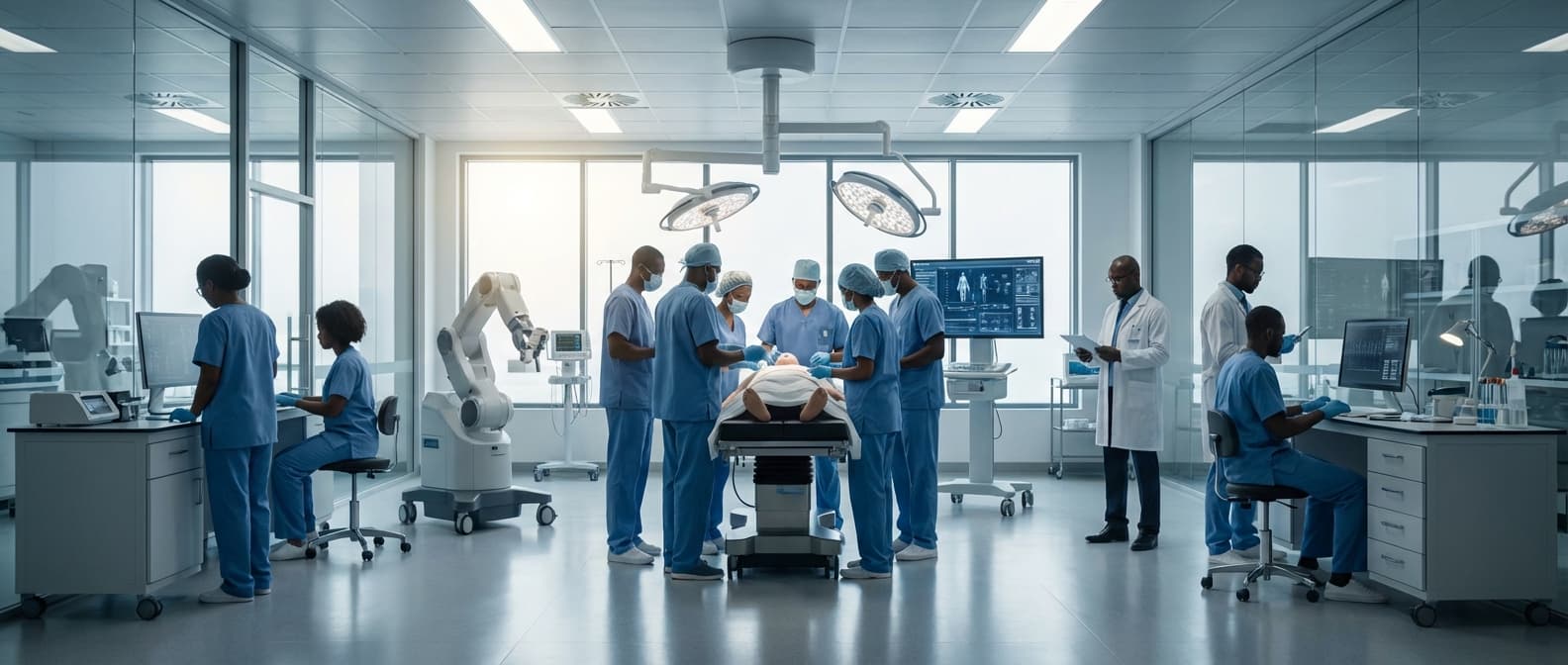
Biomedical Staffing Augmentation in Burundi
Engineering Excellence & Technical Support
Onsite biomedical engineers and PACS administrators High-standard technical execution following OEM protocols and local regulatory frameworks.
Accelerated Specialist Deployment
Leveraging our extensive network, we rapidly source and deploy highly skilled biomedical engineers and technicians to address critical equipment maintenance and repair needs in remote and underserved regions of Burundi, minimizing downtime and ensuring continuity of care.
Bridging Skills Gaps in Advanced Diagnostics
We provide specialized augmentation for healthcare facilities requiring expertise in advanced diagnostic imaging and laboratory equipment. Our augmented staff possess proficiency in calibration, troubleshooting, and operation of complex machinery, enhancing diagnostic accuracy and patient outcomes.
On-Demand Technical Support & Training
Offering flexible on-demand support and on-site training for existing biomedical teams. Our augmented personnel empower local staff with advanced troubleshooting techniques and best practices, fostering sustainable capacity building and reducing reliance on external interventions.
What Is Biomedical Staffing Augmentation In Burundi?
Biomedical Staffing Augmentation in Burundi refers to the strategic deployment of specialized, qualified, and often temporary biomedical professionals to support existing healthcare infrastructure and personnel. This service addresses critical gaps in the availability of skilled technicians, engineers, and other specialists required for the effective operation, maintenance, calibration, and repair of medical equipment. It aims to enhance the capacity of healthcare facilities to deliver consistent and high-quality patient care by ensuring the optimal functionality of their technological assets. The demand for such services is driven by factors including the rapid adoption of new medical technologies, limitations in local specialized training programs, high turnover of skilled personnel, and the need for specialized expertise for specific projects or equipment lifecycles. This augmentation can range from short-term project-based support to ongoing operational assistance, thereby improving diagnostic accuracy, treatment efficacy, and overall healthcare outcomes within the Burundian context.
| Who Needs Biomedical Staffing Augmentation? | Typical Use Cases |
|---|---|
| Public and Private Hospitals | Installation and commissioning of new imaging equipment (e.g., X-ray, CT scanners). Preventive maintenance schedules for critical care equipment (e.g., ventilators, anesthesia machines). Corrective maintenance and repair of diagnostic laboratory instruments. Calibration services for patient monitoring systems. Specialized technical support for advanced surgical equipment. |
| Clinics and Health Centers (especially those with advanced diagnostic capabilities) | On-demand repair services for ultrasound machines. On-site training for local technicians on new diagnostic tools. Maintenance of essential medical equipment in remote or underserved areas. Temporary staffing during equipment upgrades or facility expansions. |
| Government Ministries of Health and Health Sector NGOs | Development of national biomedical engineering strategies and frameworks. Management of large-scale medical equipment procurement and deployment projects. Overseeing the maintenance and repair infrastructure for national health programs. Capacity building initiatives for the national biomedical workforce. |
| Medical Equipment Suppliers and Manufacturers | Providing certified field service engineers for product support. On-site installation and training for newly acquired medical devices. Extending the reach of technical support in regions with limited local presence. |
Key Components of Biomedical Staffing Augmentation
- Assessment of existing biomedical workforce capacity and identification of skill deficits.
- Recruitment and vetting of qualified biomedical professionals with expertise in specific medical technologies.
- Deployment of augmented staff to healthcare facilities for defined periods or project scopes.
- Provision of specialized technical services including installation, commissioning, preventive maintenance, corrective maintenance, and calibration of medical devices.
- Training and knowledge transfer to in-house biomedical personnel to build local capacity.
- Management and oversight of augmented staff to ensure adherence to quality standards and operational protocols.
Who Needs Biomedical Staffing Augmentation In Burundi?
Biomedical staffing augmentation in Burundi is crucial for healthcare facilities grappling with a shortage of skilled and specialized biomedical personnel. This can impact the effective operation, maintenance, and calibration of vital medical equipment, directly affecting patient care quality and safety. The demand for such services stems from various factors, including limited local training programs, brain drain, and the increasing complexity of modern medical technology.
| Target Customer Type | Key Departments/Functions | Specific Needs Addressed by Augmentation |
|---|---|---|
| Public Hospitals | Biomedical Engineering Department, Radiology, Anesthesiology, Intensive Care Units (ICUs), Operating Theaters | Equipment maintenance, repair, calibration, installation of new equipment, technical support for critical care devices, staff training on equipment operation. |
| Private Hospitals & Clinics | All clinical departments, Laboratory Services, Imaging Centers | Ensuring high uptime for advanced diagnostic and therapeutic equipment, compliance with international standards, support for specialized procedures, outsourcing of specialized technical skills. |
| NGOs & International Aid | Field Operations, Health Program Management, Mobile Clinics | Deployment and maintenance of equipment in remote or underserved areas, rapid response to equipment failures, training local staff, ensuring equipment sustainability. |
| Government Health Authorities | Procurement & Logistics, Planning & Monitoring, Public Health Programs | Technical evaluation of new equipment purchases, national equipment maintenance strategies, capacity building for public health facilities, data management for equipment inventory. |
| Medical Equipment Suppliers | Technical Support, Field Service Engineering, Installation Teams | Augmenting field service capacity for routine maintenance and emergency repairs, specialized installation support for complex systems, managing peak demand periods. |
| Research & Educational Institutions | Laboratory Services, Research Facilities, Teaching Hospitals | Maintenance of sophisticated research equipment, ensuring equipment availability for student training, support for cutting-edge technology. |
Target Customers & Departments Requiring Biomedical Staffing Augmentation in Burundi
- Hospitals (Public & Private): The cornerstone of healthcare delivery, hospitals rely heavily on functional medical equipment. Augmentation ensures their bio-medical departments can manage the workload.
- Specialized Clinics & Diagnostic Centers: Facilities focusing on specific areas like radiology, cardiology, or laboratory diagnostics require highly specialized biomedical expertise.
- Non-Governmental Organizations (NGOs) & International Aid Organizations: These entities often operate remote health posts or run specific health programs, frequently requiring on-demand biomedical support.
- Government Health Ministries & Regional Health Authorities: These bodies oversee public health infrastructure and may require external expertise for large-scale equipment deployment, maintenance audits, or training initiatives.
- Medical Equipment Manufacturers & Distributors: Companies that sell and service medical equipment often need to supplement their existing technical teams, especially for complex installations or critical repair services in Burundi.
- Research Institutions & Universities with Medical Programs: Facilities involved in medical research or training need to ensure their equipment is operational and up-to-date, requiring specialized biomedical skills.
Biomedical Staffing Augmentation Process In Burundi
The Biomedical Staffing Augmentation Process in Burundi outlines the systematic approach to addressing shortages or specialized needs within the biomedical workforce. This process ensures that qualified personnel are efficiently identified, deployed, and integrated to support critical healthcare functions. It begins with a clear identification of the need and culminates in the successful completion of the augmented staffing period, followed by a review.
| Stage | Key Activities | Responsible Parties | Outputs/Deliverables | Timeline (Indicative) |
|---|---|---|---|---|
| Inquiry and Needs Assessment | Identification of specific biomedical staffing gaps (e.g., lack of specialized technicians, insufficient personnel for a new project). | Healthcare Facility Management, Ministry of Health Department Heads, Project Managers. | Detailed report outlining staffing needs, required skills, and justification. | 1-2 Weeks |
| Request Submission and Justification | Formal submission of an augmentation request, including the needs assessment report, budget estimates, and proposed duration of augmentation. | Requesting Healthcare Facility/Department. | Formal augmentation request document. | 1 Week |
| Approval and Budget Allocation | Review of the request by relevant authorities (e.g., Ministry of Health, funding partners). Approval based on strategic priorities, budget availability, and feasibility. | Ministry of Health Leadership, Funding Agencies. | Approved augmentation request, allocated budget. | 2-4 Weeks |
| Candidate Identification and Vetting | Development of job descriptions. Sourcing candidates through existing databases, professional networks, national recruitment agencies, or international organizations. Vetting includes reviewing CVs, conducting interviews, and verifying credentials. | Ministry of Health HR, Recruitment Agencies, Partner Organizations. | Shortlist of qualified candidates, background checks completed. | 3-6 Weeks |
| Contracting and Onboarding | Issuance of contracts or agreements. Facilitation of necessary administrative procedures (e.g., work permits, registration). Comprehensive onboarding program covering institutional policies, procedures, specific job duties, and local context. | Ministry of Health HR, Legal Department, Onboarding Team. | Signed contracts, completed onboarding documentation, staff identification. | 2-3 Weeks |
| Deployment and Supervision | Assignment of augmented staff to their respective roles and locations. Provision of ongoing supervision, mentorship, and technical support. | Supervising Managers at Healthcare Facilities, Technical Leads. | Staff successfully integrated into their roles, regular supervision reports. | Duration of Augmentation |
| Performance Monitoring and Evaluation | Regular assessment of staff performance against defined objectives and Key Performance Indicators (KPIs). Feedback mechanisms for both staff and supervisors. | Supervising Managers, Ministry of Health M&E Unit. | Performance appraisal reports, feedback summaries. | Ongoing throughout augmentation period |
| Completion and Offboarding | Formal completion of the augmentation period. Facilitation of administrative closure, final payments, and return of institutional property. | Ministry of Health HR, Finance Department, Admin. | Final performance reviews, exit interviews, clearance certificates. | 1 Week |
| Reporting and Knowledge Transfer | Documentation of lessons learned, challenges encountered, and successful strategies. Sharing of findings with stakeholders to inform future staffing decisions and improvements to the augmentation process. | Project Management Team, Ministry of Health M&E Unit. | Final project report, recommendations for process improvement. | 2 Weeks post-completion |
Biomedical Staffing Augmentation Process Workflow
- Inquiry and Needs Assessment
- Request Submission and Justification
- Approval and Budget Allocation
- Candidate Identification and Vetting
- Contracting and Onboarding
- Deployment and Supervision
- Performance Monitoring and Evaluation
- Completion and Offboarding
- Reporting and Knowledge Transfer
Biomedical Staffing Augmentation Cost In Burundi
Biomedical staffing augmentation in Burundi involves bringing in specialized medical professionals to supplement existing healthcare workforces, often on a project or temporary basis. This can be crucial for addressing skill gaps, managing surge capacity during health crises, or implementing new medical technologies and services. The cost of such augmentation is influenced by a variety of factors, making it essential to understand these drivers to accurately estimate budget requirements. Pricing is typically presented in the local currency, the Burundian Franc (BIF).
| Staffing Category | Estimated Range (BIF per month) | Notes |
|---|---|---|
| General Practitioner / Family Physician | 1,500,000 - 3,000,000 | Base rate, may increase with experience and specific skills. |
| Specialist Physician (e.g., Pediatrician, Gynecologist, Internist) | 2,500,000 - 5,000,000 | Varies significantly based on specialty demand and seniority. |
| Registered Nurse (RN) | 800,000 - 1,500,000 | General RNs. Specialized nurses (e.g., ICU, Oncology) will be higher. |
| Nurse Aid / Auxiliary Nurse | 400,000 - 700,000 | Entry-level support staff. |
| Laboratory Technician | 900,000 - 1,800,000 | Depends on specific lab disciplines and equipment knowledge. |
| Radiology Technician / Sonographer | 1,200,000 - 2,500,000 | Requires specific equipment operation skills. |
| Pharmacist | 1,000,000 - 2,000,000 | Hospital or retail pharmacy roles. |
| Biomedical Engineer / Technician (for equipment maintenance) | 1,800,000 - 3,500,000 | Crucial for maintaining medical equipment. Higher for specialized equipment. |
| Healthcare Administrator / Manager | 2,000,000 - 4,000,000 | Depends on scope of responsibility and facility size. |
| Support Staff (e.g., IT, Logistics for medical teams) | 600,000 - 1,200,000 | General administrative and operational support. |
Key Pricing Factors for Biomedical Staffing Augmentation in Burundi
- Type and Specialization of Staff: The demand for specific medical professions significantly impacts cost. Highly specialized roles (e.g., cardiac surgeons, advanced diagnostic imaging technicians) will command higher rates than general practitioners or nurses.
- Experience and Qualifications: Seniority, years of experience, advanced degrees, and specialized certifications directly influence salary expectations. More experienced and qualified professionals generally require higher compensation.
- Contract Duration and Nature: Short-term contracts or emergency deployments may incur higher per-diem rates or premium charges compared to longer-term, planned staffing solutions. Project-based roles with defined deliverables might also have different pricing structures.
- Location and Remoteness: Staffing remote or underserved areas in Burundi might require additional compensation for hardship, travel, and accommodation, increasing the overall cost.
- Agency Fees and Overhead: Recruitment agencies charge fees for sourcing, vetting, and managing staff. These fees cover their operational costs, expertise, and profit margin.
- Logistics and Support: Costs associated with travel, accommodation, visas, work permits, and any necessary local transportation for the augmented staff need to be factored in.
- Insurance and Benefits: Providing health insurance, liability insurance, and any other mandated or offered benefits for the augmented staff will add to the total cost.
- Training and Onboarding: If the augmented staff require specific training on local protocols, equipment, or administrative procedures, these costs will be incurred.
- Currency Fluctuations and Inflation: As pricing is in BIF, fluctuations in exchange rates and the general inflation rate within Burundi can impact the real cost over time.
Affordable Biomedical Staffing Augmentation Options
For organizations in the biomedical sector seeking to expand their workforce without incurring the high costs of permanent hires, affordable staffing augmentation is crucial. This involves leveraging flexible staffing solutions like contract, temp-to-hire, and project-based placements. Value bundles are pre-packaged service offerings that combine various staffing needs into a single, cost-effective solution. Cost-saving strategies focus on optimizing the hiring process, reducing overhead, and leveraging technology to streamline operations.
| Strategy Category | Description | Potential Cost Savings | Key Benefit for Biomedical Sector |
|---|---|---|---|
| Value Bundles | Pre-defined packages of staffing and related services offered at a bundled price. | Reduced per-unit cost compared to individual services; predictable budgeting. | Ensures access to necessary expertise for specific projects or periods without long-term commitments. |
| Direct Sourcing | Establishing and managing an in-house talent pool of pre-screened candidates. | Lower recruitment fees; faster time-to-hire. | Access to a readily available pool of qualified biomedical professionals for immediate needs. |
| Technology Adoption | Implementing ATS, AI screening, and virtual interview tools. | Reduced administrative overhead; increased recruiter efficiency. | Streamlines the hiring of specialized scientific and technical talent. |
| Managed Service Provider (MSP) | Outsourcing the management of the contingent workforce to a third-party provider. | Consolidated billing; potential for volume discounts; improved compliance. | Ensures adherence to strict regulatory and compliance requirements for biomedical staff. |
| Contract-to-Hire | Employing staff on a contract basis with the option to convert to permanent roles. | Reduced risk of poor hiring decisions; lower upfront permanent hiring costs. | Allows for thorough evaluation of skills and cultural fit before permanent investment. |
Key Value Bundles and Cost-Saving Strategies
- Value Bundles:
- 'Project Launch Pack': Combines recruitment, onboarding, and initial training for a dedicated project team, offering a fixed price for a set duration. This reduces the administrative burden and provides predictable costs for critical initiatives.
- 'Skill-Up Suite': Includes temporary placement of specialized personnel (e.g., regulatory affairs specialists, clinical research associates) along with access to targeted upskilling modules or knowledge transfer sessions. This ensures immediate expertise while building internal capacity.
- 'On-Demand Expertise': Offers a pool of pre-vetted, on-call professionals for short-term needs or to cover unexpected absences. This bundle typically includes a retainer fee for guaranteed availability, with usage-based charges.
- Cost-Saving Strategies:
- Direct Sourcing & Talent Pooling: Building and maintaining an internal database of pre-qualified candidates reduces reliance on expensive external recruiters and speeds up time-to-fill.
- Technology Integration: Utilizing applicant tracking systems (ATS), AI-powered screening tools, and virtual interviewing platforms to automate and optimize the recruitment and onboarding process.
- Shorter Onboarding Cycles: Developing streamlined and efficient onboarding programs that quickly integrate temporary staff, minimizing lost productivity.
- Managed Service Provider (MSP) Partnerships: Engaging an MSP to oversee and manage the entire contingent workforce, including recruitment, compliance, and payment, often leading to consolidated billing and better rates.
- Focus on Contract-to-Hire: Offering contract roles with a clear pathway to permanent employment can attract talent seeking flexibility while allowing organizations to assess fit before making a long-term commitment, reducing the risk of bad hires.
- Geographic Flexibility: Leveraging remote or hybrid work models for certain roles can expand the talent pool beyond local limitations and potentially reduce compensation expectations.
- Clear Scope Definition: Precisely defining project requirements and deliverables for contract staff helps prevent scope creep and associated cost overruns.
Verified Providers In Burundi
Ensuring access to quality healthcare in Burundi hinges on trusting the providers you engage with. Franance Health stands out as a beacon of reliability, offering a network of verified healthcare professionals and facilities. This verification process is rigorous, encompassing stringent checks on credentials, licenses, experience, and adherence to ethical standards. By choosing Franance Health, you are not just selecting a provider; you are choosing peace of mind, knowing that your health is in the hands of competent and trustworthy experts.
| Franance Health Verification Criteria | What it Means for You |
|---|---|
| Medical Licenses and Certifications | Guarantees that providers have met all legal and educational requirements to practice medicine. |
| Professional Experience and Specializations | Ensures you are connected with the right expertise for your specific health needs. |
| Reputation and Patient Feedback | Provides insights into a provider's bedside manner and patient satisfaction. |
| Adherence to Ethical Standards | Confirms providers operate with integrity and prioritize patient well-being. |
| Facility Standards and Equipment | For partner facilities, ensures a safe, hygienic, and well-equipped environment for treatment. |
Why Franance Health is the Superior Choice for Healthcare in Burundi:
- Unwavering Commitment to Quality: Franance Health's verification process is designed to uphold the highest standards of medical care, ensuring all listed providers are qualified and have a proven track record.
- Trust and Transparency: We believe in empowering patients with information. Our verified providers are transparent about their qualifications and experience, fostering trust and informed decision-making.
- Accessibility and Convenience: Franance Health simplifies the process of finding reliable healthcare, connecting you with specialists and facilities conveniently located across Burundi.
- Patient-Centric Approach: Our network is built around the needs of the patient. We prioritize accessibility, affordability, and a positive healthcare experience.
- Continuous Monitoring and Improvement: Franance Health doesn't stop at initial verification. We engage in ongoing monitoring to ensure our providers consistently meet our standards, guaranteeing sustained quality of care.
Scope Of Work For Biomedical Staffing Augmentation
This Scope of Work (SOW) outlines the requirements for augmenting existing biomedical engineering staff with specialized expertise and capacity to support [Client Name]'s critical projects. The objective is to ensure the seamless operation, maintenance, and advancement of the biomedical equipment infrastructure, thereby supporting patient care and research initiatives. This SOW details the technical deliverables and standard specifications expected from the augmented staff.
| Deliverable Category | Specific Deliverable | Standard Specifications / Requirements | Metrics for Success / Acceptance Criteria |
|---|---|---|---|
| Equipment Maintenance & Repair | Preventive Maintenance (PM) Services | Adherence to manufacturer-recommended PM schedules and protocols. Utilization of approved parts and test equipment. Documentation of all PM activities, findings, and recommendations in the CMMS. | Completion rate of scheduled PMs within +/- 5% of target dates. PM completion reports generated and signed off by client representative. No critical equipment failures reported due to missed PMs within 30 days of service. |
| Equipment Maintenance & Repair | Corrective Maintenance (CM) Services | Response time to critical equipment failure alarms: within 2 hours. Diagnosis and repair of equipment issues within 4 business hours for minor issues, 8 business hours for major issues. Use of OEM or equivalent parts. Full functional testing post-repair. | Average CM response time < 2 hours. Average CM resolution time < 6 business hours. Equipment uptime > 95% for critical equipment. Client sign-off on completed repair tickets. |
| Installation & Commissioning | New Equipment Installation Support | Verification of site readiness. Unpacking, assembly, and initial setup of new biomedical equipment as per manufacturer's instructions. Pre-installation testing and calibration. Integration with existing network and IT infrastructure. | Successful installation of X units of new equipment. All installed equipment passes pre-commissioning checks. Completion of installation within the project timeline. Client confirmation of equipment readiness for commissioning. |
| Installation & Commissioning | Equipment Commissioning & Validation | Performance verification against manufacturer specifications. Installation Qualification (IQ), Operational Qualification (OQ), and Performance Qualification (PQ) as required. Development and execution of validation protocols. Generation of commissioning reports. | Successful completion of IQ, OQ, and PQ for X units of equipment. All validation criteria met. Commissioning reports approved by client. Equipment officially placed into service. |
| Project Support | Biomedical Project Assistance | Assisting project managers with technical aspects of biomedical equipment projects. Providing input on equipment selection, procurement, and implementation strategies. Risk assessment and mitigation planning related to equipment. | Contribution to X project phases. Provision of technical documentation and recommendations. Participation in project meetings and contribution to decision-making. Timely completion of assigned project tasks. |
| Technical Consultation | Expert Advisory Services | Providing expert advice on equipment lifecycle management, technology evaluation, and departmental process improvement. Troubleshooting complex equipment issues. Recommending best practices for equipment utilization and maintenance. | Number of consultations provided: X. Impact of recommendations documented (e.g., cost savings, efficiency gains). Positive feedback from client on advisory services. |
| Documentation & Reporting | Service Reports and Documentation | Comprehensive documentation of all service activities, including PMs, CMs, installations, and validations. Maintenance of accurate equipment records in the CMMS. Generation of monthly/quarterly service summary reports. | All service activities documented in CMMS within 24 hours. Monthly service reports submitted by the 5th of the following month. Reports are accurate, comprehensive, and approved by client. |
| Compliance & Safety | Regulatory Compliance Support | Ensuring all work performed adheres to relevant regulatory standards (e.g., FDA, TJC, local health authorities). Maintaining equipment in a state of compliance. Assisting with regulatory audits related to biomedical equipment. | Zero non-compliance findings related to augmented staff's work during internal or external audits. Documentation supporting compliance readily available. |
Key Objectives
- Provide expert biomedical engineering support across specified areas.
- Enhance the capacity of the internal biomedical engineering department.
- Ensure compliance with all relevant regulatory standards and best practices.
- Facilitate the successful completion of project milestones.
- Minimize equipment downtime and optimize operational efficiency.
Service Level Agreement For Biomedical Staffing Augmentation
This Service Level Agreement (SLA) outlines the response times and uptime guarantees for Biomedical Staffing Augmentation services provided by [Your Company Name] to [Client Company Name]. This SLA is an integral part of the Master Services Agreement (MSA) dated [Date of MSA].
| Service Component | Service Level Objective (SLO) | Measurement Method | Escalation Procedure |
|---|---|---|---|
| Critical System Failure Response Time | Within 1 hour of notification during Working Hours; within 2 hours of notification outside of Working Hours. | Time logged from client notification (email, phone call, ticketing system) to Augmentation Staff acknowledgment and initiation of work. | If initial response time is not met, immediate escalation to [Your Company Name] Senior Management and notification to [Client Company Name] IT/Biomedical Director. |
| Non-Critical System Response Time | Within 4 business hours of notification during Working Hours. | Time logged from client notification to Augmentation Staff acknowledgment and initiation of work. | If response time is not met, escalation to [Your Company Name] Team Lead within 1 hour of missed SLA. |
| Augmentation Staff Availability (for pre-scheduled assignments) | 100% availability of assigned Augmentation Staff for confirmed shifts. | Confirmation of Augmentation Staff presence at the client site or logged in for remote work as per the agreed schedule. | In case of Augmentation Staff unavailability due to unforeseen circumstances (e.g., illness), [Your Company Name] will notify the client within [e.g., 2] hours of the scheduled start time and will deploy a replacement Augmentation Staff within [e.g., 4] hours, or as otherwise mutually agreed. |
| Critical System Uptime Guarantee | 99.5% Uptime for Critical Systems that require Augmentation Staff support. | Calculated based on the total time a Critical System should be operational versus the actual operational time, excluding scheduled maintenance. | If the Uptime Guarantee falls below the objective in a calendar month, [Your Company Name] will provide a service credit of [Specify Credit Amount or Percentage] of the monthly service fee for the affected Augmentation Staffing. |
Definitions
- Augmentation Staff: Qualified biomedical professionals provided by [Your Company Name] to supplement the client's existing staff.
- Critical System: A biomedical device or system whose failure would result in immediate patient harm or significant operational disruption.
- Downtime: A period during which a Critical System is unavailable for use due to a malfunction, for which Augmentation Staff is required to address.
- Response Time: The maximum allowable time from when a request for Augmentation Staff is initiated until the assigned Augmentation Staff acknowledges the request and begins working on resolution.
- Uptime Guarantee: The minimum percentage of time that Critical Systems are expected to be operational, assuming standard maintenance and absence of unforeseen catastrophic events.
- Working Hours: [Specify Client's working hours, e.g., Monday-Friday, 8:00 AM to 5:00 PM, excluding public holidays].
Frequently Asked Questions

Ready when you are
Let's scope your Biomedical Staffing Augmentation in Burundi project in Burundi.

Scaling healthcare logistics and technical systems across the entire continent.