
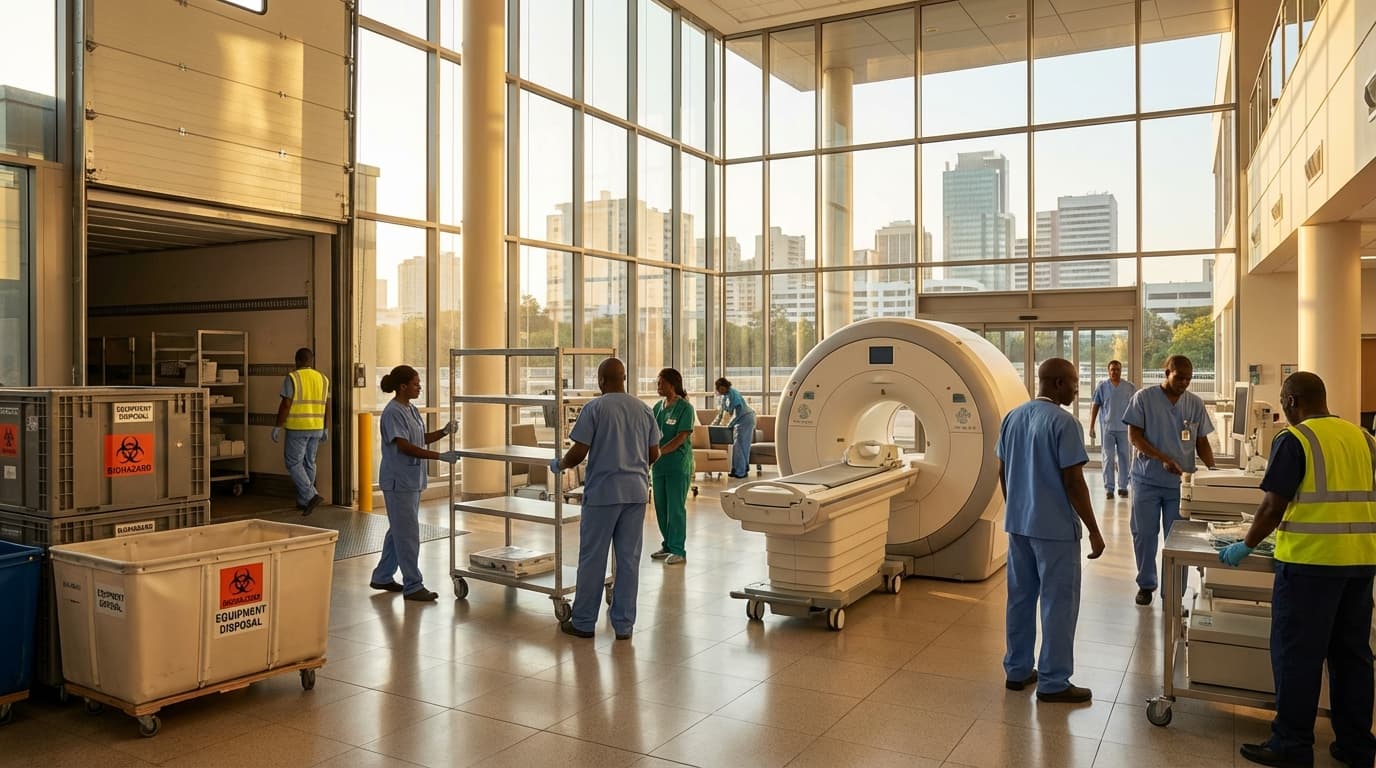
Heavy Medical Equipment De-Installation Service (MRI/CT/Cath Lab) in Burkina Faso
Engineering Excellence & Technical Support
Heavy Medical Equipment De-Installation Service (MRI/CT/Cath Lab) High-standard technical execution following OEM protocols and local regulatory frameworks.
Radiation Safety Protocols
Our team adheres to stringent radiation safety protocols during the de-installation of MRI, CT, and Cath Lab equipment, ensuring the protection of personnel, the environment, and the facility from residual radiation hazards. This includes meticulous shielding surveys and proper containment procedures.
Specialized Transport Logistics
We provide expert handling and secure transportation of high-value, sensitive medical equipment across Burkina Faso. Our logistics plan accounts for road conditions, customs regulations, and the specific weight and fragility of MRI, CT, and Cath Lab systems, utilizing specialized vehicles and trained personnel.
Precision Component De-assembly
Our certified technicians employ advanced tools and techniques for the precise de-assembly of complex medical imaging systems. We meticulously catalog and safely pack all components, including superconducting magnets, X-ray tubes, and delicate detectors, to prevent damage during the de-installation and subsequent transport process.
What Is Heavy Medical Equipment De-installation Service (Mri/ct/cath Lab) In Burkina Faso?
Heavy Medical Equipment De-Installation Service (MRI/CT/Cath Lab) in Burkina Faso refers to the specialized process of safely and meticulously dismantling, packaging, and preparing large-scale, high-value medical imaging and diagnostic systems such as Magnetic Resonance Imaging (MRI) scanners, Computed Tomography (CT) scanners, and Cardiac Catheterization (Cath Lab) suites for relocation, disposal, or decommissioning within Burkina Faso. This service is critical due to the complex nature, significant weight, sensitive components, and stringent safety protocols associated with these advanced medical technologies. It requires highly trained technicians with expertise in biomedical engineering, electrical systems, mechanical engineering, and radiation safety. The de-installation process aims to preserve the integrity of the equipment, minimize damage, and ensure compliance with regulatory requirements and manufacturer specifications.
| Who Needs This Service? | Typical Use Cases | ||||
|---|---|---|---|---|---|
| Hospitals and Clinics: Healthcare facilities in Burkina Faso undergoing upgrades, renovations, or relocating to new premises. | Medical Equipment Suppliers/Distributors: Companies that have sold used equipment and need to retrieve it for refurbishment or export. | Decommissioning Authorities: Government or regulatory bodies responsible for the safe retirement of obsolete medical equipment. | Third-Party Service Providers: Companies specializing in medical equipment maintenance and repair that require equipment to be moved for servicing. | Research Institutions: Facilities that are upgrading or relocating their advanced diagnostic imaging infrastructure. | |
| Equipment Relocation: Moving an existing MRI, CT, or Cath Lab from one department or building to another within a healthcare complex. | Inter-Facility Transfer: Relocating equipment between different hospitals or clinics within Burkina Faso. | Export/Import Operations: Preparing equipment for shipment out of or into Burkina Faso. | Facility Renovation/Expansion: Removing equipment temporarily to allow for construction or major upgrades to a medical suite. | End-of-Life Decommissioning: Safely dismantling and preparing equipment that has reached the end of its operational lifespan for disposal or recycling. | Technological Upgrades: Replacing older systems with newer models, requiring the removal of the existing unit. |
Key Components of Heavy Medical Equipment De-Installation Service:
- Site Survey and Planning: Detailed assessment of the installation site, equipment configuration, access routes, and logistical challenges.
- System De-energization and Safety Checks: Controlled shutdown of all power sources, verification of residual energy, and implementation of safety procedures to prevent electrical hazards and radiation exposure (where applicable).
- Component Disassembly: Systematic dismantling of the equipment into manageable sections, often involving specialized tools and techniques to address complex mechanical and electronic assemblies.
- Shielding and Containment Removal: For MRI and CT, this includes the safe removal of radiofrequency (RF) shielding, magnetic shielding, and radiation shielding (for CT).
- Cryogen Management (MRI): For superconducting MRI magnets, the safe venting and management of cryogens (typically liquid helium) is a critical and potentially hazardous step requiring specialized expertise.
- Cable and Plumbing Disconnection: Meticulous disconnection of all electrical cables, data conduits, cooling systems (water, air), and other ancillary connections.
- Packaging and Protection: Secure and protective packaging of individual components using specialized materials (e.g., anti-static wrapping, shock-absorbent padding, custom crates) to prevent damage during transit.
- Documentation: Comprehensive recording of the de-installation process, including photographic evidence, component inventories, and detailed reports for future reference or regulatory compliance.
- Logistics Coordination: Arrangement and management of transportation, including specialized heavy-lift vehicles and cranes, to move the disassembled equipment.
- Regulatory Compliance: Adherence to relevant national and international standards for equipment handling, transportation, and environmental safety.
Who Needs Heavy Medical Equipment De-installation Service (Mri/ct/cath Lab) In Burkina Faso?
Heavy medical equipment like MRI scanners, CT scanners, and Cath Labs are incredibly valuable and complex assets. Their de-installation requires specialized expertise, meticulous planning, and adherence to strict safety and regulatory protocols. This service is essential when existing facilities are undergoing renovation, relocation, or closure, or when upgrading to newer, more advanced equipment. The process involves dismantling, careful packaging, and secure transport, ensuring the integrity of the equipment for future re-installation or sale. This is a niche but critical service for specific healthcare institutions.
| Customer Type | Specific Equipment Likely Present | Reasons for De-Installation | Key Departments Involved |
|---|---|---|---|
| Major Hospitals (Public & Private) | MRI, CT Scanners, Cath Labs | Renovations, Relocation, Upgrades, Facility Closure | Radiology, Cardiology, Surgery, Facilities Management, Procurement |
| Specialized Medical Centers | MRI, CT Scanners, Cath Labs (depending on specialization) | Relocation, Equipment Upgrades, Facility Consolidation | Administration, Technical Services, Imaging/Cardiology Departments |
| Government Health Ministries/Agencies | MRI, CT Scanners, Cath Labs (in public facilities) | National Healthcare Infrastructure Redevelopment, Equipment Redeployment | Public Health Planning, Asset Management, Procurement |
| Medical Equipment Vendors & Manufacturers | MRI, CT Scanners, Cath Labs | Equipment Returns, Relocation for Re-installation at new sites, Demonstrations | Field Service, Installation, Logistics, Sales Support |
| Asset Liquidation & Remarketing Companies | MRI, CT Scanners, Cath Labs | Disposal of Surplus or Obsolete Equipment for resale/recycling | Operations, Logistics, Sales |
Target Customers and Departments for Heavy Medical Equipment De-Installation Service (MRI/CT/Cath Lab) in Burkina Faso:
- {"departments":["Radiology/Imaging Departments (for MRI, CT)","Cardiology Departments (for Cath Labs)","Surgical Departments (often where Cath Labs are located)","Facilities Management/Operations Departments","Procurement/Asset Management Departments"],"customerType":"Major Hospitals (Public & Private)"}
- {"departments":["Dedicated Cardiology Centers","Advanced Diagnostic Imaging Centers"],"customerType":"Specialized Medical Centers"}
- {"departments":["Public Health Infrastructure Departments","Procurement and Logistics Divisions"],"customerType":"Government Health Ministries/Agencies"}
- {"departments":["Service and Installation Departments","Logistics and Supply Chain Departments"],"customerType":"Medical Equipment Vendors & Manufacturers (for relocation or return)"}
- {"departments":["Operations and Logistics"],"customerType":"Asset Liquidation & Remarketing Companies"}
Heavy Medical Equipment De-installation Service (Mri/ct/cath Lab) Process In Burkina Faso
This document outlines the comprehensive workflow for the heavy medical equipment de-installation service (MRI, CT, Cath Lab) in Burkina Faso. The process is designed to be systematic, efficient, and compliant with all relevant safety and logistical considerations. It covers the entire journey from initial client inquiry to the successful completion of the de-installation. This service is critical for equipment relocation, upgrades, or decommissioning, requiring specialized expertise and adherence to strict protocols.
| Stage | Description | Key Activities | Responsible Party | Key Deliverables |
|---|---|---|---|---|
| The client expresses interest in de-installation services. | Receive inquiry, understand basic requirements (equipment type, location, reason for de-installation), provide preliminary information. | Client, Service Provider Sales/Inquiry Team | Initial understanding of client needs, preliminary contact established. |
| A detailed on-site evaluation is conducted. | Assess equipment condition, accessibility, power requirements, structural integrity of the facility, safety hazards, local regulations, and logistical challenges (e.g., door sizes, elevator access, transportation routes). | Service Provider Technical Team, Client Representative | Detailed site assessment report, identification of potential challenges and requirements. |
| A formal proposal outlining the scope, methodology, timeline, and cost is submitted. | Develop a comprehensive proposal based on the site survey, including detailed de-installation plan, safety protocols, required personnel, specialized tools, and cost breakdown. Discuss and refine with the client. | Service Provider Project Management/Estimating Team | Formal proposal and quotation, agreed-upon scope of work. |
| Formalizing the service agreement between the client and the service provider. | Review and sign contract, including terms and conditions, payment schedule, insurance, liability, and service level agreements. | Client, Service Provider Legal/Management Team | Signed service contract. |
| Developing a detailed execution plan and timeline. | Finalize de-installation schedule, coordinate with hospital/clinic staff, arrange for necessary permits and approvals, confirm availability of specialized equipment and personnel. | Service Provider Project Manager, Client Operations Manager | Detailed project schedule, confirmed logistics, resource allocation plan. |
| Ensuring all prerequisites for safe and efficient de-installation are met. | Safely disconnect power and utilities, remove ancillary equipment, prepare the surrounding area, implement safety barriers, brief on-site personnel on the de-installation plan and safety procedures. | Service Provider Technical Team, Client Facility Management | Site secured and prepared, all necessary safety measures in place. |
| The core de-installation process is performed by skilled technicians. | Carefully dismantle the equipment according to manufacturer specifications and best practices. This involves specialized tools, techniques for handling heavy and sensitive components, and strict adherence to safety protocols to prevent damage and injury. | Service Provider Specialized Technicians | Equipment safely and systematically dismantled. |
| Ensuring the site is left in a safe and clean condition. | Remove all de-installation tools and debris. Inspect the area for any residual hazards. Restore the site to its pre-de-installation condition as much as possible. | Service Provider Technical Team, Client Facility Management | Cleaned and cleared de-installation site, safety inspection completed. |
| Providing all necessary documentation and confirming completion. | Compile de-installation reports, including photos/videos of the process, sign-off forms, and any relevant compliance documentation. Formally handover the responsibility of the de-installed equipment. | Service Provider Project Manager, Client Representative | De-installation reports, sign-off documentation, formal handover. |
| Ensuring client satisfaction and addressing any post-service queries. | Address any final questions or concerns from the client. Provide support for subsequent logistics (e.g., transportation, storage) if part of the service agreement. | Service Provider Project Manager, Client | Client satisfaction confirmed, ongoing support provided as needed. |
De-Installation Service Workflow: Inquiry to Execution
- Inquiry & Initial Consultation
- Site Survey & Assessment
- Proposal & Quotation
- Contract & Agreement
- Planning & Scheduling
- Pre-De-Installation Preparation
- Equipment De-Installation Execution
- Post-De-Installation & Site Clearance
- Documentation & Handover
- Follow-up & Support
Heavy Medical Equipment De-installation Service (Mri/ct/cath Lab) Cost In Burkina Faso
De-installing complex and heavy medical equipment like MRI, CT scanners, and Cath Labs is a highly specialized and critical service. In Burkina Faso, the cost for such services is influenced by a combination of global industry standards and local economic realities. These machines are not only large and heavy but also contain sensitive components that require expert handling, precise disconnection, and careful preparation for transport or storage. The pricing is therefore multifaceted, reflecting the expertise, time, safety protocols, and logistical challenges involved. Understanding these factors is crucial for healthcare facilities budgeting for equipment relocation or upgrades.
| Equipment Type | Estimated Cost Range (XOF) | Notes |
|---|---|---|
| CT Scanner | 2,000,000 - 6,000,000 | Varies based on size, manufacturer, and required disassembly level. Includes site survey, specialized tools, and expert labor. |
| MRI Scanner (Low Field) | 4,000,000 - 10,000,000 | Requires specialized handling for magnets, cryogens, and RF shielding. More complex than CT scanners. |
| MRI Scanner (High Field) | 7,000,000 - 15,000,000+ | Significant cost due to extreme magnetic forces, cryogen management (e.g., liquid helium), and intricate systems. Potential need for specialized containment and transport. |
| Cath Lab (Angiography Suite) | 3,000,000 - 8,000,000 | Involves handling of heavy gantry systems, X-ray tubes, detectors, and potentially cooling systems. Radiation safety considerations are key. |
Key Pricing Factors for Medical Equipment De-Installation in Burkina Faso
- {"item":"Equipment Type and Complexity","description":"The specific type of equipment (MRI, CT, Cath Lab) dictates the complexity. MRI machines, with their powerful magnetic fields and cryogens, are generally the most complex and expensive to de-install. CT scanners and Cath Labs also have their unique challenges related to radiation shielding, intricate plumbing, and high-voltage systems."}
- {"item":"Size and Weight of Equipment","description":"Larger and heavier units require more specialized lifting equipment (cranes, heavy-duty forklifts), more personnel, and potentially structural modifications to the facility for removal. This directly impacts labor and equipment rental costs."}
- {"item":"Site Survey and Assessment","description":"A thorough on-site assessment is vital to identify potential challenges such as access routes, power requirements, cooling systems, and structural integrity. The time and expertise dedicated to this initial phase are factored into the overall cost."}
- {"item":"Labor Costs and Expertise","description":"De-installation requires highly skilled technicians, engineers, and project managers. The rates for these professionals, especially those with international experience or specialized certifications, are a significant cost component. Burkina Faso's labor market dynamics will influence these rates."}
- {"item":"Specialized Tools and Equipment","description":"Access to and rental of specialized de-installation tools, cryogen handling equipment (for MRI), vacuum pumps, and safety gear add to the expense. The availability of such specialized equipment locally can affect pricing."}
- {"item":"Safety and Environmental Protocols","description":"Strict adherence to safety regulations and environmental protocols (e.g., handling of refrigerants or hazardous materials) is paramount. The cost of implementing these protocols, including insurance and compliance, is included in the service."}
- {"item":"Dismantling and Packaging","description":"The extent of dismantling required for safe transport and the quality of packaging materials used will impact the labor and material costs."}
- {"item":"Timeframe and Urgency","description":"Emergency de-installations or those with tight deadlines often incur premium charges due to the need for rapid resource mobilization."}
- {"item":"Logistics and Transportation Planning","description":"While de-installation itself is the primary service, the planning and coordination for subsequent transportation (even if handled by a separate vendor) are often integrated into the service provider's proposal, influencing their overall quote."}
- {"item":"Geographic Location within Burkina Faso","description":"The remoteness of a facility from major urban centers can increase travel time, logistical complexity, and associated costs for the de-installation team and equipment."}
Affordable Heavy Medical Equipment De-installation Service (Mri/ct/cath Lab) Options
When it comes to the de-installation of heavy medical equipment like MRI, CT scanners, and Cath Labs, cost is a significant consideration. Hospitals and imaging centers often require these services due to upgrades, renovations, or facility closures. Fortunately, there are ways to approach these projects affordably without compromising safety or efficiency. This document outlines affordable heavy medical equipment de-installation service options, explains the concept of value bundles, and provides practical cost-saving strategies.
| Service Component | Value Bundle Option | Cost-Saving Strategies |
|---|---|---|
| De-installation Labor | Standard De-installation (basic removal) | Schedule during off-peak hours; utilize in-house maintenance staff for non-specialized tasks (under supervision); negotiate bulk discounts for multiple equipment de-installations. |
| Specialized Tools & Equipment | De-installation with all necessary specialized tools included | Inquire about renting rather than purchasing specialized tools; confirm if the provider already owns the required equipment; explore shared equipment resources within a healthcare network. |
| Transportation & Logistics | De-installation and internal relocation within the facility | Coordinate with internal facilities management for any internal movement; bundle internal and external relocation if applicable; explore pre-negotiated shipping rates with logistics partners. |
| Environmental Containment & Disposal | De-installation, removal of hazardous materials, and compliant disposal | Research local disposal options for specific components; consider equipment refurbishment and resale to offset disposal costs; inquire about provider's existing relationships with disposal facilities for potential discounts. |
| Project Management & Planning | Full-service de-installation including planning, execution, and documentation | Develop a detailed de-installation plan internally to reduce external project management time; seek providers offering tiered project management options; clearly define scope to avoid change orders. |
Key Considerations for Affordable De-Installation
- Prioritize Safety: The most critical aspect. Never compromise on safety for cost savings. Certified technicians and proper procedures are non-negotiable.
- Equipment Specifics: Understand the make, model, and specific requirements for de-installation. This influences complexity and cost.
- Timeline Flexibility: If your timeline allows for flexibility, you may be able to schedule services during off-peak times, potentially leading to lower rates.
- Location & Accessibility: Ease of access to the equipment and the facility can impact labor time and equipment rental needs.
- Disposal/Relocation Needs: Are you relocating the equipment, selling it, or disposing of it? This will affect the service package required.
- Regulatory Compliance: Ensure the de-installation process adheres to all relevant environmental and safety regulations.
Verified Providers In Burkina Faso
In Burkina Faso's evolving healthcare landscape, identifying reliable and credentialed health providers is paramount for individuals seeking quality care. Franance Health stands out as a leading organization that rigorously vets and verifies its network of healthcare professionals. This commitment to verification ensures that patients have access to competent, ethical, and well-qualified practitioners, offering peace of mind and a higher standard of medical service. Franance Health's stringent credentialing process examines a provider's educational background, licensing, professional experience, and adherence to ethical guidelines, making them the discerning choice for healthcare in Burkina Faso.
| Credential Aspect | Franance Health Verification Standard | Patient Benefit |
|---|---|---|
| Medical Education & Degrees | Verification of accredited institutions and validated degree authenticity. | Ensures providers have foundational theoretical knowledge and training. |
| Licensing & Certifications | Confirmation of valid and current professional licenses and relevant certifications. | Guarantees legal authorization to practice and adherence to professional standards. |
| Professional Experience | Thorough review of work history, practice duration, and areas of expertise. | Indicates practical application of knowledge and specialized skills. |
| Continuing Medical Education (CME) | Requirement for ongoing professional development and learning. | Confirms providers stay updated with the latest medical advancements and practices. |
| Ethical Conduct & Disciplinary History | Background checks for any past ethical violations or disciplinary actions. | Promotes patient trust and safeguards against malpractice and misconduct. |
| Peer Review & Reputation | Consideration of feedback from other healthcare professionals. | Provides an added layer of quality assessment and professional endorsement. |
Why Franance Health Credentials Matter:
- Uncompromising Quality Assurance: Franance Health's verification process goes beyond basic licensing, ensuring practitioners meet high standards of skill and knowledge.
- Patient Safety First: By vetting providers, Franance Health minimizes risks associated with unqualified or unethical medical practices.
- Trust and Transparency: Patients can have confidence in the care they receive, knowing that providers have been thoroughly evaluated.
- Access to Specialized Expertise: The network includes a diverse range of specialists, all verified to ensure they possess the required qualifications.
- Ethical Practice Standards: Franance Health emphasizes providers who adhere to the highest ethical codes of conduct.
Scope Of Work For Heavy Medical Equipment De-installation Service (Mri/ct/cath Lab)
This Scope of Work (SOW) outlines the requirements for the de-installation of heavy medical equipment, specifically Magnetic Resonance Imaging (MRI) scanners, Computed Tomography (CT) scanners, and Cardiac Catheterization (Cath Lab) systems. The service encompasses the safe and efficient disconnection, dismantling, and preparation of these complex systems for transport or relocation. This SOW defines the technical deliverables and standard specifications to ensure a successful de-installation process.
| Category | Deliverable/Specification | Description | Standard/Reference |
|---|---|---|---|
| De-installation Planning | Site Survey Report | Detailed assessment of the installation site, including access routes, power availability, structural integrity, and potential hazards. | Pre-project site visit, documented with photographs and measurements. |
| De-installation Planning | De-installation Plan | Comprehensive step-by-step plan outlining the de-installation process, safety protocols, equipment handling, and timeline. | Manufacturer's service manual, site-specific risk assessment. |
| Disconnection | Power Disconnection | Safe disconnection of all main power cables, auxiliary power supplies, and emergency power systems, adhering to electrical safety standards. | Local electrical codes, manufacturer's guidelines. |
| Disconnection | Data & Network Disconnection | Careful disconnection of all data, network, and communication cables. | Manufacturer's service manual. |
| Disconnection | Cooling System Disconnection | Safe disconnection and draining (if applicable) of all cryogenic (e.g., helium for MRI) and non-cryogenic cooling systems, including pumps, radiators, and fluid lines. | Manufacturer's service manual, hazardous material handling procedures (if applicable). |
| Dismantling | Component Dismantling | Systematic dismantling of the equipment into manageable components, following manufacturer's procedures. | Manufacturer's service manual, specialized tools. |
| Dismantling | Component Labeling | Clear and accurate labeling of all dismantled components, including part numbers, serial numbers, and assembly orientation. | Standardized labeling system, manufacturer's part lists. |
| Preparation for Transport | Component Securing | Protection of delicate components from damage during handling and transport, including wrapping, padding, and securing. | Industry best practices for equipment handling. |
| Preparation for Transport | Containment and Packaging | Appropriate packaging or containment of dismantled parts and sub-assemblies to prevent damage, contamination, or loss. | Manufacturer's recommendations, specialized packaging materials. |
| Safety & Compliance | Personal Protective Equipment (PPE) | Mandatory use of appropriate PPE by all personnel involved in the de-installation. | OSHA regulations, site-specific safety requirements. |
| Safety & Compliance | Waste Management | Proper disposal or containment of any residual fluids, refrigerants, or hazardous materials according to environmental regulations. | EPA regulations, local environmental ordinances. |
| Safety & Compliance | De-installation Report | Final report detailing the completed de-installation, including photos of dismantled components, any issues encountered, and confirmation of successful disconnection. | Project closure documentation. |
| Technical Specifications (MRI) | Cryogen Management | Safe handling and venting of cryogens (e.g., helium) in accordance with safety regulations and manufacturer specifications. | Manufacturer's cryogen handling manual, relevant safety standards. |
| Technical Specifications (MRI) | Coil Removal & Packaging | Careful removal and packaging of sensitive RF coils and gradient coils. | Manufacturer's service manual. |
| Technical Specifications (CT) | Gantry Dismantling | Safe and precise dismantling of the CT gantry, including the X-ray tube and detector assembly. | Manufacturer's service manual. |
| Technical Specifications (CT) | Table Mechanism Disassembly | Disassembly of the patient table mechanism. | Manufacturer's service manual. |
| Technical Specifications (Cath Lab) | C-Arm Disassembly | Careful dismantling of the C-arm assembly, including the imaging detectors and X-ray generator. | Manufacturer's service manual. |
| Technical Specifications (Cath Lab) | Table & Generator Disconnection | Safe disconnection and removal of the patient table and X-ray generator units. | Manufacturer's service manual. |
Key Objectives
- Safely and completely disconnect all power, data, and cooling lines from the equipment.
- Dismantle the equipment according to manufacturer guidelines and industry best practices.
- Properly label all components for re-installation.
- Prepare the equipment for secure packaging and transport.
- Ensure minimal disruption to the facility's operations.
- Comply with all relevant safety regulations and environmental standards.
Service Level Agreement For Heavy Medical Equipment De-installation Service (Mri/ct/cath Lab)
This Service Level Agreement (SLA) outlines the guaranteed response times and uptime commitments for the de-installation of heavy medical equipment, specifically Magnetic Resonance Imaging (MRI), Computed Tomography (CT), and Cardiac Catheterization (Cath Lab) systems. This agreement is between [Your Company Name] (Provider) and [Client Company Name] (Client).
| Service Component | Guaranteed Response Time (during Business Hours) | Guaranteed Response Time (outside Business Hours/Emergency) | Uptime Guarantee |
|---|---|---|---|
| MRI De-installation | 24 business hours | 8 business hours (emergency) | N/A (Service is a one-time event. Focus is on efficient and timely completion.) |
| CT De-installation | 24 business hours | 8 business hours (emergency) | N/A (Service is a one-time event. Focus is on efficient and timely completion.) |
| Cath Lab De-installation | 24 business hours | 8 business hours (emergency) | N/A (Service is a one-time event. Focus is on efficient and timely completion.) |
Key Definitions
- Service Request: A formal request initiated by the Client for de-installation services.
- Downtime: The period during which the de-installation service is unavailable due to reasons within the Provider's control.
- Response Time: The maximum time allowed for the Provider to acknowledge and begin work on a Service Request after it is formally submitted and validated.
- Uptime Guarantee: A commitment to maintaining service availability according to the specified metrics.
Frequently Asked Questions

Ready when you are
Let's scope your Heavy Medical Equipment De-Installation Service (MRI/CT/Cath Lab) in Burkina Faso project in Burkina Faso.

Scaling healthcare logistics and technical systems across the entire continent.