
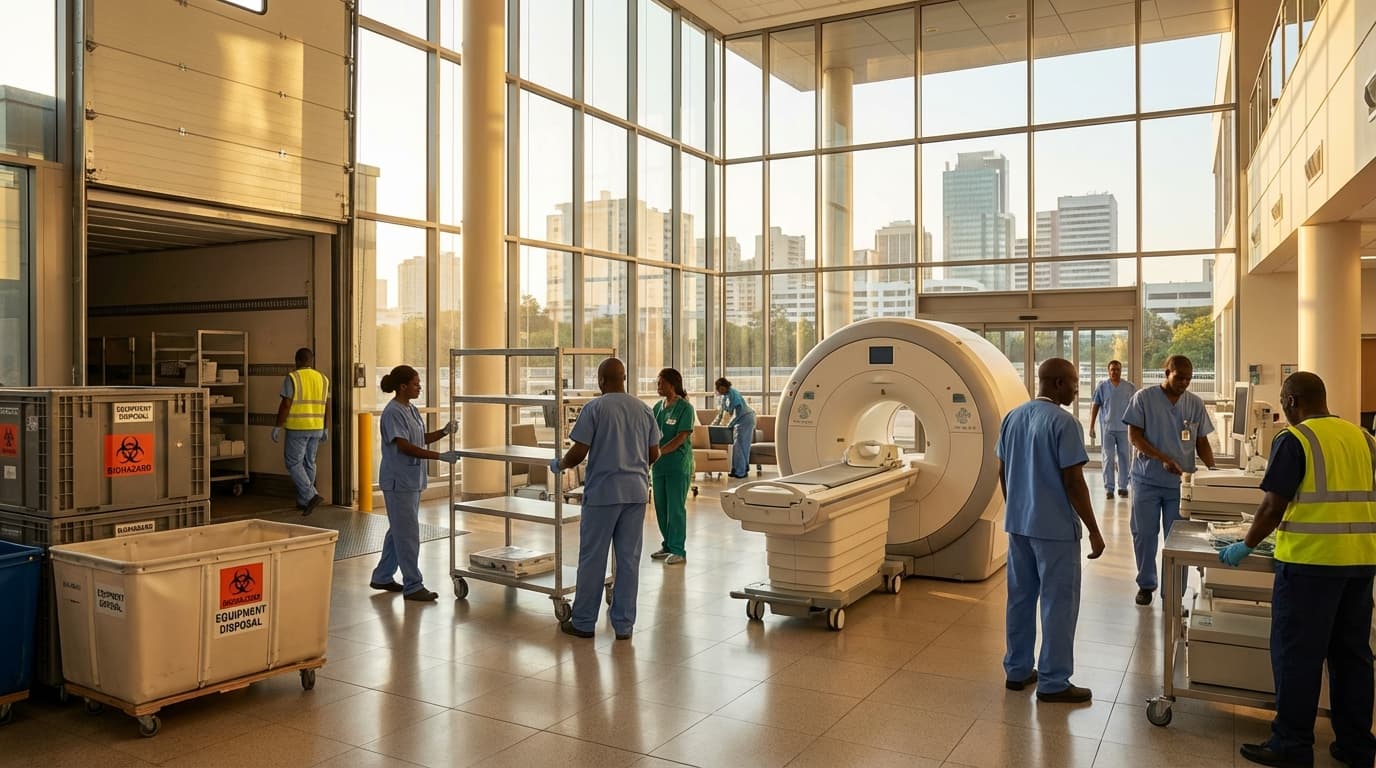
Decommissioning Service for Medical Devices in Burkina Faso
Engineering Excellence & Technical Support
Decommissioning Service for Medical Devices High-standard technical execution following OEM protocols and local regulatory frameworks.
Safe & Compliant Disposal
Ensuring strict adherence to national and international environmental and safety regulations for the proper decommissioning and disposal of obsolete and hazardous medical equipment. We prioritize the prevention of biohazards and environmental contamination.
Resource Recovery & Recycling
Maximizing the recovery of valuable materials and components from decommissioned medical devices. We partner with certified recyclers to responsibly process materials, minimizing landfill waste and promoting a circular economy in healthcare.
Secure Data Destruction
Implementing robust procedures for the secure erasure and destruction of all sensitive patient data and proprietary information stored within medical devices. Protecting patient privacy and complying with data protection laws is paramount.
What Is Decommissioning Service For Medical Devices In Burkina Faso?
Decommissioning services for medical devices in Burkina Faso refer to the systematic and controlled process of retiring a medical device from service. This encompasses a comprehensive set of activities ensuring the device is safely and responsibly removed from clinical use, data is appropriately managed, and the device's components are disposed of in compliance with environmental and regulatory standards. The service aims to prevent unauthorized reuse, protect patient data privacy, and mitigate environmental hazards associated with obsolete or non-functional medical equipment.
| Stakeholder Group | Need for Decommissioning Service | Typical Use Cases |
|---|---|---|
| Hospitals and Clinics (Public & Private) | Mandated by regulatory bodies, essential for maintaining a safe and efficient healthcare environment, managing asset lifecycle, and complying with data privacy laws. | Replacement of outdated imaging equipment (X-ray, CT scanners), disposal of end-of-life laboratory analyzers, retirement of patient monitoring systems no longer supported by manufacturers, decommissioning of surgical equipment after a determined service life. |
| Diagnostic Laboratories | Ensuring accuracy of diagnostic results by removing compromised or obsolete equipment, compliance with quality control standards, and responsible waste management of specialized reagents and consumables. | Disposal of aging PCR machines, retirement of immunoassay analyzers with no available calibration standards, decommissioning of microscopes with optical degradation. |
| Government Health Agencies & Regulatory Bodies | Overseeing compliance with national healthcare technology management policies, ensuring public safety, and promoting environmentally sound practices within the healthcare sector. | Enforcing decommissioning standards for publicly funded medical facilities, auditing decommissioning processes for licensed healthcare providers, managing large-scale equipment retirement programs. |
| Medical Device Manufacturers & Distributors | Providing end-of-life management services for their products, fulfilling Extended Producer Responsibility (EPR) obligations (where applicable), and ensuring brand reputation through responsible disposal. | Facilitating the return and proper decommissioning of leased or sold equipment at the end of its contract or service life, managing obsolete inventory, and offering certified disposal services to clients. |
Key Components of Decommissioning Services
- Inventory and Identification: Comprehensive cataloging of medical devices slated for decommissioning, including their unique identifiers, model, serial number, and current location.
- Data Sanitization and Destruction: Secure erasure or physical destruction of all sensitive patient and operational data stored on the device, adhering to international standards (e.g., HIPAA, GDPR principles).
- Disassembly and Component Segregation: Careful dismantling of the device to separate reusable components from non-reusable materials and hazardous substances.
- Hazardous Material Management: Identification, containment, and disposal of any hazardous materials (e.g., mercury, lead, batteries) in accordance with local and international environmental regulations.
- Asset Disposition: Options for disposal, including recycling, refurbishment for donation (if applicable and safe), or secure destruction and waste management.
- Documentation and Certification: Provision of detailed records of the decommissioning process, including certificates of data destruction and disposal, for audit and compliance purposes.
- Environmental Compliance: Ensuring all disposal processes adhere to Burkina Faso's environmental protection laws and waste management protocols.
Who Needs Decommissioning Service For Medical Devices In Burkina Faso?
Decommissioning services for medical devices are crucial for ensuring the safe and responsible disposal or repurposing of outdated, damaged, or end-of-life medical equipment in Burkina Faso. These services are vital for healthcare facilities to maintain compliance with regulations, protect patient data, and minimize environmental impact.
| Customer Type | Primary Departments Involved | Specific Needs/Reasons for Decommissioning |
|---|---|---|
| Hospitals (Public and Private) | Biomedical Engineering Department, IT Department, Procurement Department, Administration, Facilities Management | Replacement of old/faulty equipment, upgrades to new technology, data security for devices with patient information, compliance with disposal regulations, space optimization. |
| Clinics and Health Centers | Administrative Staff, Clinical Staff, Procurement Officer (if applicable) | Aging equipment, limited budget for repairs, need for space, ensuring safe disposal of potentially hazardous materials. |
| Diagnostic Laboratories | Laboratory Management, Biomedical Technicians, IT Department | Outdated analytical equipment, software obsolescence, data privacy concerns, ensuring proper disposal of chemical or biological waste associated with devices. |
| Research Institutions | Principal Investigators, Research Support Staff, IT Department, Facilities Management | End-of-research-life equipment, upgrades for specialized research, data security for research data stored on devices. |
| Medical Training Facilities | Department Heads, Technical Instructors, Facilities Management | Outdated training equipment, need for updated simulators, safe disposal of older anatomical models or simulators with potentially hazardous components. |
| Government Health Agencies | Ministry of Health Departments (e.g., Procurement, Technical Services, Environmental Health) | Managing national equipment inventories, ensuring standardized disposal practices across public facilities, compliance with national environmental and health regulations. |
| NGOs with Healthcare Programs | Program Managers, Logistics Officers, Biomedical Staff (if available) | Equipment no longer suitable for program needs, donation management, ensuring responsible disposal of equipment in remote areas. |
| Private Medical Practices | Practice Owner/Manager, Office Administrator | Upgrades to more modern diagnostic or treatment equipment, space constraints, ensuring patient trust through secure data handling. |
| Medical Equipment Suppliers and Distributors | Service Department, Sales Department, Logistics | Disposal of demonstration units, handling of returned or trade-in equipment, maintaining their reputation for responsible business practices. |
Target Customers and Departments for Medical Device Decommissioning Services in Burkina Faso:
- Hospitals (Public and Private)
- Clinics and Health Centers
- Diagnostic Laboratories
- Research Institutions
- Medical Training Facilities
- Government Health Agencies
- Non-Governmental Organizations (NGOs) with Healthcare Programs
- Private Medical Practices
- Medical Equipment Suppliers and Distributors (for their own demonstration or returned units)
Decommissioning Service For Medical Devices Process In Burkina Faso
This document outlines the standard workflow for the decommissioning of medical devices in Burkina Faso, from the initial inquiry to the final execution of the service. It details the steps involved, responsible parties, and key considerations to ensure a safe, compliant, and environmentally sound disposal process.
| Phase | Key Activities | Responsible Parties | Key Considerations |
|---|---|---|---|
| Inquiry and Initial Assessment | Contact, initial consultation, preliminary device assessment | Healthcare Facility, Decommissioning Service Provider | Device type, condition, potential hazards, regulatory overview |
| Proposal and Agreement | Proposal submission, negotiation, contract signing, permit acquisition | Decommissioning Service Provider, Healthcare Facility, Regulatory Authorities | Clear scope, pricing, timeline, legal compliance |
| Planning and Preparation | Decommissioning plan development, scheduling, equipment prep, notification | Decommissioning Service Provider, Healthcare Facility | Safety, waste management, logistics, regulatory compliance |
| On-site Decommissioning and Data Destruction | Securing devices, dismantling, hazardous material handling, data wiping | Decommissioning Service Provider | Safety protocols, environmental protection, data privacy |
| Transportation and Disposal/Recycling | Packaging, labeling, transportation, approved disposal/recycling | Decommissioning Service Provider, Licensed Waste Management Facilities | Environmental regulations, hazardous waste management, material segregation |
| Documentation and Finalization | Certificate issuance, report submission, record archiving, payment | Decommissioning Service Provider, Healthcare Facility, Regulatory Authorities | Proof of compliance, traceable records, professional closure |
Decommissioning Service for Medical Devices Process in Burkina Faso: Workflow
- {"steps":["Healthcare facility or owner contacts a licensed decommissioning service provider.","Initial consultation to understand the scope of work, number and type of devices, and desired timeline.","Provider conducts a preliminary assessment of the devices, noting their condition, functionality, and any associated risks (e.g., hazardous materials).","Discussion of regulatory requirements and documentation needs."],"title":"Phase 1: Inquiry and Initial Assessment"}
- {"steps":["Decommissioning provider submits a detailed proposal including service description, scope, timeline, pricing, and required documentation.","Client reviews and negotiates the proposal.","Formal agreement or contract is signed, outlining terms, responsibilities, and liabilities.","Gathering of necessary permits and authorizations from relevant authorities (e.g., Ministry of Health, Ministry of Environment)."],"title":"Phase 2: Proposal and Agreement"}
- {"steps":["Development of a detailed decommissioning plan, including safety protocols, waste management strategy, and transportation logistics.","Scheduling of the decommissioning activities, coordinating with the healthcare facility.","Preparation of necessary equipment, personal protective equipment (PPE), and disposal containers.","Notification of relevant authorities regarding the planned decommissioning activities."],"title":"Phase 3: Planning and Preparation"}
- {"steps":["Arrival of the decommissioning team at the healthcare facility.","Physical isolation and securing of the devices to be decommissioned.","Safe dismantling and removal of components, with special attention to hazardous materials (e.g., mercury, batteries, radioactive isotopes).","Secure data destruction for devices containing sensitive patient information, following established protocols.","Segregation of waste streams based on material type and hazard level."],"title":"Phase 4: On-site Decommissioning and Data Destruction"}
- {"steps":["Proper packaging and labeling of decommissioned devices and waste for safe transport.","Transportation of materials to licensed disposal or recycling facilities using approved carriers.","Disposal or recycling of devices and components in accordance with environmental regulations.","Prioritizing recycling and reuse of materials where feasible and safe."],"title":"Phase 5: Transportation and Disposal/Recycling"}
- {"steps":["Issuance of a decommissioning certificate or report by the service provider, detailing the activities performed, devices handled, and disposal methods.","Submission of required documentation to the healthcare facility and relevant regulatory bodies.","Archiving of all records related to the decommissioning process.","Final invoice and payment settlement."],"title":"Phase 6: Documentation and Finalization"}
Decommissioning Service For Medical Devices Cost In Burkina Faso
Decommissioning medical devices in Burkina Faso involves a range of costs influenced by several key factors. These costs are typically presented in the local currency, the West African CFA franc (XOF). The complexity of the device, its size and weight, the presence of hazardous materials, the security and accessibility of the facility, and the specific service provider chosen all play a significant role in determining the final price. Specialized decommissioning requiring advanced technical expertise or waste management for radioactive or biohazardous materials will naturally incur higher fees.
| Device Category | Estimated Cost Range (XOF) | Notes |
|---|---|---|
| Small/Simple Devices (e.g., thermometers, stethoscopes, basic lab equipment) | 5,000 - 25,000 XOF | Generally straightforward, minimal hazardous materials. |
| Medium Devices (e.g., X-ray machines, ultrasound machines, dental chairs) | 50,000 - 300,000 XOF | May involve some hazardous components and require specialized handling. |
| Large/Complex Devices (e.g., CT scanners, MRI machines, linear accelerators) | 300,000 - 1,500,000+ XOF | Significant disassembly, potential for high levels of hazardous materials (e.g., refrigerants, radioactive sources), extensive documentation. |
| Devices with Specific Hazardous Materials (e.g., mercury-containing equipment, older X-ray units) | Can add 20% - 50% to the base cost | Requires specialized disposal protocols and compliance with environmental regulations. |
| Remote or Difficult-to-Access Locations | Can increase costs by 15% - 40% | Due to increased transportation and logistical challenges. |
Key Pricing Factors for Medical Device Decommissioning in Burkina Faso
- Device Complexity and Technology (e.g., MRI vs. basic examination table)
- Presence of Hazardous Materials (e.g., mercury, refrigerants, biohazards, radioactive isotopes)
- Size and Weight of the Device
- Location and Accessibility of the Facility
- Disassembly and Transportation Requirements
- Environmental Disposal and Recycling Procedures
- Certification and Documentation Needs
- Service Provider's Reputation and Overhead Costs
Affordable Decommissioning Service For Medical Devices Options
Decommissioning medical devices is a critical but often overlooked step in their lifecycle. It involves securely wiping data, properly disposing of or recycling components, and ensuring compliance with healthcare regulations. Finding affordable options is paramount for many healthcare facilities. This guide explores value bundles and cost-saving strategies for medical device decommissioning.
| Strategy | Description | Potential Cost Savings |
|---|---|---|
Understanding Value Bundles in Medical Device Decommissioning
- {"title":"What are Value Bundles?","description":"Value bundles are service packages that combine multiple decommissioning tasks into a single, often discounted, offering. Instead of paying for each service individually, healthcare providers opt for a comprehensive solution."}
- {"title":"Common Components of Decommissioning Value Bundles","sublist":["Data Sanitization (meeting HIPAA and other privacy standards)","Physical Destruction (for drives and sensitive components)","Recycling of electronic waste (e-waste)","Environmental compliance documentation","Asset tracking and reporting","Logistics and transportation"],"description":"These bundles typically include a combination of:"}
- {"title":"Benefits of Bundling","sublist":["Predictable pricing and budget control","Simplified vendor management","Potential for volume discounts","Streamlined processes, reducing administrative burden","Ensured comprehensive compliance across all services"],"description":"Bundling offers several advantages:"}
Verified Providers In Burkina Faso
In Burkina Faso, ensuring you're accessing healthcare from verified and reputable providers is paramount. Franance Health stands out as a premier choice due to its rigorous credentialing process and unwavering commitment to quality care. This document outlines what makes Franance Health providers the best option for your healthcare needs in Burkina Faso.
| Franance Health Credentialing Pillars | Why This Matters for Patients |
|---|---|
| Comprehensive Educational and Professional Verification: | Franance Health meticulously checks the educational backgrounds, certifications, and licenses of all its affiliated healthcare professionals. This ensures that practitioners possess the necessary theoretical knowledge and practical skills. |
| Rigorous Experience Assessment: | Beyond qualifications, Franance Health evaluates the practical experience of providers, including their track record, specializations, and previous affiliations. This guarantees that you are treated by experienced and competent medical staff. |
| Adherence to Ethical and Professional Conduct Standards: | Franance Health mandates strict adherence to ethical guidelines and professional conduct. This includes patient confidentiality, transparent communication, and a patient-centered approach to care. |
| Facility and Equipment Standards: | For partner institutions, Franance Health verifies that facilities are well-equipped, maintained to high hygiene standards, and capable of delivering the promised medical services effectively and safely. |
| Continuous Quality Improvement and Monitoring: | Franance Health doesn't stop at initial credentialing. They implement ongoing monitoring and evaluation processes to ensure that all providers consistently meet and exceed quality standards. |
| Patient Feedback and Grievance Redressal Mechanisms: | Franance Health establishes robust channels for patient feedback and a clear process for addressing any concerns or grievances. This commitment to accountability fosters trust and continuous improvement. |
What are Verified Providers?
- Verified providers in Burkina Faso are healthcare professionals and institutions that have undergone a thorough vetting process by a recognized authority.
- This verification confirms their qualifications, licenses, adherence to ethical standards, and commitment to patient safety.
- It ensures that they meet established benchmarks for medical expertise, facility standards, and operational integrity.
Scope Of Work For Decommissioning Service For Medical Devices
This Scope of Work (SOW) outlines the technical deliverables and standard specifications for the decommissioning of medical devices. Decommissioning encompasses the safe and compliant removal, handling, and disposal or repurposing of medical equipment, ensuring data security, environmental regulations, and patient safety are met. This document serves as a guide for service providers engaged in this critical process.
| Technical Deliverable | Description | Standard Specification/Reference | Acceptance Criteria |
|---|---|---|---|
| Decommissioning Plan | A detailed plan outlining the scope, methodology, timeline, resource allocation, and risk mitigation strategies for the decommissioning project. | ISO 14971 (Risk Management), relevant hospital policies, regulatory guidelines (e.g., HIPAA, GDPR if applicable for data) | Approved by the client, comprehensive, clearly defined roles and responsibilities. |
| Data Eradication Report | Confirmation of all sensitive data (patient, operational) being securely and permanently removed from devices according to defined standards. | NIST SP 800-88 Rev. 1 (Guidelines for Media Sanitization), industry-specific data destruction standards. | Certified data erasure methods used, successful verification of data removal, no recoverable data. |
| Physical Decommissioning Report | Documentation of the safe disconnection, disassembly, and removal of medical devices from their operational environment. | Manufacturer's service manuals, site-specific safety protocols, electrical safety standards (e.g., IEC 60601 series). | No damage to surrounding infrastructure, adherence to safety procedures, proper handling of hazardous materials. |
| Waste Manifest/Chain of Custody | Documentation tracking the movement of decommissioned devices and associated waste from the client site to the final disposal/recycling facility. | Local, regional, and national environmental regulations (e.g., EPA, RCRA), hazardous waste tracking requirements. | Accurate record of all materials, clear chain of custody, all regulatory compliance met. |
| Certificate of Disposal/Recycling | Official documentation from the disposal or recycling facility certifying the proper and environmentally sound handling of the decommissioned devices and materials. | ISO 14001 (Environmental Management), R2 (Responsible Recycling) or e-Stewards certification of the facility. | Certification from an accredited facility, clear statement of material disposition, confirmation of environmental compliance. |
| Asset Disposition Report | A comprehensive report detailing the final disposition of each decommissioned asset (e.g., recycled, refurbished, donated, disposed of). | Client asset management policies, internal tracking systems. | Accurate reconciliation of all decommissioned assets with their final disposition. |
| Environmental Compliance Report | Confirmation that all decommissioning activities have adhered to relevant environmental laws and regulations, including proper handling of hazardous waste. | Local, regional, and national environmental regulations, hazardous waste management guidelines. | No environmental violations, proper classification and disposal of all waste streams. |
| Safety Compliance Report | Documentation demonstrating that all decommissioning activities were conducted in compliance with occupational health and safety standards. | OSHA standards, relevant industrial safety guidelines, site-specific safety plans. | No safety incidents reported, adherence to all safety protocols. |
Key Stages of Medical Device Decommissioning
- Initial Assessment and Planning
- Data Eradication and Security
- Physical Decommissioning and Disassembly
- Transportation and Logistics
- Disposal, Recycling, or Repurposing
- Documentation and Certification
Service Level Agreement For Decommissioning Service For Medical Devices
This Service Level Agreement (SLA) outlines the performance standards and commitments for the Decommissioning Service of Medical Devices provided by [Your Company Name] (hereinafter referred to as 'Provider') to [Client Company Name] (hereinafter referred to as 'Client'). This SLA focuses specifically on the response times and uptime guarantees related to the decommissioning process and any associated management portals or communication channels.
1. Definitions
- Decommissioning Service: The process of safely and securely rendering medical devices non-operational, including data sanitization, physical destruction (if applicable), and disposal in accordance with relevant regulations and Client policies.
- Downtime: Any period during which the Client is unable to access or utilize the Provider's designated communication channels (e.g., support portal, designated email) or initiate a decommissioning request through agreed-upon methods due to issues within the Provider's control.
- Scheduled Maintenance: Pre-announced periods of system unavailability for upgrades or maintenance, communicated to the Client at least [Number] business days in advance.
- Response Time: The maximum time allowed for the Provider to acknowledge and begin addressing a reported incident or request.
- Uptime Guarantee: The guaranteed percentage of time the Provider's critical service components (e.g., support portal, request submission system) are available and functional.
| Severity Level | Description | Provider Response Target (Business Hours) |
|---|---|---|
| Severity 1 (Critical) | Service completely unavailable, impacting the ability to initiate or proceed with critical decommissioning tasks. | [Number] |
| Severity 2 (High) | Significant degradation of service, impacting efficiency but not completely preventing operations. | [Number] |
| Severity 3 (Medium) | Minor impact on service, affecting non-critical functions or causing inconvenience. | [Number] |
| Severity 4 (Low) | General inquiries or minor functional issues with no immediate impact on service delivery. | [Number] |
Key Service Level Objectives (SLOs)
- 2. Response Times
- 2.1 Incident Reporting: The Client will report any issues related to the Decommissioning Service (e.g., inability to submit a request, communication channel failure) through [Designated Method(s) - e.g., Provider's Support Portal, Dedicated Email Address, Phone Number].
- 2.2 Severity Levels & Response Targets:
- Severity 1 (Critical): Service completely unavailable, impacting the ability to initiate or proceed with critical decommissioning tasks. Examples: Decommissioning portal inaccessible, inability to schedule urgent decommissioning requests.
- Severity 2 (High): Significant degradation of service, impacting efficiency but not completely preventing operations. Examples: Slow response times on the portal, delayed confirmation of service initiation.
- Severity 3 (Medium): Minor impact on service, affecting non-critical functions or causing inconvenience. Examples: Inability to access historical decommissioning records, minor delay in non-urgent scheduling.
- Severity 4 (Low): General inquiries or minor functional issues with no immediate impact on service delivery. Examples: Questions about reporting, minor UI glitches.
- 2.3 Provider Response Targets:
- Severity 1: Provider will acknowledge and begin working on the issue within [Number] business hours.
- Severity 2: Provider will acknowledge and begin working on the issue within [Number] business hours.
- Severity 3: Provider will acknowledge and begin working on the issue within [Number] business hours.
- Severity 4: Provider will acknowledge and begin working on the issue within [Number] business hours.
- 3. Uptime Guarantees
- 3.1 Service Availability: The Provider guarantees a minimum uptime of [Percentage]% for the critical components of the Decommissioning Service management portal and request submission system, measured monthly.
- 3.2 Exclusions: Uptime calculations will exclude periods of:
- Scheduled Maintenance (as defined above).
- Downtime caused by factors outside the Provider's reasonable control, including but not limited to Client-side network issues, third-party service failures not under Provider's direct management, force majeure events.
- Downtime caused by Client's misuse or unauthorized modification of the service or systems.
- 3.3 Monitoring: The Provider will continuously monitor the availability of the critical service components. The Client will be notified of planned downtime and, where feasible, unplanned downtime exceeding [Time Period - e.g., 30 minutes].
- 4. Reporting and Review
- 4.1 Monthly Service Reports: The Provider will provide the Client with a monthly report detailing uptime statistics, response times achieved against targets, and any significant incidents or deviations from this SLA.
- 4.2 SLA Review: This SLA will be reviewed at least annually or upon significant changes to the Decommissioning Service or the Client's requirements.
- 5. Penalties and Credits
- (Optional Section - Detail any penalties or service credits applicable for failure to meet uptime or response time guarantees. Example: 'For every 1% the monthly uptime falls below [Percentage]%, the Client will receive a credit of [Amount or Percentage] off the monthly service fee.')
- 6. Escalation Procedure
- If response times or service availability do not meet the agreed-upon standards, the Client may escalate the issue through the following channels:
- Level 1: [Designated Support Contact Person/Department]
- Level 2: [Managerial Contact Person/Department]
- Level 3: [Senior Management Contact Person/Department]
- Contact details and expected escalation response times will be provided separately.
Frequently Asked Questions

Ready when you are
Let's scope your Decommissioning Service for Medical Devices in Burkina Faso project in Burkina Faso.

Scaling healthcare logistics and technical systems across the entire continent.