
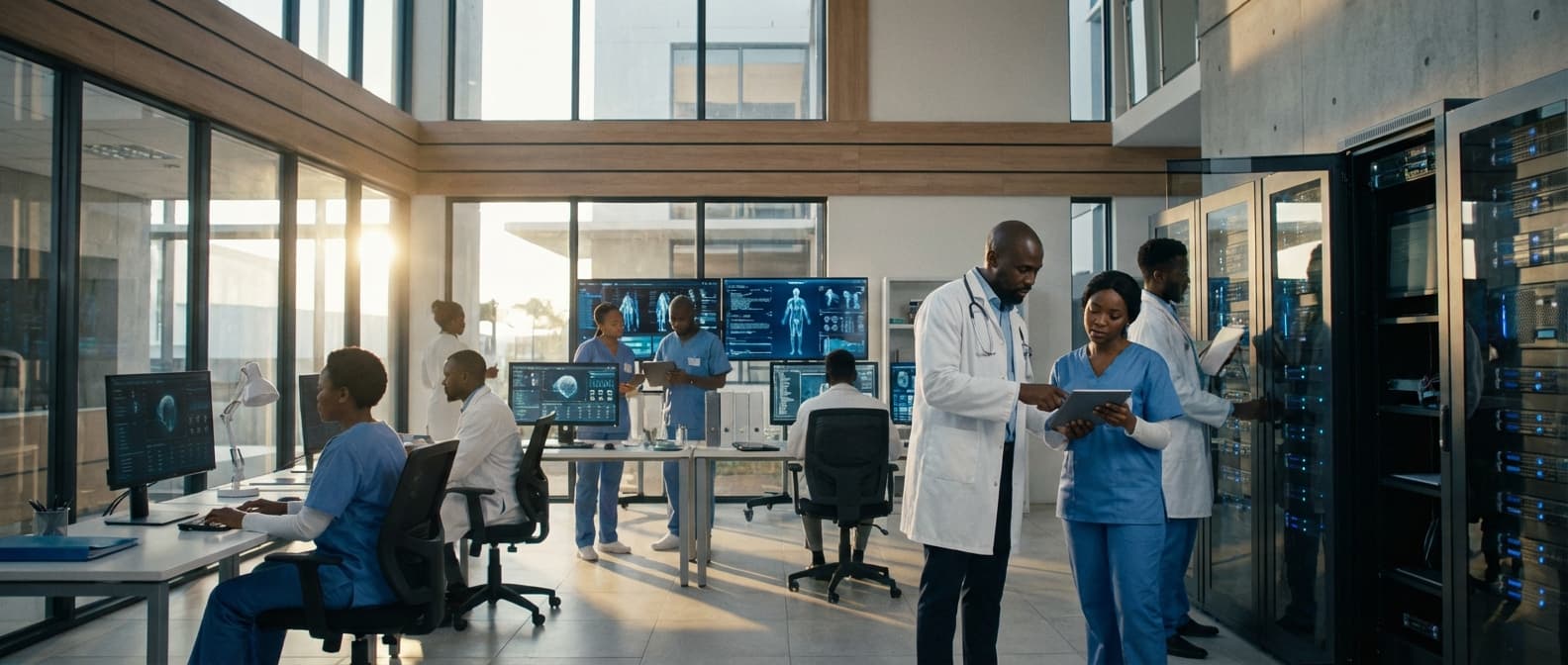
Medical IT Consultation in Burkina Faso
Engineering Excellence & Technical Support
Strategic technology consulting to optimize healthcare operations, streamline workflows, and integrate cutting-edge medical information systems. High-standard technical execution following OEM protocols and local regulatory frameworks.
Secure & Scalable Health Data Infrastructure
Design and implement robust, cloud-agnostic health information systems (HIS) and electronic health records (EHRs) tailored for Burkina Faso's specific needs, ensuring data security, privacy compliance (aligned with national regulations), and future scalability to accommodate growing patient volumes and evolving healthcare services.
Optimized Interoperability & Network Solutions
Establish secure and reliable network connectivity for healthcare facilities across remote and urban areas. Implement interoperability solutions to enable seamless data exchange between disparate systems (e.g., laboratories, pharmacies, administrative platforms), fostering a unified patient care continuum and improving diagnostic and treatment efficiency.
AI-Powered Diagnostic Support & Telemedicine Deployment
Leverage emerging technologies like artificial intelligence (AI) for diagnostic assistance and predictive analytics to support healthcare professionals. Strategize and deploy cost-effective telemedicine solutions, enabling remote consultations, specialist access, and continuous medical education for practitioners in underserved regions, thereby bridging the healthcare access gap.
What Is Medical It Consultation In Burkina Faso?
Medical IT Consultation in Burkina Faso refers to the provision of specialized information technology expertise and advisory services to healthcare organizations and professionals within the country. This service aims to optimize the design, implementation, and utilization of IT systems and solutions to enhance healthcare delivery, operational efficiency, data management, and patient care. It encompasses strategic planning, system selection, infrastructure development, cybersecurity assessment, data interoperability strategies, and the adoption of emerging health IT technologies, tailored to the specific context and resource constraints prevalent in Burkina Faso.
| Who Needs Medical IT Consultation | Typical Use Cases |
|---|---|
| Public Hospitals and Clinics: | Implementing or upgrading EHR systems to improve patient record management and reduce administrative burden. |
| Private Healthcare Providers: | Adopting LIS for efficient laboratory management and diagnostic reporting. |
| Non-Governmental Organizations (NGOs) involved in Health: | Deploying mHealth solutions for disease surveillance, data collection in remote areas, and patient outreach. |
| Ministry of Health and other Government Health Agencies: | Developing national health information exchange frameworks and cybersecurity policies. |
| Medical Training Institutions: | Integrating IT-based learning resources and simulation technologies. |
| Research Centers: | Establishing secure data repositories and analytics platforms for health research. |
| Startup HealthTech Companies: | Gaining insights into the local regulatory landscape, market needs, and integration challenges for their solutions. |
Key Components of Medical IT Consultation in Burkina Faso
- Needs Assessment and Strategy Development: Evaluating existing IT infrastructure, identifying gaps, and formulating a strategic roadmap for technology adoption aligned with organizational goals and national health priorities.
- System Selection and Implementation: Advising on the procurement and deployment of Electronic Health Records (EHRs), Picture Archiving and Communication Systems (PACS), Laboratory Information Systems (LIS), and other relevant healthcare software.
- Infrastructure Planning and Optimization: Designing and recommending suitable network architectures, hardware, and cloud solutions, considering bandwidth limitations, power reliability, and cost-effectiveness.
- Cybersecurity and Data Privacy: Implementing robust security protocols, compliance strategies (e.g., with local data protection regulations), and risk management frameworks to safeguard sensitive patient information.
- Interoperability and Data Exchange: Developing strategies and recommending standards for seamless data sharing between different healthcare facilities, departments, and national health information systems.
- Digital Health and Telemedicine Integration: Facilitating the adoption and integration of telehealth platforms, mobile health (mHealth) applications, and other digital health tools to extend healthcare reach.
- Training and Capacity Building: Providing technical training and ongoing support to healthcare staff to ensure effective utilization of implemented IT solutions.
- Project Management and Governance: Overseeing the lifecycle of IT projects, ensuring timely delivery, budget adherence, and successful integration into clinical workflows.
Who Needs Medical It Consultation In Burkina Faso?
Medical IT consultation in Burkina Faso is a crucial service for a range of healthcare entities seeking to leverage technology for improved patient care, operational efficiency, and data security. The demand stems from a growing recognition of the importance of digital transformation in the healthcare sector, even within resource-constrained environments. This consultation can address challenges related to existing infrastructure, the implementation of new systems, cybersecurity threats, and the optimization of health information management.
| Customer Type | Key Needs & Challenges | Relevant Departments |
|---|---|---|
| Public Hospitals and Health Centers | Aging IT infrastructure, limited budget for upgrades, need for electronic health records (EHR) implementation, cybersecurity awareness, network connectivity issues, data management, telemedicine integration. | Information Technology (IT) Department, Administration, Clinical Departments (e.g., Radiology, Pharmacy, Laboratories), Patient Records Department. |
| Private Clinics and Hospitals | Desire for competitive advantage through technology, efficient patient management systems, appointment scheduling software, billing and accounting integration, data privacy compliance, cybersecurity for sensitive patient data. | Administration, IT Department, Front Desk/Reception, Billing Department, Clinical Staff. |
| NGOs with Healthcare Programs | Implementing health information systems for data collection and reporting (e.g., for disease surveillance, vaccination programs), remote monitoring solutions, training of local staff on IT systems, ensuring data integrity and accessibility in remote areas. | Program Management, M&E (Monitoring & Evaluation) Department, IT Support (if available), Field Staff. |
| Medical Training Institutions | Developing digital learning platforms, managing student records, equipping computer labs, implementing simulation software, IT infrastructure for research, cybersecurity for institutional data. | IT Department, Academic Affairs, Library Services, Administration. |
| Government Health Agencies | National health information system development and maintenance, data analysis for public health policy, disease surveillance systems, e-health strategy implementation, IT infrastructure for public health initiatives, cybersecurity for national health data. | Ministry of Health IT Department, Public Health Surveillance Units, Planning and Policy Departments. |
| Pharmacies and Pharmaceutical Distributors | Inventory management systems, point-of-sale (POS) integration, supply chain tracking, electronic prescription systems, data security for sales and customer information. | Management, IT/Operations Department, Pharmacy Staff. |
| Laboratories and Diagnostic Centers | Laboratory Information Management Systems (LIMS), integration with EHRs, data analysis for diagnostic reporting, cybersecurity for patient results, reliable network connectivity for data transfer. | Laboratory Management, IT Department, Phlebotomy/Sample Collection, Reporting Staff. |
Target Customers for Medical IT Consultation in Burkina Faso
- Public Hospitals and Health Centers
- Private Clinics and Hospitals
- Non-Governmental Organizations (NGOs) with Healthcare Programs
- Medical Training Institutions
- Government Health Agencies
- Pharmacies and Pharmaceutical Distributors (with integrated IT systems)
- Laboratories and Diagnostic Centers
Medical It Consultation Process In Burkina Faso
The Medical IT Consultation Process in Burkina Faso outlines the structured approach taken from the initial client inquiry to the successful implementation of IT solutions within healthcare facilities. This process is designed to be adaptable to the specific needs and resource constraints often encountered in the region.
| Stage | Key Activities | Deliverables | Considerations in Burkina Faso |
|---|---|---|---|
| Initial Inquiry and Needs Assessment | Client contact, initial discussions, site visits (if feasible), document review. | Needs assessment report, initial problem statement. | Understanding local healthcare challenges, existing infrastructure limitations, budget constraints, language barriers (French/local dialects). |
| Scope Definition and Proposal Development | Defining project boundaries, identifying solutions, costing, proposal writing. | Detailed project proposal, cost breakdown, timeline. | Availability of specific hardware/software in the region, import regulations, potential for phased implementation due to budget or infrastructure. |
| Contractual Agreement | Legal review, negotiation, signing of contract. | Signed contract. | Understanding and adhering to Malian labor laws, intellectual property rights, and local business practices. |
| Detailed Planning and Design | System architecture, workflow mapping, technical specifications, training plans. | System design documents, implementation plan, training materials. | Reliability of internet connectivity, power supply stability, compatibility with existing non-IT infrastructure (e.g., physical spaces for equipment). |
| Implementation and Integration | Hardware setup, software installation, data migration, user training. | Configured systems, trained staff, migrated data. | Logistics for hardware delivery, ensuring local technical support availability, cultural adaptation of training methods. |
| Testing and Quality Assurance | System testing, UAT, security checks. | Test reports, sign-off on UAT. | Involving key local stakeholders in UAT, testing under actual usage conditions prevalent in Burkina Faso. |
| Deployment and Go-Live | System launch, initial monitoring. | Live operational systems. | Managing potential disruptions to patient care, having on-site support readily available. |
| Post-Implementation Support and Maintenance | Helpdesk, troubleshooting, updates, ongoing training. | Support agreements, maintenance schedules, updated documentation. | Establishing remote support capabilities, identifying and training local IT personnel for first-level support, ensuring availability of spare parts. |
| Review and Optimization | Performance evaluation, feedback collection, recommendations. | Performance reports, optimization recommendations. | Long-term sustainability planning, adapting solutions to evolving healthcare policies and technological advancements in the region. |
Key Stages of the Medical IT Consultation Process
- {"title":"Initial Inquiry and Needs Assessment","description":"The process begins when a healthcare facility expresses interest in improving their IT infrastructure or services. This can be through a formal request, an introduction, or a proactive outreach from a medical IT consultancy. The initial phase involves understanding the client's current IT setup, their pain points, existing challenges, and their desired outcomes. This often includes understanding the facility type (hospital, clinic, research center), patient volume, types of services offered, and existing technological capabilities."}
- {"title":"Scope Definition and Proposal Development","description":"Based on the needs assessment, a detailed scope of work is defined. This includes identifying specific IT areas for consultation (e.g., Electronic Health Records (EHR) implementation, network upgrades, cybersecurity, telemedicine solutions, data management, hardware procurement). A comprehensive proposal is then developed, outlining the proposed solutions, methodologies, timelines, deliverables, and associated costs. This proposal is presented to the client for review and discussion."}
- {"title":"Contractual Agreement","description":"Once the proposal is mutually agreed upon, a formal contract is established. This document details the terms of engagement, responsibilities of both parties, payment schedules, confidentiality agreements, and any legal considerations specific to Burkina Faso's regulatory environment. This ensures clarity and commitment for both the consultancy and the client."}
- {"title":"Detailed Planning and Design","description":"Following the contract signing, the project enters a detailed planning phase. This involves in-depth system analysis, architectural design of proposed solutions, and the development of implementation strategies. For instance, if an EHR is being implemented, this stage would involve workflow analysis, data migration planning, and user interface design considerations. Local context, such as internet connectivity availability and power stability, is crucial during this phase."}
- {"title":"Implementation and Integration","description":"This is the core execution phase where the designed IT solutions are put into practice. This can involve hardware installation, software deployment, network configuration, data migration, and system integration with existing legacy systems. Training of healthcare staff is a critical component of this stage to ensure proper adoption and utilization of the new technologies."}
- {"title":"Testing and Quality Assurance","description":"Before full deployment, rigorous testing is conducted to identify and resolve any bugs, errors, or performance issues. This includes functional testing, user acceptance testing (UAT), and security testing. Quality assurance measures are implemented throughout the process to ensure that the delivered solutions meet the defined specifications and client expectations."}
- {"title":"Deployment and Go-Live","description":"Once testing is successful and the client is satisfied, the solutions are deployed into the live operational environment. This 'go-live' phase requires careful management and monitoring to ensure a smooth transition and minimize disruption to healthcare services. Contingency plans are in place to address any unforeseen issues."}
- {"title":"Post-Implementation Support and Maintenance","description":"The consultation process doesn't end with the go-live. Ongoing support and maintenance are crucial for long-term success. This includes providing technical assistance, troubleshooting issues, performing regular system updates and upgrades, and offering further training as needed. Establishing a clear support framework ensures the continued optimal performance of the IT systems."}
- {"title":"Review and Optimization","description":"Periodically, the implemented solutions are reviewed to assess their effectiveness, identify areas for improvement, and adapt to evolving healthcare needs and technological advancements. This iterative process ensures that the IT infrastructure remains relevant, efficient, and continues to support the facility's mission."}
Medical It Consultation Cost In Burkina Faso
Consulting on Medical IT in Burkina Faso involves a range of factors that influence pricing. These include the complexity and scope of the project, the specific IT services required (e.g., EHR implementation, network security, telemedicine setup), the experience and reputation of the IT consultant or firm, and the duration of the engagement. Geographic location within Burkina Faso can also play a minor role, with services in major cities like Ouagadougou potentially having slightly different cost structures than in more remote areas. Furthermore, the technological infrastructure and existing IT capabilities of the healthcare facility will dictate the level of effort and expertise needed. Demand for specialized medical IT skills also impacts pricing. Costs are typically quoted in the local currency, the West African CFA franc (XOF).
| Service Type | Estimated Daily Rate (XOF) | Estimated Project Range (XOF) |
|---|---|---|
| Basic IT Assessment/Audit | 30,000 - 70,000 | 150,000 - 500,000 |
| EHR System Needs Assessment & Planning | 50,000 - 120,000 | 300,000 - 1,500,000 |
| Network Setup & Security Consultation | 40,000 - 90,000 | 200,000 - 800,000 |
| Telemedicine Platform Strategy & Implementation Guidance | 60,000 - 150,000 | 400,000 - 2,000,000 |
| Comprehensive Medical IT Strategy Development | 70,000 - 180,000 | 500,000 - 3,000,000+ |
| Data Management & Analytics Consultation | 50,000 - 110,000 | 300,000 - 1,200,000 |
Key Pricing Factors for Medical IT Consultation in Burkina Faso
- Scope and Complexity of the Project: Larger, more intricate projects naturally incur higher costs.
- Specific IT Services Required: Implementation of Electronic Health Records (EHRs), cybersecurity audits, telemedicine platform setup, and data management solutions have varying price points.
- Consultant/Firm Experience and Reputation: Highly sought-after and experienced consultants command higher fees.
- Duration of Engagement: The longer the project, the higher the overall cost, often calculated on a per-day or per-hour basis.
- Geographic Location within Burkina Faso: While less significant, major urban centers might see slightly different rates.
- Existing IT Infrastructure and Capabilities: The current state of a healthcare facility's IT systems influences the effort and expertise needed.
- Demand for Specialized Medical IT Skills: High demand for specific expertise can drive up prices.
Affordable Medical It Consultation Options
Navigating the complexities of medical IT can be a significant challenge for healthcare organizations, especially those with budget constraints. Fortunately, there are affordable medical IT consultation options available that prioritize value and cost-effectiveness. Understanding how to leverage value bundles and implement smart cost-saving strategies is key to accessing essential IT expertise without breaking the bank.
| Value Bundle Type | Description | Cost-Saving Benefit |
|---|---|---|
| Assessment & Planning Bundle | Includes an initial IT infrastructure audit, needs assessment, and development of a strategic IT roadmap tailored to your organization's goals and budget. | Prevents costly reactive IT decisions by providing a proactive, cost-optimized plan. Identifies immediate needs versus long-term investments. |
| Compliance & Security Bundle | Focuses on ensuring HIPAA compliance, data security assessments, vulnerability testing, and development of security policies and training materials. | Mitigates the high financial and reputational risks associated with data breaches and non-compliance fines. Often a fixed-fee service. |
| Technology Implementation Support Bundle | Offers targeted assistance during the implementation of new software (e.g., EHR, telemedicine platforms), including project management, user training coordination, and workflow optimization. | Reduces the risk of project delays and cost overruns associated with poorly managed implementations. Ensures better user adoption, leading to increased efficiency. |
| Remote Support & Optimization Bundle | Combines remote IT support with proactive system monitoring and performance optimization, often including regular virtual check-ins and recommendations. | Reduces the need for on-site IT staff and emergency fixes. Keeps systems running efficiently, minimizing downtime and associated costs. |
Key Affordable Medical IT Consultation Options
- On-Demand or Project-Based Consultations: Instead of long-term retainers, focus on specific, well-defined projects (e.g., EHR implementation support, cybersecurity assessment, HIPAA compliance audit). This allows you to access expertise precisely when and where you need it, minimizing overall expenditure.
- Cloud-Based Consultation Platforms: Many specialized platforms offer access to IT consultants with healthcare experience. These often operate on subscription or per-session models, making them more flexible and affordable than traditional firms.
- Consulting Cooperatives/Associations: Collaborations of independent consultants or smaller firms can offer competitive rates and a wider pool of expertise. They often have lower overheads than large corporations.
- Remote/Virtual Consultations: The rise of remote work has made virtual consultations a standard and cost-effective practice. This eliminates travel expenses and can lead to more competitive pricing.
- Managed IT Service Providers (MSPs) with Consulting Arms: Some MSPs offer a range of IT services, including consulting, as part of their packages. Bundling these services can sometimes lead to discounted consulting rates.
- Academic or Non-Profit Partnerships: In some cases, universities with strong IT or health informatics programs, or non-profit organizations focused on healthcare improvement, may offer consulting services at reduced rates or through research grants.
Verified Providers In Burkina Faso
In Burkina Faso, accessing reliable and high-quality healthcare is paramount. When seeking medical services, it's crucial to engage with verified providers who adhere to stringent standards of care and professionalism. Franance Health stands out as a leading entity in this regard, offering a network of credentialed healthcare professionals and facilities. Their commitment to rigorous vetting processes ensures that all affiliated providers meet established benchmarks for expertise, ethical practice, and patient safety. Choosing Franance Health means opting for a healthcare experience characterized by trust, competence, and a patient-centric approach. This introduction will explore the credentials that define Franance Health's providers and articulate why they represent the optimal choice for healthcare needs in Burkina Faso.
| Credential Type | Description | Importance for Patients in Burkina Faso |
|---|---|---|
| Medical Licenses and Registrations | Ensures providers are legally authorized to practice medicine in Burkina Faso and meet national regulatory requirements. | Guarantees that practitioners possess the foundational qualifications and are recognized by the relevant health authorities. |
| Specialty Certifications | Indicates advanced training and proven expertise in specific medical fields (e.g., pediatrics, cardiology, surgery). | Allows patients to identify specialists best suited for their particular health concerns, leading to more accurate diagnoses and effective treatments. |
| Continuing Medical Education (CME) | Demonstrates a commitment to lifelong learning and staying updated with the latest medical advancements, research, and best practices. | Ensures patients receive care informed by current medical knowledge, improving treatment outcomes and safety. |
| Hospital and Clinic Affiliations | Confirms that providers are associated with reputable healthcare facilities that meet established quality and safety standards. | Provides assurance that diagnostic and treatment services will be delivered in a well-equipped and professionally managed environment. |
| Peer Review and Performance Monitoring | Involves assessment of a provider's clinical performance, patient outcomes, and adherence to protocols by other medical professionals. | Offers an objective evaluation of a provider's competence and effectiveness, building confidence in their abilities. |
| Background Checks and Ethical Conduct Reviews | Verifies a provider's history and commitment to ethical medical principles, including patient confidentiality and non-discrimination. | Protects patients from potential malpractice and ensures a respectful and trustworthy healthcare interaction. |
Why Franance Health Providers are the Best Choice:
- Rigorous Credentialing and Verification Process
- Commitment to High Standards of Medical Practice
- Focus on Patient Safety and Ethical Care
- Access to a Network of Trusted Healthcare Professionals
- Enhanced Patient Experience and Peace of Mind
Scope Of Work For Medical It Consultation
This Scope of Work (SOW) outlines the services to be provided by [Consulting Firm Name] (the "Consultant") to [Client Organization Name] (the "Client") for Medical IT Consultation. The primary objective is to assess, plan, and recommend improvements to the Client's existing medical IT infrastructure, systems, and processes to enhance operational efficiency, data security, compliance, and patient care outcomes. This SOW details the technical deliverables and the standard specifications for their development and implementation.
| Deliverable | Description | Standard Specifications/Requirements | Timeline (Estimated) |
|---|---|---|---|
| Current State Assessment Report | A detailed report documenting the findings of the IT infrastructure, systems, and processes. | Includes an executive summary, detailed analysis of strengths, weaknesses, opportunities, and threats (SWOT), current architecture diagrams, risk assessment, and compliance status. Data presented in clear, understandable language with supporting visualizations. | 2-4 Weeks |
| IT Gap Analysis and Recommendations | Identifies discrepancies between the current state and desired future state, proposing actionable recommendations. | Clearly outlines specific technology gaps, functional limitations, and areas for improvement. Recommendations will be prioritized based on impact, feasibility, and cost-effectiveness. Each recommendation will include a justification and expected benefits. | 1-2 Weeks (following Assessment Report) |
| Strategic IT Roadmap | A long-term plan outlining the phased implementation of IT initiatives. | Includes a clear vision, strategic objectives, key initiatives, technology selections, estimated budget, resource requirements, and projected ROI. Aligns with the Client's overall organizational strategy and healthcare delivery model. | 3-5 Weeks |
| Solution Design & Architecture Documents | Detailed specifications for recommended IT solutions. | Includes functional and technical specifications, system integration plans, data flow diagrams, security architecture, and disaster recovery plans. Adheres to industry best practices and interoperability standards (e.g., HL7, FHIR). | 2-4 Weeks per major solution |
| Implementation Plan | A project plan for deploying recommended IT solutions. | Includes detailed work breakdown structure (WBS), project schedule, resource allocation, risk management plan, communication plan, and change management strategy. Outlines key milestones and dependencies. | 2-3 Weeks per major implementation phase |
| Training Materials and Programs | Documentation and delivery plan for user and IT staff training. | Includes user manuals, administrator guides, training presentations, hands-on lab exercises, and train-the-trainer modules. Training content will be tailored to specific roles and system functionalities. | Concurrent with implementation phases |
| Post-Implementation Review Report | An evaluation of the implemented IT solutions. | Assesses achievement of project objectives, identifies lessons learned, and provides recommendations for ongoing optimization and support. Includes performance metrics against established KPIs. | 2-3 Weeks (following major implementation) |
Project Objectives
- Conduct a comprehensive assessment of the current medical IT environment, including hardware, software, network infrastructure, data storage, and security protocols.
- Identify current pain points, inefficiencies, and risks within the existing IT systems.
- Evaluate compliance with relevant healthcare regulations (e.g., HIPAA, HITECH, GDPR).
- Develop a strategic IT roadmap for the next 3-5 years, aligning with the Client's business goals.
- Recommend specific technology solutions and upgrades, including Electronic Health Records (EHR) systems, Picture Archiving and Communication Systems (PACS), telehealth platforms, and cybersecurity enhancements.
- Provide detailed implementation plans, including timelines, resource allocation, and budget estimates.
- Develop and deliver training materials and programs for relevant IT staff and end-users.
- Establish key performance indicators (KPIs) for measuring the success of implemented IT solutions.
Service Level Agreement For Medical It Consultation
This Service Level Agreement (SLA) outlines the response times and uptime guarantees for Medical IT Consultation services provided by [Your Company Name] to [Client Name]. This SLA is effective as of [Start Date] and remains in effect until [End Date].
| Service Element | Uptime Guarantee | Response Time Target (for critical issues) | Response Time Target (for standard issues) |
|---|---|---|---|
| Core Medical IT Systems (EHR, PACS, etc.) | 99.9% Uptime | 15 minutes | 2 business hours |
| Network Infrastructure | 99.5% Uptime | 30 minutes | 4 business hours |
| General IT Support (workstations, printers) | 99.0% Uptime | 1 hour | 8 business hours |
| Consultation Services (scheduled) | N/A (scheduled appointments) | N/A | As per scheduled appointment |
Scope of Services
- On-demand IT support for medical software and hardware.
- Proactive system monitoring and maintenance.
- Consultation on IT infrastructure upgrades and cybersecurity.
- Troubleshooting and resolution of IT-related issues impacting patient care.
- Guidance on compliance with relevant healthcare regulations (e.g., HIPAA).
Frequently Asked Questions

Ready when you are
Let's scope your Medical IT Consultation in Burkina Faso project in Burkina Faso.

Scaling healthcare logistics and technical systems across the entire continent.