
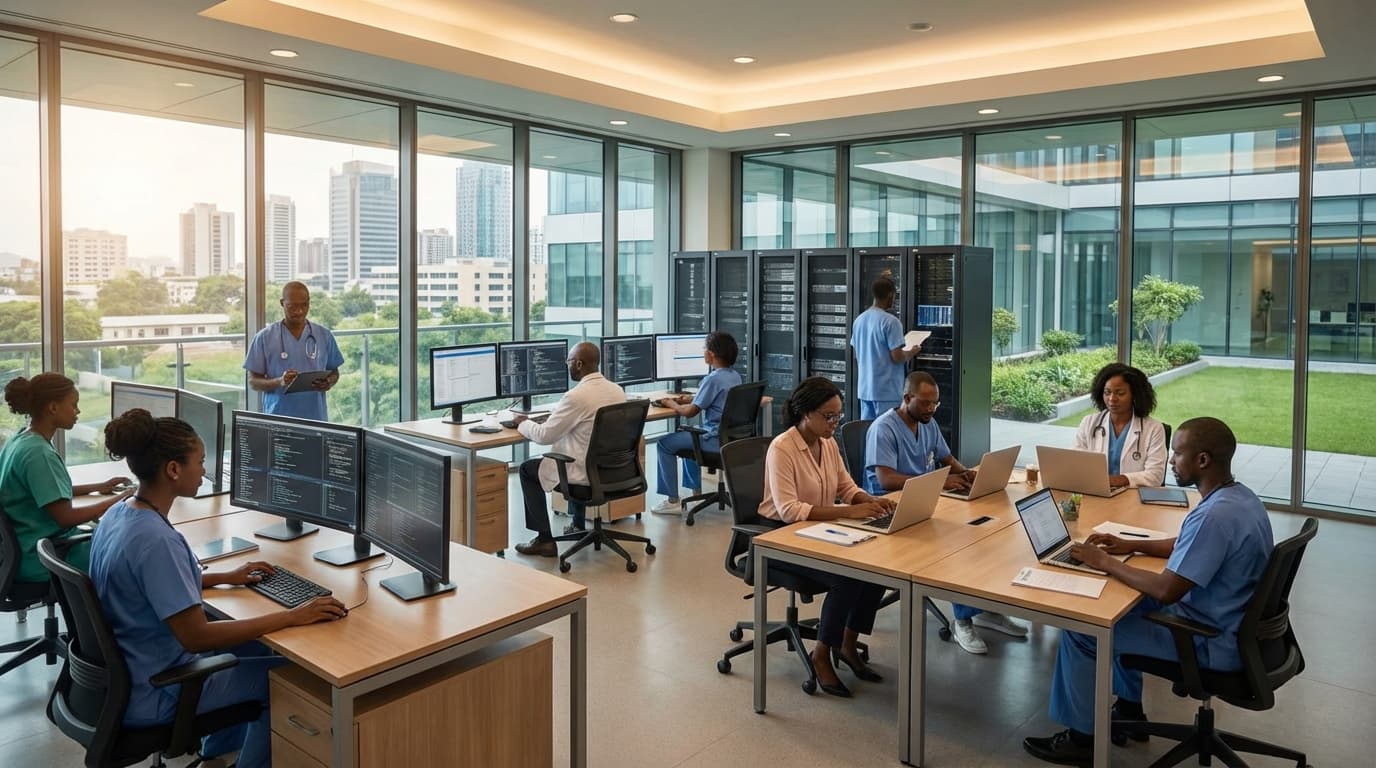
Radiology Reader & Reporting Support in Burkina Faso
Engineering Excellence & Technical Support
Remote radiology reading and reporting services High-standard technical execution following OEM protocols and local regulatory frameworks.
Enhanced Diagnostic Accuracy
Leveraging advanced AI-powered image analysis tools, our Radiology Reader & Reporting Support system significantly improves the detection rate of subtle abnormalities and anomalies, leading to more precise and timely diagnoses for patients in Burkina Faso.
Streamlined Workflow & Expert Collaboration
Our platform facilitates seamless collaboration between local radiologists and remote specialists, optimizing reporting turnaround times and ensuring that even in underserved areas, patients benefit from a high level of expertise and efficient diagnostic workflows.
Data-Driven Insights for Public Health
By collecting and analyzing anonymized imaging data, our system provides valuable insights into regional disease prevalence and trends, empowering public health initiatives and resource allocation strategies for better healthcare outcomes in Burkina Faso.
What Is Radiology Reader & Reporting Support In Burkina Faso?
Radiology Reader & Reporting Support in Burkina Faso refers to the provision of specialized services aimed at enhancing the quality and efficiency of radiological image interpretation and diagnostic reporting within the country's healthcare infrastructure. This service bridges the gap between image acquisition and the delivery of actionable diagnostic insights to referring clinicians, often by leveraging remote expertise and advanced technological solutions.
| Who Needs It? | Typical Use Cases | |||||
|---|---|---|---|---|---|---|
| Hospitals and Clinics in Burkina Faso: Particularly those with limited local access to subspecialty radiologists or insufficient radiologist staffing. This includes both public and private healthcare providers. | Emergency Departments: For rapid interpretation of trauma imaging, stroke protocols, and other urgent conditions, especially during off-hours when local radiologists may not be available. | Outpatient Facilities: To provide diagnostic reports for routine imaging requests, ensuring timely feedback for patient care planning. | Rural and Remote Healthcare Centers: Where access to any radiological expertise is severely limited, enabling these centers to benefit from advanced diagnostic capabilities. | Referral Centers and Teaching Hospitals: To augment existing services with subspecialty expertise, improve report quality, and for peer review and continuous medical education. | Public Health Initiatives and Screening Programs: For large-scale screening programs (e.g., tuberculosis detection via chest X-rays) requiring efficient and consistent interpretation. | Facilities Undergoing Upgrades or Technology Implementation: To ensure continuous service availability and expert oversight during transitions to digital imaging and reporting systems. |
Key Components of Radiology Reader & Reporting Support:
- Remote Image Interpretation (Teleradiology): This involves the transmission of digital radiological images (e.g., X-rays, CT scans, MRIs) from healthcare facilities in Burkina Faso to subspecialist radiologists located elsewhere (domestically or internationally) for interpretation and reporting.
- Second Opinions and Quality Assurance: Providing expert review of already-read studies to ensure diagnostic accuracy, adherence to best practices, and to catch potential errors or omissions.
- Subspecialty Consultations: Access to radiologists with expertise in specific modalities (e.g., neuroimaging, musculoskeletal radiology, pediatric radiology) or disease areas, which may be scarce locally.
- Report Generation and Standardization: Assisting in the creation of clear, concise, and structured diagnostic reports, often utilizing standardized templates and terminology to improve inter-reader consistency and clinical utility.
- Workflow Optimization and Technology Integration: Supporting the implementation and management of Picture Archiving and Communication Systems (PACS) and Radiology Information Systems (RIS) to streamline image management and reporting processes.
- Training and Capacity Building: Offering educational programs and mentorship for local radiologists and radiographers to enhance their skills in interpretation and reporting, thereby building sustainable local capacity.
- Critical Findings Notification: Establishing protocols for immediate communication of urgent or critical findings to referring physicians to facilitate timely patient management.
Who Needs Radiology Reader & Reporting Support In Burkina Faso?
Radiology reader and reporting support services are crucial in Burkina Faso to address the critical shortage of trained radiologists and to improve the quality and efficiency of diagnostic imaging interpretation. These services would benefit healthcare facilities struggling with a high volume of imaging studies and limited expert capacity.
| Customer Type | Primary Departments/Services Requiring Support | Specific Needs Addressed |
|---|---|---|
| Public Hospitals (Regional & District) | Radiology Department, Emergency Department, Internal Medicine, Surgery, Pediatrics, Oncology, Obstetrics & Gynecology | Overcoming radiologist shortages, ensuring timely interpretations, improving diagnostic accuracy, supporting complex case management, training junior staff. |
| Private Clinics & Diagnostic Centers | Radiology Department, Cardiology, Neurology, Orthopedics, Urology, Gastroenterology | Managing high patient volumes, providing subspecialty interpretations (e.g., neuroimaging, musculoskeletal), quality assurance, reducing turnaround times for reports. |
| Referral Centers / University Hospitals | All Radiology Subspecialties (e.g., Neuroradiology, Musculoskeletal Radiology, Interventional Radiology, Pediatric Radiology), Research Departments, Medical Education Units | Facilitating complex diagnoses, supporting advanced imaging techniques, providing expert second opinions, contributing to medical research, training future radiologists. |
| NGOs / International Health Organizations | Project-specific imaging needs (e.g., tuberculosis screening, trauma care programs), health surveillance initiatives | Providing essential diagnostic imaging services in underserved areas, supporting public health campaigns, ensuring consistent reporting standards for data collection. |
Target Customers and Departments for Radiology Reader & Reporting Support in Burkina Faso:
- {"title":"Public Hospitals and Health Centers","description":"These are the primary healthcare providers serving the majority of the population. They often face the greatest challenges in accessing specialized medical expertise."}
- {"title":"Private Clinics and Diagnostic Centers","description":"While often better resourced than public facilities, private entities can also benefit from external support to manage workloads, ensure specialized interpretations, and maintain high standards."}
- {"title":"Referral Centers and University Hospitals","description":"These institutions serve as hubs for complex cases and medical education. Reader and reporting support can enhance their capacity for advanced diagnostics and research."}
- {"title":"NGOs and International Health Organizations","description":"Organizations working on specific health initiatives or providing broad healthcare access may require radiology support for their projects and operations."}
Radiology Reader & Reporting Support Process In Burkina Faso
This document outlines the typical workflow for radiology reader and reporting support in Burkina Faso, detailing the process from the initial inquiry to the final report execution. This process is crucial for ensuring timely and accurate diagnostic information is provided to referring clinicians, impacting patient care.
| Stage | Description | Key Actors | Deliverables/Outcomes | Potential Challenges |
|---|---|---|---|---|
| Inquiry & Request Initiation | A referring physician identifies the need for a radiological examination for a patient. A request form is completed, specifying the clinical indication, suspected diagnosis, and type of imaging required. | Referring Physician, Clinical Staff | Completed Request Form | Incomplete or unclear clinical information on request form, lack of awareness of available imaging modalities. |
| Image Acquisition & Data Transfer | The patient undergoes the requested imaging procedure (e.g., X-ray, Ultrasound, CT, MRI). Images are acquired and, in modern systems, transferred to a Picture Archiving and Communication System (PACS). | Radiology Technologist/Technician, PACS Administrator | Acquired Radiological Images, DICOM Data | Equipment malfunction, power outages, insufficient storage capacity on PACS, poor image quality due to technical errors. |
| Radiologist Worklist Assignment | Acquired studies are automatically or manually assigned to a radiologist's worklist based on subspecialty, availability, or priority. | Radiologist, PACS Administrator, IT Support | Radiologist Worklist with Assigned Studies | Uneven distribution of workload, lack of subspecialty expertise for complex cases, system glitches in worklist management. |
| Image Interpretation & Dictation | The assigned radiologist reviews the acquired images, correlates them with clinical information, and dictates their findings and conclusions. | Radiologist | Dictated Report (Audio File) | Interruption during interpretation, distractions, difficulty in understanding complex cases without adequate clinical context. |
| Report Transcription | A medical transcriptionist or speech recognition software converts the radiologist's dictated report into a written document. | Medical Transcriptionist, Speech Recognition Software | Transcribed Text of the Report | Inaudible dictation, accents, technical jargon, transcription errors, delay in transcription availability. |
| Report Review & Validation | The radiologist (or a senior radiologist) reviews the transcribed report for accuracy, completeness, and clarity. Corrections are made as necessary. | Radiologist, Senior Radiologist | Corrected and Validated Report | Rushed review process, overlooking minor errors, disagreement on findings or conclusions. |
| Report Finalization & Distribution | Once validated, the report is finalized and distributed to the referring physician, typically electronically through a Hospital Information System (HIS) or PACS, or in paper form. | Radiologist, Administrative Staff, HIS/PACS Administrator | Finalized and Distributed Radiological Report | Delays in distribution, miscommunication of results, lost reports, lack of integration between PACS and HIS. |
| Archiving & Retrieval | All images and reports are securely archived within the PACS and HIS for future reference, legal purposes, and continuity of care. | PACS Administrator, HIS Administrator, IT Support | Archived Image and Report Data | Data corruption, system obsolescence, difficulty in retrieving old records, cybersecurity threats. |
Key Stages of the Radiology Reader & Reporting Support Process
- Inquiry & Request Initiation
- Image Acquisition & Data Transfer
- Radiologist Worklist Assignment
- Image Interpretation & Dictation
- Report Transcription
- Report Review & Validation
- Report Finalization & Distribution
- Archiving & Retrieval
Radiology Reader & Reporting Support Cost In Burkina Faso
Radiology reader and reporting support costs in Burkina Faso can vary significantly based on several factors. These include the complexity of the imaging modality (e.g., X-ray, CT, MRI), the number of images to be interpreted, the urgency of the report, the expertise and specialization of the radiologist, and the location within Burkina Faso (urban centers like Ouagadougou and Bobo-Dioulasso may have slightly higher costs due to overhead). The availability of qualified local radiologists also plays a role, as a scarcity can drive up prices. For remote reading services, factors like internet connectivity, data transfer costs, and the service provider's infrastructure and pricing models are crucial. Pricing is typically discussed in terms of per-study fees, monthly retainers, or even a percentage of overall departmental revenue for larger partnerships. While precise, universally published price lists are uncommon, general ranges can be estimated based on anecdotal evidence and the cost of medical services in the region.
| Service Type | Estimated Price Range (XOF) | Notes |
|---|---|---|
| Basic X-ray Interpretation (per study) | 10,000 - 25,000 | Varies by complexity (e.g., simple fracture vs. chest X-ray with multiple findings). |
| CT Scan Interpretation (per study) | 25,000 - 75,000 | Depends on the body part scanned and the number of slices/sequences. |
| MRI Scan Interpretation (per study) | 50,000 - 150,000+ | Generally the most expensive due to complexity and scan time. |
| Ultrasound Interpretation (per study) | 15,000 - 40,000 | Influenced by the type of ultrasound (e.g., abdominal, obstetric). |
| Remote Teleradiology Services (Monthly Retainer) | Negotiable (starts from 500,000+ XOF) | Highly dependent on volume, service level agreement (SLA), and provider. Can be a percentage of billing for larger institutions. |
| STAT/Rush Reporting Surcharge | 10-30% of base fee | Additional charge for urgent turnaround times. |
Factors Influencing Radiology Reader & Reporting Support Costs
- Imaging Modality Complexity (e.g., X-ray vs. CT/MRI)
- Number of Images per Study
- Report Urgency (Standard vs. STAT)
- Radiologist's Expertise and Specialization
- Geographic Location within Burkina Faso
- Availability of Local Radiologists
- Remote Reading Service Provider's Infrastructure and Model
- Internet Connectivity and Data Transfer Costs (for remote services)
- Contractual Agreements (per-study, retainer, revenue share)
Affordable Radiology Reader & Reporting Support Options
Finding affordable radiology reader and reporting support is crucial for healthcare providers looking to optimize costs while maintaining high-quality patient care. This often involves exploring value bundles and implementing smart cost-saving strategies. Value bundles can combine multiple services, such as preliminary readings, final interpretations, peer review, and quality assurance, into a single package, often at a discounted rate. Cost-saving strategies encompass negotiating flexible contracts, leveraging technology for efficiency, and considering different tiers of service based on urgency and complexity.
| Strategy/Bundle | Description | Potential Cost Savings | Considerations |
|---|---|---|---|
| Value-Based Bundles (e.g., Preliminary + Final Read) | Combines initial rapid interpretation with a thorough final read, often at a reduced combined price. | Reduced per-study cost, faster turnaround for urgent cases, improved workflow efficiency. | Requires clear communication of responsibilities and turnaround time expectations. |
| Teleradiology with Volume Tiers | Utilizing external reading services with pricing that decreases as the number of studies increases. | Significant savings for high-volume practices, access to subspecialists without recruitment costs. | Requires robust IT infrastructure, strong security protocols, and reliable connectivity. |
| AI-Assisted Reading Solutions | Leveraging AI for initial image analysis or abnormality detection, followed by radiologist review. | Reduced radiologist reading time per study, increased throughput, potential for lower reporting fees. | AI accuracy needs to be validated; requires integration with existing systems; potential for algorithm bias. |
| Flexible & Scalable Contracts | Negotiating contracts that allow for adjustments in reading volume based on demand, with flexible cancellation or modification clauses. | Avoids paying for underutilized capacity, adapts to fluctuating patient loads, better budget predictability. | Requires careful negotiation of terms, potentially higher per-unit cost for flexibility. |
| Off-Peak & Asynchronous Reading | Utilizing radiologists for reading during non-prime hours or in an asynchronous manner. | Lower per-study rates, especially for routine or non-emergent studies, efficient use of global radiologist resources. | May not be suitable for all emergent cases; requires clear communication for urgent findings. |
Key Value Bundles and Cost-Saving Strategies
- Preliminary Reads & Final Interpretations Bundle: Offers a two-tier approach where initial interpretations are done quickly for immediate clinical needs, followed by a comprehensive review by a senior radiologist for final reporting. This speeds up turnaround times and ensures accuracy at a potentially lower cost than a single, high-level read for every case.
- Teleradiology Services with Volume Discounts: Partnering with teleradiology providers who offer tiered pricing based on the volume of studies read. Higher volumes typically unlock lower per-study costs.
- On-Demand & Scheduled Reading Pools: Accessing a pool of radiologists who can be utilized on-demand for urgent cases or scheduled for routine workloads. This avoids the overhead of maintaining a full-time in-house team and pays only for services rendered.
- Integrated AI and Human Reading Solutions: Bundling AI-powered preliminary analysis with human oversight. AI can flag potential abnormalities, reducing the time a human radiologist needs to spend on each study, leading to cost efficiencies.
- Flexible Contract Terms & Service Level Agreements (SLAs): Negotiating contracts that allow for adjustments in volume or service needs without penalty. Clear SLAs ensure service quality and help manage expectations, preventing costly disputes.
- Off-Peak Hour & Subspecialty Coverage Options: Utilizing services that offer lower rates for studies read during off-peak hours or for subspecialty interpretations that may be more expensive when in high demand.
- Remote Peer Review & Quality Assurance Programs: Incorporating remote peer review into reporting workflows. This ensures diagnostic accuracy and compliance without the need for in-person collaboration, saving on travel and logistical costs.
- Customizable Reporting Templates & Integration: Working with providers to develop standardized reporting templates that integrate seamlessly with existing PACS/RIS systems. This reduces reporting time and data entry errors.
Verified Providers In Burkina Faso
In Burkina Faso, ensuring access to quality healthcare is paramount. When seeking medical services, identifying verified providers is crucial. Franance Health stands out as a leading entity in this regard, offering a network of credentialed healthcare professionals and facilities. Their rigorous verification process ensures that all listed providers meet high standards of competence, ethical practice, and patient safety. This commitment to quality translates into a more secure and reliable healthcare experience for individuals and families in Burkina Faso. Choosing Franance Health means opting for a system that prioritizes your well-being and connects you with trusted medical experts.
| Verification Aspect | Franance Health's Approach | Benefit to Patients |
|---|---|---|
| Professional Licensing | Confirmation of current and valid medical licenses from relevant authorities. | Guarantees providers are legally authorized to practice medicine. |
| Educational Background | Verification of degrees and certifications from accredited institutions. | Ensures providers have received proper medical training. |
| Clinical Experience | Assessment of practical experience and areas of specialization. | Connects patients with specialists suited to their specific needs. |
| Ethical Standards | Adherence to a strict code of conduct and patient rights protocols. | Promotes respectful and trustworthy patient-provider interactions. |
| Facility Accreditation (where applicable) | Ensures medical facilities meet safety and operational standards. | Provides a safe and well-equipped environment for treatment. |
Why Franance Health Credentials Represent the Best Choice:
- Rigorous Vetting Process: Franance Health employs a comprehensive evaluation of healthcare providers, including their educational background, professional licenses, and clinical experience.
- Commitment to Quality Standards: Providers associated with Franance Health adhere to established benchmarks for patient care, facility management, and medical ethics.
- Enhanced Patient Safety: The verification process significantly reduces the risk of encountering unqualified or fraudulent practitioners, ensuring a safer healthcare journey.
- Trust and Reliability: A Franance Health credential signifies a provider that has met stringent requirements, fostering trust and confidence among patients.
- Improved Access to Quality Care: Franance Health streamlines the process of finding dependable healthcare, making it easier for residents of Burkina Faso to access the services they need.
- Focus on Patient Well-being: By partnering with verified providers, Franance Health demonstrates a dedication to prioritizing the health and safety of the community.
Scope Of Work For Radiology Reader & Reporting Support
This Scope of Work (SOW) outlines the requirements for Radiology Reader & Reporting Support services. The vendor will provide qualified radiologists to interpret medical images and generate comprehensive reports, ensuring timely and accurate diagnostic information for patient care. The services will be delivered remotely, adhering to established clinical protocols and technical specifications.
| Deliverable | Standard Specification | Measurement/Verification Method | Acceptance Criteria |
|---|---|---|---|
| Radiology Report Generation | Reports shall be comprehensive, accurate, and clearly structured. | Review of a sample of reports by client's lead radiologist. | 98% of reviewed reports meet all quality standards and contain all required elements. |
| Report Turnaround Time (TAT) | STAT reports: within 60 minutes of image availability. Routine reports: within 24 hours. | Timestamp analysis of report generation in RIS/reporting platform. | Average TAT for STAT reports < 50 minutes. Average TAT for routine reports < 18 hours. |
| Radiologist Qualifications | Board-certified or eligible in Radiology by the American Board of Radiology (or equivalent) with subspecialty expertise as required. | Verification of credentials and licenses provided by the vendor. | All assigned radiologists possess valid licenses and required certifications. |
| Data Security | All data transmission and storage encrypted (e.g., AES-256). Secure access protocols (e.g., multi-factor authentication). | Security audit reports from the vendor. Confirmation of encryption methods. | Successful completion of security audits. No identified vulnerabilities. |
| PACS/RIS Integration | Seamless integration with client's PACS/RIS for image viewing and report upload. | Successful test data transfer and report upload. User acceptance testing. | Successful end-to-end workflow integration without manual workarounds. |
Technical Deliverables & Standard Specifications
- Image Interpretation: Prompt and accurate interpretation of various medical imaging modalities (e.g., X-ray, CT, MRI, Ultrasound, Mammography) by board-certified radiologists.
- Radiology Reporting: Generation of clear, concise, and clinically relevant radiology reports, including findings, impression, and recommendations, following established reporting templates and guidelines.
- Turnaround Time (TAT) Compliance: Adherence to agreed-upon TAT for report delivery, categorized by urgency (e.g., STAT, routine).
- Quality Assurance (QA): Implementation of a robust QA program for radiology reports, including peer review and ongoing performance monitoring.
- Communication: Seamless communication channels with referring physicians and healthcare providers for urgent findings or clarification.
- Data Security & Privacy: Strict adherence to all relevant data security and privacy regulations (e.g., HIPAA, GDPR), including secure data transmission and storage.
- System Integration: Compatibility with the client's PACS (Picture Archiving and Communication System) and RIS (Radiology Information System) for seamless workflow integration.
- Reporting Software/Platform: Utilization of a secure, web-based reporting platform or integration with the client's RIS for report generation and delivery.
- Image Archiving & Retrieval: Capability to access images for review and reporting via secure VPN or cloud-based solutions, with adherence to image archiving policies.
- Licensing & Credentialing: Provision of radiologists with valid medical licenses in the required jurisdictions and appropriate board certifications.
Service Level Agreement For Radiology Reader & Reporting Support
This Service Level Agreement (SLA) outlines the service standards for Radiology Reader & Reporting Support, focusing on response times and uptime guarantees. It defines the expected performance levels and the remedies available if these levels are not met. This SLA applies to all contracted services related to radiology image interpretation and report generation.
| Service Component | Metric | Target | Measurement Period | Remedy for Non-Compliance |
|---|---|---|---|---|
| Radiology Image Interpretation (Reading) | Report Turnaround Time (Initial Draft) | 90% of studies reported within 24 business hours | Monthly | 10% service credit on monthly fee for studies exceeding the threshold. |
| Radiology Image Interpretation (Reading) | Critical Findings Communication | Acknowledgement of critical findings within 1 hour of identification | Weekly | N/A (Service failure implies immediate escalation and investigation). |
| Radiology Report Generation | Report Availability | Final reports available in PACS/RIS within 4 hours of study completion | Monthly | 5% service credit on monthly fee for each instance of delay exceeding 4 hours. |
| System Uptime | Reader & Reporting Platform Uptime | 99.9% uptime | Monthly | 5% service credit for every hour of unplanned downtime beyond 0.1% of monthly hours. |
| Technical Support | Support Ticket Response Time | Acknowledge critical issues within 30 minutes; non-critical within 2 business hours | Monthly | 1% service credit for each missed response time target. |
| Technical Support | Issue Resolution Time | Critical issues resolved within 4 business hours; non-critical within 1 business day | Monthly | 5% service credit for each unresolved critical issue beyond the target resolution time. |
Key Service Areas
- Radiology Image Interpretation (Reading)
- Radiology Report Generation
- Integration with PACS/RIS
- Technical Support for Reporting Tools
Frequently Asked Questions

Ready when you are
Let's scope your Radiology Reader & Reporting Support in Burkina Faso project in Burkina Faso.

Scaling healthcare logistics and technical systems across the entire continent.