
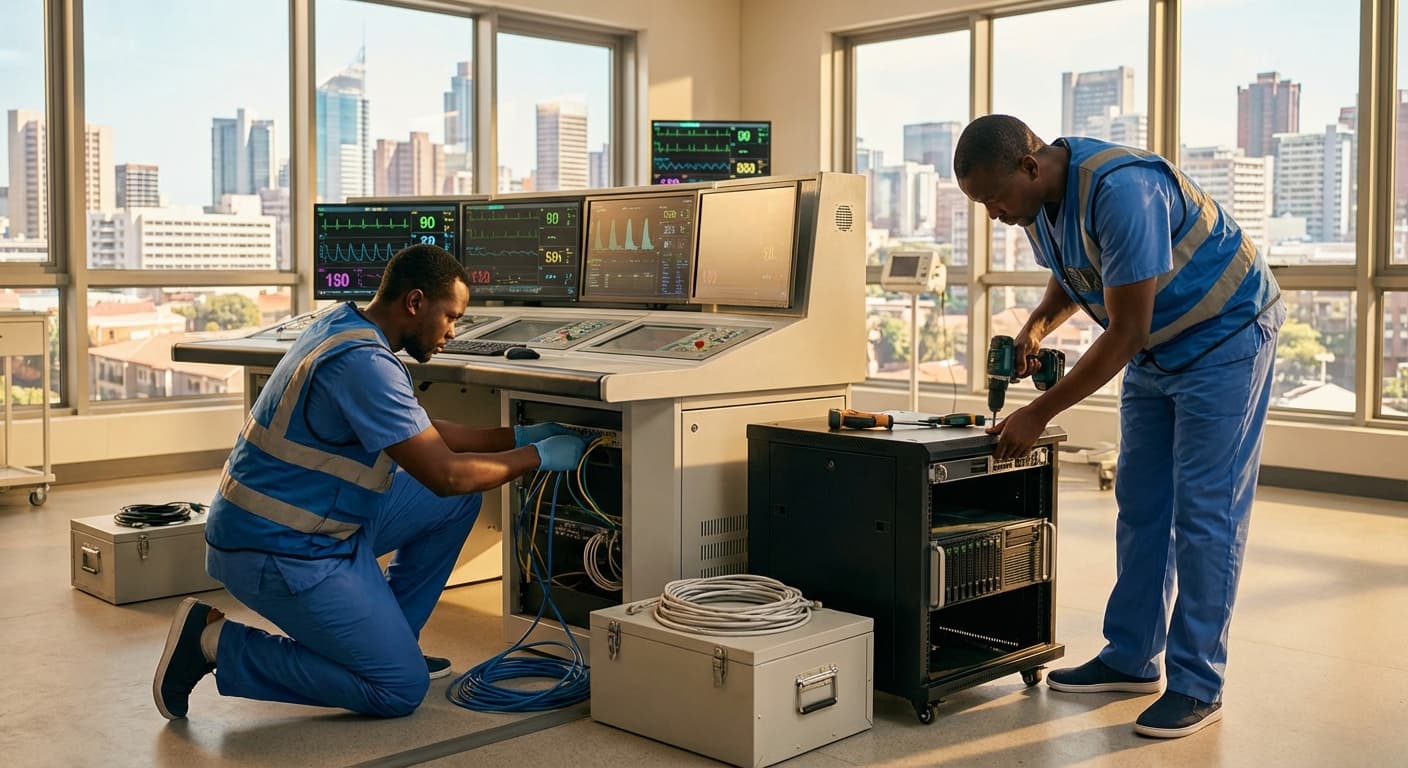
ICU Central Monitoring Station Installation Service in Burkina Faso
Engineering Excellence & Technical Support
ICU Central Monitoring Station Installation Service High-standard technical execution following OEM protocols and local regulatory frameworks.
Remote Patient Monitoring
Leverage advanced telemedicine solutions for real-time, remote monitoring of ICU patients. Our installation service ensures seamless integration, enabling critical data access for clinicians, improving response times, and enhancing patient outcomes across Burkina Faso's healthcare facilities.
Secure & Reliable Data Infrastructure
We implement robust, secure, and scalable network infrastructure for your central monitoring station. Our installation prioritizes data integrity and patient privacy, ensuring uninterrupted data flow and compliance with international healthcare standards, vital for critical care operations in Burkina Faso.
Expert Technical Support & Training
Beyond installation, we provide comprehensive technical support and hands-on training for your staff. Our certified technicians ensure smooth system operation and empower your medical personnel with the skills to effectively utilize the central monitoring station, guaranteeing optimal performance and long-term sustainability.
What Is Icu Central Monitoring Station Installation Service In Burkina Faso?
ICU Central Monitoring Station Installation Service in Burkina Faso refers to the specialized technical process of establishing and configuring a centralized system designed to continuously monitor critical patient vital signs and physiological parameters from multiple Intensive Care Units (ICUs) within a healthcare facility in Burkina Faso. This service encompasses the deployment of hardware (servers, workstations, network infrastructure, display units), software (monitoring platforms, data acquisition systems, alarm management modules), and the integration of these components with existing or new patient monitoring devices (e.g., ECG, SpO2, NIBP, IBP, respiration, temperature sensors). The primary objective is to provide healthcare professionals with real-time, aggregated, and trended patient data, enabling proactive decision-making, early detection of deterioration, and improved patient outcomes. The service also includes system calibration, network configuration, user training, and ongoing technical support to ensure optimal performance and reliability.
| Who Needs This Service? | Typical Use Cases |
|---|---|
| Hospitals and Healthcare Facilities in Burkina Faso operating Intensive Care Units (ICUs), High Dependency Units (HDUs), or Critical Care Units (CCUs). | Centralized Patient Oversight: Enabling a single point of observation for multiple critically ill patients across different ICU bays or wards. Early Warning Systems: Facilitating prompt identification of patient decompensation through real-time alerts and trend analysis. Resource Optimization: Allowing fewer clinicians to monitor a larger number of patients effectively, improving staff efficiency. Clinical Decision Support: Providing comprehensive patient data and historical trends to aid clinicians in diagnosis and treatment planning. Research and Data Analysis: Aggregating patient data for clinical research, quality improvement initiatives, and epidemiological studies. Disaster Preparedness: Enhancing the capacity to manage mass casualty incidents by providing a consolidated view of critically injured patients. Telemedicine Integration (potential future phase): Laying the groundwork for remote monitoring by specialists outside the immediate vicinity of the ICU. |
Key Components and Processes of ICU Central Monitoring Station Installation:
- System Design and Planning: Needs assessment, site survey, network architecture design, hardware/software selection, and integration strategy.
- Hardware Deployment: Installation and configuration of servers, workstations, display monitors, network switches, routers, and cabling infrastructure.
- Software Installation and Configuration: Deployment of the central monitoring software, patient data acquisition modules, alarm management systems, and database setup.
- Device Integration: Connecting and configuring individual patient monitors within ICUs to the central station via wired or wireless networks, ensuring accurate data transmission protocols.
- Network Infrastructure Setup: Establishing secure and reliable network connectivity between patient monitors, local ICU workstations, and the central monitoring station.
- Calibration and Testing: Verifying the accuracy and functionality of all connected devices and the central monitoring system, including alarm thresholds and data flow.
- Data Management and Storage: Implementing secure and compliant data storage solutions for historical patient data, enabling trend analysis and record-keeping.
- User Interface Customization: Tailoring the display of information and alarm configurations to meet the specific requirements of the healthcare facility and its clinical staff.
- Security Implementation: Establishing robust cybersecurity measures to protect sensitive patient data and prevent unauthorized access.
- Training and Handover: Comprehensive training for clinical staff and IT personnel on system operation, alarm response protocols, and basic troubleshooting.
- Post-Installation Support: Provision of ongoing technical maintenance, software updates, and troubleshooting services.
Who Needs Icu Central Monitoring Station Installation Service In Burkina Faso?
ICU Central Monitoring Station (CMS) installation services are crucial for any healthcare facility in Burkina Faso looking to enhance critical care capabilities. These advanced systems centralize the monitoring of multiple ICU patients, allowing for real-time data analysis, early detection of critical events, and improved patient outcomes. The installation of such a sophisticated system requires specialized expertise to ensure seamless integration with existing infrastructure and optimal performance.
| Target Customer Type | Key Departments Benefiting |
|---|---|
| Public Hospitals | Intensive Care Unit (ICU), Cardiology, Neurology, Anesthesiology, Emergency Department |
| Private Hospitals | Intensive Care Unit (ICU), Cardiology, Pulmonology, Surgery, Critical Care Departments |
| Tertiary Care Centers | All Critical Care Units (ICU, CCU, NICU, PICU), Trauma Centers, Transplant Units |
| University Teaching Hospitals | Intensive Care Unit (ICU), Anesthesiology & Critical Care, Medical & Surgical Departments, Research Divisions |
| Large Private Clinics | Intensive Care Unit (ICU), Cardiology, Oncology, Critical Care Services |
| NGOs/International Aid | Healthcare Facilities undergoing upgrades, Ministry of Health-supported centers, Emergency Response Units |
Target Customers & Departments for ICU Central Monitoring Station Installation in Burkina Faso:
- Hospitals (Public and Private): All hospitals with existing or planned Intensive Care Units (ICUs) are primary targets. This includes national hospitals, regional hospitals, and large private medical centers that aim to provide high-level critical care.
- Tertiary Care Centers: Facilities that serve as referral centers for complex medical cases will benefit significantly from the enhanced monitoring capabilities offered by a CMS.
- University Teaching Hospitals: These institutions require state-of-the-art equipment for both patient care and the training of medical professionals.
- Large Private Clinics and Medical Groups: Organizations investing in comprehensive healthcare services and seeking to differentiate themselves through advanced technology.
- Non-Governmental Organizations (NGOs) and International Aid Organizations: Those involved in developing or upgrading healthcare infrastructure in Burkina Faso, particularly in areas of critical care.
Icu Central Monitoring Station Installation Service Process In Burkina Faso
This document outlines the comprehensive service process for the installation of an ICU Central Monitoring Station in Burkina Faso, from the initial client inquiry to the final execution and handover. The process is designed to ensure efficient project management, adherence to standards, and a successful system implementation.
| Phase | Key Activities | Responsible Parties | Deliverables | Estimated Timeline |
|---|---|---|---|---|
| Client expresses interest; initial discussions on needs, scope, and potential solutions; preliminary budget discussion. | Client, Service Provider Sales Team | Initial understanding of client requirements, potential project feasibility assessment. | 1-3 Business Days |
| On-site visit to evaluate existing infrastructure (power, network, physical space), assess specific ICU needs, and finalize technical specifications. | Service Provider Technical Team, Client Clinical & IT Staff | Detailed site survey report, confirmed technical specifications, refined project scope. | 3-7 Business Days |
| Based on assessment, develop a detailed technical proposal, project plan, and comprehensive quotation including hardware, software, installation, training, and support costs. | Service Provider Technical & Sales Teams | Formal proposal document, detailed quotation, project timeline. | 5-10 Business Days |
| Client reviews proposal; negotiation and finalization of contract terms, including payment schedules, service level agreements (SLAs), and responsibilities. | Client, Service Provider Management | Signed contract agreement, Purchase Order (PO). | 7-14 Business Days |
| Detailed engineering design of the monitoring system, including network topology, hardware placement, software configuration, and integration points with existing hospital systems (if applicable). | Service Provider Engineering Team | Final system design documentation, hardware/software configuration plan. | 10-20 Business Days |
| Ordering of all necessary hardware and software components; management of customs clearance and transportation to Burkina Faso; warehousing and inventory management. | Service Provider Procurement & Logistics Department | Procured equipment and software, delivery tracking, inventory records. | 4-12 Weeks (dependent on lead times) |
| Preparation of the installation site, including any necessary structural modifications, power supply upgrades, network cable runs, and ensuring availability of necessary utilities. | Client Facilities Management, Service Provider Installation Team | Ready installation site, confirmed utility availability. | 1-2 Weeks (concurrent with procurement) |
| Physical installation of central monitoring station hardware (servers, workstations, displays), bedside monitor interfaces, and network cabling. Deployment of sensors and patient interface units. | Service Provider Installation Team, Local Technicians | Installed hardware, completed cabling infrastructure, initial equipment setup. | 7-21 Business Days |
| Configuration of central monitoring software, integration with bedside monitors, establishment of data flow, and integration with Electronic Health Records (EHR) or Picture Archiving and Communication Systems (PACS) if required. | Service Provider Software Engineers, IT Specialists | Configured and integrated monitoring system, data flow established. | 5-15 Business Days |
| Thorough testing of all system functionalities, including data acquisition, display accuracy, alarm generation, and data archiving. Performance testing and validation against specified requirements. | Service Provider Commissioning Engineers, Client Clinical Staff | System test reports, commissioning certificate, validated system performance. | 3-7 Business Days |
| Comprehensive training for clinical staff (nurses, doctors) and IT personnel on the operation, maintenance, and troubleshooting of the central monitoring system. Customized training modules based on user roles. | Service Provider Training Specialists | Trained hospital staff, training materials (manuals, guides). | 2-5 Business Days |
| Formal handover of the installed and commissioned system to the client. Provision of all relevant documentation, including user manuals, technical specifications, warranty information, and maintenance schedules. | Service Provider Project Manager, Client Representative | Signed handover acceptance form, complete documentation package. | 1-2 Business Days |
| Provision of ongoing technical support, maintenance services, and warranty coverage as per the agreed SLA. Remote and on-site support options available. | Service Provider Support Team | Ongoing system availability, resolved support tickets, proactive maintenance. | Ongoing (as per contract) |
ICU Central Monitoring Station Installation Service Workflow
- Inquiry & Initial Consultation
- Site Assessment & Requirements Gathering
- Proposal & Quotation Development
- Contracting & Agreement
- System Design & Configuration
- Procurement & Logistics
- Pre-installation Preparations
- On-site Installation & Cabling
- System Configuration & Integration
- Testing & Commissioning
- Staff Training
- Handover & Documentation
- Post-installation Support
Icu Central Monitoring Station Installation Service Cost In Burkina Faso
The cost of installing an ICU Central Monitoring Station in Burkina Faso is influenced by several key factors, ranging from the complexity of the system to the location of the healthcare facility. These systems are critical for real-time patient data aggregation and require specialized expertise for setup and integration. The pricing typically encompasses the cost of the monitoring station hardware and software, the required networking infrastructure, the installation labor, and post-installation training for medical staff. Factors such as the number of ICU beds to be monitored, the specific brand and model of the monitoring equipment chosen, the need for advanced features like remote access or integration with electronic health records (EHRs), and the accessibility of the installation site will all contribute to the final price. Local market conditions, the availability of skilled technicians, and any necessary import duties or taxes on specialized medical equipment also play a significant role. Prices can vary considerably, but generally, a comprehensive installation can be expected to fall within a certain range.
| Factor | Estimated Price Range (XOF - West African CFA franc) |
|---|---|
| Basic Installation (e.g., 4-8 beds, standard features) | 3,000,000 - 7,000,000 |
| Intermediate Installation (e.g., 8-16 beds, advanced features, EHR integration) | 7,000,000 - 15,000,000 |
| Advanced/Large-Scale Installation (e.g., 16+ beds, cutting-edge technology, complex integration) | 15,000,000 - 30,000,000+ |
| Additional Costs (e.g., site preparation, extensive training, remote support setup) | 500,000 - 2,000,000+ |
Key Pricing Factors for ICU Central Monitoring Station Installation in Burkina Faso
- Number of ICU Beds to be Monitored
- Type and Brand of Central Monitoring Station Hardware
- Software Licensing and Features (e.g., EHR Integration, Remote Access)
- Networking Infrastructure Requirements (cabling, switches, servers)
- Installation Labor and Technician Expertise
- Site Accessibility and Preparation Requirements
- Training for Medical Staff
- Import Duties, Taxes, and Customs Clearance
- Warranty and Maintenance Packages
- Brand Reputation and Support Services
Affordable Icu Central Monitoring Station Installation Service Options
Installing an ICU Central Monitoring Station is a critical investment for any healthcare facility. Our service options are designed to be both effective and budget-conscious, offering a range of solutions to meet diverse needs and financial constraints. We understand that affordability doesn't mean compromising on quality or functionality. Our approach focuses on providing value through tailored packages, smart procurement, and efficient implementation strategies.
| Value Bundle Tier | Included Services | Typical Use Case | Estimated Cost Range (Illustrative) |
|---|---|---|---|
| Essential Care Bundle | Core central monitoring software, 1-2 central workstations, basic network setup, standard installation, initial staff training. | Smaller ICUs, facilities with existing basic monitoring infrastructure, budget-conscious clinics. | $15,000 - $35,000 |
| Advanced Care Bundle | Comprehensive central monitoring software with advanced analytics, 2-3 central workstations, robust network integration, advanced reporting features, extended training, initial on-site support. | Mid-sized ICUs, hospitals seeking enhanced data insights and improved workflow efficiency. | $35,000 - $75,000 |
| Premium Care Bundle | All features of the Advanced Care Bundle plus: High-availability server setup, remote monitoring capabilities, integration with advanced medical devices (e.g., ventilators, dialysis machines), customized workflow solutions, dedicated project management, ongoing premium support. | Large tertiary hospitals, research facilities, centers with complex patient populations and high-volume monitoring needs. | $75,000 - $150,000+ |
Key Considerations for Affordable ICU Central Monitoring Station Installation
- Scalability: Opt for systems that can grow with your facility, avoiding costly overhauls.
- Integration Capabilities: Prioritize systems that seamlessly integrate with existing EMR/EHR and other hospital equipment.
- Training and Support: Factor in the cost of comprehensive training and ongoing technical support to maximize ROI.
- Future-Proofing: Consider emerging technologies and standards to ensure long-term viability.
- Vendor Reputation: Research and choose reputable vendors with proven track records in healthcare IT.
- Remote Monitoring Options: Explore solutions that offer remote access for enhanced oversight and reduced on-site personnel needs.
- Phased Implementation: Break down the installation into manageable phases if budget constraints are significant.
Verified Providers In Burkina Faso
In Burkina Faso, identifying healthcare providers with verified credentials is paramount for ensuring quality and trustworthy medical services. Franance Health stands out as a leading organization in this regard, meticulously vetting and credentialing healthcare professionals to guarantee a high standard of care. Their rigorous verification process instills confidence in patients, assuring them that they are receiving services from qualified and ethical practitioners. This commitment to transparency and excellence makes Franance Health-credentialed providers the optimal choice for individuals seeking reliable healthcare in Burkina Faso.
| Provider Type | Franance Health Verification Criteria | Benefits for Patients |
|---|---|---|
| Doctors | Medical school degree, residency completion, board certification, license to practice, clean disciplinary record. | Access to highly trained specialists, accurate diagnoses, effective treatment plans. |
| Nurses | Nursing diploma/degree, relevant certifications, license to practice, background checks. | Skilled and compassionate care, post-operative support, health education. |
| Specialists (e.g., Surgeons, Pediatricians) | Advanced medical degrees, specialized residency/fellowship, board certification in their specialty, ongoing professional development. | Expertise in complex medical conditions, specialized surgical procedures, tailored care for specific age groups. |
| Clinics and Hospitals | Compliance with national health regulations, quality management systems, appropriate facility infrastructure, qualified medical staff. | Safe and sterile environments, comprehensive diagnostic and treatment services, coordinated patient care. |
Why Franance Health Credentials Matter
- Ensures adherence to international medical standards.
- Verifies professional qualifications and experience.
- Confirms ethical conduct and patient safety protocols.
- Provides a transparent and trustworthy healthcare landscape.
- Facilitates access to competent and reliable medical practitioners.
Scope Of Work For Icu Central Monitoring Station Installation Service
This Scope of Work (SOW) outlines the requirements for the installation of an Intensive Care Unit (ICU) Central Monitoring Station (CMS) service. The project encompasses the supply, installation, configuration, and commissioning of a comprehensive CMS solution designed to enhance patient monitoring and facilitate efficient clinical workflow within the ICU. This includes hardware, software, networking, and integration with existing hospital infrastructure. The aim is to provide a reliable, scalable, and user-friendly system that meets the critical needs of ICU patient care.
| Task ID | Task Description | Deliverables | Standard Specifications/Requirements |
|---|---|---|---|
| 1.0 | Project Planning and Design | Detailed project plan, site survey report, system architecture design, network topology diagram. | Adherence to hospital IT policies, compliance with data privacy regulations (e.g., HIPAA), scalability for future expansion, robust security protocols. |
| 2.0 | Hardware Procurement and Delivery | Central monitoring workstations, servers, network switches, cabling, power supplies, UPS units. | High-availability servers, redundant power supplies, industry-standard networking equipment (e.g., Cisco, HP), medical-grade workstations, appropriate UPS capacity for extended outages. |
| 3.0 | Software Installation and Configuration | CMS software, patient data management modules, alert management system, reporting tools, user access control. | Latest stable version of CMS software, customizable alert thresholds and notifications, role-based access control, data encryption, audit trails, compatibility with existing HIS/EMR. |
| 4.0 | Network Infrastructure Setup | Network cabling, switch configuration, IP addressing scheme, firewall rules, VPN configuration (if remote access required). | High-speed Ethernet (Gigabit or higher), VLAN segmentation for security, robust firewall configuration, secure VPN protocols, adherence to hospital network standards. |
| 5.0 | Integration with Existing Systems | Interface development and testing for HIS/EMR, patient monitors (e.g., Philips, GE, Draeger), ventilators, infusion pumps. | HL7 v2.x or FHIR compliance for HIS/EMR integration, device-specific protocols (e.g., proprietary, TCP/IP), bi-directional data flow where applicable, rigorous testing for data accuracy and timeliness. |
| 6.0 | System Installation and Cabling | Installation of workstations, servers, network devices; complete cable management; power and network drops. | Professional installation by certified technicians, adherence to electrical safety codes, neat and organized cable management, proper labeling of all cables and devices. |
| 7.0 | System Testing and Validation | Unit testing, integration testing, system testing, user acceptance testing (UAT) reports, performance benchmarks. | Comprehensive test cases covering all functionalities, validation of data accuracy and integrity, performance testing under simulated load conditions, sign-off by hospital stakeholders. |
| 8.0 | Commissioning and Go-Live Support | Final system configuration, live system validation, immediate post-go-live technical support. | Phased go-live approach if required, on-site support during initial period, troubleshooting and issue resolution. |
| 9.0 | Training and Knowledge Transfer | Training materials (user manuals, quick reference guides), training sessions for clinical staff, training sessions for IT/biomedical engineers. | Role-specific training modules, hands-on practical exercises, competency assessments, documentation of training records. |
| 10.0 | Documentation and Handover | Final system configuration documentation, network diagrams, as-built drawings, maintenance manuals, warranty information. | Complete and accurate documentation, organized in a structured format, digital and hard copy versions provided, formal handover to hospital IT and biomedical departments. |
Project Objectives
- To successfully install and commission a fully functional ICU Central Monitoring Station.
- To ensure seamless integration of the CMS with existing patient monitoring devices and hospital information systems (HIS/EMR).
- To provide comprehensive training for clinical and technical staff on the operation and maintenance of the CMS.
- To establish a robust and secure network infrastructure to support real-time data transmission.
- To deliver all technical documentation and manuals for system operation and maintenance.
- To ensure the system meets all relevant industry standards and regulatory requirements.
Service Level Agreement For Icu Central Monitoring Station Installation Service
This Service Level Agreement (SLA) outlines the response times and uptime guarantees for the installation service of the ICU Central Monitoring Station. This SLA is an addendum to the Master Service Agreement (MSA) between [Your Company Name] (hereinafter referred to as 'Provider') and [Client Company Name] (hereinafter referred to as 'Client').
| Service Category | Priority Level | Response Time Guarantee (during Service Hours) | Uptime Guarantee (for installed system post-acceptance) |
|---|---|---|---|
| Installation Site Survey & Planning | Critical | 4 Business Hours | N/A |
| Installation & Configuration of Hardware | Critical | 8 Business Hours | N/A |
| Software Installation & Initial Setup | Critical | 8 Business Hours | N/A |
| System Testing & Validation | Critical | 12 Business Hours | N/A |
| Client Training (as per SOW) | High | 1 Business Day | N/A |
| Post-Installation Support (first 30 days) | Critical (System failure) | 2 Business Hours | 99.5% |
| Post-Installation Support (first 30 days) | High (Performance degradation) | 4 Business Hours | 99.5% |
| Post-Installation Support (first 30 days) | Medium (Minor issues/inquiries) | 8 Business Hours | 99.5% |
| Ongoing Service (post 30 days, if applicable) | Critical (System failure) | 4 Business Hours (if separate support contract) | 99.9% |
| Ongoing Service (post 30 days, if applicable) | High (Performance degradation) | 8 Business Hours (if separate support contract) | 99.9% |
Key Definitions
- Installation Service: The complete process of setting up and configuring the ICU Central Monitoring Station hardware and software at the Client's premises, as defined in the Statement of Work (SOW).
- Service Hours: Standard business hours are Monday through Friday, 8:00 AM to 5:00 PM local time, excluding national holidays. Emergency support may be available outside of Service Hours as specified in the SOW or separate agreement.
- Downtime: A period during which the ICU Central Monitoring Station is not operational or accessible for its intended use, as confirmed by both parties. Maintenance windows for scheduled updates or repairs are not considered Downtime.
- Response Time: The maximum time allowed for the Provider's technical support personnel to acknowledge and begin addressing a reported issue or request.
- Resolution Time: The target time for the Provider to resolve a reported issue or complete a requested task. This is an objective and may vary depending on the complexity of the issue.
Frequently Asked Questions

Ready when you are
Let's scope your ICU Central Monitoring Station Installation Service in Burkina Faso project in Burkina Faso.

Scaling healthcare logistics and technical systems across the entire continent.