
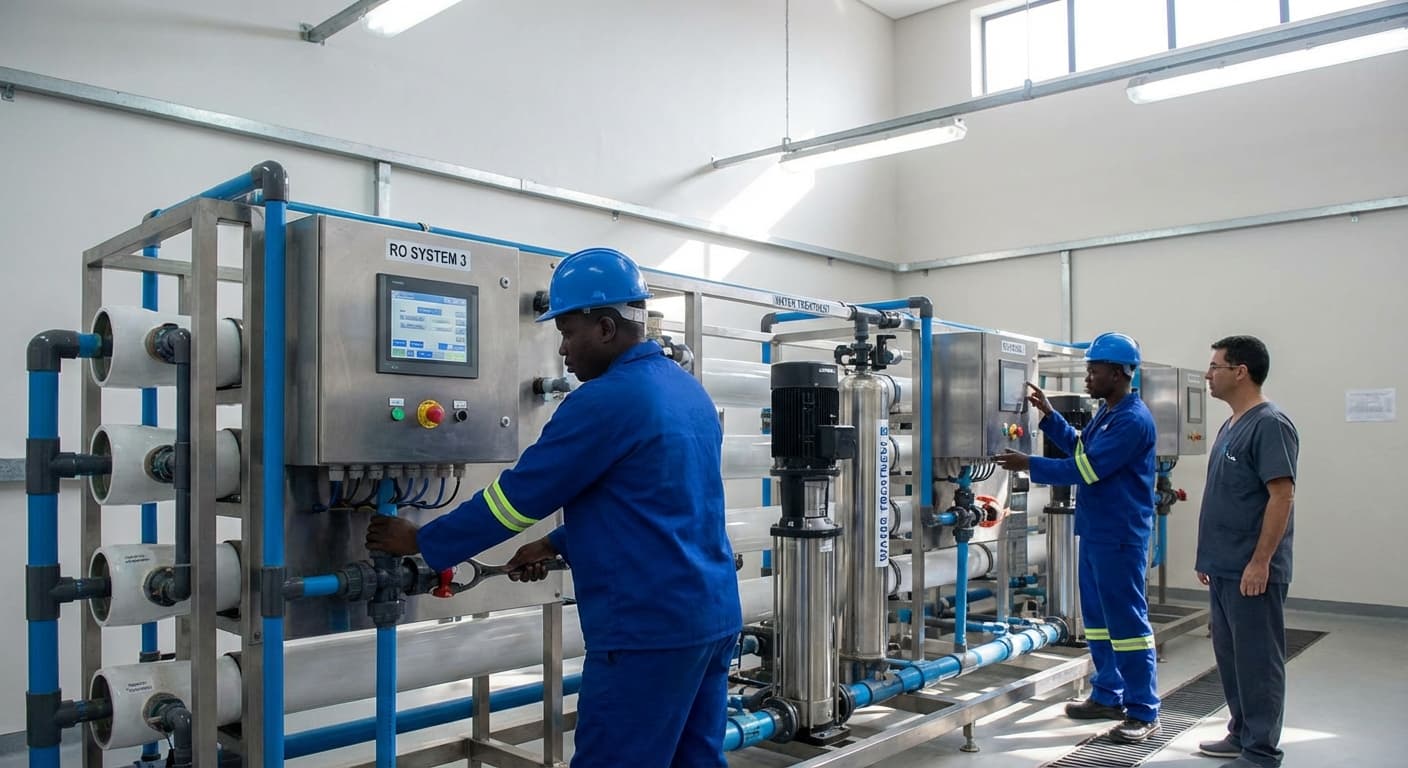
Dialysis RO/Water Treatment Plant Installation Service in Burkina Faso
Engineering Excellence & Technical Support
Dialysis RO/Water Treatment Plant Installation Service High-standard technical execution following OEM protocols and local regulatory frameworks.
Advanced RO Membrane Technology
Our installations in Burkina Faso utilize cutting-edge Reverse Osmosis (RO) membrane technology, ensuring the highest purity water for dialysis. This advanced filtration effectively removes dissolved salts, minerals, and contaminants, meeting stringent international medical standards and safeguarding patient health.
Sustainable Energy Integration (Solar Power)
Recognizing the energy challenges in Burkina Faso, our dialysis RO/Water Treatment Plant installations are designed for optimal energy efficiency and can be seamlessly integrated with solar power solutions. This reduces operational costs, enhances reliability in off-grid or unstable grid environments, and promotes environmental sustainability.
Optimized Water Distribution & Redundancy
We engineer robust water distribution networks with built-in redundancy for our dialysis RO plants in Burkina Faso. This ensures uninterrupted, high-quality water supply to multiple dialysis stations simultaneously, minimizing downtime and guaranteeing consistent treatment for all patients, even during peak demand or maintenance.
What Is Dialysis Ro/water Treatment Plant Installation Service In Burkina Faso?
Dialysis RO/Water Treatment Plant Installation Service in Burkina Faso refers to the specialized engineering and construction process of establishing facilities designed to produce ultrapure water for hemodialysis treatments. This service encompasses the design, procurement, assembly, commissioning, and validation of reverse osmosis (RO) and related water purification systems tailored to meet the stringent water quality standards required for dialysis. These plants are critical for ensuring patient safety by removing contaminants, endotoxins, and pyrogens that could cause adverse reactions or infections. The process involves multiple stages of filtration, purification, and disinfection, often including pre-filtration, RO membranes, post-filters, and potentially UV sterilization or electrodeionization (EDI) depending on the specific requirements and local water source characteristics.
| Who Needs This Service | Typical Use Cases | ||||
|---|---|---|---|---|---|
| Hospitals and Dialysis Centers in Burkina Faso | Establishment of new hemodialysis units. | Upgrade or replacement of existing water treatment systems. | Renovation or expansion of dialysis facilities. | Addressing water quality issues with current systems. | Ensuring compliance with national and international healthcare regulations for water purity. |
| Non-Governmental Organizations (NGOs) and International Aid Agencies | Supporting healthcare infrastructure development in underserved regions. | Providing essential medical equipment and services for public health initiatives. | Responding to health crises requiring increased dialysis capacity. | ||
| Government Health Ministries and Public Healthcare Providers | Developing national dialysis programs and networks. | Ensuring equitable access to safe dialysis treatment across the country. | Maintaining and upgrading public healthcare facilities. |
Key Components and Stages of Dialysis RO/Water Treatment Plant Installation
- Water Source Assessment and Characterization
- System Design and Engineering (flow rates, purity levels, redundancy)
- Component Procurement (pumps, filters, membranes, controls)
- Mechanical Installation and Plumbing
- Electrical and Instrumentation Wiring
- System Commissioning and Startup
- Water Quality Testing and Validation (compliance with AAMI/ISO standards)
- Operator Training and Documentation
- Ongoing Maintenance and Support Planning
Who Needs Dialysis Ro/water Treatment Plant Installation Service In Burkina Faso?
Dialysis requires highly purified water to function safely and effectively. Standard tap water contains impurities like minerals, bacteria, and dissolved solids that can be harmful when introduced into a patient's bloodstream during dialysis. A Reverse Osmosis (RO) and Water Treatment Plant specifically designed for dialysis ensures the removal of these contaminants to medical-grade standards. Therefore, any facility providing dialysis treatment in Burkina Faso, whether government-funded or private, will require the installation and ongoing maintenance of such a plant.
| Customer Type | Key Departments Involved |
|---|---|
| Public Hospitals and Health Centers | Nephrology Department, Biomedical Engineering Department, Procurement Department, Facilities Management |
| Private Hospitals and Clinics | Nephrology Department, Administration, Procurement Department, Technical Services |
| Specialized Dialysis Centers | Clinical Operations, Biomedical Engineering, Procurement, Administration |
| NGOs involved in healthcare | Medical Program Management, Procurement, Technical Support Teams |
| Military and Police Medical Facilities | Medical Services Command, Logistics Department, Biomedical Engineering |
| Missions and Religious Healthcare Institutions | Hospital Administration, Medical Directors, Facilities Management |
Target Customers for Dialysis RO/Water Treatment Plant Installation Service in Burkina Faso
- Public Hospitals and Health Centers
- Private Hospitals and Clinics
- Specialized Dialysis Centers
- Non-Governmental Organizations (NGOs) involved in healthcare
- Military and Police Medical Facilities
- Missions and Religious Healthcare Institutions
Dialysis Ro/water Treatment Plant Installation Service Process In Burkina Faso
This document outlines the comprehensive workflow for the installation of Dialysis Reverse Osmosis (RO) / Water Treatment Plants in Burkina Faso. It covers the entire process from the initial customer inquiry to the successful execution and handover of the operational plant, ensuring a structured and efficient approach.
| Phase | Stage | Key Activities | Deliverables/Outcomes | Responsible Party/Team |
|---|---|---|---|---|
| 1 | Inquiry and Initial Consultation | Receive customer inquiry via phone, email, or website. Initial discussion to understand basic requirements, existing infrastructure, and desired capacity. Provide preliminary information on our services and product offerings. | Acknowledged inquiry, initial understanding of client needs. | Sales/Business Development Team |
| 2 | Site Assessment and Needs Analysis | Conduct detailed on-site survey. Assess water source quality (testing required). Evaluate existing electrical and plumbing infrastructure. Determine space availability and site accessibility. Gather detailed technical specifications and regulatory requirements. | Comprehensive site assessment report, water quality analysis, defined technical specifications. | Technical Sales/Engineering Team, Local Partner (if applicable) |
| 3 | Proposal and Quotation | Develop a detailed technical proposal outlining the proposed RO system, its components, and performance specifications. Prepare a comprehensive quotation including equipment costs, installation fees, shipping, and any other associated charges. Include estimated timelines for installation. | Formal technical proposal, detailed quotation, estimated project schedule. | Engineering Team, Sales Team |
| 4 | Contract Negotiation and Agreement | Review and discuss the proposal and quotation with the client. Negotiate terms, payment schedules, and warranty details. Finalize and sign the service contract. | Signed service contract, agreed payment terms, confirmed project scope. | Sales Team, Legal Department, Client |
| 5 | Design and Engineering | Develop detailed engineering designs for the RO plant based on site assessment and client requirements. Create P&ID (Piping and Instrumentation Diagrams), electrical schematics, and layout drawings. Obtain necessary local permits and approvals (if applicable). | Final engineering drawings, P&IDs, electrical schematics, approved permits. | Engineering Department |
| 6 | Procurement and Logistics | Order all necessary RO system components, membranes, pumps, filters, control panels, piping, and other materials. Arrange for shipping and transportation of equipment to Burkina Faso, including customs clearance. | All equipment and materials procured and en route to the site. | Procurement Department, Logistics Team |
| 7 | Pre-installation Preparations | Prepare the installation site (e.g., civil works, power connections, water inlet/outlet points). Ensure all necessary tools, equipment, and safety gear are on-site. Pre-assembly of some modules (if applicable). | Site ready for installation, all tools and materials at the site. | Installation Team, Client (for site preparation) |
| 8 | On-site Installation and Assembly | Unpack and carefully inspect all delivered components. Assemble the RO plant according to the engineering designs. Install piping, electrical connections, and control systems. Ensure adherence to safety protocols throughout the installation process. | Physically installed RO/Water Treatment Plant. | Installation Team, Project Manager |
| 9 | System Testing and Commissioning | Perform rigorous pre-commissioning checks. Conduct full system testing, including leak tests, pressure tests, and flow rate verification. Run the plant to produce purified water and test its quality against specified parameters. Calibrate sensors and control systems. | Operational RO/Water Treatment Plant, verified water quality reports, system parameters calibrated. | Commissioning Team, Engineers |
| 10 | Training and Handover | Provide comprehensive training to the client's operational and maintenance staff on system operation, daily checks, troubleshooting, and basic maintenance. Hand over all relevant documentation, including operation manuals, maintenance logs, and warranty certificates. Formal acceptance of the installed plant by the client. | Trained staff, complete documentation package, signed handover certificate. | Training Specialist, Project Manager, Client |
| 11 | Post-installation Support and Maintenance | Provide ongoing technical support and troubleshooting assistance. Offer preventive maintenance services and supply of spare parts. Conduct periodic performance reviews to ensure optimal operation. | Continued optimal plant performance, satisfied client. | After-Sales Service Team, Maintenance Department |
Dialysis RO/Water Treatment Plant Installation Workflow
- Phase 1: Inquiry and Initial Consultation
- Phase 2: Site Assessment and Needs Analysis
- Phase 3: Proposal and Quotation
- Phase 4: Contract Negotiation and Agreement
- Phase 5: Design and Engineering
- Phase 6: Procurement and Logistics
- Phase 7: Pre-installation Preparations
- Phase 8: On-site Installation and Assembly
- Phase 9: System Testing and Commissioning
- Phase 10: Training and Handover
- Phase 11: Post-installation Support and Maintenance
Dialysis Ro/water Treatment Plant Installation Service Cost In Burkina Faso
Installing a Reverse Osmosis (RO) and Water Treatment plant for dialysis in Burkina Faso involves a complex process with variable costs. Several key factors influence the final price, making it challenging to provide a single definitive figure. These factors include the scale of the plant (e.g., number of dialysis stations it will support), the specific water quality issues being addressed (requiring different treatment stages), the brand and quality of RO membranes and other equipment, the complexity of the installation, the need for specialized labor, and logistical considerations within Burkina Faso.
| Service Component | Estimated Cost Range (XOF) | Notes |
|---|---|---|
| Small-Scale Dialysis Unit (e.g., 2-4 stations) | 5,000,000 - 15,000,000 | Includes basic pre-treatment, single-pass RO, basic monitoring. |
| Medium-Scale Dialysis Unit (e.g., 5-10 stations) | 12,000,000 - 30,000,000 | May include advanced pre-treatment, double-pass RO for higher purity, more robust monitoring, and some automation. |
| Large-Scale Dialysis Center (e.g., 10+ stations) | 25,000,000 - 70,000,000+ | Comprehensive pre-treatment, potentially redundant RO systems, advanced automation, sophisticated monitoring, backup systems, and extensive storage. |
| Equipment (RO Membranes, Pumps, Filters) | 2,000,000 - 15,000,000+ | Highly variable based on capacity, brand, and technology. |
| Installation Labor & Project Management | 1,000,000 - 5,000,000+ | Depends on complexity and local labor rates. International expertise may add significantly. |
| Transportation & Logistics | 500,000 - 3,000,000+ | Varies greatly with location within Burkina Faso and international shipping. |
| Pre-Treatment Systems (Filters, Softeners, UV) | 1,000,000 - 7,000,000+ | Dependent on raw water quality and required purification levels. |
Key Pricing Factors for Dialysis RO/Water Treatment Plant Installation in Burkina Faso:
- Plant Capacity: The volume of purified water required per hour or day directly impacts the size and cost of the RO system, pumps, storage tanks, and associated piping.
- Water Source Quality: The initial quality of the raw water (e.g., presence of high TDS, minerals, bacteria, organic matter, heavy metals) dictates the necessary pre-treatment stages (e.g., sediment filters, carbon filters, water softeners, UV sterilization) and the number/type of RO membranes required.
- Equipment Brand and Quality: High-end, reputable brands of RO membranes, pumps, control systems, and monitoring equipment will generally be more expensive but offer greater reliability and longevity.
- Number of Treatment Stages: More sophisticated water purification often requires multiple treatment stages, adding to the complexity and cost of the system.
- Installation Complexity and Labor: The physical site of installation, accessibility, need for civil works (e.g., concrete foundations, housing for the plant), and the availability of skilled technicians for installation and commissioning play a significant role.
- Logistics and Transportation: The cost of transporting equipment and materials to the installation site, especially if it's in a remote area, can be a considerable expense.
- After-Sales Service and Maintenance Contracts: While not strictly installation cost, these are often bundled or considered upfront. Long-term service agreements and training for local staff add to the overall investment.
- Permits and Approvals: Obtaining necessary regulatory permits and approvals from local health and environmental authorities can incur fees.
- Currency Exchange Rates: As many specialized components are likely imported, fluctuations in the West African CFA franc (XOF) against major currencies (USD, EUR) can impact the final cost.
Affordable Dialysis Ro/water Treatment Plant Installation Service Options
Installing a reliable RO (Reverse Osmosis) and water treatment plant is crucial for dialysis centers, ensuring patient safety and effective treatment. While the initial investment can seem substantial, several affordable service options, value bundles, and cost-saving strategies can make this essential infrastructure accessible.
| Value Bundle/Strategy | Description | Cost-Saving Benefit | Key Features Included |
|---|---|---|---|
| Basic Essentials Bundle | Core RO unit, essential pre-filtration, and basic monitoring. | Lower upfront investment. | RO membrane, sediment filter, carbon filter, basic pressure gauges. |
| Standard Care Package | Includes basic bundle plus advanced monitoring, leak detection, and initial setup support. | Balances cost with essential safety features and reduced setup time. | Basic bundle + TDS meter, automatic shut-off, basic installation guidance. |
| Premium Plus Service Plan | Comprehensive solution with advanced automation, remote monitoring, extended warranty, and priority maintenance. | Long-term cost reduction through proactive maintenance and reduced downtime. Higher initial cost. | Standard Care + PLC control, data logging, remote diagnostics, 2-year warranty, discounted first service. |
| Refurbished Equipment Offer | Installation of certified pre-owned RO/water treatment systems. | Significant reduction in capital expenditure (30-50% less than new). | Professionally inspected and tested equipment, new consumables, warranty on critical components. |
| Phased Installation Approach | Staged installation of the water treatment system, starting with the most critical components. | Spreads capital outlay over time, aligning with cash flow. | Initial phase: RO unit and basic pre-treatment. Subsequent phases: Permeate storage, distribution, etc. |
| Energy Efficiency Upgrade Option | Installation of energy-efficient pumps and components. | Reduces operational electricity costs over the plant's lifespan. | High-efficiency motors, variable frequency drives (VFDs). |
Affordable Dialysis RO/Water Treatment Plant Installation Service Options
- Modular & Scalable Systems: Opt for plants that can be expanded as your center grows, avoiding over-investment upfront.
- Refurbished/Pre-owned Equipment: High-quality, certified refurbished units offer significant cost savings with comparable performance.
- Phased Installation: Break down the project into manageable phases, aligning costs with budget availability.
- Leasing & Financing Options: Explore attractive leasing agreements or specialized financing plans to spread the cost over time.
- DIY & Semi-DIY Packages: For centers with technical expertise, kits or partially assembled systems can reduce labor costs.
- Local vs. National Installers: Comparing quotes from local and national providers can reveal significant price differences.
Verified Providers In Burkina Faso
In Burkina Faso's evolving healthcare landscape, discerning reliable and high-quality healthcare providers is paramount for individuals and organizations. Franance Health stands out as a premier choice due to its stringent credentialing process and commitment to excellence. This document outlines the key aspects of Franance Health's verified provider network and explains why it represents the optimal selection for healthcare services in Burkina Faso.
| Provider Category | Key Verification Criteria | Franance Health Assurance |
|---|---|---|
| General Practitioners | Valid Medical License, Minimum 3 Years Experience, Board Certification (where applicable), Malpractice Insurance | Franance Health confirms ongoing licensure and monitors patient feedback for consistent service quality. |
| Specialists (e.g., Cardiologists, Pediatricians, Surgeons) | Specialty Board Certification, Fellowship Training, Proven Track Record in Specialty, Peer Recommendations | Franance Health conducts in-depth reviews of specialist credentials and surgical outcomes (where relevant). |
| Hospitals & Clinics | Accreditation (e.g., ISO, JCI equivalent), Compliance with Health Regulations, Availability of Key Infrastructure and Equipment, Qualified Medical Staff Ratio | Franance Health assesses facility infrastructure, equipment, and staff qualifications against established standards. |
| Diagnostic Laboratories | Accreditation by Recognized Bodies, Quality Control Procedures, Certified Technicians, Up-to-Date Equipment | Franance Health verifies laboratory accreditations and adherence to stringent quality control protocols. |
| Pharmacies | Valid Pharmacy License, Proper Storage and Dispensing Practices, Authentic Medication Sourcing, Qualified Pharmacists | Franance Health ensures adherence to safe medication practices and verifies the authenticity of pharmaceutical supplies. |
Why Choose Franance Health Verified Providers?
- Uncompromising Quality Standards: Franance Health adheres to rigorous selection criteria, ensuring that all partnered providers meet and exceed national and international benchmarks for medical expertise, patient care, and ethical practices.
- Comprehensive Verification Process: Our credentialing involves thorough background checks, verification of medical licenses, continuous professional development assessments, and peer reviews to guarantee competence and reliability.
- Patient-Centric Approach: Verified Franance Health providers are committed to patient well-being, offering empathetic care, clear communication, and personalized treatment plans.
- Access to Specialized Care: The network includes a wide array of specialists, ensuring access to advanced medical services for diverse healthcare needs across Burkina Faso.
- Trust and Transparency: Franance Health prioritizes building trust by providing transparent information about provider qualifications and service offerings.
Scope Of Work For Dialysis Ro/water Treatment Plant Installation Service
This Scope of Work (SOW) outlines the requirements for the installation services of a new Reverse Osmosis (RO) and Water Treatment Plant specifically designed for dialysis operations. The service provider will be responsible for the complete installation, commissioning, and handover of the plant to ensure it meets all specified technical requirements and operational standards. The objective is to deliver a fully functional and compliant water purification system for safe and effective hemodialysis treatment.
| Section | Description | Technical Deliverables | Standard Specifications/Requirements |
|---|---|---|---|
| Includes detailed planning, site survey, and preparation for installation. Ensures minimal disruption to existing facility operations. | Installation schedule and Gantt chart Site inspection report Pre-installation checklist Utility requirements (power, water, drainage) assessment. | Adherence to client's operational hours Compliance with local building codes and safety regulations Adequate space allocation as per design drawings. |
| Receipt, inspection, and safe handling of all supplied RO/Water Treatment Plant components. | Delivery confirmation and logistics plan Detailed inventory of received equipment Condition report upon arrival. | Protection of equipment from damage during transit and handling Verification of all components against the Bill of Materials (BOM). |
| Physical assembly and interconnection of all plant components as per design and engineering drawings. | Mechanical installation completion report Electrical wiring and connection documentation Piping and plumbing diagrams with as-built markings Structural integrity verification. | Installation according to manufacturer's guidelines and approved engineering drawings Use of food-grade/medical-grade piping and fittings (as specified) Proper grounding and electrical safety measures. |
| Verification of all installed systems before initiating water flow and operation. | Pre-commissioning checklist completion Electrical continuity and insulation resistance tests Leak tests for all piping and connections Calibration of essential instruments (pressure gauges, flow meters). | All components securely fastened No visible damage to equipment or piping Electrical safety compliance. |
| Operation of the plant to test its functionality and performance against specified parameters. | Commissioning report detailing operational parameters Water quality test results (before and after treatment) Flow rate and pressure verification reports Performance test logs (e.g., rejection rate, recovery rate). | Production of purified water meeting AAMI/ISO/local dialysis water standards Consistent operation within designed parameters Minimal downtime during testing. |
| Provision of training to client personnel and formal handover of the installed plant. | Training plan and attendance records Operation and Maintenance (O&M) manuals (hard and soft copies) As-built drawings and documentation Certificate of Handover. | Comprehensive training on daily operation, monitoring, and basic troubleshooting Clear understanding of maintenance schedules and procedures All documentation provided in the agreed format. |
| Continuous documentation throughout the project lifecycle and final reporting. | Daily progress reports Weekly status updates Incident reports (if any) Final project report. | Timely and accurate reporting as per agreed communication protocol. |
Key Objectives
- To successfully install and commission the Dialysis RO/Water Treatment Plant according to design specifications.
- To ensure the plant consistently produces purified water meeting the stringent standards required for hemodialysis.
- To provide comprehensive training to the client's personnel on the operation and basic maintenance of the plant.
- To achieve full operational readiness and handover of the installed system to the client.
Service Level Agreement For Dialysis Ro/water Treatment Plant Installation Service
This Service Level Agreement (SLA) outlines the response times and uptime guarantees for the installation service of Dialysis Reverse Osmosis (RO) / Water Treatment Plants. It is an addendum to the main service contract and applies to all new installations and associated commissioning activities.
| Service Metric | Definition / Description | Target/Guarantee | Notes |
|---|---|---|---|
| Installation Completion Time | Time from site readiness to system handover and operational sign-off. | As per agreed Project Schedule (e.g., 4-6 weeks). | Excludes delays due to site preparation or client-provided infrastructure. |
| Critical Issue Response Time (During Warranty) | Time to acknowledge and dispatch technical personnel to the site for critical system failures. | Within 4 business hours. | Applies to issues directly impacting water production for dialysis. |
| Routine Issue Response Time (During Warranty) | Time to acknowledge and schedule a visit for non-critical issues or performance degradation. | Within 24 business hours. | Includes remote troubleshooting and on-site support if required. |
| Critical Issue Rectification Time (During Warranty) | Time to restore the RO/Water Treatment Plant to full operational capacity, meeting all water quality parameters. | Within 48 business hours of response. | May be extended for complex repairs requiring specialized parts, with prior client notification. |
| Uptime Guarantee (Post-Installation Warranty) | Percentage of time the system operates within specified water quality parameters and is available for use. | 98% (Excluding scheduled maintenance). | Calculated on a monthly basis. Downtime for planned maintenance is excluded. |
| Preventive Maintenance Scheduling | Frequency and notification for scheduled maintenance visits. | As per manufacturer recommendations and agreed maintenance plan (e.g., quarterly). | Client will be notified at least 7 days in advance for scheduling. |
Key Service Metrics
- Installation Completion Time: The agreed-upon timeframe for the complete installation and initial commissioning of the Dialysis RO/Water Treatment Plant, as specified in the project scope.
- Response Time: The maximum time allowed for the service provider to acknowledge and begin addressing a reported issue during the warranty period of the installation.
- Rectification Time: The maximum time allowed for the service provider to resolve a critical issue impacting the functionality of the installed plant, ensuring it meets the specified water quality standards.
- Uptime Guarantee: The minimum percentage of time the newly installed RO/Water Treatment Plant is expected to be operational and producing water meeting the required quality specifications.
- Preventive Maintenance: Scheduled maintenance activities to ensure optimal performance and longevity of the installed system.
Frequently Asked Questions

Ready when you are
Let's scope your Dialysis RO/Water Treatment Plant Installation Service in Burkina Faso project in Burkina Faso.

Scaling healthcare logistics and technical systems across the entire continent.