
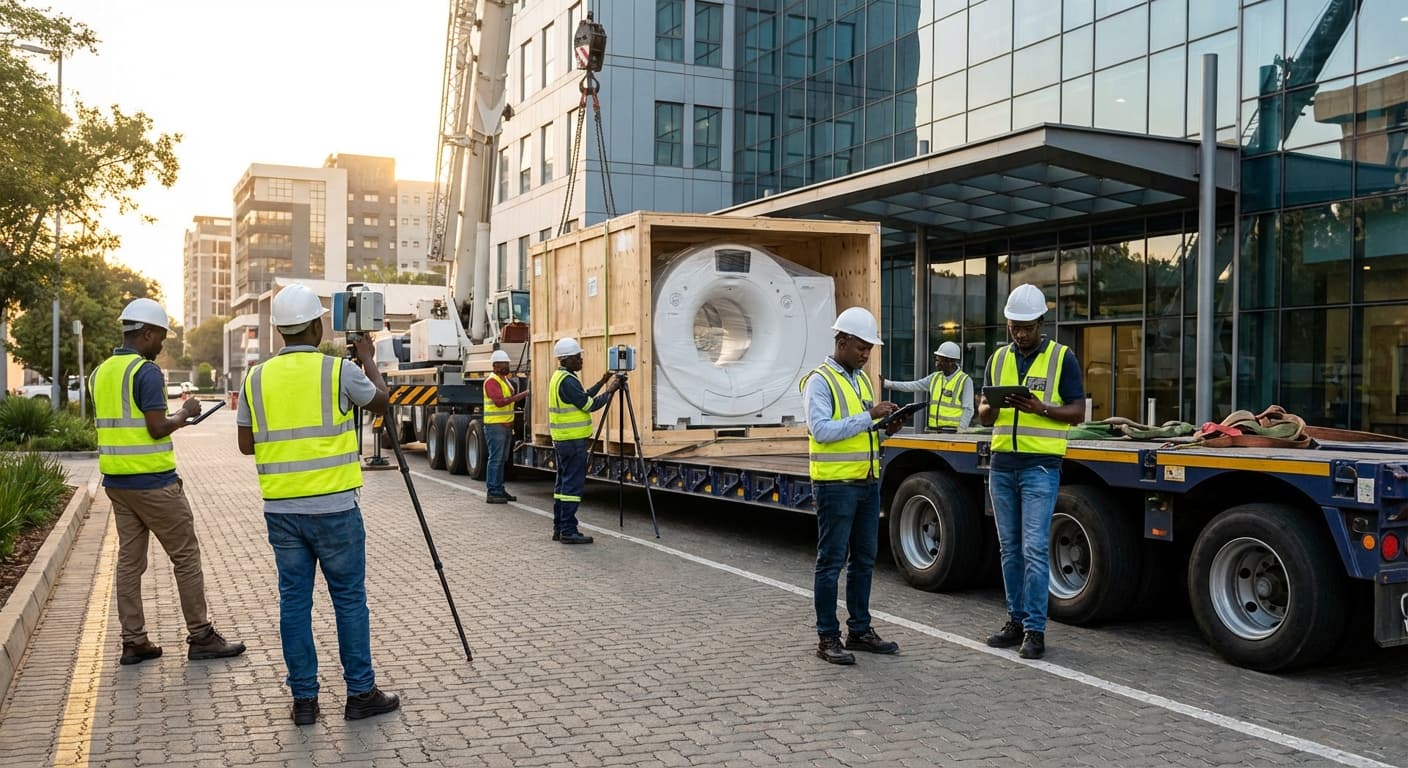
Route Survey & Rigging Plan Service for Heavy Medical Equipment in Burkina Faso
Engineering Excellence & Technical Support
Route Survey & Rigging Plan Service for Heavy Medical Equipment High-standard technical execution following OEM protocols and local regulatory frameworks.
Precision Route Planning & Clearance
Leveraging advanced GIS and surveying tools, we meticulously map optimal routes for heavy medical equipment transport across Burkina Faso's diverse terrain, ensuring critical clearances for bridges, tunnels, and urban infrastructure.
Specialized Rigging & Securing
Our certified rigging experts design and execute tailored plans for the secure lifting, lashing, and stabilization of sensitive medical equipment, mitigating risks of vibration, impact, and environmental exposure during transit and placement.
On-Site Technical Consultation & Support
We provide real-time, on-site technical consultation throughout the survey and rigging process, offering expert guidance to local teams, troubleshooting challenges, and ensuring adherence to international safety standards for successful medical equipment deployment.
What Is Route Survey & Rigging Plan Service For Heavy Medical Equipment In Burkina Faso?
Route Survey & Rigging Plan Service for Heavy Medical Equipment in Burkina Faso refers to a specialized engineering and logistical process designed to safely and efficiently transport, install, and commission large, complex, and often sensitive medical apparatus (e.g., MRI machines, CT scanners, linear accelerators) within the specific geographical and infrastructural context of Burkina Faso. This service encompasses detailed planning, assessment, and execution to overcome potential challenges such as inadequate road infrastructure, limited lifting capacity, environmental factors, and specific site constraints within healthcare facilities. The primary objective is to mitigate risks associated with damage to the equipment, personnel injury, project delays, and cost overruns during the entire lifecycle of the equipment's deployment.
| Who Needs the Service | Typical Use Cases in Burkina Faso | Key Considerations for Burkina Faso | ||||||||||||||
|---|---|---|---|---|---|---|---|---|---|---|---|---|---|---|---|---|
| Healthcare Institutions: Public and private hospitals, specialized clinics, and diagnostic centers acquiring new heavy medical equipment or relocating existing installations. | Procurement Agencies/NGOs: Organizations involved in the donation or procurement of advanced medical technology for public health initiatives and infrastructure development in Burkina Faso. | Medical Equipment Manufacturers/Distributors: Companies responsible for delivering and installing their products, often subcontracting these specialized services. | Government Health Ministries: Entities overseeing national healthcare infrastructure and planning for the deployment of critical medical assets. | Construction & Engineering Firms: Involved in the design and construction of healthcare facilities, requiring integration of heavy equipment installation plans. | Deployment of MRI, CT Scanners, Linear Accelerators: Bringing advanced diagnostic imaging and radiotherapy equipment into facilities where transport and installation pathways may be challenging. | Installation of large-scale laboratory equipment: Such as high-capacity centrifuges, gene sequencers, or specialized analytical instruments. | Relocation of existing heavy medical equipment: Due to facility upgrades, renovations, or consolidation of services. | Setting up new diagnostic centers or hospital wings: Requiring the integration of complex and heavy medical machinery. | Response to health emergencies: Requiring rapid deployment of specialized medical equipment in potentially underserved or remote areas. | Limited road infrastructure quality and load-bearing capacities of bridges and roads. | Potential for extreme weather conditions (e.g., rainy season impacting ground stability and transport). | Availability and certification of specialized lifting equipment and trained personnel. | Customs clearance procedures and import regulations for heavy machinery. | Need for robust security protocols during transit and installation. | Understanding of local site access limitations and building structural capacities. | Importance of cultural sensitivity and local stakeholder engagement. |
Key Components of Route Survey & Rigging Plan Service:
- Route Feasibility Study: Involves detailed analysis of potential transportation routes from port of entry/origin to the final destination. This includes assessing road conditions (pavement, width, load limits, gradients, bridge capacities, overhead clearances), identifying necessary permits, and determining potential detours or temporary infrastructure modifications required.
- Site Survey and Assessment: Comprehensive evaluation of the installation site within the healthcare facility. This includes analyzing building access points, internal pathways, floor loading capacities, ceiling heights, spatial constraints, and existing infrastructure (e.g., power, HVAC, radiation shielding requirements).
- Rigging and Lifting Plan Development: Engineering design of the lifting and handling operations. This includes selecting appropriate lifting equipment (cranes, jacks, dollies), calculating required capacities, defining rigging configurations, outlining precise lifting points on the equipment, and detailing safe operating procedures for personnel.
- Transportation Plan: Specifies the mode of transport (e.g., specialized trailers, air freight), packaging requirements, securing methods, and transit time estimations. It also addresses potential en-route stops and associated security measures.
- Risk Assessment and Mitigation: Identification of potential hazards throughout the entire process (e.g., weather, security, equipment failure, human error) and the development of proactive strategies to minimize or eliminate these risks.
- Permitting and Regulatory Compliance: Navigating local regulations and obtaining necessary permits for oversized loads, road closures, and specialized equipment operations within Burkina Faso.
- On-site Supervision and Execution: Providing expert personnel to oversee and direct the rigging, lifting, and positioning of the equipment at the installation site, ensuring adherence to the developed plans and safety protocols.
- Decommissioning and Relocation Planning (Optional): Services can also extend to planning for future decommissioning or relocation of heavy medical equipment.
Who Needs Route Survey & Rigging Plan Service For Heavy Medical Equipment In Burkina Faso?
When transporting and installing heavy, sensitive medical equipment in Burkina Faso, the specialized services of Route Survey & Rigging Plan are not just a luxury, but a critical necessity. These services ensure the safe, efficient, and compliant movement and positioning of vital medical technology, minimizing risks to both the equipment and the personnel involved. This is particularly true for facilities operating with limited infrastructure or in remote areas where standard logistics might prove inadequate. The need arises for any organization or department responsible for acquiring, deploying, or maintaining high-value, bulky, and often delicate medical machinery.
| Target Customer Group | Key Departments / Roles Involved |
|---|---|
| Hospitals and Healthcare Facilities | Procurement Department, Facilities Management, Biomedical Engineering, Clinical Departments (e.g., Radiology, Surgery, Oncology) |
| Government Health Ministries & Agencies | Procurement Unit, Project Management Office, Logistics Department, Infrastructure Planning |
| Non-Governmental Organizations (NGOs) & Humanitarian Organizations | Logistics Manager, Operations Director, Program Manager, Procurement Officer |
| International Development Agencies | Project Manager, Procurement Specialist, Technical Advisor (Healthcare) |
| Medical Equipment Manufacturers & Suppliers | Installation Team, Project Manager, Sales Engineer, Logistics Coordinator |
| Construction and Infrastructure Companies | Project Manager, Site Supervisor, Logistics Coordinator |
| Logistics and Freight Forwarding Companies | Oversized Cargo Specialist, Project Logistics Manager, Operations Manager |
Target Customers & Departments Requiring Route Survey & Rigging Plan Service for Heavy Medical Equipment in Burkina Faso
- Hospitals and Healthcare Facilities: Both public and private hospitals, from large university medical centers to smaller rural clinics, often receive substantial medical equipment that requires expert planning for its arrival and placement.
- Government Health Ministries & Agencies: National and regional health authorities procuring equipment for public health programs, infrastructure development projects, or emergency response stockpiles.
- Non-Governmental Organizations (NGOs) & Humanitarian Organizations: Groups involved in providing healthcare services, disaster relief, or medical aid in Burkina Faso will frequently be involved with importing and setting up heavy medical equipment in various settings.
- International Development Agencies: Organizations funding or managing healthcare projects in Burkina Faso that include the provision of sophisticated medical machinery.
- Medical Equipment Manufacturers & Suppliers: Companies that sell and install heavy medical equipment will often outsource or recommend these services to ensure successful delivery and setup for their clients.
- Construction and Infrastructure Companies: Firms involved in building or renovating healthcare facilities that are part of the medical equipment installation process.
- Logistics and Freight Forwarding Companies: Companies specializing in the transportation of oversized and heavy cargo, particularly those handling medical equipment imports.
Route Survey & Rigging Plan Service For Heavy Medical Equipment Process In Burkina Faso
This document outlines the comprehensive workflow for our Route Survey & Rigging Plan Service, specifically tailored for the intricate process of transporting and installing heavy medical equipment in Burkina Faso. Our service ensures the safe, efficient, and compliant movement of sensitive and oversized medical machinery from point of origin to its final operational location, navigating the unique logistical challenges of the region. The workflow is designed to be transparent, systematic, and collaborative, involving meticulous planning, on-site execution, and final handover.
| Stage | Description | Key Activities | Deliverables | Key Stakeholders |
|---|---|---|---|---|
| The client initiates contact to discuss their specific project requirements for heavy medical equipment transport and installation in Burkina Faso. | Receive client request, understand equipment details (type, weight, dimensions), destination, and timeline. Conduct preliminary discussion to gauge feasibility and scope. | Initial understanding of project requirements. | Client, Service Provider Sales/Project Manager |
| Based on the initial consultation, we define the precise scope of services and provide a detailed proposal. | Analyze equipment specifications, identify potential route constraints, estimate resources needed (personnel, equipment, time), develop a comprehensive service proposal outlining scope, methodology, timeline, and cost. | Detailed Service Proposal, Cost Estimate. | Client, Service Provider Project Manager/Estimator |
| Gather detailed information about the equipment, the origin, and the final installation site. | On-site inspection of origin point (e.g., port, warehouse), final installation location (e.g., hospital room). Document existing infrastructure, access points, floor load capacities, ceiling heights, power availability, and any site-specific challenges. | Site Assessment Report, Photos, Videos, Technical Drawings of Installation Area. | Service Provider Survey Team, Client Representative |
| Conduct a thorough survey of the proposed transportation route to identify and mitigate potential hazards. | Map and inspect the entire route from origin to destination. Identify road conditions, bridge clearances, weight limits, turning radii, traffic patterns, potential obstructions (e.g., overhead wires, narrow streets), and local regulations. Document findings with GPS coordinates and photographic evidence. | Route Survey Report, Maps with Critical Points Marked, Obstruction Inventory, Risk Assessment for Route. | Service Provider Survey Team, Local Authorities (if required) |
| Create a detailed, step-by-step plan for the safe lifting, maneuvering, and installation of the medical equipment. | Develop technical drawings and procedures for rigging operations, specifying lifting equipment (cranes, hoists), slings, shackles, and other necessary gear. Plan for jacking, skidding, or other movement techniques. Include detailed safety protocols, emergency procedures, and personnel roles. Coordinate with equipment manufacturers for specific handling instructions. | Comprehensive Rigging Plan, Technical Drawings, Lift Plans, Safety Procedures. | Service Provider Rigging Engineers, Equipment Manufacturer Representatives |
| Obtain all necessary permits and approvals from relevant authorities in Burkina Faso. | Submit permit applications for oversized loads, road closures, and any other required authorizations. Liaise with local government agencies, transportation departments, and law enforcement to ensure compliance and facilitate smooth transit. | Approved Permits and Licenses, Official Correspondence with Authorities. | Service Provider Logistics Coordinator, Local Authorities |
| Prepare all personnel and resources for the execution phase. | Conduct detailed pre-mobilization briefings with all involved teams (surveyors, riggers, drivers, security). Confirm availability and readiness of all specialized equipment, vehicles, and personnel. Finalize logistical arrangements for accommodation, food, and transport of personnel. | Mobilization Plan, Personnel Roster, Equipment Checklist. | Service Provider Project Manager, Team Leaders |
| Implement the approved route survey and rigging plans to transport and install the medical equipment. | Oversee the loading, transportation, and unloading of the medical equipment according to the rigging plan. Execute lifting, positioning, and final installation. Ensure all safety procedures are strictly followed. Monitor progress and manage any unforeseen issues. | Successful Transportation and Installation of Equipment, Real-time Progress Updates. | Service Provider Execution Team, Client Representative, Local Support Staff |
| Complete all final checks and formally hand over the installed equipment. | Conduct final inspections of the installed equipment and the site. Ensure all debris is cleared and the area is returned to its original state (or as agreed). Provide a formal handover to the client, confirming successful completion of services. | Handover Certificate, Site Clearance Report, Final Project Report. | Service Provider Project Manager, Client Representative |
| Gather feedback and archive all project-related documentation. | Request client feedback on the service provided. Compile all project documentation, including survey reports, rigging plans, permits, incident reports (if any), and final handover documents for archival and future reference. | Client Feedback Forms, Comprehensive Project Archive. | Service Provider Project Manager, Client |
Workflow Stages: Route Survey & Rigging Plan Service
- Inquiry & Initial Consultation
- Scope Definition & Proposal
- Site Assessment & Data Collection
- Route Survey & Analysis
- Rigging Plan Development
- Permitting & Approvals
- Pre-Operational Briefing & Resource Mobilization
- Execution: Transportation & Rigging
- Post-Execution & Handover
- Client Feedback & Documentation
Route Survey & Rigging Plan Service For Heavy Medical Equipment Cost In Burkina Faso
Estimating the cost for Route Survey & Rigging Plan Services for heavy medical equipment in Burkina Faso involves several key pricing factors. These services are crucial for ensuring the safe and efficient transportation and installation of specialized, often oversized and delicate, medical machinery. The complexity of the route, the weight and dimensions of the equipment, the accessibility of the delivery location, and the level of detail required in the plan all significantly influence the final price. Local economic conditions, the availability of specialized rigging expertise, and the need for permits or specific safety equipment also play a role. The services typically include on-site assessments, detailed route mapping, identification of potential obstacles (e.g., bridges, power lines, narrow streets), analysis of ground conditions, development of lifting and securing strategies, and the creation of comprehensive rigging plans with necessary documentation. Costs can vary widely depending on the project's scale and specific requirements.
| Service Component | Estimated Cost Range (XOF) | Notes |
|---|---|---|
| Initial Route Assessment & Reconnaissance | 150,000 - 500,000 | Basic site visit, preliminary route evaluation. |
| Detailed Route Survey (Mapping & Obstacle Identification) | 400,000 - 1,500,000 | Includes GPS mapping, photography, and detailed obstacle reporting for complex routes. |
| Load Analysis & Rigging Feasibility Study | 300,000 - 1,000,000 | Assessing lifting points, stability, and required equipment for the specific medical device. |
| Development of Comprehensive Rigging Plan (Drawings & Procedures) | 600,000 - 3,000,000+ | Highly dependent on equipment complexity and site specifics. Includes detailed lifting plans, equipment selection, and safety protocols. |
| Permit Application & Facilitation Fees | 100,000 - 500,000 | Variable based on local authority requirements and number of permits needed. |
| Project Management & Coordination | 200,000 - 1,000,000 | Oversight of the survey and planning process. |
| Contingency Planning & Risk Assessment | 150,000 - 600,000 | Developing backup plans for unforeseen issues. |
| Total Estimated Range (Per Project - Small to Medium Scale) | 1,900,000 - 8,100,000+ XOF | This is a broad estimate. Large, highly complex projects could exceed this significantly. |
Key Pricing Factors for Route Survey & Rigging Plan Services in Burkina Faso
- Equipment Specifications: Weight, dimensions, fragility, and center of gravity of the medical equipment.
- Route Complexity: Distance, terrain (urban, rural, mountainous), road conditions, and presence of overhead obstructions or tight turns.
- Site Accessibility: Ease of access to the installation site, including building entry points, internal pathways, and potential for specialized vehicle maneuvering.
- Required Rigging Expertise: Need for specialized lifting equipment (cranes, jacks), experienced rigging crews, and specialized engineers.
- Survey Scope: Depth of analysis required, including detailed topographical surveys, structural assessments of temporary supports, or environmental impact studies.
- Permits and Approvals: Costs associated with obtaining necessary permits for transport, road closures, or special access.
- Insurance and Risk Management: Premiums for specialized insurance covering the transport and rigging of high-value medical equipment.
- Time Constraints: Urgency of the project, requiring overtime or expedited survey and planning.
- Geographical Location within Burkina Faso: Costs may vary between major cities (e.g., Ouagadougou) and more remote areas due to logistics and availability of resources.
- Detailed Documentation Requirements: Level of detail in the final rigging plan, including CAD drawings, risk assessments, and contingency plans.
Affordable Route Survey & Rigging Plan Service For Heavy Medical Equipment Options
Navigating the logistics of heavy medical equipment transport requires specialized expertise. Our Affordable Route Survey & Rigging Plan Service provides comprehensive solutions designed to ensure the safe and efficient relocation of your valuable assets. We understand that budget is a critical factor, and our service is structured to offer maximum value through transparent pricing, flexible bundling options, and strategic cost-saving initiatives.
| Value Bundle Name | Description | Includes | Cost-Saving Strategy |
|---|---|---|---|
| Essential Move Package | Our most budget-friendly option for straightforward equipment moves. | Basic Route Survey (primary route), Standard Rigging Plan, Risk Assessment (standard), On-site Supervision (key phases) | Ideal for well-defined routes and equipment with standard rigging requirements. Focuses on core safety and planning needs. |
| Comprehensive Logistics Bundle | A balanced solution offering thorough planning for complex relocations. | Detailed Route Survey (multiple options), Advanced Rigging Plan, Comprehensive Risk Assessment & Mitigation, Full On-site Supervision | Bundles multiple services at a reduced per-item cost compared to individual bookings. Ensures all potential complexities are addressed upfront, preventing costly delays or unforeseen issues. |
| Premium Project Management | Our all-encompassing service for high-stakes or exceptionally large-scale projects. | In-depth Route Survey (including alternative options & stakeholder consultation), Bespoke Rigging Plan (customized for unique equipment), Proactive Risk Management (ongoing), Dedicated Project Manager & Full On-site Support | Offers integrated project oversight, streamlining communication and coordination. Proactive problem-solving minimizes disruptions and emergency response costs. Bulk service discount applied. |
| Customized Solutions | Tailored packages to meet specific project needs and budget constraints. | Flexible inclusions based on client requirements. | Allows clients to pick and choose services, paying only for what is needed. Ideal for clients with existing internal expertise or partial project requirements. |
Key Components of Our Service
- Comprehensive Route Survey: Detailed analysis of transport routes, including road suitability, bridge clearances, turning radii, and potential obstructions. Includes identification of any necessary permits or road modifications.
- Detailed Rigging Plan: Precise methodologies for lifting, securing, and maneuvering heavy medical equipment. This covers equipment specifications, lifting points, rigging gear selection, and safe load handling procedures.
- Risk Assessment & Mitigation: Proactive identification of potential hazards and development of strategies to minimize risks throughout the transport and installation process.
- On-site Supervision & Coordination: Expert oversight during the critical rigging and placement phases, ensuring adherence to the plan and seamless coordination with all involved parties.
- Documentation & Reporting: Provision of all necessary documentation, including survey reports, rigging plans, and safety checklists.
Verified Providers In Burkina Faso
Ensuring access to reliable and trustworthy healthcare is paramount in Burkina Faso. Franance Health stands out as a leading organization dedicated to verifying healthcare providers, offering a crucial layer of assurance for patients seeking quality medical services. Their rigorous credentialing process and commitment to ethical practices make them the best choice for identifying qualified and dependable healthcare professionals across the nation.
| Provider Type | Franance Health Verification Benefits | Why This Matters for Patients in Burkina Faso |
|---|---|---|
| Doctors (General Practitioners & Specialists) | Confirms medical education, licensing, and specialized training. Ensures adherence to best medical practices. | Patients can be confident they are receiving care from a legitimately qualified and competent medical professional, reducing risks associated with unqualified practitioners. |
| Nurses and Midwives | Validates nursing and midwifery certifications, practical experience, and adherence to patient care protocols. | Essential for ensuring safe and effective nursing care, crucial during childbirth and for chronic illness management. |
| Pharmacists and Pharmacies | Verifies pharmaceutical licenses, drug sourcing integrity, and dispensing accuracy. | Guarantees access to authentic medications and responsible pharmaceutical advice, preventing the circulation of counterfeit or substandard drugs. |
| Clinics and Hospitals | Assesses infrastructure, equipment, staffing qualifications, hygiene standards, and patient safety measures. | Provides assurance of a safe, well-equipped, and properly staffed healthcare facility, leading to better treatment outcomes and a more positive patient experience. |
| Diagnostic Laboratories | Confirms technical expertise, accuracy of testing equipment, and quality control procedures. | Ensures reliable and accurate diagnostic results, which are fundamental for correct diagnosis and effective treatment planning. |
Key Aspects of Franance Health's Verification Process:
- Comprehensive Background Checks: Franance Health conducts thorough investigations into the educational qualifications, professional licenses, and work history of all providers seeking their endorsement.
- Peer Review and Reputation Assessment: They engage in a robust peer review system and actively assess the professional reputation of providers within their communities.
- Adherence to Ethical Standards: A core component of their verification is ensuring that providers uphold the highest ethical standards in their practice and patient interactions.
- Continuous Monitoring and Re-verification: Franance Health doesn't stop at initial verification. They maintain ongoing monitoring and periodic re-verification to ensure continued compliance and excellence.
- Patient Feedback Integration: They actively solicit and incorporate patient feedback as a valuable metric in their assessment of provider quality.
Scope Of Work For Route Survey & Rigging Plan Service For Heavy Medical Equipment
This Scope of Work (SOW) outlines the services required for conducting detailed route surveys and developing comprehensive rigging plans for the safe and efficient transportation of heavy medical equipment. The objective is to identify all potential challenges, constraints, and requirements along the designated transport routes and to create precise rigging methodologies to ensure the integrity of the equipment and the safety of personnel and property during loading, transit, and unloading operations.
| Task Area | Description of Services | Technical Deliverables | Standard Specifications / Considerations |
|---|---|---|---|
| Route Survey | Conducting physical and desktop surveys of all proposed transportation routes from origin to final destination. This includes assessing road conditions, bridge capacities, overhead clearances, turning radii, gradient, and any temporary or permanent obstructions. Identification of alternative routes and contingency plans. | Detailed route survey report including maps, photographs, video evidence, GPS coordinates, and a comprehensive list of identified route constraints and recommendations. Digital elevation models and 3D route visualization where applicable. | Governing standards: Local/National road regulations, bridge load rating standards (e.g., AASHTO LRFD), vertical and horizontal clearance guidelines for oversized loads. Consideration of local traffic patterns and potential road closures. Environmental impact assessment for route selection. |
| Obstruction Analysis & Mitigation | Detailed identification and assessment of all potential obstructions along the chosen routes. This includes traffic signals, power lines, signage, building overhangs, narrow passages, and other infrastructure. Development of mitigation strategies such as temporary removal, modification, or traffic management plans. | Obstruction inventory with precise measurements and photographic evidence. Proposed mitigation strategies for each identified obstruction, including cost and timeline estimates. Permits and approvals required for mitigation actions. | Compliance with utility company regulations, municipal bylaws, and traffic management protocols. Minimum required clearances as per local transportation authorities and equipment dimensions. Fall protection and working at height standards for any required overhead work. |
| Equipment Weight & Dimension Verification | Confirming the exact weight, dimensions (including height, width, and length), and center of gravity of each piece of medical equipment to be transported. This may involve on-site verification if manufacturer data is unavailable or outdated. | Equipment specification sheets with verified weight and dimensional data. Certification of weight and dimension verification where applicable. | Manufacturer's technical documentation, load charts, and any specific handling instructions. Calibrated measuring equipment. ISO standards for dimensional measurement. |
| Rigging Plan Development | Designing detailed rigging plans for lifting and securing each piece of heavy medical equipment. This includes specifying lifting points, rigging gear (slings, shackles, spreader bars, etc.), lifting devices (cranes, hydraulic jacks, etc.), load distribution, and movement sequences. | Comprehensive rigging plan for each equipment item, including 3D lifting simulations or detailed engineering drawings. Equipment load charts, rigging capacity calculations, and method statements for all lifting operations. Detailed safety procedures and emergency response plans. | Industry best practices for heavy lifting (e.g., ASME B30 series, LOLER regulations). Manufacturer's recommended lifting points and procedures. Load calculation software and engineering principles. Crane load charts and operational limits. Risk assessment methodologies (e.g., HAZOP, FMEA). |
| Transportation Plan | Developing a detailed transportation plan that integrates the route survey and rigging plan. This includes outlining the transport vehicle selection, loading and unloading procedures, escort requirements, traffic control measures, and scheduling. | Integrated transportation plan document encompassing route, rigging, logistics, and safety. Detailed equipment transport checklists and pre-departure/arrival inspection forms. | Relevant transportation regulations for oversized and overweight loads. Manufacturer's transport recommendations. Traffic management plans compliant with local authorities. Chain of custody and security protocols for high-value equipment. |
| Permitting & Approvals | Identifying and assisting in obtaining all necessary permits and approvals from relevant authorities, utility companies, and stakeholders for route access, road closures, modifications, and lifting operations. | List of all required permits and applications submitted. Copies of all obtained permits and approvals. | Local, regional, and national permitting requirements. Timelines for permit acquisition and validity periods. Communication protocols with regulatory bodies. |
| Site Inspection & Handover | Conducting pre-operation site inspections at both origin and destination to confirm readiness and compliance with plans. Post-operation site inspection to ensure no damage to property and a safe environment. | Pre- and post-operation site inspection reports with photographic evidence. Sign-off forms indicating successful completion and handover. | Site safety protocols, hazard identification and control measures. Waste management and site cleanup procedures. Handover checklists. |
Key Objectives
- To accurately assess and document all feasible transport routes, identifying potential obstructions, load limits, and necessary modifications.
- To develop detailed rigging plans specifying lifting points, equipment, procedures, and safety protocols for each piece of heavy medical equipment.
- To ensure compliance with all relevant safety regulations, industry best practices, and manufacturer specifications.
- To minimize risks associated with the transportation and installation of sensitive and high-value medical equipment.
- To provide comprehensive technical documentation for client review and approval.
Service Level Agreement For Route Survey & Rigging Plan Service For Heavy Medical Equipment
This Service Level Agreement (SLA) outlines the response times and uptime guarantees for the Route Survey & Rigging Plan Service for Heavy Medical Equipment provided by [Your Company Name]. This service ensures that clients receive timely and accurate route survey and rigging plan documentation to facilitate the safe and efficient transportation and installation of heavy medical equipment.
| Service Component | Response Time (Business Hours) | Uptime Guarantee |
|---|---|---|
| Initial acknowledgement of request | 1 Business Hour | N/A |
| Provision of preliminary route survey findings (if applicable) | 4 Business Hours | N/A |
| Delivery of final Route Survey Report | 3 Business Days | N/A |
| Delivery of preliminary Rigging Plan | 2 Business Days (after receipt of final route survey) | N/A |
| Delivery of final Rigging Plan | 2 Business Days (after approval of preliminary plan) | N/A |
| Availability of support personnel for queries | 8 Business Hours | 99.5% |
| Availability of online portal/system for document access (if applicable) | N/A | 99.9% |
Scope of Service
- Route Survey: Comprehensive assessment of transportation routes, including road conditions, bridge clearances, turning radii, and potential obstructions for heavy medical equipment.
- Rigging Plan Development: Detailed plans outlining the procedures, equipment, and personnel required for the safe lifting, moving, and positioning of heavy medical equipment at the installation site.
- Documentation Provision: Timely delivery of all survey data, reports, and rigging plan documents in the agreed-upon format.
- Consultation: Expert advice and clarification regarding the survey and rigging plan.
Frequently Asked Questions

Ready when you are
Let's scope your Route Survey & Rigging Plan Service for Heavy Medical Equipment in Burkina Faso project in Burkina Faso.

Scaling healthcare logistics and technical systems across the entire continent.