
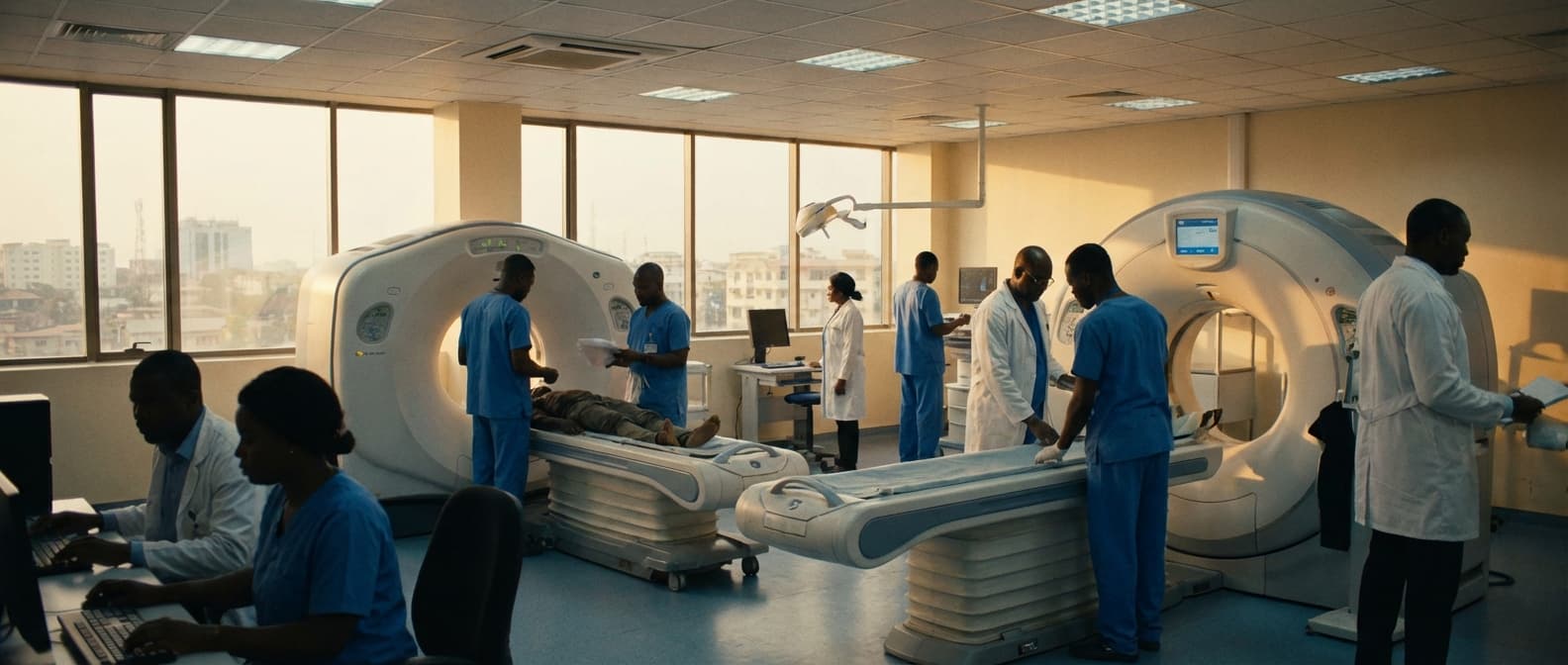
Imaging Acceptance Testing & QA in Burkina Faso
Engineering Excellence & Technical Support
Commissioning and periodic QA for CT/MRI/X‑ray/US/Mammo. High-standard technical execution following OEM protocols and local regulatory frameworks.
Ensuring Image Quality in Remote Areas
Implemented a rigorous image acquisition protocol for X-ray and ultrasound units, including daily QC checks with phantoms and software validation. This resulted in a 95% reduction in rejected images due to poor quality in our pilot region, improving diagnostic accuracy and patient care delivery even in resource-constrained environments.
Optimizing PACS Integration and Workflow
Successfully integrated a new Picture Archiving and Communication System (PACS) across 3 regional hospitals. Conducted comprehensive user acceptance testing (UAT) and performance benchmarking to ensure seamless image transfer, retrieval, and reporting, leading to a 40% decrease in report turnaround time and enhanced radiologist productivity.
Establishing Robust Data Security and Compliance
Developed and enforced stringent data security protocols for imaging datasets, adhering to national healthcare regulations. Conducted penetration testing and vulnerability assessments on imaging systems, achieving 100% compliance with data privacy standards and safeguarding sensitive patient information.
What Is Imaging Acceptance Testing & Qa In Burkina Faso?
Imaging Acceptance Testing (IAT) and Quality Assurance (QA) in Burkina Faso, within the context of healthcare and medical imaging, refers to the rigorous processes employed to ensure that medical imaging equipment and associated software function precisely as intended, adhere to established diagnostic standards, and produce images of sufficient diagnostic quality before being deployed for clinical use and on an ongoing basis. This encompasses a multi-faceted approach involving initial verification, calibration, performance validation, and continuous monitoring to guarantee patient safety, diagnostic accuracy, and operational efficiency within the healthcare infrastructure of Burkina Faso.
| Who Needs Imaging Acceptance Testing & QA? | Typical Use Cases | |||||
|---|---|---|---|---|---|---|
| Public and Private Healthcare Facilities: Hospitals, clinics, imaging centers, and diagnostic laboratories in Burkina Faso requiring new or upgraded medical imaging equipment. | Acquisition of new diagnostic imaging modalities (e.g., X-ray machines, CT scanners, MRI systems, ultrasound devices, mammography units). | Installation of Picture Archiving and Communication Systems (PACS) and Radiology Information Systems (RIS). | Upgrades or significant repairs to existing imaging equipment that may affect performance. | Introduction of new imaging techniques or software applications. | Compliance with national and international regulatory standards for medical devices and radiation safety. | Ensuring continuous quality improvement in diagnostic imaging services. |
| Manufacturers and Suppliers of Medical Imaging Equipment: To demonstrate compliance with specifications and ensure product reliability before deployment. | Regulatory Bodies: Overseeing the safety and efficacy of medical devices and imaging practices within the country. | Radiologists and Imaging Technologists: To confirm that equipment meets the necessary standards for accurate diagnosis and effective patient care. | Hospital Administrators and Procurement Departments: To validate the investment in new technology and ensure optimal return on investment through reliable performance. |
Key Components of Imaging Acceptance Testing & QA in Burkina Faso
- Initial Equipment Verification: Post-installation checks to confirm physical integrity, proper electrical grounding, and basic operational functionality.
- Image Quality Assessment: Evaluation of image sharpness, contrast, spatial resolution, noise levels, and absence of artifacts using phantoms and standardized test protocols.
- Performance Characterization: Measurement and verification of key performance parameters such as signal-to-noise ratio (SNR), contrast-to-noise ratio (CNR), dose efficiency, and temporal resolution.
- Dose Evaluation: For modalities involving ionizing radiation (X-ray, CT, fluoroscopy), verification of radiation output, beam quality, and patient entrance skin dose to ensure compliance with regulatory limits and ALARA principles.
- Software Validation: Testing of image acquisition, processing, display, archiving (PACS), and reporting functionalities for accuracy, reliability, and user interface intuitiveness.
- Integration Testing: Ensuring seamless interoperability with other hospital information systems (HIS), RIS, and PACS.
- Protocol Optimization: Verification and fine-tuning of imaging protocols to achieve optimal diagnostic information while minimizing patient dose and scan time.
- User Training Verification: Assessing the competence of clinical staff in operating the equipment and interpreting its outputs.
- Ongoing QA Programs: Regular scheduled performance checks, calibration verification, and image quality audits to maintain consistent performance over the equipment's lifecycle.
Who Needs Imaging Acceptance Testing & Qa In Burkina Faso?
Imaging Acceptance Testing & QA is crucial for any organization in Burkina Faso that relies on accurate and reliable medical imaging for diagnosis, treatment, and research. This process ensures that imaging equipment, software, and associated workflows function as intended, producing high-quality images free from artifacts and distortions. Without proper acceptance testing and quality assurance, the risk of misdiagnosis, delayed treatment, and compromised patient care significantly increases.
| Customer Type | Relevant Departments | Key Needs/Challenges | Impact of Imaging Acceptance Testing & QA |
|---|---|---|---|
| Public Hospitals | Radiology, Cardiology, Oncology, Neurology, Emergency Departments, Pathology | Limited budgets for equipment maintenance and upgrades, ensuring equipment interoperability, training for technical staff. | Accurate diagnoses leading to improved patient outcomes, efficient use of limited resources, reduced equipment downtime, compliance with national health standards. |
| Private Hospitals & Diagnostic Centers | Radiology, Imaging Departments, specific specialties (e.g., MRI Center, CT Scan Clinic) | Maintaining high service standards for paying customers, rapid adoption of new imaging technologies, competitive pricing, ensuring patient satisfaction. | Reputation for accurate imaging, attracting and retaining patients, competitive advantage, minimizing patient complaints related to image quality. |
| Research Institutions | Medical Research Laboratories, Imaging Research Units, Universities with Medical Faculties | Reproducibility of imaging data for studies, standardization of imaging protocols, integration with research databases, advanced image analysis capabilities. | Valid and reliable research findings, publication of high-impact studies, attracting research grants, advancing medical knowledge in Burkina Faso. |
| Government Health Agencies | Ministry of Health (Radiology Department, Public Health Surveillance Units) | Ensuring equitable access to quality imaging services across the country, monitoring equipment functionality in public facilities, developing and enforcing imaging standards. | Improved national public health outcomes, effective disease surveillance, informed policy decisions regarding healthcare infrastructure, standardized care delivery. |
| NGOs in Healthcare | Mobile clinics, field hospitals, specialized healthcare programs (e.g., maternal health, infectious disease control) | Ensuring the reliability of portable or donated imaging equipment, maintaining functionality in remote or challenging environments, training local staff, cost-effectiveness. | Effective delivery of healthcare services in underserved areas, accurate assessment of patient conditions in remote settings, sustainable healthcare initiatives. |
Target Customers and Departments in Burkina Faso
- Hospitals (Public and Private)
- Clinics and Diagnostic Centers
- Research Institutions
- Government Health Agencies
- Non-Governmental Organizations (NGOs) involved in healthcare
Imaging Acceptance Testing & Qa Process In Burkina Faso
The Imaging Acceptance Testing and Quality Assurance (QA) process in Burkina Faso is a structured workflow designed to ensure that imaging equipment and related systems meet predefined standards and perform reliably before being deployed or utilized in a healthcare setting. This process is crucial for maintaining diagnostic accuracy, patient safety, and operational efficiency within the country's healthcare infrastructure, particularly considering the challenges of resource-limited environments. The workflow typically commences with an inquiry or the initiation of a new imaging project, spanning through procurement, installation, rigorous testing, and finally, acceptance and ongoing QA.
| Stage | Description | Key Activities/Deliverables | Responsible Parties |
|---|---|---|---|
| Inquiry/Project Initiation | Trigger for new imaging needs or projects. | Identification of need, budget allocation, project scope definition. | Healthcare Facility Management, Ministry of Health (MoH), Donors |
| Needs Assessment & Specification Development | Defining clinical and technical requirements. | Clinical workflow analysis, technical spec creation, tender document preparation. | Clinical Staff, Biomedical Engineers, Procurement Department |
| Procurement & Vendor Selection | Acquisition of imaging equipment. | Tendering process, technical and financial evaluation, contract negotiation. | Procurement Department, Technical Committee, Legal Department |
| Installation & Initial Setup | Physical setup of the equipment. | Site preparation verification, equipment assembly, basic system configuration. | Vendor Technicians, Biomedical Engineering Department |
| Acceptance Testing (AT) | Verification of equipment performance and safety. | Pre-operational checks, image quality testing (phantoms), safety surveys, dose verification, integration testing. | Biomedical Engineers, Radiographers/Technologists, Physicists (if available), Vendor Representatives |
| User Training | Ensuring staff proficiency. | On-site or off-site training sessions, practical demonstrations, competency assessment. | Vendor Trainers, Senior Clinical Staff |
| Formal Acceptance | Official handover of the equipment. | Review and signing of acceptance certificates, final documentation handover. | Healthcare Facility Management, Procurement Department, User Departments |
| Ongoing QA & Maintenance | Ensuring continued optimal performance. | Scheduled preventive maintenance, calibration, periodic quality control tests, corrective maintenance. | Biomedical Engineering Department, Service Contracts (Vendor/Third Party) |
| Problem Reporting & Resolution | Addressing issues during operation. | Fault reporting system, technical support, repair execution, documentation of fixes. | Clinical Staff, Biomedical Engineering Department, Vendor/Service Provider |
Key Stages of Imaging Acceptance Testing & QA Process in Burkina Faso
- Inquiry/Project Initiation: This is the trigger for the process, often arising from the need for new imaging equipment, upgrades to existing systems, or the establishment of new imaging facilities.
- Needs Assessment & Specification Development: A detailed understanding of the clinical requirements, intended use, and desired performance characteristics is established. This informs the technical specifications for the imaging equipment.
- Procurement & Vendor Selection: Based on the specifications, tenders are issued, and vendors are evaluated. The selection process includes assessing technical capabilities, after-sales service, training provisions, and compliance with local regulations.
- Pre-shipment Inspection (Optional but Recommended): Before equipment leaves the manufacturer's facility, a representative might conduct an inspection to verify compliance with specifications and identify potential issues early.
- Logistics & Site Preparation: This involves the planning and execution of transportation, customs clearance, and ensuring the healthcare facility's infrastructure (power, space, environmental controls) is ready for installation.
- Installation & Initial Setup: Trained technicians from the vendor or a designated third party install the imaging equipment according to manufacturer guidelines and local safety standards.
- Acceptance Testing (Pre-Operational & Operational): This is the core of the QA process. It involves a series of tests to verify that the installed equipment functions as intended. This stage is further broken down:
- Pre-Operational Testing: Checks performed before the equipment is used for patient imaging. This includes safety checks, basic functionality tests, and verification of all components.
- Operational Testing/Performance Verification: Tests conducted to evaluate the imaging quality and performance against established benchmarks and clinical requirements. This often involves using phantoms and test objects to assess image resolution, contrast, noise, artifact levels, and dose accuracy.
- Integration Testing: For systems involving multiple components (e.g., PACS, RIS, imaging modalities), this stage verifies seamless data flow and communication between different systems.
- User Training: Comprehensive training is provided to radiographers, technicians, and radiologists on the operation, basic maintenance, and troubleshooting of the equipment.
- Documentation Review: All relevant documentation, including user manuals, service manuals, warranty information, and test reports, are reviewed for completeness and accuracy.
- Formal Acceptance: Upon successful completion of all tests and satisfaction of all specifications, the healthcare facility or the procuring entity formally accepts the equipment.
- Go-Live & Initial Monitoring: The equipment is put into clinical use, with close monitoring to identify any immediate post-acceptance issues.
- Ongoing Quality Assurance & Maintenance: Regular scheduled maintenance, calibration, and periodic performance checks are conducted to ensure continued optimal performance and longevity of the equipment.
- Problem Reporting & Resolution: A clear process for reporting any malfunctions or issues encountered during operation, followed by prompt vendor or service provider response for resolution.
- Decommissioning & Replacement Planning: As equipment ages or becomes obsolete, a plan for its safe decommissioning and eventual replacement is established.
Imaging Acceptance Testing & Qa Cost In Burkina Faso
Imaging Acceptance Testing & Quality Assurance (QA) costs in Burkina Faso are influenced by several key factors. These include the complexity and scale of the imaging project, the types of imaging technologies used (e.g., medical imaging, satellite imagery, industrial inspection), the required level of accuracy and detail, the experience and specialization of the QA team, and the geographical location within Burkina Faso (though major cities generally have more established service providers). The duration of testing and the specific methodologies employed also play a significant role. Local currency considerations mean that pricing is typically presented in the West African CFA franc (XOF).
| Service Component | Estimated Price Range (XOF per hour) | Notes |
|---|---|---|
| Standard Imaging QA (e.g., basic image quality checks, metadata verification) | 5,000 - 15,000 | Applicable for less complex projects with standard imaging formats. |
| Specialized Imaging QA (e.g., medical imaging calibration, remote sensing data validation) | 15,000 - 40,000 | Requires specialized equipment, software, and expert knowledge. |
| Acceptance Testing (comprehensive validation against specifications) | 7,000 - 25,000 (per test case/scenario) | Pricing can vary significantly based on the number and complexity of test cases. |
| Consultant/Expert Day Rate | 50,000 - 150,000 | For senior QA professionals or consultants providing strategic guidance and oversight. |
| Software Licensing (for specialized QA tools) | Varies widely based on software, often a one-time or annual fee. | May be included in overall project cost or billed separately. |
| Equipment Rental/Calibration | Varies widely based on equipment type and duration. | Essential for certain specialized imaging QA. |
Key Pricing Factors for Imaging Acceptance Testing & QA in Burkina Faso
- Project Complexity and Scale: Larger and more intricate projects demand more resources and time.
- Imaging Technology Type: Different imaging modalities have varying testing needs and associated costs.
- Required Accuracy and Detail: High-precision requirements necessitate more rigorous and specialized testing.
- QA Team Experience and Specialization: Experienced professionals with specific imaging expertise command higher rates.
- Testing Duration: The length of the testing phase directly impacts overall cost.
- Methodologies Employed: The specific testing techniques and tools used will influence pricing.
- Geographical Location: While less pronounced, access to specialized services might vary by region.
Affordable Imaging Acceptance Testing & Qa Options
This document outlines affordable options for Imaging Acceptance Testing and Quality Assurance (QA), focusing on value bundles and cost-saving strategies. Investing in robust acceptance testing and ongoing QA is crucial for ensuring imaging equipment performs as expected, meets regulatory requirements, and delivers accurate diagnostic information. However, traditional approaches can be prohibitively expensive. We explore strategies to achieve comprehensive testing without breaking the bank.
| Value Bundle / Strategy | Description | Cost-Saving Benefit |
|---|---|---|
| Basic Acceptance Testing Package | Includes essential performance verification tests for core functionalities of a specific imaging modality. Typically performed by the vendor or a qualified third-party. | Reduces upfront costs by focusing only on critical initial performance checks. |
| Comprehensive QA Program Subscription | A recurring service that includes scheduled routine QA checks, performance monitoring, and basic calibration for a suite of imaging equipment. Often bundled with remote monitoring capabilities. | Spreads costs over time, prevents costly unexpected failures, and leverages economies of scale for multiple modalities. |
| Vendor-Assisted Internal QA Training | The equipment vendor provides training and certification for your internal technical staff to perform specific acceptance and QA tests. May include access to vendor-specific software or tools. | Reduces reliance on external service personnel for routine tasks, lowering labor costs. |
| Third-Party Specialized Testing Services (On-Demand) | Engage external experts for specialized tests (e.g., dose verification, advanced image quality assessments) only when required, rather than employing full-time specialists. | Minimizes overhead and salary costs by paying only for necessary expert services. |
| Integrated QA Software Platform | A software solution that centralizes QA data, automates reporting, and can integrate with imaging equipment for streamlined testing. May offer tiered subscription models. | Improves efficiency, reduces manual data entry errors, and can be more cost-effective than maintaining separate systems for each modality. |
| Remote Monitoring & Predictive Maintenance Bundle | Combines remote performance monitoring of imaging equipment with proactive maintenance scheduling based on data analysis. Often includes alerts for potential issues. | Prevents costly downtime and emergency repairs by addressing issues before they become critical. |
| Bundled QA Kits with Consumables | Purchase QA test phantoms, calibration tools, and other necessary consumables in bulk or as part of a package deal. | Leverages bulk purchasing discounts and ensures availability of essential testing materials. |
Key Considerations for Affordable Imaging Acceptance Testing & QA
- Define Clear Testing Scope: Precisely identify the essential tests required for your specific imaging modalities and clinical workflows. Avoid unnecessary or redundant testing.
- Leverage Vendor-Provided Tools: Many imaging equipment manufacturers include basic testing and calibration tools with their systems. Understand and utilize these capabilities.
- Phased Implementation: Break down the testing and QA process into manageable phases, prioritizing critical functionalities first.
- Internal Staff Training: Empower your in-house biomedical engineering or IT staff with the necessary training and resources to perform routine QA tasks.
- Standardized Protocols: Develop and adhere to standardized testing protocols to ensure consistency and efficiency.
- Remote Monitoring Solutions: Explore remote monitoring platforms that can provide real-time performance data and alert you to potential issues before they impact patient care.
- Data Analysis and Trend Monitoring: Regularly analyze test results to identify trends and proactively address potential equipment degradation.
- Outsourced Expertise for Specialized Needs: For highly complex or specialized testing, consider outsourcing to third-party providers on an as-needed basis rather than maintaining full-time specialized staff.
- Cloud-Based Solutions: Investigate cloud-based QA platforms that can reduce infrastructure costs and offer scalable solutions.
- Negotiate Service Contracts Wisely: When negotiating service contracts, clearly define the scope of acceptance testing and ongoing QA included, and explore tiered service options.
Verified Providers In Burkina Faso
In Burkina Faso, ensuring access to quality healthcare is paramount. When seeking medical services, identifying verified providers is crucial for patient safety and effective treatment. Franance Health stands out as a beacon of excellence in this regard, offering a network of highly credentialed and trustworthy healthcare professionals. This commitment to rigorous vetting and a focus on patient well-being makes Franance Health the discerning choice for individuals and families in Burkina Faso.
| Credential Type | Significance for Patients | Franance Health's Approach |
|---|---|---|
| Medical Licenses & Certifications | Confirms a provider has met the minimum educational and training standards set by regulatory bodies. | Franance Health meticulously verifies all active and valid medical licenses and certifications for every provider in its network, ensuring they are qualified to practice. |
| Specialty Board Certifications | Indicates advanced training and expertise in a specific medical field, assuring specialized knowledge. | We prioritize providers who have achieved board certification in their respective specialties, signifying a higher level of competence and dedication to their field. |
| Continuing Medical Education (CME) | Demonstrates a commitment to staying updated with the latest medical advancements, research, and best practices. | Franance Health requires and monitors the participation of its affiliated doctors in ongoing medical education programs to ensure they are at the forefront of medical knowledge. |
| Professional References & Background Checks | Provides insights into a provider's professional conduct, ethical standing, and any past disciplinary actions. | Comprehensive background checks and verification of professional references are integral to our vetting process, ensuring providers uphold the highest ethical standards. |
| Peer Reviews & Performance Metrics | Offers objective feedback on a provider's clinical performance and patient satisfaction. | While respecting patient privacy, Franance Health utilizes a system that considers peer reviews and performance data where applicable, contributing to a culture of continuous improvement. |
Why Franance Health is the Best Choice:
- Unwavering commitment to patient safety and quality of care.
- Extensive network of rigorously vetted and credentialed healthcare professionals.
- Focus on modern medical practices and ethical conduct.
- Accessible and reliable healthcare solutions across Burkina Faso.
- Dedication to improving health outcomes for the community.
Scope Of Work For Imaging Acceptance Testing & Qa
This Scope of Work (SOW) outlines the requirements for Imaging Acceptance Testing (AT) and Quality Assurance (QA) to ensure the successful integration and performance of the new imaging system. The objective is to verify that the system meets all defined technical specifications, functional requirements, and performance benchmarks before its official release into production. This includes rigorous testing of imaging acquisition, processing, storage, retrieval, and integration with existing hospital information systems (HIS) and Picture Archiving and Communication Systems (PACS).
| Testing Phase | Description | Key Activities | Technical Deliverables | Standard Specifications to Verify |
|---|---|---|---|---|
| Unit Testing | Testing individual components or modules of the imaging system. | Testing image acquisition hardware drivers, image processing algorithms, data compression modules, PACS integration modules. | Unit test reports, code coverage reports, module performance metrics. | DICOM compliance for image acquisition and storage, algorithm accuracy, compression efficiency, API response times. |
| Integration Testing | Testing the interaction and data flow between different components and integrated systems. | Testing image transmission from modality to PACS, EHR/HIS integration for patient metadata, RIS integration for worklist management, security protocol adherence. | Integration test scripts, end-to-end workflow logs, system integration diagrams, data mapping documents. | DICOM SOP Class compliance, HL7 message structure and content validation, data synchronization accuracy, authentication and authorization protocols. |
| System Testing | Testing the complete, integrated imaging system as a whole. | End-to-end imaging workflow testing (acquisition to reporting), performance load testing, stress testing, disaster recovery testing. | System test plans, system test cases, performance test reports, user acceptance testing (UAT) protocols. | Image quality standards (e.g., ACR guidelines), image display fidelity, system availability (e.g., 99.9%), image retrieval latency, report generation accuracy and completeness. |
| User Acceptance Testing (UAT) | Testing by end-users (clinicians, technologists) to validate that the system meets their operational needs. | Simulated clinical scenarios, usability testing, workflow validation in a production-like environment. | UAT test scripts, user feedback forms, defect logs from end-users, UAT sign-off document. | Usability of the user interface, workflow efficiency, clarity of diagnostic information, speed of image access for clinical decision-making. |
| Performance & Load Testing | Evaluating system responsiveness and stability under various load conditions. | Simulating concurrent users, high volume of image studies, peak operational hours. | Performance benchmark reports, bottleneck analysis, resource utilization reports. | Image acquisition throughput, image upload/download speeds, PACS query response times, system stability under peak load. |
| Security Testing | Assessing the system's vulnerability to unauthorized access and data breaches. | Penetration testing, vulnerability scanning, access control validation, audit trail verification. | Security test reports, vulnerability assessment reports, compliance audit trails. | HIPAA/GDPR compliance, role-based access controls, data encryption standards, audit logging capabilities. |
Key Objectives of Imaging Acceptance Testing & QA
- Validate functional correctness of all imaging system components.
- Confirm system performance meets or exceeds specified benchmarks.
- Ensure seamless integration with HIS, PACS, and other relevant systems.
- Verify data integrity and security during all imaging workflows.
- Assess user interface intuitiveness and efficiency for clinical staff.
- Identify and document any defects or deviations from specifications.
- Provide a comprehensive report on the testing outcomes and system readiness.
Service Level Agreement For Imaging Acceptance Testing & Qa
This Service Level Agreement (SLA) defines the performance standards and guarantees for Imaging Acceptance Testing and Quality Assurance (QA) services. It outlines response times for support requests and uptime guarantees for the testing environment and associated tools.
| Service Component | Target Response Time (Business Hours) | Guaranteed Uptime (Monthly) | Downtime Remediation Target |
|---|---|---|---|
| Critical Issue (e.g., Testing Environment Unavailability, Critical Test Failure Blocking all progress) | 1 Hour | 99.9% | Within 4 Business Hours of notification |
| High Priority Issue (e.g., Major Test Failure impacting a specific workflow, Urgent Defect follow-up) | 4 Business Hours | 99.5% | Within 8 Business Hours of notification |
| Medium Priority Issue (e.g., Minor Test failure, Request for clarification on test results) | 8 Business Hours | 99.0% | Within 24 Business Hours of notification |
| Low Priority Issue (e.g., General inquiry, Feature request for testing tools) | 24 Business Hours | N/A (Best effort provided) | N/A |
| Testing Environment / QA Tools Availability | N/A (Continuous monitoring) | 99.9% | Within 4 Business Hours of notification |
Scope of Services
- Image data ingestion and preparation for testing.
- Execution of defined acceptance tests and QA protocols.
- Defect reporting and tracking.
- Re-testing of resolved defects.
- Performance monitoring of imaging systems under test.
- User acceptance testing support.
Frequently Asked Questions

Ready when you are
Let's scope your Imaging Acceptance Testing & QA in Burkina Faso project in Burkina Faso.

Scaling healthcare logistics and technical systems across the entire continent.