
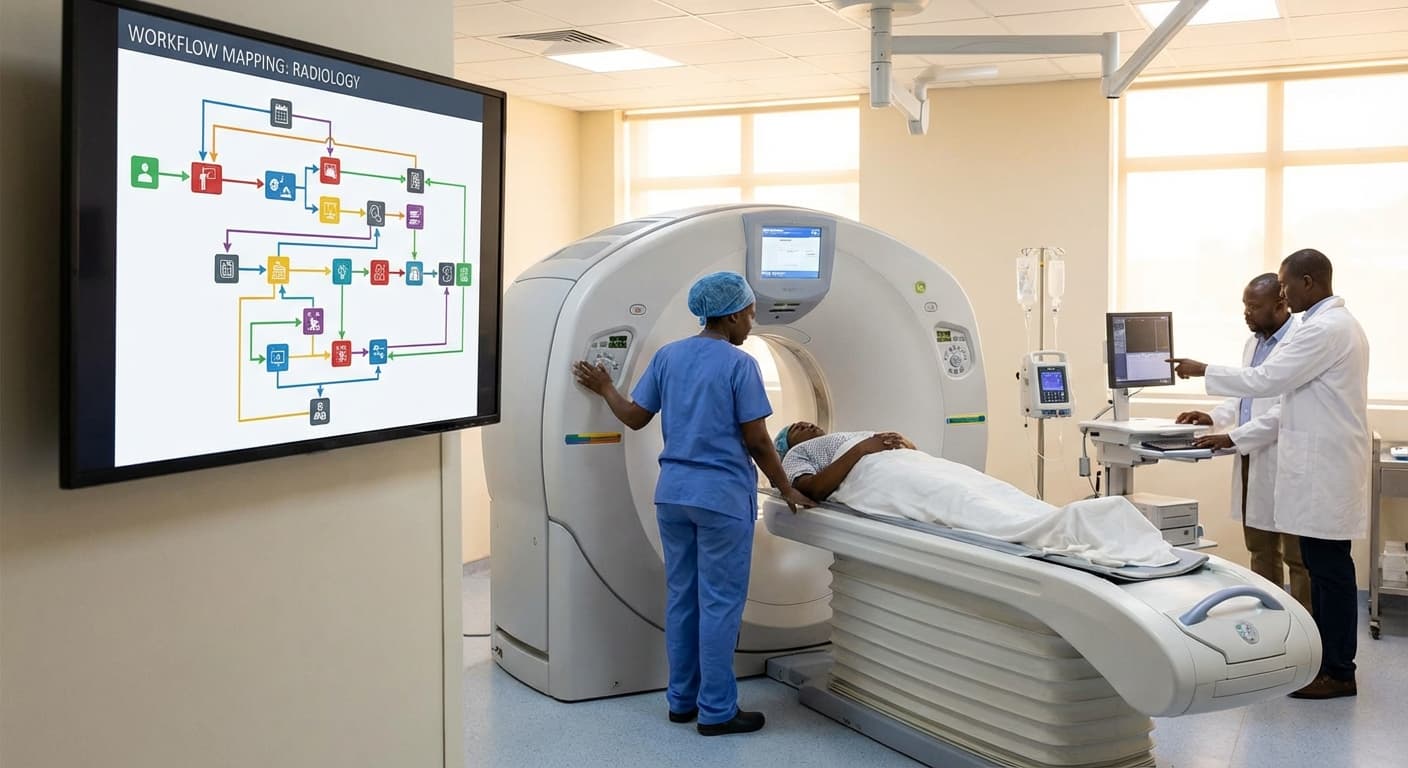
Department Workflow Mapping Service (Radiology/ICU/OT/Lab/Dialysis) in Burkina Faso
Engineering Excellence & Technical Support
Department Workflow Mapping Service (Radiology/ICU/OT/Lab/Dialysis) High-standard technical execution following OEM protocols and local regulatory frameworks.
Streamlined Patient Flow in Radiology
Implementing a digital workflow map for radiology departments in Burkina Faso, visualizing patient journeys from referral to report generation. This includes optimizing scheduling, reducing wait times for imaging, and ensuring timely diagnostic reports to accelerate treatment decisions in critical care settings.
Optimized Resource Allocation in ICU
Mapping critical care unit (ICU) workflows to identify bottlenecks in patient bed management, equipment availability, and staff deployment. This service aims to enhance real-time visibility of ICU resources, improve patient handoffs, and ensure efficient response to critical events, ultimately saving lives.
Enhanced Sample Tracking in Pathology Labs
Developing a comprehensive workflow map for pathology and diagnostic laboratories, focusing on specimen accessioning, processing, testing, and result reporting. This service ensures improved sample integrity, reduced turnaround times for vital lab tests, and a more reliable diagnostic pipeline for healthcare providers across Burkina Faso.
What Is Department Workflow Mapping Service (Radiology/icu/ot/lab/dialysis) In Burkina Faso?
Department Workflow Mapping Service, in the context of Burkina Faso's healthcare facilities (Radiology, ICU, OT, Lab, Dialysis), is a systematic process of analyzing, documenting, and optimizing the sequence of activities, information flow, and resource utilization within these specialized clinical departments. It involves a granular examination of each step, from patient admission or sample reception to final report generation or patient discharge, identifying bottlenecks, redundancies, and areas for improvement. The objective is to enhance operational efficiency, improve patient care quality, reduce turnaround times, and ensure compliance with established protocols and standards.
| Who Needs Department Workflow Mapping Service? | Typical Use Cases |
|---|---|
| Hospitals and Clinics in Burkina Faso operating specialized departments (Radiology, ICU, OT, Lab, Dialysis). | Improving patient flow and reducing wait times in the Radiology department for imaging procedures and reporting. |
| Healthcare administrators and department managers responsible for operational efficiency and quality of care. | Optimizing resource allocation (staffing, equipment) in the Intensive Care Unit (ICU) to manage critical patient loads effectively. |
| Healthcare professionals (physicians, nurses, technicians) seeking to streamline their daily operations and reduce workload. | Enhancing the efficiency of the Operating Theatre (OT) booking, preparation, and execution processes to maximize surgical suite utilization. |
| External consultants or regulatory bodies involved in healthcare quality improvement and accreditation. | Streamlining specimen collection, processing, and analysis workflows in the Laboratory to improve diagnostic turnaround times. |
| Organizations aiming to enhance patient safety and reduce medical errors. | Optimizing patient scheduling, dialysis session management, and post-treatment monitoring in the Dialysis unit. |
| Entities involved in the implementation of new technologies or Electronic Health Records (EHRs). | Standardizing protocols and procedures across multiple facilities for consistent service delivery. |
| Research institutions studying healthcare operational dynamics. | Identifying training needs for staff based on observed workflow inefficiencies. |
| Government health ministries and public health agencies seeking to improve the overall healthcare system's performance. | Benchmarking departmental performance against national or international standards. |
Key Components of Department Workflow Mapping Service:
- Process Identification and Documentation: Comprehensive mapping of all existing steps, roles, and interactions within a department.
- Data Collection and Analysis: Gathering quantitative and qualitative data on process duration, resource allocation, error rates, and staff feedback.
- Bottleneck Identification: Pinpointing constraints that impede smooth workflow and delay patient throughput.
- Redundancy and Inefficiency Detection: Identifying duplicate tasks or steps that add no value.
- Technology and Information Flow Assessment: Evaluating the effectiveness of existing systems and data exchange mechanisms.
- Risk and Compliance Assessment: Ensuring adherence to safety protocols, regulatory requirements, and best practices.
- Optimization Strategy Development: Formulating recommendations for process re-engineering, automation, or resource redistribution.
- Implementation Planning: Creating actionable plans for integrating proposed improvements.
- Monitoring and Evaluation: Establishing metrics to track the impact of implemented changes.
Who Needs Department Workflow Mapping Service (Radiology/icu/ot/lab/dialysis) In Burkina Faso?
Healthcare facilities in Burkina Faso facing challenges with efficiency, patient flow, and resource allocation within critical departments like Radiology, Intensive Care Units (ICU), Operating Theatres (OT), Laboratories, and Dialysis centers can significantly benefit from a dedicated workflow mapping service. This service is designed to meticulously document, analyze, and optimize the processes within these vital areas, leading to improved patient outcomes, reduced wait times, and more effective resource utilization. The target customers are primarily public and private healthcare institutions that are experiencing bottlenecks, communication breakdowns, or suboptimal operational performance in these specialized departments.
| Target Customer Type | Key Needs Addressed | Potential Benefits |
|---|---|---|
| Public Hospitals (National & Regional) | Improving efficiency of limited resources, standardizing care, reducing patient wait times, ensuring equitable access to specialized services. | Reduced operational costs, increased patient satisfaction, improved clinical outcomes, enhanced data-driven decision making. |
| Private Hospitals & Clinics | Optimizing patient flow for higher throughput, enhancing service quality to attract more patients, streamlining operations for profitability, ensuring competitive service delivery. | Increased revenue, improved staff productivity, enhanced reputation, reduced errors and adverse events. |
| Specialized Medical Centers | Fine-tuning complex processes within their niche departments, ensuring seamless integration of advanced technology, maintaining high standards of specialized care. | World-class service delivery, reduced operational risks, stronger specialized expertise, improved research and development capabilities. |
| Government Health Ministries/Agencies | Developing national healthcare strategies, identifying areas for systemic improvement, standardizing best practices across facilities, optimizing public health resource allocation. | Improved national health outcomes, more efficient public health spending, better regulatory oversight, evidence-based policy formulation. |
Target Departments & Their Workflow Challenges
- {"challenges":["Long patient wait times for imaging procedures.","Inefficient equipment scheduling and utilization.","Delays in report generation and delivery.","Patient throughput bottlenecks (imaging to reading).","Supply chain management for consumables."],"department":"Radiology"}
- {"challenges":["Complex patient care pathways and handoffs.","Inconsistent staff communication and task delegation.","Medication administration errors.","Equipment availability and maintenance issues.","Patient monitoring and data entry inefficiencies."],"department":"Intensive Care Unit (ICU)"}
- {"challenges":["Surgical schedule optimization and delays.","Sterilization and instrument management bottlenecks.","Staffing coordination and skill mix alignment.","Pre-operative and post-operative patient flow.","Inventory management for surgical supplies."],"department":"Operating Theatre (OT)"}
- {"challenges":["Sample collection, transport, and processing delays.","Test turnaround times.","Equipment calibration and maintenance.","Quality control and assurance processes.","Data management and reporting accuracy."],"department":"Laboratory"}
- {"challenges":["Patient scheduling and treatment slot management.","Machine availability and maintenance.","Medication and supply management.","Staff workload and patient-to-staff ratios.","Waste management and infection control."],"department":"Dialysis"}
Department Workflow Mapping Service (Radiology/icu/ot/lab/dialysis) Process In Burkina Faso
This document outlines the Department Workflow Mapping Service offered in Burkina Faso, specifically for departments such as Radiology, Intensive Care Unit (ICU), Operating Theatre (OT), Laboratory, and Dialysis. The service aims to analyze, document, and optimize the processes within these critical healthcare departments to improve efficiency, reduce errors, and enhance patient care. The workflow begins with an initial inquiry from a healthcare facility and culminates in the delivery of a comprehensive workflow map and actionable recommendations.
| Stage | Description | Key Activities | Deliverables | Responsible Parties |
|---|---|---|---|---|
| The process begins when a healthcare facility expresses interest in the workflow mapping service. | Contact initiation, initial discussion of needs, service overview, preliminary assessment of scope. | Service proposal, initial understanding of client's challenges. | Client (Healthcare Facility), Service Provider |
| A detailed understanding of the specific department's needs, objectives, and current challenges is established. | On-site visits, interviews with key personnel (doctors, nurses, technicians, administrators), review of existing documentation (if any), definition of project scope and objectives. | Detailed needs assessment report, agreed-upon project scope and objectives. | Service Provider, Client (Department Heads, Key Staff) |
| Information regarding the current workflow is systematically gathered and analyzed. | Observation of daily operations, detailed interviews with frontline staff, collection of data on patient flow, resource utilization, communication patterns, and potential bottlenecks. | Raw data, initial observations, identification of recurring issues and inefficiencies. | Service Provider (Analysts, Consultants), Client (Staff willing to provide information) |
| The collected data is used to create visual representations of the current processes. | Development of flowcharts, process diagrams, swimlane diagrams, and other visual aids depicting the sequence of steps, decision points, roles, and responsibilities within the department. Documentation of standard operating procedures (SOPs) if not already in place. | Draft workflow maps and documented processes. | Service Provider (Workflow Analysts, Process Engineers) |
| The drafted workflow maps and documentation are reviewed with the relevant stakeholders for accuracy and completeness. | Presentations of draft maps to department staff and management, gathering feedback, making necessary revisions based on input. | Validated workflow maps and documented processes. | Service Provider, Client (Department Staff, Management) |
| Based on the analyzed workflow and feedback, actionable recommendations for improvement are formulated. | Identification of areas for optimization (e.g., reducing waiting times, improving communication, streamlining resource allocation, minimizing errors), proposing solutions, prioritizing recommendations. | List of prioritized recommendations for process improvement. | Service Provider (Consultants, Process Improvement Specialists) |
| A comprehensive report is prepared and presented to the healthcare facility's management. | Compilation of findings, workflow maps, recommendations, and anticipated benefits into a formal report. Presentation of the report, answering questions, facilitating discussion on next steps. | Final Workflow Mapping Report, Presentation Deck. | Service Provider, Client (Management, Department Heads) |
| Assistance can be provided to the healthcare facility during the implementation of the recommended changes. | Training of staff on new processes, support in revising SOPs, project management for implementation, change management strategies. | Successful adoption of new workflows, improved departmental efficiency. | Service Provider (Optional), Client (Department Staff, Management) |
| A period of follow-up to assess the impact of implemented changes and identify any further areas for refinement. | Post-implementation review meetings, data collection on key performance indicators (KPIs), minor adjustments to processes. | Assessment of improvement, identification of long-term optimization opportunities. | Service Provider, Client (Department Staff, Management) |
Workflow Stages
- Inquiry and Initial Consultation
- Needs Assessment and Scoping
- Data Collection and Analysis
- Workflow Mapping and Documentation
- Validation and Feedback
- Recommendation Development
- Report Generation and Presentation
- Implementation Support (Optional)
- Follow-up and Review
Department Workflow Mapping Service (Radiology/icu/ot/lab/dialysis) Cost In Burkina Faso
This document outlines the typical cost of Department Workflow Mapping services specifically for Radiology, Intensive Care Unit (ICU), Operating Theatre (OT), Laboratory, and Dialysis departments in Burkina Faso. Workflow mapping is a crucial process for identifying inefficiencies, optimizing resource allocation, improving patient flow, and ultimately enhancing the quality and safety of care. The cost of these services is influenced by several factors, leading to a range of pricing in the local currency, the West African CFA franc (XOF).
| Department Type | Estimated Cost Range (XOF) | Typical Scope of Mapping |
|---|---|---|
| Radiology Department | 750,000 - 1,500,000 | Patient registration, imaging requests, image acquisition, image interpretation, reporting, PACS integration, equipment utilization. |
| Intensive Care Unit (ICU) | 1,000,000 - 2,000,000 | Patient admission, monitoring, treatment protocols, medication administration, interdisciplinary team communication, discharge planning, equipment management. |
| Operating Theatre (OT) | 1,200,000 - 2,500,000 | Surgical scheduling, patient preparation, pre-operative assessment, intra-operative procedures, post-operative care, sterile supply management, instrument sterilization, staff coordination. |
| Laboratory Department | 600,000 - 1,200,000 | Sample reception and processing, testing procedures, quality control, result reporting, LIS integration, inventory management, equipment calibration. |
| Dialysis Unit | 800,000 - 1,600,000 | Patient scheduling and preparation, dialysis treatment protocols, machine setup and maintenance, fluid management, medication administration, infection control, waste management. |
Key Pricing Factors for Workflow Mapping Services in Burkina Faso:
- Scope and Complexity of the Department: Larger departments with more complex processes, specialized equipment, and a higher volume of patients will naturally incur higher mapping costs.
- Number of Sub-processes and Interdependencies: Mapping the intricate workflows between different units (e.g., radiology reporting to ICU treatment, lab results to OT planning) adds to the complexity and cost.
- Duration and Depth of the Engagement: A comprehensive mapping exercise involving extensive observation, interviews, data analysis, and report generation will be more costly than a preliminary assessment.
- Consultant Expertise and Reputation: Highly experienced and reputable workflow consultants, particularly those with specific healthcare domain knowledge in Burkina Faso, will command higher fees.
- Data Collection Methods: The methods employed for data collection (e.g., direct observation, interviews, surveys, system logs, video recording) can influence the time and resources required.
- Deliverables Required: The extent of the final deliverables, such as detailed process maps, identification of bottlenecks, recommendations, implementation roadmaps, and training materials, will affect the overall cost.
- Technology and Tools Used: The use of specialized workflow mapping software or digital tools can add to the cost, though it may also improve efficiency.
- Geographic Location within Burkina Faso: While major cities like Ouagadougou and Bobo-Dioulasso might have a slightly higher cost of living impacting consultant fees, the core pricing is driven by the service itself.
- Urgency of the Project: Expedited projects may incur premium charges.
- Client-Specific Requirements: Unique client needs, such as integration with existing hospital information systems or specific regulatory compliance mapping, can impact pricing.
Affordable Department Workflow Mapping Service (Radiology/icu/ot/lab/dialysis) Options
Our Affordable Department Workflow Mapping Service is designed to streamline operations and identify cost-saving opportunities within critical hospital departments like Radiology, ICU, Operating Theatre (OT), Laboratory, and Dialysis. By meticulously mapping your existing workflows, we uncover inefficiencies, bottlenecks, and areas for improvement, leading to significant cost reductions and enhanced patient care.
We offer flexible value bundles tailored to your department's specific needs and budget. These bundles combine essential workflow analysis with targeted interventions and recommendations, ensuring you receive the maximum return on investment. Our process is transparent, collaborative, and focused on delivering actionable insights that drive tangible results.
| Value Bundle | Included Services | Target Departments | Estimated Cost Range | Key Value Proposition |
|---|---|---|---|---|
| Essential Workflow Audit | Current state process mapping, bottleneck identification, basic efficiency recommendations. | Any Department (Radiology, ICU, OT, Lab, Dialysis) | $X,XXX - $X,XXX | Foundation for understanding current operations and identifying immediate improvements. |
| Efficiency Enhancement Package | Essential Workflow Audit + root cause analysis of inefficiencies, proposed process redesign, initial resource optimization strategies. | Any Department (Radiology, ICU, OT, Lab, Dialysis) | $X,XXX - $XX,XXX | Deeper dive into inefficiencies, with actionable strategies for significant time and cost savings. |
| Strategic Optimization Bundle | Efficiency Enhancement Package + technology integration assessment, interdepartmental workflow integration, advanced cost-saving recommendations (e.g., inventory management, staff allocation models). | Any Department (Radiology, ICU, OT, Lab, Dialysis) | $XX,XXX - $XX,XXX | Comprehensive approach to optimize departmental operations, leverage technology, and achieve long-term cost reductions. |
| Custom Workflow Solutions | Tailored service based on specific departmental challenges and objectives, flexible scope and deliverables. | Any Department (Radiology, ICU, OT, Lab, Dialysis) | Custom Quote | Bespoke solutions designed to address unique departmental needs and maximize impact. |
Key Benefits of Workflow Mapping:
- Increased efficiency and reduced turnaround times.
- Minimized waste of resources (time, materials, personnel).
- Improved patient safety and reduced errors.
- Enhanced communication and collaboration between departments.
- Identification of training needs and skill gaps.
- Basis for process automation and technological integration.
- Strategic planning for future growth and resource allocation.
Verified Providers In Burkina Faso
In Burkina Faso, ensuring access to quality healthcare is paramount. When seeking medical services, it's crucial to identify Verified Providers who meet stringent standards. Franance Health stands out as a leading organization in this regard, offering a network of credentialed healthcare professionals and facilities. Their commitment to rigorous vetting processes guarantees that patients receive care from competent and trustworthy practitioners, making them the best choice for your health needs in Burkina Faso.
| Provider Type | Franance Health Verification Benefits | Why it's the Best Choice |
|---|---|---|
| Doctors (General Practitioners & Specialists) | Verification of medical degrees, licenses, and ongoing professional development. Confirmation of specialized training and experience. | Ensures you are treated by qualified, experienced, and up-to-date medical professionals. Reduces risk of misdiagnosis or improper treatment. |
| Hospitals and Clinics | Assessment of infrastructure, equipment, hygiene standards, and patient safety protocols. Verification of administrative and medical staff qualifications. | Provides access to safe, well-equipped, and efficiently managed healthcare facilities. Guarantees a higher standard of care and patient comfort. |
| Laboratories and Diagnostic Centers | Validation of equipment calibration, quality control measures, and staff expertise in performing accurate tests. | Ensures reliable and precise diagnostic results, crucial for effective treatment planning and monitoring. |
| Pharmacies | Verification of drug sourcing, storage, dispensing practices, and pharmacist licensing. Adherence to regulations on medication safety and quality. | Guarantees access to authentic, safe, and correctly dispensed medications, preventing counterfeit or substandard drugs. |
Why Franance Health Credentials Matter
- Rigorous Vetting Process: Franance Health employs a comprehensive evaluation of medical professionals and facilities, ensuring they meet international quality and safety standards.
- Expertise and Specialization: Their network includes a diverse range of specialists, guaranteeing access to the most appropriate care for various medical conditions.
- Patient-Centrust Approach: Verified Providers through Franance Health prioritize patient well-being, ethical practices, and transparent communication.
- Reliability and Trustworthiness: The 'Verified Provider' status signifies a commitment to excellence and adherence to regulatory requirements, building patient confidence.
- Access to Advanced Facilities: Franance Health partners with facilities equipped with modern technology and resources to deliver optimal medical outcomes.
Scope Of Work For Department Workflow Mapping Service (Radiology/icu/ot/lab/dialysis)
This document outlines the Scope of Work (SOW) for a comprehensive workflow mapping service across critical hospital departments: Radiology, Intensive Care Unit (ICU), Operating Theater (OT), Laboratory, and Dialysis. The objective is to visually represent, analyze, and optimize existing processes within these departments to enhance efficiency, reduce errors, improve patient flow, and support better resource allocation. The service includes the identification of key stakeholders, data gathering, process documentation, analysis, and the delivery of detailed workflow maps and recommendations.
| Phase | Activities | Deliverables | Timeline (Indicative) |
|---|---|---|---|
| Kick-off meeting with stakeholders, define project scope and objectives, identify key personnel from each department, establish communication protocols, develop detailed project plan. | Project Charter, Stakeholder Register, Detailed Project Plan, Communication Plan. | 1-2 Weeks |
| Conduct interviews and workshops with department staff (physicians, nurses, technicians, administrators), observe current processes in action, review existing documentation (SOPs, protocols, forms), gather quantitative data (patient volumes, turnaround times, resource utilization). | Interview Notes, Observation Logs, Data Collection Sheets, Preliminary Process Flows. | 4-6 Weeks |
| Develop detailed process maps for each department using standard notation (e.g., BPMN 2.0). Document decision points, roles and responsibilities, inputs, outputs, and systems used for each step. Validate maps with departmental stakeholders. | As-Is Workflow Diagrams (per department), Process Narratives, Roles & Responsibilities Matrix. | 6-8 Weeks |
| Analyze As-Is workflows to identify bottlenecks, inefficiencies, non-value-added steps, potential for automation, and compliance gaps. Prioritize areas for improvement based on impact and feasibility. | Bottleneck Analysis Report, Inefficiency Identification Matrix, Prioritized List of Improvement Opportunities. | 2-3 Weeks |
| Develop proposed To-Be workflows incorporating identified improvements. Define optimized processes, new roles/responsibilities if applicable, and potential technology enhancements. Develop a roadmap for implementation. | To-Be Workflow Diagrams (per department), Recommendations Report (including proposed changes, benefits, implementation considerations), Implementation Roadmap. | 3-4 Weeks |
| Present As-Is and To-Be workflows and recommendations to all stakeholders. Incorporate feedback and refine documentation. Finalize all deliverables. | Final Workflow Diagrams (As-Is & To-Be), Final Recommendations Report, Final Project Report. | 2 Weeks |
Service Objectives
- To accurately document the current state workflows for Radiology, ICU, OT, Laboratory, and Dialysis departments.
- To identify bottlenecks, inefficiencies, redundancies, and potential areas for improvement within each workflow.
- To provide a clear, visual representation of each department's processes.
- To develop actionable recommendations for process optimization.
- To ensure stakeholder buy-in and understanding of the mapped workflows and proposed changes.
- To establish a baseline for future performance monitoring and improvement initiatives.
Service Level Agreement For Department Workflow Mapping Service (Radiology/icu/ot/lab/dialysis)
This Service Level Agreement (SLA) outlines the response times and uptime guarantees for the Department Workflow Mapping Service, specifically for Radiology, Intensive Care Unit (ICU), Operating Theatre (OT), Laboratory, and Dialysis departments. This service aims to provide accurate and efficient mapping of departmental workflows to improve operational efficiency, resource allocation, and patient care pathways.
| Service Component | Target Response Time (Business Hours) | Uptime Guarantee |
|---|---|---|
| Initial Consultation/Scope Definition | 2 Business Days | N/A (Service initiated by request) |
| Workflow Data Collection (On-site/Remote) | Within 5 Business Days of agreed schedule | N/A (Dependent on client availability) |
| Draft Workflow Map Submission | 10 Business Days from completion of data collection | N/A |
| Review and Feedback Incorporation | 5 Business Days from receipt of client feedback | N/A |
| Final Workflow Map Delivery | 3 Business Days from incorporation of final feedback | N/A |
| Support for Workflow Map Usage (Queries) | 8 Business Hours | 99.5% |
| Updates/Revisions to Workflow Map (Minor) | 5 Business Days | N/A |
| Emergency Support (Critical Workflow Issue Identification) | 2 Business Hours | N/A |
Key Service Components
- Workflow Discovery and Analysis
- Process Mapping and Visualization
- Bottleneck Identification and Optimization Recommendations
- Technology Integration Assessment
- Training and Documentation Support
Frequently Asked Questions

Ready when you are
Let's scope your Department Workflow Mapping Service (Radiology/ICU/OT/Lab/Dialysis) in Burkina Faso project in Burkina Faso.

Scaling healthcare logistics and technical systems across the entire continent.