
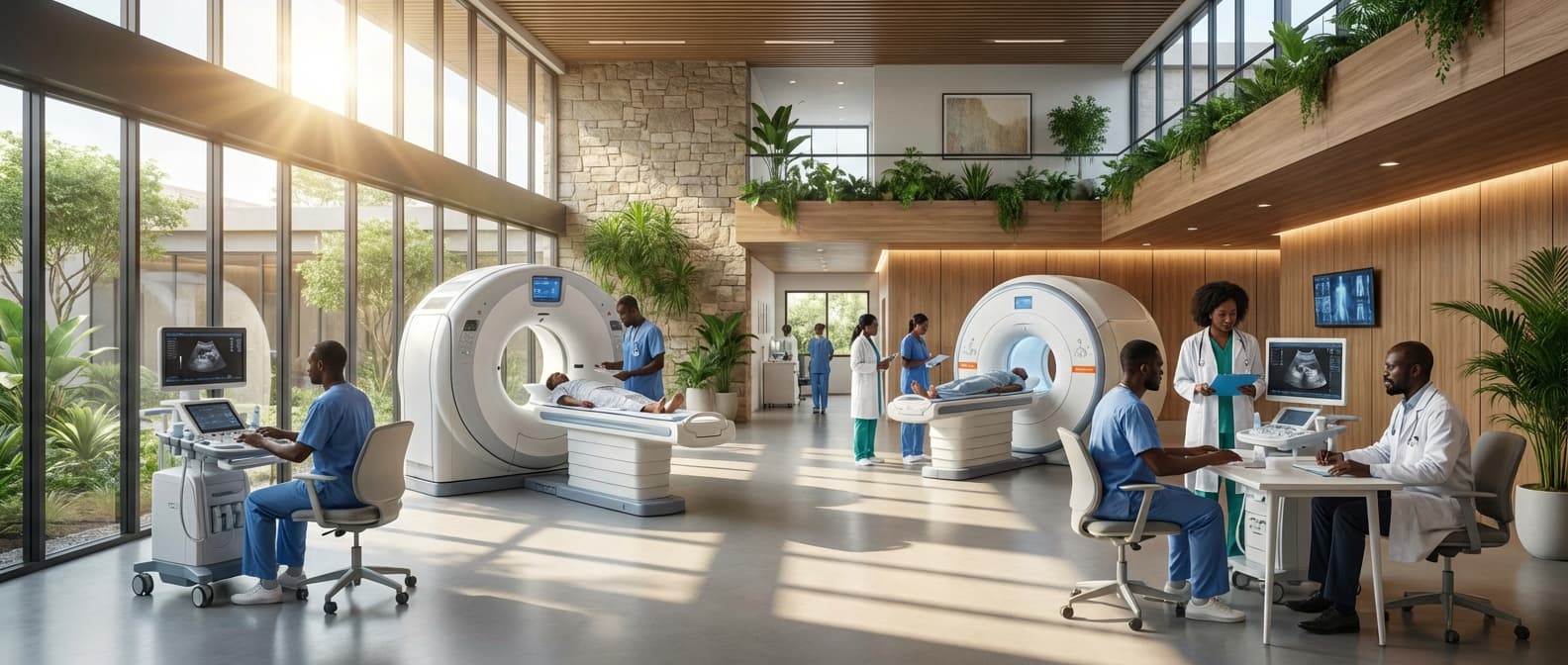
Diagnostic Imaging in Burkina Faso
Engineering Excellence & Technical Support
High-resolution imaging systems including CT scanners, MRI, X-ray, and ultrasound technology for accurate clinical diagnosis. High-standard technical execution following OEM protocols and local regulatory frameworks.
Mobile X-ray Units Deployed to Remote Areas
Four state-of-the-art mobile X-ray units have been deployed to four underserved rural health districts. These units are equipped with digital radiography (DR) capabilities, enabling rapid image acquisition and transmission, significantly improving diagnostic turnaround times for critical conditions like tuberculosis and fractures in communities with limited access to fixed imaging facilities.
AI-Powered Tuberculosis Screening Pilot
A pilot program integrating Artificial Intelligence (AI) for automated analysis of chest X-rays has been launched in two regional hospitals. This AI tool assists radiologists in identifying potential signs of tuberculosis with enhanced accuracy and speed, allowing for earlier detection and referral of suspected cases, thereby contributing to more effective public health interventions.
PACS Network Expansion for Centralized Reporting
The Picture Archiving and Communication System (PACS) network has been expanded to connect three district hospitals to the central referral hospital's radiology department. This secure digital infrastructure facilitates the remote reading and reporting of imaging studies by specialist radiologists, improving access to expert diagnostics for patients across a wider geographical area and reducing the need for patient travel.
What Is Diagnostic Imaging In Burkina Faso?
Diagnostic imaging in Burkina Faso refers to the use of medical technologies to create visual representations of the interior of the human body for diagnostic and treatment planning purposes. This encompasses a range of imaging modalities that employ various physical principles, including X-rays, sound waves, magnetic fields, and radioisotopes. The primary objective is to detect, characterize, and monitor diseases and injuries by visualizing anatomical structures and physiological processes non-invasively or minimally invasively. The availability and sophistication of these services are critical components of a functional healthcare system, contributing to early detection, accurate diagnosis, and improved patient outcomes. Challenges in Burkina Faso often include access to advanced equipment, trained personnel, consistent power supply, and the procurement of consumables.
| Who Needs Diagnostic Imaging | Typical Use Cases | |||||||
|---|---|---|---|---|---|---|---|---|
| Patients presenting with symptoms suggestive of internal pathology (e.g., pain, swelling, altered function). | Fracture detection and assessment of bone integrity. | Diagnosis of infections (e.g., pneumonia, abscesses). | Evaluation of abdominal and pelvic organs for masses, inflammation, or structural abnormalities. | Screening for certain cancers (e.g., mammography for breast cancer, CT for lung cancer in high-risk individuals). | Monitoring disease progression or response to treatment. | Pre-operative planning and post-operative assessment. | Assessment of neurological conditions (e.g., stroke, tumors). | Evaluation of cardiovascular diseases (e.g., using CT angiography). |
| Individuals undergoing routine medical examinations or health screenings. | Patients referred by primary healthcare providers for further investigation. | Emergency room patients requiring rapid assessment of trauma or acute conditions. | Individuals with a family history of certain diseases. | Patients requiring interventional procedures guided by imaging. | Pregnant women for monitoring fetal development and maternal health (primarily ultrasound). | Pediatric patients for a wide range of conditions, with emphasis on non-ionizing modalities where possible. |
Key Diagnostic Imaging Modalities in Burkina Faso
- Radiography (X-ray): Utilizes ionizing radiation to produce images of bones, certain soft tissues, and organs. It remains a foundational imaging technique due to its accessibility and relative cost-effectiveness.
- Computed Tomography (CT) Scan: Employs a series of X-ray images taken from different angles around the body, processed by a computer to create cross-sectional slices. It offers detailed visualization of bones, soft tissues, and blood vessels.
- Ultrasonography (Ultrasound): Uses high-frequency sound waves to create images. It is particularly useful for visualizing soft tissues, organs, and blood flow, and is non-ionizing, making it safe for pregnant women and children.
- Magnetic Resonance Imaging (MRI): Generates images using strong magnetic fields and radio waves. It provides excellent soft tissue contrast and is valuable for imaging the brain, spinal cord, joints, and internal organs, though it is less widely available than X-ray or ultrasound.
- Fluoroscopy: A type of medical imaging that displays continuous X-ray images on a monitor, like an "X-ray movie." It is used to visualize the movement of internal organs or to guide medical procedures.
- Mammography: A specialized X-ray technique used for screening and diagnosing breast cancer.
Who Needs Diagnostic Imaging In Burkina Faso?
Diagnostic imaging plays a crucial role in healthcare delivery, offering vital insights for diagnosis, treatment planning, and monitoring. In a resource-constrained setting like Burkina Faso, identifying and prioritizing the most impactful use cases for diagnostic imaging is essential for optimizing limited resources and improving patient outcomes.
| Department/Customer Group | Primary Imaging Needs | Key Conditions Addressed |
|---|---|---|
| Maternal and Child Health Clinics | Ultrasound (portable/basic) | Pregnancy monitoring, fetal assessment, pediatric abdominal issues, congenital anomalies |
| District/Regional Hospitals | X-ray, Ultrasound | Fractures, chest infections, abdominal pain, urinary tract issues, pregnancy complications |
| Emergency Departments | X-ray, Ultrasound, CT (if available) | Trauma, acute abdomen, head injuries, internal bleeding |
| Tuberculosis Control Programs | Chest X-ray | Diagnosis and monitoring of tuberculosis |
| Surgical Departments | X-ray, Ultrasound, CT (if available) | Pre-operative planning, post-operative assessment for a wide range of surgical interventions |
| Referral/Specialized Hospitals | CT, MRI, advanced Ultrasound | Complex tumors, neurological disorders, advanced cardiovascular diseases, detailed anatomical assessment |
Target Customers and Departments for Diagnostic Imaging in Burkina Faso
- {"title":"Primary Healthcare Facilities","description":"While often lacking advanced imaging equipment, these facilities serve as the first point of contact for a vast majority of the population. They benefit from portable or basic ultrasound units for common conditions like pregnancy monitoring, abdominal pain, and identifying fluid collections. Referrals for more complex imaging are critical."}
- {"title":"District and Regional Hospitals","description":"These facilities represent a significant hub for diagnostic services. They require a range of imaging modalities, including X-ray, ultrasound, and potentially CT scans, to manage a broader spectrum of conditions. This is where the bulk of diagnostic imaging utilization will occur."}
- {"title":"Referral Centers and Specialized Hospitals (e.g., National Hospitals, University Hospitals)","description":"These institutions serve as tertiary care centers and often have the most advanced imaging equipment available. They cater to complex cases requiring sophisticated diagnostics like MRI, CT angiography, and advanced ultrasound techniques. They are also crucial for training and research."}
- {"title":"Maternal and Child Health Clinics","description":"Dedicated to women's and children's health, these clinics rely heavily on ultrasound for antenatal care (fetal growth, position, detecting abnormalities) and pediatric diagnostics (abdominal issues, congenital anomalies). X-ray may be used for pediatric bone fractures or chest conditions."}
- {"title":"Emergency Departments and Trauma Centers","description":"Rapid diagnosis is critical in emergency settings. X-ray (for fractures, chest injuries), ultrasound (for internal bleeding, fluid), and CT scans are essential for trauma assessment, acute abdominal pain, and neurological emergencies."}
- {"title":"Infectious Disease Units (e.g., Tuberculosis, HIV/AIDS Clinics)","description":"Chest X-rays are indispensable for diagnosing and monitoring tuberculosis. Other imaging modalities may be used to assess complications related to HIV/AIDS or other opportunistic infections."}
- {"title":"Surgical Departments","description":"Surgeons rely on pre-operative imaging to plan procedures and post-operative imaging to assess outcomes and complications. This includes X-ray, CT, and ultrasound for various surgical specialties."}
- {"title":"Internal Medicine and Cardiology Departments","description":"Chest X-rays are common for respiratory conditions. Echocardiography (a form of ultrasound) is vital for cardiac assessment. CT scans may be used for complex pulmonary or vascular diseases."}
- {"title":"Oncology Units","description":"Imaging is fundamental for cancer diagnosis, staging, treatment planning (e.g., radiation therapy guidance), and monitoring response to therapy. CT and MRI are particularly important in oncology."}
- {"title":"Public Health Programs and Research Initiatives","description":"Diagnostic imaging data is valuable for epidemiological studies, disease surveillance, and evaluating the impact of public health interventions. This can involve both routine imaging and specific research protocols."}
Diagnostic Imaging Process In Burkina Faso
The diagnostic imaging process in Burkina Faso, like in many healthcare systems, follows a structured workflow designed to efficiently move a patient from the initial request for imaging to the delivery of the diagnostic report. This process is crucial for accurate diagnosis and effective treatment planning. The workflow typically begins with a clinical inquiry from a healthcare professional, progresses through the practical steps of image acquisition, and culminates in the interpretation and reporting of the findings by a radiologist.
| Stage | Description | Key Activities | Responsible Personnel | Potential Challenges |
|---|---|---|---|---|
| Inquiry & Referral | The process is initiated when a healthcare provider determines that diagnostic imaging is necessary for patient evaluation. | Clinical assessment, identification of imaging needs, completion of imaging request form. | Physician, Nurse Practitioner, Clinical Officer. | Lack of clear indication for imaging, incomplete referral forms, patient awareness of imaging necessity. |
| Patient Reception & Preparation | The patient arrives at the imaging department and is prepared for the specific imaging procedure. | Registration, vital signs check, explanation of procedure, consent, patient preparation (e.g., fasting, contrast administration). | Receptionist, Nurse, Radiographer/Technologist. | Long waiting times, language barriers, patient anxiety, insufficient preparation instructions. |
| Image Acquisition | The actual imaging procedure is performed using the appropriate modality. | Positioning the patient, operating imaging equipment (X-ray machine, ultrasound probe, CT/MRI scanner), acquiring images. | Radiographer/Technologist. | Equipment malfunction, power outages, lack of trained personnel, unavailability of specific imaging modalities (e.g., CT, MRI), patient cooperation issues. |
| Image Processing & Quality Control | The acquired images are processed and reviewed to ensure diagnostic quality. | Digitization (if analog), image enhancement, verification of image clarity and completeness, rejection of suboptimal images. | Radiographer/Technologist, PACS Administrator (if applicable). | Poor image quality, insufficient processing capabilities, lack of quality assurance protocols. |
| Radiologist Interpretation & Reporting | A qualified radiologist analyzes the images and dictates a diagnostic report. | Review of images, identification of abnormalities, correlation with clinical information, dictation/typing of report. | Radiologist. | Shortage of radiologists, heavy workload, delayed interpretation due to limited availability, lack of sub-specialist expertise. |
| Report Delivery & Integration | The diagnostic report is finalized and communicated back to the referring clinician and integrated into the patient's medical record. | Finalizing report, transmitting report (electronically or physically), inclusion in patient chart. | Radiologist, Medical Records Staff, Referring Clinician. | Delayed report delivery, miscommunication, lack of integrated electronic health records, difficulty accessing reports by referring physicians. |
Diagnostic Imaging Workflow in Burkina Faso
- Patient referral/request by a clinician.
- Patient reception and preparation.
- Image acquisition (X-ray, Ultrasound, CT, MRI).
- Image processing and quality control.
- Radiologist interpretation and reporting.
- Report delivery and integration into patient records.
Diagnostic Imaging Cost In Burkina Faso
Diagnostic imaging plays a crucial role in modern healthcare, enabling accurate diagnosis and effective treatment planning. However, the cost of these services can be a significant barrier to access, particularly in low-income countries like Burkina Faso. Several factors influence the pricing of diagnostic imaging procedures in Burkina Faso, including the type of examination, the facility's overhead, the availability of specialized equipment, the expertise of the radiologist, and the prevailing economic conditions. Public and private healthcare providers often have different pricing structures. Public facilities, while generally more affordable due to government subsidies, may experience longer waiting times and limitations in the availability of certain advanced technologies. Private clinics, on the other hand, typically offer faster service and access to a wider range of equipment but at a higher cost. The specific type of imaging modality also heavily impacts the price. For instance, basic X-rays are generally less expensive than more complex procedures like CT scans or MRIs. The cost of consumables, maintenance of equipment, and the salaries of highly trained personnel also contribute to the overall pricing. Currency fluctuations and inflation can further affect the local currency (CFA franc) cost of these services over time. It's important to note that these prices are approximate and can vary significantly between different healthcare providers and regions within Burkina Faso.
| Pricing Factor | Impact on Cost |
|---|---|
| Type of Imaging Modality | Basic procedures (X-ray) are less expensive than advanced ones (CT, MRI). |
| Facility Type (Public vs. Private) | Private facilities are generally more expensive than public ones. |
| Equipment Availability and Technology | Access to newer, specialized equipment increases costs. |
| Radiologist Expertise and Specialization | Highly qualified and specialized radiologists command higher fees. |
| Overhead Costs (Rent, Utilities, Staff Salaries) | Higher operational expenses translate to higher service prices. |
| Consumables and Maintenance | Cost of contrast agents, films, and equipment upkeep are factored in. |
| Geographic Location | Costs might be slightly higher in major urban centers compared to rural areas. |
| Insurance Coverage and Out-of-Pocket Payment | Availability of insurance or the need for direct payment influences affordability. |
Common Diagnostic Imaging Procedures and Estimated Cost Ranges in Burkina Faso (CFA Francs)
- X-ray (e.g., chest X-ray, limb X-ray): 10,000 - 30,000 CFA
- Ultrasound (e.g., abdominal, obstetric): 15,000 - 40,000 CFA
- CT Scan (e.g., head CT, abdominal CT): 50,000 - 150,000 CFA
- MRI Scan: Significantly higher, often not widely available and can range from 100,000 CFA to upwards of 300,000 CFA or more, depending on the complexity and facility.
Affordable Diagnostic Imaging Options
Diagnostic imaging plays a crucial role in healthcare, but the associated costs can be a significant concern for patients. Fortunately, there are various affordable diagnostic imaging options and strategies to help manage expenses. Value bundles and targeted cost-saving measures can make essential imaging services more accessible.
| Cost-Saving Strategy | Description | Potential Savings |
|---|---|---|
| Inquire About Self-Pay Discounts | Many imaging centers offer discounted rates for patients paying out-of-pocket, bypassing insurance. This can be significantly cheaper than using insurance for certain procedures. | Can be 20-50% or more compared to billed rates. |
| Shop Around and Compare Prices | Imaging costs can vary dramatically between different facilities (hospitals vs. independent imaging centers, different geographic locations). Obtain price quotes before scheduling. | Savings can range from hundreds to thousands of dollars depending on the procedure. |
| Utilize 'Out-of-Network' Benefits Strategically | If your preferred provider is out-of-network, understand your plan's out-of-network coverage. Sometimes, paying out-of-pocket and seeking reimbursement can be more cost-effective than using an in-network provider with high deductibles. | Depends on individual plan details and provider fees. |
| Negotiate Prices (Especially for Self-Pay) | Don't hesitate to ask if there's room for negotiation, particularly if you are paying directly for services. Larger imaging centers may have more flexibility. | Variable, but worth attempting. |
| Explore Imaging Accreditation | Accredited facilities often adhere to higher standards, which can sometimes correlate with more efficient operations and potentially better pricing, though this is not a direct guarantee of cost savings. | Indirect potential for efficiency. |
| Consider Advanced Imaging Techniques Wisely | While advanced imaging like MRI and CT scans are powerful, ensure they are medically necessary. Sometimes, less expensive alternatives (like X-rays or ultrasounds) can provide sufficient diagnostic information. | Avoids unnecessary high costs. |
| Ask About Package Deals or Bundles | As discussed, inquire if the facility offers bundled services for related tests or conditions, which can often lead to discounts. | Typically offers a percentage off the combined individual costs. |
| Check for Financial Assistance Programs | Many hospitals and imaging centers have financial assistance or charity care programs for low-income patients. Inquire with the billing department. | Can significantly reduce or eliminate costs. |
Understanding Value Bundles
- {"title":"What are Value Bundles?","description":"Value bundles are packages of healthcare services offered at a predetermined, often reduced, price. In diagnostic imaging, this could mean bundling multiple imaging tests related to a specific condition or body part, or combining imaging with a physician consultation or follow-up visit."}
- {"title":"Benefits of Value Bundles","description":"Bundles can simplify billing, provide price transparency, and often result in overall cost savings compared to paying for each service individually. They encourage coordinated care by grouping related services."}
- {"title":"Examples in Imaging","description":"A common example is a 'cardiac bundle' that might include an echocardiogram, stress test, and a cardiologist's interpretation. Another could be a 'spine bundle' for back pain, encompassing X-rays, an MRI, and a physical therapy assessment."}
Verified Providers In Burkina Faso
In Burkina Faso's evolving healthcare landscape, the assurance of quality and reliability in medical services is paramount. Verified providers, particularly those with recognized credentials, offer peace of mind and a higher standard of care. Franance Health stands out as a leading example of such a provider, distinguishing itself through its commitment to excellence and rigorous adherence to international standards. Their credentials are not merely certifications but a testament to their dedication to patient well-being and ethical medical practice.
| Credential Type | Significance for Patients | Franance Health's Commitment |
|---|---|---|
| International Healthcare Accreditation (e.g., JCI, ISO) | Ensures adherence to global best practices in patient care, safety, and operational efficiency. | Actively seeks and maintains accreditations, demonstrating a commitment to world-class standards. |
| Medical Professional Licensing & Board Certification | Confirms that doctors and specialists possess the necessary qualifications, expertise, and legal authorization to practice. | Rigorous verification of all medical staff's licenses, certifications, and educational backgrounds. |
| Specialized Program Certifications (e.g., for cardiology, oncology) | Indicates excellence and specific expertise in particular medical fields, offering specialized and advanced care. | Invests in specialized training and resources to achieve and maintain high standards in various medical disciplines. |
| Commitment to Continuous Quality Improvement | Demonstrates an ongoing effort to enhance patient outcomes, refine processes, and adapt to new medical advancements. | Regular internal audits, patient feedback mechanisms, and participation in quality improvement initiatives. |
Why Franance Health is the Best Choice in Burkina Faso:
- International Accreditation & Certification: Franance Health actively pursues and maintains accreditations from reputable international health organizations. These certifications involve stringent evaluations of their facilities, equipment, medical protocols, and staff qualifications, ensuring they meet global benchmarks for healthcare delivery.
- Highly Qualified Medical Professionals: The credentialing process at Franance Health prioritizes the expertise and experience of their medical team. Doctors, nurses, and specialists undergo thorough background checks, verification of their licenses, and continuous professional development, ensuring they are at the forefront of medical knowledge and practice.
- Patient-Centric Approach & Safety Standards: Beyond clinical expertise, Franance Health's credentials often reflect a strong emphasis on patient safety, infection control, and a commitment to patient rights. This translates into a healthcare experience that is not only effective but also compassionate and secure.
- Transparency and Accountability: Verified providers like Franance Health operate with a high degree of transparency. Their adherence to standards means they are accountable for their services, offering patients a clear understanding of the care they will receive and the qualifications of the practitioners providing it.
- Access to Advanced Technology & Treatments: Maintaining high credentials often necessitates investment in state-of-the-art medical technology and the adoption of the latest evidence-based treatment protocols. Franance Health's verification signifies their commitment to providing access to advanced diagnostic and therapeutic options.
Scope Of Work For Diagnostic Imaging
This document outlines the Scope of Work (SOW) for diagnostic imaging services, detailing the technical deliverables and standard specifications required. The objective is to ensure high-quality, accurate, and timely diagnostic imaging to support patient care and clinical decision-making.
| Imaging Modality | Standard Image Resolution | Standard Report Turnaround Time | Data Retention Period | Key Performance Indicators (KPIs) | Relevant Standards |
|---|---|---|---|---|---|
| X-Ray | Minimum 300 DPI (Digital Radiography) | 24-48 Hours | 7 Years (Adults), 10 Years (Pediatrics) | Image Quality Score (>90%) | ACR, HIPAA, FDA |
| CT Scan | Minimum 512x512 matrix, appropriate slice thickness | 24-48 Hours | 7 Years (Adults), 10 Years (Pediatrics) | Report Accuracy (>95%) | ACR, HIPAA, FDA |
| MRI | Minimum 512x512 matrix, appropriate slice thickness | 24-72 Hours | 7 Years (Adults), 10 Years (Pediatrics) | Image Artifact Rate (<5%) | ACR, HIPAA, FDA |
| Ultrasound | High-resolution digital images, Doppler capability | 24-48 Hours | 7 Years (Adults), 10 Years (Pediatrics) | Physician Satisfaction Score (>85%) | AIUM, HIPAA, FDA |
| Mammography | High-resolution digital images | 48-72 Hours | 10 Years | Recall Rate (<10%) | ACR, MQSA, HIPAA, FDA |
| Nuclear Medicine | Appropriate matrix size and slice thickness for the study | 48-72 Hours | 7 Years (Adults), 10 Years (Pediatrics) | Turnaround Time Compliance (>90%) | ACR, HIPAA, FDA |
Key Technical Deliverables
- Digital Images (DICOM format)
- Radiology Reports (Structured and Narrative)
- Image Archiving and Retrieval
- Quality Assurance and Control Reports
- Equipment Maintenance and Calibration Records
- Data Backup and Disaster Recovery Plans
- Integration with Hospital Information Systems (HIS/PACS)
- Compliance with Regulatory Standards
Service Level Agreement For Diagnostic Imaging
This Service Level Agreement (SLA) outlines the performance expectations and guarantees for diagnostic imaging services provided by [Provider Name] to [Client Name]. It covers response times for critical imaging requests and system uptime for diagnostic imaging platforms.
| Service Metric | Service Level Objective (SLO) | Measurement Period | Measurement Method |
|---|---|---|---|
| Response Time: Critical Imaging Request (e.g., STAT X-ray, Ultrasound for acute trauma) | 95% of critical imaging requests to be initiated (technician dispatched or room prepared) within 30 minutes of notification. | Monthly | Monitoring of PACS/RIS timestamps and dispatch logs. |
| Response Time: Routine Imaging Request (e.g., scheduled MRI, CT) | 98% of routine imaging requests to be scheduled within 24 hours of referral. | Monthly | Monitoring of RIS scheduling data. |
| System Uptime: Diagnostic Imaging PACS/RIS | 99.9% uptime, excluding scheduled maintenance. | Monthly | Continuous monitoring of server availability and application responsiveness. |
| System Uptime: Imaging Modalities (e.g., CT, MRI, X-ray machines) | 98.0% uptime, excluding scheduled maintenance and manufacturer-specified downtime. | Monthly | Monitoring of modality operational status and scheduled maintenance logs. |
Key Service Metrics
- Response Times for Critical Imaging Requests
- System Uptime Guarantees
- Reporting and Review
- Escalation Procedures
Frequently Asked Questions

Ready when you are
Let's scope your Diagnostic Imaging in Burkina Faso project in Burkina Faso.

Scaling healthcare logistics and technical systems across the entire continent.