
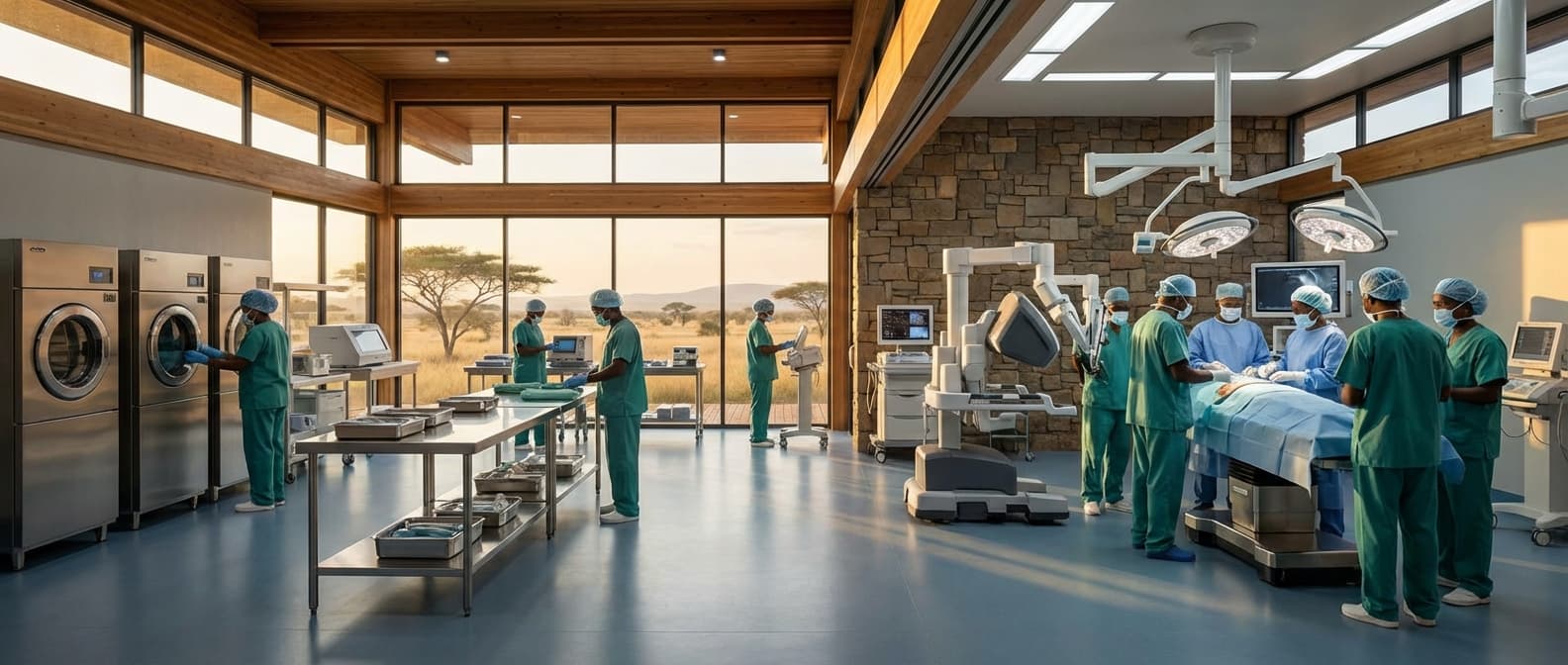
CSSD Design & Validation in Burkina Faso
Engineering Excellence & Technical Support
CSSD workflow design, validation and process development High-standard technical execution following OEM protocols and local regulatory frameworks.
Optimized CSSD Layout for Enhanced Workflow
Designed a state-of-the-art Central Sterile Supply Department (CSSD) layout in Ouagadougou, focusing on a logical, unidirectional workflow to minimize cross-contamination risks and maximize operational efficiency. This design incorporates dedicated zones for receiving, cleaning, disinfection, sterile storage, and dispatch, ensuring a seamless and safe process for instrument reprocessing.
Rigorous Validation of Sterilization Cycles
Implemented a comprehensive validation protocol for steam sterilization cycles at a major hospital in Bobo-Dioulasso. This included conducting biological and chemical indicator testing, cycle parameter monitoring (temperature, pressure, time), and load distribution studies to ensure consistent and effective sterilization, meeting international standards and safeguarding patient safety.
Strategic Equipment Selection and Integration
Provided expert consultation for the selection and integration of critical CSSD equipment, including autoclaves, washer-disinfectors, and sterile packaging systems, for a new healthcare facility in Koudougou. This involved assessing local infrastructure capabilities, cost-effectiveness, and long-term maintenance requirements to ensure a robust and sustainable sterilization infrastructure tailored to Burkina Faso's healthcare needs.
What Is Cssd Design & Validation In Burkina Faso?
CSSD (Central Sterile Services Department) Design & Validation in Burkina Faso refers to the comprehensive process of planning, configuring, and verifying the operational readiness of a healthcare facility's sterile processing capabilities. This service ensures that the CSSD meets international standards for infection prevention and control, thereby guaranteeing the safety of surgical instruments and medical devices used in patient care. It encompasses the physical layout, workflow optimization, equipment selection and installation, and rigorous performance testing to confirm efficacy and compliance.
| Who Needs CSSD Design & Validation? | Typical Use Cases/Scenarios |
|---|---|
| Hospitals and Clinics (Public and Private): Facilities performing surgical procedures, diagnostic interventions, and any patient care requiring reusable medical instruments. | New Healthcare Facility Construction or Renovation: Establishing a new CSSD or upgrading an existing one to meet current standards and increased capacity needs. |
| Specialized Surgical Centers: Operating rooms dedicated to specific surgical disciplines (e.g., orthopedics, ophthalmology, cardiology) with unique instrument sets and sterilization requirements. | Emergency Department Settings: Ensuring rapid and effective turnaround of critical instruments used in urgent care scenarios. |
| Diagnostic Laboratories: Sterilization of equipment and supplies for specimen handling and analysis. | Outbreak Preparedness: Designing or validating CSSD capabilities to handle increased sterilization demands during public health emergencies. |
| Healthcare Training Institutions: Establishing model CSSD units for educational purposes. | Rural Health Centers with Surgical Capabilities: Implementing basic but compliant sterile processing systems where infrastructure may be limited. |
Key Components of CSSD Design & Validation
- Needs Assessment: Identifying the specific sterilization and disinfection requirements based on the healthcare facility's service offerings, patient volume, and surgical procedures.
- Spatial Planning & Layout Design: Optimizing the physical space to ensure a unidirectional workflow (contamination to sterile), efficient material handling, and appropriate zoning for different activities (decontamination, preparation & packaging, sterilization, sterile storage).
- Equipment Specification & Selection: Defining the technical requirements and sourcing of critical equipment such as washer-disinfectors, ultrasonic cleaners, sterilizers (autoclaves, low-temperature sterilizers), packaging systems, and monitoring devices.
- Workflow Analysis & Process Development: Establishing Standard Operating Procedures (SOPs) for every stage of the sterile processing cycle, including instrument decontamination, inspection, assembly, packaging, sterilization, storage, and distribution.
- Infection Prevention & Control Integration: Incorporating best practices for air handling (HVAC), water quality, waste management, and staff safety to minimize the risk of cross-contamination.
- Validation & Qualification: Conducting a series of tests to confirm that the CSSD design and installed equipment perform as intended and consistently produce sterile products. This includes Installation Qualification (IQ), Operational Qualification (OQ), and Performance Qualification (PQ).
- Staff Training & Competency Assessment: Developing and delivering training programs for CSSD technicians on equipment operation, SOP adherence, and infection control principles.
- Regulatory Compliance & Documentation: Ensuring adherence to national and international guidelines (e.g., WHO, ISO standards) and establishing a robust documentation system for all processes and validation activities.
Who Needs Cssd Design & Validation In Burkina Faso?
Central Sterile Supply Departments (CSSDs) are critical for infection prevention and control in healthcare settings. Proper design and rigorous validation of CSSD processes are paramount to ensure the safety of patients and healthcare workers, particularly in regions like Burkina Faso where resources and infrastructure may be challenged. Investing in well-designed CSSDs and validated workflows reduces the risk of healthcare-associated infections (HAIs), improves operational efficiency, and contributes to the overall quality of healthcare delivery. This is not a luxury but a necessity for any facility aiming to provide safe and effective medical care.
| Department | Key Needs & Responsibilities | Impact of CSSD Design & Validation |
|---|---|---|
| CSSD (Central Sterile Supply Department) | Receiving, cleaning, disinfection, sterilization, packaging, storage, and distribution of sterile medical devices. Training of staff. Process monitoring and documentation. | Ensures the availability of sterile instruments, reduces instrument reprocessing errors, minimizes HAIs, optimizes workflow, and improves staff safety. |
| Surgical Departments (General Surgery, Obstetrics & Gynecology, Orthopedics, etc.) | Requirement for a consistent supply of sterile instruments for all procedures. Reporting instrument issues and reprocessing failures. | Reduces surgical site infections (SSIs), ensures efficient surgical scheduling, and improves patient outcomes by providing safe and reliable instruments. |
| Infection Prevention and Control (IPC) Department | Monitoring of HAIs, auditing CSSD processes, setting IPC standards, and investigating outbreaks. Ensuring compliance with national and international guidelines. | Provides data to validate CSSD effectiveness, identifies areas for improvement, and ensures adherence to best practices for infection control. |
| Nursing Departments | Proper handling and storage of sterile supplies, reporting of compromised sterile packaging, and patient care related to surgical/procedural sites. | Ensures integrity of sterile items from point of issue to point of use, contributes to patient safety by preventing contamination. |
| Administrative and Management Staff | Budget allocation for CSSD equipment and renovations, oversight of operational efficiency, and ensuring compliance with regulatory requirements. | Facilitates investment in appropriate infrastructure and technology, leading to improved healthcare quality, cost-effectiveness, and reduced liability. |
| Biomedical Engineering Department | Maintenance and repair of sterilization equipment, validation of equipment performance, and advising on equipment selection. | Ensures the reliable and effective functioning of sterilization equipment, critical for achieving validated sterilization cycles. |
Target Customers & Departments for CSSD Design & Validation in Burkina Faso:
- Hospitals (Public and Private)
- Specialized Clinics (e.g., Surgical Centers, Dental Clinics, Ophthalmology Clinics)
- Maternity Centers
- District and Regional Health Centers with surgical capabilities
- International NGOs and Humanitarian Organizations operating healthcare facilities
- Government Ministries of Health and their regional offices (for policy and standards development)
Cssd Design & Validation Process In Burkina Faso
The design and validation process for a Central Sterile Supply Department (CSSD) in Burkina Faso involves a structured workflow to ensure the facility meets international standards for infection control and efficient sterilization. This process typically begins with an initial inquiry and culminates in a fully operational and validated CSSD. The following outlines the key stages from initial contact through the final execution of the project.
| Stage | Description | Key Activities | Responsible Parties | Key Deliverables |
|---|---|---|---|---|
| Initial contact from a healthcare facility or government body regarding the need for a new or upgraded CSSD. | Discuss facility requirements, current sterilization practices, patient volume, types of procedures performed, and budget constraints. | Client (Hospital/Ministry of Health), Potential CSSD Consultant/Designer | Needs assessment report, preliminary scope of work, initial budget estimate. |
| Evaluating the viability of the project and identifying the optimal location for the CSSD. | Site analysis (space availability, utilities, accessibility, waste management), risk assessment, financial viability study, preliminary regulatory review. | CSSD Consultant/Designer, Project Manager, Client | Feasibility report, recommended site, preliminary project plan. |
| Developing a high-level design concept and a more refined budget. | Space planning, workflow analysis, preliminary equipment list, identification of key infrastructure requirements (ventilation, water, power), development of a detailed cost estimate. | CSSD Consultant/Designer, Architect, Project Manager | Conceptual design drawings, preliminary equipment list, detailed budget proposal. |
| Producing comprehensive architectural, mechanical, electrical, and plumbing (MEP) drawings and specifications. | Finalizing layout, material selection, detailed specifications for all infrastructure, coordination with local building codes and standards (e.g., WHO guidelines, national health regulations). | Architects, MEP Engineers, CSSD Consultant/Designer, Local Regulatory Bodies | Complete architectural and engineering drawings, technical specifications, bill of quantities (BOQ). |
| Sourcing materials and appointing contractors for the construction of the CSSD facility. | Tender process for construction, contract negotiation, site preparation, civil works, installation of utilities, interior finishing, adherence to construction quality standards. | Project Manager, Procurement Specialist, Construction Company, Client | Constructed CSSD facility, completed infrastructure. |
| Choosing and installing all necessary sterilization and ancillary equipment. | Detailed equipment specification development, vendor selection, purchasing, site preparation for equipment, professional installation, initial equipment testing. | CSSD Consultant/Designer, Procurement Specialist, Equipment Vendors, Biomedical Engineers | Installed and pre-commissioning tested CSSD equipment. |
| Verifying that the facility and equipment operate according to design specifications and performance standards. | Installation Qualification (IQ), Operational Qualification (OQ), Performance Qualification (PQ) for all equipment, environmental monitoring, workflow testing, documentation of all validation activities. | Validation Engineers, CSSD Consultant/Designer, Biomedical Engineers, Client | IQ, OQ, PQ reports, validation certificates, operational protocols. |
| Ensuring staff are competent in operating the CSSD and transferring ownership to the client. | Comprehensive training programs for CSSD staff on equipment operation, sterilization processes, infection control protocols, safety procedures, and documentation. Official handover of the facility and equipment with all associated documentation. | CSSD Consultant/Designer, Equipment Vendors, Client Staff | Trained staff, training manuals, operational and maintenance manuals, signed handover documents. |
| Establishing a system for continuous quality improvement and periodic re-assessment. | Regular internal audits, ongoing equipment maintenance and calibration, periodic re-validation of sterilization processes (especially after major maintenance or changes in procedures), continuous staff competency checks. | CSSD Management, Biomedical Engineers, Quality Assurance Department, External Auditors | Audit reports, maintenance logs, re-validation reports, updated protocols. |
CSSD Design & Validation Workflow in Burkina Faso
- Inquiry & Needs Assessment
- Feasibility Study & Site Selection
- Conceptual Design & Budgeting
- Detailed Design & Engineering
- Procurement & Construction
- Equipment Selection & Installation
- Validation & Commissioning
- Training & Handover
- Ongoing Monitoring & Re-validation
Cssd Design & Validation Cost In Burkina Faso
Designing and validating a Central Sterile Supply Department (CSSD) in Burkina Faso involves a range of costs influenced by several key factors. These factors dictate the final price, which is typically quoted in the local currency, the West African CFA franc (XOF). Understanding these elements is crucial for accurate budgeting and successful project implementation. The complexity of the CSSD, the scale of the facility, the specific equipment chosen, the required level of validation, and the expertise of the chosen consultants all play a significant role in determining the overall cost.
| Service Component | Estimated Range (XOF) - Low End | Estimated Range (XOF) - High End | Notes |
|---|---|---|---|
| Conceptual Design & Feasibility Study | 500,000 | 2,000,000 | Basic layout, workflow assessment, preliminary equipment list. |
| Detailed Architectural & Engineering Design | 1,500,000 | 7,500,000 | Includes detailed drawings, specifications, MEP integration. |
| Equipment Sourcing & Procurement Support | 200,000 | 1,000,000 | Consultation on equipment selection, vendor negotiation. |
| Initial Commissioning & Installation Qualification (IQ) | 1,000,000 | 5,000,000 | Verification of equipment installation and functionality. |
| Operational Qualification (OQ) | 1,500,000 | 8,000,000 | Testing equipment performance under defined operating conditions. |
| Performance Qualification (PQ) | 2,000,000 | 10,000,000 | Validation of the entire process under simulated normal operating conditions. |
| Validation Protocol Development & Execution | 1,000,000 | 7,000,000 | Documenting the validation plan and conducting the tests. |
| Staff Training (Basic) | 300,000 | 1,500,000 | On-the-job training, basic SOPs. |
| Project Management & Consultancy Fees | 500,000 | 3,000,000 | Varies greatly based on firm and duration. |
| Total Estimated Range (excluding major equipment purchase) | 8,500,000 | 45,000,000+ | This is a broad estimate. Actual costs can be significantly higher with complex projects or specialized requirements. |
Key Pricing Factors for CSSD Design & Validation in Burkina Faso
- Scope of Services: This includes the extent of the design work (e.g., layout, workflow optimization, architectural integration) and the depth of validation required (e.g., initial commissioning, performance qualification, ongoing monitoring).
- Facility Size and Complexity: Larger CSSDs with more specialized areas (e.g., dedicated decontamination zones, sterile storage, separate instrument processing) will naturally incur higher design and validation costs.
- Equipment Selection: The type and quantity of sterilization and processing equipment (autoclaves, washer-disinfectors, ultrasonic cleaners, instrument sets) significantly impact the budget. High-end, advanced equipment will be more expensive.
- Level of Validation and Quality Standards: Adherence to international standards (e.g., ISO 13485, AAMI ST79) and the rigor of the validation process will influence costs. More stringent validation protocols require more time, resources, and specialized expertise.
- Consultant Expertise and Reputation: Experienced and reputable CSSD design and validation consultants, whether local or international, will command higher fees. Their expertise ensures compliance and operational efficiency.
- Geographic Location within Burkina Faso: While not as significant as other factors, transportation and logistical costs for consultants and equipment installation might vary slightly between major cities like Ouagadougou and more remote regions.
- Existing Infrastructure and Renovation Needs: If an existing space is being repurposed, the cost of any necessary renovations, upgrades to utilities (water, electricity, ventilation), and structural modifications will add to the overall expense.
- Training Requirements: The cost of training CSSD staff on new equipment, workflows, and sterilization protocols is often included or considered as a separate but related expense.
- Regulatory Approvals and Inspections: Obtaining necessary permits and undergoing inspections by local health authorities can incur fees and require dedicated project management time.
Affordable Cssd Design & Validation Options
Designing and validating a Central Sterile Services Department (CSSD) is a crucial investment for any healthcare facility, ensuring patient safety through effective sterilization of medical instruments. While comprehensive, state-of-the-art solutions can be costly, a strategic approach can yield affordable CSSD design and validation options. This involves understanding the core requirements, leveraging technology wisely, and optimizing processes. Value bundles offer a way to package essential services and equipment at a more predictable and often reduced cost. Cost-saving strategies focus on maximizing efficiency, minimizing waste, and making informed decisions about initial investments and ongoing operational expenses.
| Value Bundle Component | Description | Cost-Saving Benefit |
|---|---|---|
| Basic Design & Equipment Package | Includes essential layout planning, core sterilization equipment (e.g., autoclave, washer-disinfector), and basic safety features. | Lower upfront investment by focusing on immediate needs and essential functions. |
| Integrated Workflow & Tracking Bundle | Combines software solutions for instrument tracking, sterilization cycle monitoring, and reporting with necessary hardware (scanners, printers). | Reduces errors, improves traceability, and optimizes staff time, leading to increased efficiency and reduced rework. |
| Validation & Training Package | Covers initial validation of equipment and processes, and essential staff training on operation, maintenance, and infection control protocols. | Ensures compliance from the outset, minimizing the risk of costly re-validation or infection control breaches. |
| Phased Upgrade & Expansion Bundle | Allows for the initial installation of core systems with a pre-defined plan and discounted pricing for future additions (e.g., advanced equipment, increased capacity). | Spreads capital expenditure over time and secures favorable pricing for future growth. |
| Maintenance & Support Bundle | Includes scheduled preventive maintenance, priority repair services, and access to technical support for a defined period. | Reduces unexpected downtime and repair costs, ensuring continuous operation and equipment longevity. |
Cost-Saving Strategies for CSSD Design & Validation
- Phased Implementation: Break down the project into manageable stages, allowing for budget allocation over time and avoiding a large upfront capital outlay.
- Modular Design: Opt for modular CSSD layouts that can be expanded or reconfigured as needs evolve, reducing the need for major renovations in the future.
- Equipment Standardization: Choose a limited range of reliable and versatile equipment from reputable manufacturers. Bulk purchasing or long-term service agreements can lead to discounts.
- Technology Integration: Utilize modern, integrated systems for tracking, workflow management, and data logging. This can improve efficiency and reduce manual errors.
- Outsourcing Specific Services: Consider outsourcing non-core functions like specialized decontamination processes or instrument repair, which may be more cost-effective than in-house solutions.
- Lean Process Optimization: Implement Lean principles to streamline workflows, reduce unnecessary movement, and eliminate waste in the CSSD process.
- Energy-Efficient Equipment: Invest in energy-efficient autoclaves, washer-disinfectors, and lighting to reduce long-term operational costs.
- Staff Training & Cross-Training: Well-trained staff are more efficient and less prone to errors. Cross-training can ensure flexibility and reduce reliance on specialized personnel.
- Preventive Maintenance Programs: Proactive maintenance prevents costly breakdowns and extends the lifespan of equipment, reducing the total cost of ownership.
- Accurate Needs Assessment: Conduct a thorough analysis of instrument turnover, sterilization needs, and workflow demands to avoid over- or under-sizing the CSSD and its equipment.
Verified Providers In Burkina Faso
In Burkina Faso, ensuring access to reliable and high-quality healthcare is paramount. Verified providers, especially those holding credible credentials, offer a significant advantage. Franance Health stands out in this regard, offering a range of services backed by rigorous verification processes and a commitment to excellence. Their credentials signify a dedication to patient safety, ethical practices, and up-to-date medical expertise, making them a top choice for healthcare needs in the region.
| Credential Type | Significance for Patients | Franance Health's Commitment |
|---|---|---|
| Professional Medical Licenses | Ensures practitioners have met regulatory requirements and are qualified to practice. | All Franance Health medical staff hold valid and current professional licenses in Burkina Faso. |
| Specialty Certifications | Indicates advanced training and expertise in specific medical fields. | Franance Health actively recruits and retains specialists with recognized certifications. |
| Accreditations (e.g., ISO, National Health Standards) | Demonstrates adherence to established quality management and safety protocols. | Franance Health strives for and maintains relevant accreditations to assure operational excellence. |
| Continuous Professional Development (CPD) Records | Confirms ongoing learning and updating of medical knowledge and skills. | Franance Health mandates and supports regular CPD for all its healthcare professionals. |
| Ethical Practice Guidelines | Ensures providers operate with integrity, respect patient rights, and maintain confidentiality. | Franance Health upholds a strict code of ethical conduct for all employees and partners. |
Why Choose Franance Health in Burkina Faso?
- Commitment to Quality Care
- Patient-Centric Approach
- Experienced and Qualified Professionals
- Adherence to International Standards
- Comprehensive Service Offerings
Scope Of Work For Cssd Design & Validation
This document outlines the Scope of Work (SOW) for the Design and Validation of a Central Sterile Supply Department (CSSD), including key technical deliverables and standard specifications. The objective is to ensure the CSSD is designed and validated to meet all relevant regulatory requirements, infection control standards, and operational efficiency goals. This includes the architectural design, equipment specification, process flow definition, and final validation of the operational CSSD.
| Technical Deliverable | Description | Applicable Standards/Specifications |
|---|---|---|
| Functional Program Document | Detailed requirements for the CSSD, including space needs, workflow, capacity, staffing, and regulatory compliance. | Hospital design guidelines, local building codes, infection control guidelines (e.g., CDC, WHO). |
| Schematic Design Drawings | Preliminary drawings showing layout, room adjacencies, and basic equipment placement. | AIA Guidelines for Design and Construction, ISO 13485 (for medical devices processed). |
| Design Development Drawings | More detailed drawings including room dimensions, door schedules, finishes, and preliminary MEP (Mechanical, Electrical, Plumbing) integration. | Specific hospital standards, NFPA codes (fire safety), ASHRAE standards (HVAC). |
| Equipment Specifications & Schedules | Detailed technical specifications for all CSSD equipment (sterilizers, washer-disinfectors, ultrasonic cleaners, packaging systems, etc.), including performance criteria, utilities, and interface requirements. | Manufacturer specifications, ANSI/AAMI standards, HTM (Health Technical Memoranda) if applicable. |
| Process Flow Diagrams | Visual representation of the entire sterile processing workflow, from soiled receiving to sterile storage and distribution. | Lean principles, Six Sigma methodologies, infection control best practices. |
| Validation Master Plan (VMP) | Overall strategy for validation activities, outlining scope, objectives, responsibilities, and schedule. | ISPE Good Practice Guides (GAMP 5), FDA 21 CFR Part 11, relevant regulatory guidance. |
| Installation Qualification (IQ) Protocol & Report | Documents that verify equipment is installed according to manufacturer specifications and design requirements. | Manufacturer manuals, design documents, site acceptance criteria. |
| Operational Qualification (OQ) Protocol & Report | Documents that verify equipment operates correctly within its defined operating ranges. | Manufacturer operating manuals, performance specifications, simulated use scenarios. |
| Performance Qualification (PQ) Protocol & Report | Documents that verify the entire CSSD system, including equipment and processes, consistently produces sterile products meeting all requirements under normal operating conditions. | Real-world processing loads, established sterilization parameters, relevant international standards (e.g., ISO 17665, ISO 11135). |
| Standard Operating Procedures (SOPs) | Detailed procedures for all CSSD operations, including cleaning, disinfection, sterilization, packaging, storage, and documentation. | Manufacturer instructions, regulatory requirements, infection control guidelines. |
| Training Materials and Records | Comprehensive materials for training CSSD staff on equipment operation, process execution, and documentation, along with records of completed training. | SOPs, equipment manuals, competency assessments. |
| Final Project Report and Handover Documentation | Compilation of all design, construction, and validation documentation, including as-built drawings, equipment manuals, and validation reports, for handover to the client. | Project management standards, client-specific requirements. |
Key Phases and Activities
- Phase 1: Planning and Requirements Gathering
- Phase 2: Design Development (Architectural & Engineering)
- Phase 3: Equipment Specification and Procurement Support
- Phase 4: Process Definition and Workflow Optimization
- Phase 5: Construction and Installation Oversight
- Phase 6: Commissioning and Validation
- Phase 7: Training and Handover
Service Level Agreement For Cssd Design & Validation
This Service Level Agreement (SLA) outlines the guaranteed response times and uptime for CSSD (Central Sterile Supply Department) Design & Validation services. This SLA is a contractual agreement between the service provider and the client, ensuring predictable performance and support.
| Service Component | Response Time Guarantee (Business Hours) | Uptime Guarantee (for ongoing monitoring/support if applicable) | Definition of Incident |
|---|---|---|---|
| Critical Design/Validation Issue Reporting (e.g., equipment failure impacting sterile processing) | 1 Business Hour | N/A (Focus on resolution) | An issue that directly and immediately prevents the ability to sterilize critical items, or compromises the sterility assurance of processed items. |
| High Priority Design/Validation Issue Reporting (e.g., deviation from validation protocol, significant design discrepancy) | 4 Business Hours | N/A (Focus on resolution) | An issue that significantly hinders the validation process or design implementation, but does not immediately stop all sterile processing. |
| Medium Priority Design/Validation Issue Reporting (e.g., minor design clarification, protocol adjustment request) | 8 Business Hours (1 Business Day) | N/A (Focus on resolution) | A request for clarification, minor adjustment, or non-critical information that does not immediately impact sterile processing capabilities or validation progress. |
| Low Priority Design/Validation Issue Reporting (e.g., general inquiry, documentation request) | 24 Business Hours (3 Business Days) | N/A (Focus on resolution) | A general inquiry or request for information that has no immediate impact on sterile processing or validation. |
| Ongoing Validation Support/Monitoring (if applicable to the contract) | N/A (Focus on scheduled tasks) | 99.5% | The CSSD Design & Validation service's ability to be accessed and utilized for its intended support and monitoring functions. Excludes scheduled maintenance and events beyond reasonable control. |
Scope of Services Covered
- Initial CSSD design consultation and review.
- Development of sterilization process validation protocols.
- Execution and documentation of sterilization process validation.
- Post-validation support and troubleshooting for design elements.
- Performance monitoring and reporting related to validated processes.
Frequently Asked Questions

Ready when you are
Let's scope your CSSD Design & Validation in Burkina Faso project in Burkina Faso.

Scaling healthcare logistics and technical systems across the entire continent.