
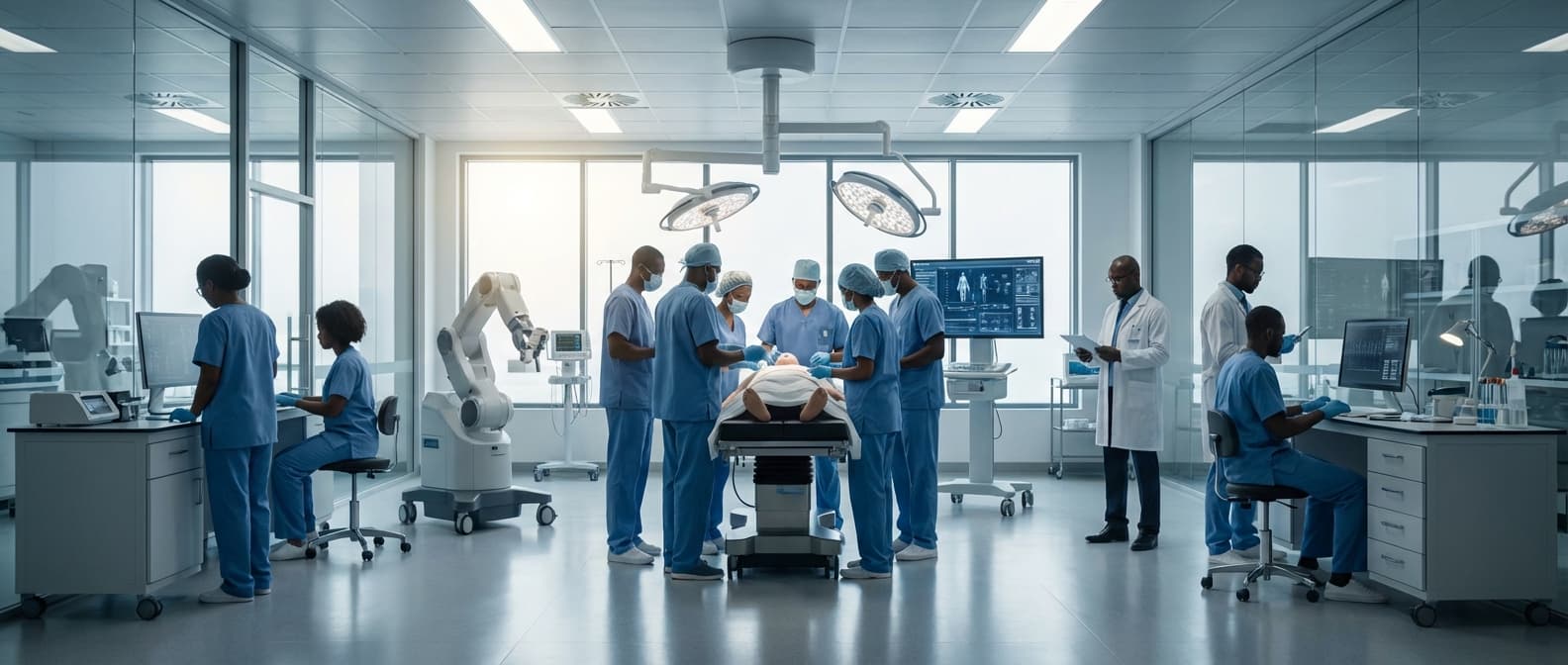
Biomedical Engineering Consulting in Burkina Faso
Engineering Excellence & Technical Support
Equipment selection, procurement and implementation consulting High-standard technical execution following OEM protocols and local regulatory frameworks.
Enhancing Healthcare Infrastructure & Accessibility
We specialize in optimizing existing and designing new healthcare facilities, ensuring optimal patient flow, efficient equipment placement, and adherence to international standards. Our expertise extends to developing sustainable solutions for remote and underserved areas, bridging the accessibility gap in rural Burkina Faso through innovative medical device deployment and localized maintenance strategies.
Optimizing Diagnostic & Therapeutic Capabilities
Leveraging cutting-edge biomedical engineering principles, we assess, select, and implement appropriate diagnostic and therapeutic technologies tailored to Burkina Faso's unique epidemiological landscape and resource constraints. This includes developing robust protocols for equipment calibration, validation, and user training to maximize diagnostic accuracy and treatment efficacy.
Building Local Capacity & Sustainable Solutions
Our approach prioritizes knowledge transfer and capacity building. We offer comprehensive training programs for local healthcare professionals and technicians in the operation, maintenance, and basic repair of medical equipment. By fostering local expertise, we ensure the long-term sustainability and cost-effectiveness of biomedical technology within Burkina Faso's healthcare system.
What Is Biomedical Engineering Consulting In Burkina Faso?
Biomedical Engineering Consulting in Burkina Faso is a specialized professional service that applies engineering principles to healthcare and medical technology within the specific socio-economic and regulatory context of Burkina Faso. It encompasses a broad range of activities aimed at optimizing the use, management, and development of medical devices and healthcare infrastructure. This service is critical for ensuring the safety, efficacy, and sustainability of medical technologies, ultimately contributing to improved patient care and public health outcomes in the nation.
| Who Needs Biomedical Engineering Consulting? | Typical Use Cases |
|---|---|
| Public and Private Hospitals: (e.g., CHU Yalgado Ouédraogo, Hôpital Privé La Concorde) | Needs assessment for new equipment, validation of existing device performance, development of preventative maintenance programs, compliance with national medical device regulations, training of biomedical technicians. |
| Clinics and Health Centers: (e.g., Dispensaires, Centres Médicaux avec Unités de Soins Ambulatoires - CMA) | Guidance on appropriate and cost-effective equipment selection, basic maintenance strategies, ensuring equipment safety for patients and staff. |
| Medical Device Manufacturers and Distributors: (e.g., Local importers, international suppliers with presence) | Support with product registration, understanding local regulatory requirements, post-market surveillance strategies, technical training for local partners. |
| Government Ministries of Health: (e.g., Ministère de la Santé et de l'Hygiène Publique) | Development of national medical technology policies, procurement strategies for public health programs, establishment of regulatory frameworks, capacity building initiatives for the biomedical workforce. |
| Non-Governmental Organizations (NGOs) and International Development Agencies: (e.g., WHO, Médecins Sans Frontières) | Assistance in deploying and managing medical equipment in humanitarian or development projects, ensuring sustainability of interventions, infrastructure assessment for new project sites. |
| Research Institutions and Universities: (e.g., Université Joseph Ki-Zerbo, Institut Supérieur des Sciences de la Population) | Technical consultation for setting up research laboratories, advice on specialized scientific equipment, collaboration on projects involving medical technology innovation. |
Key Aspects of Biomedical Engineering Consulting in Burkina Faso
- Technical Expertise Provision: Offering specialized knowledge in the design, selection, installation, maintenance, and troubleshooting of medical equipment.
- Regulatory Compliance Guidance: Assisting healthcare facilities and manufacturers in navigating and adhering to national and international standards and regulations pertaining to medical devices and healthcare facilities.
- Infrastructure Assessment and Planning: Evaluating existing healthcare infrastructure and advising on the optimal procurement, integration, and utilization of medical technology.
- Training and Capacity Building: Developing and delivering training programs for healthcare professionals, technicians, and administrators on the safe and effective operation and maintenance of medical equipment.
- Procurement and Asset Management: Supporting the strategic acquisition of medical equipment, including needs assessment, vendor evaluation, and lifecycle management.
- Quality Assurance and Risk Management: Implementing systems to ensure the quality and safety of medical devices and processes, including risk assessment and mitigation strategies.
- Research and Development Support: Providing technical expertise for local innovation and adaptation of medical technologies to meet specific healthcare challenges in Burkina Faso.
- Healthcare Facility Design and Optimization: Advising on the architectural and engineering aspects of healthcare facilities to ensure efficient workflow, patient safety, and technology integration.
Who Needs Biomedical Engineering Consulting In Burkina Faso?
Biomedical Engineering Consulting plays a crucial role in advancing healthcare infrastructure and capabilities within Burkina Faso. Identifying the right target customers and departments is essential for ensuring the effective deployment of these services. These consultations can bridge gaps in technical expertise, improve equipment management, enhance patient safety, and ultimately contribute to better health outcomes for the population.
| Department/Unit | Key Needs and Consulting Focus |
|---|---|
| Clinical Engineering/Biomedical Department: | Equipment lifecycle management, preventive maintenance planning, repair and troubleshooting, risk assessment and mitigation, staff training on equipment use and basic maintenance. |
| Procurement/Logistics Department: | Needs assessment for new equipment, technical specifications development, vendor evaluation, contract negotiation, and ensuring compliance with standards. |
| Infection Prevention and Control: | Ensuring medical equipment is properly cleaned, sterilized, and maintained to prevent healthcare-associated infections. Consulting on the appropriate use and maintenance of sterilization equipment. |
| Information Technology (IT) Department (in healthcare settings): | Integration of medical devices with hospital information systems (HIS), cybersecurity for medical devices, management of networked medical equipment. |
| Quality Assurance/Management Department: | Developing and implementing quality control procedures for medical equipment, ensuring compliance with national and international safety standards, accreditation support. |
| Capital Planning and Infrastructure Development: | Designing and planning for new medical facilities or renovations, including the integration of medical gas systems, electrical infrastructure, and optimal equipment placement. |
| Training and Education Department: | Developing training programs for healthcare professionals on the safe and effective use of medical equipment, and for biomedical technicians on maintenance and repair. |
Target Customers and Departments for Biomedical Engineering Consulting in Burkina Faso
- Public Healthcare Facilities: From national referral hospitals to regional and district hospitals, these institutions are often the primary beneficiaries of biomedical engineering expertise. They require support in maintaining, repairing, and upgrading a wide range of medical equipment.
- Private Healthcare Providers: As the private sector grows, so does the need for specialized biomedical engineering services to ensure the quality and safety of their medical equipment and facilities.
- Ministry of Health and Public Health Agencies: These governmental bodies are responsible for setting healthcare policy, standards, and overseeing the national health system. Consulting can assist them in strategic planning for medical equipment procurement, infrastructure development, and regulatory frameworks.
- Non-Governmental Organizations (NGOs) and International Development Partners: Organizations actively involved in healthcare projects and initiatives in Burkina Faso often require biomedical engineering expertise to support their programs, from setting up new clinics to maintaining donated equipment.
- Medical Training and Research Institutions: Universities and research centers involved in medical education and research need access to functional and advanced medical equipment. Biomedical engineering consultants can help them acquire, install, and maintain specialized research apparatus.
- Medical Equipment Manufacturers and Distributors: Companies that supply medical equipment to Burkina Faso can benefit from consulting services to understand local market needs, provide effective after-sales support, and navigate regulatory requirements.
Biomedical Engineering Consulting Process In Burkina Faso
The workflow for biomedical engineering consulting in Burkina Faso, from initial inquiry to project execution, involves a structured and collaborative process. It begins with understanding the client's needs and ends with the successful implementation and delivery of tailored solutions. This process emphasizes clear communication, thorough assessment, strategic planning, and diligent execution, adapted to the specific context and resources available in Burkina Faso.
| Stage | Description | Key Activities | Deliverables/Outcomes |
|---|---|---|---|
| Inquiry and Initial Consultation | The client initiates contact to discuss their needs, challenges, or project ideas related to biomedical engineering. | Understanding the client's background, scope of interest, and preliminary requirements. Initial discussion to gauge mutual fit. | Clarified understanding of the client's general needs. Decision to proceed to next stage. |
| Needs Assessment and Feasibility Study | A deep dive into the client's specific requirements, existing infrastructure, operational context, and budget. This stage determines the viability of the proposed solutions. | Site visits (if applicable), interviews with stakeholders, analysis of existing equipment and facilities, identification of gaps, risk assessment, and preliminary technical and financial feasibility analysis. | Detailed needs assessment report. Feasibility study report outlining potential solutions, their benefits, costs, and risks. Recommendation on project scope. |
| Proposal Development and Negotiation | Based on the needs assessment, a comprehensive proposal is developed, outlining the scope of work, methodology, timelines, budget, and expected outcomes. | Developing technical specifications, defining project phases, creating a detailed budget, outlining the project team and their roles, and presenting the proposal to the client. Negotiation of terms and conditions. | Formal project proposal. Agreed-upon scope of work, timeline, and budget. Signed contract or Letter of Agreement. |
| Project Planning and Design | Detailed planning and design of the agreed-upon solutions. This involves technical specifications, blueprints, and action plans. | Detailed engineering design (e.g., for equipment customization, facility modification), development of project management plans, resource allocation, and creation of detailed implementation schedules. | Finalized design documents. Comprehensive project plan. Procurement specifications. |
| Procurement and Installation | Acquisition of necessary equipment, materials, and technology, followed by their installation and integration into the client's environment. | Sourcing and purchasing of equipment/materials, logistics and shipping, site preparation, installation, and initial configuration of systems. | Installed equipment/systems. Verified functionality of individual components. |
| Training and Capacity Building | Educating the client's staff on the operation, maintenance, and troubleshooting of new equipment and systems. | Development of training materials, delivery of hands-on training sessions, workshops, and practical demonstrations. Focus on sustainability and local ownership. | Trained personnel. Competency assessments. Training manuals and resources. |
| Implementation and Testing | The full integration and testing of the designed solutions within the client's operational environment to ensure they meet the defined objectives. | System integration, comprehensive testing (performance, safety, reliability), validation against requirements, and initial operational adjustments. | Fully implemented and tested solutions. Validation reports. Performance metrics. |
| Project Closeout and Handover | Formal completion of the project, including final documentation and the official transfer of responsibilities to the client. | Final project documentation (as-built drawings, manuals), financial reconciliation, final acceptance by the client, and handover of all project-related assets and knowledge. | Project completion report. Final documentation package. Client acceptance sign-off. |
| Post-Implementation Support and Evaluation | Ongoing support to ensure the continued success of the implemented solutions and evaluation of the project's impact. | Troubleshooting, maintenance support, performance monitoring, impact assessment, and collection of feedback for continuous improvement. Potential for further phases or upgrades. | Ongoing client satisfaction. Documented project impact. Recommendations for future development. |
Biomedical Engineering Consulting Workflow
- Inquiry and Initial Consultation
- Needs Assessment and Feasibility Study
- Proposal Development and Negotiation
- Project Planning and Design
- Procurement and Installation
- Training and Capacity Building
- Implementation and Testing
- Project Closeout and Handover
- Post-Implementation Support and Evaluation
Biomedical Engineering Consulting Cost In Burkina Faso
Biomedical engineering consulting costs in Burkina Faso can vary significantly based on a number of factors. These include the specific expertise required, the scope and complexity of the project, the duration of the engagement, and the experience level of the consultant. Local market conditions, the consultant's reputation, and overhead costs also play a role. Projects requiring highly specialized knowledge in areas like medical device design, regulatory affairs, or advanced imaging technology will naturally command higher fees than general equipment maintenance or training.
Pricing Factors in Burkina Faso:
- Expertise Specialization: The more niche and in-demand the biomedical engineering specialty, the higher the hourly or project rate.
- Project Scope and Complexity: Large-scale hospital equipment planning, new facility design, or complex validation studies will be priced higher than smaller, defined tasks.
- Consultant Experience & Reputation: Highly experienced and reputable consultants with a proven track record will charge premium rates.
- Duration of Engagement: Longer-term projects may offer slightly reduced hourly rates but will have a higher overall cost.
- Travel and Living Expenses: If the consultant needs to travel within Burkina Faso or internationally, these costs will be factored in.
- Market Demand & Supply: The availability of local qualified biomedical engineers can influence pricing.
- Client Type: Large governmental or international organizations might have different budget expectations than smaller private clinics.
- Urgency: Rush projects often incur additional fees.
Estimated Cost Ranges (in West African CFA Francs - XOF):
It's crucial to note that these are estimated ranges and actual costs can fall outside of these. Obtaining detailed quotes from multiple consultants is highly recommended.
- Hourly Rates: For general consulting or less specialized tasks, expect rates to range from 15,000 XOF to 50,000 XOF per hour. Highly specialized or senior consultants could charge upwards of 75,000 XOF per hour.
- Project-Based Fees: For defined projects, the total cost can vary dramatically. A basic equipment needs assessment might range from 250,000 XOF to 1,000,000 XOF. Larger projects, such as planning for a new hospital wing's medical equipment, could cost anywhere from 5,000,000 XOF to 20,000,000 XOF or more, depending on the scale and complexity.
- Retainers: For ongoing advice or support, monthly retainers can be negotiated, often with a reduced hourly rate for work performed. These could range from 100,000 XOF to 500,000 XOF per month for limited support, escalating for more comprehensive packages.
| Service Type / Duration | Estimated Cost Range (XOF) | Notes |
|---|---|---|
| Hourly Rate (General Consulting) | 15,000 - 50,000 XOF | Applicable for less specialized tasks, ongoing advice |
| Hourly Rate (Specialized/Senior Consultant) | 50,000 - 75,000+ XOF | For niche expertise, complex problem-solving, and high-level strategy |
| Project Fee (Basic Needs Assessment) | 250,000 - 1,000,000 XOF | Assessing immediate equipment requirements for a department |
| Project Fee (Mid-size Project e.g., Equipment Planning for a Clinic Wing) | 1,000,000 - 5,000,000 XOF | Involves detailed planning, vendor selection support |
| Project Fee (Large-scale e.g., Hospital-wide Equipment Master Plan) | 5,000,000 - 20,000,000+ XOF | Comprehensive planning for new facilities or major upgrades |
| Monthly Retainer (Limited Support) | 100,000 - 500,000 XOF | For ongoing advisory services, periodic reviews |
Key Pricing Factors for Biomedical Engineering Consulting in Burkina Faso
- Expertise Specialization and Demand
- Project Scope, Size, and Complexity
- Consultant's Experience Level and Reputation
- Duration of the Consulting Engagement
- Inclusion of Travel and Living Expenses
- Local Market Dynamics (Supply & Demand)
- Client's Organizational Type and Budget
- Project Urgency and Timeline Requirements
Affordable Biomedical Engineering Consulting Options
Biomedical engineering consulting can be a vital resource for startups, research institutions, and established companies seeking expertise in product development, regulatory affairs, quality systems, market analysis, and more. However, the perceived cost can be a barrier. Fortunately, there are several affordable options and strategies to leverage consulting services without breaking the bank. This guide explores value bundles and cost-saving strategies to make expert biomedical engineering advice accessible.
| Cost-Saving Strategy | Description | Benefit |
|---|---|---|
| Define Scope Precisely | Clearly articulate project goals, deliverables, and timelines before engaging a consultant. Avoid scope creep. | Minimizes wasted time and resources, leading to a more accurate quote and efficient project execution. |
| Leverage Freelance or Boutique Firms | Consider independent consultants or smaller, specialized firms who often have lower overhead than large corporations. | Can offer competitive pricing for niche expertise without compromising quality. |
| Phased Engagements | Break down large projects into smaller, manageable phases, engaging consultants for specific tasks rather than the entire project lifecycle. | Allows for budget control and the ability to assess value at each stage before committing further. |
| Internal Knowledge Augmentation | Use consultants to train or upskill internal teams on specific topics or processes, rather than relying on them for every task. | Builds long-term internal capacity and reduces future reliance on external help. |
| Remote Consulting | Embrace virtual meetings and digital collaboration tools to reduce travel and associated costs. | Significant savings on travel expenses, accommodation, and per diems. |
| Shared Resources | If applicable, explore collaborations with other organizations to share consulting costs for common needs (e.g., regulatory training). | Divides the expense, making expert advice more affordable for all parties involved. |
| Negotiate Terms | Don't hesitate to discuss pricing, payment schedules, and contract terms with potential consultants. | Can lead to more favorable rates, flexible payment options, or bundled discounts. |
| Focus on High-Impact Areas | Prioritize consulting engagements where the expertise will have the most significant positive impact on your product or business. | Ensures that your investment is directed towards areas that offer the greatest return. |
Understanding Value Bundles
- {"title":"Project-Based Bundles","description":"These are pre-defined packages of services tailored to common project phases, such as initial feasibility studies, prototype development, or regulatory submission preparation. They offer a fixed scope and price, providing cost certainty."}
- {"title":"Retainer Bundles","description":"A set number of consulting hours or days purchased in advance at a discounted rate. This is ideal for ongoing advice, regular check-ins, or when an organization anticipates a consistent need for expertise over a period."}
- {"title":"Outcome-Based Bundles","description":"While less common, some consultants offer packages tied to specific project outcomes or milestones. This can involve a base fee plus a success fee, aligning the consultant's interests with the client's success."}
- {"title":"Specialty Service Bundles","description":"Combining multiple related services into one package. For instance, a bundle might include design control documentation, risk management, and biocompatibility testing guidance for a new medical device."}
Verified Providers In Burkina Faso
In Burkina Faso, identifying truly verified healthcare providers is paramount for ensuring quality and trustworthy medical services. Franance Health stands out as a leading entity in this regard, not only by meticulously vetting its network but also by upholding stringent credentialing processes. This commitment to verification means that every provider associated with Franance Health has undergone a rigorous assessment, guaranteeing their qualifications, licenses, and ethical standing. Choosing a Franance Health-verified provider offers unparalleled peace of mind, knowing you are receiving care from competent and reputable professionals. Their transparent and robust credentialing framework sets a benchmark for excellence in the Burkinabe healthcare landscape.
| Credential Type | Franance Health Verification Standard | Benefit to Patients |
|---|---|---|
| Medical Licenses | Mandatory and current within Burkina Faso. | Ensures providers are legally authorized to practice. |
| Specialty Certifications | Verified through accredited institutions. | Confirms expertise in specific medical fields. |
| Continuing Medical Education (CME) | Proof of participation in accredited CME programs. | Guarantees providers stay updated with the latest medical advancements. |
| Professional Affiliations | Membership in recognized medical associations. | Indicates adherence to professional best practices and ethical codes. |
| Clean Disciplinary Record | Background checks for any past malpractice or ethical violations. | Protects patients from potentially harmful practitioners. |
Why Franance Health Credentials Matter
- Rigorous Qualification Checks: Franance Health verifies medical licenses, educational degrees, and specialized training of all listed providers.
- Professional Background Screening: A thorough review of professional history and disciplinary actions ensures providers meet ethical standards.
- Continuous Performance Monitoring: Ongoing evaluation of patient feedback and clinical outcomes helps maintain high service quality.
- Compliance with National Regulations: All providers are confirmed to adhere to Burkina Faso's healthcare laws and regulations.
- Patient Safety Focus: The credentialing process prioritizes patient safety through the selection of skilled and responsible practitioners.
Scope Of Work For Biomedical Engineering Consulting
This Scope of Work outlines the consulting services to be provided by [Your Consulting Firm Name] (hereinafter referred to as 'Consultant') to [Client Company Name] (hereinafter referred to as 'Client') in the field of Biomedical Engineering. The engagement will focus on [briefly describe the primary area of focus, e.g., developing a novel medical device, optimizing an existing manufacturing process, regulatory strategy for a new product].
| Technical Deliverable | Description | Standard Specifications/Guidelines | Timeline (Estimated) |
|---|---|---|---|
| Feasibility Report | Detailed analysis of technical viability, market potential, and risk assessment for the proposed [product/process]. | Internal Client Standards, Industry Best Practices, [Specific regulatory guidance documents if applicable, e.g., FDA QSR, ISO 13485] | Weeks 1-4 |
| Conceptual Design Document | High-level design of the [medical device/system], including functional requirements, key features, and architectural overview. | ISO 13485, IEC 60601 (for electrical medical equipment), [Other relevant standards] | Weeks 5-8 |
| Risk Management Plan | Identification, evaluation, and mitigation of potential risks associated with the design, manufacturing, and use of the [product/process]. | ISO 14971 | Weeks 6-9 |
| Regulatory Pathway Assessment | Identification of applicable regulatory bodies (e.g., FDA, EMA), classification of the device, and recommended regulatory submission strategy. | FDA 21 CFR Part 820, EU MDR (Regulation (EU) 2017/745), [Country-specific regulations] | Weeks 8-12 |
| Design History File (DHF) Outline/Structure | Template and guidance for organizing all design and development records in compliance with regulatory requirements. | FDA 21 CFR Part 820.30 | Weeks 10-13 |
| Verification and Validation (V&V) Test Plan | Detailed plan for testing the [product/process] to ensure it meets design specifications (verification) and user needs (validation). | ISO 13485, IEC 62304 (for software), User Needs Documentation | Weeks 14-17 |
| Final Consulting Report and Recommendations | Comprehensive summary of project activities, findings, and actionable recommendations for the Client's next steps. | Internal Client Standards, Industry Best Practices | Week 18 |
Project Phases and Key Activities
- Phase 1: Needs Assessment and Feasibility Study
- Phase 2: Design and Development Support
- Phase 3: Regulatory Strategy and Documentation
- Phase 4: Testing and Validation Planning
- Phase 5: Project Closure and Knowledge Transfer
Service Level Agreement For Biomedical Engineering Consulting
This Service Level Agreement (SLA) outlines the guaranteed response times and uptime for biomedical engineering consulting services provided by [Consulting Company Name] (hereinafter referred to as "Consultant") to [Client Name] (hereinafter referred to as "Client"). This SLA is an appendix to the main consulting agreement between the parties.
| Service Component | Severity Level | Response Time Guarantee (Business Hours) | Target Resolution Time (Business Hours) | Uptime Guarantee |
|---|---|---|---|---|
| Core Consulting Deliverables (e.g., design documents, validation protocols, risk management plans) | Level 1 (Critical) | 1 Hour | 4 Business Hours | 99.5% |
| Core Consulting Deliverables | Level 2 (High) | 2 Business Hours | 8 Business Hours | 99.5% |
| Core Consulting Deliverables | Level 3 (Medium) | 4 Business Hours | 24 Business Hours | 99.5% |
| General Inquiries/Requests for Information | Level 4 (Low) | 8 Business Hours | 48 Business Hours | N/A (Not applicable to uptime guarantee) |
| Consultant Provided Software/Tools (if applicable) | Level 1 (Critical) | 1 Hour | 4 Business Hours | 99.5% |
| Consultant Provided Software/Tools (if applicable) | Level 2 (High) | 2 Business Hours | 8 Business Hours | 99.5% |
Key Definitions
- {"term":"Business Hours","definition":"Monday through Friday, 9:00 AM to 5:00 PM Eastern Standard Time (EST), excluding public holidays observed by the Consultant."}
- {"term":"Incident","definition":"Any event that disrupts or degrades the agreed-upon level of service or functionality related to the consulting engagement."}
- {"term":"Severity Level 1 (Critical)","definition":"A major service disruption where the core functionality of the consulting engagement is unavailable, impacting the Client's critical operations. This typically involves a complete system failure or a significant regulatory compliance risk."}
- {"term":"Severity Level 2 (High)","definition":"A significant service disruption where a major feature or functionality is unavailable or severely degraded, causing substantial impact to the Client's operations, but not a complete outage. This might involve significant delays in project timelines or a non-critical regulatory compliance issue."}
- {"term":"Severity Level 3 (Medium)","definition":"A minor service disruption where a non-essential feature or functionality is unavailable or degraded, causing minimal impact to the Client's operations. This could be an inconvenience or a minor deviation from expected performance."}
- {"term":"Severity Level 4 (Low)","definition":"A general inquiry, request for information, or a minor bug report with no immediate impact on service functionality or Client operations."}
- {"term":"Response Time","definition":"The maximum time elapsed between the Client reporting an Incident and the Consultant acknowledging the report and initiating work to resolve the Incident."}
- {"term":"Resolution Time","definition":"The target time elapsed between the Consultant acknowledging an Incident and providing a solution or workaround that restores the service to an acceptable level."}
- {"term":"Uptime Guarantee","definition":"The percentage of time during the agreed-upon service period that the consulting services and any agreed-upon deliverables are available and performing as expected."}
Frequently Asked Questions

Ready when you are
Let's scope your Biomedical Engineering Consulting in Burkina Faso project in Burkina Faso.

Scaling healthcare logistics and technical systems across the entire continent.