
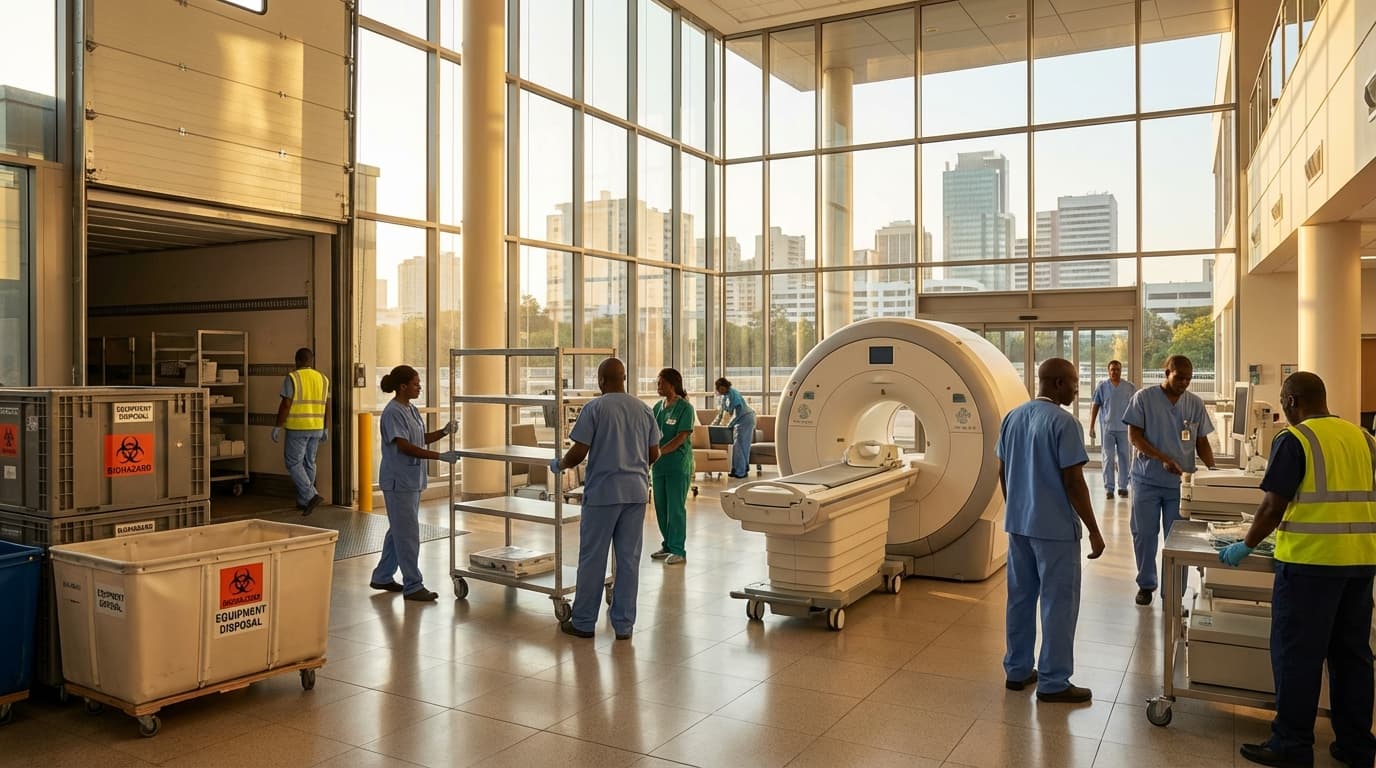
Heavy Medical Equipment De-Installation Service (MRI/CT/Cath Lab) in Botswana
Engineering Excellence & Technical Support
Heavy Medical Equipment De-Installation Service (MRI/CT/Cath Lab) High-standard technical execution following OEM protocols and local regulatory frameworks.
Precision Component Mapping & Tagging
Our certified technicians meticulously map and tag every component of complex medical equipment (MRI, CT, Cath Lab) during de-installation. This ensures accurate inventory, facilitates safe transport, and streamlines re-installation at the new location, minimizing downtime and preventing loss of critical parts.
Hazardous Material Handling Expertise
We adhere to stringent safety protocols for the handling and disposal of potentially hazardous materials commonly found in medical imaging equipment, such as cryogens in MRI machines and lead shielding. Our trained personnel in Botswana ensure compliance with local and international regulations, safeguarding personnel and the environment.
Specialized Logistics & Transportation Planning
Leveraging our experience in Botswana's unique logistical landscape, we develop customized transportation plans for oversized and delicate medical equipment. This includes coordinating specialized vehicle requirements, route surveys, and secure loading/unloading procedures to guarantee the safe and timely arrival of your high-value assets.
What Is Heavy Medical Equipment De-installation Service (Mri/ct/cath Lab) In Botswana?
Heavy medical equipment de-installation service, particularly for MRI, CT, and Cath Lab systems in Botswana, refers to the specialized process of safely and systematically dismantling, preparing, and packaging large, complex, and sensitive imaging and interventional diagnostic equipment for relocation, storage, or disposal. This service is critical for maintaining equipment integrity, ensuring compliance with safety regulations, and mitigating risks associated with handling high-value, technologically advanced machinery. The scope of work typically encompasses the disconnection of power, data, and ancillary systems; the removal of superconducting magnets (for MRI); the disassembly of gantry components; the secure packaging of delicate parts; and the logistical coordination for transport. Expertise in electromagnetic shielding, radiation safety, and precise mechanical handling is paramount.
| Who Needs This Service | Typical Use Cases | ||||
|---|---|---|---|---|---|
| Hospitals and diagnostic imaging centers in Botswana undertaking equipment upgrades or replacements. | Relocation of a hospital or imaging facility to a new site. | Sale or transfer of used medical equipment to another healthcare provider. | Consolidation or decommissioning of medical imaging departments. | Equipment undergoing major servicing or refurbishment off-site. | Disposal of obsolete or non-functional heavy medical imaging systems in compliance with environmental regulations. |
| Hospital administration and facilities management departments. | Medical imaging department managers and radiologists. | Procurement and asset management teams. | Third-party medical equipment service providers and asset remarketers. | Regulatory bodies overseeing healthcare infrastructure and radiation safety. |
Key Components of Heavy Medical Equipment De-Installation
- Site assessment and planning
- De-energization and safety lockout/tagout procedures
- Systematic disassembly of major components (e.g., magnet, gantry, patient table, console)
- Coolant and cryogen management (e.g., helium for MRI)
- Specialized lifting and rigging operations
- Secure packaging and crating of sensitive components
- Environmental control and protection during de-installation
- Documentation of de-installation process and equipment status
- Logistical coordination for transportation
- Compliance with radiation safety regulations
Who Needs Heavy Medical Equipment De-installation Service (Mri/ct/cath Lab) In Botswana?
The de-installation of heavy medical equipment like MRI, CT scanners, and Cath Labs is a complex and specialized undertaking. It requires meticulous planning, expert knowledge, specialized tools, and strict adherence to safety protocols. This service is crucial for a variety of institutions in Botswana that operate or intend to upgrade these advanced diagnostic and interventional suites. Ensuring a safe, efficient, and compliant de-installation process is paramount to prevent damage to valuable equipment, minimize downtime, and protect personnel and the environment.
| Target Customer | Relevant Departments | Reasons for De-Installation |
|---|---|---|
| Public Hospitals (e.g., Princess Marina Hospital, Nyangabgwe Referral Hospital) | Radiology Department, Cardiology Department, Medical Engineering Department | Equipment upgrades/replacements, relocation of units within the hospital, decommissioning of old equipment for disposal or sale. |
| Private Hospitals (e.g., Bokamoso Private Hospital, Gaborone Private Hospital) | Radiology Department, Cardiology Department, Biomedical Engineering Department | Technological advancements requiring newer models, expansion of services, facility renovations, or closure of specific departments. |
| Specialized Diagnostic Imaging Centers | Radiology Department, Imaging Services Management | Upgrading to higher resolution or advanced functionality scanners, lease-end returns, or relocation to new facilities. |
| Tertiary Healthcare Facilities | Multiple departments depending on equipment type (e.g., Neurology, Oncology, Cardiology) | Consolidation of services, integration of new technologies, or strategic reallocation of resources. |
| Medical Equipment Suppliers/Installers | Technical Services, Logistics Department | Managing the removal of old equipment after installation of new units for their clients, or handling equipment for export/resale. |
| Government Health Ministries | Procurement and Asset Management, Public Health Infrastructure Planning | Overseeing the management and decommissioning of aging public medical infrastructure, facilitating upgrades across the national healthcare system. |
Who Needs Heavy Medical Equipment De-Installation Service (MRI/CT/Cath Lab) in Botswana?
- Hospitals (Public and Private)
- Specialized Diagnostic Imaging Centers
- Tertiary Healthcare Facilities
- Research Institutions (if applicable)
- Medical Equipment Suppliers/Installers (for relocation or disposal)
- Government Health Ministries (for public healthcare infrastructure management)
Heavy Medical Equipment De-installation Service (Mri/ct/cath Lab) Process In Botswana
This document outlines the comprehensive workflow for the Heavy Medical Equipment De-Installation Service (MRI/CT/Cath Lab) in Botswana, from the initial inquiry to the successful execution of the de-installation. Our process is designed to be thorough, efficient, and compliant with all relevant safety and regulatory standards, ensuring a seamless transition for our clients.
| Stage | Description | Key Activities | Deliverables | Responsible Party |
|---|---|---|---|---|
| The client expresses interest in de-installing heavy medical equipment. | Receive client's request, gather preliminary information about the equipment (type, model, location), and understand the project's scope and urgency. | Initial confirmation of service inquiry, basic project understanding. | Client, Service Provider Sales/Inquiry Team |
| A detailed on-site evaluation to assess the feasibility and requirements of the de-installation. | Conduct thorough site inspection, assess access routes, power requirements, structural integrity, existing infrastructure, and safety hazards. Develop a detailed de-installation plan, including specialized tools, lifting equipment, and personnel requirements. Identify any potential challenges or special considerations. | Detailed site survey report, preliminary de-installation plan, risk assessment, logistical plan. | Service Provider Technical Team, Site Management |
| Based on the site survey and plan, a formal proposal is submitted to the client. | Develop a comprehensive quotation detailing scope of work, timeline, costs, terms and conditions. Negotiate and finalize the service agreement with the client. | Formal quotation, signed service agreement, payment schedule. | Service Provider Sales/Project Management, Client Procurement/Management |
| All necessary preparations are made to ensure a safe and efficient de-installation. | Secure all necessary permits and approvals, schedule de-installation dates, procure specialized tools and equipment, organize logistics for transportation of equipment and personnel, conduct pre-de-installation safety briefings, communicate with facility management and relevant stakeholders. | Permits and approvals, confirmed schedule, all required equipment and tools on-site, pre-de-installation briefings completed. | Service Provider Project Management, Site Management, Relevant Authorities |
| The physical de-installation of the heavy medical equipment. | Safely disconnect power and ancillary services, dismantle the equipment according to manufacturer specifications and best practices, carefully remove components, package and secure equipment for transport, ensure adherence to all safety protocols throughout the process. | Dismantled and safely packaged equipment, de-installation completed. | Service Provider Technical De-Installation Crew, Site Safety Officer |
| Restoration of the de-installation site to its agreed-upon condition and formal handover. | Remove all temporary structures and debris, ensure the site is clean and safe, conduct a final inspection with the client, address any minor site remediation needs, and formally hand over the site. | Clean and safe de-installation site, signed handover certificate. | Service Provider De-Installation Crew, Site Management, Client Representative |
| Ongoing support and administrative closure of the project. | Provide necessary documentation (e.g., de-installation certificates, waste disposal records), address any post-project queries from the client, and complete project administrative tasks. | Project completion documentation, client satisfaction confirmation. | Service Provider Project Management, Administration |
Key Stages of the De-Installation Process
- Inquiry & Initial Assessment
- Site Survey & Planning
- Quotation & Agreement
- Pre-De-Installation Preparations
- Equipment De-Installation
- Site Remediation & Handover
- Post-De-Installation Support
Heavy Medical Equipment De-installation Service (Mri/ct/cath Lab) Cost In Botswana
The cost of heavy medical equipment de-installation services for MRI, CT scanners, and Cath Labs in Botswana is a complex undertaking influenced by several critical factors. These specialized services require skilled technicians, precise handling, and adherence to strict safety and environmental protocols. The pricing is not standardized and will vary significantly based on the specific equipment, location, and the complexity of the de-installation process. Understanding these factors is crucial for budgeting and planning such critical medical infrastructure projects.
| Equipment Type | Estimated De-Installation Cost Range (BWP) | Notes |
|---|---|---|
| MRI Scanner | BWP 50,000 - BWP 250,000+ | Highly complex due to magnet removal, shielding, and specialized cooling systems. Costs can escalate significantly with larger magnet strengths and difficult site access. |
| CT Scanner | BWP 30,000 - BWP 150,000+ | Involves careful dismantling of the gantry, table, and associated electronics. Transportation and site access are key drivers of cost. |
| Cath Lab (Angiography System) | BWP 40,000 - BWP 200,000+ | Complex system with heavy X-ray generators, C-arms, and patient monitoring equipment. Requires specialized rigging and careful handling of delicate components. |
Key Pricing Factors for Heavy Medical Equipment De-Installation in Botswana:
- Equipment Type and Size: Different modalities have varying complexities. MRI machines, with their powerful magnets, are notoriously challenging to de-install and transport. CT scanners and Cath Labs also have unique structural and technical requirements.
- Dismantling Complexity: The extent to which the equipment needs to be disassembled. This includes the number of components, the need for specialized tools, and the time required for careful separation and packaging.
- Logistics and Transportation: The distance the equipment needs to be moved, the accessibility of the site (e.g., ground floor vs. high-rise, narrow corridors), and the need for specialized transport vehicles (e.g., cranes, heavy-duty trucks).
- Site Preparation and Remediation: This can include structural modifications required for removal, disposal of hazardous materials (e.g., refrigerants from MRI/CT units), and any necessary site restoration after removal.
- Technical Expertise and Personnel: The number of specialized technicians required, their skill levels, and the duration of their engagement directly impact labor costs.
- Safety and Regulatory Compliance: Adherence to Botswana's occupational health and safety regulations, as well as any specific environmental regulations related to the disposal of certain components, adds to the cost.
- Time Constraints and Urgency: If the de-installation needs to be completed within a tight deadline, premium charges may apply.
- Permits and Approvals: Obtaining necessary permits for heavy lifting, transportation, or environmental disposal can incur administrative fees.
- Insurance and Risk Management: Comprehensive insurance coverage for the de-installation process is essential and contributes to the overall cost.
- Service Provider's Overhead and Reputation: Established companies with a proven track record and robust infrastructure may command higher prices, reflecting their reliability and quality of service.
Affordable Heavy Medical Equipment De-installation Service (Mri/ct/cath Lab) Options
When it comes to de-installing large and complex medical equipment like MRIs, CT scanners, and Cath Labs, finding an affordable service is crucial. Hospitals and imaging centers often need to relocate, upgrade, or decommission these valuable assets, and de-installation is a specialized process that requires expertise, precision, and adherence to strict safety protocols. This service goes beyond simple removal; it involves meticulous disassembly, careful packing, and preparation for transport, all while minimizing downtime and risk. Exploring options that offer value bundles and implementing cost-saving strategies can significantly reduce the overall expense associated with these projects.
| Value Bundle Option | Included Services | Potential Cost Savings | Ideal For |
|---|---|---|---|
| Basic De-installation & Removal | De-installation, basic packing, and removal from the site. | Lower upfront cost. | Situations where no further transport or storage is immediately required, or client handles onward logistics. |
| De-installation & On-site Crating | De-installation, meticulous packing/crating of components on-site. | Reduces risk of damage during subsequent handling. | Clients planning to move equipment themselves or using a separate logistics provider. |
| Full-Service De-installation & Logistics Coordination | De-installation, expert packing/crating, and coordination of transport to a new location or storage facility. | Streamlined process, single point of contact, reduced coordination effort. | Complete end-to-end solution, complex relocations, maximizing efficiency. |
| De-installation with Recycling/Disposal | De-installation and environmentally responsible disposal or recycling of obsolete equipment. | Avoids potential disposal fees and regulatory penalties. | When equipment is at the end of its lifecycle and needs to be retired. |
Key Components of Medical Equipment De-Installation Services
- Specialized Labor: Highly trained technicians with experience in handling sensitive and heavy medical machinery.
- Logistics & Planning: Detailed coordination for scheduling, site assessment, and transportation.
- Disassembly: Careful dismantling of components according to manufacturer specifications.
- Packing & Crating: Secure packaging to protect equipment during transit.
- Rigging & Lifting: Use of specialized equipment for safe lifting and maneuvering.
- Site Restoration: Returning the de-installation area to its original or agreed-upon condition.
- Disposal/Recycling (Optional): Environmentally responsible handling of retired equipment.
- Documentation & Compliance: Ensuring all necessary permits and regulatory requirements are met.
Verified Providers In Botswana
When seeking healthcare services in Botswana, partnering with verified providers is paramount for ensuring quality, safety, and effectiveness of care. Franance Health stands out as a leading example of a credentialed and trusted healthcare partner, offering a superior choice for individuals and organizations. Our rigorous vetting process and commitment to excellence in healthcare delivery make us the preferred option for comprehensive and reliable medical solutions.
| Credential | Description | Franance Health's Assurance |
|---|---|---|
| Medical Licenses | Mandatory for all practicing doctors, nurses, and specialists in Botswana. | Franance Health verifies active and unencumbered medical licenses for all registered practitioners. |
| Professional Certifications | Specialty-specific certifications demonstrating expertise in areas like cardiology, pediatrics, surgery, etc. | We confirm that providers hold relevant and current professional certifications for their respective fields. |
| Educational Qualifications | Degrees and diplomas from accredited institutions, forming the foundation of medical knowledge. | Franance Health validates the authenticity and accreditation of all educational qualifications of our providers. |
| Professional Indemnity Insurance | Essential for protecting patients and providers against unforeseen medical liabilities. | We ensure that all Franance Health partners maintain adequate and up-to-date professional indemnity insurance. |
| Continuing Professional Development (CPD) | Ongoing training and education to stay abreast of medical advancements and best practices. | Franance Health encourages and often requires evidence of ongoing CPD to maintain a high level of expertise. |
| Criminal Record Checks | Ensuring the safety and trustworthiness of healthcare providers, especially those working with vulnerable populations. | Background checks, including criminal record verification, are part of our stringent onboarding process. |
Why Franance Health Represents the Best Choice:
- Unwavering Commitment to Quality: Franance Health prioritizes the highest standards of healthcare. We meticulously select and onboard our providers, ensuring they meet and exceed all relevant industry benchmarks and regulatory requirements within Botswana.
- Extensive Network of Verified Professionals: Our network comprises a diverse range of medical specialists, general practitioners, nurses, and allied health professionals, all thoroughly credentialed and experienced.
- Patient-Centric Approach: We believe in putting the patient first. Franance Health facilitates access to care that is not only medically sound but also compassionate, understanding, and tailored to individual needs.
- Streamlined Access to Care: We simplify the process of finding and accessing healthcare services, connecting you with the right provider efficiently and effectively, minimizing waiting times and administrative hurdles.
- Commitment to Ethical Practices: Integrity and ethical conduct are at the core of Franance Health's operations. We ensure all our partners adhere to strict ethical guidelines, promoting transparency and trust in every interaction.
- Continuous Improvement and Innovation: Franance Health is dedicated to staying at the forefront of medical advancements and best practices. We continuously evaluate and update our processes to ensure we offer the most effective and up-to-date healthcare solutions.
- Peace of Mind: By choosing Franance Health, you gain the assurance that you are receiving care from qualified, reputable, and dedicated healthcare professionals, providing you with invaluable peace of mind.
Scope Of Work For Heavy Medical Equipment De-installation Service (Mri/ct/cath Lab)
This Scope of Work (SOW) outlines the requirements for the de-installation of heavy medical equipment, specifically Magnetic Resonance Imaging (MRI), Computed Tomography (CT), and Cardiac Catheterization (Cath Lab) systems. The service includes all necessary labor, equipment, and expertise to safely and efficiently dismantle, prepare for transport, and prepare the site for subsequent equipment installation or disposal.
| Phase | Activity | Description | Deliverables/Specifications |
|---|---|---|---|
| Site Survey & Assessment | On-site evaluation of the equipment, surrounding environment, power requirements, and access routes. Identification of potential hazards and logistical challenges. | Detailed site survey report including equipment condition, power disconnect points, rigging paths, and any necessary structural modifications. Pre-de-installation checklist completed. |
| De-installation Plan Development | Creation of a detailed, step-by-step plan for the de-installation process, tailored to each specific equipment type and site. | Comprehensive de-installation plan document including sequence of operations, safety protocols, required tools and materials, personnel roles, and estimated timeline. Client approval of the plan. |
| Permits & Notifications | Obtaining all necessary permits and providing required notifications to relevant authorities and hospital departments. | Proof of submitted permit applications or granted permits. Notices sent to facilities management, biomedical engineering, radiation safety, and other affected departments. |
| Power Down & Isolation | Safely shutting down and electrically isolating the equipment from all power sources. | Confirmation of complete power deactivation verified by qualified personnel using appropriate testing equipment. Lockout/Tagout procedures implemented. |
| Component Disassembly | Systematic dismantling of the equipment into manageable sections, following manufacturer guidelines and best practices. | All major components safely separated. Cabling and connections clearly labeled and organized. Manufacturer-specific de-installation manuals followed. |
| Cooling System De-commissioning (MRI Specific) | Safely venting and removing cryogenic coolants (e.g., liquid helium) in accordance with strict safety regulations and environmental protocols. | Empty and inert cooling system. Documentation of coolant disposal by licensed third-party vendor. Compliance with all environmental regulations. |
| Structural Component Removal | Removal of any supporting structures, shielding, or associated infrastructure that is part of the de-installation scope. | Site cleared of de-installation-related structural components. No damage to existing building structures unless specified in the plan. |
| Cleaning & Inspection | Thorough cleaning of all de-installed components and a final inspection for any damage incurred during de-installation. | Clean components ready for packing. Damage report detailing any issues found, with photographic evidence. |
| Crating & Packaging | Appropriate crating and packaging of all components to ensure protection during transit and storage. | Components secured in protective crates or packaging suitable for heavy medical equipment. All packaging clearly labeled with equipment identification and handling instructions. |
| Labeling & Documentation | Clear labeling of all packaged components with serial numbers, equipment type, and destination. Preparation of all required shipping and de-installation documentation. | All crates and packages labeled. Final de-installation report including equipment inventory, serial numbers, photos, and condition assessment. Bill of lading prepared. |
| Site Clean-up | Removal of all tools, equipment, debris, and packaging materials from the de-installation site. | Site left in a clean and safe condition, ready for subsequent activities. All waste disposed of in accordance with regulations. |
| Minor Site Repairs | Repair of any minor cosmetic damage to flooring, walls, or ceilings that occurred during the de-installation process (as defined in the site survey report). | Repairs completed to a pre-de-installation standard. Client sign-off on site condition. |
Key Objectives
- Safe and secure de-installation of complex medical equipment.
- Minimization of downtime for adjacent hospital operations.
- Compliance with all relevant safety, environmental, and regulatory standards.
- Proper documentation of the de-installation process.
- Preparation of the equipment and site for transportation or disposal.
Service Level Agreement For Heavy Medical Equipment De-installation Service (Mri/ct/cath Lab)
This Service Level Agreement (SLA) outlines the response times and uptime guarantees for the de-installation of heavy medical equipment, specifically Magnetic Resonance Imaging (MRI), Computed Tomography (CT), and Cardiac Catheterization (Cath Lab) systems. This SLA is designed to ensure efficient and timely service delivery, minimizing disruption to the healthcare facility's operations.
| Service Event | Response Time (Business Hours) | Uptime Guarantee (N/A for De-installation - replaced with Completion Guarantee) |
|---|---|---|
| Emergency De-installation Request (e.g., facility closure, urgent relocation) | 2 Business Hours | N/A |
| Scheduled De-installation Request (planned relocation, upgrade, disposal) | 24 Business Hours | N/A |
| Completion of De-installation (from commencement of on-site work) | Defined by Project Plan (typically 1-5 business days depending on equipment complexity) | N/A |
Scope of Service
- De-installation of MRI scanners, including magnet removal and component disassembly.
- De-installation of CT scanners, including gantry disassembly and component removal.
- De-installation of Cath Lab systems, including C-arm removal, table disassembly, and associated control consoles.
Frequently Asked Questions

Ready when you are
Let's scope your Heavy Medical Equipment De-Installation Service (MRI/CT/Cath Lab) in Botswana project in Botswana.

Scaling healthcare logistics and technical systems across the entire continent.