
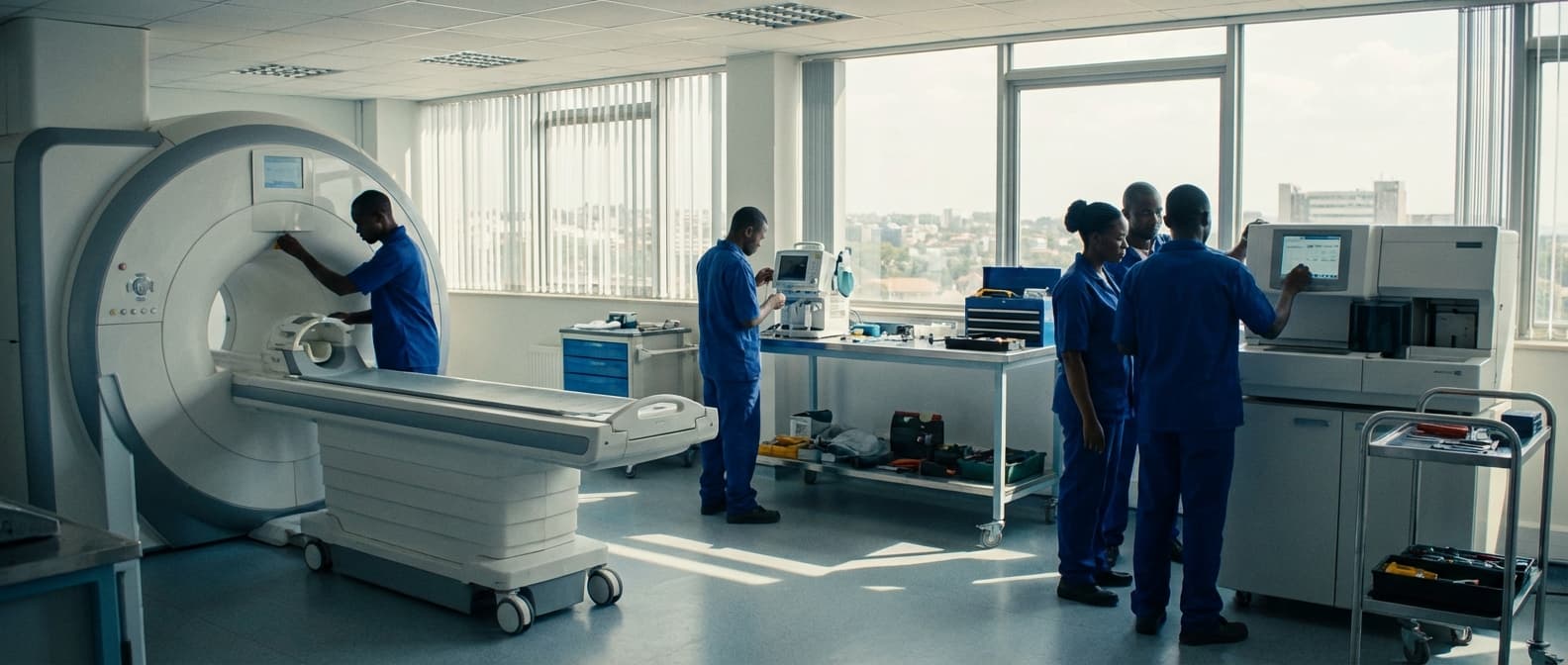
Comprehensive Maintenance Contract (CMC) Management Service (Parts & Labor) in Botswana
Engineering Excellence & Technical Support
Comprehensive Maintenance Contract (CMC) Management Service (Parts & Labor) High-standard technical execution following OEM protocols and local regulatory frameworks.
Predictive Maintenance Analytics
Leverage advanced analytics and IoT sensors to predict potential equipment failures BEFORE they occur. Our CMC service in Botswana proactively schedules maintenance, minimizing downtime and costly emergency repairs for your critical assets.
Guaranteed Parts & Labor Uptime
Experience unparalleled peace of mind with our Comprehensive Maintenance Contract (CMC) in Botswana. We guarantee swift response times and prioritize availability of certified technicians and genuine parts for both labor and required replacements, ensuring minimal operational disruption.
Lifecycle Asset Optimization & Reporting
Gain deep insights into your equipment's performance and costs. Our CMC management service provides detailed lifecycle reporting, enabling strategic decision-making for asset replacement, upgrades, and overall operational efficiency within your Botswana-based operations.
What Is Comprehensive Maintenance Contract (Cmc) Management Service (Parts & Labor) In Botswana?
A Comprehensive Maintenance Contract (CMC) Management Service (Parts & Labor) in Botswana refers to a specialized service offering that oversees and manages all aspects of a client's maintenance needs for their assets, encompassing both the provision of spare parts and the execution of labor for repairs, servicing, and preventative maintenance. This service is designed to provide a holistic and predictable maintenance framework, mitigating operational disruptions and optimizing asset lifespan and performance. It entails a contractual agreement where a service provider takes on the responsibility for the upkeep of specified equipment or facilities, including diagnostic assessments, scheduled servicing, unplanned repairs, and the procurement and stocking of necessary spare parts. The "Parts & Labor" component explicitly signifies that the contract covers the cost and management of all required replacement components and the skilled personnel necessary to perform the maintenance tasks. In essence, it transitions maintenance from a reactive cost center to a proactive, managed operational expense with guaranteed service levels.
| Who Needs CMC Management Service (Parts & Labor)? | Typical Use Cases in Botswana | |||||||||||
|---|---|---|---|---|---|---|---|---|---|---|---|---|
| Organizations with critical operational assets: Businesses reliant on continuous operation of machinery, equipment, or facilities cannot afford significant downtime. | Manufacturing Plants: Maintaining production lines, assembly machines, robotics, and industrial ovens to ensure consistent output and product quality. | Mining Operations: Upkeep of heavy machinery (e.g., excavators, haul trucks), processing equipment, and ancillary systems in a demanding environment. | Hospitality Sector (Hotels & Resorts): Maintenance of HVAC systems, elevators, kitchen equipment, and generators to ensure guest comfort and operational continuity. | Healthcare Facilities (Hospitals & Clinics): Ensuring the reliability of medical equipment (e.g., MRI scanners, X-ray machines), laboratory instruments, and building infrastructure (e.g., power systems, sterilization units). | Information Technology (IT) Infrastructure: Management of servers, data centers, network equipment, and critical IT hardware to guarantee system availability. | Transportation & Logistics Companies: Maintenance of vehicle fleets (trucks, buses), warehouse equipment (forklifts, conveyor belts), and associated infrastructure. | Government & Public Sector Agencies: Upkeep of critical infrastructure, public transport systems, and specialized equipment used in service delivery. | Educational Institutions: Maintaining laboratory equipment, IT labs, campus facilities, and specialized machinery for technical training. | Companies with complex or specialized equipment: Assets that require specific technical expertise for maintenance and repair, or where spare parts are difficult to source. | Businesses seeking predictable operational costs: Transferring the variability of maintenance expenses to a fixed or predictable contract. | Organizations aiming to extend asset lifespan and optimize performance: Proactive and expert maintenance contributes to longer operational life and improved efficiency. | Companies lacking in-house maintenance expertise or resources: Outsourcing maintenance allows them to focus on their core business activities. |
Key Components of CMC Management Service (Parts & Labor) in Botswana:
- Asset Register Management: Maintaining an accurate and up-to-date inventory of all covered assets, including their specifications, purchase dates, warranty information, and maintenance history.
- Preventative Maintenance Scheduling & Execution: Developing and implementing a proactive maintenance schedule based on manufacturer recommendations, operational usage, and asset criticality. This includes routine inspections, lubrication, calibration, and minor adjustments.
- Corrective Maintenance & Repair Management: Prompt response to equipment failures and breakdowns. This involves fault diagnosis, repair, and restoration of functionality, leveraging the included labor and parts.
- Spare Parts Inventory Management: Strategic sourcing, procurement, stocking, and inventory control of essential spare parts to minimize downtime. This often involves maintaining a dedicated inventory or having established supply chain agreements.
- Labor Management: Sourcing, training, and deploying qualified technical personnel to perform all maintenance activities. This can include in-house technicians or sub-contracted specialists.
- Performance Monitoring & Reporting: Tracking maintenance activities, asset uptime, repair turnaround times, and costs. Regular reporting to the client on the status of their assets and maintenance operations.
- Service Level Agreement (SLA) Adherence: Ensuring all maintenance activities are performed within agreed-upon response times, resolution times, and quality standards.
- Risk Management: Identifying potential maintenance-related risks and implementing strategies to mitigate them, such as proactive replacement of aging components.
- Cost Optimization: Leveraging economies of scale for parts procurement and efficient labor deployment to manage maintenance expenditure effectively.
- Technical Support & Consultation: Providing expert advice on asset optimization, potential upgrades, and best practices for maintenance and operational efficiency.
Who Needs Comprehensive Maintenance Contract (Cmc) Management Service (Parts & Labor) In Botswana?
Comprehensive Maintenance Contract (CMC) Management Services, covering both parts and labor, are crucial for organizations in Botswana aiming to optimize the uptime, performance, and longevity of their critical assets. These services are designed to proactively manage all aspects of maintenance contracts, ensuring cost-effectiveness, regulatory compliance, and operational efficiency.
| Department | Key Responsibilities | Needs for CMC Management Service |
|---|---|---|
| Operations/Production | Ensuring continuous operational uptime, managing production schedules, minimizing downtime. | Proactive maintenance scheduling, rapid response for breakdowns, guaranteed parts availability, minimizing production losses due to equipment failure. |
| Facilities Management | Maintaining building systems, HVAC, electrical, plumbing, and ensuring a safe and functional environment. | Managing contracts for diverse building systems, ensuring compliance with safety standards, optimizing energy efficiency through well-maintained equipment. |
| Information Technology (IT) | Managing servers, networks, data centers, end-user devices, and critical IT infrastructure. | Ensuring high availability of IT systems, managing vendor contracts for hardware and software maintenance, rapid replacement of faulty components. |
| Procurement/Purchasing | Sourcing and managing contracts for goods and services, ensuring cost-effectiveness and value for money. | Negotiating favorable contract terms, tracking vendor performance, ensuring competitive pricing for parts and labor, managing contract renewals and expirations. |
| Finance/Accounting | Budgeting, cost control, financial reporting, and managing capital expenditures. | Accurate tracking of maintenance costs, identifying cost-saving opportunities, ensuring predictable maintenance budgets, optimizing ROI on equipment. |
| Engineering/Technical Services | Overseeing technical operations, ensuring equipment performance and adherence to specifications. | Ensuring maintenance activities meet technical standards, managing specialized technical expertise through vendors, quality assurance of repair work. |
| Compliance/Risk Management | Ensuring adherence to regulatory requirements, industry standards, and mitigating operational risks. | Maintaining equipment in compliance with safety and environmental regulations, minimizing risks associated with equipment failure, ensuring insurance coverage is adequate. |
| Human Resources (HR) | Managing workforce, training, and ensuring staff are equipped with necessary skills. | Reducing the need for extensive in-house specialized maintenance training, allowing HR to focus on core competencies and strategic workforce planning. |
Target Customers in Botswana for CMC Management Services (Parts & Labor)
- Large-scale industrial facilities (mining, manufacturing, power generation)
- Telecommunication infrastructure providers
- Healthcare institutions (hospitals, clinics with advanced medical equipment)
- Financial institutions with extensive IT infrastructure and ATMs
- Government agencies managing critical public infrastructure (transport, utilities)
- Commercial real estate owners and large facility management companies
- Educational institutions with specialized laboratories and IT systems
- Companies operating in remote or challenging logistical environments
- Businesses with a high dependency on specialized or proprietary equipment
- Organizations seeking to reduce in-house maintenance overhead and risk
Comprehensive Maintenance Contract (Cmc) Management Service (Parts & Labor) Process In Botswana
This document outlines the comprehensive workflow for managing a Comprehensive Maintenance Contract (CMC) service, covering both parts and labor, within the context of Botswana. It details the process from the initial customer inquiry to the successful execution and completion of the maintenance service. The aim is to provide a clear, step-by-step guide for service providers and clients involved in CMC agreements in Botswana.
| Phase | Step | Description | Key Activities | Responsible Parties | Output/Deliverable |
|---|---|---|---|---|---|
| Phase 1: Inquiry & Proposal | 1.1 Initial Inquiry | Client expresses interest in a CMC for their equipment/assets. | Contacting service provider, specifying equipment, scope of service (preventive, corrective, etc.). | Client, Service Provider Sales/BD Team | Inquiry received, preliminary information gathered. |
| Phase 1: Inquiry & Proposal | 1.2 Site/Equipment Assessment | Understanding the existing equipment, its condition, and maintenance history. | Site visit (if applicable), review of equipment specifications, maintenance logs. | Service Provider Technical Team, Client | Assessment report, identification of potential challenges. |
| Phase 1: Inquiry & Proposal | 1.3 Proposal Generation | Developing a tailored CMC proposal based on the assessment. | Defining scope of work, service levels (SLA), included/excluded services, spare parts strategy, labor rates, proposed contract duration, pricing. | Service Provider Sales/Technical Team | Formal CMC Proposal document. |
| Phase 2: Contract Negotiation & Award | 2.1 Proposal Review & Negotiation | Client reviews the proposal, raises queries, and negotiates terms. | Discussions on pricing, SLAs, payment terms, contract duration, specific inclusions/exclusions. | Client, Service Provider Sales/Legal Team | Agreed-upon terms and conditions. |
| Phase 2: Contract Negotiation & Award | 2.2 Contract Finalization & Signing | Formalizing the agreed terms into a legally binding contract. | Drafting the CMC agreement, legal review, signatures from both parties. | Service Provider Legal Team, Client Legal Team, Authorized Signatories | Signed Comprehensive Maintenance Contract (CMC). |
| Phase 3: Service Planning & Scheduling | 3.1 Contract Kick-off Meeting | Introduction of teams and establishing communication protocols. | Meeting between client and service provider teams to align on expectations and processes. | Service Provider Project Manager/Account Manager, Client Stakeholders | Defined communication channels, points of contact. |
| Phase 3: Service Planning & Scheduling | 3.2 Preventive Maintenance Scheduling | Planning and scheduling routine maintenance based on contract terms and manufacturer recommendations. | Developing a preventive maintenance schedule (e.g., monthly, quarterly, annually), coordinating with client for access and downtime. | Service Provider Operations/Planning Team, Client Operations Team | Approved Preventive Maintenance Schedule. |
| Phase 3: Service Planning & Scheduling | 3.3 Spare Parts Inventory Management | Ensuring availability of necessary spare parts for planned and unplanned maintenance. | Assessing required parts based on equipment and PM schedule, stocking strategy, procurement of critical spares. | Service Provider Logistics/Inventory Team | Adequate spare parts stock. |
| Phase 4: Service Execution (Parts & Labor) | 4.1 Preventive Maintenance Execution | Performing scheduled maintenance tasks to prevent failures. | On-site service delivery by technicians, executing checklists, performing inspections, lubrication, adjustments, filter changes, etc. | Service Provider Technicians, Site Supervisor | Completed Preventive Maintenance Report. |
| Phase 4: Service Execution (Parts & Labor) | 4.2 Corrective Maintenance (Breakdown Response) | Responding to equipment failures and performing repairs. | Receiving breakdown notification, dispatching technicians, diagnosis, part replacement (if needed), repair, testing. | Service Provider Technicians, Field Service Manager, Client Operations | Repaired Equipment, Corrective Maintenance Report. |
| Phase 4: Service Execution (Parts & Labor) | 4.3 Parts Procurement & Replacement | Sourcing and fitting required spare parts for both preventive and corrective maintenance. | Identifying part numbers, ordering from suppliers (local or international), receiving, quality check, installation, testing. | Service Provider Procurement/Logistics Team, Technicians | Installed and functional spare parts. |
| Phase 4: Service Execution (Parts & Labor) | 4.4 Labor Deployment & Management | Ensuring skilled technicians are available and efficiently deployed. | Scheduling technicians, managing their travel, allocating tasks, ensuring safety protocols are followed. | Service Provider Field Service Manager, Technicians | On-site technical expertise. |
| Phase 5: Completion & Reporting | 5.1 Service Completion Verification | Ensuring all contracted service tasks are completed to satisfaction. | Client representative verifies completed work, technician signs off on tasks. | Client Representative, Service Provider Technician/Supervisor | Service Completion Sign-off. |
| Phase 5: Completion & Reporting | 5.2 Detailed Service Report Generation | Documenting all work performed, parts used, and observations. | Compiling reports for preventive and corrective maintenance, including details of tasks performed, parts replaced, labor hours, recommendations, equipment status. | Service Provider Technicians/Supervisors | Comprehensive Service Reports. |
| Phase 5: Completion & Reporting | 5.3 Client Review & Acceptance | Client reviews the service reports and accepts the completed work. | Client reviews reports for accuracy and completeness, provides formal acceptance. | Client Stakeholders, Service Provider Account Manager | Accepted Service Reports. |
| Phase 6: Invoicing & Payment | 6.1 Invoice Generation | Creating invoices based on the executed services and contract terms. | Generating invoices for labor, parts used, any agreed-upon fixed fees, or time-and-material charges as per the contract. | Service Provider Finance/Billing Department | Generated Service Invoice. |
| Phase 6: Invoicing & Payment | 6.2 Invoice Submission | Submitting invoices to the client for payment. | Delivering invoices to the client's designated accounts payable department. | Service Provider Finance Department, Client Accounts Payable | Submitted Invoice. |
| Phase 6: Invoicing & Payment | 6.3 Payment Processing | Client processes and makes payment for the invoiced services. | Internal client payment procedures, bank transfer or other agreed-upon payment methods. | Client Finance Department, Service Provider Finance Department | Payment Received. |
| Phase 7: Post-Service Review & Contract Renewal | 7.1 Performance Review Meetings | Periodically reviewing the effectiveness of the CMC and service delivery. | Regular meetings to discuss performance against SLAs, identify areas for improvement, address client feedback. | Service Provider Account Manager, Client Stakeholders | Performance review minutes, action plans for improvement. |
| Phase 7: Post-Service Review & Contract Renewal | 7.2 Contract Renewal Consideration | Initiating discussions for contract renewal well in advance of expiry. | Reviewing contract performance, assessing ongoing needs, preparing renewal proposals, negotiating new terms if necessary. | Service Provider Account Manager, Client Management | Contract renewal decision/new contract. |
Comprehensive Maintenance Contract (CMC) Management Service (Parts & Labor) Process in Botswana
- Phase 1: Inquiry & Proposal
- Phase 2: Contract Negotiation & Award
- Phase 3: Service Planning & Scheduling
- Phase 4: Service Execution (Parts & Labor)
- Phase 5: Completion & Reporting
- Phase 6: Invoicing & Payment
- Phase 7: Post-Service Review & Contract Renewal
Comprehensive Maintenance Contract (Cmc) Management Service (Parts & Labor) Cost In Botswana
Comprehensive Maintenance Contract (CMC) management services for both parts and labor in Botswana represent a crucial investment for businesses seeking to ensure the optimal performance and longevity of their critical assets. These contracts typically cover scheduled preventive maintenance, unscheduled repairs, and the supply of necessary spare parts. The cost of such services is highly variable and depends on a multitude of factors. Understanding these factors is essential for businesses to accurately budget and select the most suitable CMC provider. Service providers will often tailor their pricing based on the complexity of the equipment, its age and condition, the required response times, the geographic location of the equipment within Botswana, and the level of expertise needed from the technicians. Furthermore, the volume and type of equipment to be maintained will significantly influence the overall contract cost. Negotiation plays a key role, and businesses should be prepared to discuss service level agreements (SLAs) and the specific inclusions and exclusions of the contract.
| Equipment Category | Estimated Annual Cost Range (BWP) | Key Considerations |
|---|---|---|
| Standard Office Equipment (Printers, Copiers, PCs) | 500 - 3,000 per unit | Focus on common wear-and-tear parts, basic diagnostics, and on-site support. Response times are generally less critical. |
| Light Industrial Machinery (Small-scale manufacturing, food processing) | 5,000 - 25,000 per unit | Includes more complex mechanical and electrical components, scheduled inspections, and emergency repair services. Availability of specific parts is crucial. |
| Heavy Industrial Machinery (Mining, large-scale manufacturing) | 30,000 - 150,000+ per unit | High complexity, critical operational impact. Requires specialized technicians, extensive spare parts inventory, and very short response times. Often includes predictive maintenance technologies. |
| Medical Equipment (Diagnostic, treatment devices) | 20,000 - 200,000+ per unit | Requires highly specialized, certified technicians. Stringent regulatory requirements. Critical patient safety implications. OEM support is often preferred. |
| IT Infrastructure (Servers, Network Devices, Data Centers) | 10,000 - 100,000+ per annum (depending on scale) | Focus on uptime, data integrity, and cybersecurity. Tiered support levels based on criticality. Often includes remote monitoring and management. |
Key Factors Influencing CMC Cost in Botswana
- Type and Complexity of Equipment: Specialized or highly technical equipment (e.g., medical imaging machines, industrial automation systems) will generally command higher maintenance costs due to the specialized skills and parts required.
- Age and Condition of Equipment: Older equipment or that which is in poor condition may require more frequent servicing and a higher likelihood of component failures, leading to increased labor and parts expenses.
- Service Level Agreements (SLAs): Response times for call-outs, uptime guarantees, and proactive maintenance schedules defined in the SLA directly impact pricing. Faster response times and higher uptime guarantees typically result in higher costs.
- Scope of Coverage (Parts & Labor): The extent to which parts are covered (e.g., all parts vs. specific high-wear items) and the inclusion of all labor (preventive, corrective, emergency) will affect the overall price.
- Geographic Location: For equipment located in remote areas of Botswana, travel costs for technicians and the logistics of delivering spare parts can significantly increase the contract price.
- Frequency of Maintenance: The number of scheduled preventive maintenance visits per year will be a direct cost driver.
- Volume of Equipment: Larger fleets of equipment often benefit from economies of scale, potentially leading to lower per-unit maintenance costs. However, the overall contract value will be higher.
- Technician Expertise and Availability: The need for highly specialized technicians or those with specific certifications can influence labor rates.
- Brand and Manufacturer Support: Original Equipment Manufacturer (OEM) maintenance contracts might be more expensive but often offer superior expertise and genuine parts.
- Contract Duration: Longer-term contracts may sometimes offer slight discounts compared to shorter-term agreements.
- Risk Mitigation and Downtime Costs: Businesses that experience significant financial losses due to equipment downtime will often opt for more comprehensive (and expensive) CMCs to minimize such risks.
Affordable Comprehensive Maintenance Contract (Cmc) Management Service (Parts & Labor) Options
Our Affordable Comprehensive Maintenance Contract (CMC) Management Service offers a streamlined approach to ensuring your equipment operates at peak performance while minimizing your expenses. We provide flexible options for managing both parts and labor costs, empowering you to choose the best value for your specific needs. Our service goes beyond simple repairs; it's about proactive care, predictive maintenance, and strategic cost optimization. We understand that every business has unique operational demands and budget constraints, which is why we've developed a range of value bundles and cost-saving strategies tailored to deliver exceptional ROI. From extended warranty management to integrated spare parts inventory solutions, our aim is to reduce downtime, prolong asset lifespan, and ultimately improve your bottom line.
| Value Bundle/Strategy | Description | Primary Cost-Saving Benefit | Ideal For |
|---|---|---|---|
| Bronze Basic Care | Includes essential reactive maintenance and emergency call-outs. | Reduced immediate repair costs for unexpected failures. | Low-risk equipment or businesses with tight budgets. |
| Silver Proactive Plus | Includes Bronze benefits plus scheduled preventive maintenance and basic parts discounts. | Reduced downtime and lower overall repair costs through proactive care. | Moderately critical equipment or businesses seeking a balance of cost and coverage. |
| Gold Comprehensive Elite | Includes Silver benefits plus priority response, advanced diagnostics, predictive maintenance integration, and extended warranty negotiation. | Maximized uptime, minimized unforeseen expenses, and optimized asset lifespan. | Mission-critical equipment or businesses prioritizing operational continuity and long-term asset value. |
| Parts Pooling & Bulk Buy | Centralized procurement and stocking of common spare parts for multiple clients. | Significant discounts on parts due to bulk purchasing power. | Businesses with a diverse range of similar equipment or high parts consumption. |
| Remote Monitoring & Diagnostics | Utilizing technology to monitor equipment performance remotely and diagnose issues without an on-site visit. | Reduced on-site labor costs and faster issue resolution. | Equipment suitable for remote monitoring and businesses seeking rapid troubleshooting. |
Value Bundles & Cost-Saving Strategies
- Tiered Service Levels: Offering different levels of coverage (e.g., Bronze, Silver, Gold) with varying response times, preventive maintenance frequencies, and included services. Higher tiers offer more comprehensive coverage for potentially higher risk equipment, while lower tiers provide essential support at a more accessible price point.
- Preventive Maintenance Packages: Bundling scheduled inspections, cleaning, lubrication, and minor adjustments to prevent costly breakdowns. This proactive approach significantly reduces the likelihood of unexpected failures and associated emergency repair costs.
- Extended Warranty Management: Negotiating and managing extended warranties with manufacturers to cover your assets beyond their standard warranty period. This can be significantly cheaper than self-insuring or paying for ad-hoc repairs.
- Strategic Spare Parts Inventory: Implementing an optimized spare parts strategy, including stocking critical components and leveraging bulk purchasing discounts. We help you balance having necessary parts on hand with avoiding excessive inventory costs.
- Predictive Maintenance Integration: Utilizing IoT sensors and data analytics to monitor equipment health and predict potential failures before they occur. This allows for planned maintenance during non-peak hours, minimizing disruption and cost.
- Labor Rate Optimization: Negotiating favorable labor rates with a network of qualified technicians. We ensure you receive skilled service at competitive prices, potentially through volume agreements.
- Performance-Based Contracts: Aligning our service fees with your equipment's uptime and performance metrics. This incentivizes us to keep your assets running efficiently, as our compensation is tied to your success.
- Consolidated Vendor Management: Acting as a single point of contact for all your maintenance needs, reducing administrative overhead and streamlining communication with multiple service providers.
- Energy Efficiency Audits: Incorporating basic energy efficiency checks during maintenance to identify and address potential energy waste, leading to lower utility bills.
Verified Providers In Botswana
Ensuring you receive quality healthcare is paramount, and in Botswana, 'Verified Providers' signifies a commitment to excellence. Franance Health stands at the forefront of this movement, offering a network of healthcare professionals and facilities that meet stringent standards. Their rigorous credentialing process and dedication to patient well-being make them the superior choice for your medical needs. Choosing a verified provider means peace of mind, knowing you are in the hands of competent and ethical practitioners.
| Aspect | Franance Health Advantage | Benefit to You |
|---|---|---|
| Credentialing Process | Comprehensive and multi-layered verification | Ensures competence and experience of practitioners |
| Quality Standards | Strict adherence to facility and service protocols | Guarantees a safe and effective healthcare environment |
| Provider Network | Diverse range of specialists and services | Access to all your medical needs under one trusted umbrella |
| Patient Focus | Emphasis on well-being and satisfaction | Prioritizes your health journey and positive outcomes |
| Trust and Reliability | Recognized 'Verified Provider' status | Peace of mind and confidence in your healthcare choices |
Why Franance Health Represents the Best Choice for Verified Providers:
- Rigorous Credentialing: Franance Health employs a multi-stage verification process for all its providers, scrutinizing qualifications, licenses, and experience.
- Commitment to Quality: They partner with facilities that adhere to high standards of hygiene, equipment, and patient care protocols.
- Patient-Centric Approach: Franance Health prioritizes patient safety, satisfaction, and positive health outcomes.
- Continuous Monitoring: Providers within the Franance Health network are subject to ongoing performance reviews and quality assurance.
- Access to Expertise: Their network encompasses a wide range of specialists, ensuring comprehensive healthcare solutions.
- Transparency and Trust: The 'Verified Provider' status from Franance Health offers a clear indication of reliability and trustworthiness.
- Ethical Practice: All Franance Health partners are expected to uphold the highest ethical standards in their medical practice.
Scope Of Work For Comprehensive Maintenance Contract (Cmc) Management Service (Parts & Labor)
This Scope of Work (SOW) outlines the requirements for a Comprehensive Maintenance Contract (CMC) Management Service, encompassing both parts and labor. The service provider will be responsible for the planning, execution, and oversight of all maintenance activities as defined within the client's existing or to-be-established CMC agreements. This includes ensuring proactive and reactive maintenance are performed efficiently, cost-effectively, and to the highest technical standards.
| Technical Deliverable | Standard Specification | Key Performance Indicators (KPIs) |
|---|---|---|
| Maintenance Schedule (Preventive & Predictive) | Developed using manufacturer guidelines, asset criticality, and operational history. Delivered quarterly and updated as needed. | Adherence to schedule (>95%), Reduction in unplanned downtime (%), MTBF improvement (%) |
| Spare Parts Management System | Centralized, cloud-based inventory management system with real-time tracking, minimum/maximum stock level alerts, and demand forecasting. Includes a catalog of approved parts with specifications. | Parts availability for critical components (>98%), Inventory turnover ratio, Reduction in stock-outs (%) |
| Vendor Performance Reports | Monthly reports detailing service completion, adherence to SLAs, quality of work, response times, and cost analysis. Includes corrective action plans for underperforming vendors. | Vendor SLA compliance (%), Customer satisfaction with vendor service (score), Cost savings achieved through vendor management (%) |
| Maintenance Log and History Database | Secure, searchable digital database capturing all maintenance activities, including date, time, technician, work performed, parts used, and root cause analysis. Accessible to authorized client personnel. | Completeness of records (>99%), Accuracy of data (%), Audit readiness |
| Asset Condition Assessment Reports | Periodic reports (e.g., semi-annual) detailing the physical and functional condition of key assets, including recommendations for repair, refurbishment, or replacement. | Timeliness of reports, Actionability of recommendations, Accuracy of condition assessment |
| Downtime and Uptime Reporting | Monthly reports detailing equipment downtime by cause, duration, and impact on operations. Uptime percentage calculated per asset and for critical systems. | Overall equipment effectiveness (OEE) (%), Reduction in unplanned downtime (%), MTTR (hours/incidents) |
| Cost Tracking and Budget Management | Detailed monthly breakdown of all maintenance expenditures, including labor, parts, vendor fees, and overheads. Comparison against allocated budget. | Variance from budget (%), Cost per asset maintenance (currency), Cost savings identification and realization (%) |
| Health, Safety, and Environmental (HSE) Compliance Records | Documentation of all safety procedures, training records, incident reports, and adherence to relevant HSE regulations. Includes risk assessments for maintenance activities. | Zero safety incidents (%), Compliance audit pass rate (100%), Completion of mandatory HSE training (%) |
| Warranty Claim Management System | Process for identifying, initiating, tracking, and closing warranty claims. Includes documentation of parts returned for warranty and confirmation of credit received. | Warranty claim success rate (%), Average time to resolve warranty claims (days), Value of warranty claims processed (currency) |
Key Responsibilities of the CMC Management Service Provider
- Establish and maintain a central repository for all CMC documentation, including contracts, service level agreements (SLAs), asset registers, maintenance logs, and warranty information.
- Develop and implement a proactive maintenance schedule based on manufacturer recommendations, asset criticality, and historical data.
- Coordinate and oversee all scheduled preventive maintenance (PM) activities, ensuring they are performed by qualified personnel and documented thoroughly.
- Manage and respond to all unscheduled (breakdown) maintenance requests, ensuring rapid resolution and minimal downtime.
- Source, procure, and manage spare parts inventory, ensuring availability of critical components while optimizing stock levels to minimize holding costs.
- Negotiate and manage contracts with original equipment manufacturers (OEMs), authorized service providers, and third-party maintenance vendors.
- Monitor and evaluate vendor performance against contractual obligations and SLAs, providing regular performance reports.
- Conduct regular site visits and inspections to assess the condition of assets and the quality of maintenance being performed.
- Develop and manage a comprehensive asset lifecycle management strategy, including planning for replacements and upgrades.
- Ensure all maintenance activities comply with relevant health, safety, and environmental regulations.
- Provide regular reporting on maintenance costs, equipment uptime, MTBF (Mean Time Between Failure), MTTR (Mean Time To Repair), and other key performance indicators (KPIs).
- Implement and manage a robust change management process for all maintenance activities and asset modifications.
- Conduct root cause analysis (RCA) for recurring failures and implement corrective actions.
- Provide technical guidance and support to client personnel regarding equipment operation and maintenance.
- Manage warranty claims and ensure timely resolution.
Service Level Agreement For Comprehensive Maintenance Contract (Cmc) Management Service (Parts & Labor)
This Service Level Agreement (SLA) outlines the guaranteed response times and uptime for the Comprehensive Maintenance Contract (CMC) Management Service, covering both parts and labor. It defines the commitment of [Service Provider Name] to ensure optimal performance and minimal disruption of the managed services.
| Incident Severity | Response Time Guarantee (Parts & Labor) | Resolution Time Target (Parts & Labor) | Uptime Guarantee |
|---|---|---|---|
| Critical Incident | 15 minutes | 4 hours | 99.9% |
| Major Incident | 1 hour | 8 business hours | 99.9% |
| Minor Incident | 4 business hours | 24 business hours | 99.9% |
Key Definitions
- Downtime: Any period during which the managed service is unavailable or significantly degraded in performance, preventing normal operation.
- Response Time: The maximum time allowed for [Service Provider Name] to acknowledge a reported issue and initiate troubleshooting.
- Resolution Time: The maximum time allowed to resolve a reported issue and restore the managed service to its agreed-upon performance levels.
- Critical Incident: An issue that renders the entire managed service unusable or severely impacts its core functionality.
- Major Incident: An issue that significantly degrades the performance of the managed service or affects a substantial portion of its functionality.
- Minor Incident: An issue that has a limited impact on the managed service and does not prevent its core functionality.
- Uptime Guarantee: The minimum percentage of time the managed service is expected to be available and operational over a defined period.
Frequently Asked Questions

Ready when you are
Let's scope your Comprehensive Maintenance Contract (CMC) Management Service (Parts & Labor) in Botswana project in Botswana.

Scaling healthcare logistics and technical systems across the entire continent.