
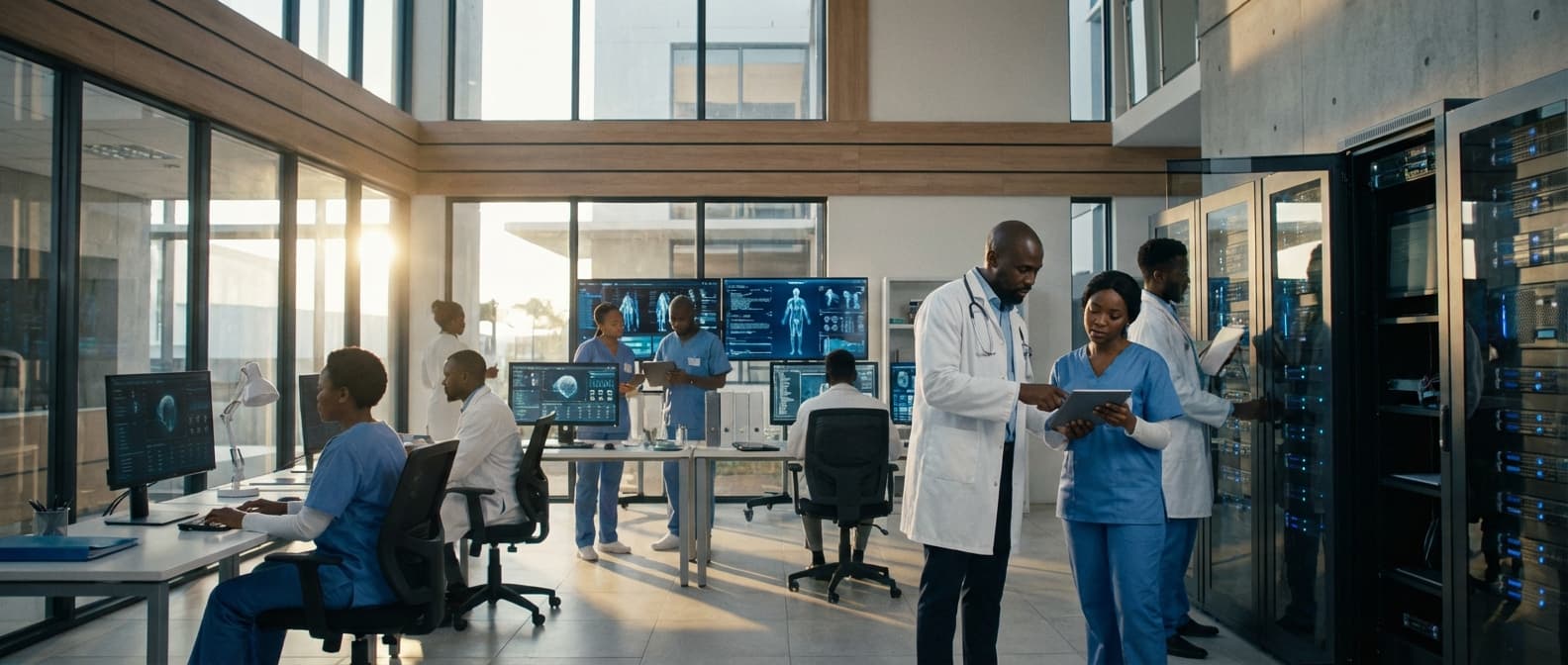
Tele-Radiology in Botswana
Engineering Excellence & Technical Support
24/7 access to certified radiologists providing rapid, accurate remote interpretation of diagnostic imaging studies. High-standard technical execution following OEM protocols and local regulatory frameworks.
Bridging Geographical Gaps
Tele-radiology extends expert diagnostic capabilities to remote and underserved areas of Botswana, enabling timely interpretations for patients far from specialized medical facilities. This significantly improves access to critical imaging services, regardless of location.
Cloud-Based Image Sharing
Secure, cloud-based platforms facilitate the rapid transmission of medical images and reports between local clinics and international or national tele-radiology hubs. This ensures efficient data management and reduces turnaround times for diagnoses.
AI-Enhanced Diagnostics
The integration of AI-powered diagnostic tools within the tele-radiology workflow assists radiologists in identifying subtle abnormalities and prioritizing urgent cases. This boosts diagnostic accuracy and efficiency, particularly in high-volume environments.
What Is Tele-radiology In Botswana?
Tele-radiology in Botswana refers to the practice of transmitting radiological images (such as X-rays, CT scans, and MRI scans) from one location to another for interpretation by a radiologist. This service leverages telecommunications technology to overcome geographical barriers and provide expert diagnostic services, particularly in areas where specialized radiologists are scarce. It is a critical component of modern healthcare delivery, aiming to improve access to timely and accurate radiological assessments, thereby enhancing patient care and outcomes.
| Who Needs Tele-radiology in Botswana? | Typical Use Cases | ||||||
|---|---|---|---|---|---|---|---|
| Patients in remote or underserved areas with limited access to on-site radiology expertise. | Emergency room consultations for acute conditions requiring rapid radiological assessment (e.g., trauma, stroke). | Primary healthcare facilities lacking dedicated radiologists for routine diagnostic imaging. | Hospitals requiring specialized radiology interpretations (e.g., neuroimaging, musculoskeletal imaging) not available locally. | Referral centers managing complex cases requiring expert radiological opinion. | Public health initiatives and screening programs in geographically dispersed populations. | Post-operative follow-up imaging to monitor patient recovery. | Teleradiology for specialized imaging modalities like mammography or ultrasound, requiring specific expertise. |
Key Components of Tele-radiology Services in Botswana:
- Image Acquisition: Radiological imaging equipment (e.g., digital X-ray, CT, MRI) at a primary healthcare facility or hospital captures patient images.
- Image Transmission: Captured images are securely transmitted over a network (e.g., internet, dedicated VPN) to a remote teleradiology center.
- Image Interpretation: Board-certified radiologists at the teleradiology center review the transmitted images and generate diagnostic reports.
- Report Delivery: The finalized reports are securely transmitted back to the referring physician at the originating facility.
- Consultation and Communication: Facilitates direct communication between referring physicians and radiologists for clarification or further discussion.
Who Needs Tele-radiology In Botswana?
Tele-radiology offers a critical solution to address the significant disparities in access to diagnostic imaging expertise across Botswana. The country faces challenges such as a shortage of qualified radiologists, particularly in rural and remote areas, leading to delayed diagnoses and suboptimal patient care. Tele-radiology bridges this gap by enabling remote interpretation of medical images by subspecialist radiologists, regardless of geographical location. This not only improves diagnostic accuracy and turnaround times but also facilitates continuous medical education and skill development for local healthcare professionals.
| Customer Segment | Key Needs Addressed | Relevant Departments |
|---|---|---|
| Public District Hospitals | Access to radiologist expertise, improved diagnostic turnaround time, support for emergency and routine cases. | Emergency Medicine, General Surgery, Internal Medicine, Pediatrics, Obstetrics/Gynecology, Orthopedics. |
| Referral & Tertiary Hospitals | Specialized subspecialty interpretation, management of high caseloads, expert consultation for complex cases. | Neurosurgery, Cardiology, Oncology, Radiology (general), Gastroenterology. |
| Rural & Remote Clinics | Basic diagnostic imaging interpretation, reduced patient referral burden, improved access to care. | General Practice, Primary Healthcare, Maternal and Child Health. |
| Private Clinics/Hospitals | Cost-effective access to radiology services, flexible interpretation options, enhanced patient care. | Internal Medicine, General Practice, Specialized Clinics (e.g., orthopedics, dermatology). |
| Mobile Clinics/Outreach | On-site diagnostic support, timely treatment decisions, extended reach of healthcare services. | Public Health Programs, Emergency Response Units. |
| Medical Training Institutions | Educational case studies, learning from expert interpretations, skill development for trainees. | Radiology Training Programs, Medical Schools. |
Target Customers and Departments for Tele-Radiology in Botswana
- Public Hospitals & District Hospitals: These facilities often lack dedicated radiology departments or have limited access to radiologists. Tele-radiology can provide essential diagnostic support for a wide range of medical conditions, from emergency cases to routine screenings. This includes departments like Emergency Medicine, General Surgery, Internal Medicine, Pediatrics, and Obstetrics/Gynecology.
- Referral Hospitals & Tertiary Centers: While these centers may have some in-house radiologists, tele-radiology can supplement their services, particularly for complex cases or to manage caseloads when local specialists are unavailable or on leave. This is crucial for departments like Neurosurgery, Cardiology, Oncology, and Advanced Imaging.
- Rural & Remote Clinics/Health Posts: These facilities often have no on-site radiology services. Tele-radiology allows them to benefit from expert interpretations, significantly improving their diagnostic capabilities for conditions that would otherwise require patient transfer, leading to better patient outcomes and reduced healthcare costs.
- Private Healthcare Providers: Smaller private clinics and hospitals may not have the resources to employ full-time radiologists. Tele-radiology offers a flexible and cost-effective solution to ensure their patients receive timely and accurate diagnostic interpretations.
- Mobile Clinics & Outreach Programs: For initiatives reaching underserved populations, tele-radiology can be integrated to provide immediate diagnostic support, enabling prompt treatment decisions in the field.
- Medical Training Institutions: Tele-radiology platforms can serve as valuable educational tools for training the next generation of radiologists and healthcare professionals in Botswana, providing exposure to a diverse range of cases and expert interpretations.
Tele-radiology Process In Botswana
Tele-radiology in Botswana facilitates remote diagnostic imaging services, connecting healthcare facilities with radiologists located elsewhere. This process aims to improve access to specialist interpretation, especially in underserved areas, and expedite diagnosis for timely patient care. The workflow typically begins with an inquiry from a healthcare provider, followed by image acquisition, secure transmission, radiologist interpretation, report generation, and finally, the return of findings to the referring facility.
| Stage | Description | Key Actors | Technologies Involved |
|---|---|---|---|
| Inquiry & Request Generation | A healthcare professional at a remote clinic or hospital identifies the need for a radiological interpretation. A request is formally initiated, often through an electronic health record (EHR) system or a dedicated tele-radiology portal. | Referring Clinician (Doctor, Nurse Practitioner), Radiographer/Technologist | EHR System, Tele-radiology Software/Portal, PACS (Picture Archiving and Communication System) at originating site |
| Image Acquisition | The necessary radiological images (X-ray, CT, MRI, Ultrasound) are acquired by a radiographer or technologist at the referring facility using the available imaging equipment. | Radiographer/Technologist | X-ray Machine, CT Scanner, MRI Scanner, Ultrasound Machine |
| Data Preparation & Transmission | Acquired images are anonymized and prepared for transmission. This often involves DICOM (Digital Imaging and Communications in Medicine) formatting and compression. Images are then securely uploaded to a central tele-radiology platform or directly to the radiologist's workstation via a secure network connection. | Radiographer/Technologist, IT Support | PACS, DICOM Standards, Secure Internet/VPN Connection, Tele-radiology Software |
| Radiologist Review & Interpretation | A qualified radiologist, working remotely, accesses the images from the tele-radiology platform. They analyze the images, identify any abnormalities, and formulate a diagnosis. | Remote Radiologist | High-resolution Monitor, Tele-radiology Workstation, PACS |
| Report Generation & Dictation | The radiologist dictates their findings and diagnosis, often using speech recognition software integrated with the tele-radiology system. This forms the basis of the radiology report. | Remote Radiologist | Speech Recognition Software, Dictation Software, Tele-radiology Software |
| Report Review & Approval | In some cases, a senior radiologist or a peer may review the dictated report for accuracy and completeness before it is finalized. The report is then formally approved. | Remote Radiologist (Senior/Peer), Quality Assurance Personnel | Tele-radiology Software, EHR System |
| Report Dissemination & Action | The finalized radiology report is transmitted back to the referring healthcare facility, usually through the tele-radiology platform or integrated EHR. The referring clinician reviews the report and integrates it into the patient's overall care plan, initiating further treatment or management as necessary. | Referring Clinician, Radiologist, EHR System | Tele-radiology Software, EHR System, Secure Communication Channels |
| System Feedback & Archiving | Feedback on the tele-radiology service may be collected. Images and reports are securely archived in the PACS and/or EHR systems for future reference and audits, adhering to data retention policies. | IT Support, Referring Facility Staff, Radiologist | PACS, EHR System, Archiving Solutions |
Tele-Radiology Workflow in Botswana
- Inquiry & Request Generation
- Image Acquisition
- Data Preparation & Transmission
- Radiologist Review & Interpretation
- Report Generation & Dictation
- Report Review & Approval
- Report Dissemination & Action
- System Feedback & Archiving
Tele-radiology Cost In Botswana
Tele-radiology, the remote interpretation of medical images, offers a valuable solution for enhancing diagnostic capabilities, particularly in regions with a scarcity of specialized radiologists, such as Botswana. The cost of tele-radiology services in Botswana is influenced by several key factors, leading to a range of pricing structures. These factors include the volume of studies, the complexity of imaging modalities (e.g., X-ray, CT, MRI), the turnaround time required for reports, the sub-specialty expertise needed (e.g., neuroradiology, musculoskeletal radiology), and the operational costs of the tele-radiology provider, including technology infrastructure and radiologist compensation. Local currency pricing in Botswana, the Pula (BWP), will reflect these variables. While precise, publicly available cost data is limited due to the proprietary nature of service agreements, general estimations can be made based on industry benchmarks and the specific operational context within Botswana.
| Service Type (Estimated) | Estimated Cost Range (BWP) | Notes |
|---|---|---|
| X-ray Interpretation (per study) | BWP 150 - BWP 400 | Basic imaging, routine turnaround. |
| CT Scan Interpretation (per study) | BWP 400 - BWP 1,200 | Moderate complexity, standard turnaround. |
| MRI Scan Interpretation (per study) | BWP 600 - BWP 2,000 | Higher complexity, standard turnaround. |
| Ultrasound Interpretation (per study) | BWP 250 - BWP 700 | Varies by complexity (e.g., abdominal vs. obstetric). |
| Sub-specialty Consult/Interpretation (e.g., Neuroradiology) | BWP 800 - BWP 3,000+ | Higher cost due to specialized expertise and limited availability. |
| Urgent/STAT Interpretation (Add-on) |
| Applied per study for expedited reporting. |
| Monthly Subscription/Platform Fee (for facilities) | BWP 2,000 - BWP 10,000+ | May include access to platform, software, and baseline support. |
Factors Influencing Tele-Radiology Costs in Botswana
- Volume of Studies: Higher volumes often lead to lower per-study costs due to economies of scale.
- Imaging Modality Complexity: CT and MRI scans are generally more expensive to interpret than X-rays.
- Turnaround Time (TAT): Urgent or STAT interpretations command higher fees than routine reads.
- Sub-specialty Expertise: Niche sub-specialties are typically priced higher due to limited availability of qualified professionals.
- Technology & Infrastructure: Costs associated with secure data transmission, PACS (Picture Archiving and Communication System) integration, and IT support.
- Radiologist Compensation: The fees paid to remote radiologists, which can vary based on experience and location.
- Provider Overhead: Operational costs of the tele-radiology company, including administrative staff, licensing, and insurance.
Affordable Tele-radiology Options
Tele-radiology offers a cost-effective solution for healthcare providers seeking expert diagnostic imaging interpretation. Affordable options often involve flexible service models, efficient workflow integration, and strategic resource allocation. Understanding value bundles and employing cost-saving strategies are key to maximizing the benefits of tele-radiology.
| Cost-Saving Strategy | Description | Impact on Affordability |
|---|---|---|
| Optimize Workflow Integration | Seamless integration with existing PACS/RIS minimizes manual data entry and turnaround time, reducing operational costs. | Lowers per-study processing costs and increases radiologist efficiency. |
| Leverage Off-Peak Hours/Overnight Coverage | Utilize tele-radiologists for overnight or weekend reads when local staffing costs are higher. This is often at a reduced rate. | Significant reduction in labor costs for off-hours reporting. |
| Focus on Core Service Needs | Identify essential subspecialty needs and contract for them only, rather than paying for broad coverage that may not be fully utilized. | Avoids overspending on services not frequently required. |
| Negotiate Volume Discounts | For facilities with substantial and consistent imaging volumes, negotiating tiered pricing based on volume can yield significant savings. | Reduced per-study cost as volume increases. |
| Choose Providers with Lower Overhead | Smaller, more agile tele-radiology groups or those with a distributed radiologist network may have lower overhead, passing savings on to clients. | Potentially lower base pricing for services. |
| Standardize Reporting Templates | Working with tele-radiologists who use standardized, yet customizable, reporting templates can improve efficiency and reduce report generation time. | Faster reporting cycles and reduced administrative burden. |
| Evaluate Turnaround Time Requirements | Matching service level agreements (SLAs) to actual clinical needs. Urgent reads will naturally cost more than routine ones. | Aligns costs with necessity, preventing overpayment for speed. |
Understanding Value Bundles in Tele-Radiology
- {"title":"Per-Study/Per-Image Pricing","description":"A straightforward model where providers are charged a fixed fee for each diagnostic study or individual image interpreted. This is ideal for facilities with predictable imaging volumes or those seeking granular cost control."}
- {"title":"Subscription/Retainer Models","description":"Involves a recurring fee (monthly, quarterly, annually) for a defined level of service, such as a certain number of reads per period, 24/7 coverage, or access to subspecialty expertise. This offers budget predictability and guaranteed availability."}
- {"title":"Tiered Service Packages","description":"Bundles that offer different levels of service based on complexity, turnaround time requirements, or subspecialty needs. Higher tiers may include faster reads, more detailed reports, or access to rare subspecialties."}
- {"title":"Technology Integration Bundles","description":"Some tele-radiology providers may bundle their services with PACS (Picture Archiving and Communication System) or RIS (Radiology Information System) integration support, streamlining workflow and reducing IT overhead for the client."}
- {"title":"Dedicated Radiologist/Team Access","description":"This bundle provides a dedicated radiologist or a small team of radiologists for a facility, ensuring consistency in reporting style and familiarity with the facility's clinical needs. This often comes with a premium but offers enhanced continuity of care."}
Verified Providers In Botswana
Finding reliable and qualified healthcare providers is paramount in Botswana. Franance Health has established itself as a trusted name, offering a rigorous credentialing process that ensures their network of providers meets the highest standards of professionalism, expertise, and ethical practice. This commitment to verification not only benefits patients by offering peace of mind but also elevates the overall quality of healthcare services available in the country. Franance Health's dedication to thorough background checks, license verification, and ongoing performance monitoring makes them the leading choice for accessing dependable healthcare.
| Credential Type | Franance Health Verification Standard | Benefit to Patients |
|---|---|---|
| Medical License | Active and valid, confirmed with regulatory bodies | Ensures providers are legally qualified to practice. |
| Educational Qualifications | Verified degrees and certifications from accredited institutions | Confirms foundational medical knowledge and specialization. |
| Professional Experience | Thorough review of past practice history and references | Guarantees practical application of skills and experience. |
| Ethical Conduct | Checks for disciplinary actions and adherence to professional codes | Ensures providers operate with integrity and prioritize patient welfare. |
| Continuing Professional Development (CPD) | Evidence of ongoing training and skill enhancement | Confirms providers stay updated with the latest medical advancements. |
Why Franance Health Providers are the Best Choice:
- Rigorous Credentialing Process: Franance Health goes above and beyond standard verification to ensure all associated healthcare professionals are licensed, experienced, and have a proven track record of excellent patient care.
- Commitment to Quality: Their stringent vetting process includes checks for educational qualifications, specialized training, and adherence to ethical guidelines, guaranteeing a high standard of medical expertise.
- Patient Trust and Safety: By partnering only with verified providers, Franance Health prioritizes patient well-being and safety, fostering a trusted healthcare ecosystem.
- Access to Expertise: The Franance Health network comprises a diverse range of specialists and general practitioners, ensuring access to the right care for a wide spectrum of health needs.
- Continuous Monitoring: Franance Health doesn't stop at initial verification; they engage in ongoing performance reviews to maintain the integrity and quality of their provider network.
Scope Of Work For Tele-radiology
This document outlines the Scope of Work (SoW) for the provision of Tele-Radiology services. It details the technical deliverables and standard specifications required to ensure efficient, secure, and high-quality remote radiological interpretation and reporting.
| Deliverable Category | Technical Deliverables | Standard Specifications |
|---|---|---|
| Image Acquisition & Transmission | Integration with existing PACS/RIS | DICOM 3.0 compliance for image transfer; secure VPN or dedicated network connectivity; image compression standards (e.g., JPEG2000 lossy/lossless as per agreement) |
| Image Viewing & Interpretation Platform | Web-based or client-server viewer software | High-resolution image display; advanced visualization tools (e.g., MPR, 3D rendering); user-friendly interface; multi-monitor support; cross-platform compatibility (Windows, macOS, web browsers) |
| Reporting System | Integrated reporting module or integration with existing RIS | Structured reporting templates; voice recognition/dictation support; report generation in PDF or HL7 format; digital signature capabilities |
| Data Storage & Archiving | Secure, scalable, and compliant storage solution | HIPAA/GDPR compliant; data encryption at rest and in transit; audit trails for access and modifications; long-term archiving capabilities |
| Security & Access Control | Robust security protocols and user authentication | Role-based access control (RBAC); multi-factor authentication (MFA); regular security audits and penetration testing; compliance with relevant data privacy regulations |
| Connectivity & Bandwidth | Reliable and sufficient network infrastructure | Guaranteed uptime; adequate bandwidth to support real-time image streaming and data transfer (minimum specified bandwidth per user/site); low latency |
| Interoperability | Seamless integration with hospital IT systems | HL7 standards for patient demographics and orders; DICOM standards for images; API availability for custom integrations |
| Disaster Recovery & Business Continuity | Plan and infrastructure for data backup and service restoration | Regular data backups; defined RTO (Recovery Time Objective) and RPO (Recovery Point Objective); redundant systems and failover mechanisms |
| Audit Trails & Logging | Comprehensive logging of all system activities | Logging of user logins/logouts, image access, report creation/modification, system errors; retention of logs for a specified period for compliance and troubleshooting |
| Software Updates & Maintenance | Regular updates and ongoing maintenance of all software components | Scheduled updates with minimal downtime; bug fixes and performance enhancements; notification of planned maintenance in advance |
Key Areas Covered in Tele-Radiology SoW
- Service Description and Objectives
- Technical Requirements and Infrastructure
- Data Management and Security
- Reporting Standards and Turnaround Times
- Quality Assurance and Performance Monitoring
- Training and Support
- Service Level Agreements (SLAs)
Service Level Agreement For Tele-radiology
This Service Level Agreement (SLA) outlines the performance standards for the Tele-Radiology service provided by [Your Company Name] to [Client Name]. It defines the agreed-upon response times for image interpretation requests and the guaranteed uptime for the tele-radiology platform.
| Study Type | Target Response Time (from submission to report availability) | Maximum Allowable Response Time (for SLA breach) |
|---|---|---|
| Critical Study | 30 minutes | 60 minutes |
| Urgent Study | 2 hours | 4 hours |
| Routine Study | 24 hours | 48 hours |
Key Definitions
- Critical Study: A study requiring immediate interpretation due to suspected life-threatening conditions (e.g., stroke, pulmonary embolism, acute hemorrhage).
- Urgent Study: A study requiring prompt interpretation, but not immediately life-threatening (e.g., suspected fracture, acute abdominal pain).
- Routine Study: A study that can be interpreted within a standard timeframe, not requiring immediate attention.
- Uptime: The percentage of time the tele-radiology platform is operational and accessible to authorized users, excluding scheduled maintenance.
- Downtime: The percentage of time the tele-radiology platform is unavailable due to unexpected technical issues or unscheduled maintenance.
- Scheduled Maintenance: Pre-announced periods when the platform may be unavailable for updates or routine upkeep.
- Response Time: The time elapsed from the successful submission of a radiology study to the platform until the final report is made available in the platform.
- Service Credit: A monetary credit applied to the client's invoice as compensation for failure to meet defined SLA metrics.
Frequently Asked Questions

Ready when you are
Let's scope your Tele-Radiology in Botswana project in Botswana.

Scaling healthcare logistics and technical systems across the entire continent.