
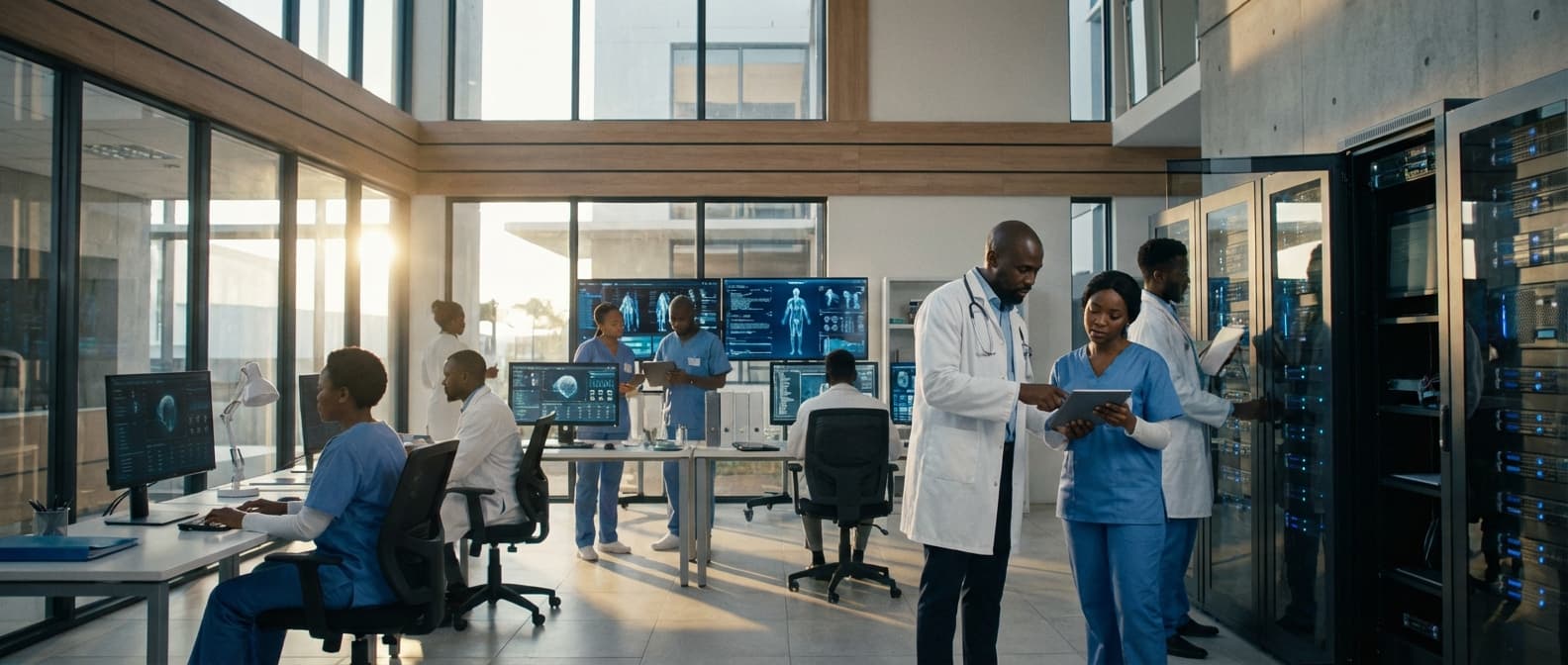
Medical IT Consultation in Botswana
Engineering Excellence & Technical Support
Strategic technology consulting to optimize healthcare operations, streamline workflows, and integrate cutting-edge medical information systems. High-standard technical execution following OEM protocols and local regulatory frameworks.
EHR Implementation & Optimization
Streamlining patient data management through robust Electronic Health Record (EHR) system deployment and optimization, ensuring seamless data flow, improved accuracy, and enhanced clinical decision-making for healthcare providers in Botswana.
Secure Healthcare Network Infrastructure
Designing and implementing secure, reliable, and scalable IT network infrastructures tailored to the unique challenges of Botswana's healthcare landscape, safeguarding sensitive patient information and ensuring uninterrupted access to critical systems.
Data-Driven Health Insights
Leveraging advanced data analytics and reporting tools to transform raw healthcare data into actionable insights, empowering Botswana's health sector to identify trends, improve resource allocation, and drive evidence-based public health initiatives.
What Is Medical It Consultation In Botswana?
Medical IT Consultation in Botswana refers to the provision of expert advice, strategic planning, and implementation support for information technology solutions within the healthcare sector. This service is designed to enhance efficiency, improve patient care, ensure data security, and facilitate regulatory compliance for healthcare organizations. It encompasses a broad spectrum of IT-related challenges and opportunities specific to the unique healthcare landscape and infrastructure of Botswana.
| Who Needs Medical IT Consultation in Botswana? | Typical Use Cases |
|---|---|
| Public Healthcare Facilities: Ministry of Health, District Health Management Teams, Public Hospitals, and Clinics seeking to modernize systems, improve data management, and extend healthcare reach. | Implementing nationwide EHR systems, establishing central data repositories for public health surveillance, upgrading network infrastructure in rural clinics. |
| Private Healthcare Providers: Hospitals, specialized clinics, diagnostic centers, and individual practitioners looking to enhance operational efficiency, patient experience, and competitive advantage. | Adopting advanced PACS for radiology departments, implementing patient portals for appointment scheduling and record access, enhancing cybersecurity for patient data. |
| Non-Governmental Organizations (NGOs) and Faith-Based Organizations (FBOs) in Healthcare: Organizations providing healthcare services, often in underserved areas, needing cost-effective and scalable IT solutions. | Deploying mobile health (mHealth) solutions for community health workers, implementing simplified record-keeping systems, establishing remote consultation capabilities for specialist outreach. |
| Medical Research Institutions and Universities: Facilities involved in medical research and education requiring robust data management, analytical tools, and secure research platforms. | Setting up secure data warehousing for clinical trials, implementing specialized software for bioinformatics, developing e-learning platforms for medical students. |
| Medical Equipment Vendors and Suppliers: Companies providing medical technology who need to ensure their offerings are compatible with existing IT infrastructure and can be seamlessly integrated. | Consulting on the IT requirements for new medical devices, advising on network integration protocols for diagnostic equipment. |
Key Aspects of Medical IT Consultation in Botswana
- Needs Assessment and Gap Analysis: Evaluating existing IT infrastructure, workflows, and identifying areas for improvement.
- Strategic IT Planning: Developing long-term IT roadmaps aligned with organizational goals, including digital transformation strategies.
- System Selection and Implementation: Advising on and managing the procurement and deployment of Electronic Health Records (EHRs), Picture Archiving and Communication Systems (PACS), Laboratory Information Systems (LIS), and other healthcare-specific software.
- Network and Infrastructure Design: Ensuring robust and secure network connectivity, server management, and data storage solutions.
- Cybersecurity and Data Protection: Implementing measures to safeguard sensitive patient data against breaches, ensuring compliance with data privacy regulations.
- Interoperability and Data Integration: Facilitating seamless data exchange between different healthcare systems and stakeholders.
- Telemedicine and Remote Care Solutions: Designing and implementing platforms for remote patient monitoring and consultations.
- IT Project Management: Overseeing the planning, execution, and closure of IT projects.
- Training and Capacity Building: Educating healthcare staff on the effective use of new technologies.
- Regulatory Compliance: Ensuring adherence to national and international healthcare IT standards and regulations.
Who Needs Medical It Consultation In Botswana?
Medical IT consultation in Botswana is a vital service for a range of healthcare providers and institutions looking to optimize their technological infrastructure, improve patient care, and enhance operational efficiency. From managing electronic health records (EHRs) to implementing cybersecurity measures and ensuring compliance with regulations, specialized IT expertise is crucial for navigating the complexities of modern healthcare technology.
| Customer Type | Key Departments/Needs | Specific IT Challenges |
|---|---|---|
| Public Hospitals & Clinics | IT Department, Administration, Clinical Departments (e.g., Pediatrics, Surgery, Pharmacy), Records Management | Legacy system integration, data security, telemedicine infrastructure, patient portal development, network reliability, EHR implementation/optimization, budget constraints. |
| Private Hospitals & Specialist Clinics | Management, IT, Finance, Patient Services, Clinical Specialties (e.g., Cardiology, Oncology) | Scalability of EHRs, data analytics for business intelligence, patient engagement tools, cybersecurity threats, cloud migration, compliance with data privacy laws. |
| Diagnostic Laboratories | Lab Management, IT, Quality Assurance, Technicians | Laboratory Information Management Systems (LIMS) integration, secure sample tracking, data integrity, reporting automation, remote diagnostics, interoperability with EHRs. |
| Radiology & Imaging Centers | Radiology Department, IT, Administration, Technologists | Picture Archiving and Communication Systems (PACS) management, teleradiology solutions, data storage and retrieval, cybersecurity for medical images, integration with EHRs. |
| Government Health Ministries & Agencies | IT Divisions, Public Health Units, Planning & Policy Departments, Data Management Units | National health information exchange strategies, data standardization, public health surveillance systems, cybersecurity policy development, e-health initiatives, capacity building. |
Target Customers for Medical IT Consultation in Botswana
- Public Hospitals and Clinics
- Private Hospitals and Specialist Clinics
- Community Health Centers
- Diagnostic Laboratories
- Radiology and Imaging Centers
- Medical Research Institutions
- Government Health Ministries and Agencies
- Pharmaceutical Companies with Local Operations
- Medical Equipment Suppliers and Maintainers
- Healthcare Startups and New Facilities
Medical It Consultation Process In Botswana
The Medical IT Consultation Process in Botswana is a structured workflow designed to address the information technology needs of healthcare facilities. It typically begins with an initial inquiry from a client (e.g., a hospital, clinic, or government health agency) seeking IT solutions or expertise. This inquiry triggers a series of stages, each with defined activities and objectives, leading to the successful implementation and ongoing support of medical IT systems.
| Stage | Key Activities | Objective | Typical Deliverables |
|---|---|---|---|
| Inquiry & Initial Contact | Receive inquiry, initial screening, schedule introductory meeting | Understand basic need, establish communication | Acknowledgement of inquiry, meeting schedule |
| Needs Assessment & Scoping | Site visits, stakeholder interviews, data gathering, documentation review | Define current state, identify pain points, clarify requirements | Needs assessment report, scope document |
| Proposal Development & Presentation | Solution design, cost estimation, timeline planning, proposal writing | Present tailored solution, gain client buy-in | Project proposal, presentation slides |
| Contract Negotiation & Signing | Review and finalize terms, sign contract | Formalize agreement and commitment | Signed contract, Statement of Work (SOW) |
| System Design & Planning | Technical architecture, software selection, network design, security planning | Develop detailed technical blueprint | System design document, project plan, security plan |
| Implementation & Deployment | Hardware installation, software configuration, data migration, integration | Deploy and integrate IT solutions | Configured systems, migrated data, integrated modules |
| Training & Knowledge Transfer | Develop training materials, conduct user training, provide documentation | Empower users and IT staff | Training manuals, user guides, trained personnel |
| Testing & Quality Assurance | Unit testing, integration testing, performance testing, UAT | Verify functionality and performance, ensure quality | Test reports, UAT sign-off |
| Go-Live & Post-Implementation Support | System launch, immediate troubleshooting, performance monitoring | Ensure smooth transition to operational use | Operational systems, incident resolution reports |
| Ongoing Maintenance & Support | System monitoring, updates, patching, helpdesk support | Ensure continuous operation and security | Maintenance logs, support tickets, performance reports |
| Project Closure & Review | Final documentation, lessons learned session, client feedback | Formalize project completion, identify improvements | Project closure report, lessons learned document |
Workflow Stages of Medical IT Consultation in Botswana
- {"title":"1. Inquiry & Initial Contact","description":"This is the first touchpoint where a healthcare institution expresses a need for IT services. This can be through various channels like email, phone calls, or formal proposals. The goal is to understand the client's basic requirements and establish initial communication."}
- {"title":"2. Needs Assessment & Scoping","description":"A detailed understanding of the client's current IT infrastructure, existing challenges, operational workflows, and specific objectives is gathered. This often involves site visits, stakeholder interviews, and document review. The scope of the consultation is clearly defined."}
- {"title":"3. Proposal Development & Presentation","description":"Based on the needs assessment, a tailored proposal is developed. This document outlines the proposed IT solutions, methodologies, timelines, deliverables, and cost estimates. It is then presented to the client for review and discussion."}
- {"title":"4. Contract Negotiation & Signing","description":"Once the proposal is accepted in principle, contract terms are negotiated. This includes service level agreements (SLAs), payment schedules, confidentiality clauses, and intellectual property rights. A formal contract is then signed by both parties."}
- {"title":"5. System Design & Planning","description":"The core IT solutions are designed and planned in detail. This involves selecting appropriate hardware and software, designing network architecture, planning data migration strategies, and developing security protocols. Project management plans are finalized."}
- {"title":"6. Implementation & Deployment","description":"The designed IT solutions are installed, configured, and deployed within the healthcare facility. This stage may involve hardware setup, software installation, network configuration, data migration, and integration with existing systems. Rigorous testing is conducted."}
- {"title":"7. Training & Knowledge Transfer","description":"End-users and IT staff are trained on the new systems and technologies. This ensures effective adoption and utilization of the implemented solutions. Comprehensive documentation and user manuals are provided."}
- {"title":"8. Testing & Quality Assurance","description":"Thorough testing is performed to ensure that the implemented systems function as intended, meet all functional and non-functional requirements, and are secure. User acceptance testing (UAT) is a critical part of this stage."}
- {"title":"9. Go-Live & Post-Implementation Support","description":"The new IT systems are officially launched into production. The consultation team provides immediate post-implementation support to address any issues that arise during the initial operational phase. This includes bug fixing and performance monitoring."}
- {"title":"10. Ongoing Maintenance & Support","description":"Long-term support and maintenance services are provided as per the agreed contract. This includes system monitoring, regular updates and patches, troubleshooting, and preventative maintenance to ensure optimal performance and security of the medical IT infrastructure."}
- {"title":"11. Project Closure & Review","description":"Once the project objectives are met and the systems are stable, the project is formally closed. A post-project review is conducted to evaluate the success of the consultation, identify lessons learned, and gather client feedback for future improvements."}
Medical It Consultation Cost In Botswana
Estimating the cost of Medical IT consultation in Botswana involves considering several key pricing factors. These factors influence the overall expense, which can vary significantly based on the complexity of the project, the expertise of the consultant, and the specific needs of the healthcare facility. It's important to note that the local currency in Botswana is the Botswana Pula (BWP). Consultation fees are generally quoted in BWP.
| Consultation Type/Service | Typical Hourly Rate (BWP) | Estimated Project Cost Range (BWP) | Notes |
|---|---|---|---|
| Initial Assessment & Strategy Development (e.g., needs analysis, IT roadmap) | 300 - 600 BWP | 1,500 - 7,500 BWP | For a few days of focused work. |
| Software Selection & Implementation Advisory (e.g., EMR/EHR, PACS) | 400 - 750 BWP | 5,000 - 30,000 BWP+ | Dependent on the complexity of the software and implementation. |
| Network Infrastructure & Security Assessment | 350 - 700 BWP | 4,000 - 25,000 BWP | Includes recommendations for upgrades and security protocols. |
| Telemedicine/Remote Patient Monitoring Setup | 450 - 800 BWP | 7,000 - 40,000 BWP+ | Covers platform selection, integration, and workflow design. |
| Data Management & Analytics Consultation | 400 - 750 BWP | 6,000 - 35,000 BWP | Focus on data integrity, reporting, and insights. |
| Regulatory Compliance & Auditing | 500 - 900 BWP | 8,000 - 50,000 BWP+ | Depending on specific regulations and scope. |
| Ongoing IT Support & Strategic Partnership | 300 - 600 BWP (Monthly Retainer) | Negotiable based on service level agreements (SLAs) | Often involves a monthly retainer for continuous advice and oversight. |
| Specialized Project Management | 400 - 800 BWP | 10,000 - 70,000 BWP+ | For managing larger IT projects from initiation to completion. |
Key Pricing Factors for Medical IT Consultation in Botswana
- Scope and Complexity of the Project: This is the most significant driver of cost. Simple advice on software selection will be far less expensive than a full system implementation, network overhaul, or cybersecurity assessment for a large hospital.
- Consultant's Experience and Specialization: Highly experienced consultants with specialized knowledge in healthcare IT (e.g., EMR/EHR implementation, telemedicine, medical imaging IT, data analytics, regulatory compliance like HIPAA in relevant contexts) will command higher rates.
- Duration of the Consultation: Whether it's a one-off assessment, ongoing advisory services, or a project-based engagement will directly impact the total cost.
- Location and Size of the Healthcare Facility: Larger facilities or those in more remote areas might incur additional travel and logistical costs for the consultant.
- Specific Technology or Software Involved: Consultation related to complex or niche medical technologies might be priced differently.
- Deliverables Required: The depth of reports, documentation, training materials, and implementation plans expected from the consultation will affect pricing.
- Urgency of the Request: Rush projects or emergency consultations may incur premium fees.
Affordable Medical It Consultation Options
Navigating the complexities of Medical IT can be daunting for healthcare organizations, especially those with budget constraints. Fortunately, there are several affordable medical IT consultation options available. These solutions often leverage value-based approaches and strategic cost-saving measures to deliver essential expertise without breaking the bank. Understanding these options can empower healthcare providers to make informed decisions and optimize their IT investments.
| Value Bundle Type | Description | Cost-Saving Strategy | Ideal For |
|---|---|---|---|
| Assessment & Planning Bundle | Comprehensive IT infrastructure assessment, needs analysis, and strategic roadmap development. | Bundled pricing for a defined scope; avoids piecemeal consulting fees for initial phases. | Organizations needing a clear understanding of their current IT state and a future vision, or those undergoing significant changes. |
| Compliance & Security Bundle | HIPAA compliance audits, risk assessments, policy development, and cybersecurity best practice implementation. | Package deals often include multiple services at a reduced rate compared to individual bookings; proactive approach prevents costly breaches. | Any healthcare organization needing to ensure regulatory compliance and protect sensitive patient data. |
| Technology Implementation Support Bundle | Guidance and support for EMR/EHR selection and implementation, practice management software integration, or telemedicine platform setup. | Covers critical phases of a project at a predictable cost; prevents costly errors and delays. | Organizations implementing new software or upgrading existing systems. |
| Managed Services Integration Bundle | Consultation on selecting and integrating with managed IT service providers, ensuring seamless operations and support. | Aims to optimize ongoing IT costs by identifying the right managed service partner and service level agreement. | Organizations looking to offload day-to-day IT management while retaining strategic oversight. |
| Training & Staff Augmentation Bundle | Customized IT training programs for staff, or temporary IT personnel augmentation for specific projects or periods. | Focuses on maximizing internal staff efficiency and bridging knowledge gaps, reducing the need for permanent hires. | Organizations needing to upskill their existing IT team or requiring temporary specialized IT skills. |
Affordable Medical IT Consultation Options
- Project-Based Consultations: Instead of ongoing retainers, engage consultants for specific, well-defined projects. This could include EMR implementation support, cybersecurity assessments, or cloud migration planning. This focused approach ensures you only pay for the expertise needed for a particular task.
- Niche or Specialized Firms: Smaller, specialized IT consulting firms often have lower overhead than larger, full-service companies, allowing them to offer more competitive rates. They may focus on specific areas like HIPAA compliance, medical practice management software, or telemedicine infrastructure.
- Remote or Virtual Consulting: Leverage the power of technology to access expert advice from anywhere. Many consultants offer remote services, reducing travel costs and allowing for more flexible scheduling. Video conferencing and collaborative tools make virtual engagement highly effective.
- Academic Institutions/University Programs: Some universities with health informatics or computer science programs may offer student-led consulting services or have faculty who provide consultations at reduced rates for non-profit or community healthcare organizations.
- Industry Associations and Non-Profits: Organizations dedicated to healthcare IT often provide resources, guidance, and sometimes even access to consulting expertise at member rates or through grant programs.
- Referral Networks and Peer Recommendations: Tap into your network of healthcare colleagues. Referrals can lead to trusted consultants who offer fair pricing due to existing relationships or a desire to build their reputation.
- On-Demand Consulting Platforms: Online platforms connect businesses with freelance IT consultants. These platforms can offer a wide range of expertise at competitive hourly rates, allowing you to hire for short bursts of assistance as needed.
Verified Providers In Botswana
In Botswana's burgeoning healthcare landscape, identifying trusted and credible healthcare providers is paramount for individuals seeking quality care. Franance Health stands out as a beacon of excellence, distinguished by its rigorous credentialing process and unwavering commitment to patient well-being. This document outlines Franance Health's credentials and explains why they represent the optimal choice for healthcare services in Botswana.
| Credential Category | Description of Verification | Implication for Patients |
|---|---|---|
| Licensure and Certification | Verification of medical licenses and board certifications for all practitioners. | Ensures practitioners are legally qualified and have met recognized standards of expertise. |
| Facility Accreditation | Accreditation by national and international healthcare bodies (e.g., JCI, COHSASA where applicable or national equivalents). | Guarantees that facilities meet rigorous standards for safety, quality of care, and operational management. |
| Continuing Medical Education (CME) | Mandatory participation in ongoing professional development and training programs. | Ensures healthcare providers are up-to-date with the latest medical knowledge, techniques, and best practices. |
| Peer Review and Performance Monitoring | Regular evaluation of clinical outcomes and adherence to treatment protocols through peer review. | Promotes continuous improvement in the quality and effectiveness of medical services. |
| Infection Control Protocols | Strict adherence to and regular auditing of infection prevention and control measures. | Minimizes the risk of healthcare-associated infections for patients. |
| Patient Safety Initiatives | Implementation of comprehensive patient safety protocols and risk management strategies. | Prioritizes the well-being and safety of patients throughout their healthcare journey. |
Franance Health Credentials and Quality Assurance:
- Accreditation by Recognized Bodies: Franance Health facilities and its affiliated practitioners undergo stringent evaluations and are accredited by national and international healthcare accreditation organizations. This ensures adherence to the highest standards of medical practice, patient safety, and operational efficiency.
- Qualified and Experienced Medical Professionals: All healthcare providers associated with Franance Health are fully licensed, board-certified, and possess extensive experience in their respective fields. Continuous professional development and ongoing training are mandatory, ensuring they remain at the forefront of medical advancements.
- Robust Quality Management Systems: Franance Health implements comprehensive quality management systems that monitor and evaluate all aspects of patient care, from initial consultation to treatment and follow-up. This includes regular audits, patient feedback mechanisms, and data-driven performance improvement initiatives.
- State-of-the-Art Facilities and Technology: Franance Health invests in modern medical infrastructure and cutting-edge diagnostic and therapeutic technologies. This commitment to advanced equipment ensures accurate diagnoses and effective treatment protocols.
- Ethical Practice and Patient-Centric Approach: Upholding the highest ethical standards is a cornerstone of Franance Health's philosophy. They are dedicated to transparent communication, informed consent, and a patient-centric approach that prioritizes individual needs and preferences.
- Compliance with Regulatory Standards: Franance Health operates in strict compliance with all relevant healthcare regulations and legal frameworks set forth by the Botswana Ministry of Health and Wellness.
- Strong Community Partnerships: Franance Health actively collaborates with other healthcare stakeholders, government agencies, and community organizations to enhance the overall health ecosystem in Botswana.
Scope Of Work For Medical It Consultation
This Scope of Work (SOW) outlines the services to be provided by [Consultant Name/Company] (hereinafter referred to as "Consultant") to [Client Name/Organization] (hereinafter referred to as "Client") for Medical IT Consultation. The project aims to assess, recommend, and potentially implement improvements to the Client's existing medical IT infrastructure, systems, and workflows to enhance efficiency, security, compliance, and patient care delivery. This SOW details the objectives, deliverables, timelines, and responsibilities for the consultation engagement.
| Phase | Activity | Technical Deliverable | Standard Specifications / Considerations |
|---|---|---|---|
| Phase 1: Assessment & Analysis | Discovery and Information Gathering | Current State Assessment Report | Detailed inventory of hardware (servers, workstations, medical devices), software (EHR, PACS, LIS, etc.), network topology, and security controls. Assessment of existing IT policies and procedures. Identification of key stakeholders and their IT needs. |
| Phase 1: Assessment & Analysis | Workflow Analysis | Workflow Mapping and Bottleneck Identification | Documentation of current clinical and administrative workflows that rely on IT systems. Identification of inefficiencies, manual workarounds, and areas for automation. Consideration of user experience and adoption challenges. |
| Phase 1: Assessment & Analysis | Security and Compliance Review | Security & Compliance Gap Analysis Report | Evaluation of current security measures against industry best practices and regulatory requirements (e.g., access controls, encryption, vulnerability management, incident response plans). Assessment of data backup and disaster recovery strategies. |
| Phase 2: Recommendation & Strategy Development | Solution Identification and Evaluation | Technology Recommendation Report | Proposals for new or upgraded hardware, software, and network solutions. Evaluation of vendor solutions, including cost-benefit analysis, scalability, and integration capabilities. Recommendations for cloud adoption or on-premise solutions. |
| Phase 2: Recommendation & Strategy Development | IT Strategy and Roadmap | Strategic IT Roadmap | A phased plan for implementing recommended solutions, including timelines, resource allocation, and budget estimates. Prioritization of initiatives based on impact and urgency. Alignment with long-term organizational goals. |
| Phase 2: Recommendation & Strategy Development | Data Management and Integration Strategy | Data Management & Integration Plan | Recommendations for data governance, data quality improvement, and secure data sharing. Strategies for integrating disparate systems and ensuring interoperability (e.g., HL7, FHIR standards). |
| Phase 3: Implementation Support (Optional) | Vendor Selection Assistance | Vendor Evaluation Criteria and Shortlist | Development of RFPs, evaluation of vendor proposals, and assistance in selecting appropriate IT solution providers. Due diligence on vendor security and compliance. |
| Phase 3: Implementation Support (Optional) | Project Management Support | Project Status Reports & Risk Register | Oversight of implementation projects, ensuring adherence to scope, budget, and timeline. Identification and mitigation of project risks. |
| Phase 3: Implementation Support (Optional) | Training and Change Management | Training Plan & Change Management Strategy | Development of training materials and plans for end-users. Strategies to facilitate user adoption and minimize disruption during system changes. |
Project Objectives
- To conduct a comprehensive assessment of the Client's current medical IT infrastructure, including hardware, software, network, and security.
- To identify key challenges, inefficiencies, and risks within the existing IT environment related to medical operations.
- To evaluate the Client's compliance with relevant healthcare regulations (e.g., HIPAA, HITECH, GDPR if applicable).
- To provide actionable recommendations for optimizing IT systems, workflows, and data management to improve patient care, operational efficiency, and cost-effectiveness.
- To develop a strategic roadmap for future IT investments and upgrades aligned with the Client's business goals.
- To ensure the security and integrity of sensitive patient data.
- To facilitate seamless integration of new or upgraded IT solutions.
Service Level Agreement For Medical It Consultation
This Service Level Agreement (SLA) outlines the commitment of [Consultant Name/Company] to its client, [Client Name], regarding the provision of Medical IT Consultation services. This SLA defines the expected response times for support requests and the guaranteed uptime for critical IT systems managed by the consultant. This document is an appendix to the main service agreement between both parties.
| Incident Severity | Response Time Target (During Business Hours) | Response Time Target (Outside Business Hours) | Uptime Guarantee (Critical Systems) | Uptime Guarantee (Non-Critical Systems) |
|---|---|---|---|---|
| Critical Incident | 15 minutes | 1 hour | 99.9% | 99.0% |
| High Priority Incident | 1 hour | 3 hours | 99.9% | 99.0% |
| Normal Priority Incident | 4 business hours | Next business day | N/A | 99.0% |
Key Definitions
- Business Hours: Monday to Friday, 9:00 AM to 5:00 PM [Client's Time Zone], excluding public holidays.
- Critical Incident: An IT issue that severely impacts patient care, essential medical workflows, or the availability of critical patient data. Examples include the complete unavailability of the Electronic Health Record (EHR) system, inability to access diagnostic imaging, or a significant network outage affecting multiple clinical areas.
- High Priority Incident: An IT issue that significantly impacts a specific department or workflow, but does not directly prevent patient care. Examples include a single workstation malfunction affecting a clinician's ability to access records, or a non-critical application failure.
- Normal Priority Incident: An IT issue that has a minor impact on users or a single user, or is a general inquiry. Examples include a printer issue for one user, or a request for information regarding IT policies.
- Uptime Guarantee: The percentage of time that a specified IT system is operational and accessible to authorized users.
- Response Time: The maximum time allowed from the initiation of a support request to the first substantive action or acknowledgment by the consultant.
- Resolution Time: The target time from the initiation of a support request to the restoration of the affected service. Note: Resolution times are targets and may vary based on the complexity of the issue and third-party dependencies.
Frequently Asked Questions

Ready when you are
Let's scope your Medical IT Consultation in Botswana project in Botswana.

Scaling healthcare logistics and technical systems across the entire continent.