
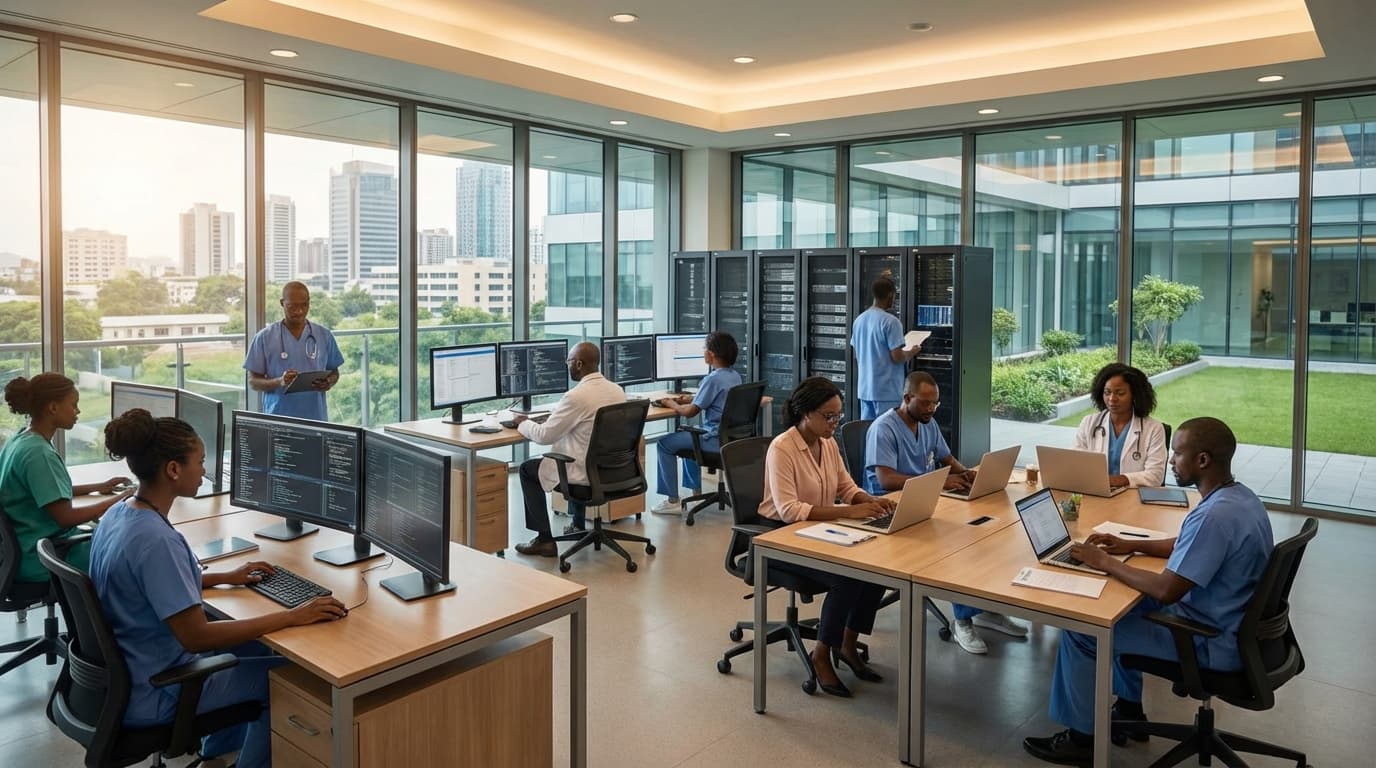
Radiology Reader & Reporting Support in Botswana
Engineering Excellence & Technical Support
Remote radiology reading and reporting services High-standard technical execution following OEM protocols and local regulatory frameworks.
Enhanced Diagnostic Accuracy
Our AI-powered radiology reader provides real-time assistance, identifying subtle abnormalities and improving the diagnostic accuracy of complex imaging studies for radiologists across Botswana. This translates to earlier disease detection and better patient outcomes.
Streamlined Reporting Workflow
Automated report generation and structured reporting templates significantly reduce the administrative burden on radiologists. This allows for faster turnaround times and improved efficiency in delivering critical diagnostic reports to healthcare providers in remote and urban areas of Botswana.
Bridging Geographic Gaps
Our cloud-based platform offers remote access to advanced radiology interpretation tools, enabling specialists to support healthcare facilities in underserved regions of Botswana. This democratizes access to expert radiological insights, regardless of location.
What Is Radiology Reader & Reporting Support In Botswana?
Radiology Reader & Reporting Support in Botswana refers to the provision of expert interpretation of medical imaging studies and the generation of comprehensive, actionable reports by qualified radiologists, often remotely accessed, to healthcare facilities within Botswana. This service aims to augment existing radiology capabilities, address specialist shortages, and improve the turnaround time and diagnostic accuracy of radiological examinations. It involves the reception of DICOM (Digital Imaging and Communications in Medicine) data, its interpretation by a radiologist, and the subsequent generation of a structured, evidence-based report that aids in clinical decision-making.
| Who Needs It? | Typical Use Cases | ||||||||
|---|---|---|---|---|---|---|---|---|---|
| Hospitals and Clinics lacking in-house radiology specialists. | Emergency departments requiring immediate interpretation of trauma imaging. | Rural or remote healthcare facilities with limited access to diagnostic imaging expertise. | Facilities experiencing temporary shortages of radiologists (e.g., due to leave, illness). | Specialized medical centers needing subspecialty interpretations (e.g., neuroimaging, musculoskeletal imaging). | Public health initiatives requiring large-scale screening or diagnostic support. | Private healthcare providers aiming to expand service offerings and improve efficiency. | Research institutions needing expert review of imaging data. | Tertiary care hospitals seeking to manage high imaging volumes and optimize reporting turnaround. | Government health ministries aiming to enhance the overall quality of diagnostic services nationwide. |
| Interpretation of X-rays, CT scans, MRIs, ultrasounds, mammograms, and other modalities. | Second opinions for complex or equivocal cases. | Subspecialty readings (e.g., neuroradiology, interventional radiology, pediatric radiology, musculoskeletal radiology, body imaging, breast imaging). | Teleradiology consultations for on-call coverage. | Preliminary readings for urgent cases. | Population health studies requiring consistent interpretation of imaging data. | Support for training of local medical professionals through case reviews and feedback. | Disaster response and emergency preparedness, providing rapid interpretation of mass casualty imaging. | Outpatient imaging centers seeking efficient and accurate reporting to support referring physicians. |
Key Components of Radiology Reader & Reporting Support
- Image Acquisition & Transmission: Healthcare facilities capture medical images (X-ray, CT, MRI, Ultrasound, etc.) and securely transmit the DICOM data to the support service provider.
- Remote Interpretation: Board-certified or fellowship-trained radiologists, located either within Botswana or internationally, access and interpret the transmitted images.
- Report Generation: A detailed diagnostic report is generated, including findings, impressions, recommendations, and relevant clinical context.
- Report Delivery: Reports are delivered securely and electronically back to the referring clinician or healthcare facility within predefined turnaround times.
- Quality Assurance: Mechanisms for peer review and ongoing quality assessment of interpretations and reports.
- Integration with PACS/RIS: Potential for integration with Picture Archiving and Communication Systems (PACS) and Radiology Information Systems (RIS) for seamless workflow.
Who Needs Radiology Reader & Reporting Support In Botswana?
Radiology reader and reporting support services are crucial for enhancing diagnostic accuracy, improving workflow efficiency, and addressing the shortage of specialized radiologists, particularly in resource-limited settings. In Botswana, several key customer segments and departments stand to benefit significantly from such support.
| Customer Segment/Department | Specific Needs Addressed | Potential Impact of Radiology Reader & Reporting Support | Key Considerations for Botswana |
|---|---|---|---|
| Public Healthcare Facilities (District Hospitals, Referral Hospitals) | Limited number of radiologists, high patient volumes, need for timely and accurate diagnoses, diverse range of imaging modalities. | Reduced turnaround time for reports, improved diagnostic accuracy, better patient management, capacity building for local staff, support for complex cases. | Scalability to meet varying demand, affordability, integration with existing Picture Archiving and Communication Systems (PACS), cultural sensitivity in communication. |
| Private Healthcare Clinics and Hospitals | Desire for high-quality, subspecialty reporting, competitive advantage, efficient patient throughput, outsourcing options for overloaded in-house radiologists. | Access to subspecialty expertise (e.g., neuroradiology, musculoskeletal), enhanced reputation for diagnostic services, faster reporting for private patients, flexible service models. | Service level agreements (SLAs) for turnaround times, data security and privacy compliance, clear billing and payment structures. |
| Botswana Defence Force (BDF) Medical Services | Need for consistent and specialized reporting for military personnel, potential for deployment to remote areas, requirement for rapid diagnostic turnaround in critical situations. | Specialized reporting for combat-related injuries, efficient support for deployed medical units, standardization of reporting across BDF facilities, rapid consultation for critical cases. | Reliable connectivity, robust security protocols for sensitive data, potential for mobile or remote access solutions. |
| Academic and Training Institutions | Need for educational resources, training of future radiologists, access to a wide range of cases for teaching purposes, quality assurance for trainee reports. | Case-based learning opportunities, mentorship for trainees, structured feedback on reporting quality, development of standardized reporting templates. | Integration with existing curriculum, faculty collaboration, provision of anonymized case data for educational use. |
| Research Initiatives | Requirement for accurate and consistent radiological interpretation for research studies, support for image analysis in clinical trials, data extraction for research purposes. | Standardized image acquisition and interpretation protocols, expert review of research-related imaging, assistance with quantitative image analysis, contribution to evidence-based medicine. | Clear research ethics board (REB) approval processes, data anonymization, collaborative research agreements. |
Target Customers and Departments in Botswana
- Public Healthcare Facilities (District Hospitals, Referral Hospitals)
- Private Healthcare Clinics and Hospitals
- Botswana Defence Force (BDF) Medical Services
- Academic and Training Institutions
- Research Initiatives
Radiology Reader & Reporting Support Process In Botswana
The Radiology Reader & Reporting Support Process in Botswana outlines the systematic workflow for handling radiology image interpretation requests and the generation of diagnostic reports. This process ensures efficient utilization of limited radiology resources, facilitates timely patient care, and maintains diagnostic quality. The workflow begins with an inquiry, typically initiated by a referring physician, and progresses through several stages of image review, consultation, reporting, and finalization. This system is crucial in a context where access to specialized radiologists might be geographically dispersed or limited, often leveraging Picture Archiving and Communication Systems (PACS) and Radiology Information Systems (RIS) where available.
| Stage | Description | Key Actors/Systems | Outputs/Deliverables | Potential Challenges |
|---|---|---|---|---|
| A clinician identifies the need for radiological imaging for a patient and generates a request. | Referring Clinician (Doctor, Nurse Practitioner) | Completed Radiology Request Form/Order | Incomplete or ambiguous request information. |
| Radiology images are acquired using various modalities (X-ray, CT, Ultrasound, MRI) and transmitted to the PACS. | Radiographer/Technologist, PACS Administrator | Digital Image Data stored on PACS | Technical issues with imaging equipment or PACS connectivity, poor image quality. |
| Requests/studies are added to a digital worklist for radiologists, prioritized based on urgency (e.g., emergency, inpatient, outpatient, specific protocols). | RIS, PACS, Radiologist (initial triage) | Prioritized Digital Worklist | Overload of urgent cases, difficulty in accurate prioritization by non-radiologists. |
| A qualified radiologist reviews the images, identifies abnormalities, and formulates a diagnosis. | Radiologist (Reader) | Preliminary findings, drafted report content | Limited radiologist availability, high workload, complex cases requiring specialized knowledge. |
| If necessary, the interpreting radiologist consults with colleagues, subspecialists, or referring clinicians for complex or unclear cases. | Radiologist (Reader), Other Radiologists, Referring Clinician | Consensus diagnosis, enriched diagnostic opinion | Geographical distance, communication barriers, lack of subspecialist availability. |
| The radiologist dictates or types a formal diagnostic report, summarizing findings, diagnosis, and recommendations. | Radiologist (Reporter), Medical Transcriptionist (if applicable) | Draft Diagnostic Report | Transcription errors, dictation clarity issues, language barriers. |
| A second radiologist (if part of the workflow, e.g., for teaching or quality control) or the reporting radiologist reviews the draft report for accuracy, completeness, and consistency. | Radiologist (Reviewer/Reporter) | Finalized Diagnostic Report | Subjectivity in interpretation, potential for oversight. |
| The finalized report is electronically dispatched to the referring clinician and archived within the RIS/PACS. | RIS, PACS, IT Support | Electronically Dispatched Final Report, Archived Report | System downtime, incorrect recipient information, data loss. |
| Regular audits of reports and patient outcomes are conducted to identify areas for improvement in interpretation and reporting. Feedback loops are established for referring clinicians. | Radiology Department Management, Quality Assurance Team, Referring Clinicians | Quality Improvement Initiatives, Feedback reports | Lack of structured feedback mechanisms, resistance to change. |
Radiology Reader & Reporting Support Process Workflow
- Inquiry Initiation
- Image Acquisition and Transmission
- Worklist Prioritization
- Image Interpretation (Reading)
- Consultation and Second Opinions
- Report Generation
- Report Review and Validation
- Report Dispatch and Archiving
- Quality Assurance and Feedback
Radiology Reader & Reporting Support Cost In Botswana
The cost of radiology reader and reporting support services in Botswana can vary significantly based on several factors. These factors influence pricing, making it crucial for healthcare providers to understand them when budgeting for such services. The primary drivers of cost include the complexity and volume of imaging studies, the required turnaround time for reports, the expertise and qualifications of the radiologists, and the technology and infrastructure supporting the service. Sub-specialization in specific areas of radiology, such as neuroradiology or interventional radiology, will also command higher fees due to the specialized knowledge and experience required. The geographic location of the providing facility within Botswana might also play a role, with potential logistical costs affecting pricing for remote areas. Finally, the contract model – whether it's a per-study fee, a monthly retainer, or a dedicated radiologist model – will heavily influence the overall cost.
| Service Type | Estimated Price Range (BWP) | Notes |
|---|---|---|
| General Radiology Reading & Reporting (Per Study) | 250 - 750 | Applies to X-rays, basic ultrasounds, and CTs. Price varies by modality and complexity. |
| Specialized Radiology Reading & Reporting (Per Study) | 500 - 1500+ | Includes MRI, advanced CT interpretation, mammography, interventional radiology. Sub-specialty dictates higher end of range. |
| Monthly Retainer (for a clinic/small hospital) | 5,000 - 25,000+ | Covers a defined volume of studies or a certain level of availability. Negotiable based on volume and scope. |
| Dedicated Radiologist (Full-time Equivalent) | 30,000 - 80,000+ per month | For larger hospitals or imaging centers requiring constant on-site or remote dedicated expertise. Includes salary, benefits, and overhead. |
| Teleradiology Services (Per Study - Remote) | 200 - 600 | Often more cost-effective for off-hours or specialized reads when local expertise is limited. Price depends on modality and turnaround. |
| Quality Assurance/Peer Review | 50 - 150 per report | An additional service for ensuring report accuracy and consistency. |
Key Pricing Factors for Radiology Reader & Reporting Support in Botswana
- Complexity and Volume of Imaging Studies
- Required Turnaround Time for Reports
- Radiologist Expertise and Qualifications (General vs. Sub-specialized)
- Technology and Infrastructure of the Service Provider
- Geographic Location and Logistical Considerations
- Contract Model (Per-study, Retainer, Dedicated Radiologist)
Affordable Radiology Reader & Reporting Support Options
Finding affordable radiology reader and reporting support is crucial for healthcare providers looking to optimize their resources without compromising diagnostic quality. This involves exploring various service models, understanding value bundles, and implementing strategic cost-saving measures. Remote radiology reading services, AI-powered reporting tools, and outsourced teleradiology solutions are key areas to consider. The goal is to achieve efficient, accurate, and cost-effective diagnostic workflows.
| Value Bundle Strategy | Cost-Saving Strategy | Description |
|---|---|---|
| Tiered Service Packages | Volume-Based Discounts | Providers offer different service levels (e.g., standard, premium, STAT) with varying turnaround times and pricing. Higher volumes unlock lower per-study costs. |
| Integrated AI & Human Reading | Reduced Radiologist Time per Study | Bundling AI pre-reading and anomaly detection with human radiologist final review. AI handles initial screening, allowing radiologists to focus on complex cases, increasing efficiency. |
| Subspecialty Coverage Bundles | Avoidance of In-House Subspecialist Recruitment | Accessing a pool of subspecialist radiologists for complex interpretations as part of a package. This avoids the high cost of recruiting and employing niche subspecialists internally. |
| Extended Hours & Overflow Support | 24/7 Coverage without Fixed Costs | Subscription-based models for round-the-clock reading or to handle unexpected surges in imaging volume. Pay only for what is needed, avoiding the cost of maintaining 24/7 in-house staff. |
| Technology & Software Bundles | Reduced IT Infrastructure Investment | Service providers often include access to their PACS, RIS, or reporting software as part of their service fee, reducing capital expenditure on IT systems for the healthcare facility. |
| Training & Quality Assurance | Improved Diagnostic Accuracy & Reduced Liability | Bundling regular training for remote readers and robust QA processes into the service. While seemingly an added cost, it proactively reduces errors and potential malpractice claims. |
Affordable Radiology Reader & Reporting Support Options
- {"title":"Remote Radiology Reading Services (Teleradiology)","description":"Utilizing off-site radiologists to interpret medical images. This can significantly reduce overhead costs associated with in-house staffing and infrastructure."}
- {"title":"AI-Powered Reporting Tools","description":"Leveraging artificial intelligence to assist radiologists in generating reports. AI can automate repetitive tasks, identify potential abnormalities, and improve report consistency, leading to faster turnaround times and reduced radiologist workload."}
- {"title":"Flexible Work Models","description":"Engaging radiologists on a per-study, hourly, or project basis, rather than full-time employment. This allows for scalability and cost management based on fluctuating demand."}
- {"title":"Hybrid Models","description":"Combining in-house radiology services with outsourced support for specific specialties, subspecialties, or during off-peak hours. This optimizes resource allocation."}
- {"title":"Outsourced Workflow Management","description":"Partnering with service providers who manage the entire radiology workflow, from image acquisition to report delivery, including reading and quality assurance."}
Verified Providers In Botswana
In Botswana's healthcare landscape, identifying trusted and credentialed providers is paramount for ensuring quality patient care. Franance Health stands out as a beacon of reliability, offering a robust network of verified healthcare professionals and institutions. Their commitment to rigorous credentialing processes not only guarantees that practitioners meet the highest standards of expertise and ethical practice but also provides patients with the confidence and peace of mind that they are receiving the best possible medical attention. This dedication to verification sets Franance Health apart as the premier choice for healthcare services in Botswana.
| Provider Type | Franance Health Verification Standard | Benefits for Patients | Why it Represents the Best Choice |
|---|---|---|---|
| Medical Doctors | MBChB/MD, Valid Practicing License, Specialist Certifications (where applicable), Clean Disciplinary Record | Access to highly qualified and experienced physicians across various specialties. | Ensures patients are treated by licensed professionals with proven expertise and a commitment to ethical conduct. |
| Nurses | Registered Nurse (RN) or Enrolled Nurse (EN) Qualification, Valid Practicing License, Relevant Certifications (e.g., Midwifery, Critical Care) | Skilled and compassionate nursing care, contributing to effective patient recovery and well-being. | Guarantees competent and caring nursing staff dedicated to patient comfort and optimal health outcomes. |
| Specialist Practitioners (e.g., Surgeons, Cardiologists, Pediatricians) | All standard doctor qualifications plus Board Certification/Fellowship in their respective specialty, extensive clinical experience. | Access to advanced medical knowledge and treatments for complex health conditions. | Provides access to the highest level of expertise for specialized care, leading to better diagnosis and treatment. |
| Hospitals and Clinics | Accreditation from recognized bodies (e.g., Ministry of Health, ISO standards), Proper Licensing, Adequate Infrastructure, Qualified Medical Staff Ratio, Infection Control Protocols. | Safe and well-equipped facilities offering comprehensive medical services. | Ensures a safe, hygienic, and well-resourced environment for all medical procedures and patient stays. |
| Diagnostic Laboratories | Accreditation (e.g., SANAS equivalent, Ministry of Health approval), Certified Technicians, Quality Control measures, Up-to-date Equipment. | Accurate and reliable diagnostic testing for informed medical decisions. | Delivers precise and trustworthy diagnostic results, crucial for accurate diagnosis and effective treatment planning. |
| Pharmacies | Registered Pharmacist in charge, Valid Pharmacy License, Proper Storage and Dispensing Protocols, Authentic Medication Sourcing. | Safe and reliable access to essential medications prescribed by healthcare professionals. | Ensures patients receive genuine and correctly dispensed medications, promoting safe and effective pharmaceutical care. |
Why Franance Health is the Best Choice
- Unparalleled Network of Verified Healthcare Professionals
- Rigorous Credentialing and Quality Assurance
- Commitment to Patient Safety and Ethical Practices
- Enhanced Access to Specialized Medical Services
- Trustworthy and Reliable Healthcare Solutions
Scope Of Work For Radiology Reader & Reporting Support
This Scope of Work (SOW) outlines the requirements for Radiology Reader & Reporting Support services. The provider will be responsible for the accurate and timely interpretation of diagnostic imaging studies and the generation of comprehensive radiology reports. This includes adherence to established medical guidelines, quality standards, and client-specific protocols. The services are crucial for supporting clinical decision-making and patient care pathways within the client's healthcare system.
| Specification | Description | Standard/Metric |
|---|---|---|
| Interpretation Accuracy | The percentage of interpretations that are clinically accurate and free from significant errors. | = 98% (as determined by client's internal QA process or a mutually agreed-upon QA metric). |
| Report Clarity & Completeness | Reports must be easily understood by referring physicians and include all necessary information (e.g., findings, impression, recommendations). | Adherence to client-defined reporting template and satisfaction with report clarity by referring physicians. |
| Turnaround Time (TAT) - Routine | Maximum time allowed for interpretation and reporting of non-urgent studies. | e.g., < 24 business hours (specific times to be defined based on modality and client needs). |
| Turnaround Time (TAT) - Urgent | Maximum time allowed for interpretation and reporting of urgent studies. | e.g., < 12 business hours (specific times to be defined based on modality and client needs). |
| Turnaround Time (TAT) - STAT | Maximum time allowed for interpretation and reporting of STAT studies. | e.g., < 1-2 business hours (specific times to be defined based on modality and client needs). |
| Data Transmission Security | Protocols and encryption standards for secure transmission of reports and images. | HIPAA/GDPR compliant encryption (e.g., TLS 1.2+), secure VPN, SFTP. |
| Integration Standard | Format and protocol for integrating reports into client's systems. | HL7 (e.g., ORU messages), DICOM SR, FHIR, or API integration as agreed. |
| Compliance | Adherence to all relevant healthcare regulations and accreditation standards. | HIPAA, GDPR, ACR, Joint Commission standards, and client-specific policies. |
Technical Deliverables
- Digital Image Interpretation: Reading and analyzing a defined volume and modality mix of radiological images (e.g., X-ray, CT, MRI, Ultrasound, Nuclear Medicine).
- Radiology Report Generation: Producing clear, concise, and accurate radiology reports based on image findings, incorporating relevant clinical history and differential diagnoses.
- Report Standardization: Ensuring all reports adhere to established medical reporting standards (e.g., ACR guidelines) and client-specific templates and terminology.
- Quality Assurance: Implementing internal quality control measures to ensure the accuracy and completeness of all interpretations and reports. This may include peer review or a defined error correction process.
- Turnaround Time (TAT) Compliance: Meeting agreed-upon turnaround times for routine, urgent, and STAT interpretations.
- Communication: Facilitating clear communication with referring physicians for critical findings or clarification as per established protocols.
- Data Security & Privacy: Ensuring strict adherence to all data privacy regulations (e.g., HIPAA, GDPR) and implementing robust security measures for all data accessed and processed.
- Integration Capabilities: Providing reports in a format compatible with the client's Picture Archiving and Communication System (PACS) and/or Electronic Health Record (EHR) systems, via HL7, DICOM SR, or other agreed-upon integration methods.
- Audit Trail & Logging: Maintaining comprehensive audit trails for all interpretations and report modifications.
- Adherence to Protocols: Following client-specific protocols for study interpretation, reporting, and communication.
Service Level Agreement For Radiology Reader & Reporting Support
This Service Level Agreement (SLA) outlines the guaranteed response times and uptime for the Radiology Reader & Reporting Support service. This service ensures timely and accurate interpretation of radiology images and the generation of comprehensive reports, critical for patient care and clinical decision-making. The following sections detail the key performance indicators (KPIs) and commitments made by the service provider.
| Service Element | Uptime Guarantee | Response Time (Critical Cases) | Response Time (Routine Cases) | Reporting Turnaround Time (Critical Cases) | Reporting Turnaround Time (Routine Cases) |
|---|---|---|---|---|---|
| Image Availability & PACS Access | 99.9% | N/A | N/A | N/A | N/A |
| Radiologist Assignment | N/A | Within 15 minutes | Within 60 minutes | N/A | N/A |
| Report Dictation & Transcription | 99.9% | Within 30 minutes of study completion | Within 90 minutes of study completion | N/A | N/A |
| Report Finalization | N/A | Within 60 minutes of dictation completion | Within 180 minutes of dictation completion | Within 2 hours of image upload | Within 8 business hours of image upload |
| EHR Integration & Report Delivery | 99.9% | Within 15 minutes of report finalization | Within 30 minutes of report finalization | N/A | N/A |
| Technical Support Availability | 24x7 | Critical Issue: Within 30 minutes | Routine Issue: Within 2 business hours | N/A | N/A |
Service Components Covered
- Image pre-processing and loading into the PACS (Picture Archiving and Communication System).
- Assignment of images to qualified and available radiologists for interpretation.
- Real-time dictation and transcription of radiology reports.
- Report review and finalization by the assigned radiologist.
- Integration with Electronic Health Records (EHR) for report delivery.
- Technical support for the reading and reporting platform.
Frequently Asked Questions

Ready when you are
Let's scope your Radiology Reader & Reporting Support in Botswana project in Botswana.

Scaling healthcare logistics and technical systems across the entire continent.