
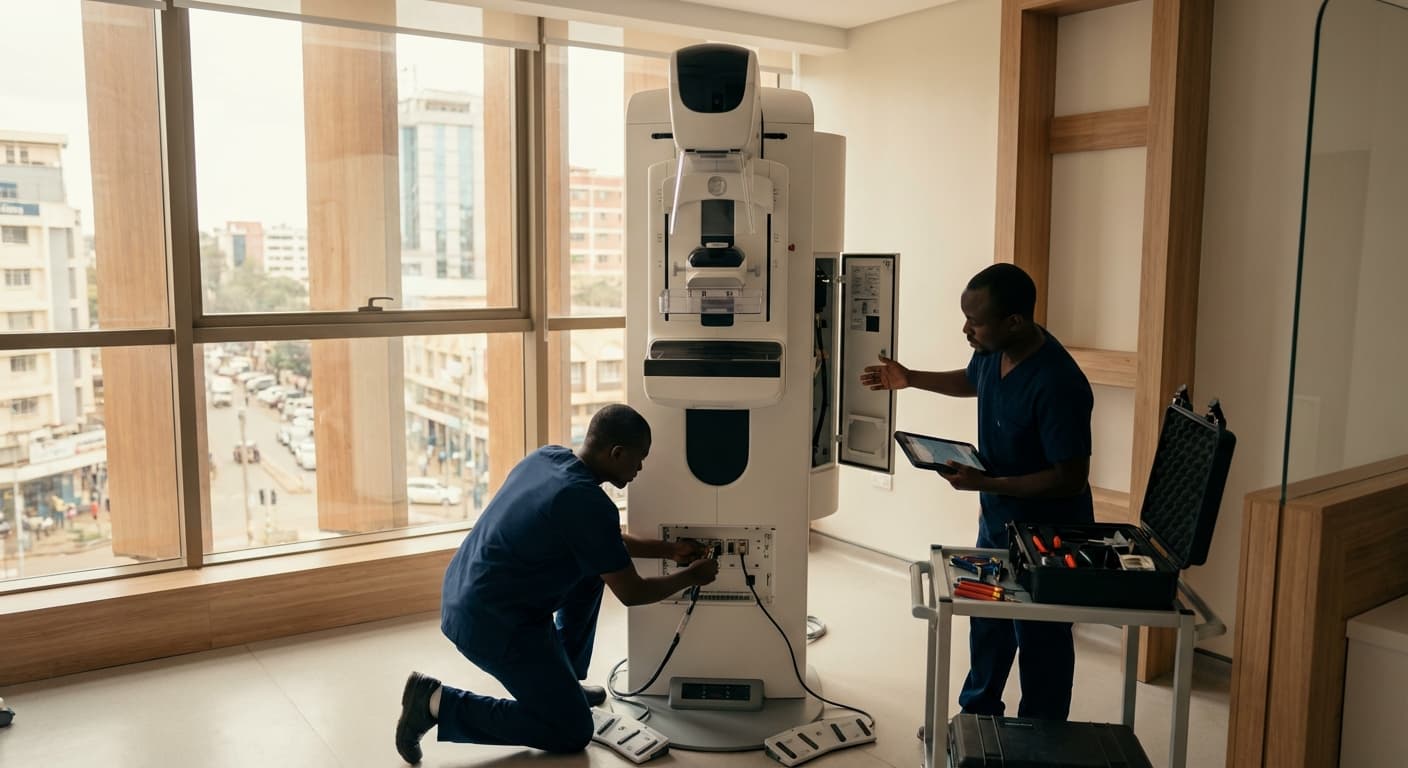
Mammography Installation Service in Botswana
Engineering Excellence & Technical Support
Mammography Installation Service High-standard technical execution following OEM protocols and local regulatory frameworks.
Advanced Imaging Technology Integration
We specialize in the seamless installation of cutting-edge mammography systems in Botswana, ensuring optimal image quality and diagnostic accuracy. Our expert technicians are certified to handle the latest digital mammography, 3D mammography (tomosynthesis), and contrast-enhanced mammography equipment, integrating them with PACS and RIS for efficient workflow management.
Certified & Compliant Installation
Our installation services adhere strictly to international and local regulatory standards for medical equipment in Botswana. We provide comprehensive site assessment, radiation shielding verification, calibration, and performance testing by certified professionals, guaranteeing safe and compliant operation from day one.
Comprehensive Training & Support
Beyond installation, we offer thorough training for your radiology staff on the operation and basic maintenance of the new mammography equipment. Our commitment extends to providing responsive post-installation technical support and maintenance planning, ensuring long-term system reliability and performance for healthcare providers across Botswana.
What Is Mammography Installation Service In Botswana?
Mammography Installation Service in Botswana refers to the comprehensive process of setting up, calibrating, and commissioning mammography equipment within healthcare facilities in the country. This service ensures that the installed mammography units meet stringent technical specifications and regulatory requirements, guaranteeing their accurate and safe operation for diagnostic imaging. It encompasses a series of critical steps, from initial site assessment and equipment delivery to final testing and user training. The primary objective is to enable reliable mammographic screening and diagnostic procedures for the early detection of breast cancer and other related pathologies.
| Stakeholder/Entity | Reason for Requiring Service | Typical Use Cases |
|---|---|---|
| Healthcare Facilities (Hospitals, Clinics, Diagnostic Centers) in Botswana | To acquire and operationalize mammography equipment for diagnostic and screening purposes. This includes both new installations and replacements of existing systems. | Installation of new digital or film-screen mammography units for breast cancer screening programs, diagnostic mammography for symptomatic patients, and specialized mammographic procedures. |
| Government Health Ministries and Departments | To ensure the availability of state-of-the-art diagnostic imaging technology for public health initiatives, especially breast cancer early detection programs. | Overseeing the installation of mammography units in public hospitals and health centers across various districts to improve access to breast cancer screening and diagnosis. |
| Private Radiology Practices and Imaging Centers | To enhance diagnostic capabilities and offer specialized breast imaging services to meet growing patient demand. | Establishing dedicated breast imaging suites with the latest mammography technology to provide comprehensive diagnostic services, including tomosynthesis and contrast-enhanced mammography. |
| Non-Governmental Organizations (NGOs) and International Aid Organizations | As part of broader healthcare improvement projects or specific cancer control initiatives. | Facilitating the installation of mammography equipment in underserved areas or as part of mobile screening units to reach remote populations. |
Key Components of Mammography Installation Service
- Site Assessment and Preparation: Evaluating the physical space, power supply, environmental conditions (temperature, humidity), and radiation shielding requirements to ensure suitability for mammography equipment installation.
- Equipment Delivery and Unpacking: Secure transportation and careful unpacking of the mammography system, including the X-ray generator, detector (e.g., digital radiography flat-panel detector), compression paddle, imaging workstation, and associated accessories.
- Mechanical and Electrical Installation: Assembling and connecting all physical components of the mammography unit, and integrating it with the facility's electrical infrastructure, ensuring proper grounding and power surge protection.
- Software Installation and Configuration: Installing and configuring the mammography system's software, Picture Archiving and Communication System (PACS) integration, and ensuring compatibility with existing hospital information systems (HIS).
- Calibration and Quality Assurance (QA): Performing rigorous calibration procedures to optimize image quality, reduce radiation dose, and ensure adherence to international and national diagnostic imaging standards. This includes tests for kVp accuracy, timer accuracy, dose linearity, spatial resolution, and artifact detection.
- Radiation Safety Compliance: Verifying and documenting compliance with Botswana's radiation protection regulations, including the verification of X-ray beam filtration and alignment, and the implementation of safety interlocks.
- System Testing and Commissioning: Conducting comprehensive performance tests under simulated clinical conditions to validate the entire workflow, from image acquisition to post-processing and archiving.
- User Training and Handover: Providing in-depth training to radiographers, radiologists, and biomedical engineers on the operation, maintenance, and basic troubleshooting of the mammography system.
- Documentation and Certification: Providing all necessary documentation, including installation reports, calibration certificates, QA test results, and user manuals, to formally hand over the operational system.
Who Needs Mammography Installation Service In Botswana?
Mammography installation is a specialized service crucial for healthcare facilities aiming to provide essential diagnostic imaging for breast cancer screening and diagnosis. In Botswana, as in many developing nations, the demand for such services is driven by a growing awareness of breast cancer's prevalence and the government's commitment to improving public health infrastructure. This service involves the expert setup, calibration, and testing of mammography equipment, ensuring optimal performance and patient safety. Specialized technicians with in-depth knowledge of medical imaging technology are required for successful installation, often involving complex electrical, mechanical, and software configurations.
| Target Customer Type | Key Departments Involved | Rationale for Installation |
|---|---|---|
| Public Hospitals | Radiology Department, Diagnostic Imaging Unit, Oncology Department | To provide essential breast cancer screening and diagnostic services to the general population, fulfilling public health mandates. |
| Private Hospitals and Clinics | Radiology Department, Diagnostic Imaging Services, Women's Health Unit | To enhance service offerings, attract patients seeking advanced diagnostics, and improve revenue generation through specialized imaging. |
| Specialized Cancer Treatment Centers | Oncology Department, Radiology Department, Pathology Department | To ensure accurate and timely diagnosis as a crucial first step in the cancer treatment pathway, supporting early detection and staging. |
| NGOs and Charitable Foundations | Medical Services Unit, Outreach Programs Team | To facilitate mobile screening initiatives, community health programs, and provide access to diagnostics in areas with limited healthcare infrastructure. |
| Ministry of Health and Wellness Facilities | Procurement Department, Hospital Management, Radiology Services Directorate | To upgrade existing equipment, expand diagnostic capacity, and implement national health policies related to non-communicable disease screening. |
Target Customers and Departments Requiring Mammography Installation Service in Botswana
- {"title":"Public Hospitals","description":"Government-funded hospitals across Botswana, from tertiary referral centers to district hospitals, are key beneficiaries. They often serve a large patient population and are central to national health initiatives."}
- {"title":"Private Hospitals and Clinics","description":"Private healthcare providers investing in advanced diagnostic capabilities to offer comprehensive services to their clientele. This includes both standalone diagnostic centers and private hospital wings."}
- {"title":"Specialized Cancer Treatment Centers","description":"Facilities specifically dedicated to cancer diagnosis and treatment, which would require state-of-the-art mammography units as a core component of their diagnostic services."}
- {"title":"Non-Governmental Organizations (NGOs) and Charitable Foundations","description":"Organizations involved in health outreach programs, breast cancer awareness campaigns, and provision of free or subsidized medical services, particularly in underserved areas."}
- {"title":"Ministry of Health and Wellness Facilities","description":"Government facilities managed or directly overseen by the Ministry of Health and Wellness, which may be procuring and installing new equipment as part of national health strategies and infrastructure upgrades."}
Mammography Installation Service Process In Botswana
This document outlines the typical workflow for a mammography installation service process in Botswana, covering all stages from the initial customer inquiry to the final execution and handover. The process is designed to ensure a smooth, efficient, and compliant installation of mammography equipment.
| Phase | Stage/Step | Description | Key Activities | Responsible Parties | Deliverables/Outcomes |
|---|---|---|---|---|---|
| 1: Inquiry and Initial Assessment | Initial Contact | The client expresses interest in installing mammography equipment. | Receive inquiry, understand client's needs (type of equipment, location, timeline), initial site information gathering. | Client (Hospital/Clinic), Service Provider Sales Team | Confirmation of interest, basic understanding of project scope. |
| 1: Inquiry and Initial Assessment | Site Visit and Needs Analysis | Detailed assessment of the installation site to determine technical requirements and feasibility. | On-site inspection of the room, power supply, cooling, radiation shielding requirements, space availability, network infrastructure. | Service Provider Technical Team, Client Facilities Management | Detailed site assessment report, identification of potential challenges, preliminary technical specifications. |
| 2: Quotation and Agreement | Proposal Generation | Development of a comprehensive quotation based on the site assessment and client requirements. | Costing of equipment, installation labor, materials, travel, training, and any site modifications. Technical specifications. | Service Provider Sales/Technical Team | Formal quotation and technical proposal. |
| 2: Quotation and Agreement | Contract Negotiation and Signing | Agreement on terms, conditions, pricing, and project timelines. | Review of proposal, negotiation of terms, signing of contract/purchase order. | Client Management, Service Provider Management | Signed contract, confirmed project commencement date. |
| 3: Pre-Installation Planning and Site Preparation | Detailed Project Planning | Creation of a detailed installation plan, including timelines, resource allocation, and risk management. | Development of a work breakdown structure, scheduling of activities, identification of critical path, contingency planning. | Service Provider Project Manager, Technical Team | Detailed project plan, schedule of works. |
| 3: Pre-Installation Planning and Site Preparation | Site Modifications and Preparations | Ensuring the installation site meets all technical and regulatory requirements. | Implementing necessary structural changes (e.g., radiation shielding), electrical upgrades, HVAC adjustments, network cabling. | Client Facilities Management, Approved Contractors, Service Provider Oversight | Prepared installation site, completion certificates for any structural/electrical modifications. |
| 4: Equipment Delivery and Logistics | Equipment Procurement and Manufacturing | Ordering and manufacturing of the specified mammography equipment. | Placing order with manufacturer, quality control checks during manufacturing. | Service Provider Procurement, Manufacturer | Manufactured and ready-for-shipment equipment. |
| 4: Equipment Delivery and Logistics | Shipping and Customs Clearance | Transporting the equipment from the manufacturer to Botswana and clearing it through customs. | Arranging international shipping, managing all import documentation, customs duties, and taxes. | Service Provider Logistics Team, Freight Forwarders, Customs Agents | Equipment cleared through customs and ready for local transport. |
| 4: Equipment Delivery and Logistics | Local Transportation to Site | Moving the equipment from the port/airport to the client's installation site. | Secure transportation, specialized handling for sensitive medical equipment, coordination with site access. | Service Provider Logistics Team, Specialized Movers | Equipment safely delivered to the installation site. |
| 5: Installation and Setup | Unpacking and Assembly | Careful unpacking of all components and initial assembly of the mammography system. | Checking for any transit damage, assembling the main unit and accessories according to manufacturer guidelines. | Service Provider Installation Technicians | Mammography system components unpacked and ready for installation. |
| 5: Installation and Setup | System Installation | Physically installing the mammography unit and associated components in the prepared room. | Positioning the unit, connecting power, network, and any peripheral devices, ensuring proper alignment and integration. | Service Provider Installation Technicians | Mammography system physically installed in the designated space. |
| 6: Testing and Calibration | Initial System Checks | Performing basic functional tests to ensure all components are operational. | Power-on tests, checking indicator lights, basic control surface functionality. | Service Provider Installation Technicians | System passes initial functional checks. |
| 6: Testing and Calibration | Performance Testing and Quality Assurance (QA) | Rigorous testing to verify the system meets all performance specifications and regulatory standards. | Image quality testing using phantoms, dose verification, radiation safety checks, adherence to Botswana health regulations. | Service Provider Technical Specialists, Radiographer (for acceptance testing) | System meets performance benchmarks, QA reports, radiation safety compliance. |
| 6: Testing and Calibration | Calibration and Fine-Tuning | Adjusting system parameters for optimal image acquisition and diagnostic accuracy. | Manufacturer-specific calibration procedures, fine-tuning settings based on testing results. | Service Provider Technical Specialists | Optimized system performance. |
| 7: Training and Handover | User Training | Educating clinical staff on the operation and basic maintenance of the mammography system. | Hands-on training for radiographers and technicians on system operation, patient positioning, image acquisition, and basic troubleshooting. | Service Provider Application Specialist/Trainer, Clinical Staff | Trained clinical staff, training attendance records. |
| 7: Training and Handover | Documentation and Handover | Providing all necessary documentation and formally handing over the installed system. | Delivery of user manuals, service manuals, warranty information, installation completion certificate, QA reports. | Service Provider Project Manager, Client Representative | Complete handover package, signed acceptance certificate. |
| 8: Post-Installation Support | Warranty Period Support | Providing support and maintenance during the warranty period as per the contract. | Responding to service calls, performing scheduled maintenance, troubleshooting issues. | Service Provider Technical Support Team | Continued reliable operation of the mammography system. |
| 8: Post-Installation Support | Service Agreements and Maintenance | Establishing ongoing maintenance plans for long-term system performance and longevity. | Offering annual maintenance contracts (AMCs), remote diagnostics, planned preventative maintenance. | Service Provider Service Department, Client | Long-term operational efficiency and minimal downtime. |
Mammography Installation Service Process Workflow
- Phase 1: Inquiry and Initial Assessment
- Phase 2: Quotation and Agreement
- Phase 3: Pre-Installation Planning and Site Preparation
- Phase 4: Equipment Delivery and Logistics
- Phase 5: Installation and Setup
- Phase 6: Testing and Calibration
- Phase 7: Training and Handover
- Phase 8: Post-Installation Support
Mammography Installation Service Cost In Botswana
The cost of mammography installation services in Botswana can vary significantly depending on several key factors. These include the complexity of the installation, the type and brand of the mammography equipment, the required site preparation, any necessary upgrades to existing infrastructure, and the specific service provider. It's essential to obtain detailed quotes from multiple qualified vendors to ensure competitive pricing. Costs are typically quoted in Botswana Pula (BWP).
| Service Component | Estimated Price Range (BWP) |
|---|---|
| Basic Digital Mammography Unit Installation (Standard Site) | 5,000 - 15,000 |
| Advanced Digital Mammography Unit Installation (with minor site upgrades) | 15,000 - 40,000 |
| Installation requiring significant site preparation (shielding, electrical upgrades) | 40,000 - 100,000+ |
| Equipment transportation and logistics (variable based on distance) | 1,000 - 10,000 |
| On-site training for staff (per day, estimated) | 500 - 2,000 |
| Initial Calibration and Testing | 2,000 - 5,000 |
Key Pricing Factors for Mammography Installation in Botswana
- Equipment Type and Brand: High-end digital mammography systems will generally incur higher installation costs than older analog models or basic digital units. Brand reputation and proprietary installation requirements also play a role.
- Site Preparation and Infrastructure: The existing condition of the installation site is crucial. This can include the need for specialized flooring, radiation shielding, dedicated electrical circuits, cooling systems, and network connectivity. Extensive modifications will increase costs.
- Installation Complexity: Factors like the size and weight of the equipment, the accessibility of the installation location, and the need for specialized lifting or maneuvering equipment will influence the labor and time required, thus affecting the price.
- Service Provider Expertise and Reputation: Experienced and certified installation teams may charge more due to their proven track record, specialized knowledge, and potentially faster or more efficient service.
- Ancillary Services: Installation costs might also encompass training for hospital staff, initial calibration and testing, warranty registration, and post-installation support. Bundling these services can impact the overall price.
- Location within Botswana: While less significant than other factors, very remote locations might incur slightly higher transportation and logistical costs for the installation team and equipment.
Affordable Mammography Installation Service Options
Securing affordable mammography installation services is crucial for healthcare facilities aiming to expand their diagnostic capabilities without exceeding budget constraints. This involves understanding various service models, exploring value-added packages, and implementing smart cost-saving strategies. The installation process for mammography equipment is complex, requiring specialized technicians, site preparation, and meticulous calibration to ensure diagnostic accuracy and patient safety. By carefully evaluating service provider offerings and adopting a strategic approach, institutions can achieve significant savings.
| Value Bundle Type | Included Services | Potential Cost Savings | Considerations |
|---|---|---|---|
| Basic Installation Package | On-site equipment delivery, basic mounting, power connection, and initial system check. | Lower upfront cost. | May require additional fees for site prep, advanced calibration, or extended training. |
| Standard Installation Package | Site assessment, comprehensive installation (including minor electrical/structural adjustments), full calibration, basic user training, and initial system validation. | Good balance of cost and comprehensive service. | May not include advanced software integration or specialized on-site support for extended periods. |
| Premium/All-Inclusive Package | Full-service installation, including all site modifications, advanced software integration, extensive operator and technician training, on-site support for a defined post-installation period, and initial preventative maintenance. | Predictable total cost, reduced risk of hidden fees, and enhanced operational readiness. | Higher initial investment, but can offer better long-term value and reduced downtime. |
| Phased Installation | Breaking down installation into stages (e.g., site preparation first, then equipment installation). | Spreads out capital expenditure, allowing for better cash flow management. | Requires careful project management to ensure seamless integration between phases. |
Key Considerations for Affordable Mammography Installation
- Understanding Installation Scope: Clearly define what is included in the installation service – site assessment, power/ventilation requirements, cabling, equipment mounting, calibration, and initial training.
- Comparing Service Provider Models: Evaluate 'full-service' packages versus 'a-la-carte' options to determine the best fit for your needs and budget.
- Negotiating Contract Terms: Don't hesitate to negotiate pricing, payment schedules, and warranty periods.
- Considering Equipment Lifespan and Maintenance: Factor in long-term operational costs, including maintenance contracts, when evaluating initial installation expenses.
- Leveraging Existing Infrastructure: Assess if any existing site modifications can be utilized to reduce preparation costs.
- Exploring Refurbished or Certified Pre-Owned Equipment: While not directly installation, this can significantly lower the overall capital expenditure, impacting the perceived 'affordability' of the entire process.
Verified Providers In Botswana
In Botswana's evolving healthcare landscape, identifying reliable and skilled medical professionals is paramount. Franance Health stands out as a beacon of trust, offering a carefully curated network of verified providers. Our rigorous credentialing process ensures that every practitioner affiliated with Franance Health meets the highest standards of education, experience, and ethical practice, making them the premier choice for your health needs.
| Provider Type | Franance Health Verification Criteria | Benefits of Choosing Franance Health |
|---|---|---|
| General Practitioner | MBBS/MD, Current Botswana Medical Council License, Minimum 3 Years Post-Graduation Experience, Clean Disciplinary Record | Reliable primary care, prompt diagnosis, referrals to specialists. |
| Specialist (e.g., Cardiologist, Dermatologist) | MBBS/MD, Specialist Postgraduate Degree (e.g., MMed, FRCS), Current Botswana Medical Council License, Fellowship/Membership in relevant professional body, Minimum 5 Years Specialization Experience, Proven clinical outcomes | Expert diagnosis and treatment for complex conditions, access to advanced sub-specialties. |
| Dentist | BDS/DMD, Current Botswana Dental Association License, Minimum 3 Years Post-Graduation Experience, Proficiency in modern dental procedures | Comprehensive oral health care, preventative treatments, cosmetic dentistry. |
| Pharmacist | B.Pharm, Current Botswana Health Professions Council License, Knowledge of drug interactions and dispensing protocols, Commitment to patient medication adherence | Safe and accurate medication dispensing, expert advice on drug usage and potential side effects. |
Why Franance Health Providers are the Best Choice:
- Uncompromising Quality Assurance: We meticulously vet each provider's qualifications, licenses, and certifications.
- Extensive Experience: Our network includes specialists and general practitioners with proven track records.
- Commitment to Patient Care: Franance Health providers prioritize patient well-being and ethical treatment.
- Access to Advanced Practices: We connect you with professionals utilizing modern medical techniques and technologies.
- Peace of Mind: Knowing you're in the hands of a verified and trusted provider.
Scope Of Work For Mammography Installation Service
This Scope of Work (SOW) outlines the requirements for the professional installation of a new mammography system at [Client Facility Name]. It details the technical deliverables, standard specifications, and responsibilities of both the installation vendor and the client to ensure a successful and compliant deployment.
| Section | Description | Key Deliverables | Standard Specifications/Requirements |
|---|---|---|---|
| Detailed review of the intended installation location, including room dimensions, power requirements, radiation shielding, environmental conditions, and network connectivity. | Site survey report, confirmed installation plan, identified any necessary modifications. | Compliance with manufacturer's site preparation guide, local building codes, radiation safety regulations (e.g., ACR, state licensing boards). Room should be adequately shielded to meet regulatory limits for radiation exposure. Adequate ventilation and temperature control (typically 18-24°C). Stable and clean power supply (UPS recommended). |
| Receipt, inspection, and careful unpacking of the mammography system components at the client facility. | Inventory of all delivered items, report of any shipping damage. | Manufacturer's recommended handling procedures for sensitive medical equipment. Verification of serial numbers against packing lists. |
| Assembly and secure mounting of all system components, including the mammography unit, console, workstation, and any accessories. Connection to electrical power and grounding. | Fully assembled and physically installed mammography system. | Adherence to manufacturer's installation manuals. All electrical connections must be made by qualified electricians and comply with local electrical codes and hospital standards. Grounding must be properly implemented for safety and performance. Cable management for a clean and safe environment. |
| Connection of the mammography system to the hospital's Picture Archiving and Communication System (PACS), Radiology Information System (RIS), and other relevant IT networks. | Successful data transfer to PACS/RIS, verification of DICOM connectivity and HL7 messaging. | Compliance with hospital IT security policies and DICOM standards. Verification of network bandwidth and stability. Secure data transmission protocols. |
| Performing all necessary system calibrations, alignments, and initial quality control tests to ensure optimal performance and image quality. | Completed calibration logs, passed initial QA tests as per manufacturer and regulatory requirements. | Manufacturer's recommended calibration procedures. Adherence to ACR, MQSA (US), or equivalent international standards for mammography QA. Use of calibrated phantoms for image quality assessment. |
| Verification of existing or installation of any required radiation shielding. Testing to ensure radiation levels are within regulatory limits. | Radiation survey report, confirmation of compliance with safety regulations. | Compliance with local and national radiation safety standards. Independent physicist may be required for final sign-off. |
| Comprehensive functional testing of all system modes, features, and accessories. End-to-end workflow testing. | Documented system test results, successful completion of all functional tests. | Testing of all imaging modes (e.g., FFDM, Tomosynthesis), compression, magnification, AEC, post-processing functions. Verification of user interface responsiveness and error handling. |
| Provision of training for radiographers, radiologists, and relevant technical staff on the operation, basic maintenance, and troubleshooting of the new mammography system. | Training attendance records, user competency assessment (if applicable), provision of training materials. | Manufacturer's standard training curriculum. Training tailored to the specific roles and responsibilities of the trainees. Hands-on sessions are crucial. |
| Provision of all relevant user manuals, service manuals, installation records, warranty information, and QA reports. Formal handover of the installed system to the client. | Complete documentation package, signed handover certificate. | All documentation in English and/or client's preferred language. Digital and/or hard copy formats as agreed. |
Key Objectives
- To ensure the mammography system is installed according to manufacturer specifications and relevant regulatory standards.
- To provide a fully functional and calibrated mammography system ready for clinical use.
- To minimize disruption to ongoing patient care during the installation process.
- To ensure proper integration with existing hospital IT infrastructure (PACS, RIS, etc.).
- To provide comprehensive training to designated clinical and technical staff.
Service Level Agreement For Mammography Installation Service
This Service Level Agreement (SLA) outlines the response times and uptime guarantees for the Mammography Installation Service provided by [Your Company Name] to [Client Name]. This SLA is an appendix to the Master Service Agreement (MSA) dated [Date of MSA].
| Service Component | Severity Level | Response Time Target | Resolution Time Target (during Business Hours) | Resolution Time Target (outside Business Hours) | Uptime Guarantee |
|---|---|---|---|---|---|
| Mammography Installation & Configuration | Critical Incident | 2 Business Hours | 8 Business Hours | 16 Business Hours (from start of next Business Day) | 99.5% Uptime (post-successful installation and acceptance) |
| Mammography Installation & Configuration | Major Incident | 4 Business Hours | 16 Business Hours | 24 Business Hours (from start of next Business Day) | 99.5% Uptime (post-successful installation and acceptance) |
| Mammography Installation & Configuration | Minor Incident | 8 Business Hours | 3 Business Days | 3 Business Days (from start of next Business Day) | 99.5% Uptime (post-successful installation and acceptance) |
| Post-Installation Support & Troubleshooting | Critical Incident | 2 Business Hours | 8 Business Hours | 16 Business Hours (from start of next Business Day) | 99.5% Uptime (monthly average) |
| Post-Installation Support & Troubleshooting | Major Incident | 4 Business Hours | 16 Business Hours | 24 Business Hours (from start of next Business Day) | 99.5% Uptime (monthly average) |
| Post-Installation Support & Troubleshooting | Minor Incident | 8 Business Hours | 3 Business Days | 3 Business Days (from start of next Business Day) | 99.5% Uptime (monthly average) |
Definitions
- Installation Service: Refers to the end-to-end process of setting up and configuring the mammography equipment at the Client's designated facility, as detailed in the Statement of Work (SOW).
- Downtime: The period during which the mammography equipment is not operational or accessible due to a fault or failure in the installed system, excluding scheduled maintenance or events outside of the Service Provider's control.
- Response Time: The maximum time allowed for [Your Company Name] to acknowledge and begin addressing a reported incident.
- Resolution Time: The maximum time allowed for [Your Company Name] to restore the mammography equipment to full operational status after an incident is reported.
- Critical Incident: An incident that renders the mammography equipment completely inoperable, preventing any diagnostic imaging.
- Major Incident: An incident that significantly impairs the functionality of the mammography equipment, affecting a substantial portion of its diagnostic capabilities.
- Minor Incident: An incident that causes a minor disruption to the mammography equipment's functionality, but does not prevent its primary use.
- Scheduled Maintenance: Planned periods for system updates, preventative maintenance, or upgrades agreed upon in advance by both parties.
- Business Hours: 9:00 AM to 5:00 PM, Monday through Friday, excluding national holidays.
Frequently Asked Questions

Ready when you are
Let's scope your Mammography Installation Service in Botswana project in Botswana.

Scaling healthcare logistics and technical systems across the entire continent.