
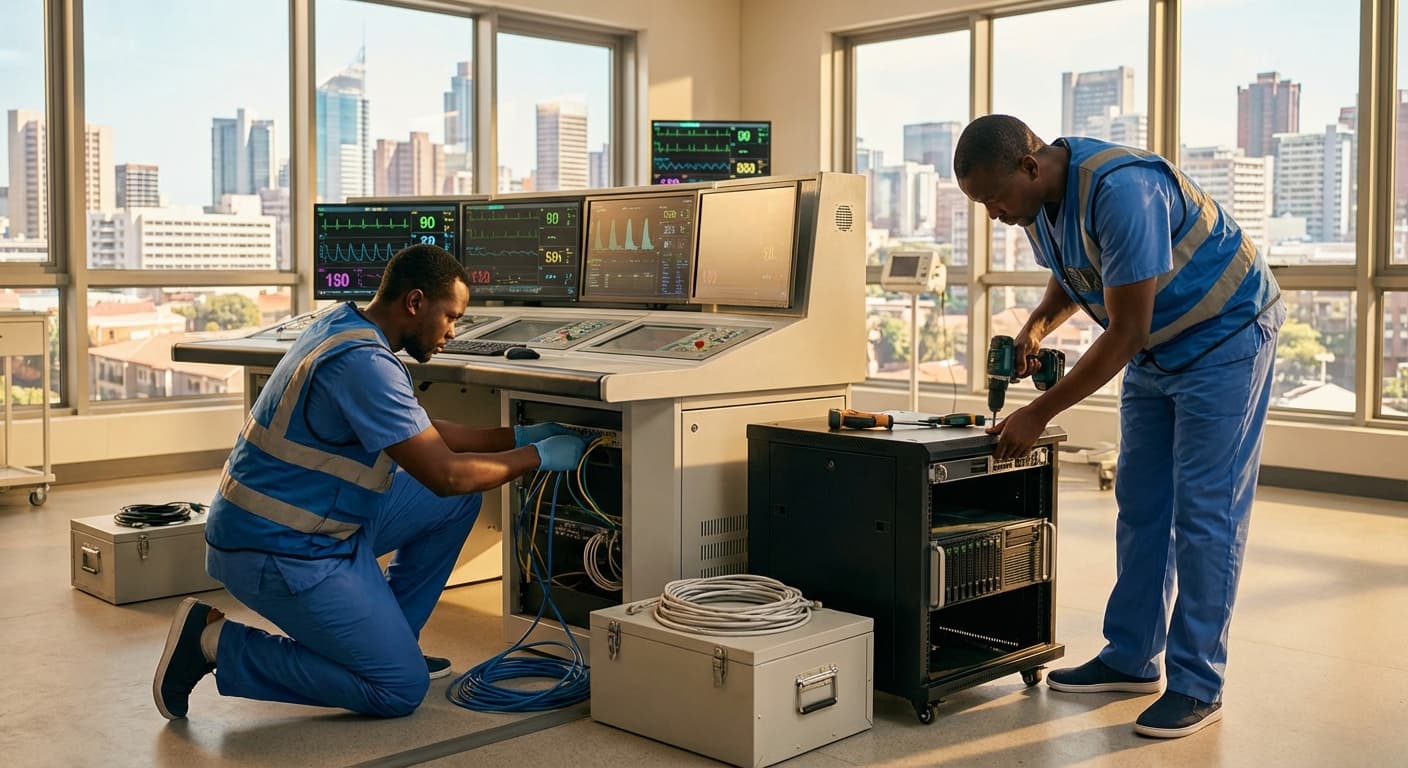
ICU Central Monitoring Station Installation Service in Botswana
Engineering Excellence & Technical Support
ICU Central Monitoring Station Installation Service High-standard technical execution following OEM protocols and local regulatory frameworks.
Robust Network Infrastructure
We design and implement a high-availability, secure network infrastructure tailored for critical data transmission, ensuring uninterrupted patient monitoring and seamless integration with existing hospital systems in Botswana.
Tailored System Integration
Our expert technicians meticulously integrate diverse monitoring devices and hospital information systems (HIS) to create a unified, real-time view of patient status, minimizing downtime and maximizing clinical efficiency within Botswana's healthcare facilities.
Comprehensive Staff Training
We provide in-depth, hands-on training for your ICU staff on the new central monitoring system, empowering them with the knowledge and confidence to effectively utilize the technology for optimal patient care and rapid response in Botswana.
What Is Icu Central Monitoring Station Installation Service In Botswana?
ICU Central Monitoring Station Installation Service in Botswana refers to the comprehensive process of designing, supplying, installing, configuring, and commissioning a centralized system for real-time patient vital sign monitoring within Intensive Care Units (ICUs) of healthcare facilities. This service ensures that critical patient data, collected from bedside patient monitors, is transmitted, aggregated, and displayed at a central nursing station, enabling continuous surveillance, early detection of patient deterioration, and efficient clinical decision-making by medical staff. The service encompasses the entire lifecycle from initial site assessment and needs analysis to final handover and post-installation support, adhering to established medical device integration standards and local regulatory requirements.
| Requirement | Affected Stakeholders | Typical Use Cases |
|---|---|---|
| Advanced Patient Surveillance: Continuous real-time monitoring of multiple critical care patients simultaneously. | ICU Nurses, Intensivists, Critical Care Physicians, Hospital Administrators | Early detection of adverse events (e.g., cardiac arrest, respiratory failure), proactive intervention, reduced response times to patient deterioration, improved patient outcomes. |
| Centralized Data Management & Analysis: Aggregation and storage of patient vital sign data for trend analysis and research. | Clinical Staff, Researchers, IT Departments, Quality Improvement Teams | Identification of patient care trends, evaluation of treatment efficacy, support for clinical research, generation of audit trails. |
| Enhanced Workflow Efficiency: Reduced need for constant physical presence at each bedside, freeing up nursing staff for other critical tasks. | ICU Nurses, Nursing Supervisors | Optimized nurse-to-patient ratios, improved situational awareness across the ICU, streamlined communication regarding patient status. |
| Remote Monitoring & Tele-ICU Capabilities: Facilitates remote oversight of patients by specialists in distributed locations. | Intensivists, Telemedicine Providers, Hospital IT | Extending critical care expertise to underserved areas, providing specialist support for smaller facilities, disaster preparedness. |
| Compliance & Reporting: Adherence to regulatory requirements for patient monitoring and data integrity. | Hospital Administrators, Regulatory Bodies, IT Departments | Ensuring data accuracy for legal and accreditation purposes, facilitating performance reporting. |
Key Components and Scope of Service:
- Needs Assessment & System Design: Site surveys, evaluation of existing infrastructure, determination of monitoring requirements (number of beds, data points, network topology), and conceptual design of the central monitoring station architecture.
- Hardware Procurement & Supply: Sourcing and delivery of central monitoring workstations, servers, network switches, cabling, uninterruptible power supplies (UPS), and associated peripheral devices.
- Network Infrastructure Integration: Design and implementation of a secure, robust, and reliable network to facilitate data transmission from bedside monitors to the central station. This may involve integration with existing hospital IT infrastructure or the deployment of a dedicated network segment.
- Software Installation & Configuration: Installation and configuration of the central monitoring software platform, including patient profiles, alarm management settings, data logging, trend analysis modules, and user access controls.
- Bedside Monitor Integration: Establishing connectivity and interoperability between various brands and models of bedside patient monitors and the central monitoring system, often utilizing standard communication protocols (e.g., HL7, DICOM, proprietary vendor protocols).
- System Testing & Validation: Conducting comprehensive functional testing, performance testing, stress testing, and clinical validation to ensure accuracy, reliability, and adherence to specifications.
- User Training & Handover: Providing in-depth training to clinical staff (nurses, physicians) and IT personnel on the operation, maintenance, and troubleshooting of the central monitoring system. Formal handover of the installed system and documentation.
- Post-Installation Support & Maintenance: Offering warranty support, ongoing maintenance contracts, software updates, and troubleshooting services to ensure continuous optimal system performance.
Who Needs Icu Central Monitoring Station Installation Service In Botswana?
This document outlines the critical need for ICU Central Monitoring Station Installation Services in Botswana. These specialized services are essential for upgrading and expanding Intensive Care Unit (ICU) capabilities within healthcare facilities, ensuring optimal patient care through real-time, centralized monitoring of vital signs and critical parameters. The installation of a robust central monitoring system allows medical staff to efficiently manage multiple high-acuity patients, detect early signs of deterioration, and respond promptly to emergencies, ultimately improving patient outcomes and operational efficiency. These services are particularly vital for hospitals seeking to enhance their critical care infrastructure to meet national health standards and to provide advanced medical services to the population.
| Target Customer Segment | Primary Departments Benefiting | Specific Needs/Reasons for Installation |
|---|---|---|
| Government Hospitals | Intensive Care Units (ICUs), High Dependency Units (HDUs), Emergency Departments (EDs) | Enhancing national healthcare infrastructure, improving access to advanced critical care, standardized patient monitoring, supporting medical training. |
| Private Hospitals | ICUs, HDUs, Cardiac Catheterization Labs, Operating Rooms (ORs) with post-anesthesia care units (PACUs) | Competitive advantage, premium patient care, attracting specialized medical professionals, optimizing staff allocation, meeting international standards of care. |
| Mission and Non-Profit Hospitals | ICUs, HDUs, General Wards with high-risk patients | Expanding critical care capacity, improving patient outcomes in resource-limited settings, ensuring continuity of care, supporting community health initiatives. |
| University Teaching Hospitals | ICUs, Research Laboratories, Simulation Centers, Various Specialty Units (e.g., Neurosurgery ICU, Cardiothoracic ICU) | Facilitating advanced medical research, providing hands-on training for future healthcare professionals, integrating cutting-edge technology for patient care and education, standardizing monitoring protocols across departments. |
| Ministry of Health and Wellness (Botswana) | National Health Planning, Hospital Infrastructure Development, Public Health Emergency Response Teams | Developing national standards for critical care, ensuring equitable distribution of advanced medical technology, strengthening public health infrastructure, enabling data collection for health analytics and policy making. |
| Healthcare Procurement and Planning Departments | Biomedical Engineering Departments, IT Departments, Facilities Management | System integration, network infrastructure, technical support, long-term maintenance planning, ensuring compatibility with existing hospital systems, training for technical staff. |
Target Customers and Departments Requiring ICU Central Monitoring Station Installation Services in Botswana:
- Hospitals (Government, Private, and Mission-based) with existing or planned ICU facilities.
- Tertiary and Referral Hospitals responsible for complex patient care and specialized medical services.
- University Teaching Hospitals requiring advanced infrastructure for medical education and research.
- Large District Hospitals looking to upgrade their critical care capabilities.
- Newly constructed healthcare facilities prioritizing state-of-the-art critical care infrastructure from inception.
- Healthcare organizations seeking to expand or modernize their ICU departments.
Icu Central Monitoring Station Installation Service Process In Botswana
This document outlines the comprehensive workflow for the ICU Central Monitoring Station Installation Service Process in Botswana, from initial inquiry to successful execution and handover. The process is designed to ensure a seamless, efficient, and high-quality installation that meets the specific needs of healthcare facilities in Botswana.
| Phase | Activity | Description | Key Stakeholders | Deliverables/Outcomes |
|---|---|---|---|---|
| 1: Inquiry and Initial Consultation | Service Request Received | Client expresses interest in ICU Central Monitoring Station installation. | Client (Hospital/Clinic Management, IT Department, Biomedical Engineering) | Initial understanding of client's needs. |
| 1: Inquiry and Initial Consultation | Initial Consultation Meeting | Discuss project scope, objectives, budget, and timeline. Understand existing infrastructure. | Service Provider Sales/Technical Team, Client Representatives | Clarified project requirements, preliminary feasibility assessment. |
| 2: Site Survey and Requirements Gathering | On-site Assessment | Detailed inspection of the ICU environment, network infrastructure, power availability, and physical space. | Service Provider Technical Team, Client Biomedical Engineering/IT | Detailed site assessment report, identification of potential challenges. |
| 2: Site Survey and Requirements Gathering | Requirements Documentation | Formalize specific hardware, software, network, and integration requirements. | Service Provider Technical Team, Client Biomedical Engineering/IT | Comprehensive requirements document. |
| 3: Proposal and Quotation | Solution Design | Develop a tailored solution based on gathered requirements and site survey. | Service Provider Technical Team | Proposed system architecture and configuration. |
| 3: Proposal and Quotation | Proposal Submission | Present a detailed proposal outlining the proposed solution, scope of work, timeline, and detailed cost breakdown. | Service Provider Sales/Technical Team, Client Management | Formal project proposal. |
| 4: Contract and Agreement | Negotiation and Finalization | Review and negotiate terms, conditions, and pricing. Address any client queries. | Service Provider Management, Client Legal/Procurement | Agreed-upon contract terms. |
| 4: Contract and Agreement | Contract Signing | Formalize the agreement between the client and the service provider. | Authorized representatives of both parties | Signed Service Agreement. |
| 5: Project Planning and Design | Detailed Project Plan | Develop a comprehensive project plan including phases, tasks, responsibilities, and milestones. | Service Provider Project Manager, Technical Team | Detailed project schedule and resource allocation. |
| 5: Project Planning and Design | System Design and Integration Plan | Finalize the detailed technical design, including network topology, server configuration, and integration with existing EMR/HIS if applicable. | Service Provider Technical Team, Client IT | Detailed system design documents. |
| 6: Procurement and Logistics | Equipment Procurement | Source and procure all necessary hardware, software licenses, and accessories from approved vendors. | Service Provider Procurement Team, Vendors | Ordered and confirmed equipment. |
| 6: Procurement and Logistics | Logistics and Shipping | Arrange for secure transportation and delivery of equipment to the installation site in Botswana. | Service Provider Logistics Team, Shipping Companies | Equipment delivered to site. |
| 7: Pre-installation Preparation | Site Preparation | Ensure the ICU environment meets all technical and safety requirements (e.g., network cabling, power outlets, server room readiness). | Client Facilities Management, Service Provider Technical Team | Ready installation environment. |
| 7: Pre-installation Preparation | Equipment Inspection and Staging | Receive, inspect, and pre-configure equipment at the staging area if necessary. | Service Provider Technical Team | Verified and pre-configured equipment. |
| 8: Installation and Configuration | Hardware Installation | Install all central monitoring stations, servers, network devices, and workstations. | Service Provider Technical Team | Installed hardware components. |
| 8: Installation and Configuration | Software Installation and Configuration | Install and configure the central monitoring software, patient monitoring interfaces, and relevant modules. | Service Provider Technical Team | Configured software and system settings. |
| 8: Installation and Configuration | Network Integration | Connect and configure the monitoring system to the hospital's existing network infrastructure. | Service Provider Technical Team, Client IT | Integrated network connectivity. |
| 9: Testing and Validation | System Testing | Conduct comprehensive functional and performance testing of all system components. | Service Provider Technical Team, Client Biomedical Engineering | Test reports indicating system functionality. |
| 9: Testing and Validation | Integration Testing | Verify seamless integration with existing hospital systems (e.g., HIS/EMR, PACS) if applicable. | Service Provider Technical Team, Client IT/Biomedical Engineering | Successful integration confirmed. |
| 9: Testing and Validation | User Acceptance Testing (UAT) | Client representatives validate system performance and functionality against predefined criteria. | Client Key Users, Service Provider Project Manager | UAT sign-off. |
| 10: Training and Handover | End-User Training | Provide comprehensive training to ICU staff (nurses, doctors) on operating the central monitoring system. | Service Provider Training Specialists, Client ICU Staff | Trained end-users. |
| 10: Training and Handover | Administrator Training | Train IT and biomedical engineering staff on system administration, maintenance, and troubleshooting. | Service Provider Technical Specialists, Client IT/Biomedical Engineering | Trained system administrators. |
| 10: Training and Handover | Project Handover | Formally hand over the installed system, documentation, and training materials to the client. | Service Provider Project Manager, Client Management | Signed project acceptance form, handover documentation. |
| 11: Post-Installation Support and Maintenance | Warranty Period | Provide support and address any issues arising during the warranty period. | Service Provider Support Team, Client IT/Biomedical Engineering | Resolved issues, system stability. |
| 11: Post-Installation Support and Maintenance | Ongoing Maintenance and Support | Offer optional service level agreements (SLAs) for ongoing maintenance, updates, and technical support. | Service Provider Support Team, Client IT/Biomedical Engineering | Continued system operability and optimization. |
ICU Central Monitoring Station Installation Service Process in Botswana
- Phase 1: Inquiry and Initial Consultation
- Phase 2: Site Survey and Requirements Gathering
- Phase 3: Proposal and Quotation
- Phase 4: Contract and Agreement
- Phase 5: Project Planning and Design
- Phase 6: Procurement and Logistics
- Phase 7: Pre-installation Preparation
- Phase 8: Installation and Configuration
- Phase 9: Testing and Validation
- Phase 10: Training and Handover
- Phase 11: Post-Installation Support and Maintenance
Icu Central Monitoring Station Installation Service Cost In Botswana
The cost of installing an ICU Central Monitoring Station (CMS) in Botswana can vary significantly based on several factors. A CMS is a critical component of modern intensive care units, allowing medical staff to remotely monitor multiple patients' vital signs from a central location. This enhances patient safety, improves response times to critical events, and optimizes staff workflow.
Several elements influence the overall installation cost. These include the size and complexity of the ICU, the number of patient monitoring beds to be integrated, the specific features and capabilities required of the CMS (e.g., advanced waveform display, data archiving, alarm management, integration with electronic health records - EHRs), the brand and model of the CMS equipment, the necessary network infrastructure upgrades, the cost of installation labor, and any ongoing maintenance and support contracts. Furthermore, the chosen vendor or installer will also have their own pricing structures and overheads.
It's important to note that this is a specialized medical equipment installation. Therefore, engaging with reputable medical equipment suppliers and certified installation technicians is crucial for ensuring proper functionality, compliance with healthcare standards, and long-term reliability. Obtaining detailed quotes from multiple providers is highly recommended to compare offerings and identify the best value.
| Cost Component | Estimated Range (BWP) | Notes |
|---|---|---|
| Basic ICU Central Monitoring System (e.g., for 5-10 beds) | 100,000 - 300,000 | Includes core monitoring functions, basic connectivity, and standard features. |
| Mid-Range ICU Central Monitoring System (e.g., for 10-20 beds) | 250,000 - 700,000 | Offers more advanced features, better integration capabilities, and higher scalability. |
| High-End/Enterprise ICU Central Monitoring System (e.g., for 20+ beds or complex needs) | 600,000 - 1,500,000+ | Includes state-of-the-art technology, comprehensive integration with EHRs, advanced analytics, and extensive customization. |
| Installation Labor and Technical Services | 20,000 - 100,000+ | Varies based on complexity, vendor rates, and site preparation required. |
| Network Infrastructure Upgrades (if needed) | 10,000 - 50,000+ | Depends on existing network capacity and the bandwidth requirements of the CMS. |
| Software Licenses & EHR Integration | 15,000 - 100,000+ | Highly variable depending on the software suite and the complexity of integration. |
| Training for Medical Staff | 5,000 - 25,000 | Covers initial training sessions and potential follow-up sessions. |
| Annual Maintenance & Support Contract | 5% - 15% of initial system cost per year | Essential for ongoing updates, technical support, and hardware service. |
Key Pricing Factors for ICU Central Monitoring Station Installation in Botswana
- Number of Patient Monitoring Beds: The more beds the CMS needs to support, the higher the cost of sensors, cables, and potentially the central unit.
- Required Features and Capabilities: Advanced features like EKG interpretation, hemodynamic monitoring, blood gas analysis integration, and sophisticated alarm systems will increase the price.
- Brand and Model of CMS: Premium brands with advanced technology and robust features typically command higher prices.
- Existing Infrastructure: The need for network cabling, server upgrades, or power supply modifications can add to the installation cost.
- Installation Labor and Expertise: Specialized technicians with experience in medical equipment installation are essential and their fees contribute to the overall cost.
- Software Licensing and Integration: Costs associated with CMS software, including licenses and integration with existing hospital IT systems (e.g., EHRs).
- Training: The cost of training medical staff on the operation and maintenance of the new CMS.
- Maintenance and Support Contracts: Post-installation service agreements for ongoing technical support and updates.
- Site Assessment and Design: Initial consultations and design planning for the CMS layout and integration.
Affordable Icu Central Monitoring Station Installation Service Options
Installing an Intensive Care Unit (ICU) Central Monitoring Station (CMS) is a critical investment for any healthcare facility. This system allows for continuous, real-time observation of multiple critically ill patients, improving response times and patient outcomes. While the initial cost can be significant, understanding available service options, value bundles, and cost-saving strategies can make this essential upgrade more accessible and budget-friendly.
| Service Component | Standard Offering | Value Bundle Inclusion | Cost-Saving Tip |
|---|---|---|---|
| Central Monitoring Station Hardware (Servers, Displays) | Purchased individually | Often included as part of a comprehensive package | Consider refurbished options; standardize models |
| Patient Monitor Integration (Wired/Wireless) | Separate setup and configuration | Typically includes initial integration and testing | Leverage existing network infrastructure; standardize monitor brands if possible |
| Software Licenses (OS, CMS Application) | Perpetual or subscription-based, purchased separately | Bundled with hardware and services; may offer tiered licensing | Optimize licensing; explore bundled software discounts |
| Installation & Cabling | Project-based, hourly rates | Fixed price within the bundle | Minimize new cabling by using existing infrastructure |
| System Configuration & Testing | Separate service engagement | Included in the bundle; comprehensive testing | Ensure clear requirements to avoid re-configuration |
| Basic User Training | Hourly rate or per session | Included for key personnel | Invest in comprehensive training to maximize ROI |
| Warranty & Initial Support | Standard manufacturer warranty | Often extended warranty or bundled initial support package | Negotiate extended warranty terms |
Understanding Value Bundles and Cost-Saving Strategies
- What are Value Bundles? Value bundles are pre-packaged service offerings that combine multiple essential components of an ICU CMS installation at a potentially discounted price compared to purchasing each service individually. These often include hardware (monitors, central station hardware), software licenses, installation, basic training, and sometimes extended warranties or initial support packages.
- Why Consider Value Bundles? Bundles offer convenience, predictability in cost, and often leverage economies of scale for the provider, translating into savings for the buyer. They simplify the procurement process and ensure compatibility between different system components.
- Key Cost-Saving Strategies:
- 1. Phased Implementation: Instead of a full-scale, immediate installation across all ICU beds, consider a phased approach. Start with a core set of beds and expand over time as budget allows. This allows for learning and refinement.
- 2. Negotiate Bulk Discounts: If purchasing multiple units of hardware or software licenses, actively negotiate for bulk discounts. This is particularly effective when buying from a single vendor.
- 3. Explore Refurbished or Certified Pre-Owned Equipment: For non-critical components or initial deployments, consider high-quality, certified refurbished equipment. Ensure it comes with a warranty and is from a reputable source.
- 4. Leverage Existing Infrastructure: If your facility has existing network infrastructure, cabling, and power, work with your vendor to integrate the new CMS with these existing resources, reducing the need for extensive new installations.
- 5. Optimize Software Licensing: Understand the different licensing models available for CMS software. Some vendors offer perpetual licenses, while others have subscription-based models. Choose the model that best fits your long-term budget and usage needs. Avoid over-licensing.
- 6. Standardize Hardware: Where possible, standardize on a limited number of hardware models from a single vendor. This simplifies maintenance, training, and spare parts management.
- 7. Prioritize Essential Features: Identify the 'must-have' features for your ICU and avoid paying for advanced functionalities you may not immediately need or use. Some vendors offer modular software that can be upgraded later.
- 8. Invest in Comprehensive Training: While training is a cost, inadequate training leads to inefficiencies, errors, and potentially system underutilization, which is a greater long-term cost. Ensure your staff is well-trained on the system's operation and troubleshooting.
- 9. Explore Government Grants and Funding: Research available healthcare technology grants or funding opportunities from government agencies or non-profit organizations that may subsidize the cost of critical infrastructure like ICU CMS.
- 10. Long-Term Maintenance and Support Contracts: While an upfront cost, a well-negotiated long-term maintenance and support contract can prevent costly emergency repairs and ensure optimal system uptime. Compare different support tiers and contract lengths.
Verified Providers In Botswana
When seeking healthcare in Botswana, particularly for specialized or critical needs, identifying verified and reputable providers is paramount. Franance Health stands out as a leading organization whose credentials and commitment to excellence make them the premier choice for patients. Their rigorous vetting process and dedication to upholding the highest standards of medical care ensure that individuals receive safe, effective, and compassionate treatment. This commitment translates into a network of healthcare professionals and facilities that patients can trust implicitly. By prioritizing evidence-based practices, continuous professional development, and patient-centric approaches, Franance Health-credentialed providers consistently deliver superior health outcomes. Choosing a provider affiliated with Franance Health signifies opting for quality, reliability, and peace of mind in your healthcare journey.
| Credential Category | Description | Benefits for Patients |
|---|---|---|
| Medical Licensing & Registration | Verification of current and valid licenses from the relevant Botswana health authorities. | Ensures providers are legally qualified and adhere to professional regulations. |
| Specialization Certification | Confirmation of board certifications or recognized qualifications in specific medical specialties. | Guarantees that providers have advanced training and expertise in their chosen fields. |
| Continuing Medical Education (CME) | Evidence of ongoing participation in educational programs to stay current with medical advancements. | Confirms that providers are committed to lifelong learning and offer up-to-date treatments. |
| Quality Assurance Audits | Regular assessments of facilities and practices to ensure adherence to quality and safety protocols. | Provides assurance of a safe and effective healthcare environment. |
| Ethical Conduct Reviews | Screening for a history of ethical breaches or malpractice claims. | Reassures patients of the provider's integrity and commitment to patient welfare. |
Why Franance Health Credentials Matter
- Rigorous Vetting Process: Ensures all affiliated providers meet stringent quality and ethical standards.
- Commitment to Excellence: Demonstrates a dedication to providing the highest caliber of medical care.
- Patient-Centric Approach: Focuses on individual needs and well-being throughout the treatment process.
- Evidence-Based Practices: Guarantees that treatments are informed by the latest medical research and best practices.
- Continuous Professional Development: Ensures providers are up-to-date with the latest advancements in their respective fields.
- Trust and Reliability: Offers patients confidence in the quality and safety of the healthcare they receive.
Scope Of Work For Icu Central Monitoring Station Installation Service
This Scope of Work (SOW) outlines the requirements for the installation of a new ICU Central Monitoring Station (CMS). The service provider will be responsible for the complete end-to-end installation, configuration, testing, and commissioning of the CMS hardware and software, ensuring seamless integration with existing ICU bedside monitors and network infrastructure. The goal is to provide a reliable and efficient central monitoring system that enhances patient care and clinical workflow within the Intensive Care Unit.
| Category | Technical Deliverable | Standard Specifications |
|---|---|---|
| Hardware Installation | CMS Server(s) | Rack-mount servers meeting minimum performance specifications (CPU, RAM, Storage) as per vendor recommendations. Redundant power supplies and network interfaces required. |
| Hardware Installation | Workstations (Clinician & Nurse Station) | High-resolution monitors (24" or larger, dual-monitor setup recommended), powerful workstations capable of real-time data processing and display. Ergonomic design and adjustable stands. |
| Hardware Installation | Network Switches & Cabling | Managed Gigabit Ethernet switches with sufficient port density. Structured cabling (Cat 6a or higher) installed in accordance with industry standards and hospital IT policies. Fiber optic backbone where applicable. |
| Software Installation & Configuration | CMS Operating System & Application Software | Latest stable version of the CMS vendor's software. Installation and licensing to be managed by the service provider. Secure configuration with role-based access control. |
| Software Installation & Configuration | Database Configuration | High-availability database cluster configured for optimal performance and data integrity. Regular backups and disaster recovery plan implementation. |
| Integration | Bedside Monitor Connectivity | Establish reliable data streams from all specified ICU bedside monitors to the CMS. Compatibility with existing network protocols (e.g., HL7, proprietary vendor protocols). DHCP or static IP addressing as per hospital network. |
| Integration | Network Infrastructure Integration | Seamless integration with the hospital's existing IP network. Configuration of VLANs, firewalls, and security policies as directed by the hospital IT department. |
| Testing & Commissioning | Data Acquisition & Display Testing | Verify real-time data acquisition from all connected devices. Accurate display of vital signs, waveforms, and alarm status on all workstations. Performance testing under simulated load conditions. |
| Testing & Commissioning | Alarm Management Testing | Verify all configured alarm thresholds and notification mechanisms (audible, visual, and potentially pager/mobile alerts). Testing of alarm acknowledgement and silencing functions. Compliance with clinical alarm management guidelines. |
| Testing & Commissioning | System Performance Testing | Measure system latency, data throughput, and workstation responsiveness. Ensure system stability and reliability over extended periods. |
| Testing & Commissioning | User Acceptance Testing (UAT) | Joint testing with clinical and IT staff to validate functionality against predefined use cases and requirements. Formal sign-off upon successful UAT. |
| Documentation | As-Built Drawings | Detailed network diagrams, rack elevations, cable pathways, and device configurations reflecting the final installed system. Provided in both digital (CAD) and hardcopy formats. |
| Documentation | System Manuals & Guides | Comprehensive user manuals, administrator guides, and troubleshooting manuals for all installed hardware and software components. Provided in digital format. |
| Documentation | Training Materials | Materials for end-user and administrator training sessions, including presentations, exercises, and reference guides. Provided in digital format. |
| Training | End-User Training | Hands-on training for ICU nursing staff and physicians on CMS operation, alarm management, and basic troubleshooting. Tailored to clinical workflows. |
| Training | Administrator Training | In-depth training for IT personnel on system administration, maintenance, configuration, and advanced troubleshooting. |
Key Objectives
- Install and configure all CMS server hardware, workstations, and associated network devices.
- Integrate the CMS with existing ICU bedside monitors (specific models to be provided separately).
- Configure and test data acquisition, display, and alarm management functionalities.
- Ensure secure data transmission and storage in compliance with relevant healthcare regulations (e.g., HIPAA).
- Provide comprehensive training to clinical and IT staff on CMS operation and basic troubleshooting.
- Deliver all required technical documentation and as-built drawings.
Service Level Agreement For Icu Central Monitoring Station Installation Service
This Service Level Agreement (SLA) outlines the response times and uptime guarantees for the installation and ongoing support services provided by [Your Company Name] for the ICU Central Monitoring Station. This SLA is an addendum to the Master Service Agreement (MSA) between [Your Company Name] and [Client Name].
| Service Component | Severity Level | Response Time (Business Hours) | Response Time (Outside Business Hours) | Resolution Target (Business Hours) | Uptime Guarantee |
|---|---|---|---|---|---|
| ICU Central Monitoring Station Installation | N/A | As per Project Plan | N/A | As per Project Plan | N/A (Initial functionality tested upon completion) |
| Critical System Failure | Severity 1 (Critical) | 1 Hour | 2 Hours | 4 Business Hours | 99.9% (Excluding Scheduled Downtime) |
| Major System Malfunction (affecting >25% of monitored parameters or stations) | Severity 2 (Major) | 2 Business Hours | 4 Business Hours | 8 Business Hours | 99.9% (Excluding Scheduled Downtime) |
| Minor System Malfunction (affecting <25% of monitored parameters or stations, or non-critical alerts) | Severity 3 (Minor) | 4 Business Hours | Next Business Day | 24 Business Hours | 99.9% (Excluding Scheduled Downtime) |
| Preventative Maintenance / Scheduled Upgrades | N/A | N/A | N/A | As per scheduled notification | N/A (during scheduled window) |
Definitions
- Critical System Downtime: A period during which the ICU Central Monitoring Station is completely inoperable, preventing the real-time monitoring of all patient vital signs. Minor intermittent alerts or partial functionality do not constitute Critical System Downtime.
- Scheduled Downtime: Planned downtime for maintenance, upgrades, or repairs that has been communicated to the Client at least [Number] business days in advance.
- Unscheduled Downtime: Any Critical System Downtime that is not Scheduled Downtime.
- Business Hours: Monday through Friday, 8:00 AM to 5:00 PM [Client's Time Zone], excluding public holidays observed by [Your Company Name].
- Response Time: The maximum time allowed from the Client's notification of a Service Issue to the initiation of troubleshooting and resolution efforts by [Your Company Name].
- Resolution Time: The maximum time allowed from the initiation of troubleshooting to the restoration of the ICU Central Monitoring Station to its contracted service level.
- Service Issue: Any malfunction or degradation in the performance of the ICU Central Monitoring Station that impedes its primary function of real-time patient monitoring.
Frequently Asked Questions

Ready when you are
Let's scope your ICU Central Monitoring Station Installation Service in Botswana project in Botswana.

Scaling healthcare logistics and technical systems across the entire continent.