
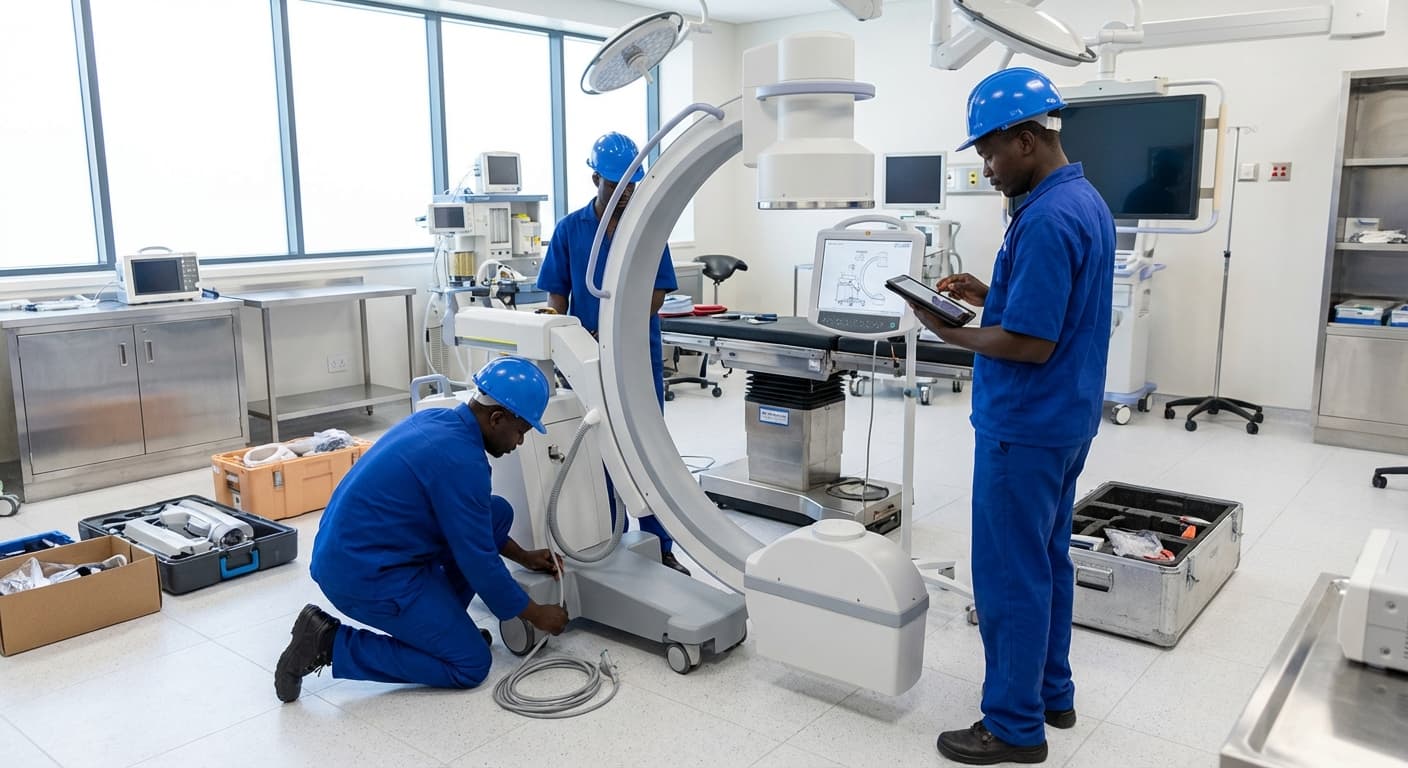
C-Arm Installation Service in Botswana
Engineering Excellence & Technical Support
C-Arm Installation Service High-standard technical execution following OEM protocols and local regulatory frameworks.
Precision C-Arm Calibration for Optimal Imaging
Our expert technicians meticulously calibrate your C-arm system to the highest industry standards, ensuring accurate positioning and crystal-clear fluoroscopic images essential for precise diagnostic and interventional procedures in Botswana's healthcare facilities.
Robust Radiation Safety Integration
We prioritize patient and staff safety by implementing comprehensive radiation shielding and leakage testing during every C-arm installation. Our service ensures full compliance with Botswana's healthcare regulations and best practices for radiation protection.
Streamlined Workflow Optimization with Integrated Systems
Beyond physical installation, we focus on seamless integration of your C-arm with existing Picture Archiving and Communication Systems (PACS) and other imaging modalities. This optimizes clinical workflows, reducing turnaround times and enhancing diagnostic efficiency for healthcare providers across Botswana.
What Is C-arm Installation Service In Botswana?
C-Arm Installation Service in Botswana refers to the specialized process of procuring, setting up, calibrating, and commissioning C-arm imaging systems within healthcare facilities in Botswana. This service ensures that these sophisticated medical devices are correctly integrated into the hospital's infrastructure, comply with local regulatory requirements, and are ready for clinical use, providing high-quality fluoroscopic imaging for diagnostic and interventional procedures.
| Who Needs C-Arm Installation Service | Typical Use Cases |
|---|---|
| Hospitals and Medical Centers in Botswana requiring new C-arm systems for existing or expanded imaging departments. | Orthopedic surgery (fracture fixation, joint replacement) |
| Surgical centers performing minimally invasive procedures. | Cardiology and vascular interventional procedures (angiography, angioplasty) |
| Specialized clinics (e.g., pain management, urology) that utilize intraoperative imaging. | Pain management injections and nerve blocks |
| Healthcare facilities upgrading from older C-arm technology to more advanced systems. | Neurosurgery (spinal procedures, image-guided biopsies) |
| Government or private entities establishing new healthcare infrastructure. | Urology procedures (stenting, stone removal) |
| Any facility needing to ensure compliance with national healthcare regulations and radiation safety standards. | Emergency medicine for rapid intraoperative assessment |
| Organizations seeking to improve diagnostic and interventional imaging capabilities. | General surgery for locating foreign objects or guiding biopsies |
Key Components of C-Arm Installation Service
- Site Assessment and Planning: Evaluating the designated installation space for power, space, shielding, ventilation, and network connectivity requirements.
- Equipment Procurement and Delivery: Sourcing and transporting the C-arm system, including ancillary equipment and accessories, from manufacturers or distributors to the installation site.
- Physical Installation: Assembling and positioning the C-arm unit, including the X-ray tube, image intensifier/flat panel detector, and control console, within the prepared space.
- Electrical and Network Integration: Connecting the C-arm to the facility's power supply, grounding systems, and, where applicable, integrating it with Picture Archiving and Communication Systems (PACS) and Electronic Health Records (EHR).
- Radiation Shielding Verification: Ensuring that any required lead shielding (e.g., for walls, doors, or the C-arm itself) is adequate and properly installed to meet radiation safety standards.
- Calibration and Testing: Performing precise adjustments to X-ray parameters, image acquisition settings, and image processing algorithms to optimize image quality and diagnostic accuracy.
- Quality Assurance (QA) and Quality Control (QC): Conducting comprehensive tests to verify system performance, safety, and adherence to manufacturer specifications and regulatory guidelines.
- User Training and Familiarization: Providing initial training to clinical staff (radiologists, surgeons, technologists) on the operation, maintenance, and safety protocols of the C-arm system.
- Documentation and Commissioning: Completing all necessary paperwork, including installation reports, calibration certificates, and warranty registration, and formally commissioning the system for clinical use.
Who Needs C-arm Installation Service In Botswana?
C-arm installation services are a critical requirement for healthcare facilities that utilize fluoroscopy-guided imaging procedures. In Botswana, as in many developing nations, the adoption of advanced medical imaging technology like C-arms is on the rise to improve diagnostic accuracy, enable minimally invasive surgeries, and enhance patient outcomes. The proper installation and setup of these sophisticated X-ray systems are paramount for ensuring their optimal performance, safety, and longevity. This specialized service involves not only the physical placement of the C-arm but also its integration with existing hospital infrastructure, power systems, radiation shielding, and potentially PACS (Picture Archiving and Communication Systems). Qualified technicians with expertise in medical equipment installation are essential to guarantee that the C-arm meets all regulatory standards and manufacturer specifications, thereby minimizing downtime and maximizing the return on investment for the healthcare provider.
| Target Customer Type | Key Departments / Use Cases | Reason for Needing Installation Service |
|---|---|---|
| Public Hospitals | Orthopedics, General Surgery, Emergency, Interventional Radiology, Urology | Expansion of services, replacement of older equipment, need for specialized surgical guidance, compliance with safety standards. |
| Private Hospitals | Orthopedics, Interventional Radiology, Cardiology, Neurosurgery, Pain Management, General Surgery | Attracting top medical talent, offering advanced procedures, catering to a higher patient volume, ensuring seamless integration with advanced PACS. |
| Specialty Clinics (e.g., Orthopedic Clinics, Pain Management Centers) | Orthopedics, Pain Management Procedures (e.g., nerve blocks, epidurals) | Performing minimally invasive procedures requiring real-time imaging, enhancing diagnostic precision, ensuring patient safety during interventions. |
| Surgical Centers | Orthopedic Surgery, Spine Surgery, General Surgery | Facilitating complex and minimally invasive surgical techniques, reducing procedural time, improving surgical outcomes through accurate guidance. |
| Diagnostic Imaging Centers | Interventional Radiology, Pain Management | Providing specialized imaging services, accurate localization for biopsies and drainage procedures, advanced diagnostic capabilities. |
Target Customers and Departments for C-Arm Installation Services in Botswana
- Hospitals (Public and Private)
- Specialty Clinics
- Surgical Centers
- Diagnostic Imaging Centers
- Orthopedic Departments
- Interventional Radiology Departments
- Pain Management Clinics
- Emergency Departments
- Urology Departments
- Cardiology Departments
- Neurosurgery Departments
- General Surgery Departments
C-arm Installation Service Process In Botswana
This document outlines the comprehensive service process for C-arm installation in Botswana, from the initial client inquiry to the final execution and post-installation support. The workflow is designed for efficiency, clarity, and to ensure a smooth and successful integration of C-arm equipment within healthcare facilities across the country.
| Stage | Description | Key Activities | Deliverables | Responsible Party |
|---|---|---|---|---|
| The client expresses interest in C-arm installation services and seeks information about capabilities, pricing, and timelines. This stage involves understanding the client's specific needs and the intended application of the C-arm. | Client contacts service provider via phone, email, or website. Initial discussion of requirements, desired C-arm specifications, and facility type. Answering preliminary questions. | Confirmation of client's interest. Basic understanding of project scope. | Client, Service Provider Sales/Consulting Team |
| A thorough evaluation of the installation site is conducted to identify all technical, logistical, and safety requirements for the C-arm. | Site visit by technical specialists. Assessment of power supply, ventilation, space, imaging room layout, access routes, and any structural modifications needed. Discussion of workflow integration. | Detailed site assessment report. Proposed installation plan including room preparation recommendations. | Service Provider Technical Team, Client Facility Management |
| Based on the initial inquiry and site assessment, a detailed quotation is prepared, outlining all costs, services, and project timelines. Upon agreement, a formal contract is established. | Preparation of comprehensive quotation covering equipment, installation, training, and any additional services. Negotiation of terms. Signing of Service Level Agreement (SLA) and Purchase Order (PO). | Formal quotation. Signed SLA/PO. Agreed project timeline. | Service Provider Sales Team, Client Procurement/Management |
| The selected C-arm equipment is procured, and all necessary logistics for transportation to Botswana and to the installation site are managed. | Ordering of C-arm and accessories. Coordination of shipping, customs clearance, and delivery to the client's facility. Ensuring all regulatory requirements are met. | C-arm equipment and accessories delivered to site. All necessary import documentation. | Service Provider Procurement & Logistics Team, Shipping/Customs Agents |
| Ensuring the installation site is fully prepared according to the recommendations from the site assessment and installation plan. | Completion of any necessary civil works, electrical upgrades, or structural modifications at the facility. Ensuring the room is clean and ready for equipment. | Completed site modifications. Verified readiness of the installation environment. | Client Facility Management, Service Provider Technical Team (oversight) |
| The C-arm equipment is physically installed by certified technicians. | Unpacking and assembly of the C-arm. Positioning and securing the equipment. Connecting all necessary power and data cables. | Physically installed C-arm unit. | Service Provider Certified Technicians |
| Comprehensive testing and calibration are performed to ensure the C-arm operates optimally and meets all performance specifications. | Functional testing of all C-arm components. Image quality assessment. Radiation safety checks. Calibration of imaging parameters. | Fully functional and calibrated C-arm. Test reports. | Service Provider Certified Technicians, Radiation Safety Officer (if applicable) |
| Healthcare professionals are trained on the operation, basic maintenance, and safety features of the new C-arm system. | Demonstration of C-arm operation. Hands-on training sessions. Q&A. Explanation of safety protocols. | Trained healthcare staff. Training manual. | Service Provider Application Specialist/Trainer, Client Medical Staff |
| All relevant documentation is provided to the client, and formal handover of the installed system is completed. | Compilation of user manuals, service records, warranty information, and test reports. Formal sign-off by the client confirming successful installation and handover. | Complete documentation package. Signed handover certificate. | Service Provider Project Manager, Client Representative |
| Ongoing support is provided to address any issues, perform routine maintenance, and ensure the continued optimal performance of the C-arm. | Troubleshooting and technical support. Scheduled preventive maintenance. Warranty support. Spare parts availability. | Reliable C-arm operation. Ongoing service and support. | Service Provider Technical Support Team, Service Provider Maintenance Engineers |
C-Arm Installation Service Process Workflow
- Inquiry & Initial Consultation
- Site Assessment & Planning
- Quotation & Agreement
- Equipment Procurement & Logistics
- Pre-Installation Preparation
- On-Site Installation
- Testing & Calibration
- User Training
- Documentation & Handover
- Post-Installation Support & Maintenance
C-arm Installation Service Cost In Botswana
Installing a C-arm system in Botswana involves several factors that influence the overall cost. These factors range from the type and complexity of the C-arm itself to the logistical challenges of the installation site. Understanding these elements is crucial for accurate budgeting and for selecting the right service provider. The price is typically quoted in Botswana Pula (BWP).
| Cost Component/Service | Estimated Range (BWP) | Notes |
|---|---|---|
| Basic C-Arm Installation (Standard Model, Minimal Site Prep) | 15,000 - 40,000 | Covers basic setup, connection, and initial testing for simpler C-arms. |
| Advanced C-Arm Installation (High-End Model, Moderate Site Prep) | 40,000 - 100,000 | Includes more complex systems, potential minor structural work, and more extensive calibration. |
| Comprehensive Installation (Top-Tier C-Arm, Significant Site Prep & Training) | 100,000 - 250,000+ | For state-of-the-art C-arms requiring substantial room modifications, lead shielding, and in-depth staff training. |
| Site Preparation (Electrical, Structural, Shielding) | 5,000 - 50,000+ | Highly variable based on existing infrastructure and required upgrades. |
| Logistics & Transportation (within Botswana) | 2,000 - 15,000 | Covers local delivery, handling, and setup logistics. |
| Biomedical Technician/Engineer Labor (per day) | 1,500 - 3,000 | Rate can vary based on experience and specialization. |
| On-site Training (per session) | 3,000 - 10,000 | For operators and maintenance staff. |
Key Pricing Factors for C-Arm Installation in Botswana
- Type and Model of C-Arm: Advanced, high-end C-arms with specialized features (e.g., 3D imaging, robotic arms) will generally incur higher installation costs than basic, standard models.
- Site Preparation: This includes any necessary modifications to the operating room or imaging suite, such as electrical upgrades, structural reinforcements, lead shielding installation/verification, and ventilation systems. The extent of preparation directly impacts labor and material costs.
- Installation Complexity: Factors like the size and weight of the C-arm, the number of components, and the accessibility of the installation location can affect the time and effort required, thus influencing cost.
- Technical Expertise and Training: The cost often includes the labor of certified biomedical engineers and technicians. If extensive training for hospital staff on operating and maintaining the C-arm is required, this will add to the overall expense.
- Logistics and Transportation: Moving the C-arm from the point of origin (e.g., manufacturer, distributor) to the hospital in Botswana, including customs duties, import taxes, and local transportation, is a significant cost component.
- Post-Installation Services: This can include initial calibration, system testing, quality assurance checks, and warranty registration. Some providers bundle these services, while others charge separately.
- Geographical Location within Botswana: While less of a primary driver, if the hospital is in a remote area, travel and accommodation expenses for the installation team might be higher.
- Service Provider's Reputation and Experience: Established and reputable installation service providers may command higher prices due to their proven track record, expertise, and guaranteed quality of service.
Affordable C-arm Installation Service Options
Securing a C-arm for medical imaging is a significant investment. Beyond the initial purchase price, the cost of professional installation can be a substantial factor. Fortunately, numerous affordable C-arm installation service options exist, often incorporating value bundles and strategic cost-saving measures to make this essential service more accessible for healthcare facilities.
| Cost-Saving Strategy | Description | Potential Savings | Considerations |
|---|---|---|---|
| Value Bundles | Service providers often package installation with other essential services like initial maintenance, extended warranties, or user training. This can offer a discounted overall price compared to purchasing services individually. | 5-15% on bundled services. | Ensure the bundle includes services you actually need. Review the terms and conditions carefully. |
| Off-Peak Scheduling | Scheduling installation during non-peak hours or days (e.g., weekends, evenings) can sometimes lead to lower labor rates. | 10-20% on labor costs. | May impact hospital operations; requires careful coordination with clinical staff. |
| DIY Site Preparation (Partial) | For minor tasks like clearing space or ensuring adequate power outlets, facilities can undertake some preparation themselves, reducing the installer's time on-site. | Variable, depending on scope. | Requires understanding of installation requirements to avoid mistakes that could increase overall costs. |
| Negotiating Contract Terms | Don't hesitate to negotiate on pricing, payment terms, and the scope of services included. Compare quotes from multiple vendors. | 5-10% on the total installation cost. | Requires research and a clear understanding of your facility's needs. |
| Leveraging Manufacturer Promotions | Manufacturers may offer discounted or complimentary installation services as part of equipment purchase promotions. | Can significantly reduce or eliminate installation costs. | Often tied to specific equipment models or purchase timelines. |
| Remote Support and Troubleshooting | Opt for service plans that prioritize remote support for minor issues, minimizing the need for costly on-site visits. | Reduces ongoing maintenance costs. | Not a substitute for necessary physical installation and repairs. |
| Local Installers | Choosing a local installation company can sometimes reduce travel expenses compared to national providers. | Reduces travel and accommodation fees. | Ensure the local provider has experience with C-arm systems and a good reputation. |
Key Components of C-Arm Installation Services:
- Site Assessment and Planning: Evaluating the room's layout, power requirements, and any structural modifications needed.
- Equipment Delivery and Unpacking: Safe transportation and careful handling of the C-arm unit.
- Physical Installation and Setup: Assembling, positioning, and connecting all components of the C-arm system.
- Electrical and Power Integration: Ensuring proper wiring, grounding, and power supply to meet safety standards.
- Network and Data Connectivity: Integrating the C-arm with PACS (Picture Archiving and Communication System) and other hospital networks.
- Calibration and Testing: Performing rigorous tests to ensure optimal image quality and system functionality.
- User Training and Documentation: Providing training for medical staff and essential documentation for operation and maintenance.
- Decommissioning of Old Equipment (Optional): Removal and disposal of previous imaging equipment.
Verified Providers In Botswana
In the pursuit of reliable and high-quality healthcare services in Botswana, identifying Verified Providers is paramount. Franance Health stands out as a beacon of excellence, offering a comprehensive network of healthcare professionals and facilities that have undergone rigorous credentialing and vetting. This meticulous process ensures that every provider associated with Franance Health meets the highest standards of medical expertise, ethical practice, and patient care. By choosing Franance Health, individuals and organizations are not just selecting a healthcare service; they are investing in peace of mind, knowing they are accessing care from trusted and qualified professionals.
| Provider Type | Franance Health Verified Benefits | What it Means for You |
|---|---|---|
| Doctors (General Practitioners & Specialists) | Holds valid medical license, board certifications, malpractice insurance, and positive peer reviews. | Access to competent and ethical medical advice and treatment, with confidence in their qualifications. |
| Nurses | Possesses current nursing registration, relevant certifications, and a proven track record of compassionate care. | Receive attentive and skilled nursing care, ensuring your well-being and comfort. |
| Hospitals & Clinics | Meets stringent facility standards, employs qualified medical staff, and adheres to infection control protocols. | Experience a safe and well-equipped healthcare environment with access to comprehensive medical services. |
| Laboratories & Diagnostic Centers | Utilizes calibrated equipment, employs certified technicians, and maintains quality assurance for accurate results. | Obtain reliable diagnostic tests and results crucial for proper diagnosis and treatment planning. |
| Pharmacies | Operates with licensed pharmacists, maintains proper drug storage, and dispenses prescription medications accurately. | Receive safe and accurate dispensing of your prescribed medications from trusted sources. |
Why Franance Health Credentials Represent the Best Choice:
- Rigorous Verification Process: Franance Health employs a multi-faceted credentialing process that includes thorough background checks, verification of licenses and certifications, and assessment of professional experience.
- Commitment to Quality Care: All verified providers adhere to stringent quality control measures and are dedicated to delivering patient-centered care with compassion and integrity.
- Access to Specialized Expertise: Franance Health partners with a diverse range of specialists, ensuring access to the best possible medical advice and treatment for a wide spectrum of health needs.
- Enhanced Patient Safety: The credentialing ensures that only qualified and ethical practitioners are part of the network, minimizing risks and prioritizing patient safety.
- Seamless Healthcare Navigation: Franance Health simplifies the process of finding and accessing healthcare, making it easier for individuals to connect with the right providers when they need them most.
- Continuous Professional Development: Verified providers are often encouraged to engage in ongoing training and education, staying abreast of the latest advancements in medical science and technology.
Scope Of Work For C-arm Installation Service
This Scope of Work (SOW) outlines the services required for the professional installation of a C-Arm imaging system. It details the technical deliverables, standard specifications, and responsibilities of both the service provider and the client to ensure a successful and compliant installation. The objective is to integrate the C-Arm into the existing clinical environment, ensuring optimal functionality, safety, and adherence to all relevant regulations. This SOW covers site preparation, equipment delivery and unpacking, physical installation, system configuration, initial testing and calibration, user training, and final acceptance.
| Phase/Activity | Description | Technical Deliverables | Standard Specifications / Requirements |
|---|---|---|---|
| On-site visit to assess the installation location, power requirements, network connectivity, structural integrity, and any necessary modifications. | Site assessment report, including recommendations for structural modifications, power upgrades, and environmental controls. | Availability of dedicated space meeting manufacturer's footprint and environmental requirements (temperature, humidity, EMI shielding). Adequate power outlets (voltage, amperage, grounding) as per manufacturer specifications. Network ports for PACS/RIS integration. |
| Coordination of equipment delivery to the site. Careful unpacking and inspection of all components for damage. | Confirmation of all delivered items against the packing list. Documented inspection of all components. | All C-Arm components (gantry, workstation, monitors, power supplies, cables) received intact and undamaged. Secure handling to prevent cosmetic or functional damage. |
| Positioning and securing the C-Arm gantry, workstation, and monitors. Connecting all required cabling (power, data, video). | Properly mounted and secured C-Arm gantry. Functional workstation and monitor setup. All cables routed neatly and safely. | Gantry stability and smooth articulation. Correct cable connections as per manufacturer diagrams. Compliance with ergonomic and accessibility guidelines. Proper grounding of all equipment. |
| Installation and configuration of the C-Arm software. Integration with hospital Picture Archiving and Communication System (PACS) and Radiology Information System (RIS) if applicable. | Fully functional C-Arm software. Successful DICOM connectivity and data transfer to PACS/RIS. | Operating system and C-Arm application software installed and configured. HL7 integration for patient demographics (if applicable). Verification of DICOM conformance statements. |
| Performing system diagnostics, image quality tests, and calibration procedures to ensure optimal performance. | Comprehensive test reports, including image quality metrics and calibration logs. Radiation safety checks. | All system functions tested as per manufacturer's test protocols. Image noise, resolution, and contrast within acceptable limits. Radiation output and dose monitoring calibrated and verified. |
| Verification of radiation shielding, interlocks, and dose monitoring equipment. Ensuring compliance with local and national radiation safety regulations. | Radiation safety compliance report. Certification of radiation protection measures. | Compliance with IEC 60601-1-3, NCRP, or equivalent local regulations. Proper functioning of collimators, dose rate indicators, and safety interlocks. |
| Providing hands-on training to designated clinical staff (radiologists, technologists) on C-Arm operation, basic troubleshooting, and safety procedures. | Training attendance records. Competency assessment documentation (optional). | Training delivered by qualified personnel. Content covers system startup/shutdown, image acquisition modes, basic image manipulation, routine maintenance, and emergency procedures. |
| Client walk-through and formal sign-off of the installed and tested C-Arm system. | Signed-off Installation Acceptance Form. | Client confirms satisfaction with the installation, performance, and training provided. All agreed-upon deliverables are met. |
Key Objectives of C-Arm Installation
- Ensure safe and secure physical installation of the C-Arm unit and associated components.
- Verify correct integration with existing medical imaging infrastructure (PACS, RIS, etc.).
- Perform comprehensive system testing and calibration to meet manufacturer specifications.
- Confirm compliance with all relevant safety and radiation regulations.
- Provide adequate training to designated clinical staff on C-Arm operation and basic troubleshooting.
- Achieve client sign-off and formal acceptance of the installed system.
Service Level Agreement For C-arm Installation Service
This Service Level Agreement (SLA) outlines the response times and uptime guarantees for the C-Arm Installation Service provided by [Your Company Name] to [Client Name]. This SLA is incorporated by reference into the Master Service Agreement (MSA) between the parties.
| Issue Severity | Definition | Response Time (during Business Hours) | Response Time (outside Business Hours - Premium Support) | Target Resolution Time (estimate, subject to complexity) | Uptime Guarantee |
|---|---|---|---|---|---|
| Critical Issue | C-Arm system completely inoperable, preventing all imaging procedures. | 1 Hour | 2 Hours | 4-8 Business Hours (may require on-site visit) | 99.5% (monthly) |
| Major Issue | Significant impairment of C-Arm functionality, affecting a substantial portion of its use. | 2 Business Hours | 4 Business Hours | 8-16 Business Hours (may require on-site visit) | 99.5% (monthly) |
| Minor Issue | Minimal impact on functionality, does not prevent routine procedures. | 4 Business Hours | 8 Business Hours | 1-3 Business Days (remote troubleshooting prioritized) | 99.5% (monthly) |
Key Definitions
- Installation Service: Refers to the professional services provided by [Your Company Name] to set up, configure, and test a C-Arm imaging system at the Client's designated facility.
- Downtime: Refers to the period during which the C-Arm system is unavailable for use due to a service-impacting issue that is within the responsibility of [Your Company Name] to resolve under this SLA. Scheduled maintenance, client-induced issues, or force majeure events are excluded.
- Critical Issue: An issue that renders the C-Arm system completely inoperable, preventing any imaging procedures.
- Major Issue: An issue that significantly impairs the functionality of the C-Arm system, affecting a substantial portion of its intended use but not rendering it completely inoperable.
- Minor Issue: An issue that has a minimal impact on the functionality of the C-Arm system and does not prevent routine imaging procedures.
- Response Time: The maximum time allowed for [Your Company Name] to acknowledge a reported issue and begin investigation and/or remediation efforts.
- Resolution Time: The maximum time allowed for [Your Company Name] to resolve an issue and restore the C-Arm system to its intended operational status. This is dependent on the severity of the issue and availability of parts/personnel.
- Business Hours: [Specify your company's business hours, e.g., Monday to Friday, 9:00 AM to 5:00 PM Local Time, excluding public holidays].
Frequently Asked Questions

Ready when you are
Let's scope your C-Arm Installation Service in Botswana project in Botswana.

Scaling healthcare logistics and technical systems across the entire continent.