
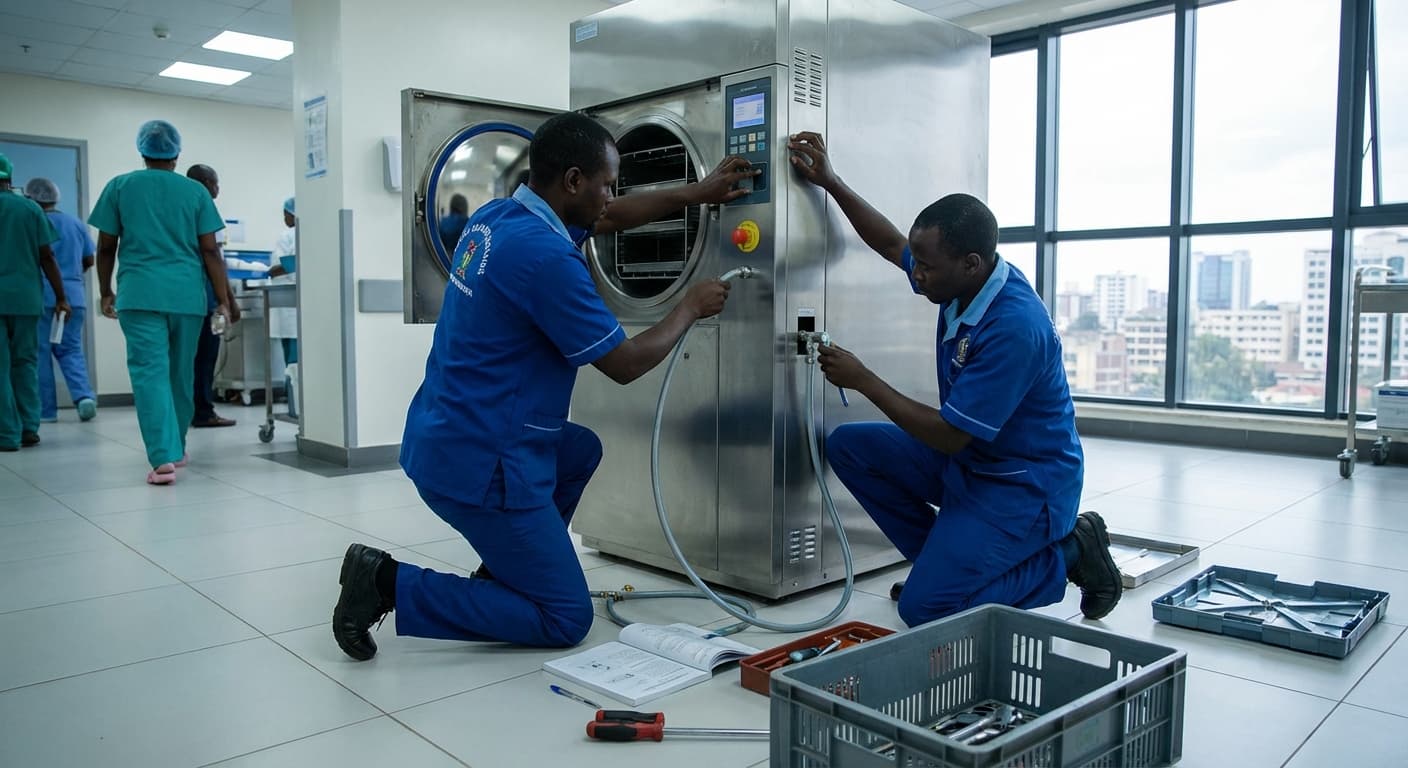
Autoclave & Sterilizer Installation Service in Botswana
Engineering Excellence & Technical Support
Autoclave & Sterilizer Installation Service High-standard technical execution following OEM protocols and local regulatory frameworks.
Optimized Autoclave Performance
Expert installation of autoclaves and sterilizers in Botswana, ensuring precise temperature, pressure, and cycle time calibration for maximum microbial kill efficiency and instrument longevity, adhering to global sterilization standards.
Robust Sterilizer Integration & Compliance
Seamless integration of sterilizer units with existing facility infrastructure in Botswana, including secure electrical hookups, ventilation systems, and water supply, guaranteeing operational safety and compliance with local health and safety regulations.
Calibration & Validation Expertise
Professional installation of autoclaves and sterilizers in Botswana, featuring meticulous initial calibration and validation services to confirm efficacy and provide comprehensive documentation for regulatory audits and quality assurance.
What Is Autoclave & Sterilizer Installation Service In Botswana?
Autoclave and sterilizer installation services in Botswana refer to the specialized professional services required for the proper setup, calibration, and operational readiness of autoclaves and other sterilization equipment within various healthcare, laboratory, and industrial facilities. These services are critical for ensuring that sterilization processes meet stringent regulatory standards, thereby safeguarding against microbial contamination and ensuring the integrity of sterilized materials or instruments. The installation process typically encompasses site assessment, equipment positioning, utility connections (electrical, steam, water, drainage), leak testing, performance verification, and comprehensive user training.
| Who Needs Autoclave & Sterilizer Installation Service? | Typical Use Cases | ||||||||
|---|---|---|---|---|---|---|---|---|---|
| Hospitals and Clinics: For sterilizing surgical instruments, medical devices, laboratory equipment, and healthcare waste. | Dental Practices: Sterilizing dental instruments and equipment to prevent cross-contamination. | Diagnostic Laboratories (Medical & Research): Sterilizing culture media, glassware, instruments, and biohazardous waste. | Pharmaceutical Manufacturing: Sterilizing equipment, packaging materials, and cleanroom components. | Veterinary Clinics: Sterilizing surgical instruments and equipment. | Research and Development Facilities: Sterilizing laboratory equipment, glassware, and biological materials. | Food and Beverage Industry (Specific Applications): For sterilizing certain food products, packaging, or equipment to ensure product safety and shelf-life. | Cosmetic and Beauty Salons (High-End): Sterilizing instruments used for invasive procedures. | Government and Defense Agencies: For sterilizing medical equipment in military hospitals and field operations. | Educational Institutions (Medical/Science Faculties): For sterilizing equipment used in teaching laboratories. |
| Sterilization of Reusable Medical and Dental Instruments: Ensuring instruments are free from viable microorganisms before patient use. | Laboratory Glassware and Equipment Decontamination: Preparing glassware for reuse and ensuring a sterile environment for experiments. | Waste Management: Sterilizing biohazardous waste to render it safe for disposal, particularly in healthcare and research settings. | Pharmaceutical Production: Sterilization of production equipment and final product packaging to maintain aseptic conditions. | Research: Ensuring sterility for experiments involving cell cultures, media preparation, and microbiological studies. | Industrial Applications: In specific industries requiring high levels of microbial control, such as in the production of certain chemicals or materials. |
Key Components of Autoclave & Sterilizer Installation Service
- Site Assessment and Planning: Evaluating the installation location for spatial constraints, structural integrity, adequate ventilation, and accessibility to necessary utilities (power, water, steam, compressed air).
- Equipment Delivery and Placement: Safely transporting and precisely positioning the autoclave or sterilizer according to manufacturer specifications and site plan.
- Utility Connections: Integrating the equipment with existing or newly installed utility systems, including electrical wiring, plumbing for water supply and drainage, and steam generation/distribution systems.
- System Testing and Calibration: Conducting initial power-on checks, functional tests, pressure testing, and cycle validation to ensure all parameters (temperature, pressure, time) are within specified tolerances. This often involves running calibration cycles.
- Safety Feature Verification: Confirming the proper functioning of all safety interlocks, pressure relief valves, and emergency shut-off mechanisms.
- User Training and Commissioning: Providing comprehensive training to end-users on equipment operation, routine maintenance, troubleshooting, and proper loading/unloading procedures. Formal commissioning signifies the equipment's readiness for operational use.
- Documentation and Certification: Supplying all necessary installation documentation, calibration certificates, and performance reports as per local and international standards.
- Post-Installation Support: Offering initial troubleshooting assistance and potentially scheduling follow-up inspections or preventive maintenance.
Who Needs Autoclave & Sterilizer Installation Service In Botswana?
In Botswana, the demand for reliable autoclave and sterilizer installation services is driven by a critical need for infection control and instrument reprocessing across various sectors. These essential services ensure that medical, dental, and laboratory equipment is properly sterilized, preventing the spread of diseases and maintaining the integrity of critical procedures. The installation process requires specialized knowledge and adherence to stringent safety standards, making professional services indispensable.
| Target Customer | Key Departments/Areas Requiring Service | Primary Need |
|---|---|---|
| Hospitals (Public and Private) | Operating Theatres, Central Sterilization Supply Department (CSSD), Emergency Rooms, Maternity Wards, Outpatient Departments | Ensuring sterility of surgical instruments, medical devices, and equipment for patient safety and effective treatment. |
| Clinics and Health Centers | Treatment Rooms, Minor Procedure Areas | Sterilizing basic medical instruments and supplies for general healthcare services and minor interventions. |
| Dental Practices | Sterilization Room/Area | Maintaining the highest standards of infection control for dental instruments and tools used in patient care. |
| Laboratories (Medical, Research, and Industrial) | Microbiology Labs, Research Labs, Quality Control Labs | Sterilizing glassware, media, and equipment for accurate and reliable experimental results and to prevent contamination. |
| Veterinary Clinics and Hospitals | Operating Rooms, Treatment Areas | Ensuring the sterility of instruments used in animal surgeries and procedures to prevent infections. |
| Surgical Centers | Sterilization Area, Procedure Rooms | Facilitating the safe and effective sterilization of instruments for same-day surgical procedures. |
| Beauty and Tattoo Parlors | Sterilization Station | Meeting hygiene regulations and ensuring the safety of clients by sterilizing reusable tattooing equipment and beauty instruments. |
| Non-Governmental Organizations (NGOs) | Mobile Clinics, Outreach Facilities | Establishing and maintaining infection control protocols in remote or temporary healthcare settings. |
Who Needs Autoclave & Sterilizer Installation Service in Botswana?
- Hospitals (Public and Private)
- Clinics and Health Centers
- Dental Practices
- Laboratories (Medical, Research, and Industrial)
- Veterinary Clinics and Hospitals
- Surgical Centers
- Beauty and Tattoo Parlors (where applicable for reusable instruments)
- Non-Governmental Organizations (NGOs) with healthcare outreach programs
Autoclave & Sterilizer Installation Service Process In Botswana
This document outlines the comprehensive workflow for Autoclave & Sterilizer Installation Services in Botswana, guiding clients from their initial inquiry to the successful execution of the installation.
| Phase | Step | Description | Key Activities | Deliverables |
|---|---|---|---|---|
| Phase 1: Inquiry & Consultation | 1.1 Initial Contact | The client expresses interest in autoclave/sterilizer installation services. | Receive inquiry via phone, email, or website form. Understand client's basic needs and equipment type. | Confirmation of inquiry receipt. Initial understanding of client requirements. |
| 1.2 Needs Assessment & Preliminary Discussion | Gather detailed information about the client's specific requirements and site. | Discuss equipment specifications, intended use, site location, existing infrastructure (power, water, ventilation), and any specific regulatory requirements. | Preliminary understanding of project scope, potential challenges, and equipment compatibility. | |
| Phase 2: Site Assessment & Planning | 2.1 On-Site Survey | A qualified technician visits the client's premises for a thorough assessment. | Measure installation space, check power supply (voltage, amperage), assess water supply and drainage, evaluate ventilation, identify potential access challenges, and note any structural modifications needed. | Detailed site survey report, including measurements, photos, and initial observations. |
| 2.2 Technical Planning | Develop a comprehensive installation plan based on the site assessment. | Determine optimal placement of the unit, plan for necessary plumbing, electrical, and ventilation connections, identify required tools and materials, and create a preliminary project timeline. | Draft installation plan, including layout diagrams and a list of required services. | |
| Phase 3: Quotation & Agreement | 3.1 Quotation Preparation | Generate a detailed and transparent quotation for the installation service. | Itemize costs for labor, materials, any required modifications, testing, and validation. Include a breakdown of estimated timelines. | Formal quotation document. |
| 3.2 Contract Negotiation & Signing | Review and finalize the terms and conditions of the service agreement. | Discuss and agree on the scope of work, pricing, payment schedule, warranty information, and responsibilities of both parties. Sign the service contract. | Signed service agreement/contract. | |
| Phase 4: Procurement & Preparation | 4.1 Equipment & Material Procurement | Source and acquire the necessary autoclave/sterilizer unit (if not provided by client) and all required installation materials. | Order equipment, purchase plumbing supplies, electrical components, ventilation materials, safety equipment, and any specialized tools. | Confirmation of equipment and material availability. |
| 4.2 Site Preparation | Prepare the installation site according to the approved plan. | If necessary, carry out any minor structural modifications, ensure clear access to the installation area, and set up a safe working environment. | Site readiness for installation. | |
| Phase 5: Installation Execution | 5.1 Delivery & Unpacking | Safely transport and unpack the autoclave/sterilizer and associated components. | Careful handling of equipment to prevent damage. Initial inspection of the unit for any visible defects. | Equipment and materials staged for installation. |
| 5.2 Unit Placement & Mounting | Position and securely mount the autoclave/sterilizer in its designated location. | Ensure the unit is level and stable, following manufacturer guidelines for placement. | Autoclave/sterilizer positioned and secured. | |
| 5.3 Plumbing & Electrical Connections | Connect the unit to the building's water supply, drainage, and electrical systems. | Install water inlet and outlet pipes, connect to the drainage system, and wire the unit to the power supply, ensuring all connections meet safety standards. | Completed plumbing and electrical connections. | |
| 5.4 Ventilation Installation (if applicable) | Install or connect the unit to the required ventilation system. | Ensure proper airflow and exhaust as per manufacturer and safety regulations. | Ventilation system connected and functional. | |
| Phase 6: Testing & Validation | 6.1 Functional Testing | Conduct initial tests to ensure all components are working correctly. | Power on the unit, test door seals, check control panel functionality, and perform basic operational checks. | Demonstration of basic unit functionality. |
| 6.2 Performance Validation | Perform comprehensive tests to validate the sterilization cycles and performance. | Run complete sterilization cycles with biological and/or chemical indicators to confirm efficacy and adherence to standards (e.g., HTM 01-01, ISO 17665). | Validation reports, calibration certificates (if applicable). | |
| Phase 7: Training & Handover | 7.1 User Training | Educate the client's staff on the proper operation and basic maintenance of the autoclave/sterilizer. | Demonstrate daily operation, loading/unloading procedures, cycle selection, error code interpretation, and basic cleaning routines. | Trained personnel, user manuals provided. |
| 7.2 Final Handover | Formally hand over the installed and validated unit to the client. | Provide all relevant documentation, including operation manuals, service history, warranty information, and validation reports. Address any final client questions. | Completed installation handover, all documentation provided. | |
| Phase 8: Post-Installation Support & Maintenance | 8.1 Warranty Support | Provide support during the warranty period for any issues that may arise. | Respond to client inquiries, diagnose and resolve any reported problems within the scope of the warranty. | Resolution of warranty-related issues. |
| 8.2 Scheduled Maintenance | Offer ongoing maintenance services to ensure optimal performance and longevity of the unit. | Perform regular preventative maintenance checks, calibration, and servicing as per manufacturer recommendations and service agreements. | Scheduled maintenance reports, extended equipment lifespan. |
Autoclave & Sterilizer Installation Service Process in Botswana
- Phase 1: Inquiry & Consultation
- Phase 2: Site Assessment & Planning
- Phase 3: Quotation & Agreement
- Phase 4: Procurement & Preparation
- Phase 5: Installation Execution
- Phase 6: Testing & Validation
- Phase 7: Training & Handover
- Phase 8: Post-Installation Support & Maintenance
Autoclave & Sterilizer Installation Service Cost In Botswana
The cost of autoclave and sterilizer installation services in Botswana can vary significantly based on several key factors. These factors influence the overall price, making it crucial for clients to understand them when budgeting for such services. The complexity of the installation, the type and size of the equipment, the location of the installation site, and the qualifications of the service provider all play a crucial role in determining the final cost. Reputable service providers will offer detailed quotes after an on-site assessment to ensure accuracy.
| Service | Estimated Price Range (BWP) | Notes |
|---|---|---|
| Small Tabletop Autoclave Installation | 1,500 - 4,000 | Basic electrical connection, minor plumbing adjustments, functional testing. |
| Medium-Sized Autoclave/Sterilizer Installation | 4,000 - 10,000 | May include dedicated electrical circuits, basic plumbing modifications, initial calibration, and site assessment. |
| Large/Industrial Autoclave/Sterilizer Installation | 10,000 - 30,000+ | Complex plumbing and electrical, potential structural modifications, ventilation system integration, extensive testing and validation. Price highly dependent on specific unit and site. |
| Site Assessment/Consultation Fee | 200 - 800 | Often waived if installation is subsequently booked with the provider. |
| Additional Plumbing Work (per hour/item) | 200 - 600 | Depends on complexity, materials, and labor required. |
| Additional Electrical Work (per hour/item) | 250 - 700 | Depends on complexity, materials, and labor required. |
Factors Influencing Autoclave & Sterilizer Installation Costs in Botswana
- Type of Autoclave/Sterilizer: Different models (e.g., tabletop, large industrial, specific sterilization methods like steam, dry heat, or chemical vapor) have varying installation requirements and complexities.
- Size and Weight of Equipment: Larger and heavier units often require specialized lifting equipment and more robust structural considerations, increasing labor and potential material costs.
- Site Preparation: This can include modifications to existing plumbing, electrical outlets (including dedicated circuits or higher amperage requirements), ventilation, and structural reinforcement, all contributing to the overall cost.
- Accessibility of Installation Site: Difficult-to-reach locations or sites requiring extensive maneuvering of equipment can increase labor time and potentially necessitate specialized equipment hire.
- Distance from Service Provider: For installations in remote areas, travel time and potential overnight accommodation for technicians will be factored into the cost.
- Plumbing and Electrical Requirements: The need for new water supply lines, drainage, dedicated power circuits, or specific voltage/phase requirements can add significantly to the installation price.
- Ventilation and Exhaust Systems: Some sterilizers require dedicated ventilation or exhaust systems to safely dissipate steam or other byproducts, adding to the installation complexity and cost.
- Testing and Calibration: Post-installation testing, calibration, and validation are essential to ensure the equipment functions correctly and meets safety standards. These services are typically included but can vary in their extent.
- Warranty and Maintenance Contracts: While not strictly installation, some providers may bundle initial warranty checks or offer discounted maintenance contracts, which can influence the perceived total cost.
- Qualifications and Reputation of the Service Provider: Experienced and certified technicians may command higher rates due to their expertise and the assurance of a reliable installation. Smaller, less established providers might offer lower prices but with potential risks.
Affordable Autoclave & Sterilizer Installation Service Options
Ensuring proper sterilization of medical and laboratory equipment is critical for patient safety and reliable research. Our affordable autoclave and sterilizer installation services offer a range of solutions designed to meet your budget and operational needs. We understand that the initial investment can be significant, so we've developed value bundles and cost-saving strategies to make professional installation accessible for everyone. From basic setup to comprehensive integration, our goal is to provide efficient, safe, and cost-effective installation options.
| Cost-Saving Strategy | Description | Benefit | ||||||||||||||||||
|---|---|---|---|---|---|---|---|---|---|---|---|---|---|---|---|---|---|---|---|---|
| Off-Peak Scheduling | Schedule your installation during less busy periods (weekdays, specific times of day). | Reduced labor rates and potential for faster service. | Early Bird Booking Discounts | Book your installation well in advance of your equipment arrival. | Secure preferred dates and often receive a discount on the installation fee. | Bundle with Equipment Purchase | If purchasing new equipment, inquire about bundled installation discounts from the manufacturer or supplier. | Potential for significant savings when combining purchase and installation. | Pre-Installation Site Assessment | Conduct a thorough assessment of your site's readiness before our technicians arrive. | Minimizes on-site time, reducing labor costs and preventing delays. | Utilize Existing Infrastructure | Leverage existing, compatible utility connections where possible. | Avoids unnecessary new installations or upgrades, saving on materials and labor. | Group Installations | If multiple units require installation in close proximity or within the same facility, coordinate for a single service call. | Reduces travel time and logistical costs for our team, translating to lower overall charges. | Refurbished or Certified Pre-Owned Equipment | Consider purchasing certified pre-owned autoclaves or sterilizers which often come with a warranty and at a lower initial cost. | Lower upfront equipment cost, making the overall investment more manageable, and often still benefiting from installation services. |
Value Bundles for Autoclave & Sterilizer Installation
- Basic Installation Bundle: Ideal for straightforward setups, this bundle includes physical placement, connection to utilities (water, power, drainage as applicable), initial functional testing, and a basic user orientation. This is our most budget-friendly option for standard equipment.
- Standard Integration Bundle: This package expands on the basic bundle by including minor plumbing or electrical modifications required for the specific location, integration with existing facility systems (if applicable and within scope), and a more in-depth training session for your staff. It offers a good balance of cost and functionality.
- Premium Performance Bundle: For facilities requiring advanced setup, this bundle encompasses all aspects of the standard bundle, plus advanced calibration, validation documentation support, custom interface setup, and extended on-site training. This is designed for maximum efficiency and regulatory compliance.
- Customizable Solutions: We also offer the flexibility to tailor a package specifically to your unique requirements. Discuss your needs with our experts, and we'll create a personalized installation plan and quote.
- Retrofit & Relocation Packages: Need to move or upgrade existing equipment? Our specialized packages ensure a smooth transition with minimal downtime.
Verified Providers In Botswana
When seeking healthcare services in Botswana, particularly those involving financial management and insurance claims, it's crucial to engage with verified providers. Franance Health stands out as a premier partner in this regard, offering a seamless and trustworthy experience for patients and healthcare institutions alike. Their robust credentialing process ensures that all affiliated providers meet stringent quality and ethical standards, giving you peace of mind. Franance Health's commitment to transparency, efficiency, and patient-centric care makes them the optimal choice for navigating the complexities of healthcare finance.
| Feature | Franance Health Verified Providers | General Providers |
|---|---|---|
| Credential Verification | Mandatory and Comprehensive | Variable, often minimal or none |
| Billing & Insurance Handling | Streamlined and Transparent | Can be complex and confusing |
| Patient Experience | Prioritized for Ease and Trust | Depends on individual practice |
| Ethical Standards | Guaranteed Adherence | Variable |
| Financial Accountability | High | Variable |
Why Choose Franance Health Verified Providers:
- Uncompromising Quality Assurance: Rigorous vetting process ensures providers adhere to the highest medical and ethical standards.
- Financial Transparency & Efficiency: Streamlined billing and insurance processing, minimizing patient confusion and delays.
- Patient-Centric Approach: Focus on accessible, affordable, and high-quality healthcare services.
- Trusted Network: Access to a curated list of reputable healthcare professionals and facilities.
- Regulatory Compliance: Adherence to all relevant healthcare regulations and data protection laws.
- Enhanced Patient Experience: Simplified administrative processes allow patients to focus on their health.
Scope Of Work For Autoclave & Sterilizer Installation Service
This Scope of Work (SOW) outlines the requirements for the professional installation of an autoclave and sterilizer at [Client Facility Name and Address]. The service includes the delivery, unboxing, assembly, connection to utilities, initial testing, and handover of the specified equipment. The objective is to ensure the autoclave and sterilizer are installed correctly, safely, and in accordance with manufacturer specifications and relevant industry standards, ready for operational use.
| Task Description | Details/Requirements | Deliverables | Standard Specifications/Notes |
|---|---|---|---|
| Site Preparation Verification | Confirm availability and adequacy of designated installation space, ensuring sufficient clearance around the unit for operation and maintenance. Verify access to required utility connections (power, water, drain, ventilation). | Site readiness report, confirmation of utility availability. | Manufacturer's installation manual clearance requirements, local building codes. |
| Equipment Unboxing and Inspection | Carefully unpack the autoclave and sterilizer, inspect for any physical damage incurred during transit. Document any issues immediately. | Inventory of received equipment and accessories, damage report (if applicable). | Manufacturer's packing list, visual inspection for dents, scratches, or broken components. |
| Equipment Placement and Anchoring | Position the autoclave and sterilizer in the pre-approved location according to manufacturer's layout guidelines. Secure the unit to the floor or wall as per installation requirements to prevent tipping or movement. | Properly positioned and secured autoclave and sterilizer unit. | Manufacturer's installation manual for placement and anchoring instructions, seismic bracing requirements if applicable. |
| Utility Connection | Connect the autoclave and sterilizer to existing facility utilities: electrical power (correct voltage and amperage), potable water supply (pressure and quality), drainage system, and ventilation/exhaust system as required. | Functional utility connections, leak-free connections. | Electrical: Voltage, amperage, and circuit breaker ratings as per manufacturer's specifications. Water: Pressure range, water quality (e.g., deionized, filtered) if specified. Drain: Proper slope and connection to waste system. Venting: Adequate airflow, connection to fume hood or exhaust system if required. |
| Initial System Configuration and Setup | Configure the unit's control panel settings based on manufacturer recommendations and client's intended use. This may include setting sterilization cycles, temperature, pressure, and time parameters. | Configured and operational control system. | Manufacturer's operating manual for default and recommended settings. |
| Functional Testing and Calibration | Perform comprehensive testing of all functions, including heating, sterilization cycles, pressure control, door sealing, and safety interlocks. Calibrate sensors and instruments to ensure accuracy. | Successful completion of all test cycles, calibration certificates for critical sensors. | Manufacturer's recommended test procedures, validation protocols (e.g., Bowie-Dick test, biological indicators for validation if specified in purchase order). Calibration traceable to national standards if required. |
| User Training and Demonstration | Provide on-site training to designated client personnel on the safe and proper operation of the autoclave and sterilizer, including routine maintenance, error troubleshooting, and emergency procedures. | Trained personnel, demonstration of key functions. | Manufacturer's operator manual content, focus on safety and critical operating parameters. |
| Documentation and Handover | Provide all relevant documentation, including the operation manual, maintenance manual, warranty information, installation checklist, and any test/calibration reports. Formally hand over the installed equipment to the client. | Complete documentation package, signed acceptance form. | Manufacturer's official documentation, completed installation and testing sign-off form. |
Project Phases and Activities
- Site Preparation Verification
- Equipment Unboxing and Inspection
- Equipment Placement and Anchoring
- Utility Connection (Water, Power, Drain, Venting)
- Initial System Configuration and Setup
- Functional Testing and Calibration
- User Training and Demonstration
- Documentation and Handover
Service Level Agreement For Autoclave & Sterilizer Installation Service
This Service Level Agreement (SLA) outlines the response times and uptime guarantees for the Autoclave & Sterilizer Installation Service provided by [Your Company Name]. This SLA is a supplement to the Master Services Agreement (MSA) and is effective as of [Start Date].
| Service Level | Definition | Target Response Time (within Service Hours) | Target Resolution Time (within Service Hours) | Uptime Guarantee (Monthly) |
|---|---|---|---|---|
| Standard Installation Support | For non-critical operational issues impacting less than the full functionality. | 4 Business Hours | 8 Business Hours | 99.0% |
| Critical Installation Support | For issues that render the entire autoclave or sterilizer inoperable or pose a significant risk to operations. | 2 Business Hours | 4 Business Hours | 99.5% |
Definitions
- Service Hours: Business hours defined as Monday to Friday, 8:00 AM to 5:00 PM [Your Time Zone], excluding public holidays.
- Installation Service: The complete process of delivering, setting up, and ensuring the operational readiness of specified autoclaves and sterilizers at the client's designated location.
- Downtime: Any period during which the installed autoclave or sterilizer is unavailable for its intended use due to a defect or malfunction attributable to the installation, as determined by [Your Company Name]. This excludes scheduled maintenance, client-induced issues, or external factors beyond our control.
- Response Time: The maximum time allowed for [Your Company Name] to acknowledge a reported service issue and initiate troubleshooting efforts.
- Resolution Time: The maximum time allowed for [Your Company Name] to resolve a reported service issue and restore the installed equipment to operational status. This may involve remote troubleshooting, dispatching a technician, or recommending further action.
- Uptime Guarantee: The guaranteed percentage of time the installed autoclave or sterilizer will be available for use, calculated over a monthly period.
Frequently Asked Questions

Ready when you are
Let's scope your Autoclave & Sterilizer Installation Service in Botswana project in Botswana.

Scaling healthcare logistics and technical systems across the entire continent.