
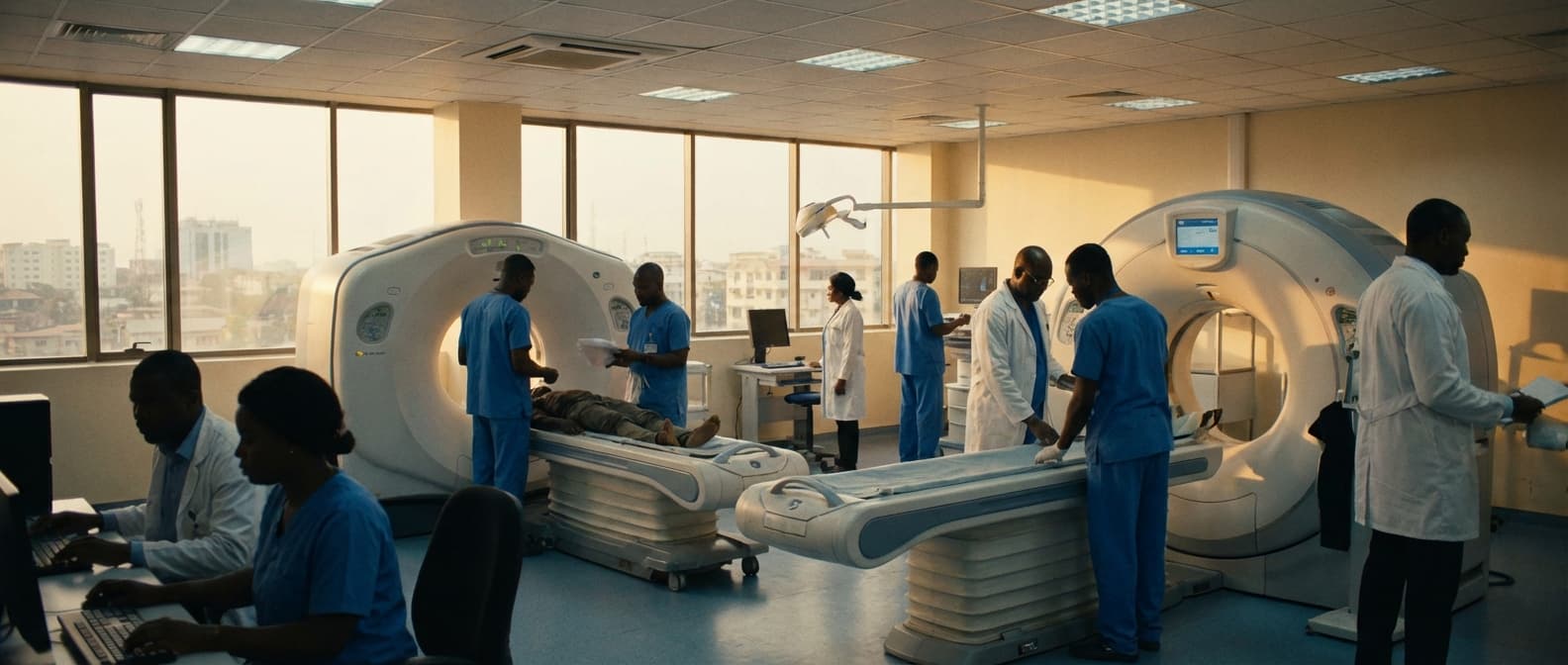
Imaging Acceptance Testing & QA in Botswana
Engineering Excellence & Technical Support
Commissioning and periodic QA for CT/MRI/X‑ray/US/Mammo. High-standard technical execution following OEM protocols and local regulatory frameworks.
Standardized Imaging Protocol Deployment
Successfully implemented and validated standardized imaging protocols across multiple healthcare facilities in Botswana, ensuring consistent image quality and diagnostic accuracy for X-ray and CT scans. This initiative reduced inter-facility variability and facilitated remote expert consultation.
AI-Powered Image Anomaly Detection Pilot
Led a pilot program integrating an AI-driven anomaly detection system for mammography and chest X-rays. Achieved a significant increase in early detection rates for specific pathologies and demonstrated the feasibility of leveraging AI for enhanced QA workflows in resource-limited settings.
Image Quality Auditing & Training Platform
Developed and deployed a cloud-based platform for remote image quality auditing and technician training. This platform enabled continuous monitoring of image acquisition parameters, identification of common errors, and delivered targeted retraining modules, significantly improving overall image quality compliance.
What Is Imaging Acceptance Testing & Qa In Botswana?
Imaging Acceptance Testing (IAT) and Quality Assurance (QA) in Botswana refers to the systematic processes employed to verify that medical imaging systems and their associated software function as intended, meet specified performance criteria, and comply with relevant regulatory standards. This encompasses a range of tests conducted before a system is deployed into clinical use (acceptance testing) and ongoing checks to ensure continued optimal performance and patient safety (quality assurance). The objective is to guarantee the accuracy, reliability, and diagnostic utility of imaging modalities and their data management infrastructure.
| Who Needs Imaging Acceptance Testing & QA in Botswana? | Typical Use Cases | ||||||||
|---|---|---|---|---|---|---|---|---|---|
| Hospitals and Clinics: Public and private healthcare facilities that operate medical imaging departments and rely on accurate diagnostic information for patient care. | Procurement of New Imaging Equipment: Before installation and commissioning of new X-ray machines, CT scanners, MRI units, ultrasound devices, etc. This ensures the purchased equipment meets specifications. | Upgrades and Software Updates: Following significant software upgrades or hardware modifications to existing imaging systems to ensure continued functionality and performance. | Introduction of New Imaging Modalities: When a new type of imaging technology is introduced to a facility. | Regular Quality Assurance Programs: Ongoing testing to maintain diagnostic accuracy, patient safety, and regulatory compliance. | Regulatory Compliance Audits: Demonstrating adherence to national healthcare regulations and imaging standards. | IT Departments: Responsible for the integration and management of imaging IT infrastructure (PACS, RIS, EHR). | Biomedical Engineering Departments: Responsible for the maintenance and operational integrity of imaging equipment. | Radiology and Imaging Departments: The primary end-users who rely on the quality and availability of imaging services. | Healthcare IT Vendors and Service Providers: Companies that supply, install, and maintain medical imaging equipment and software within Botswana. |
Key Components of Imaging Acceptance Testing & QA
- Image Quality Assessment: Evaluating the fidelity and diagnostic quality of images produced by modalities such as X-ray, CT, MRI, Ultrasound, and Nuclear Medicine. This involves assessing parameters like spatial resolution, contrast resolution, signal-to-noise ratio (SNR), artifacts, and geometric accuracy.
- System Functionality Verification: Testing all operational aspects of the imaging system, including image acquisition, processing, display, storage, and retrieval. This covers user interface usability, command execution, and workflow integration.
- Data Integrity and Management: Ensuring that patient data (images and associated metadata) is accurately captured, stored, transmitted, and retrieved without corruption or loss. This includes testing Picture Archiving and Communication Systems (PACS), Electronic Health Records (EHR) integration, and data archival solutions.
- Dose Management and Radiation Safety (for X-ray modalities): Verifying that radiation output is within acceptable limits, that dose reduction techniques are effective, and that compliance with national radiation safety regulations is maintained.
- Connectivity and Interoperability: Testing the seamless integration of imaging systems with other hospital IT infrastructure, such as RIS (Radiology Information Systems), EHRs, and other departmental systems, adhering to standards like DICOM (Digital Imaging and Communications in Medicine) and HL7.
- Performance Benchmarking: Establishing baseline performance metrics for speed, throughput, and system response times, and periodically re-evaluating these metrics.
- Software Validation: Testing all software components, including firmware, operating systems, and application software, for bugs, security vulnerabilities, and adherence to functional specifications.
- User Training and Competency Assessment: While not strictly a technical QA component, ensuring that end-users are adequately trained and competent in operating the imaging systems and interpreting the resulting images is crucial for overall QA.
Who Needs Imaging Acceptance Testing & Qa In Botswana?
Imaging Acceptance Testing & Quality Assurance (QA) are crucial for any organization in Botswana that relies on digital imaging for its operations, decision-making, and patient care. This ensures that imaging systems function correctly, produce accurate and reliable results, and meet regulatory and performance standards. Without proper testing and QA, organizations risk incorrect diagnoses, inefficient workflows, data integrity issues, and significant financial and reputational damage. Therefore, understanding who needs these services in Botswana is vital for maximizing the value and safety of imaging technologies.
| Customer Type | Relevant Departments | Imaging Technologies Involved | Key Benefits of Acceptance Testing & QA |
|---|---|---|---|
| Hospitals and Clinics (Public & Private) | Radiology/Medical Imaging, Cardiology, Oncology, Pathology, Emergency Services, Surgery | X-ray, CT Scanners, MRI Machines, Ultrasound Devices, Mammography Units, Digital Fluoroscopy, Endoscopy | Accurate diagnoses, improved patient safety, reduced repeat scans, regulatory compliance, efficient workflow, reliable data for treatment planning. |
| Diagnostic Imaging Centers | All departments related to image acquisition and interpretation | X-ray, CT Scanners, MRI Machines, Ultrasound Devices, Mammography Units, Bone Densitometers | Consistent image quality, reduced downtime, optimal equipment performance, increased throughput, enhanced client trust. |
| Medical Research Institutions | Research Departments utilizing imaging modalities | MRI, CT, PET Scanners, High-Resolution Microscopes, Specialized Imaging Software | Reproducible research results, data integrity, reliable imaging for study outcomes, validation of new imaging techniques. |
| Government Agencies (Health, Forensics, etc.) | Public Health Laboratories, Police Forensics Units, Disaster Management Agencies | Digital X-ray, Forensic Imaging Equipment, Satellite Imagery Analysis Tools, Drone-based Imaging | Reliable evidence for legal proceedings, accurate public health surveillance, effective disaster response planning, data security. |
| Veterinary Clinics and Zoos | Diagnostic Imaging Services for Animals | Veterinary X-ray, Ultrasound, CT Scanners (scaled for animals) | Accurate diagnosis and treatment of animal health issues, improved animal welfare, reliable imaging for research on animal diseases. |
| Industrial Inspection Services | Quality Control, Non-Destructive Testing (NDT) | Industrial X-ray, Ultrasonic Testing Equipment, Eddy Current Testing, Thermal Imaging Cameras | Early detection of defects in infrastructure and manufactured goods, enhanced safety, compliance with industry standards, cost savings. |
| Mining and Natural Resources Sector | Geological Survey, Exploration, Safety Inspection | Ground Penetrating Radar (GPR), Seismic Imaging Equipment, Drone Imaging for Site Surveys | Accurate geological mapping, identification of mineral deposits, infrastructure integrity checks, environmental monitoring. |
| Security and Surveillance Agencies | Airport Security, Border Control, Law Enforcement | X-ray Scanners (luggage, cargo), Body Scanners, Facial Recognition Systems, CCTV Footage Analysis Software | Effective threat detection, enhanced security, accurate identification, reliable evidence collection, public safety. |
| Educational Institutions (Medical Schools, Universities) | Medical Training Programs, Engineering Departments, Research Labs | Simulation Equipment, Diagnostic Imaging Equipment for Training, Advanced Imaging Instruments | Effective training of future professionals, validation of teaching materials, reliable data for academic research. |
Target Customers and Departments in Botswana Requiring Imaging Acceptance Testing & QA
- Hospitals and Clinics (Public & Private)
- Diagnostic Imaging Centers
- Medical Research Institutions
- Government Agencies (Health, Forensics, etc.)
- Veterinary Clinics and Zoos
- Industrial Inspection Services
- Mining and Natural Resources Sector
- Security and Surveillance Agencies
- Educational Institutions (Medical Schools, Universities)
Imaging Acceptance Testing & Qa Process In Botswana
This document outlines the Imaging Acceptance Testing & QA Process for new imaging equipment and systems implemented within Botswana's healthcare facilities. The workflow ensures that all imaging solutions meet specified quality standards, operational requirements, and regulatory compliance before full deployment and routine use. This structured process aims to minimize risks, ensure patient safety, and maximize the effectiveness of imaging services.
| Phase | Key Activities | Responsible Parties | Deliverables/Outcomes | Key Considerations |
|---|---|---|---|---|
| Identify the need for new imaging equipment/system. Define functional, technical, clinical, and budget requirements. Consult with stakeholders (clinicians, radiologists, IT, administrators, Ministry of Health). | Healthcare Facility Management, Clinical Department Heads, Ministry of Health (MoH) Procurement Unit, IT Department | Detailed Requirements Document, Needs Assessment Report | Alignment with national health strategies, existing infrastructure, clinical workflow, long-term support needs. |
| Issue Request for Proposal (RFP) or Expression of Interest (EOI). Evaluate vendor proposals based on technical specifications, compliance, support, training, and cost. Conduct site visits to observe existing installations if applicable. | MoH Procurement Unit, Technical Evaluation Committee (including clinical & IT experts), Ministry of Health Officials | Vendor Shortlist, Technical Evaluation Report, Recommendation for Award | Compliance with international standards (e.g., IEC, FDA), vendor reputation, local support capabilities, cybersecurity measures. |
| Award contract to the selected vendor. Negotiate terms, including warranty, service level agreements (SLAs), payment schedules, and acceptance criteria. Ensure all contractual clauses address Botswana's specific regulatory requirements. | MoH Procurement Unit, Legal Department, Finance Department, Selected Vendor | Signed Procurement Contract, Purchase Order | Clear acceptance criteria tied to performance metrics, penalties for non-compliance, intellectual property rights. |
| Conduct a thorough assessment of the installation site to confirm suitability for the equipment. Verify power, environmental controls, space, network connectivity, and any required structural modifications. Finalize installation plan. | Vendor Installation Team, Facility Maintenance Staff, IT Department, Project Manager | Site Readiness Report, Approved Installation Plan | Ensuring electrical safety, adequate ventilation, radiation shielding (if applicable), accessibility for maintenance. |
| Oversee the safe delivery of the imaging equipment and components. Supervise the installation process by the vendor according to the approved plan and manufacturer guidelines. Ensure proper handling and protection of equipment. | Vendor Installation Team, Facility Logistics Staff, Project Manager | Installed Equipment, Installation Completion Report | Damage assessment upon arrival, adherence to environmental conditions during transport and installation. |
| Configure the imaging system software and hardware according to defined specifications. Integrate the system with existing hospital IT infrastructure, including PACS, RIS, HIS, and EMR systems. Perform initial network testing. | Vendor Technical Team, Facility IT Department, PACS/RIS Administrators | Configured System, Integration Test Report | Data security, interoperability standards (e.g., DICOM, HL7), access control, network bandwidth considerations. |
| The vendor conducts comprehensive internal quality assurance tests to verify that all components and functions operate as per manufacturer specifications. This includes performance, safety, and basic functionality checks. | Vendor QA Team, Vendor Technical Team | Internal QA Test Results, Pre-Acceptance Checklist | Adherence to manufacturer's testing protocols, documented test results, identification and resolution of initial defects. |
| End-users (clinicians, technologists) perform tests based on predefined test scenarios and clinical workflows. This phase validates that the system meets the functional and clinical requirements and is user-friendly. Bug reporting and resolution. | Clinical Users (Radiologists, Radiographers, Technologists), IT Support, Project Manager | UAT Test Scripts, User Feedback Report, Bug Tracking Log, UAT Sign-off | Realistic clinical scenarios, feedback mechanism for usability issues, traceability of issues and resolutions. |
| Perform comprehensive system validation and calibration according to national and international standards. This ensures the accuracy, reliability, and safety of the imaging output. Verification of image quality and dose levels (if applicable). | Vendor Service Engineers, Medical Physics Department (if available), MoH Regulatory Bodies | Validation & Calibration Certificates, Performance Verification Report | Compliance with radiation protection regulations (if applicable), accuracy of diagnostic information, ensuring consistent image quality. |
| Provide comprehensive training to all relevant personnel on system operation, maintenance, troubleshooting, and troubleshooting. Ensure availability of user manuals, technical documentation, and service guides. | Vendor Trainers, Facility Super-users, IT Department | Training Materials, Trained Personnel, User Manuals, Service Manuals | Tailored training for different user groups, clear and accessible documentation, ongoing training support. |
| Officially deploy the imaging system into production. Monitor system performance closely during the initial period. Conduct a post-implementation review to assess project success, identify lessons learned, and address any outstanding issues. | Facility Management, Clinical Staff, IT Department, Vendor Support Team, Project Manager | Live System, Post-Implementation Review Report, Project Closure Document | Robust support plan during go-live, user satisfaction assessment, financial performance review. |
| Establish a schedule for routine preventative maintenance and quality control checks. Implement a process for ongoing performance monitoring, user feedback collection, and system updates. Periodic audits to ensure continued compliance and optimal performance. | Facility Biomedical Engineering Department, Vendor Service Engineers, IT Department, Clinical Users | Maintenance Logs, QC Reports, System Update Records, Audit Reports | Proactive maintenance strategy, responsive troubleshooting, continuous improvement of imaging services. |
Imaging Acceptance Testing & QA Process Workflow
- Inquiry & Requirement Gathering
- Vendor Proposal & Technical Review
- Procurement & Contract Negotiation
- Pre-Installation Site Assessment
- Equipment Delivery & Installation
- System Configuration & Integration
- Internal QA Testing (Manufacturer/Vendor)
- User Acceptance Testing (UAT)
- Validation & Calibration
- Training & Documentation
- Go-Live & Post-Implementation Review
- Ongoing Quality Assurance & Maintenance
Imaging Acceptance Testing & Qa Cost In Botswana
Imaging Acceptance Testing & Quality Assurance (QA) in Botswana involves evaluating the functionality, performance, and reliability of imaging systems and software before they are deployed or used in critical applications. This process is crucial to ensure that images are acquired, processed, and stored accurately, meeting defined standards and user requirements. The cost of these services in Botswana is influenced by several factors, including the complexity of the imaging system, the scope of the testing required, the duration of the project, the expertise of the QA professionals, and the geographical location within Botswana.
| Service Component | Estimated Range (BWP) | Notes |
|---|---|---|
| Initial Consultation & Scope Definition | 1,500 - 5,000 | For defining testing needs and project scope. |
| Functional Testing (Basic) | 3,000 - 10,000 per system/module | Verifying core functionalities, image display, acquisition parameters. |
| User Acceptance Testing (UAT) Facilitation | 4,000 - 15,000 per project phase | Involving end-users to validate against their workflow needs. |
| Performance & Load Testing | 5,000 - 25,000 per system | Assessing speed, response times, and handling of large datasets. |
| Integration Testing (PACS/HIS) | 6,000 - 30,000 per integration point | Ensuring seamless data flow and interoperability. |
| Image Quality Assessment (Manual & Automated) | 3,500 - 18,000 per modality type | Checking image clarity, resolution, artifact detection. |
| Documentation & Reporting | 2,000 - 8,000 per report | Detailed reports, test scripts, and findings. |
| Daily Rate for Senior QA Engineer | 2,500 - 7,000 | Dependent on experience and specialization. May include travel expenses if applicable. |
| Project-Based QA Engagement (Small to Medium Complexity) | 20,000 - 100,000+ | Covers a defined scope for a typical implementation or upgrade. |
| Comprehensive QA for Large-Scale Deployments | 100,000 - 500,000+ | For complex hospital-wide systems or multiple imaging modalities. |
Key Pricing Factors for Imaging Acceptance Testing & QA in Botswana
- Complexity of Imaging System: This includes the type of imaging modality (e.g., X-ray, MRI, CT, ultrasound, digital pathology), the sophistication of the software used for image acquisition, processing, and analysis, and the integration with other hospital information systems (HIS) or Picture Archiving and Communication Systems (PACS). More complex systems demand more specialized testing.
- Scope of Testing: The breadth and depth of the QA activities are major cost drivers. This can range from basic functional testing and user acceptance testing (UAT) to comprehensive performance, security, and interoperability testing. The number of test cases, scenarios, and the level of detail in reporting will significantly impact the overall cost.
- Testing Duration and Frequency: Projects requiring extensive testing over a longer period will naturally incur higher costs. Similarly, ongoing or repeated testing cycles for system updates or upgrades will add to the cumulative expense.
- Expertise of QA Professionals: The level of experience and specialized knowledge of the QA engineers and technicians are critical. Professionals with expertise in medical imaging physics, DICOM standards, specific imaging software, and regulatory compliance (if applicable) command higher rates.
- Geographical Location: While less of a primary driver for remote testing, on-site acceptance testing in remote or less accessible areas of Botswana might incur additional travel and accommodation expenses for the QA team.
- Third-Party Software/Hardware Dependencies: If the imaging system relies on third-party software or hardware for its operation, testing their integration and functionality can add to the overall cost.
- Documentation and Reporting Requirements: The extent and format of the acceptance testing and QA reports required by the client will influence the time and effort involved, thereby affecting the cost.
Affordable Imaging Acceptance Testing & Qa Options
For healthcare organizations seeking robust yet budget-friendly imaging acceptance testing and Quality Assurance (QA) solutions, understanding value bundles and cost-saving strategies is crucial. This approach allows for comprehensive verification of imaging equipment and adherence to regulatory standards without straining operational budgets. We'll explore how to maximize ROI through strategic planning and the intelligent selection of services.
| Strategy | Description | Cost-Saving Benefit | Value Proposition |
|---|---|---|---|
| Value Bundling | Combining multiple services (e.g., initial acceptance testing, annual QA, phantom studies, calibration) into a single package at a discounted rate. | Reduced per-service cost, predictable budgeting, streamlined vendor management. | Comprehensive coverage at a lower overall investment. Ensures consistent, high-quality testing across the equipment lifecycle. |
| Phased Testing Approach | Breaking down testing into essential initial phases and subsequent periodic evaluations, prioritizing critical parameters first. | Spreads costs over time, allows for incremental investment, focuses resources on immediate needs. | Ensures foundational performance is met early, with ongoing checks to maintain standards without upfront full commitment. |
| Leveraging Remote & Automated Tools | Utilizing remote access for some tests and employing automated QA software to reduce on-site technician time. | Lower travel expenses, faster testing cycles, reduced disruption to clinical operations. | Increased efficiency and reduced labor costs for routine and initial testing. |
| Long-Term Service Agreements | Negotiating multi-year contracts for acceptance testing and ongoing QA services, often including bundled benefits. | Volume discounts, protection against price increases, enhanced vendor relationship and understanding of specific site needs. | Guaranteed service quality and pricing stability over an extended period. |
| Customizable Service Packages | Tailoring testing protocols and service levels to specific equipment types, volumes, and regulatory requirements. | Avoids paying for unnecessary services, focuses investment on critical areas. | Optimizes spending by aligning services directly with organizational needs and risk profiles. |
| Training & Knowledge Transfer | Incorporating basic in-house QA checks or training for specific personnel as part of a service agreement. | Empowers internal staff for routine checks, reduces reliance on external services for simple tasks. | Improved staff competency and proactive issue identification. |
Key Benefits of Affordable Imaging Acceptance Testing & QA
- Ensures equipment meets manufacturer specifications and clinical needs from day one.
- Minimizes downtime and potential costly repairs by identifying issues early.
- Facilitates compliance with regulatory bodies (e.g., ACR, Joint Commission, FDA).
- Improves image quality, leading to more accurate diagnoses and better patient outcomes.
- Optimizes workflow efficiency for radiology departments.
- Reduces the risk of repeat scans due to poor image quality.
- Provides documentation for accreditation and audits.
- Supports informed purchasing decisions for future equipment.
Verified Providers In Botswana
In Botswana's healthcare landscape, discerning patients seek assurance of quality and reliability. Verified providers stand as beacons of trust, ensuring that medical services meet rigorous standards. Among these, Franance Health distinguishes itself through its unwavering commitment to excellence and comprehensive credentialing. This dedication makes them the premier choice for individuals prioritizing their well-being and seeking the highest caliber of medical care.
| Credentialing Aspect | Franance Health's Standard | Patient Benefit |
|---|---|---|
| Medical Licensing | Verification of current and valid medical licenses in Botswana. | Ensures providers are legally qualified and authorized to practice. |
| Educational Background | Confirmation of accredited medical education and specialized training. | Guarantees a strong foundation of medical knowledge and expertise. |
| Professional Experience | Thorough review of clinical experience and practice history. | Indicates a depth of practical skills and successful patient outcomes. |
| Specialty Certifications | Validation of board certifications or equivalent qualifications. | Confirms specialized knowledge and proficiency in specific medical fields. |
| Continuing Professional Development | Evidence of ongoing training and engagement with the latest medical advancements. | Ensures patients receive care informed by current best practices and research. |
| Ethical Conduct | Adherence to professional codes of conduct and ethical guidelines. | Provides peace of mind knowing care is delivered with integrity and respect. |
Why Franance Health is the Superior Choice:
- Rigorous Credentialing Process: Franance Health meticulously vets all healthcare professionals, ensuring they meet stringent educational, licensing, and experience requirements.
- Commitment to Quality Care: Beyond basic credentials, Franance Health prioritizes providers with a proven track record of delivering patient-centered, evidence-based medical services.
- Patient Safety Focus: Adherence to the highest safety protocols and continuous quality improvement initiatives are hallmarks of Franance Health's network.
- Access to Specialized Expertise: Franance Health connects patients with a diverse range of specialists, offering comprehensive care for all medical needs.
- Patient-Centric Approach: Their network is built on providers who prioritize clear communication, empathy, and understanding of individual patient concerns.
Scope Of Work For Imaging Acceptance Testing & Qa
This document outlines the Scope of Work (SOW) for Imaging Acceptance Testing and Quality Assurance (QA). It details the objectives, responsibilities, technical deliverables, and standard specifications required to ensure the successful deployment and operational readiness of imaging systems. The goal is to verify that the installed imaging solutions meet all functional, performance, and quality requirements as defined in the project scope and relevant industry standards.
| Phase/Activity | Description | Key Deliverables | Associated Standards/Specifications |
|---|---|---|---|
| Test Planning & Preparation | Development of comprehensive test plans, test cases, and test scripts. Resource allocation and environment setup. | Test Plan, Master Test Cases, Test Environment Configuration Document | ISO 27001 (Information Security), Project-Specific Requirements Document |
| Functional Testing | Verification of all documented functional requirements. Testing individual features and modules. | Functional Test Cases, Test Execution Logs, Defect Reports | DICOM Part 14 (Grayscale Standard Display Function), HL7 (for integration) |
| Performance Testing | Assessment of system speed, throughput, and responsiveness under various load conditions. | Performance Test Cases, Performance Test Reports, Load Test Results | DICOM Part 18 (Telnet Protocol), Vendor-Specific Performance Metrics |
| Image Quality Assurance | Evaluation of image fidelity, noise levels, spatial resolution, and artifact presence using phantom studies and clinical datasets. | Image Quality Assessment Reports, Phantom Study Results, Clinical Case Reviews | ACR (American College of Radiology) Guidelines, AAPM (American Association of Physicists in Medicine) Reports |
| Integration Testing | Verification of seamless data exchange and interoperability with PACS, RIS, EMR/EHR, and other connected systems. | Integration Test Cases, Interoperability Test Results, Interface Logs | DICOM Part 10 (Storage Media), HL7 v2.x/v3, FHIR (for EMR/EHR) |
| User Acceptance Testing (UAT) | End-user validation of system functionality, usability, and workflow effectiveness in a simulated or live environment. | UAT Test Cases, UAT Sign-off Document, User Feedback Summary | Usability Standards (e.g., ISO 9241), Workflow Design Specifications |
| Security & Compliance Testing | Verification of data security, access controls, audit trails, and adherence to regulatory mandates. | Security Test Cases, Audit Log Reviews, Compliance Verification Report | HIPAA (Health Insurance Portability and Accountability Act), GDPR (General Data Protection Regulation), NIST Cybersecurity Framework |
| Regression Testing | Re-testing previously tested functionalities after defect fixes or system updates to ensure no new issues are introduced. | Regression Test Suite, Regression Test Results | Project-Specific Change Management Procedures |
| Documentation Review | Validation of accuracy, completeness, and clarity of user manuals, technical documentation, and training materials. | Documentation Review Checklist, Feedback on Documentation | Technical Writing Standards, Project Documentation Templates |
| Final Acceptance & Sign-off | Formal acceptance of the system based on successful completion of all testing phases and resolution of critical defects. | Final Acceptance Report, Project Sign-off Document | Project Management Plan, Contractual Agreement |
Key Objectives of Imaging Acceptance Testing & QA
- Verify full compliance with specified functional requirements.
- Validate system performance against defined benchmarks (e.g., image acquisition speed, processing time, throughput).
- Ensure image quality meets diagnostic and archival standards.
- Confirm integration with existing IT infrastructure (PACS, RIS, EMR/EHR).
- Test system reliability, stability, and error handling.
- Validate user interface and workflow efficiency.
- Ensure compliance with relevant regulatory and security standards (e.g., HIPAA, DICOM).
- Identify and document any defects or deviations from specifications.
Service Level Agreement For Imaging Acceptance Testing & Qa
This Service Level Agreement (SLA) outlines the performance expectations for Imaging Acceptance Testing and Quality Assurance (QA) services, focusing on response times and uptime guarantees. This SLA is intended to ensure timely and reliable execution of testing procedures, facilitating efficient product development and release cycles.
| Service Component | Metric | Target/Guarantee | Measurement Period | Reporting Frequency | Remediation |
|---|---|---|---|---|---|
| Imaging Acceptance Testing - New Test Case Creation Request | Response Time | 2 Business Hours | Per Request | N/A | If exceeded, prioritisation for the next available testing slot. |
| Imaging Acceptance Testing - Test Execution Commencement (Post-Setup) | Response Time | 4 Business Hours | Per Request | N/A | If exceeded, automatic escalation to Senior QA Engineer. |
| Quality Assurance - Defect Triage & Initial Assessment | Response Time | 1 Business Day | Per Defect | N/A | If exceeded, notification to the relevant Development Lead. |
| Testing Environment & Tools Availability | Uptime | 99.5% | Monthly | Monthly | Service credits applied based on a predefined schedule for unmet uptime. |
| Urgent Defect Reporting & Initial Review | Response Time | 2 Business Hours | Per Incident | N/A | Immediate notification to the on-call QA Lead and Development Lead. |
| Test Plan Review Request | Response Time | 3 Business Days | Per Request | N/A | If exceeded, acknowledgement and updated estimated review time. |
Key Service Components
- Imaging Acceptance Testing: The process of validating that imaging functionalities meet specified requirements and user expectations.
- Quality Assurance (QA): The broader set of activities ensuring the overall quality of imaging features and the product.
- Response Times: The maximum acceptable delay between a request for a testing service and the commencement of that service or a substantive response.
- Uptime Guarantees: The commitment to the availability of the testing environment and associated tools.
- Escalation Procedures: Defined steps for addressing service disruptions or failures.
Frequently Asked Questions

Ready when you are
Let's scope your Imaging Acceptance Testing & QA in Botswana project in Botswana.

Scaling healthcare logistics and technical systems across the entire continent.