
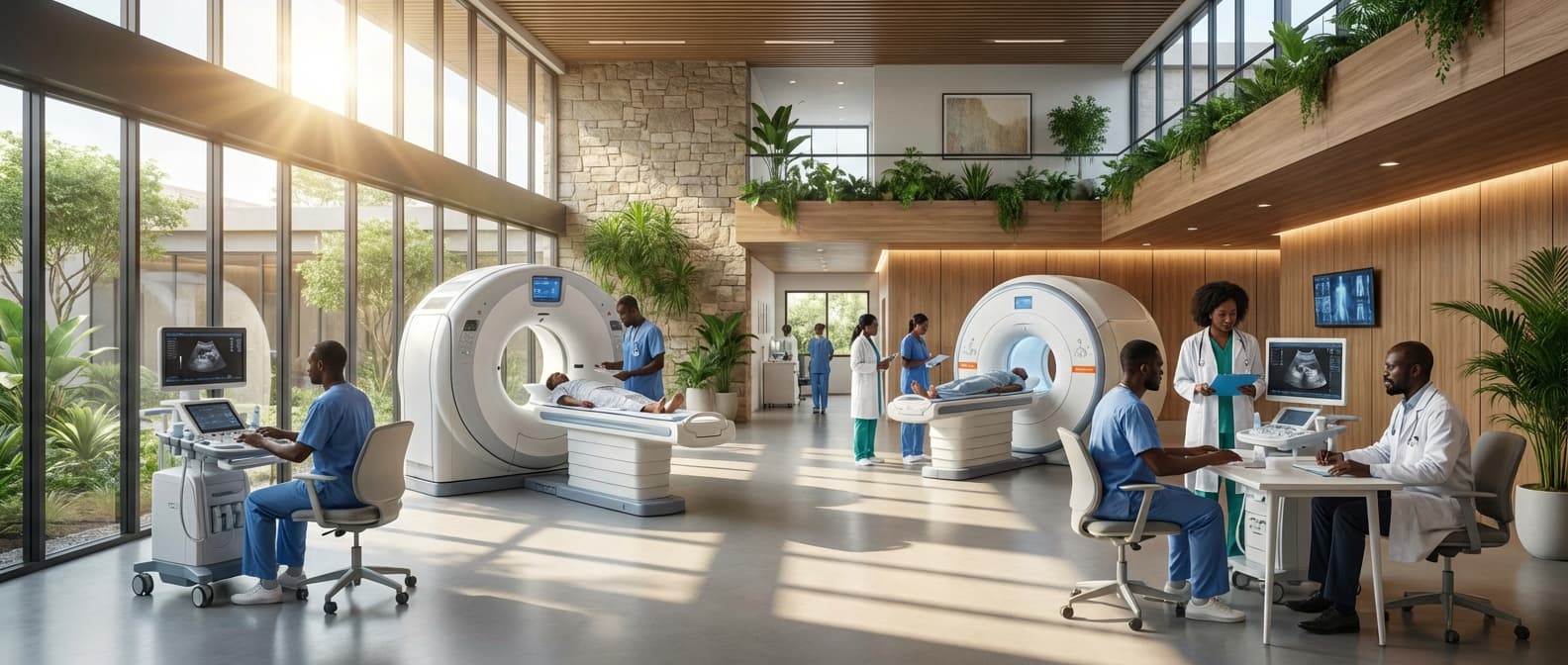
Diagnostic Imaging in Botswana
Engineering Excellence & Technical Support
High-resolution imaging systems including CT scanners, MRI, X-ray, and ultrasound technology for accurate clinical diagnosis. High-standard technical execution following OEM protocols and local regulatory frameworks.
Mobile X-ray Units Expand Rural Reach
Deployment of strategically located mobile X-ray units significantly increases access to essential diagnostic imaging services for remote communities, reducing travel burdens and enabling earlier detection of conditions like tuberculosis and pneumonia.
Point-of-Care Ultrasound Training Program
A comprehensive training program empowers healthcare workers with point-of-care ultrasound (POCUS) skills, enabling rapid bedside diagnoses of critical conditions such as ectopic pregnancies, appendicitis, and fluid accumulation, thereby improving patient outcomes in resource-limited settings.
Digital Archiving and Tele-Radiology Initiative
Implementation of a digital archiving system and a nascent tele-radiology network facilitates remote interpretation of diagnostic images by specialists, overcoming geographical barriers and improving the turnaround time for diagnostic reports, especially in areas with limited on-site radiology expertise.
What Is Diagnostic Imaging In Botswana?
Diagnostic imaging in Botswana refers to a suite of medical imaging technologies and procedures employed for the detection, diagnosis, staging, and monitoring of diseases and injuries. This service involves the utilization of various physical principles, such as X-rays, magnetic fields, sound waves, and radioisotopes, to generate internal anatomical and physiological data. These data are then interpreted by qualified radiologists and other medical professionals to provide crucial information to clinicians for patient management. The service is essential across a broad spectrum of healthcare, from primary care to highly specialized tertiary services.
| Imaging Modality | Underlying Principle | Typical Applications in Botswana |
|---|---|---|
| X-ray (Radiography) | Attenuation of X-rays by tissues of varying densities. | Fracture detection, pneumonia and tuberculosis screening, dental imaging, mammography (where available). |
| Computed Tomography (CT) | Reconstruction of cross-sectional images from multiple X-ray projections. | Trauma assessment (head, chest, abdomen), diagnosis of stroke, appendicitis, complex fractures, tumor characterization, lung nodule detection. |
| Ultrasound (Sonography) | Reflection of high-frequency sound waves from tissue interfaces. | Obstetric and gynecological assessments, abdominal organ evaluation (liver, kidneys, gallbladder), thyroid imaging, vascular studies, bedside imaging in emergency and critical care. |
| Magnetic Resonance Imaging (MRI) | Interaction of atomic nuclei with magnetic fields and radiofrequency pulses. | Detailed soft tissue evaluation: neurological conditions (brain tumors, multiple sclerosis), musculoskeletal injuries (ligament tears, joint pathology), cardiac imaging, advanced cancer staging. |
| Nuclear Medicine (e.g., SPECT, PET - less common in many public facilities) | Detection of gamma rays emitted by radiopharmaceuticals administered to the patient. | Thyroid function tests, bone scans for metastatic disease or occult fractures, cardiac stress tests (myocardial perfusion imaging). (Availability may be limited to tertiary centers). |
Key Stakeholders Requiring Diagnostic Imaging Services
- Patients with Suspected or Diagnosed Conditions: Individuals presenting with symptoms indicative of underlying pathology, or those with a confirmed diagnosis requiring further characterization or monitoring.
- Surgical Candidates: Patients undergoing pre-operative assessment to plan surgical interventions, assess risk, and identify anatomical variations.
- Trauma Patients: Individuals sustaining injuries from accidents or violence, where rapid and accurate imaging is critical for identifying fractures, internal bleeding, and organ damage.
- Oncology Patients: Patients diagnosed with cancer requiring staging (determining the extent of the disease), treatment planning (e.g., radiotherapy), and monitoring for treatment response or recurrence.
- Patients with Chronic Diseases: Individuals managing conditions such as cardiovascular disease, respiratory illnesses, or neurological disorders, who may require ongoing imaging for assessment of disease progression or treatment efficacy.
- Referral Patients: Individuals referred from primary or secondary healthcare facilities to specialized centers for advanced diagnostic imaging capabilities.
- Public Health Initiatives: Population-level screening programs for specific conditions (e.g., tuberculosis screening via chest X-rays).
Who Needs Diagnostic Imaging In Botswana?
Diagnostic imaging plays a crucial role in healthcare delivery in Botswana. This service is essential for accurate diagnosis, treatment planning, and monitoring of various medical conditions. The demand for these services is driven by a growing population, increasing prevalence of non-communicable diseases, and the need for specialized medical interventions.
| Healthcare Facility Level | Primary Imaging Modalities Utilized | Key Departments Involved |
|---|---|---|
| Primary Health Posts/Clinics | Basic X-ray (limited), Ultrasound (basic) | General Practice, Maternity, Minor Surgery |
| District Hospitals | X-ray, Ultrasound | Internal Medicine, Surgery, Pediatrics, Obstetrics & Gynecology, Emergency |
| Referral Hospitals/Tertiary Centers | X-ray, Ultrasound, CT Scan, MRI (increasingly), Fluoroscopy | All specialty departments (Cardiology, Neurology, Oncology, Orthopedics, etc.), Radiology, Emergency, ICU |
| Specialty Clinics (Private) | X-ray, Ultrasound, CT Scan, MRI (depending on specialty and investment) | Cardiology, Neurology, Orthopedics, Gynecology, etc. |
Target Customers & Departments for Diagnostic Imaging in Botswana
- {"items":["Patients: Individuals across all age groups presenting with symptoms requiring detailed internal visualization.","Referring Physicians: Doctors (GPs, specialists) in both public and private sectors who require imaging to aid in diagnosis and management.","Specialty Clinics: Outpatient clinics focusing on cardiology, neurology, oncology, orthopedics, etc., that necessitate advanced imaging modalities.","Hospitals: All levels of healthcare facilities, from primary health posts (requiring basic ultrasound and X-ray) to tertiary hospitals (requiring CT, MRI, and advanced X-ray).","Emergency Departments: For acute conditions requiring rapid diagnosis (e.g., trauma, stroke, appendicitis).","Surgical Departments: Pre-operative assessment and post-operative monitoring.","Maternity Wards/Obstetricians: For prenatal screening and monitoring of fetal development.","Rehabilitation Centers: To assess injury progression and treatment effectiveness.","Research Institutions: For medical research requiring imaging data.","Government Health Programs: For screening and public health initiatives (e.g., TB screening with X-ray)."],"title":"Target Customers"}
- {"items":["Radiology Department: The primary department responsible for operating imaging equipment and interpreting results. This includes sections for X-ray, Ultrasound, CT, and MRI.","Emergency Medicine/Trauma Units: Critical for immediate diagnosis of life-threatening conditions.","Surgical Departments (General Surgery, Orthopedics, Neurosurgery, etc.): For pre-operative planning, intra-operative guidance, and post-operative assessment.","Internal Medicine Departments: For diagnosis and management of a wide range of conditions affecting organs like lungs, heart, and abdomen.","Cardiology Department: Utilizing echocardiography, CT angiography, and MRI for heart conditions.","Neurology and Neurosurgery Departments: For diagnosis of strokes, tumors, and other brain/spinal cord abnormalities using CT and MRI.","Oncology Departments: For tumor detection, staging, monitoring treatment response, and follow-up using CT, MRI, and PET-CT (where available).","Obstetrics and Gynecology Departments: Primarily using ultrasound for antenatal care and diagnosis of gynecological issues.","Pediatrics Departments: For diagnosing congenital abnormalities, injuries, and diseases in children.","Pulmonology Departments: For diagnosing lung diseases like pneumonia, tuberculosis, and cancer using X-ray and CT scans.","Urology Departments: For diagnosing kidney stones, tumors, and other urinary tract issues using ultrasound and CT scans.","Rheumatology Departments: For assessing joint and bone health using X-ray and MRI."],"title":"Key Departments Utilizing Diagnostic Imaging"}
Diagnostic Imaging Process In Botswana
The diagnostic imaging process in Botswana, like in many healthcare systems, follows a structured workflow designed to ensure timely and accurate interpretation of medical images for patient diagnosis and management. This process typically begins with a physician's referral, detailing the clinical suspicion and the specific imaging modality required. Upon receiving the inquiry, the radiology department or a designated imaging center initiates a series of steps. These include patient registration, scheduling the appointment, preparing the patient for the specific examination, performing the imaging procedure, and finally, the interpretation of the images by a radiologist, leading to the generation of a diagnostic report. This report is then communicated back to the referring physician for clinical correlation and patient care decisions. Challenges in this process can include equipment availability, radiologist shortages, and access to remote areas, which may necessitate mobile imaging units or referral to specialized centers.
| Stage | Description | Key Personnel Involved | Potential Bottlenecks/Considerations |
|---|---|---|---|
| Physician Referral and Inquiry | A doctor identifies a clinical need for imaging to aid diagnosis or monitoring. | Referring Physician | Clarity of referral information, urgency of the request. |
| Patient Registration and Administrative Procedures | Patient details are entered into the hospital/clinic system, and examination is formally requested. | Reception Staff, Clerks | System efficiency, accuracy of patient data. |
| Scheduling and Appointment Management | An appropriate slot is allocated for the imaging examination based on urgency and equipment availability. | Scheduling Clerks, Technologists | Equipment downtime, specialist availability, patient no-shows, backlogs. |
| Patient Preparation for Imaging | Instructions are given to the patient regarding dietary restrictions, clothing, or contrast media administration. | Radiographers/Technologists, Nurses | Patient compliance, availability of contrast agents, patient anxiety. |
| Image Acquisition (Execution of the Scan) | The actual imaging procedure is performed using the designated modality (X-ray, Ultrasound, CT, MRI, etc.). | Radiographers/Technologists | Equipment functionality, patient cooperation, radiation safety protocols. |
| Image Processing and Quality Control | Images are processed, enhanced, and reviewed for diagnostic quality before interpretation. | Radiographers/Technologists | System performance, image artifacts, QC protocols. |
| Radiological Interpretation | A radiologist analyzes the images and dictates findings. | Radiologist | Radiologist workload, subspecialty expertise, availability of prior imaging. |
| Report Generation and Dissemination | The dictated findings are transcribed into a formal report, which is then sent to the referring physician. | Radiologist, Transcriptionists, IT Department | Transcription accuracy, communication channels, IT system reliability, postal delays (if applicable). |
| Clinical Correlation and Patient Management | The referring physician uses the imaging report in conjunction with other clinical information to manage the patient. | Referring Physician | Physician's understanding of the report, follow-up planning. |
Key Stages in Botswana's Diagnostic Imaging Workflow
- Physician Referral and Inquiry
- Patient Registration and Administrative Procedures
- Scheduling and Appointment Management
- Patient Preparation for Imaging
- Image Acquisition (Execution of the Scan)
- Image Processing and Quality Control
- Radiological Interpretation
- Report Generation and Dissemination
- Clinical Correlation and Patient Management
Diagnostic Imaging Cost In Botswana
Diagnostic imaging plays a crucial role in modern healthcare, enabling accurate diagnoses and guiding treatment plans. However, the cost of these services can be a significant barrier for many in Botswana. Several factors influence the pricing of diagnostic imaging procedures, including the type of imaging modality used, the complexity of the examination, the geographical location of the facility, and the specific equipment and technology employed. Radiologists' fees, contrast agent costs, and administrative overhead also contribute to the overall price. Prices can vary considerably between public and private healthcare providers, with private facilities generally being more expensive. It's important for patients to inquire about potential costs upfront and explore options for affordability, such as medical aid coverage or government subsidies where applicable. Below is a discussion of common diagnostic imaging procedures and their estimated cost ranges in Botswana Pula (BWP).
| Imaging Procedure | Estimated Cost Range (BWP) |
|---|---|
| Plain X-ray (e.g., Chest X-ray, Limb X-ray) | 200 - 600 |
| Ultrasound (Abdomen, Pelvis, Thyroid, etc.) | 300 - 800 |
| Mammogram (Bilateral) | 400 - 900 |
| CT Scan (e.g., Head, Abdomen/Pelvis - non-contrast) | 1,500 - 3,500 |
| CT Scan (with contrast) | 2,500 - 5,000 |
| MRI Scan (e.g., Brain, Knee, Spine - without contrast) | 3,000 - 7,000 |
| MRI Scan (with contrast) | 4,000 - 9,000 |
Factors Influencing Diagnostic Imaging Costs in Botswana
- Type of Imaging Modality (e.g., X-ray, Ultrasound, CT Scan, MRI)
- Complexity of the Examination (e.g., number of views, body part scanned, contrast usage)
- Geographical Location of the Facility (urban vs. rural, specific city)
- Technology and Equipment Used (e.g., older vs. state-of-the-art machines)
- Radiologist's Fees and Interpretation
- Cost of Contrast Agents (if required)
- Administrative and Overhead Costs of the Facility
- Public vs. Private Healthcare Provider Pricing
- Medical Aid Coverage and Payer Agreements
- Government Subsidies or Healthcare Programs
Affordable Diagnostic Imaging Options
Navigating the costs of diagnostic imaging can be a significant concern for many individuals. Fortunately, several affordable options and cost-saving strategies exist. Understanding concepts like "value bundles" and exploring alternatives to traditional, unbundled services can lead to substantial savings without compromising necessary care. This guide aims to illuminate these pathways to more economical diagnostic imaging.
| Cost-Saving Strategy | Description | Potential Savings |
|---|---|---|
| Value Bundles | Pre-negotiated package for a procedure and related services (e.g., MRI + interpretation). | Significant reduction compared to unbundled costs. |
| Outpatient Imaging Center | Imaging services performed outside a hospital setting. | Often 30-60% less expensive than hospital-based imaging. |
| Price Transparency/Shopping Around | Obtaining all-inclusive pricing and comparing across facilities. | Can lead to hundreds or thousands of dollars in savings. |
| Urgent Care vs. ER | Choosing urgent care for non-emergencies requiring imaging. | ER imaging can be several times more expensive than urgent care. |
Key Strategies for Affordable Diagnostic Imaging
- Value Bundles: Often offered by imaging centers or healthcare networks, value bundles group multiple diagnostic tests or a specific imaging procedure with related follow-up services (like a radiologist's interpretation) into a single, pre-negotiated price. This can significantly reduce costs compared to paying for each component separately. These bundles are particularly common for procedures like MRIs, CT scans, or mammograms.
- Price Transparency: Before scheduling any imaging, inquire about the all-inclusive price. Many providers now offer transparent pricing, allowing you to compare costs across different facilities. Websites and apps that aggregate pricing information can be invaluable tools.
- Outpatient Imaging Centers: Imaging performed at an outpatient center is typically less expensive than the same procedure done in a hospital setting. Hospitals often have higher overhead costs, which are passed on to patients.
- Negotiate or Shop Around: Don't hesitate to ask for discounts, especially if you are paying out-of-pocket or have a high deductible. Compare prices at different imaging facilities in your area. Even a few hundred dollars can be saved.
- Generic or Preferred Imaging: If your doctor offers a choice, ask if there are preferred imaging providers or if a "generic" option exists that might be more cost-effective.
- Urgent Care vs. ER: For non-life-threatening situations requiring imaging, consider an urgent care center over an emergency room, as ERs are significantly more expensive.
- Insurance Verification: Thoroughly understand your insurance plan's coverage for diagnostic imaging, including deductibles, co-pays, co-insurance, and out-of-network costs. Contact your insurance provider directly to confirm benefits and any pre-authorization requirements.
- Payment Plans: If facing a substantial bill, inquire about payment plans or financial assistance programs offered by the imaging provider.
Verified Providers In Botswana
In Botswana's evolving healthcare landscape, identifying reliable and high-quality medical providers is paramount. Franance Health stands out as a premier choice, offering a network of verified providers who meet stringent standards of excellence. This verification process ensures that patients receive competent, ethical, and up-to-date medical care. Franance Health's commitment to quality assurance means that their listed providers have undergone thorough vetting, encompassing their credentials, experience, and adherence to best medical practices. Choosing a Franance Health verified provider offers peace of mind and confidence in the quality of care received.
| Service Area | Example Verified Provider Type | Key Benefits of Verification |
|---|---|---|
| General Practice | Family Doctor | Accessible primary care, continuity of treatment, early detection of illnesses |
| Specialty Medicine | Cardiologist | Expert diagnosis and management of complex conditions, access to advanced treatments |
| Surgical Services | General Surgeon | Safe and effective surgical procedures, post-operative care coordination |
| Maternal & Child Health | Obstetrician/Gynecologist | Comprehensive prenatal, delivery, and postnatal care, expert pediatric services |
| Dental Care | General Dentist | Preventative care, restorative treatments, oral health education |
| Mental Health Services | Psychiatrist | Diagnosis and treatment of mental health disorders, therapeutic interventions |
Why Franance Health Verified Providers are the Best Choice:
- Rigorous Credentialing: Franance Health meticulously verifies the qualifications, licenses, and certifications of all its associated healthcare professionals, ensuring they meet the highest medical standards.
- Experienced Practitioners: We prioritize providers with proven track records and extensive experience in their respective fields, leading to better diagnostic accuracy and treatment outcomes.
- Commitment to Ethics: All verified providers adhere to a strict code of medical ethics and professional conduct, guaranteeing patient-centered care and confidentiality.
- Continuous Professional Development: Franance Health encourages and monitors ongoing training and development among its network, ensuring providers stay abreast of the latest medical advancements and techniques.
- Patient-Centric Approach: Verified providers are dedicated to delivering compassionate and personalized care, fostering strong patient-doctor relationships.
- Access to Specialized Services: Our network includes a diverse range of specialists, providing comprehensive healthcare solutions for various medical needs.
Scope Of Work For Diagnostic Imaging
This Scope of Work (SOW) outlines the requirements for diagnostic imaging services, including the technical deliverables and standard specifications expected from the provider. The objective is to ensure high-quality, accurate, and timely diagnostic imaging to support patient care and clinical decision-making.
| Imaging Modality | Technical Deliverables | Standard Specifications |
|---|---|---|
| X-ray (Radiography) | Digital X-ray images (DICOM format). Post-processing for optimal contrast and detail. Radiologist's interpretation report. | Minimum spatial resolution of 3.5 lp/mm for general radiography. PACS-compliant DICOM metadata. ACR standards for image quality and dose reduction where applicable. |
| Computed Tomography (CT) | Axial, sagittal, and coronal reformatted images (DICOM format). Multiplanar reconstructions (MPR), 3D reconstructions (e.g., MIP, VR) upon clinical request. Radiologist's interpretation report. | Slice thickness and reconstruction kernel to be specified per clinical indication. PACS-compliant DICOM metadata including dose information. ACR standards for image quality, contrast, and radiation dose. |
| Magnetic Resonance Imaging (MRI) | T1-weighted, T2-weighted, FLAIR, diffusion-weighted images (DWI), and other sequences as per clinical protocol (DICOM format). Post-processing for image enhancement. Radiologist's interpretation report. | Field strength (e.g., 1.5T, 3T) as specified. Signal-to-noise ratio (SNR) and contrast-to-noise ratio (CNR) to meet diagnostic requirements. PACS-compliant DICOM metadata. ACR guidelines for image quality and protocol optimization. |
| Ultrasound (US) | B-mode images, Doppler images (color, spectral), and cine loops (DICOM or compatible format). Radiologist's interpretation report. | High-resolution grayscale imaging with adequate penetration. Accurate Doppler velocity measurements. PACS-compliant DICOM metadata. ACR standards for image acquisition and interpretation. |
| Mammography | Digital mammography images (DICOM format) including craniocaudal (CC) and mediolateral oblique (MLO) views. Radiologist's interpretation report. | High-resolution digital images with excellent contrast and detail. Compliance with ACR standards for mammography image quality, compression, and radiation dose. Automated breast ultrasound (ABUS) may be an additional deliverable if specified. |
| Nuclear Medicine (PET/CT, SPECT/CT) | Functional and anatomical co-registered images (DICOM format). Time-activity curves (TACs) for dynamic studies if applicable. Radiologist's interpretation report. | Appropriate radiotracer selection and administration. Image acquisition protocols optimized for lesion detection and characterization. PACS-compliant DICOM metadata including acquisition parameters and tracer details. ACR guidelines for image quality and dose. |
Key Objectives
- To provide comprehensive diagnostic imaging services across various modalities.
- To ensure the delivery of technically sound and interpretable imaging studies.
- To adhere to established clinical protocols and best practices.
- To maintain patient safety and data privacy.
- To facilitate seamless integration with the existing healthcare information system.
Service Level Agreement For Diagnostic Imaging
This Service Level Agreement (SLA) outlines the performance standards and commitments for diagnostic imaging services provided by [Provider Name] to [Client Name]. This SLA focuses specifically on response times for critical requests and guarantees for system uptime.
| Service Component | Definition | Target | Measurement Method | Remedy for Non-Compliance |
|---|---|---|---|---|
| Response Time for Critical Imaging Requests | The time elapsed from the initiation of a critical imaging request (e.g., emergent scan with immediate clinical impact) to the first acknowledgement and commencement of diagnostic work by the assigned radiologist or imaging technician. | Within 15 minutes of request submission during business hours (Mon-Fri, 8 AM - 6 PM PST). Within 30 minutes outside of business hours, on weekends, and holidays. | Automated system logs tracking request initiation time and radiologist/technician acknowledgement time. Manual verification for edge cases. | For each instance exceeding the target response time, a credit of [X]% of the service fee for that specific request will be applied to the next invoice. Cumulative exceeding events beyond [Y] per month will trigger a deeper review and potential for service credit of [Z]% of the monthly service fee. |
| System Uptime Guarantee | The percentage of scheduled operational time during which the diagnostic imaging systems (PACS, RIS, imaging modalities) are available and functional for use. | 99.8% uptime during scheduled operational hours (24/7/365). | Monitored by the provider's internal network monitoring tools. Uptime is calculated as (Total Scheduled Operational Hours - Downtime Hours) / Total Scheduled Operational Hours * 100%. Scheduled maintenance is excluded from this calculation. | For any full calendar month where uptime falls below 99.8%, a service credit of [A]% of the monthly service fee will be applied to the next invoice. If uptime falls below 99%, a service credit of [B]% of the monthly service fee will be applied. |
Key Performance Indicators (KPIs)
- Response Time for Critical Imaging Requests
- System Uptime Guarantee
Frequently Asked Questions

Ready when you are
Let's scope your Diagnostic Imaging in Botswana project in Botswana.

Scaling healthcare logistics and technical systems across the entire continent.