
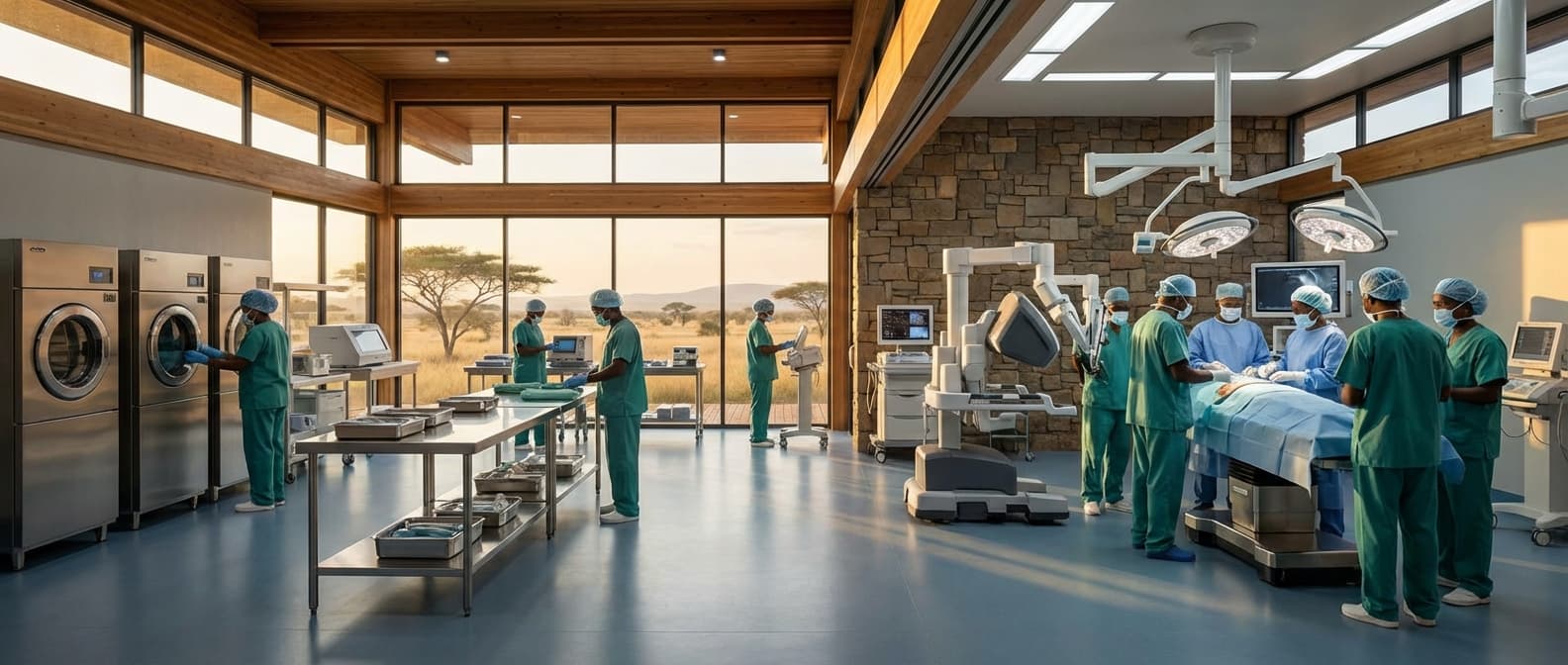
Medical Gas System Design & Installation in Botswana
Engineering Excellence & Technical Support
Medical gas pipeline systems: O2, N2O, air, vacuum High-standard technical execution following OEM protocols and local regulatory frameworks.
Advanced Medical Gas Piping
Design and installation of state-of-the-art medical gas piping systems adhering to international standards (e.g., ISO, HTM) for oxygen, medical air, vacuum, and nitrous oxide. Expertise includes material selection, route planning, pressure regulation, and leak detection to ensure patient safety and system reliability.
Central Gas Supply Integration
Seamless integration of bulk cryogenic storage systems, medical air compressors, and vacuum pumps with piped medical gas networks. Focus on redundancy, energy efficiency, and robust alarm systems to guarantee uninterrupted supply critical for patient care in Botswanan healthcare facilities.
Regulatory Compliance & Commissioning
Ensuring full compliance with Botswana's Ministry of Health regulations and relevant international codes for medical gas systems. Comprehensive commissioning and testing procedures, including pressure testing, purity analysis, and flow rate verification, are conducted to guarantee optimal performance and safety before handover.
What Is Medical Gas System Design & Installation In Botswana?
Medical gas systems are critical infrastructure in healthcare facilities, responsible for the safe and reliable delivery of various medical gases to patient care areas. In Botswana, the design and installation of these systems adhere to stringent international standards and local regulations to ensure patient safety, operational efficiency, and compliance. The service encompasses the meticulous planning, engineering, procurement, construction, and commissioning of centralized gas supply infrastructure. This includes the selection and integration of gas sources (bulk liquid oxygen tanks, medical air compressors, vacuum pumps, nitrous oxide sources), distribution piping networks, pressure regulation and alarm systems, outlets at patient bedsides, and associated monitoring and control mechanisms. Proper design prioritizes gas purity, flow rates, pressure integrity, and fail-safe redundancies to prevent supply interruptions during critical medical procedures and for continuous patient support.
| Entity/Facility | Primary Need | Typical Use Cases |
|---|---|---|
| Hospitals (Public and Private) | Life support, anesthesia, diagnostics, therapeutic interventions | Oxygen administration for respiratory distress, anesthetic gas delivery in operating theatres, vacuum for surgical aspiration, nitrous oxide for analgesia, medical air for ventilators and pneumatic devices. |
| Clinics and Health Centers (with surgical/emergency capabilities) | Emergency resuscitation, minor surgical procedures, oxygen therapy | Oxygen for critical care, vacuum for minor procedures, medical air for basic ventilation. |
| Specialized Medical Facilities (e.g., Dialysis Centers, Endoscopy Units) | Specific procedural support and patient care | Medical air for ventilator support in intensive care units (ICUs) within these facilities, vacuum for irrigation and suction during procedures. |
| Research and Development Laboratories (in medical contexts) | Controlled atmosphere, calibration, and specialized experiments | High-purity gases for analytical equipment, controlled environments for cell cultures. |
Key Components of Medical Gas System Design & Installation in Botswana
- Central Gas Supply Source Selection and Sizing (e.g., cryogenic liquid oxygen, medical air compressors, vacuum systems)
- Design of Medical Gas Pipeline Networks (materials, sizing, routing, welding standards)
- Pressure Regulation and Control Systems (reducing valves, regulators, safety relief devices)
- Gas Alarm Systems (monitoring pressure, oxygen concentration, system faults)
- Medical Gas Outlets and Terminal Units (standardized connections for specific gases)
- Nitrogen Generators and CO2 Systems (for specialized applications)
- Ventilation and Exhaust Systems for Medical Gas Storage Areas
- System Testing, Commissioning, and Validation (pressure testing, purity analysis, flow rate verification)
- Compliance with National and International Standards (e.g., NFPA 99, ISO 7396 series)
- Integration with Building Management Systems (BMS) for centralized monitoring and control
Who Needs Medical Gas System Design & Installation In Botswana?
Designing and installing a reliable medical gas system is crucial for healthcare facilities in Botswana to ensure patient safety and provide essential medical services. These systems are not a luxury but a necessity for modern medical practice. From basic oxygen to complex anesthetic gases, the correct delivery and management are paramount. The demand for expert design and installation spans across various healthcare settings and the specific departments within them.
| Customer Type | Key Departments/Areas Requiring Medical Gas Systems | Specific Needs/Services |
|---|---|---|
| Hospitals (Public & Private) | Operating Theatres / Surgical Suites, Intensive Care Units (ICU), High Dependency Units (HDU), Emergency Departments / Trauma Centers, General Wards, Neonatal Intensive Care Units (NICU), Recovery Rooms, Pulmonary Function Labs | Oxygen (O2) for resuscitation and breathing support, Nitrous Oxide (N2O) for anesthesia, Medical Air (MA) for ventilation and drug delivery, Vacuum systems for suction, Specialized gas mixtures (e.g., heliox) if applicable. |
| Specialty Clinics (e.g., Surgical Centers) | Operating Rooms, Post-Anesthesia Care Units (PACU) | High-quality, reliable supply of anesthetic gases (O2, N2O) and medical air for surgical procedures. |
| Diagnostic and Imaging Centers | MRI Suites (requiring cryogenic gases like Helium, although this is a specialized type of gas system) | While not strictly 'medical' gases in the same vein as O2/N2O, specialized gas handling is critical for some diagnostic equipment. |
| Ambulance and Emergency Medical Services | Ambulances, Mobile Treatment Units | Compact and robust oxygen delivery systems for immediate patient care en route. |
| Research and Educational Institutions | Medical Simulation Labs, Research Laboratories, Lecture Halls (for demonstrations) | Reliable gas supply for training purposes, simulations, and experimental setups. |
| Government Health Ministries and Agencies | Public Health Infrastructure Planning, National Emergency Stockpiling | Ensuring standardized, safe, and accessible medical gas infrastructure across the nation, particularly for public healthcare facilities. |
Target Customers and Departments Requiring Medical Gas System Design & Installation in Botswana
- Hospitals (Public and Private)
- Specialty Clinics (e.g., Surgical Centers, Intensive Care Units)
- Diagnostic and Imaging Centers (requiring specific gases for procedures)
- Ambulance and Emergency Medical Services (for mobile units)
- Research and Educational Institutions (with medical training facilities)
- Government Health Ministries and Agencies
Medical Gas System Design & Installation Process In Botswana
This document outlines the typical workflow for the Design and Installation of Medical Gas Systems in Botswana, from the initial inquiry to the final execution and handover. The process is structured to ensure compliance with relevant standards, efficient project management, and the delivery of safe and reliable medical gas infrastructure.
| Stage | Key Activities | Deliverables | Responsible Parties | Considerations for Botswana |
|---|---|---|---|---|
| Client expresses interest, defines project scope and requirements. Initial discussions on system type, capacity, and budget. | Project brief, preliminary scope of work. | Client, Potential Contractor/Consultant | Understanding of local healthcare needs, existing infrastructure, and regulatory bodies (e.g., Ministry of Health and Wellness). |
| Detailed assessment of medical gas requirements for different departments. Site visits to evaluate existing conditions, structural integrity, and accessibility. | Needs assessment report, site survey report, preliminary layout. | Contractor/Consultant, Client Representative | Availability of land, power supply, water, and access for construction equipment. Local building codes and regulations. |
| Development of a preliminary design concept, including pipe routing, location of manifolds, outlets, and alarms. Cost estimation and proposal submission. | Conceptual design drawings, preliminary bill of quantities (BOQ), project proposal. | Contractor/Consultant | Consideration for environmental factors (e.g., heat, dust), availability of specific medical gases in Botswana (e.g., oxygen from local sources). |
| Creation of comprehensive engineering drawings, schematics, and specifications. Material selection, pressure calculations, and adherence to international standards (e.g., ISO, HTM). | Detailed engineering drawings (PID, layout, electrical), equipment specifications, material list, calculations. | Design Engineer, Consulting Engineer | Sourcing of approved materials and equipment that meet international standards and are readily available or importable to Botswana. Compliance with Botswana Bureau of Standards (BOBS) if applicable. |
| Issuance of tender documents, evaluation of bids, and selection of a contractor. Procurement of all necessary materials and equipment. | Tender documents, bid evaluation report, awarded contract, purchase orders. | Client, Tendering Committee, Selected Contractor | Local content requirements, import duties and taxes, lead times for specialized equipment, reliable suppliers. |
| Fabrication of major components (e.g., manifolds, control panels) in a workshop environment. Quality control checks during manufacturing. | Manufactured components, quality control certificates. | Equipment Manufacturer, Contractor | Ensuring manufacturers have experience with medical gas systems and can provide necessary certifications. |
| Preparation of the installation site, including trenching, structural modifications, and installation of supporting infrastructure. | Prepared installation areas, completed civil works. | Civil Contractor, General Contractor | Coordination with local authorities for any necessary permits (e.g., excavation, building modifications). Availability of skilled local labor. |
| Installation of piping, valves, outlets, alarms, and central supply units. Testing of individual components and the entire system. | Installed medical gas system, preliminary test reports. | Installation Team, Commissioning Engineer | Adherence to strict safety protocols during installation. Environmental considerations during work (e.g., dust control). Working hours to minimize disruption to hospital operations. |
| Comprehensive testing to verify system performance, purity, and integrity. Final handover to the client with all necessary documentation. | Final test reports, validation certificates, operational manuals. | Commissioning Engineer, Client Representative | Involvement of the Ministry of Health and Wellness or their appointed representatives for final inspection and approval. User acceptance testing. |
| Training of hospital staff on the operation and maintenance of the medical gas system. Provision of detailed 'as-built' drawings and O&M manuals. | Trained personnel, as-built drawings, operation & maintenance manuals. | Training Specialist, Contractor | Ensuring that training materials are available in a language understood by local staff. Documentation should be practical and easy to follow for routine maintenance. |
Medical Gas System Design & Installation Process in Botswana
- Inquiry & Initial Consultation
- Needs Assessment & Site Survey
- Conceptual Design & Proposal Development
- Detailed Design & Engineering
- Tendering & Procurement
- System Manufacturing & Pre-fabrication
- Site Preparation & Civil Works
- Installation & Commissioning
- Testing, Validation & Handover
- Training & As-Built Documentation
Medical Gas System Design & Installation Cost In Botswana
Designing and installing a medical gas system in Botswana involves a complex interplay of factors that influence the overall cost. These systems are critical for patient care, requiring adherence to stringent safety and quality standards. The pricing is not a fixed figure but varies significantly based on several key considerations.
Key Pricing Factors:
- Scope and Complexity of the System: The number of medical gases required (e.g., oxygen, medical air, nitrous oxide, vacuum), the total number of outlets, the size and configuration of the healthcare facility, and the specific medical specialties served all contribute to the system's complexity and, therefore, its cost. A small clinic will have a significantly lower cost than a large multi-specialty hospital.
- Type of Medical Gases: Different gases have varying sourcing and purification requirements. High-purity oxygen, for instance, might be more expensive to source and deliver than medical air. The storage method (e.g., cylinders, bulk liquid oxygen tanks) also impacts initial investment and ongoing operational costs.
- System Components and Equipment: This includes the medical gas generators or sources, the distribution piping network (material, diameter, and length), pressure regulators, alarm systems, shut-off valves, and terminal units (outlets at patient bedsides). The quality, brand, and technological sophistication of these components play a major role.
- Installation Labor and Expertise: The installation requires specialized technicians with expertise in medical gas systems, who are aware of local building codes and international standards (e.g., NFPA 99). The availability of skilled labor in Botswana can influence labor rates.
- Facility Location and Accessibility: Remote locations within Botswana might incur higher transportation costs for materials and personnel, as well as potential logistical challenges, leading to increased installation expenses.
- Regulatory Compliance and Certifications: Adhering to Botswana's health regulations and obtaining necessary certifications for the system's design and installation adds to the overall cost, often involving third-party inspections and approvals.
- Project Management and Engineering Fees: Professional design, engineering, and project management services are essential for a compliant and efficient system, adding a significant portion to the total cost.
- Maintenance and Warranty: While not strictly an installation cost, the warranty period and the provisions for ongoing maintenance and servicing by the installer are often factored into the initial proposal.
| Factor Category | Typical Cost Influence | Potential Cost Range (BWP) |
|---|---|---|
| System Design & Engineering | Complexity, number of gases, facility size | BWP 50,000 - BWP 500,000+ |
| Medical Gas Sourcing/Generation | Bulk liquid O2, generators, cylinder banks | BWP 100,000 - BWP 1,000,000+ |
| Piping Network Installation | Material (copper), length, number of outlets | BWP 20,000 - BWP 1,000,000+ |
| Terminal Units & Outlets | Number of outlets, type of connectors | BWP 2,000 - BWP 10,000 per outlet |
| Alarm & Monitoring Systems | Features, integration with facility BMS | BWP 30,000 - BWP 200,000+ |
| Installation Labor & Supervision | Skill level, project duration, remote location premium | BWP 100,000 - BWP 1,500,000+ |
| Testing, Commissioning & Certification | Third-party inspections, regulatory approvals | BWP 20,000 - BWP 150,000+ |
Indicative Cost Ranges (Botswana Pula - BWP)
- Small Clinic/Doctor's Office (e.g., 2-5 outlets): BWP 50,000 - BWP 150,000
- Medium-Sized Health Post/Ward (e.g., 10-30 outlets): BWP 150,000 - BWP 500,000
- Large Hospital Unit/Specialty Department (e.g., 50-100+ outlets): BWP 500,000 - BWP 2,000,000+
- Full Hospital System Design & Installation: BWP 2,000,000 - BWP 10,000,000+
Affordable Medical Gas System Design & Installation Options
Designing and installing a medical gas system is a critical investment for healthcare facilities. The costs can vary significantly based on system complexity, size of the facility, and the specific medical gases required. Fortunately, there are several affordable design and installation options, including value bundles and strategic cost-saving measures, that can help facilities manage their budget without compromising safety or compliance.
| Cost-Saving Strategy | Description | Potential Benefits |
|---|---|---|
| Early Planning & Design Consultation | Engage with experienced medical gas system designers and installers early in the facility planning or renovation process. This allows for optimal system layout and integration, minimizing costly modifications later. | Reduced change orders, more efficient use of space, better system performance. |
| Standardization of Components | Whenever possible, opt for standardized medical gas equipment and piping. This can lead to bulk purchasing discounts and simplified maintenance and repair with readily available parts. | Lower equipment costs, reduced lead times for parts, easier technician training. |
| Energy-Efficient Equipment Selection | Choose medical gas generators, compressors, and vacuum pumps with high energy efficiency ratings. While the upfront cost may be slightly higher, the long-term operational savings can be substantial. | Reduced electricity bills, lower carbon footprint, potential for government incentives. |
| Phased Implementation | Break down the installation into phases, prioritizing essential medical gases and areas. This allows for spreading the cost over time and adapting to evolving facility needs. | Improved cash flow management, ability to address immediate critical needs, flexibility for future expansion. |
| Competitive Bidding & Vendor Negotiation | Obtain multiple quotes from reputable medical gas system providers and negotiate pricing and contract terms. Clearly define project scope to ensure accurate and comparable bids. | Potentially lower overall project cost, better contract terms. |
| In-House Training for Basic Maintenance | For certain basic maintenance tasks, consider training facility maintenance staff. This can reduce reliance on external service calls for routine checks and minor adjustments. | Reduced service call costs, quicker response times for minor issues. |
| Long-Term Service & Maintenance Agreements | Negotiate comprehensive service and maintenance agreements that include preventative maintenance and priority response. This can prevent minor issues from escalating into costly breakdowns. | Predictable maintenance costs, extended equipment lifespan, minimized downtime. |
Value Bundles for Medical Gas Systems
- Integrated Design & Installation Packages: Many reputable medical gas system providers offer comprehensive packages that combine the design, engineering, equipment procurement, and installation services. These bundles often come with a fixed price, simplifying budgeting and reducing the risk of cost overruns. They streamline the project by having a single point of contact, improving communication and coordination.
- Phased Installation Bundles: For facilities with budget constraints or undergoing gradual expansion, phased installation bundles can be an excellent option. These packages break down the project into manageable stages, allowing for upfront investment in essential components while deferring further installations to future phases as funding becomes available. This approach ensures critical needs are met first.
- Technology Upgrade Bundles: As technology advances, some providers offer bundles that include the latest energy-efficient equipment and modern control systems. While the initial cost might seem higher, these bundles can lead to significant long-term savings through reduced energy consumption, lower maintenance requirements, and enhanced system reliability.
- Maintenance & Monitoring Bundles: Beyond initial installation, ongoing maintenance and monitoring are crucial for system longevity and compliance. Value bundles often include extended warranty periods, preventative maintenance plans, and remote monitoring services. These packages can prevent costly emergency repairs and ensure continuous system performance.
Verified Providers In Botswana
When seeking healthcare services in Botswana, it's crucial to ensure you're engaging with verified and reputable providers. Franance Health stands out as a leading entity, offering a comprehensive network of accredited healthcare professionals and facilities. Their rigorous credentialing process and commitment to quality assurance make them a trusted partner for all your medical needs. By choosing Franance Health, you gain access to a curated selection of practitioners who meet the highest industry standards, ensuring you receive safe, effective, and compassionate care.
| Provider Type | Franance Health Verification Means | Benefits for Patients |
|---|---|---|
| Doctors (GPs & Specialists) | Medical Council Registration, Board Certification, Peer Reviews, Background Checks | Access to qualified and experienced medical professionals, reduced risk of medical errors, assurance of up-to-date medical knowledge. |
| Hospitals & Clinics | Accreditation by national health authorities, adherence to international safety standards, regular inspections, robust operational protocols | Access to well-equipped facilities, adherence to hygiene and safety standards, provision of comprehensive medical services. |
| Laboratories | Licensing by relevant regulatory bodies, participation in proficiency testing programs, quality control measures | Accurate and reliable diagnostic testing, timely results, confidence in medical diagnoses. |
| Pharmacies | Pharmacy Council Registration, adherence to dispensing regulations, quality assurance of medications | Access to genuine and safe medications, professional advice on drug usage, reliable pharmaceutical services. |
Why Franance Health is Your Best Choice:
- Unparalleled Network of Verified Providers
- Stringent Credentialing and Quality Assurance
- Commitment to Patient Safety and Well-being
- Access to Specialized Medical Expertise
- Streamlined Healthcare Experience
Scope Of Work For Medical Gas System Design & Installation
This Scope of Work (SOW) outlines the requirements for the design and installation of a new medical gas system and the upgrade of existing systems. It details the technical deliverables expected from the contractor and references standard specifications that will govern the project. The project aims to ensure a safe, reliable, and code-compliant medical gas infrastructure. The scope includes, but is not limited to, the design, procurement, installation, testing, and commissioning of the medical gas systems.
| Deliverable | Description | Format/Standard | Responsibility |
|---|---|---|---|
| Schematic Design Drawings | Initial drawings showing the proposed layout, main piping routes, and location of outlets and sources for all medical gases. | CAD format (e.g., AutoCAD) | Contractor |
| Design Development Drawings | More detailed drawings incorporating feedback from schematic design, including pipe sizing, valve locations, and equipment specifications. | CAD format (e.g., AutoCAD) | Contractor |
| Construction Documents | Final, detailed drawings and specifications ready for bidding and construction. Includes all necessary information for installation. | CAD format, PDF | Contractor |
| Bill of Materials (BOM) | Comprehensive list of all materials, equipment, and components required for the project, including manufacturers, model numbers, and quantities. | Excel or similar spreadsheet format | Contractor |
| Equipment Submittals | Detailed technical specifications, performance data, and certifications for all major equipment (e.g., medical air compressors, vacuum pumps, oxygen concentrators, manifolds). | Contractor | |
| Piping & Installation Plans | Detailed plans for pipe routing, supports, welding procedures, and installation methods. | CAD format, PDF | Contractor |
| Pressure Testing Reports | Documentation of all pressure testing performed on the piping system to verify integrity and leak-free operation. | Certified Report, PDF | Contractor |
| Purity & Dew Point Testing Reports | Reports confirming the purity and dew point of medical gases meet specified standards. | Certified Report, PDF | Contractor |
| Alarm System Testing & Calibration | Documentation of testing and calibration of all system alarms for pressure, flow, and purity. | Certified Report, PDF | Contractor |
| As-Built Drawings | Final drawings reflecting the actual installed system, including any deviations from the original design. | CAD format, PDF | Contractor |
| Operations & Maintenance (O&M) Manuals | Comprehensive manuals for all installed equipment and systems, including operating procedures, maintenance schedules, troubleshooting guides, and parts lists. | Hardcopy and Electronic (PDF) | Contractor |
| Training Materials | Documentation and presentations for training facility staff on the operation and maintenance of the medical gas systems. | PowerPoint, PDF | Contractor |
| Warranty Certificates | Official documentation for all manufacturer and installation warranties. | Hardcopy | Contractor |
Key Project Phases and Activities
- Phase 1: Design & Engineering
- Phase 2: Procurement & Fabrication
- Phase 3: Installation
- Phase 4: Testing & Commissioning
- Phase 5: Documentation & Training
Service Level Agreement For Medical Gas System Design & Installation
This Service Level Agreement (SLA) outlines the service standards for the design and installation of medical gas systems, specifically focusing on response times for critical issues and uptime guarantees for operational systems post-installation. This agreement aims to ensure the reliability, safety, and continuous availability of medical gas supply in healthcare facilities.
| Service Level Component | Description | Target | Measurement & Reporting |
|---|---|---|---|
| Design Phase - Initial Consultation | Time to schedule and conduct an initial consultation after request to discuss project scope and requirements. | Within 2 business days | Date of request and confirmation of consultation scheduling. |
| Design Phase - Submission of Preliminary Design | Time to submit preliminary design drawings and specifications for client review. | Within 10 business days of initial consultation | Date of submission of preliminary design. |
| Design Phase - Final Design Submission | Time to submit final, approved design drawings and specifications after incorporating client feedback. | Within 5 business days of final client approval of preliminary design | Date of submission of final design. |
| Installation Phase - Project Commencement | Time from contract signing to the commencement of on-site installation activities. | Within 15 business days | Date of contract signing and confirmed start date. |
| Installation Phase - Progress Reporting | Frequency of project progress updates to the client. | Weekly | Date of weekly progress report submission. |
| Post-Installation - Critical Issue Response Time (24/7 Support) | Time from reporting a critical issue to the start of on-site service. | Within 4 hours | Time of call/notification and time technician arrives on-site (verified by log). |
| Post-Installation - Non-Critical Issue Response Time (Business Hours) | Time from reporting a non-critical issue during business hours to the start of on-site service. | Within 8 business hours | Time of call/notification and time technician arrives on-site (verified by log). |
| Post-Installation - Critical Issue Resolution Target | Target time for resolving critical issues to restore full system functionality. | Within 12 hours of on-site service commencement | Time technician arrives on-site and time system is confirmed operational. |
| Post-Installation - Non-Critical Issue Resolution Target | Target time for resolving non-critical issues. | Within 24 business hours of on-site service commencement | Time technician arrives on-site and time issue is resolved. |
| Post-Installation - Uptime Guarantee | Guaranteed percentage of time the medical gas system will be operational and functional. | 99.5% | System logs, monitoring data, and incident reports. Measured monthly. |
Definitions
- Medical Gas System: Refers to the complete network of piping, valves, regulators, alarms, outlets, and associated equipment used to deliver medical gases (e.g., oxygen, medical air, nitrous oxide, vacuum) to patient care areas.
- Critical Issue: An event that causes a complete or partial failure of the medical gas supply, posing an immediate threat to patient safety or operational capacity of the healthcare facility.
- Non-Critical Issue: A problem that affects system performance or non-essential functions but does not pose an immediate threat to patient safety.
- Uptime Guarantee: The percentage of time the medical gas system is expected to be fully operational and available for use.
- Response Time: The maximum allowable time from the acknowledgment of a reported issue to the initiation of on-site service by a qualified technician.
- Resolution Time: The maximum allowable time from the initiation of on-site service to the restoration of the medical gas system to its operational state.
Frequently Asked Questions

Ready when you are
Let's scope your Medical Gas System Design & Installation in Botswana project in Botswana.

Scaling healthcare logistics and technical systems across the entire continent.