
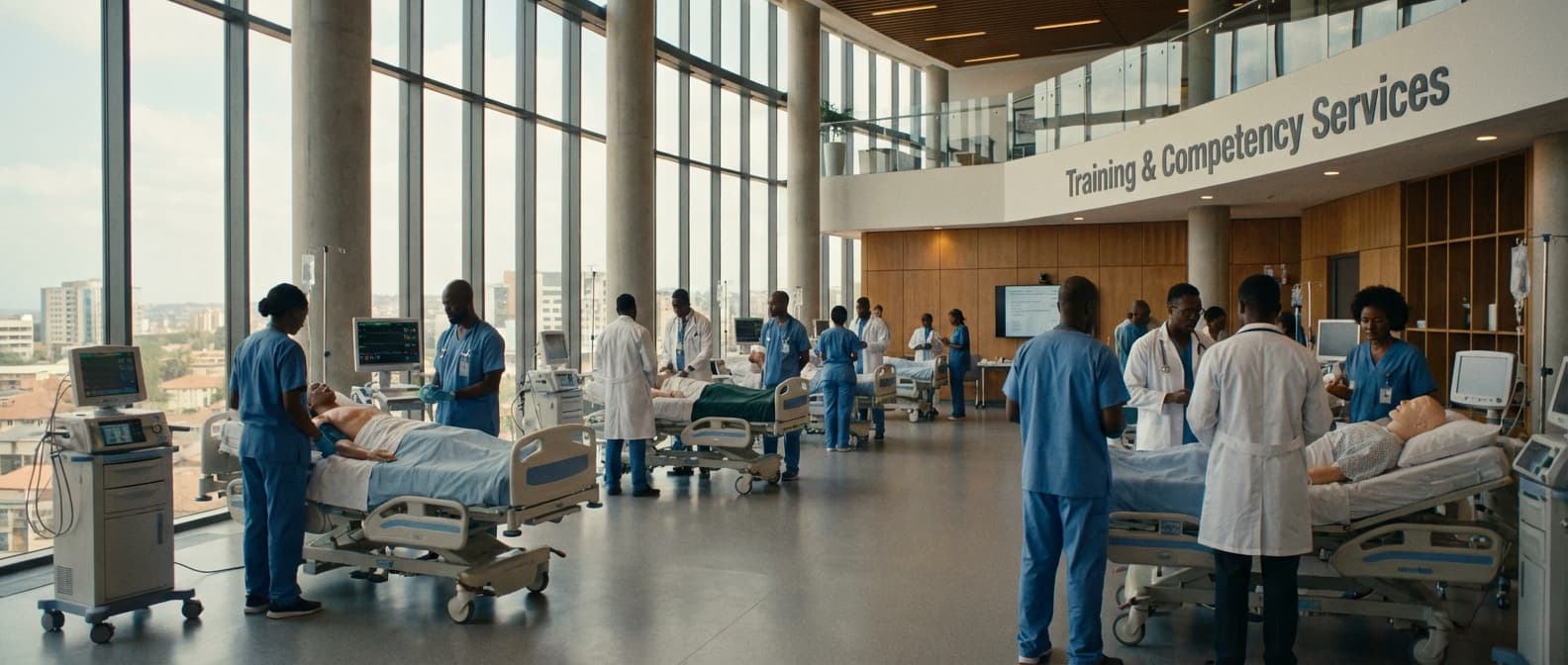
Biomedical Engineering First-Line Support Training Service in Benin
Engineering Excellence & Technical Support
Biomedical Engineering First-Line Support Training Service High-standard technical execution following OEM protocols and local regulatory frameworks.
Remote Diagnostic & Troubleshooting Mastery
Equip your Benin-based biomedical teams with the skills to remotely diagnose and troubleshoot a wide range of medical equipment issues. Our training focuses on efficient problem identification, utilizing diagnostic tools, and implementing timely solutions to minimize downtime and ensure patient care continuity.
Regulatory Compliance & Safety Protocol Adherence
Ensure your first-line support personnel in Benin are proficient in adhering to all relevant biomedical equipment regulations and safety protocols. Our training emphasizes best practices for equipment handling, maintenance logs, risk assessment, and incident reporting to uphold the highest standards of patient and staff safety.
Preventive Maintenance & Calibration Fundamentals
Empower your biomedical engineering support in Benin with the essential knowledge of preventive maintenance schedules and calibration procedures. Our training provides hands-on understanding of routine checks, component inspections, and calibration techniques crucial for extending equipment lifespan and maintaining accuracy.
What Is Biomedical Engineering First-line Support Training Service In Benin?
Biomedical Engineering First-Line Support Training Service in Benin refers to a specialized training program designed to equip personnel with the foundational knowledge and practical skills necessary to perform initial diagnostics, troubleshooting, and basic maintenance of medical devices and equipment within healthcare facilities across Benin. This service is crucial for ensuring the operational readiness and reliability of medical technology, thereby directly impacting patient care and safety.
| Target Audience | Need for Training | Typical Use Cases |
|---|---|---|
| Biomedical Technicians (Junior/Entry-Level): Individuals newly recruited or seeking to formalize their practical experience in biomedical equipment maintenance. | To establish a competent workforce capable of handling routine maintenance and initial troubleshooting, reducing reliance on external service providers for minor issues and ensuring equipment availability. | Responding to minor equipment alarms (e.g., battery low on a vital signs monitor, sensor disconnected from an infusion pump), performing daily equipment checks, cleaning and disinfecting medical devices, replacing fuses or power cords, documenting routine maintenance logs. |
| Clinical Staff (Nurses, Doctors): Healthcare professionals who operate medical devices daily and can benefit from understanding basic operational checks and immediate issue identification. | To empower clinical staff to perform basic user-level checks, identify potential issues early, and report them effectively, thereby minimizing downtime and preventing minor problems from escalating. | Performing pre-operative checks on anesthesia machines, identifying an error message on a patient monitor and reporting it to the biomedical department, ensuring correct setup and power connection of portable diagnostic tools. |
| Healthcare Facility Administrators/Managers: Decision-makers responsible for the operational efficiency and capital investment in medical equipment. | To ensure that maintenance budgets are optimized through in-house handling of basic tasks, thereby increasing the lifespan of equipment and improving return on investment, while maintaining a high standard of patient care. | Assessing training needs for the biomedical department, allocating resources for equipment maintenance, ensuring compliance with equipment service contracts and regulatory requirements. |
| Government Health Ministry/Agency Personnel: Officials involved in public health infrastructure and regulation. | To ensure a standardized level of biomedical equipment maintenance across public health facilities, improving healthcare delivery and meeting national health targets. | Developing national guidelines for equipment maintenance, evaluating the competency of biomedical departments in public hospitals, overseeing the procurement and maintenance of medical equipment in national health programs. |
Service Involves:
- Device Identification and Classification: Training on recognizing various types of biomedical equipment, understanding their intended medical applications, and classifying them based on complexity and criticality.
- Basic Principles of Operation: Instruction on the fundamental scientific and engineering principles underpinning common medical devices (e.g., electrical safety, fluid dynamics, signal processing).
- Preventive Maintenance Procedures: Education on performing routine checks, calibrations, cleaning, and scheduled inspections to prevent equipment failure.
- Troubleshooting Methodologies: Development of systematic approaches to identify and resolve common equipment malfunctions, including error code interpretation and basic diagnostic tests.
- Safety Protocols and Regulations: Emphasis on adherence to local and international safety standards for medical equipment operation, maintenance, and handling of electrical and mechanical hazards.
- Documentation and Reporting: Training on accurate record-keeping of maintenance activities, incident reports, and equipment status for inventory management and compliance.
- Basic Repair and Component Replacement: Instruction on replacing simple, user-replaceable components and performing minor repairs under supervision or according to standardized procedures.
Who Needs Biomedical Engineering First-line Support Training Service In Benin?
Biomedical Engineering First-Line Support Training Service in Benin is crucial for ensuring the efficient and safe operation of medical equipment across the country. This training aims to equip technical personnel with the foundational knowledge and practical skills to perform initial diagnostics, basic maintenance, and troubleshooting of various medical devices. This proactive approach not only minimizes equipment downtime but also enhances patient safety by ensuring devices are functioning optimally.
| Customer Type | Relevant Departments | Specific Roles/Personnel | Training Needs Rationale |
|---|---|---|---|
| Hospitals (Public and Private) | Biomedical Engineering Department, Clinical Engineering, Information Technology (IT) Department, Pharmacy, Radiology, Cardiology, Operating Rooms, Intensive Care Units (ICUs), General Wards | Biomedical Technicians, Clinical Engineers, IT Support Staff (for connected devices), Ward Managers, Nurses | To enable prompt identification and resolution of minor equipment issues, reduce reliance on external service providers for routine problems, and improve patient care by minimizing downtime of critical medical devices. |
| Clinics and Health Centers | Administrative Office, Clinical Staff | Healthcare Assistants, Clinic Managers, General Practitioners | To empower on-site personnel to handle basic equipment checks and minor troubleshooting, especially in remote or resource-limited settings where immediate access to specialized biomedical engineers might be challenging. |
| Diagnostic Laboratories | Laboratory Department, Quality Assurance Department | Laboratory Technicians, Lab Managers | To ensure the accuracy and reliability of diagnostic equipment through proper handling, basic calibration checks, and timely reporting of any malfunctions. |
| Medical Equipment Suppliers and Distributors | Technical Support Department, Field Service Department, Sales Department | Field Service Engineers (junior level), Technical Support Representatives, Sales Representatives (for basic product knowledge) | To equip new technical staff with fundamental skills for initial client support, enabling them to provide basic assistance and accurately identify issues for escalation, thereby improving customer satisfaction. |
| Government Health Agencies | Procurement Department, Planning Department, Technical Services Unit | Health Facility Managers, Procurement Officers, Ministry of Health Technicians | To enhance the capacity of government-run facilities to manage and maintain their medical equipment effectively, ensuring better healthcare delivery across the nation. |
| Non-Governmental Organizations (NGOs) involved in healthcare | Program Management, Operations Department, Field Staff | Healthcare Workers, Project Coordinators, Logistics Officers | To build self-sufficiency in managing medical equipment in project sites, particularly in areas with limited infrastructure and specialized technical support, ensuring continuity of healthcare services. |
Target Customers and Departments for Biomedical Engineering First-Line Support Training Service in Benin
- Hospitals (Public and Private)
- Clinics and Health Centers
- Diagnostic Laboratories
- Medical Equipment Suppliers and Distributors
- Government Health Agencies
- Non-Governmental Organizations (NGOs) involved in healthcare
Biomedical Engineering First-line Support Training Service Process In Benin
This document outlines the workflow for a Biomedical Engineering First-Line Support Training Service in Benin, detailing the process from initial inquiry to the execution of the training.
| Stage | Description | Key Activities | Responsible Parties | Deliverables |
|---|---|---|---|---|
| The initial contact from a client (e.g., hospital, clinic, Ministry of Health) seeking first-line support training for their biomedical engineering staff. | Receive and acknowledge inquiry, understand client's specific needs, identify target audience, assess existing skill levels, define training objectives. | Client (Inquirer), Service Provider (Sales/Consulting Team) | Initial needs assessment report, client contact information. |
| Based on the needs assessment, a detailed proposal is created outlining the training program. | Develop training curriculum, define modules and content, select trainers, estimate costs and duration, outline methodology, specify equipment and materials required, propose training schedule options. | Service Provider (Training Development Team, Subject Matter Experts) | Formal training proposal document. |
| Formalization of the training service agreement between the client and the service provider. | Review and negotiation of proposal terms, signing of contract/Memorandum of Understanding (MoU), define payment terms, set service level agreements (SLAs). | Client (Procurement/Legal Department), Service Provider (Legal/Management Team) | Signed training contract/MoU, payment schedule. |
| Tailoring the standard curriculum to meet the specific equipment and operational context of the client. | Incorporate client-specific equipment models, tailor case studies, adapt troubleshooting scenarios, incorporate local regulations and protocols. | Service Provider (Training Development Team, Trainers), Client (Technical Representatives) | Customized training modules, updated training materials. |
| Arranging all practical aspects for the successful delivery of the training. | Confirm training dates and venue, arrange for training equipment and consumables, manage trainer travel and accommodation, communicate pre-training information to participants. | Service Provider (Logistics Coordinator), Client (Facilities Manager, Participant Coordinator) | Confirmed training schedule, venue booking, logistics plan. |
| The actual execution of the training program for the participants. | Conduct theoretical sessions, deliver practical hands-on exercises, facilitate group discussions, demonstrate equipment maintenance and troubleshooting techniques. | Service Provider (Trainers) | Completed training sessions, participant engagement. |
| Measuring the effectiveness of the training and the participants' understanding. | Administer pre- and post-training assessments (quizzes, practical tests), collect participant feedback through evaluation forms, observe participant performance during practical sessions. | Service Provider (Trainers, Assessment Team), Client (Participants) | Assessment results, participant feedback summary, training effectiveness report. |
| Issuing certificates upon successful completion and providing post-training support. | Issue certificates of completion to successful participants, provide post-training support (e.g., Q&A sessions, access to online resources), schedule follow-up sessions if required, gather client testimonials. | Service Provider (Training Administration, Support Team), Client (Participants) | Certificates of completion, post-training support materials, client testimonials. |
Biomedical Engineering First-Line Support Training Service Workflow
- Inquiry & Needs Assessment
- Proposal Development
- Agreement & Contract
- Curriculum Customization
- Logistics & Scheduling
- Training Delivery
- Assessment & Evaluation
- Certification & Follow-up
Biomedical Engineering First-line Support Training Service Cost In Benin
The cost of first-line support training for Biomedical Engineering professionals in Benin can vary significantly based on several factors. This training is crucial for ensuring the proper maintenance and operation of medical equipment, thereby improving healthcare delivery. The pricing is influenced by the training provider's reputation and expertise, the duration and intensity of the program, the complexity of the equipment covered, and the inclusion of practical, hands-on sessions. Furthermore, the location of the training (e.g., in a major city like Cotonou versus a more remote area) and the number of participants can also impact the overall cost. Demand for specialized biomedical engineering skills in Benin also plays a role in pricing.
| Training Category | Estimated Cost Range (XOF - West African CFA Franc) | Notes |
|---|---|---|
| Basic First-Line Support (e.g., general troubleshooting, basic maintenance of common equipment) | 75,000 - 150,000 | Typically a shorter duration (2-3 days), focuses on fundamental skills. |
| Intermediate First-Line Support (e.g., more complex diagnostics, specific equipment families like imaging or laboratory equipment) | 150,000 - 300,000 | Longer duration (4-5 days), may involve specialized modules. |
| Advanced/Specialized First-Line Support (e.g., training on a single, highly complex equipment type, calibration, advanced troubleshooting) | 300,000 - 700,000+ | Can extend to a week or more, often delivered by equipment manufacturers or highly specialized training centers. Costs can be significantly higher for niche equipment. |
| On-site Training (for a group of 5-10 participants) | 500,000 - 1,500,000+ | Includes trainer's travel, accommodation, and potentially customized content. Price is highly dependent on location and duration. |
Key Pricing Factors for Biomedical Engineering First-Line Support Training in Benin:
- Training Provider Reputation and Expertise
- Program Duration and Intensity
- Scope of Medical Equipment Covered (e.g., general vs. specialized)
- Inclusion of Practical/Hands-on Sessions
- Training Location (e.g., urban vs. rural)
- Number of Participants (group discounts may apply)
- Level of Customization (tailored vs. standard curriculum)
- Materials and Resources Provided (manuals, software access)
- Certification and Accreditation
Affordable Biomedical Engineering First-line Support Training Service Options
This document outlines affordable first-line biomedical engineering support training service options, focusing on value bundles and cost-saving strategies. Effective first-line support is crucial for maintaining medical equipment uptime, ensuring patient safety, and optimizing operational efficiency within healthcare facilities. By investing in targeted training, organizations can empower their on-site teams to handle a wider range of issues, reducing reliance on external vendors and minimizing costly downtime. This approach not only enhances immediate problem resolution but also builds in-house expertise and fosters a proactive maintenance culture.
| Value Bundle Type | Key Features | Target Audience | Cost-Saving Strategy | Typical Investment Range (per trainee/course) |
|---|---|---|---|---|
| Basic Troubleshooting & Preventive Maintenance | Core principles of biomedical equipment function, common failure modes, basic diagnostic techniques, routine preventive maintenance procedures for high-volume equipment. | Entry-level biomedical technicians, facilities maintenance staff, clinical engineers with limited experience. | Empowers staff to handle routine tasks, reducing the need for specialized technicians for simple issues. Extends equipment life through preventive care. | $300 - $700 |
| Specific Equipment Family Training | In-depth training on the operation, troubleshooting, and basic repair of a defined category of medical devices (e.g., vital signs monitors, infusion pumps, basic imaging equipment). | Biomedical technicians focused on specific departments or equipment types. | Reduces vendor dependence for specific equipment lines. Faster resolution of issues within that equipment family. | $500 - $1,200 |
| Digital Health & Connectivity Basics | Understanding of networked medical devices, basic network troubleshooting, data security fundamentals for medical equipment, integration principles. | Biomedical technicians working with connected devices, IT support staff interacting with medical equipment. | Addresses growing complexity of connected devices. Prevents IT-related downtime for medical equipment. | $400 - $900 |
| Modular Training Packages | Bite-sized online modules or in-person workshops covering specific skills or equipment types. Allows customization of training based on organizational needs. | All levels of biomedical engineering staff, including experienced technicians needing to upskill in niche areas. | Pay only for needed skills. Flexible scheduling reduces disruption to operations. Scalable to team size and specific needs. | $100 - $400 per module |
| Train-the-Trainer Programs | Equips experienced internal staff with the knowledge and skills to train new hires or existing staff on specific procedures and equipment. | Senior biomedical engineers or technicians identified as potential trainers. | Establishes sustainable in-house training capacity, drastically reducing long-term training costs and vendor reliance. | $1,000 - $3,000 (for the trainer) |
Key Benefits of Affordable First-Line Biomedical Engineering Training
- Reduced equipment downtime through faster on-site resolution of common issues.
- Enhanced patient safety by ensuring equipment is properly maintained and functional.
- Lowered operational costs by decreasing the need for expensive external service calls and vendor interventions.
- Increased efficiency and productivity of clinical staff who rely on functional medical devices.
- Development of in-house technical expertise and problem-solving capabilities.
- Improved equipment lifespan through early detection and resolution of minor problems.
- Greater control over maintenance schedules and resource allocation.
Verified Providers In Benin
In the bustling healthcare landscape of Benin, identifying reliable and credentialed providers is paramount for ensuring quality patient care. Franance Health stands out as a beacon of trust, offering a network of verified healthcare professionals who have undergone rigorous vetting processes. This dedication to verification not only instills confidence in patients but also underscores Franance Health's commitment to setting a high standard for healthcare services across the nation. Their credentialing process is designed to assess not just formal qualifications but also practical experience, ethical conduct, and a patient-centered approach, making them the premier choice for individuals seeking dependable medical assistance.
| Credentialing Aspect | Franance Health Standard | Benefit to Patients |
|---|---|---|
| Medical License Verification | Mandatory and up-to-date checks with relevant medical boards. | Ensures providers are legally qualified to practice. |
| Educational Background Validation | Confirmation of degrees and certifications from accredited institutions. | Guarantees foundational medical knowledge. |
| Professional Experience Assessment | Review of past work history, including hospital affiliations and practice duration. | Indicates practical competence and exposure to diverse cases. |
| Ethical Conduct Review | Background checks for any disciplinary actions or malpractice claims. | Promotes trust and patient safety. |
| Continuing Medical Education (CME) | Requirement for providers to demonstrate ongoing learning and skill development. | Ensures providers stay current with the latest medical advancements. |
Why Franance Health Providers are the Best Choice:
- Rigorous Credentialing: All providers undergo a comprehensive background check and verification of their medical licenses, certifications, and professional history.
- Quality Assurance: Franance Health maintains ongoing monitoring of provider performance to ensure consistent adherence to high standards of care.
- Patient-Centric Approach: Verified providers are committed to compassionate and ethical patient care, prioritizing individual needs and well-being.
- Specialized Expertise: Access to a diverse network of specialists across various medical disciplines, ensuring you find the right care for your specific condition.
- Peace of Mind: The assurance that you are receiving care from a trusted and verified healthcare professional.
Scope Of Work For Biomedical Engineering First-line Support Training Service
This Scope of Work (SOW) outlines the requirements for a comprehensive training service for Biomedical Engineering First-Line Support personnel. The objective is to equip support staff with the necessary technical knowledge, troubleshooting skills, and practical experience to effectively diagnose, resolve, and escalate common issues related to a wide range of biomedical equipment. This training will ensure timely and accurate support, minimize equipment downtime, and enhance patient safety.
| Deliverable | Description | Standard Specification | Acceptance Criteria |
|---|---|---|---|
| Training Curriculum Development | Comprehensive curriculum covering all listed modules, tailored to the specific equipment inventory and support needs of the organization. | Curriculum documents shall be provided in editable format (e.g., Word, Google Docs). Includes learning objectives, module breakdown, content outlines, and assessment methods. | Curriculum is approved by the organization's training lead and subject matter experts within two weeks of SOW initiation. Content accurately reflects the organization's equipment and support processes. |
| Training Material Creation | Development of all necessary training materials, including presentations, handouts, practical exercise guides, and case studies. | Materials to be delivered in both digital (PDF, PPT) and printable formats. Content must be clear, concise, and visually engaging. | All training materials are finalized and approved by the organization prior to the commencement of training sessions. |
| Instructor-Led Training Sessions | Delivery of training modules by qualified and experienced biomedical engineering trainers. | Sessions will include a mix of lectures, discussions, demonstrations, and hands-on practical exercises. Each session will be scheduled and communicated in advance. | Completion of all scheduled training sessions with a minimum of 90% attendance rate. Post-training feedback surveys indicating high satisfaction levels (average score >4/5). |
| Practical Skills Assessment | Hands-on evaluation of trainees' ability to perform basic troubleshooting, maintenance, and safety checks on simulated or actual equipment. | Assessments designed to test practical application of learned skills. A standardized checklist will be used for evaluation. | All trainees must achieve a passing score (e.g., 80%) on the practical skills assessment. Deficiencies will be identified and addressed through remedial training. |
| Knowledge Assessment | Written or online examination to evaluate the theoretical understanding of training content. | Assessment to cover all key concepts and principles taught. A clear grading rubric will be provided. | All trainees must achieve a passing score (e.g., 75%) on the knowledge assessment. Opportunities for re-assessment will be provided for those who do not pass. |
| Post-Training Support and Q&A | Provision of a limited period of post-training support to address any lingering questions or concerns from the trainees. | This may include scheduled Q&A sessions or a dedicated email/forum for trainees to submit questions. | Support provided for a defined period (e.g., 30 days) post-training. All submitted queries responded to within 2 business days. |
| Training Report | A comprehensive report summarizing the training delivery, trainee performance, and overall effectiveness of the program. | Report to include statistics on attendance, assessment results, and feedback received. Recommendations for future training or improvement. | Report delivered within 7 days of the completion of all training activities. Report to be accurate and provide actionable insights. |
Key Training Modules
- Introduction to Biomedical Engineering Support Fundamentals
- Medical Equipment Classification and Risk Management
- Principles of Biomedical Equipment Operation (General)
- Common Biomedical Equipment Families and Their Functionality (e.g., Patient Monitoring, Diagnostic Imaging, Life Support)
- Basic Troubleshooting Methodologies and Diagnostic Tools
- Preventive Maintenance Procedures and Schedules
- Safety Standards and Regulations (e.g., IEC 60601 series, local regulatory requirements)
- Documentation and Reporting Standards
- Incident Management and Escalation Protocols
- Introduction to Cybersecurity in Healthcare Technology
- Hands-on Practical Sessions and Simulated Scenarios
Service Level Agreement For Biomedical Engineering First-line Support Training Service
This Service Level Agreement (SLA) outlines the response times and uptime guarantees for the Biomedical Engineering First-Line Support Training Service. This agreement is designed to ensure timely and effective support for all users of the training platform.
| Incident Severity | Response Time Guarantee | Target Resolution Time | Uptime Guarantee |
|---|---|---|---|
| Critical Incident | 1 Hour | 4 Business Hours | 99.5% |
| Major Incident | 2 Business Hours | 8 Business Hours | 99.8% |
| Minor Incident | 4 Business Hours | 2 Business Days | 99.9% |
Key Service Definitions
- Service Hours: Monday to Friday, 8:00 AM to 5:00 PM (excluding public holidays).
- Response Time: The maximum time allowed for the support team to acknowledge and begin working on a reported issue.
- Resolution Time: The maximum time allowed to fully resolve a reported issue, taking into account the complexity and nature of the problem.
- Uptime: The percentage of time the training service is available and accessible to users.
- Critical Incident: An issue that significantly disrupts or prevents access to core training functionalities, affecting a large number of users or critical training modules.
- Major Incident: An issue that impairs significant functionalities or causes intermittent disruptions, affecting a moderate number of users.
- Minor Incident: An issue that causes minor inconveniences or affects a limited number of users, without significantly impacting core functionalities.
Frequently Asked Questions

Ready when you are
Let's scope your Biomedical Engineering First-Line Support Training Service in Benin project in Benin.

Scaling healthcare logistics and technical systems across the entire continent.