
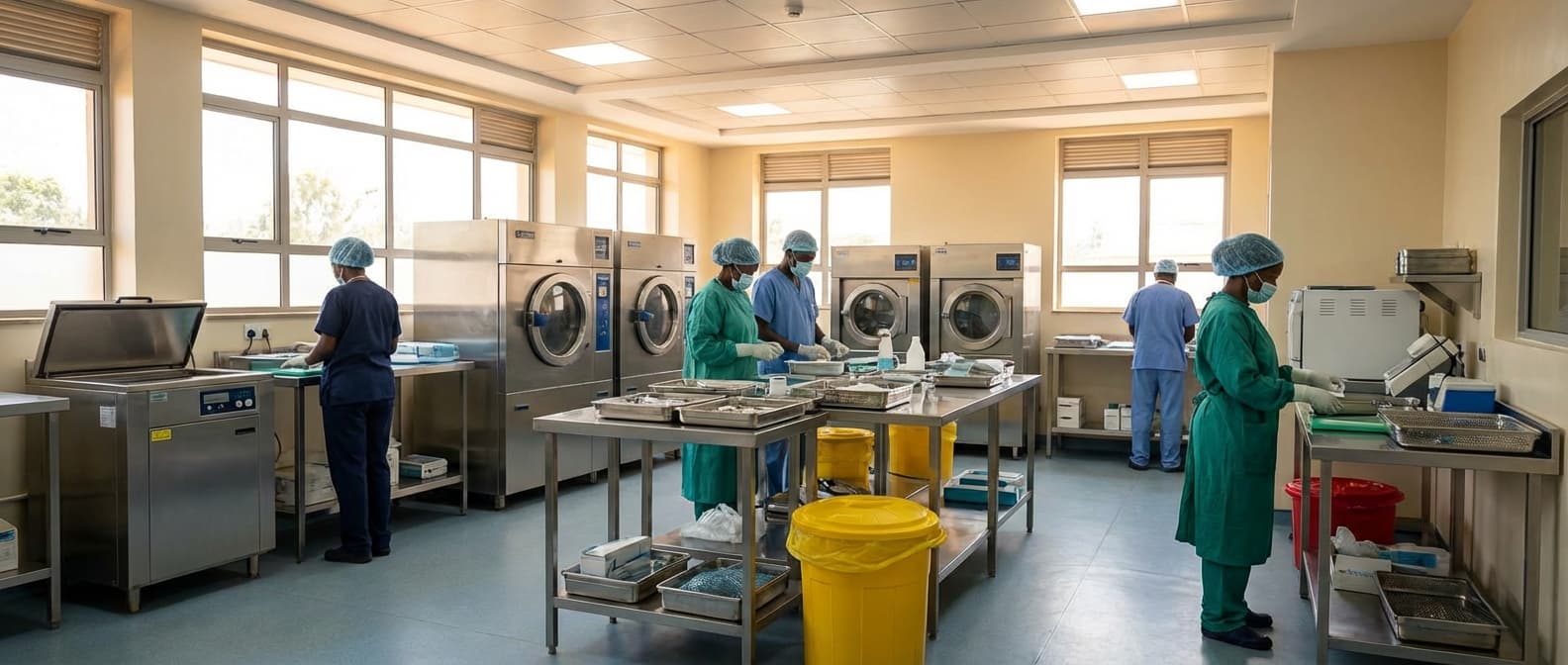
Infection-Control Readiness Support Service for Reusable Equipment in Benin
Engineering Excellence & Technical Support
Infection-Control Readiness Support Service for Reusable Equipment High-standard technical execution following OEM protocols and local regulatory frameworks.
Standardized Cleaning & Disinfection Protocols
Implementation of WHO-endorsed, context-specific protocols for the cleaning, disinfection, and sterilization of reusable medical equipment. This ensures a unified and effective approach across all healthcare facilities, minimizing the risk of cross-contamination.
Targeted Training & Capacity Building
Development and delivery of tailored training modules for healthcare workers on best practices for handling and reprocessing reusable equipment. Focus on practical skills, hazard identification, and adherence to infection control standards to build sustainable local capacity.
Robust Monitoring & Quality Assurance Framework
Establishment of a comprehensive quality assurance system that includes regular audits, performance monitoring, and data collection. This framework identifies areas for improvement and ensures the continuous effectiveness of infection control measures for reusable equipment.
What Is Infection-control Readiness Support Service For Reusable Equipment In Benin?
Infection-Control Readiness Support Service (ICRSS) for Reusable Equipment in Benin is a specialized technical service designed to bolster the capacity of healthcare facilities to safely manage, process, and maintain reusable medical equipment, thereby preventing healthcare-associated infections (HAIs). This service addresses critical gaps in the infection prevention and control (IPC) continuum by focusing on the infrastructure, practices, and human resources required for the effective disinfection, sterilization, and storage of instruments and devices that are intended for multiple patient uses. It is rooted in established international guidelines and adapted to the specific context of Benin's healthcare system, considering resource limitations and prevalent infectious disease burdens.
| Who Needs the Service | Typical Use Cases | ||||
|---|---|---|---|---|---|
| Public and private healthcare facilities in Benin, including hospitals (tertiary, secondary, and primary), health centers, and clinics that utilize reusable medical equipment for patient care. | Surgical departments requiring sterile instruments for operative procedures. | Maternity wards utilizing reusable delivery instruments and perineal care items. | Dental clinics where instruments are routinely reused. | Diagnostic laboratories employing reusable specimen collection and processing tools. | Any healthcare setting where medical devices (e.g., endoscopes, respiratory therapy equipment, surgical tools, thermometers) are sterilized or disinfected between patient uses. |
Key Components of ICRSS for Reusable Equipment in Benin
- Assessment of existing infrastructure and workflow for reusable equipment reprocessing.
- Development and implementation of standardized operating procedures (SOPs) for cleaning, disinfection, sterilization, and storage.
- Training and capacity building for healthcare personnel involved in equipment reprocessing (e.g., nurses, technicians, biomedical engineers).
- Provision or facilitation of access to appropriate equipment (e.g., autoclaves, washer-disinfectors, sterilization monitoring devices).
- Establishment of quality assurance and monitoring systems for reprocessing processes.
- Support for the proper handling, tracking, and disposal of contaminated equipment.
- Guidance on maintenance and calibration of reprocessing equipment.
- Development of strategies for the safe procurement and selection of reusable medical devices.
Who Needs Infection-control Readiness Support Service For Reusable Equipment In Benin?
This service is designed to bolster the capacity of healthcare facilities in Benin to effectively manage and maintain reusable medical equipment, ensuring optimal infection prevention and control. It targets specific departments and roles that are directly involved in the use, cleaning, sterilization, and overall management of these critical items. By providing expert guidance and practical support, this service aims to reduce the risk of healthcare-associated infections (HAIs) and improve patient safety.
| Customer Type | Key Departments/Roles | Primary Needs/Concerns |
|---|---|---|
| Hospitals (Public/Private) | CSSD, Surgical Depts, ICU, Maternity, ER, IPC Committee | Standardization of reprocessing procedures, equipment validation, staff training, audit support, capacity building for sterilization technologies. |
| Health Centers (Primary Care) | General Wards, Treatment Rooms, Midwifery Units, Health Technicians | Basic cleaning and disinfection protocols, appropriate equipment selection, practical training for limited resources, supply chain for cleaning agents. |
| Specialized Clinics (e.g., Dental) | Dental Surgeons, Dental Nurses, Sterilization Technicians | Specific instrument reprocessing protocols, autoclaving procedures, chemical sterilization options, staff competency assessments. |
| Central Sterile Supply Departments (CSSDs) | CSSD Managers, Technicians, Supervisors | Workflow optimization, validation of sterilization cycles, quality control measures, staff accreditation, traceability systems. |
| Infection Prevention and Control (IPC) Units | IPC Officers, Committee Members | Development and review of IPC policies and guidelines for reusable equipment, risk assessments, outbreak investigations related to equipment, training needs analysis. |
Target Customers and Departments for Infection-Control Readiness Support Service for Reusable Equipment in Benin
- Hospitals (Public and Private): From large tertiary care centers to smaller district hospitals.
- Health Centers (Primary Care Level): Clinics and health posts where reusable equipment is routinely used.
- Surgical Departments: Operating rooms, post-anesthesia care units (PACUs).
- Maternity Wards and Neonatal Intensive Care Units (NICUs): Requiring strict adherence to sterilization protocols.
- Emergency Departments/Trauma Centers: High volume usage and critical need for sterile equipment.
- Outpatient Clinics: Especially those performing minor procedures.
- Dental Clinics: For instruments and equipment requiring sterilization.
- Central Sterile Supply Departments (CSSDs): The core of sterilization and reprocessing.
- Infection Prevention and Control (IPC) Committees/Officers: Responsible for oversight and policy implementation.
- Department Heads and Nurse Managers: For departmental implementation and staff training.
- Biomedical Engineering Departments: For maintenance and validation of sterilization equipment.
- Procurement Officers: To ensure acquisition of appropriate and compatible equipment.
- Healthcare Workers: Nurses, doctors, technicians, and support staff who directly handle reusable equipment.
Infection-control Readiness Support Service For Reusable Equipment Process In Benin
This document outlines the workflow for the Infection-Control Readiness Support Service for Reusable Equipment Process in Benin, from initial inquiry to the successful execution of support. The service aims to enhance the capacity of healthcare facilities in Benin to safely reprocess reusable medical equipment, thereby preventing healthcare-associated infections (HAIs). The workflow is structured into distinct phases, ensuring a systematic and comprehensive approach to assessing needs, developing solutions, and implementing sustainable practices.
| Phase | Key Activities | Responsible Parties | Deliverables/Outcomes | Timeline (Indicative) |
|---|---|---|---|---|
| Phase 1: Inquiry and Initial Assessment | Healthcare facility or Ministry of Health expresses interest/need for support. Initial information gathering on existing practices and perceived challenges. Preliminary screening for eligibility. | Inquiring Facility/MOH, Support Service Coordinator | Confirmation of interest, basic understanding of facility's context, eligibility decision. | 1-2 weeks |
| Phase 2: Needs Analysis and Site Visit | Detailed assessment of current reusable equipment reprocessing workflows, infrastructure, human resources, available equipment, and existing infection control protocols. Identification of specific gaps and risks. | Support Service Team (Infection Control Specialist, Biomedical Engineer, Logistics Officer) | Comprehensive Needs Assessment Report, detailed site evaluation findings, identification of priority areas. | 2-4 weeks |
| Phase 3: Development of Support Plan | Based on the Needs Assessment Report, a tailored support plan is developed. This includes recommendations for infrastructure upgrades, equipment procurement/repair, policy development, training modules, and supply chain management. | Support Service Team, Inquiring Facility Representatives, Ministry of Health (for approval) | Approved Support Plan, budget allocation, procurement plan, training schedule. | 3-5 weeks |
| Phase 4: Training and Capacity Building | Conducting targeted training sessions for healthcare workers on infection control principles, standard operating procedures (SOPs) for reprocessing, proper use and maintenance of equipment, and waste management. | Support Service Trainers, Healthcare Facility Staff | Trained personnel, improved understanding of IPC practices, development of in-house champions. | Ongoing throughout implementation (e.g., 1-3 weeks per training module) |
| Phase 5: Equipment Assessment and Technical Support | Technical assessment of existing reprocessing equipment, provision of repair or maintenance services, and guidance on procurement of new, appropriate equipment based on the support plan. | Biomedical Engineers, Technicians, Equipment Suppliers (if applicable) | Functional reprocessing equipment, optimized equipment maintenance schedules, recommendations for new equipment. | Ongoing throughout implementation (e.g., 4-8 weeks) |
| Phase 6: Implementation and Monitoring | Putting the support plan into action: implementing new SOPs, introducing new equipment, ensuring availability of consumables, and establishing regular monitoring mechanisms to track progress and identify ongoing challenges. | Healthcare Facility Management, Support Service Team, Ministry of Health | Established and functional reprocessing workflows, improved adherence to IPC guidelines, availability of necessary supplies. | 6-12 months (initial phase) |
| Phase 7: Evaluation and Follow-up | Periodic evaluation of the implemented support service's effectiveness in reducing HAIs and improving reprocessing practices. Providing ongoing technical assistance and follow-up to ensure sustainability and identify any further needs. | Support Service Team, External Evaluators (if applicable), Ministry of Health | Evaluation reports, sustainability plans, updated recommendations, long-term impact assessment. | Quarterly/Annually post-implementation |
Infection-Control Readiness Support Service for Reusable Equipment Process Workflow
- Phase 1: Inquiry and Initial Assessment
- Phase 2: Needs Analysis and Site Visit
- Phase 3: Development of Support Plan
- Phase 4: Training and Capacity Building
- Phase 5: Equipment Assessment and Technical Support
- Phase 6: Implementation and Monitoring
- Phase 7: Evaluation and Follow-up
Infection-control Readiness Support Service For Reusable Equipment Cost In Benin
Assessing the cost of Infection-Control Readiness Support Services for reusable equipment in Benin involves a careful consideration of several key pricing factors. These factors directly influence the overall investment required to ensure safe and effective reprocessing of medical devices. The local currency, the West African CFA franc (XOF), is the primary unit of pricing.
Key Pricing Factors:
- Scope of Services: The breadth and depth of support offered significantly impact cost. This can range from basic training on current protocols to comprehensive program development, auditing, and ongoing mentorship.
- Type and Volume of Equipment: The complexity of the reusable equipment (e.g., surgical instruments, endoscopes, respiratory devices) and the quantity needing reprocessing will affect the resources, training, and supplies required.
- Infrastructure Assessment and Upgrade Needs: Evaluating existing reprocessing facilities for adequacy and identifying necessary upgrades (e.g., ventilation, water supply, sterilization equipment) will add to the cost.
- Training and Capacity Building: The number of personnel to be trained, the duration and intensity of training, and the need for specialized trainers (local or international) are crucial cost drivers.
- Supply Chain Management for Consumables: Ensuring a reliable supply of detergents, disinfectants, sterilization wraps, and other consumables, including logistics and inventory management, will be factored in.
- Equipment Procurement and Maintenance: If new or upgraded reprocessing equipment is required, its purchase price and ongoing maintenance contracts will be included.
- Monitoring and Evaluation: The establishment of robust systems for tracking reprocessing effectiveness, compliance, and patient outcomes will contribute to the service cost.
- Geographic Reach and Accessibility: Costs may vary depending on the number of facilities to be supported and their geographical dispersion within Benin, influencing travel and logistical expenses.
- Duration of Support: Whether the service is a one-time intervention, a short-term project, or long-term ongoing support will determine the overall investment.
- Local Partnership and Expertise: Collaboration with local healthcare institutions and leveraging local expertise can potentially optimize costs compared to relying solely on external consultants.
Estimated Pricing Ranges in XOF:
It's important to note that these are estimates and actual costs can vary widely based on the specific project requirements and negotiations. These ranges are presented for a single healthcare facility or a small cluster of facilities within a defined scope of work.
Small-scale Intervention (e.g., basic training and protocol review for a single department):
- Range: 500,000 XOF - 2,000,000 XOF
- Includes: Initial assessment, a few days of on-site training for a limited number of staff, review of existing protocols, and a basic report.
Medium-scale Support (e.g., comprehensive training, minor infrastructure recommendations, and protocol development for a hospital unit):
- Range: 2,000,000 XOF - 10,000,000 XOF
- Includes: In-depth assessment, multi-day training for a larger team, development of new or revised SOPs, recommendations for minor equipment or infrastructure adjustments, and initial monitoring plan.
Large-scale Program (e.g., nationwide program support, significant infrastructure assessment, equipment recommendations, and long-term capacity building for multiple facilities):
- Range: 10,000,000 XOF - 50,000,000+ XOF
- Includes: Comprehensive national or regional assessment, development of national guidelines, extensive training programs, support for infrastructure upgrades and equipment procurement, establishment of robust M&E systems, and ongoing technical assistance over an extended period.
These figures are illustrative and should be treated as a guide. A detailed needs assessment and a tailored proposal are essential for obtaining accurate costings for any infection-control readiness support service in Benin.
| Service Scale | Estimated Cost Range (XOF) | Typical Inclusions |
|---|---|---|
| Small-scale Intervention | 500,000 - 2,000,000 | Initial assessment, limited on-site training, protocol review, basic report |
| Medium-scale Support | 2,000,000 - 10,000,000 | In-depth assessment, multi-day training, SOP development, minor infrastructure/equipment recommendations, initial M&E plan |
| Large-scale Program | 10,000,000 - 50,000,000+ | National/regional assessment, guideline development, extensive training, infrastructure/equipment upgrade support, robust M&E, long-term TA |
Key Pricing Factors for Infection-Control Readiness Support Services in Benin
- Scope of Services
- Type and Volume of Reusable Equipment
- Infrastructure Assessment and Upgrade Needs
- Training and Capacity Building
- Supply Chain Management for Consumables
- Equipment Procurement and Maintenance
- Monitoring and Evaluation Systems
- Geographic Reach and Accessibility
- Duration of Support
- Local Partnership and Expertise
Affordable Infection-control Readiness Support Service For Reusable Equipment Options
Our Affordable Infection-Control Readiness Support Service for Reusable Equipment Options is designed to empower healthcare facilities with comprehensive solutions to ensure the highest standards of patient safety while managing costs effectively. We understand the critical need for robust infection control protocols for reusable medical devices, and our service offers a flexible, tiered approach to meet diverse budgetary and operational requirements. By focusing on proactive prevention, streamlined processes, and smart resource allocation, we help facilities reduce the risk of healthcare-associated infections (HAIs) and achieve significant cost savings.
| Cost-Saving Strategy | Description | Impact on Readiness Support |
|---|---|---|
| Preventative Maintenance Focus | Prioritizing regular checks and upkeep of reusable equipment to prevent malfunctions and contamination, rather than reactive repairs. | Reduces costly emergency interventions and equipment downtime, ensuring consistent availability of disinfected equipment. |
| Optimized Sterilization & Disinfection Processes | Implementing evidence-based best practices and utilizing efficient sterilization/disinfection technologies to minimize cycle times and resource consumption. | Lowers utility costs (water, energy) and reduces the need for excessive consumable supplies, while ensuring effective microbial inactivation. |
| Staff Training & Empowerment | Providing comprehensive, role-specific training on infection control protocols, proper equipment handling, and the importance of adherence. | Minimizes human error, a significant contributor to HAIs, thereby reducing associated treatment costs and potential legal liabilities. |
| Data-Driven Risk Assessment & Monitoring | Utilizing analytics to identify high-risk equipment, procedures, and environmental factors, allowing for targeted interventions. | Focuses resources on areas with the greatest potential for infection transmission, maximizing the impact of prevention efforts and avoiding costly broad-spectrum measures. |
| Consumable Management & Standardization | Streamlining the selection and procurement of infection control consumables, and promoting standardized usage across departments. | Leverages bulk purchasing power, reduces waste, and ensures consistent efficacy of infection control agents. |
| Technology Integration & Automation | Exploring and implementing appropriate technologies for tracking, monitoring, and automating aspects of the reprocessing cycle. | Improves efficiency, reduces manual labor requirements, enhances accuracy of tracking, and provides real-time data for quality assurance. |
| Flexible Service Tiers & Scalability | Offering customizable service packages that allow facilities to choose the level of support that best fits their current needs and budget. | Avoids overspending on unnecessary services, allowing for phased implementation and scaling as the facility's needs evolve. |
Value Bundles
- {"title":"Basic Readiness Bundle","description":"Ideal for facilities seeking foundational support and essential infection control monitoring. Focuses on critical touchpoints and routine compliance checks."}
- {"title":"Enhanced Preparedness Bundle","description":"Builds upon the Basic Bundle with more in-depth training, advanced risk assessment, and performance analytics. Offers proactive identification of potential issues."}
- {"title":"Comprehensive Resilience Bundle","description":"Our most robust offering, providing end-to-end infection control management, including emergency preparedness, advanced technology integration, and customized protocol development. Guarantees maximum infection prevention and operational continuity."}
Verified Providers In Benin
Ensuring access to high-quality healthcare in Benin is paramount, and for individuals and organizations seeking reliable medical services, identifying verified providers is crucial. Franance Health stands out as a leader in this regard, offering a comprehensive network of credentialed professionals and facilities. Their rigorous vetting process ensures that every provider listed meets stringent standards for expertise, ethics, and patient care, making them the undisputed best choice for healthcare needs in Benin.
| Credential Type | Verification Process | Benefit to Patients |
|---|---|---|
| Medical Licenses | Confirmed with the Benin Ministry of Health and relevant medical boards. | Guarantees that practitioners are legally authorized to practice medicine. |
| Specialty Certifications | Validated with recognized national and international specialty boards. | Confirms specialized knowledge and advanced skills in specific medical fields. |
| Continuing Medical Education (CME) | Reviewed for completion and relevance to current medical practices. | Ensures providers stay updated with the latest medical advancements and techniques. |
| Hospital/Clinic Accreditation | Assessed against national and international healthcare quality standards (e.g., ISO, JCI equivalent). | Indicates adherence to high standards of facility management, patient safety, and operational efficiency. |
| Professional References & Background Checks | Thorough checks conducted to ensure a clean professional history and positive patient feedback. | Provides an additional layer of assurance regarding the provider's integrity and past performance. |
Why Franance Health Credentials Matter
- Expertise Verification: Franance Health meticulously checks the qualifications, training, and experience of all healthcare professionals.
- Ethical Standards: Providers are assessed for their commitment to ethical practices and patient well-being.
- Quality of Care Assurance: The credentials reflect a dedication to delivering safe, effective, and patient-centered healthcare.
- Regulatory Compliance: Franance Health ensures providers adhere to all relevant health regulations in Benin.
- Patient Trust and Safety: Verified credentials build confidence and minimize risks for patients seeking medical attention.
Scope Of Work For Infection-control Readiness Support Service For Reusable Equipment
This Scope of Work (SOW) outlines the services to be provided by the vendor for Infection-Control Readiness Support, specifically focusing on reusable medical equipment. The goal is to ensure that all reusable equipment within the client's facility is managed, cleaned, disinfected, and sterilized in accordance with best practices and regulatory requirements, thereby minimizing the risk of healthcare-associated infections (HAIs). This SOW details the technical deliverables, standard specifications, and reporting requirements.
| Deliverable | Description | Standard Specification/Reference | Timeline |
|---|---|---|---|
| Initial Assessment Report | A comprehensive report detailing the current state of reusable equipment infection control, identifying gaps, risks, and areas for improvement. Includes inventory of existing equipment and current protocols. | Aligned with CDC guidelines, AAMI standards, and relevant national/local regulations. Report format to be mutually agreed upon. | Week 1-2 |
| Standard Operating Procedures (SOPs) for Reusable Equipment | Development of detailed SOPs for the entire lifecycle of reusable equipment, including receiving, cleaning, disinfection, sterilization, storage, and distribution. SOPs will cover different equipment types and risk levels. | Adherence to AAMI ST79, CDC Guidelines for Disinfection and Sterilization in Healthcare Facilities, FDA guidance, and manufacturer's instructions for use (IFUs). | Week 3-6 |
| Staff Training Program Materials | Creation of training modules and materials (presentations, handouts, checklists) for clinical and non-clinical staff involved in handling reusable equipment. Focus on proper techniques, documentation, and error recognition. | Content to be evidence-based and practical. Materials to be provided in digital and printable formats. | Week 4-7 |
| Training Session Delivery & Competency Assessment | Conducting hands-on training sessions for designated staff. Includes a competency assessment to ensure understanding and practical application of learned skills. | Minimum of X sessions (to be determined based on facility size and staffing). Competency assessment to include practical demonstrations and written quizzes. | Week 8-10 |
| Validation Report for Sterilization Processes | Documented evidence that the sterilization processes (e.g., autoclaving, chemical sterilization) consistently achieve the desired level of microbial kill for specific equipment types. | Biological indicator testing, chemical indicator monitoring, and process parameter review as per AAMI ST79 and manufacturer IFUs. | Week 12-14 |
| Disinfection Efficacy Testing Report | Data demonstrating the effectiveness of specified disinfection methods against relevant microorganisms for high-level disinfected equipment. | Testing to be performed on representative equipment and high-level disinfectants according to EN or ASTM standards, and manufacturer IFUs. | Week 13-15 |
| Monitoring and Compliance Audit Reports | Regular reports detailing findings from routine audits of cleaning, disinfection, and sterilization processes. Includes identification of non-compliance issues and recommended corrective actions. | Frequency: Monthly. Reports to include data on adherence to SOPs, proper documentation, and staff practice observations. | Monthly (starting Week 16) |
| Quarterly Improvement Recommendations Report | A report summarizing performance trends, identifying persistent challenges, and proposing actionable recommendations for process optimization, technology adoption, or further staff training. | Data-driven insights based on audit reports and compliance metrics. Recommendations to be prioritized based on impact and feasibility. | Quarterly (starting Week 20) |
| Final Project Report | A comprehensive summary of the project, including achieved outcomes, compliance improvements, cost-benefit analysis of implemented changes, and recommendations for sustained infection control. | Detailed analysis of pre- and post-intervention data. Executive summary and detailed appendices. | End of Project (Month 6) |
Key Service Areas
- Assessment of current infection control practices for reusable equipment.
- Development and implementation of standardized cleaning, disinfection, and sterilization protocols.
- Training of facility staff on infection control procedures for reusable equipment.
- Validation and verification of equipment cleaning and sterilization processes.
- Ongoing monitoring and reporting of infection control compliance.
- Recommendations for equipment upgrades or process improvements.
Service Level Agreement For Infection-control Readiness Support Service For Reusable Equipment
This Service Level Agreement (SLA) outlines the response times and uptime guarantees for the Infection-Control Readiness Support Service for Reusable Equipment. This service is critical to ensuring the safe and effective reprocessing of reusable medical devices, minimizing the risk of healthcare-associated infections.
| Service Component | Response Time Guarantee (Business Hours) | Uptime Guarantee |
|---|---|---|
| Critical Equipment Failure (e.g., sterilizer malfunction) | 1 hour | 99.9% uptime for critical sterilization equipment. |
| Non-critical Equipment Issue (e.g., software glitch) | 4 business hours | 99.5% uptime for all supported infection control equipment. |
| Infection Control Protocol Deviation Alert | 2 business hours | N/A (Focus on timely response and remediation) |
| Request for Expert Consultation | 8 business hours | N/A (Focus on timely scheduling and delivery of consultation) |
Key Service Components
- Proactive monitoring of infection control equipment and processes.
- Timely response to identified issues or potential failures.
- On-site or remote support for troubleshooting and resolution.
- Regular reporting on equipment status and performance.
- Access to expert consultation on infection control best practices related to reusable equipment.
Frequently Asked Questions

Ready when you are
Let's scope your Infection-Control Readiness Support Service for Reusable Equipment in Benin project in Benin.

Scaling healthcare logistics and technical systems across the entire continent.