
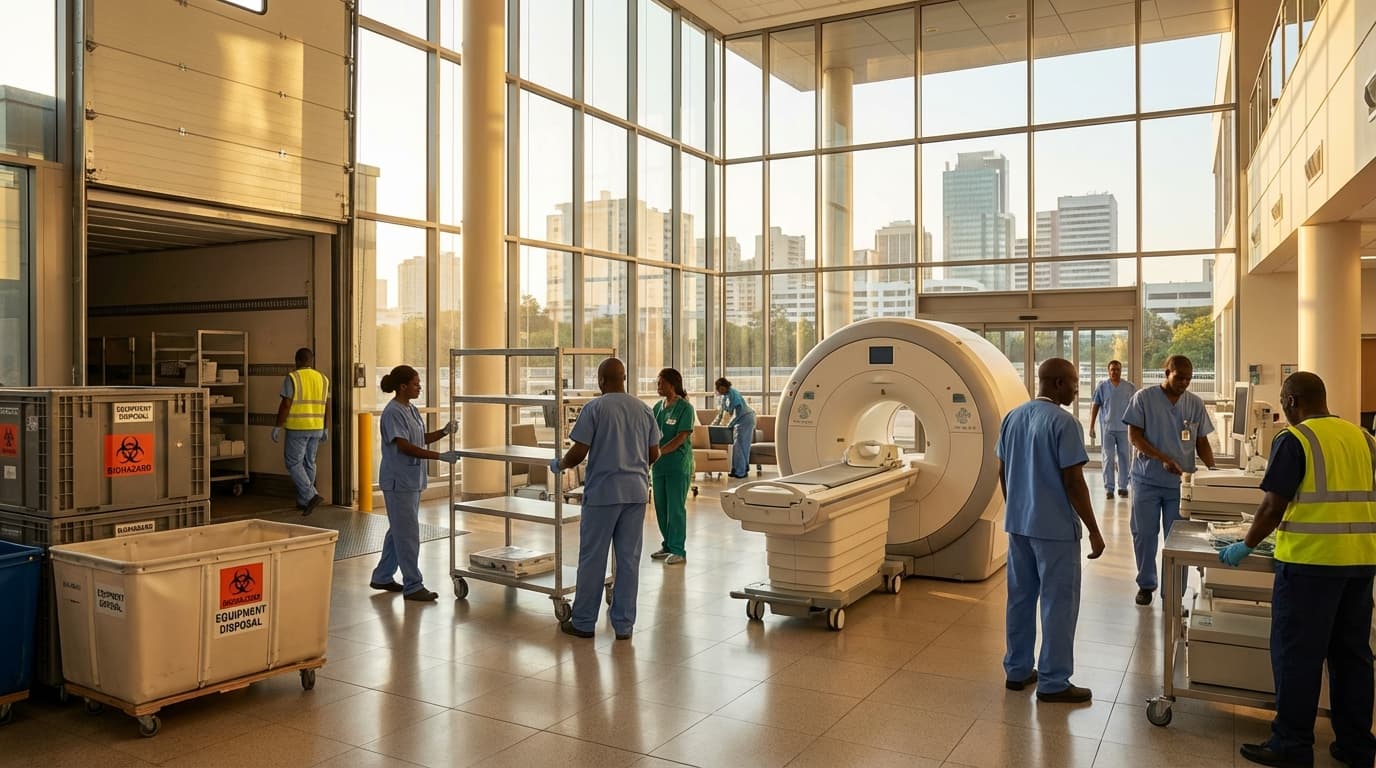
Heavy Medical Equipment De-Installation Service (MRI/CT/Cath Lab) in Benin
Engineering Excellence & Technical Support
Heavy Medical Equipment De-Installation Service (MRI/CT/Cath Lab) High-standard technical execution following OEM protocols and local regulatory frameworks.
Specialized Radiation Shielding & Containment
Our team is expertly trained in managing and safely dismantling radiation-sensitive equipment like MRI, CT scanners, and Cath Labs in Benin. We employ specialized shielding and containment protocols to ensure zero radiation leakage and protect both personnel and the environment throughout the de-installation process.
Precision Component Handling & Preservation
De-installing complex medical imaging systems requires meticulous attention to detail. We utilize advanced handling techniques and climate-controlled procedures to safeguard delicate components, superconducting magnets, and sensitive electronics, ensuring their integrity for potential relocation, resale, or responsible disposal.
Logistics & Certified Transportation Management
Navigating the logistical challenges of heavy medical equipment in Benin is our expertise. We provide end-to-end solutions, including safe disconnection, secure packaging, certified transportation with specialized rigging, and adherence to all import/export regulations for seamless de-installation and movement of your valuable assets.
What Is Heavy Medical Equipment De-installation Service (Mri/ct/cath Lab) In Benin?
Heavy medical equipment de-installation service, specifically for modalities such as Magnetic Resonance Imaging (MRI), Computed Tomography (CT) scanners, and Cardiac Catheterization (Cath) Labs, refers to the highly specialized process of dismantling, safely removing, and preparing complex, high-value diagnostic and interventional imaging systems for relocation, disposal, or long-term storage. These systems are characterized by their substantial weight, intricate componentry, sensitive calibration, and often, unique environmental requirements (e.g., RF shielding for MRI, dedicated cooling for CT). De-installation necessitates adherence to strict safety protocols, precise handling procedures, and often requires specialized tools and expertise beyond general rigging or moving services. The service encompasses the entire de-assembly of the equipment, including removal of ancillary components, disconnection of power and data lines, packaging of sensitive parts, and the physical extraction from the facility, often involving structural considerations like doorway egress and transportation logistics.
| Who Needs This Service? | Typical Use Cases | |||||
|---|---|---|---|---|---|---|
| Hospitals and Healthcare Facilities undergoing renovation, relocation, or closure. | Relocation: Moving a hospital or clinic to a new site, requiring the transfer of existing imaging equipment. | Upgrade/Replacement: De-installing older equipment to make space for newer, technologically advanced systems. | Equipment Sales/Transfers: Preparing equipment for sale to another institution or for transfer between departments within a larger healthcare network. | End-of-Lease Returns: Safely removing equipment at the conclusion of a lease agreement. | Temporary Site Operations: De-installing equipment from a temporary facility after its use is concluded. | Facility Decommissioning: Complete shutdown and removal of all assets from a healthcare building. |
| Medical Equipment Manufacturers and Vendors. | Refurbishment and Servicing: De-installing equipment from a client site for refurbishment at a central facility. | Asset Recovery: Removing equipment from sites where maintenance contracts have ended or ownership is being reclaimed. | Demonstration Unit Preparation: De-installing equipment previously used for demonstrations. | Disposal and Recycling: Preparing non-functional or obsolete equipment for responsible disposal or recycling according to environmental standards. | International Shipments: De-installing and preparing equipment for secure export and international transit. | |
| Asset Management and Logistics Companies specializing in healthcare infrastructure. | Consolidated De-installation Projects: Managing the removal of multiple pieces of heavy medical equipment across various sites. | Turnkey Solutions: Providing end-to-end services from de-installation to re-installation or disposal. | Auditing and Inventory Management: Verifying the presence and condition of equipment during de-installation for asset tracking. |
Key Aspects of Heavy Medical Equipment De-Installation Service (MRI/CT/Cath Lab)
- Specialized Expertise: Requires certified technicians with specific training and experience in the particular modality being de-installed.
- Risk Mitigation: Focuses on preventing damage to the equipment, the facility infrastructure, and ensuring personnel safety.
- Component Management: Involves careful disassembly, labeling, and packaging of individual sub-systems and sensitive parts.
- Logistical Planning: Encompasses detailed planning for egress from the facility, transportation, and potential storage or disposal.
- Regulatory Compliance: Adherence to relevant safety standards, environmental regulations, and manufacturer guidelines.
- Environmental Considerations: Management of coolant disposal, shielding material removal, and other potentially hazardous substances.
- Documentation: Comprehensive record-keeping of the de-installation process for traceability and future re-installation.
Who Needs Heavy Medical Equipment De-installation Service (Mri/ct/cath Lab) In Benin?
When complex and high-value medical imaging and interventional equipment like MRI, CT scanners, and Cath Labs need to be moved, decommissioned, or installed, specialized de-installation services are essential. These services are critical for ensuring the safety of personnel and the equipment, adhering to regulatory compliance, and minimizing downtime for healthcare facilities. In Benin, several types of institutions and departments would require such expertise.
| Customer Type | Key Departments / Areas of Need | Specific Equipment Involved | Reasons for De-Installation |
|---|---|---|---|
| Hospitals and Medical Centers | Radiology Department, Cardiology Department, Neurology Department, Oncology Department, Surgical Department | MRI Scanners, CT Scanners, Cardiac Catheterization (Cath) Labs, Linear Accelerators (for Radiation Therapy) | Upgrades, replacements, relocation within the facility, decommissioning for disposal/sale, installation of new equipment. |
| Specialized Imaging Clinics | Diagnostic Imaging Centers | MRI Scanners, CT Scanners | Renovation of premises, relocation to a new facility, technology upgrades. |
| Research Institutions | Medical Research Laboratories, University Medical Schools | Specialized MRI/CT systems for research purposes, advanced imaging modalities | Equipment upgrades for research projects, relocation to new research wings, decommissioning of outdated research equipment. |
| Government Health Agencies | Public Hospitals, National Health Infrastructure Projects | Various imaging and interventional equipment across public healthcare facilities | National equipment replacement programs, new hospital constructions, centralizing or decentralizing specialized services. |
| Private Medical Groups | Multi-specialty Clinics, High-End Diagnostic Centers | MRI Scanners, CT Scanners, Cath Labs, advanced ultrasound machines | Expansion of services, relocation of practices, modernization of equipment to maintain competitiveness. |
Target Customers and Departments Requiring Heavy Medical Equipment De-Installation Services in Benin
- Hospitals and Medical Centers
- Specialized Imaging Clinics
- Research Institutions
- Government Health Agencies
- Private Medical Groups
Heavy Medical Equipment De-installation Service (Mri/ct/cath Lab) Process In Benin
This document outlines the detailed workflow for a Heavy Medical Equipment De-Installation Service (MRI/CT/Cath Lab) in Benin, covering the process from initial inquiry to successful execution. We emphasize safety, regulatory compliance, and efficient project management to ensure minimal disruption and optimal equipment readiness for transport or relocation.
| Stage | Description | Key Activities | Deliverables | Responsible Party | Timeline (Indicative) |
|---|---|---|---|---|---|
| The client contacts the service provider with a requirement for de-installation of heavy medical equipment. This stage involves understanding the scope and feasibility. | Receive client inquiry, gather initial equipment details (make, model, serial number, current location), understand the reason for de-installation (relocation, upgrade, disposal), discuss preliminary timelines and budget. | Acknowledgement of inquiry, preliminary equipment list, initial understanding of project scope. | Client, Service Provider | 1-3 Business Days |
| Based on the initial assessment, a detailed proposal is prepared and presented to the client. Upon acceptance, a formal contract is established. | Conduct a detailed equipment assessment (if not fully known), estimate manpower, specialized tools, and logistical requirements. Develop a comprehensive proposal outlining scope of work, methodology, safety protocols, timeline, and cost. Present proposal to client, negotiate terms, and finalize contract. | Detailed Project Proposal, Signed Service Contract. | Service Provider, Client | 3-7 Business Days |
| A thorough site survey is conducted to identify all practical considerations for de-installation. | On-site visit to the equipment location. Assess access routes, power requirements, structural considerations, ventilation, cooling systems, and potential hazards. Identify egress routes for equipment removal. Develop a detailed de-installation plan, including rigging, lifting, and transportation strategies. Obtain necessary permits or approvals from local authorities (if required). | Detailed Site Survey Report, De-Installation Plan, Risk Assessment, Permit Applications (if applicable). | Service Provider | 5-10 Business Days |
| All necessary preparations are made to ensure a smooth and safe de-installation process. | Schedule de-installation dates. Procure and mobilize specialized tools, lifting equipment, and safety gear. Coordinate with the client for power disconnection and isolation. Prepare the equipment for safe disconnection (e.g., coolant management for CT/MRI, imaging system shutdown). Arrange for temporary site protection if needed. | Mobilized Personnel and Equipment, Scheduled Utilities Disconnection, Site Protection (if applicable). | Service Provider, Client | 2-5 Business Days (Preceding De-Installation) |
| The core process of safely disconnecting and disassembling the heavy medical equipment. | Execute the de-installation plan. Safely disconnect power, cooling, and other essential services. Disassemble components according to manufacturer specifications and the de-installation plan. Utilize specialized lifting and rigging techniques. Package components securely for transport. Adhere strictly to all safety protocols and environmental regulations. | De-installed Equipment Components (secured and packaged), Completed De-Installation Checklist. | Service Provider | Varies (1-5+ Days depending on equipment complexity and size) |
| The equipment is prepared for onward movement and formally handed over to the client or designated transporter. | Inspect de-installed components for any damage. Prepare a preliminary report on the de-installation process. Load equipment onto transportation if arranged by the service provider, or secure it for client's designated transporter. Provide equipment manifests and relevant documentation to the client. | De-installed Equipment (ready for transport/storage), Preliminary De-Installation Report, Equipment Manifests. | Service Provider, Client | 1-3 Business Days |
| Finalizing all project documentation and closing out the service agreement. | Provide final de-installation report including photos, safety records, and any incident reports. Obtain client sign-off on the completion of services. Process final invoicing and payment. Archive project documentation. | Final De-Installation Report, Client Sign-off, Final Invoice. | Service Provider, Client | 3-5 Business Days |
Workflow Stages
- Inquiry & Initial Assessment
- Proposal & Contract
- Site Survey & Planning
- Pre-De-Installation Preparations
- De-Installation Execution
- Post-De-Installation & Handover
- Documentation & Closure
Heavy Medical Equipment De-installation Service (Mri/ct/cath Lab) Cost In Benin
De-installing heavy medical equipment like MRI, CT scanners, and Cath Labs is a highly specialized and complex process. The cost in Benin is influenced by a multitude of factors, making it difficult to provide a single fixed price. These services require trained technicians, specialized tools, logistics for transportation, and adherence to stringent safety protocols. The pricing will vary significantly based on the specific equipment, the complexity of the de-installation, the location within Benin, and the vendor providing the service. It's crucial to obtain detailed quotes from multiple reputable de-installation companies for an accurate assessment.
| Equipment Type | Estimated Cost Range (XOF) | Notes |
|---|---|---|
| CT Scanner (Mid-range) | 1,500,000 - 3,500,000 | Excludes specialized transport and significant structural modifications. Price can increase with higher slice counts. |
| MRI Scanner (Low to Mid-field) | 2,000,000 - 6,000,000 | Includes cryogen handling (if applicable). Higher field strengths will be significantly more expensive. Transportation costs are a major factor. |
| Cath Lab (Interventional Suite) | 2,500,000 - 7,000,000 | Complex system with multiple components and heavy shielding. May require specialized power infrastructure disconnection. |
| Ancillary Heavy Equipment (e.g., large X-ray units) | 800,000 - 2,000,000 | Cost varies based on weight and complexity of removal. |
Key Pricing Factors for Heavy Medical Equipment De-Installation in Benin:
- Type and Size of Equipment: Larger and more complex machines (e.g., high-field MRI, 64-slice CT) will naturally incur higher de-installation costs due to their intricate components and weight.
- Accessibility and Location: The ease of access to the de-installation site and the remoteness of the location within Benin will impact labor and transportation costs. Urban centers might be more accessible but could also have higher operational overheads for service providers.
- Dismantling Complexity: The number of components to be disassembled, the need for specialized tools (e.g., cryogen handling for MRI), and the time required for each step are significant cost drivers.
- Specialized Tools and Equipment: The de-installation process often requires custom-built tools, lifting equipment, and potentially temporary structural modifications, all of which add to the overall expense.
- Logistics and Transportation: Moving heavy, sensitive equipment requires specialized transport vehicles, packaging, and insurance. The distance to the next destination or storage facility plays a crucial role.
- Vendor Expertise and Reputation: Experienced and reputable de-installation companies with a proven track record in handling such sensitive equipment will generally command higher prices due to their reliability and expertise.
- Safety and Environmental Compliance: Adherence to strict safety regulations and environmental protocols (e.g., safe disposal of refrigerants) adds to the cost but is essential for compliance and risk mitigation.
- Downtime Considerations: While not a direct de-installation cost, the potential impact on hospital operations and the need for expedited services can influence pricing.
- Permits and Approvals: Depending on local regulations, certain permits might be required for moving and de-installing large medical equipment, which can incur administrative fees.
- On-site Support and Supervision: The level of on-site supervision and the duration of technician presence can also affect the final quote.
Affordable Heavy Medical Equipment De-installation Service (Mri/ct/cath Lab) Options
Navigating the de-installation of heavy medical equipment like MRI, CT scanners, and Cath Labs can be a significant undertaking, often perceived as prohibitively expensive. However, by understanding value bundles and implementing strategic cost-saving measures, healthcare facilities can access affordable and efficient de-installation services without compromising safety or regulatory compliance. This guide outlines key considerations and practical approaches.
| Service Type | Typical Components Included in Bundles | Potential Cost-Saving Strategies |
|---|---|---|
| MRI/CT Scanner De-installation | Rigging, disassembly, disconnection, packaging, site assessment, project management. | Early booking, phased removal, thorough site survey, comparing multiple quotes, negotiating for bundled transport. |
| Cath Lab De-installation | Specialized lifting, component removal, electrical isolation, shielding disassembly, waste management. | Phased approach, vendor experience verification, off-peak scheduling, upfront site preparation, exploring recycling credits. |
| General Heavy Medical Equipment | Crating, transportation, equipment assessment, specialized personnel, insurance. | Long-term contracts, detailed equipment condition reports, understanding regulatory requirements beforehand, bundled service packages. |
Understanding Value Bundles and Cost-Saving Strategies
- What are Value Bundles? Value bundles in medical equipment de-installation typically refer to a package of services offered at a combined price, often providing a discount compared to procuring each service individually. These bundles can include: de-installation planning, specialized rigging and lifting, precise disassembly, secure transportation, environmental containment, and sometimes even basic site remediation.
- Benefits of Bundling: By opting for a bundled service, facilities often benefit from streamlined project management, a single point of contact, and predictable costs. It reduces the administrative burden of coordinating multiple vendors for different stages of the de-installation process.
- Key Cost-Saving Strategies:
- 1. Early Planning and Lead Time: The earlier you engage a de-installation service, the more options you'll have, and the better pricing you can negotiate. Last-minute calls incur premium charges.
- 2. Phased De-installation: If possible, breaking down the de-installation into smaller, manageable phases can sometimes spread costs and allow for more flexible scheduling, potentially aligning with budget cycles or other facility projects.
- 3. Comprehensive Site Assessment: A thorough on-site assessment by the de-installation provider upfront can identify potential challenges (e.g., access points, structural limitations, power requirements) and prevent costly surprises during the actual de-installation. This also allows for accurate quoting.
- 4. Equipment Condition and Documentation: Providing clear and accurate information about the equipment's condition, including its model, age, and any known issues, helps in precise planning and can influence the complexity and cost of the de-installation.
- 5. Vendor Comparison and Negotiation: Obtain quotes from multiple reputable de-installation specialists. Don't just focus on the lowest price; consider their experience, certifications, insurance, and client testimonials. Negotiate based on your specific needs and budget.
- 6. Off-Peak Scheduling: If your facility's operations allow, scheduling de-installation during off-peak hours or less busy periods might result in lower rates.
- 7. bundled Transportation Options: Explore if the de-installation provider can also offer transportation as part of a larger package. This integration can often lead to cost efficiencies and simplified logistics.
- 8. Site Preparation: Performing basic site preparation yourself (e.g., clearing pathways, ensuring adequate lighting) can reduce the time the specialized team needs to spend on-site, thereby lowering labor costs.
- 9. Recycling and Disposal Considerations: Inquire about the vendor's policies and potential cost reductions associated with responsible recycling or disposal of components. Some may offer credits or reduced fees for properly handled materials.
- 10. Long-Term Contracts and Partnerships: For institutions with ongoing equipment replacement cycles, establishing a long-term contract or partnership with a de-installation service provider can yield significant volume discounts and preferential scheduling.
- 11. Regulatory Compliance Review: Understanding and ensuring compliance with all relevant environmental and safety regulations upfront can prevent costly fines or delays. Discuss this with your chosen provider.
Verified Providers In Benin
In Benin's burgeoning healthcare landscape, identifying trusted and qualified medical providers is paramount for ensuring quality care and patient safety. Franance Health stands out as a leading credentialing body, rigorously vetting healthcare professionals and facilities to guarantee adherence to the highest standards of medical practice. Their comprehensive verification process ensures that accredited providers possess the necessary expertise, ethical conduct, and up-to-date knowledge to deliver exceptional healthcare services. Choosing a Franance Health-verified provider means opting for assurance, competence, and a commitment to your well-being.
| Credentialing Aspect | Franance Health Verification Process | Benefit for Patients |
|---|---|---|
| Education & Training | Thorough review of medical degrees, certifications, and continuous professional development records. | Confirms providers have the foundational knowledge and specialized skills. |
| Clinical Competence | Assessment of practical skills, patient outcomes, and peer reviews. | Ensures providers can effectively diagnose and treat conditions. |
| Ethical Conduct | Background checks and evaluation of disciplinary history. | Guarantees providers operate with integrity and prioritize patient welfare. |
| Facility Standards (for accredited institutions) | Inspection of infrastructure, equipment, and safety protocols. | Ensures a safe and well-equipped environment for treatment. |
| Licensure & Regulatory Compliance | Verification of current and valid medical licenses and adherence to national regulations. | Confirms providers are legally authorized and compliant. |
Why Franance Health Credentials Matter
- Ensures practitioners meet stringent educational and professional requirements.
- Confirms adherence to ethical guidelines and best medical practices.
- Provides a layer of patient safety and confidence in healthcare quality.
- Facilitates access to specialized medical expertise.
- Promotes transparency and accountability within the healthcare sector.
Scope Of Work For Heavy Medical Equipment De-installation Service (Mri/ct/cath Lab)
This Scope of Work (SOW) outlines the requirements for the professional de-installation of heavy medical imaging equipment, specifically Magnetic Resonance Imaging (MRI), Computed Tomography (CT) scanners, and Cardiac Catheterization (Cath Lab) systems. The service encompasses all necessary technical procedures, safety protocols, and logistical considerations to ensure the safe and efficient removal of these complex systems from their current operational locations. The objective is to prepare the equipment for transportation or disposal in accordance with industry best practices and manufacturer guidelines. This document details the technical deliverables expected and the standard specifications that must be adhered to.
| Equipment Type | Key Components for De-installation | Standard Specifications/Considerations |
|---|---|---|
| MRI (Magnetic Resonance Imaging) | Magnet assembly (including superconducting magnet, cryogens if applicable), gradient coils, RF coils, patient table, console, shielding, power supplies, cooling system (e.g., helium recovery system). | Magnet ramp-down/quench procedures (if applicable) must be performed by certified technicians. Strict adherence to magnetic field safety protocols. Specialized lifting and rigging equipment required. HVAC system integration assessment and disconnection. |
| CT Scanner (Computed Tomography) | Gantry (including X-ray tube, detector array, patient table), console, power supply units, cooling system (air or liquid). | Precise alignment and support of gantry during disassembly. Handling of high-voltage components. Safe disconnection of cooling systems. Dust control measures for sensitive detector components. |
| Cath Lab (Cardiac Catheterization) | X-ray system (C-arm, generator, detector), patient table, angiography workstation, console, cooling systems, control room equipment. | Maintenance of precise alignment of the C-arm assembly. Safe handling of high-voltage X-ray generators. Secure disconnection of imaging detectors. Consideration for room layout and access for removal of large components. |
Technical Deliverables
- Comprehensive de-installation plan including site survey, risk assessment, and timeline.
- Safe disconnection and removal of all power, cooling, and data cabling associated with the equipment.
- Expert disassembly of the main imaging components (e.g., MRI magnet, CT gantry, Cath Lab X-ray tube assembly) according to manufacturer specifications.
- Secure packaging and protection of all removed components for transport or storage.
- Documentation of the de-installation process, including photographs and detailed notes.
- Post-de-installation site remediation to return the area to a safe and clean condition.
- Confirmation of all safety interlocks and emergency shutdown procedures being properly engaged.
- Collection and transfer of any residual refrigerants or special fluids in compliance with environmental regulations.
Service Level Agreement For Heavy Medical Equipment De-installation Service (Mri/ct/cath Lab)
This Service Level Agreement (SLA) outlines the response times and uptime guarantees for the De-Installation Service of Heavy Medical Equipment, specifically Magnetic Resonance Imaging (MRI), Computed Tomography (CT), and Cardiac Catheterization (Cath Lab) systems. This SLA is designed to ensure prompt and reliable service delivery for critical healthcare infrastructure.
| Service Component | Service Level Objective | Definition | Measurement Method |
|---|---|---|---|
| **Initial Response (Non-Emergency) | Within 4 Business Hours | Acknowledgement of service request and assignment of a technician. | Time-stamped log of ticket creation and technician assignment. |
| **On-Site Arrival (Non-Emergency) | Within 24 Business Hours | Scheduled arrival of a qualified technician at the customer's site to commence de-installation. | Time-stamped log of technician arrival at the customer site. |
| **Initial Response (Emergency - e.g., critical scheduling conflict) | Within 2 Business Hours | Urgent acknowledgement of service request and immediate dispatch of a qualified technician. | Time-stamped log of ticket creation and technician dispatch. |
| **On-Site Arrival (Emergency) | Within 12 Business Hours | Expedited arrival of a qualified technician at the customer's site to commence de-installation. | Time-stamped log of technician arrival at the customer site. |
| **Project Completion Adherence | As per Agreed Schedule | Completion of the de-installation within the timeline mutually agreed upon in the project plan. | Project completion date versus scheduled completion date. |
| **Documentation & Handover | Within 5 Business Days of Completion | Provision of all necessary de-installation reports, safety certificates, and handover documentation. | Date of delivery of final documentation to the customer. |
| **Post-De-Installation Support Window (If applicable) | N/A (Focus on schedule adherence) | For de-installation services, 'uptime' is interpreted as the timely and scheduled execution of the task. Guarantees are primarily focused on scheduled completion rather than operational availability. | N/A |
Service Level Objectives
- Response Time: Defines the maximum time allowed for the service provider to acknowledge a request and dispatch a qualified technician.
- Uptime Guarantee (Post-De-Installation): For the contracted period following the successful de-installation, this SLA may include provisions for the availability of post-de-installation support or warranty, though direct uptime guarantees for de-installation itself are not applicable in the same way as for operational equipment. This section will focus on readiness and adherence to schedule.
Frequently Asked Questions

Ready when you are
Let's scope your Heavy Medical Equipment De-Installation Service (MRI/CT/Cath Lab) in Benin project in Benin.

Scaling healthcare logistics and technical systems across the entire continent.