
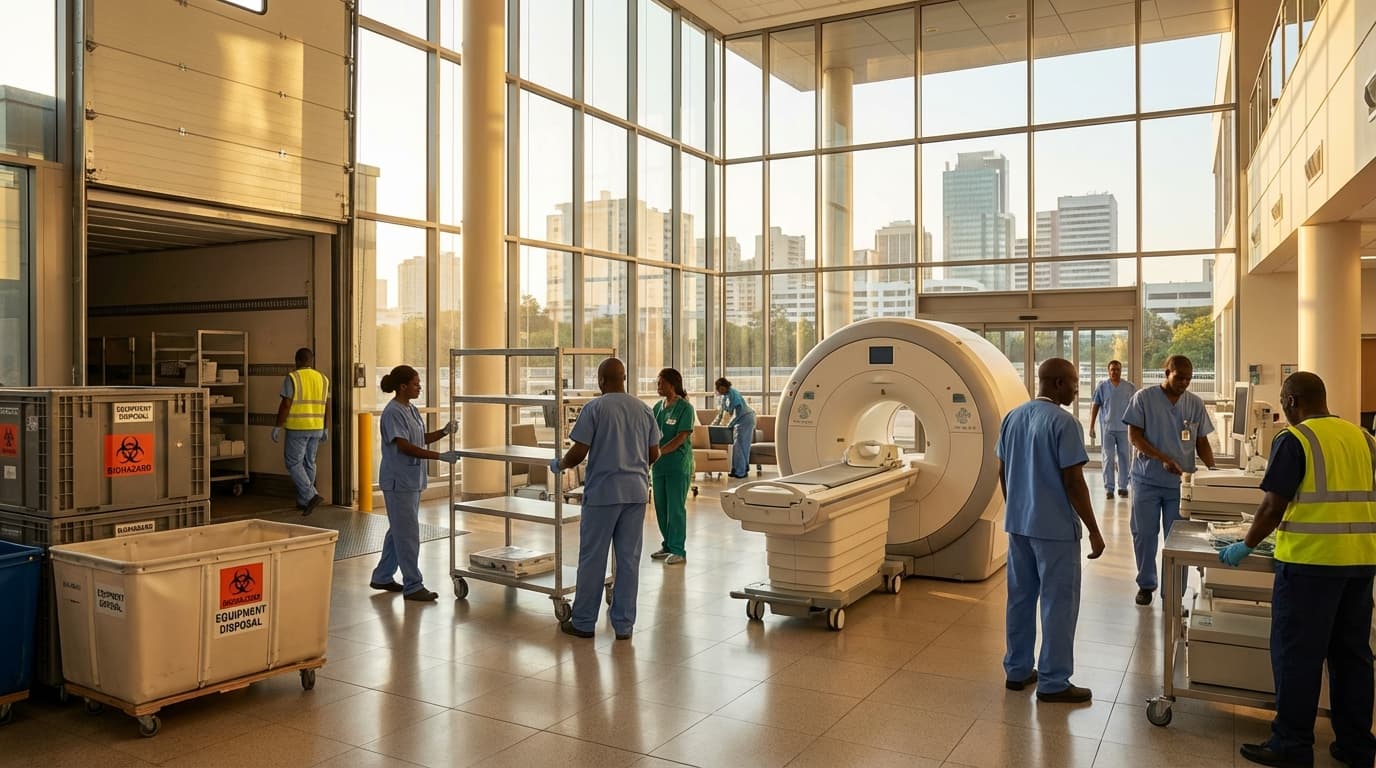
Decommissioning Service for Medical Devices in Benin
Engineering Excellence & Technical Support
Decommissioning Service for Medical Devices High-standard technical execution following OEM protocols and local regulatory frameworks.
Enhanced Patient Safety & Data Integrity
Our specialized decommissioning ensures secure data sanitization of medical devices, preventing breaches of sensitive patient information and maintaining regulatory compliance, while also mitigating risks associated with outdated or malfunctioning equipment in Benin's healthcare facilities.
Optimized Resource Allocation & Cost Savings
We provide cost-effective and efficient decommissioning solutions, enabling healthcare providers in Benin to free up valuable space, reinvest in modern equipment, and adhere to environmentally responsible disposal practices, thereby optimizing their operational budgets.
Environmentally Responsible & Compliant Disposal
Leveraging best practices and adhering to international standards, our service guarantees the safe and environmentally sound disposal or recycling of decommissioned medical devices, minimizing hazardous waste and supporting Benin's sustainability goals.
What Is Decommissioning Service For Medical Devices In Benin?
Decommissioning services for medical devices in Benin refer to the formal process of safely and responsibly retiring a medical device from service. This involves a comprehensive set of procedures designed to ensure that the device is no longer operational, its data is securely managed or destroyed, and its disposal complies with national and international environmental and safety regulations. The objective is to prevent unauthorized use, mitigate potential hazards associated with obsolete equipment, and minimize environmental impact.
| Who Needs Decommissioning Services? | Typical Use Cases |
|---|---|
| Hospitals and Clinics (Public and Private) | End-of-life equipment retirement due to age or obsolescence. |
| Diagnostic Laboratories | Replacement of outdated or unserviceable analytical instruments. |
| Research Institutions | Decommissioning of specialized research equipment that is no longer in use or has reached its operational limit. |
| Medical Device Manufacturers (for their own facilities or end-of-life programs) | Disposal of demonstration units, prototypes, or returned devices no longer suitable for resale. |
| Government Health Agencies | Management of surplus or obsolete medical equipment from national stockpiles or public health programs. |
| Healthcare Facilities undergoing upgrades or renovations | Removal of old equipment to make space for new installations. |
Key Components of Medical Device Decommissioning in Benin
- Data Sanitization and Destruction: Securely erasing or physically destroying all patient-identifiable information (PHI) and other sensitive data stored on the device, adhering to data privacy regulations.
- Functional Disablement: Rendering the device permanently inoperable to prevent any potential future use, often involving the removal or disabling of critical components.
- Hazardous Material Management: Identifying and safely removing, containing, and disposing of any hazardous materials (e.g., mercury, radioactive isotopes, batteries) in accordance with environmental standards.
- Asset Tracking and Documentation: Maintaining detailed records of the decommissioning process, including device identification, reasons for decommissioning, methods used, and responsible parties, for auditable purposes.
- Environmental Disposal: Ensuring that the device and its components are disposed of through approved channels, prioritizing recycling or environmentally sound waste management practices.
- Regulatory Compliance: Adhering to all relevant national (e.g., Ministry of Health regulations, environmental protection agency guidelines) and international standards for medical device disposal.
Who Needs Decommissioning Service For Medical Devices In Benin?
Decommissioning services for medical devices in Benin are crucial for a variety of healthcare providers and institutions. These services ensure the safe, secure, and environmentally responsible disposal of obsolete, damaged, or end-of-life medical equipment. This process is essential for maintaining regulatory compliance, protecting patient data, and preventing the spread of hazardous materials.
| Customer Type | Key Departments Involved | Typical Devices Requiring Decommissioning |
|---|---|---|
| Hospitals (Public & Private) | Biomedical Engineering, IT/Information Security, Facilities Management, Procurement, Clinical Departments (e.g., Radiology, Surgery, ICU) | X-ray machines, CT scanners, MRI machines, ultrasound devices, anesthesia machines, ventilators, surgical robots, patient monitors, defibrillators, laboratory analyzers, sterilizers. |
| Clinics & Health Centers | Clinic Administrator, Lead Nurse, IT Support (if applicable) | EKG machines, basic diagnostic tools, patient chairs, small laboratory equipment, minor surgical instruments. |
| Diagnostic Laboratories | Laboratory Director, IT/Data Management, Safety Officer | Blood analyzers, microscopes, centrifuges, PCR machines, immunoassay analyzers, spectrophotometers. |
| Research Institutions/Universities | Research Leads, IT Security, Facilities Management, Procurement | Specialized imaging equipment, high-throughput screening systems, advanced analytical instruments, data servers associated with medical devices. |
| Government Health Ministries | Procurement Department, Health Infrastructure Division, Regulatory Compliance Unit | Varies widely depending on the ministry's asset portfolio and initiatives. |
| NGOs/International Aid Orgs | Logistics Manager, Program Coordinator, Asset Manager | Similar to hospitals and clinics, depending on the scope of their operations. |
| Medical Equipment Suppliers | Service Department, Sales Department, Trade-in/Asset Recovery | Older models of equipment they no longer sell or support, trade-in units. |
Target Customers and Departments for Medical Device Decommissioning in Benin
- {"title":"Hospitals (Public and Private)","description":"Large healthcare institutions with a significant inventory of medical equipment, including imaging machines, surgical instruments, laboratory equipment, and patient monitoring systems. They often have dedicated biomedical engineering departments responsible for equipment lifecycle management."}
- {"title":"Clinics and Health Centers","description":"Smaller healthcare facilities that still utilize a range of medical devices, from diagnostic tools to basic treatment equipment. These may have fewer resources and rely more on external decommissioning services."}
- {"title":"Diagnostic Laboratories","description":"Facilities specializing in medical testing, which use a variety of sophisticated laboratory equipment that requires specialized decommissioning due to potential biohazards and sensitive components."}
- {"title":"Research Institutions and Universities","description":"Organizations involved in medical research that use advanced equipment. Decommissioning is important for data security and responsible disposal of potentially complex machinery."}
- {"title":"Government Health Ministries and Agencies","description":"Entities responsible for overseeing healthcare infrastructure and regulations. They may require decommissioning services for publicly owned medical equipment or when managing national health initiatives."}
- {"title":"Non-Governmental Organizations (NGOs) and International Aid Organizations","description":"Organizations operating healthcare programs in Benin that acquire and manage medical equipment. They need to ensure compliance with international standards for disposal."}
- {"title":"Private Medical Equipment Suppliers and Distributors","description":"Companies that sell, install, and service medical devices. They may offer decommissioning as part of their service package or require it for old equipment taken as trade-ins."}
Decommissioning Service For Medical Devices Process In Benin
This document outlines the standard workflow for decommissioning medical devices in Benin, from the initial inquiry to the successful execution of the service. The process is designed to ensure compliance with local regulations, environmental safety, and responsible disposal of medical equipment.
| Phase | Step | Description | Key Stakeholders | Documentation |
|---|---|---|---|---|
| Inquiry & Planning |
| Initial contact from client requesting decommissioning services. | Client, Service Provider | Inquiry Form/Email |
| Inquiry & Planning |
| Service provider assesses inquiry and provides a formal quotation. Client accepts the offer. | Service Provider, Client | Quotation, Service Agreement |
| Inquiry & Planning |
| On-site inspection to inventory devices, identify hazardous materials, and assess risks. | Service Provider, Client Representative | Site Visit Report, Inventory List |
| Inquiry & Planning |
| Creation of a detailed plan for the safe and compliant decommissioning and disposal. | Service Provider | Decommissioning Plan |
| Inquiry & Planning |
| Submission and approval of the decommissioning plan by relevant authorities and the client. | Service Provider, Regulatory Authorities, Client | Approved Decommissioning Plan |
| Execution |
| Deployment of skilled personnel and necessary equipment to the client's site. | Service Provider | Mobilization Schedule |
| Execution |
| Precise identification and logging of each device to be decommissioned. | Service Provider Team | Device Log |
| Execution |
| Implementing safety protocols, isolating power, and removing/decontaminating hazardous materials. | Service Provider Team | Safety Checklist, Decontamination Records |
| Execution |
| Careful dismantling of the medical devices according to the approved plan. | Service Provider Team | Disassembly Notes (if required) |
| Execution |
| Separating hazardous and non-hazardous waste for proper handling. | Service Provider Team | Waste Segregation Report |
| Execution |
| Secure transport of waste to an authorized treatment or disposal facility. | Service Provider, Authorized Waste Facility | Waste Manifests, Disposal Certificates |
| Closure |
| Providing the client with official documentation confirming the decommissioning and disposal. | Service Provider | Certificate of Decommissioning and Waste Disposal |
| Closure |
| Submitting a comprehensive report detailing all aspects of the decommissioning process. | Service Provider | Final Decommissioning Report |
Decommissioning Service for Medical Devices Process in Benin
- The process begins with an inquiry from a healthcare facility or organization requiring the decommissioning of one or more medical devices.
- The decommissioning service provider assesses the inquiry and provides a preliminary quotation.
- Upon acceptance of the quotation, a site visit is scheduled to conduct a detailed inventory and risk assessment.
- A formal decommissioning plan is developed, outlining the scope, methodology, safety protocols, and disposal methods.
- The plan is submitted for approval to the relevant authorities and the client.
- Once approved, the decommissioning team mobilizes to the site.
- The medical devices are identified, cataloged, and assessed for hazardous materials.
- Safety procedures are implemented, including isolation of power, removal of consumables, and decontamination where necessary.
- Disassembly of the device is performed according to the plan.
- Hazardous components are segregated and managed according to environmental regulations.
- Non-hazardous components are collected for recycling or disposal.
- All waste is transported to an authorized facility for final treatment or disposal.
- A certificate of decommissioning and waste disposal is issued to the client.
- The process is concluded with a final report detailing all activities and outcomes.
Decommissioning Service For Medical Devices Cost In Benin
Decommissioning medical devices in Benin involves a range of costs influenced by several key factors. These services are crucial for ensuring safe and environmentally responsible disposal of equipment that is no longer in use, outdated, or non-functional. The pricing structure generally reflects the complexity of the device, the materials involved, and the disposal methods employed. It's important to note that specific prices can vary significantly between service providers and are subject to negotiation.
| Device Category | Estimated Cost Range (XOF) | Notes |
|---|---|---|
| Small Laboratory Equipment (e.g., centrifuges, microscopes) | 20,000 - 75,000 | Generally straightforward disassembly and disposal if non-hazardous. Costs increase if specialized components or hazardous reagents are present. |
| Medium Diagnostic Devices (e.g., basic ultrasound machines, ECG machines) | 50,000 - 200,000 | May involve some electronic components. Consideration for potential mercury content in older models. |
| Large Imaging Equipment (e.g., older X-ray machines, CT scanners without full decommissioning of radioactive sources) | 150,000 - 750,000+ | Significant costs due to size, complexity, and potential for hazardous materials (e.g., lead shielding, older radioactive components). Full radiation safety protocols are essential. |
| Specialized Surgical or Anesthesia Equipment | 75,000 - 300,000 | Depends on the intricacy of the machinery and any associated gas cylinders or chemical components. |
| General Hospital Furniture/Non-electronic Equipment (e.g., beds, trolleys - if part of a decommissioning project) | 5,000 - 25,000 per item | Primarily labor and transport costs, potential for material recycling. |
| Data Wiping/Destruction Services (as an add-on) | 10,000 - 50,000 per device | This cost is often per device and depends on the level of security required for data erasure. |
Key Pricing Factors for Medical Device Decommissioning in Benin:
- Device Type and Complexity: Larger, more complex, or specialized medical equipment (e.g., MRI machines, X-ray units, laboratory analyzers) will naturally incur higher decommissioning costs due to the specialized knowledge, tools, and potentially hazardous components involved.
- Size and Weight of the Device: The physical dimensions and weight directly impact transportation and handling costs. Heavier or bulkier items require more labor and specialized equipment for removal.
- Hazardous Materials Content: Devices containing hazardous materials like mercury, radioactive isotopes (in older imaging equipment), or certain chemicals require specialized handling, containment, and disposal protocols, significantly increasing costs.
- Disassembly Requirements: Some devices may require extensive disassembly to safely remove components or prepare them for recycling or disposal. This adds labor time and complexity.
- Environmental Disposal Methods: The chosen disposal method plays a crucial role. Options range from basic landfilling (least expensive but often not compliant for medical waste) to more environmentally sound practices like secure hazardous waste incineration, material recycling, or specialized treatment. The latter are more costly but essential for regulatory compliance.
- Data Destruction: For devices storing patient data (e.g., imaging systems, electronic health records), secure data destruction services are often required to comply with privacy regulations. This adds an additional layer of cost.
- Transportation and Logistics: The distance from the healthcare facility to the decommissioning site or disposal facility, as well as the accessibility of the location, will influence transportation costs.
- Regulatory Compliance and Certification: Ensuring all decommissioning activities adhere to Benin's environmental and health regulations is paramount. This may involve fees for permits, certifications, or audits, which are factored into the overall service cost.
- Service Provider Reputation and Expertise: Established service providers with a proven track record and specialized expertise may command higher prices, reflecting their reliability and commitment to best practices.
- Volume of Devices: For large-scale decommissioning projects involving multiple devices, providers might offer volume discounts.
Affordable Decommissioning Service For Medical Devices Options
Decommissioning medical devices is a crucial step to ensure data security, regulatory compliance, and environmental responsibility. Finding affordable services requires understanding various options, value bundles, and implementing cost-saving strategies. This document outlines how to approach medical device decommissioning with an emphasis on affordability.
| Cost-Saving Strategy | Description | Impact on Affordability |
|---|---|---|
| Negotiate Bundled Services | Instead of piecemeal services, inquire about comprehensive decommissioning packages. Providers often offer discounts for larger, integrated service agreements. | Significant reduction through volume discounts and streamlined operations. |
| Early Planning & Scheduling | Avoid rush fees by scheduling decommissioning well in advance. This allows providers to optimize their logistics and resource allocation. | Minimizes emergency surcharges and allows for better negotiation on standard rates. |
| Prioritize Data Sanitization Level | Understand the required level of data sanitization (e.g., wiping vs. physical destruction) based on the device and its data. Over-sanitizing can be an unnecessary expense. | Tailors services to actual needs, preventing overspending on redundant security measures. |
| Leverage Provider's Network & Scale | Larger decommissioning companies have established logistics networks and economies of scale, which can translate to lower per-unit costs. | Benefits from efficient processes and established supply chains. |
| Inquire About Recycling Rebates or Credits | Some decommissioning services include recycling. Ask if valuable components can be recovered, leading to potential rebates or credits that offset service costs. | Reduces net expenditure through asset recovery. |
| Consider Pooled Services for Multiple Facilities | If your organization has multiple locations, consolidating decommissioning services can lead to better pricing due to increased volume. | Achieves economies of scale for larger projects. |
| Review Device Lifecycles & Replacement Schedules | Proactive management of medical device lifecycles can lead to planned decommissioning, avoiding unexpected expenses and allowing for more cost-effective disposal. | Enables strategic planning and negotiation, rather than reactive spending. |
| Seek Multiple Quotes & Compare Offerings | Always obtain quotes from several reputable decommissioning service providers. Compare not only price but also the scope of services included in their value bundles. | Ensures competitive pricing and the best value for money. |
| Understand Certification Requirements | Clarify the exact documentation and certification needed for your compliance. Some providers may offer tiered documentation services. | Ensures you only pay for necessary compliance documentation. |
Understanding Value Bundles in Medical Device Decommissioning
- What are Value Bundles? Value bundles are comprehensive service packages designed to cover multiple aspects of medical device decommissioning. Instead of paying for individual services, you opt for a pre-defined set that offers convenience and often a reduced overall cost.
- Common Components of Decommissioning Value Bundles:
- Data Sanitization/Destruction: Secure erasure or physical destruction of protected health information (PHI) to meet HIPAA and other privacy regulations.
- Asset Tracking & Inventory: Cataloging devices, recording their status, and managing their lifecycle.
- Logistics & Transportation: Safe and secure removal and transport of devices from your facility.
- Environmental Disposal/Recycling: Proper handling of e-waste, including precious metal recovery where applicable.
- Documentation & Certification: Providing auditable records of all decommissioning activities, including certificates of data destruction.
- Regulatory Compliance Support: Ensuring all processes adhere to relevant healthcare regulations (e.g., FDA, HIPAA, EPA).
- Repair & Refurbishment (Optional): For devices with remaining value, some bundles may include assessment for potential resale or donation.
- Disassembly & Parts Reclamation (Optional): Breaking down devices for reusable components.
Verified Providers In Benin
Ensuring access to quality healthcare in Benin hinges on the reliability and integrity of healthcare providers. Franance Health distinguishes itself by rigorously vetting and credentialing medical professionals and facilities. This commitment to verification offers patients unparalleled assurance of safety, competence, and ethical practice. By choosing Franance Health-verified providers, individuals are investing in their well-being with the confidence that they are receiving care from the most qualified and trustworthy sources available.
| Credential Aspect | Franance Health Verification | Patient Benefit |
|---|---|---|
| Educational Background | Verification of degrees, diplomas, and certifications from accredited institutions. | Ensures a strong foundation of medical knowledge. |
| Professional Licensing | Confirmation of valid and current medical licenses issued by relevant authorities. | Guarantees legal and ethical practice. |
| Clinical Experience | Assessment of years of practice, areas of focus, and performance history. | Indicates practical skill and familiarity with diverse cases. |
| Specialty Certifications | Validation of specialized training and board certifications in specific medical fields. | Provides access to expert care for complex conditions. |
| Professional References | Collection and review of feedback from peers and former supervisors. | Offers insights into a provider's professional conduct and capabilities. |
| Background Checks | Screening for any disciplinary actions or legal issues related to medical practice. | Protects patients from unqualified or unethical practitioners. |
Why Franance Health Credentials Matter
- Uncompromising Quality Assurance: Franance Health's credentialing process is thorough, examining educational backgrounds, professional licenses, clinical experience, and adherence to ethical standards. This rigorous vetting ensures that only the most qualified professionals are recognized.
- Enhanced Patient Safety: Verified providers have demonstrated a commitment to patient safety protocols, best practices, and continuous professional development, minimizing risks and ensuring optimal care outcomes.
- Access to Specialized Expertise: Franance Health identifies and highlights providers with specific specializations and advanced skills, making it easier for patients to find the exact expertise they need for complex or specific health concerns.
- Trust and Transparency: The credentialing process brings transparency to the healthcare landscape in Benin. Patients can trust that a Franance Health-verified provider has met stringent criteria, fostering confidence and reducing uncertainty.
- Commitment to Continuous Improvement: Franance Health often incorporates ongoing monitoring and re-credentialing, ensuring that providers maintain their high standards and stay abreast of the latest medical advancements.
Scope Of Work For Decommissioning Service For Medical Devices
This Scope of Work (SOW) outlines the requirements for the decommissioning of medical devices. It details the technical deliverables and standard specifications necessary to ensure a safe, compliant, and environmentally responsible decommissioning process. The aim is to provide a comprehensive framework for service providers undertaking this critical task.
| Deliverable | Description | Standard Specification/Reference | Acceptance Criteria |
|---|---|---|---|
| Decommissioning Plan | A detailed plan outlining procedures, timelines, safety protocols, risk mitigation strategies, and resource allocation for the decommissioning project. | ISO 14971 (Risk Management), applicable regulatory guidelines (e.g., FDA, CE), site-specific procedures. | Plan approved by client, covers all specified devices and site conditions, demonstrates adherence to safety and regulatory standards. |
| Asset Inventory Report | A comprehensive list of all devices to be decommissioned, including manufacturer, model, serial number, location, and current status. | Client-provided asset list, verified by service provider on-site. | Accurate and complete inventory matching on-site verification, with any discrepancies clearly documented. |
| Data Sanitization/Destruction Report | Confirmation of data erasure or physical destruction of storage media within devices, adhering to data privacy regulations. | NIST SP 800-88 Rev. 1 (Guidelines for Media Sanitization), HIPAA, GDPR, client-specific data policies. | Certificate of data destruction for each device, detailing method used and verification process. |
| Decommissioned Device Certificates | Individual certificates for each decommissioned device, confirming completion of the process. | Client-defined format, may include device details, date of decommissioning, and service provider signature. | Certificate issued for every device listed in the final inventory. |
| Recycling/Disposal Certificates | Documentation from certified recyclers/disposal facilities confirming proper handling of hazardous and non-hazardous components. | EPA regulations, WEEE Directive (for EU), local environmental regulations, certified vendor documentation (e.g., R2, e-Stewards). | Certificates of recycling and/or disposal from licensed and reputable third-party vendors. |
| Final Project Report | A comprehensive summary of the entire decommissioning process, including challenges encountered, lessons learned, and confirmation of all deliverables. | Client-defined format, may include executive summary, detailed findings, financial reconciliation, and environmental impact assessment. | Report submitted within agreed timeframe, addresses all SOW requirements, and is accepted by the client. |
| Waste Manifests | Documentation tracking the movement and disposal of all waste materials generated during decommissioning. | Local, state, and federal hazardous waste regulations (e.g., RCRA in the US). | Legible and complete waste manifests for all hazardous and non-hazardous waste streams. |
| Safety Incident Report (if applicable) | Detailed report of any safety incidents, near misses, or accidents that occurred during the decommissioning process. | OSHA standards, client's safety policy, relevant incident reporting procedures. | Timely reporting of any incidents with full investigation and proposed corrective actions. |
Key Stages of Medical Device Decommissioning
- Planning and Risk Assessment
- Asset Identification and Verification
- Data Sanitization and Destruction
- Physical Decommissioning and Disassembly
- Component Segregation and Recycling/Disposal
- Documentation and Reporting
- Site Restoration (if applicable)
Service Level Agreement For Decommissioning Service For Medical Devices
This Service Level Agreement (SLA) outlines the response times and uptime guarantees for the Decommissioning Service for Medical Devices provided by [Your Company Name] (hereinafter referred to as 'Provider') to [Client Company Name] (hereinafter referred to as 'Client'). This SLA is an integral part of the Master Service Agreement (MSA) between the parties.
| Incident Severity | Response Time (Business Hours) | Target Resolution Time (Business Hours) | Uptime Guarantee |
|---|---|---|---|
| Critical Incident | 1 Hour | 4 Business Hours | 99.9% (Monthly) |
| Major Incident | 2 Business Hours | 8 Business Hours | 99.9% (Monthly) |
| Minor Incident | 4 Business Hours | 2 Business Days | 99.9% (Monthly) |
Definitions
- Decommissioning Service: The process of safely and securely removing medical devices from service, including data sanitization, physical disposal, and compliance with relevant regulations.
- Business Hours: Monday to Friday, 9:00 AM to 5:00 PM [Client's Time Zone], excluding public holidays.
- Response Time: The maximum time allowed for the Provider to acknowledge a reported Incident and begin investigation.
- Resolution Time: The maximum time allowed for the Provider to resolve an Incident and restore the service to a functional state.
- Incident: Any event that causes or may cause an interruption to or a reduction in the quality of the Decommissioning Service.
- Critical Incident: An Incident that renders the Decommissioning Service completely unavailable or severely degrades its functionality, impacting the Client's ability to proceed with essential decommissioning activities.
- Major Incident: An Incident that significantly impacts the Decommissioning Service, causing partial unavailability or substantial degradation of functionality, but where some limited functionality may still be available.
- Minor Incident: An Incident that has a minimal impact on the Decommissioning Service, causing minor degradation of functionality or affecting a limited number of devices/processes.
- Uptime Guarantee: The percentage of time the Decommissioning Service is available and operational during the agreed-upon service period.
- Downtime: The period during which the Decommissioning Service is unavailable or not functioning as intended.
Frequently Asked Questions

Ready when you are
Let's scope your Decommissioning Service for Medical Devices in Benin project in Benin.

Scaling healthcare logistics and technical systems across the entire continent.