
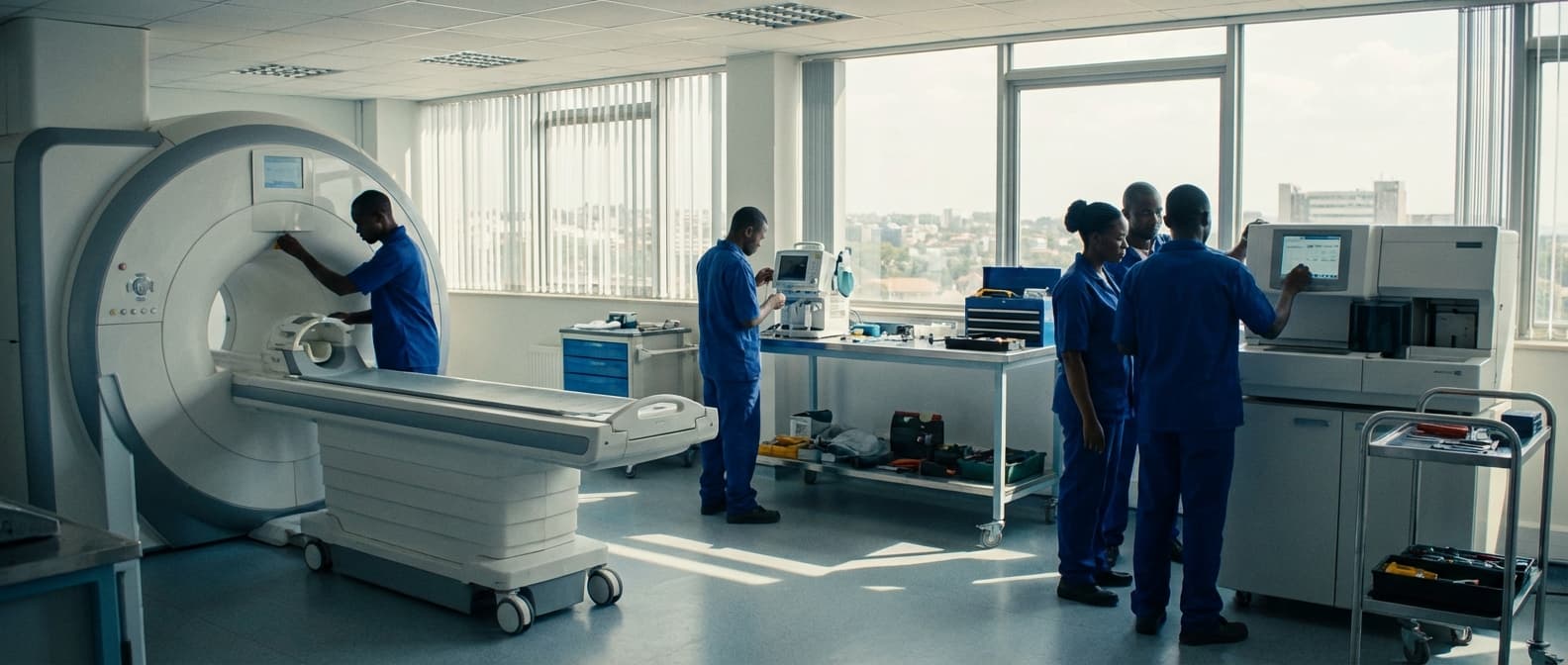
Uptime, Downtime & Root-Cause Analysis Reporting Service in Benin
Engineering Excellence & Technical Support
Uptime, Downtime & Root-Cause Analysis Reporting Service High-standard technical execution following OEM protocols and local regulatory frameworks.
Real-Time Uptime Monitoring & SLA Compliance
Leverage our advanced Uptime monitoring service in Benin to gain immediate visibility into your service availability. We provide real-time dashboards and proactive alerts to ensure you meet your Service Level Agreements (SLAs), minimizing revenue loss and customer dissatisfaction.
Automated Downtime Detection & Incident Response
Our service automatically detects and flags service disruptions across your infrastructure in Benin. Receive instant notifications and access comprehensive incident logs to expedite your response, reduce Mean Time To Detect (MTTD), and minimize the impact of downtime on your operations.
In-Depth Root-Cause Analysis (RCA) & Preventative Action
Go beyond just knowing there was an issue. Our Root-Cause Analysis reporting service in Benin provides detailed, data-driven insights into the underlying causes of downtime. We help you identify recurring problems and implement preventative measures to enhance system resilience and stability.
What Is Uptime, Downtime & Root-cause Analysis Reporting Service In Benin?
In Benin, Uptime, Downtime, and Root-Cause Analysis (RCA) Reporting Services are critical for ensuring the operational integrity and reliability of IT infrastructure and business-critical systems. These services provide detailed insights into system availability, periods of unavailability, and the underlying reasons for failures, enabling proactive mitigation and continuous improvement.
| Target Audience | Typical Use Cases |
|---|---|
| Businesses reliant on IT infrastructure (e.g., telecommunications, banking, e-commerce, government agencies). | Ensuring continuous service delivery for customers and internal operations. Identifying and resolving recurring system failures to minimize revenue loss and reputational damage. Validating Service Level Agreements (SLAs) with vendors and internal teams. Optimizing IT resource allocation and performance tuning. Facilitating compliance with industry regulations and audit requirements. |
| IT Operations Teams and System Administrators. | Proactive identification of performance degradations before they lead to full downtime. Streamlining incident response and resolution processes. Generating data-driven insights for capacity planning and infrastructure upgrades. Demonstrating the effectiveness of IT support and maintenance efforts. |
| Risk Management and Compliance Officers. | Assessing and mitigating operational risks associated with system availability. Providing auditable records of system performance and incident management. Ensuring adherence to business continuity and disaster recovery plans. |
Key Components of Uptime, Downtime & RCA Reporting Services:
- {"title":"Uptime Monitoring","description":"Continuous observation and measurement of system availability, typically expressed as a percentage (e.g., 99.99% uptime). This involves real-time tracking of network devices, servers, applications, and services to ensure they are functioning as expected and accessible to users."}
- {"title":"Downtime Tracking","description":"The systematic recording of all periods when a system or service is unavailable or not functioning correctly. This includes the duration, start time, end time, and the specific systems affected. Granular data on downtime is essential for calculating availability metrics and identifying performance bottlenecks."}
- {"title":"Root-Cause Analysis (RCA)","description":"A structured methodology used to identify the fundamental reasons for an incident or failure, rather than just addressing its symptoms. This process involves data collection, event correlation, hypothesis testing, and documentation to pinpoint the originating cause(s) of downtime."}
- {"title":"Reporting and Dashboards","description":"The presentation of collected uptime and downtime data, along with RCA findings, in accessible formats. This typically includes executive summaries, detailed incident reports, trend analysis, and interactive dashboards that provide real-time visibility into system performance and availability."}
Who Needs Uptime, Downtime & Root-cause Analysis Reporting Service In Benin?
In today's digital-first business landscape, reliable IT infrastructure is paramount. Businesses in Benin are increasingly recognizing the critical need for robust Uptime, Downtime, and Root-Cause Analysis (RCA) reporting services. These services are not just about fixing problems; they are about proactively preventing them, optimizing performance, and ensuring business continuity. Organizations that rely heavily on their IT systems for operations, customer service, revenue generation, and data management are the prime beneficiaries. Ignoring IT performance can lead to significant financial losses, reputational damage, and a loss of competitive edge. Therefore, understanding who needs these services and which departments are most impacted is crucial for service providers and businesses alike.
| Department | Key Responsibilities & Needs | Impact of Uptime/Downtime & RCA |
|---|---|---|
| IT Operations/Infrastructure Management | Maintaining server health, network stability, application performance, system backups, and disaster recovery planning. | Directly responsible for system availability. Downtime leads to operational paralysis, extended outages, and customer dissatisfaction. RCA is vital for identifying systemic issues and preventing recurrence. |
| Customer Service/Support | Handling customer inquiries, resolving issues, and ensuring a seamless customer experience across all touchpoints. | Downtime directly impacts customer satisfaction, leading to frustration, loss of trust, and potential churn. RCA helps understand why service disruptions occurred, enabling improvements. |
| Sales & Marketing | Managing CRM systems, online sales platforms, lead generation, and marketing campaign execution. | Website or platform downtime can result in lost sales opportunities and damaged brand reputation. RCA helps pinpoint the cause of these disruptions to ensure future campaign success. |
| Finance & Accounting | Managing financial transactions, payroll, billing, and reporting; ensuring data integrity and compliance. | Downtime in financial systems can lead to payment processing failures, delayed reporting, and compliance breaches. RCA is crucial for preventing financial errors and ensuring data security. |
| Business Development/Strategy | Identifying growth opportunities, planning future initiatives, and analyzing market trends. | Reliable IT infrastructure is foundational for strategic planning and execution. Persistent downtime hinders innovation and the ability to capitalize on new opportunities. |
| Compliance & Risk Management | Ensuring adherence to regulatory requirements, data privacy, and security standards. | Downtime can lead to security vulnerabilities and data breaches, resulting in regulatory fines and reputational damage. RCA helps identify and mitigate risks proactively. |
| Human Resources | Managing employee data, payroll, internal communication platforms, and HR systems. | Downtime in HR systems can disrupt employee access to critical information, payroll processing, and internal communication, impacting morale and productivity. |
Target Customers & Departments for Uptime, Downtime & Root-Cause Analysis Reporting Services in Benin
- Large Enterprises with complex IT infrastructures
- Small and Medium-sized Businesses (SMBs) reliant on digital operations
- Government Agencies and Public Sector organizations
- Financial Institutions (Banks, Insurance Companies)
- Telecommunications Providers
- E-commerce and Online Retailers
- Healthcare Providers
- Educational Institutions
- Technology Startups and IT Service Providers
- Companies with remote or distributed workforces
Uptime, Downtime & Root-cause Analysis Reporting Service Process In Benin
This document outlines the standard workflow for the Uptime, Downtime & Root-Cause Analysis (RCA) Reporting Service Process in Benin. This service aims to provide clients with comprehensive reports on system availability, including detailed analysis of any downtime incidents and their underlying causes. The process begins with an initial inquiry from a client and concludes with the delivery of a final RCA report.
| Stage | Description | Key Activities | Responsible Party | Deliverables/Outcomes | |
|---|---|---|---|---|---|
| The process begins when a potential client expresses interest in the Uptime, Downtime & RCA Reporting Service. | Client contacts service provider (email, phone, website). | Client, Service Provider Sales/Account Management | Initial interest, potential leads generated. | |
| Understanding the client's specific needs, systems to be monitored, reporting frequency, and service level agreements (SLAs). | Needs assessment meeting, system inventory, service proposal creation, contract negotiation, agreement signing. | Service Provider Technical Team, Service Provider Sales/Account Management, Client | Defined scope of services, agreed-upon SLAs, signed contract. | |
| Establishing the necessary infrastructure and tools to collect uptime and downtime data for the client's systems. | Deploying monitoring agents/tools, configuring monitoring parameters, establishing secure data access, network connectivity checks. | Service Provider Technical Team | Functional monitoring system, baseline performance data. | |
| Continuous and automated monitoring of the client's systems to record periods of operation (uptime) and service unavailability (downtime). | Automated health checks, performance metric collection, logging of system status changes. | Service Provider Monitoring System | Real-time uptime/downtime status, historical performance logs. | |
| Proactively identifying deviations from normal operation that constitute downtime and alerting relevant parties. | Automated alert generation based on predefined thresholds, immediate notification to client and internal teams via email/SMS/dashboard. | Service Provider Monitoring System, Service Provider Operations Team | Timely incident alerts, initial incident documentation. | |
| Investigating the underlying reasons for downtime incidents to identify the root cause and prevent recurrence. | Log analysis, system diagnostics, interview with client personnel, review of recent changes, identification of contributing factors. | Service Provider Technical Team, Client Technical Team (collaborative) | Identified root cause(s) of downtime. | Service Provider Technical Team |
| Compiling collected data and RCA findings into a structured and comprehensive report. | Data aggregation from monitoring tools, synthesis of RCA findings, inclusion of uptime/downtime statistics, graphical representations, executive summary. | Service Provider Reporting Team | Draft RCA report. | |
| Presenting the generated report to the client for review and acceptance. | Internal report quality check, scheduled report review meeting with client, addressing client queries, final report submission. | Service Provider Reporting Team, Service Provider Account Management, Client | Approved and delivered RCA report. | |
| Providing ongoing support and suggesting actionable recommendations based on RCA findings to enhance system reliability. | Facilitating implementation of corrective actions, recommending proactive maintenance, sharing best practices, periodic service review. | Service Provider Technical Team, Service Provider Account Management, Client | Improved system reliability, reduced future downtime, client satisfaction. |
Uptime, Downtime & Root-Cause Analysis Reporting Service Process in Benin: Workflow Stages
- Inquiry & Service Request
- Scope Definition & Agreement
- Data Collection & Monitoring Setup
- Uptime & Downtime Tracking
- Incident Detection & Notification
- Root-Cause Analysis (RCA)
- Report Generation
- Report Review & Delivery
- Follow-up & Improvement Recommendations
Uptime, Downtime & Root-cause Analysis Reporting Service Cost In Benin
Organizations in Benin requiring Uptime, Downtime, and Root-Cause Analysis (RCA) reporting services can expect a range of costs influenced by several key factors. These services are crucial for ensuring system reliability, identifying performance bottlenecks, and preventing future outages. The pricing is generally structured to reflect the complexity of the systems being monitored, the level of detail required in the analysis, and the frequency of reporting. Understanding these pricing drivers is essential for budgeting and selecting the most appropriate service provider.
| Service Level | Typical Description | Estimated Price Range (CFA Francs - XOF) | Notes |
|---|---|---|---|
| Basic Monitoring & Reporting | Routine uptime/downtime reporting, basic alerts, simple incident summaries. | 50,000 - 150,000 per month | Suitable for small businesses with less critical infrastructure. |
| Standard Uptime & Downtime Analysis | More detailed downtime reporting, initial investigation into causes, weekly summary reports. | 150,000 - 400,000 per month | Appropriate for mid-sized businesses with standard IT operations. |
| Comprehensive RCA & Performance Reporting | In-depth root cause analysis for significant incidents, proactive performance monitoring, detailed monthly reports with recommendations, historical trend analysis. | 400,000 - 1,000,000+ per month | Ideal for larger enterprises, mission-critical systems, and organizations prioritizing in-depth reliability. |
| Ad-hoc RCA Engagement | Per-incident root cause analysis, typically billed hourly or per engagement. | 50,000 - 200,000 per incident | Engaged when a specific, complex issue arises outside of a regular service contract. Hourly rates for IT consultants specializing in RCA can also apply. |
| Consulting & Implementation | Setting up and configuring monitoring systems, developing custom RCA frameworks, strategic advice on reliability. | On Quote Basis (can range from 500,000 to several million CFA Francs for large projects) | One-time or project-based fees for establishing robust reporting and analysis capabilities. |
Key Factors Influencing Cost
- Scope of Monitoring: The number of systems, applications, and infrastructure components to be monitored directly impacts the cost. A broader scope requires more resources for data collection and analysis.
- Downtime Severity and Impact: The criticality of the systems being monitored. High-availability or mission-critical systems that cannot tolerate significant downtime will command higher reporting fees due to the urgency and expertise required for RCA.
- Data Volume and Retention: The amount of data generated by the monitoring systems and the duration for which this data needs to be stored and analyzed. Larger data volumes and longer retention periods increase storage and processing costs.
- Reporting Frequency and Detail: The frequency of reports (e.g., daily, weekly, monthly, ad-hoc) and the level of detail required in the RCA (e.g., executive summary vs. in-depth technical analysis) will affect pricing.
- Complexity of Root Cause Analysis: The difficulty in pinpointing the root cause of an issue. Simple, recurring issues may be cheaper to analyze than complex, intermittent problems requiring advanced diagnostic tools and expertise.
- Service Provider Expertise and Reputation: Established providers with proven track records and specialized expertise in RCA often charge a premium for their services.
- Automation and Tools Used: The extent to which the service provider relies on automated monitoring and RCA tools versus manual investigation. Advanced tooling can sometimes lead to more efficient, though potentially upfront more expensive, service delivery.
- Service Level Agreements (SLAs): The guaranteed response and resolution times for critical incidents, which are often tied to RCA reporting, will influence the cost.
- Customization Requirements: Any specific requirements for custom dashboards, alerts, or reporting formats will add to the overall cost.
Affordable Uptime, Downtime & Root-cause Analysis Reporting Service Options
This document outlines affordable options for Uptime, Downtime, and Root-Cause Analysis (RCA) reporting services. We'll explore value bundles designed for cost-effectiveness and discuss strategies to maximize savings while ensuring essential reporting needs are met. For businesses of all sizes, maintaining high availability and understanding the reasons behind any disruptions is crucial. Reliable reporting helps in proactive problem-solving, continuous improvement, and demonstrating service level agreement (SLA) compliance. We aim to provide clarity on how to achieve these critical reporting functions without a prohibitive budget.
| Service Component | Description | Typical Value Proposition | Cost-Saving Approach |
|---|---|---|---|
| Basic Uptime & Downtime Monitoring | Automated tracking of system availability with simple alerts. | Essential for basic SLA adherence and initial awareness of issues. | Leverage free or low-cost open-source monitoring tools; focus on critical systems only. |
| Standard Uptime & Downtime Reporting + Basic RCA | Detailed historical uptime/downtime reports with automated incident logging and basic root-cause identification (e.g., CPU spikes, memory leaks). | Provides actionable data for performance optimization and initial incident investigation. | Utilize SaaS reporting platforms with tiered pricing; opt for shared dashboards or reports for multiple services. |
| Comprehensive Uptime, Downtime & Advanced RCA Bundle | In-depth reporting including trend analysis, impact assessment, and automated generation of detailed RCA reports with expert review. May include proactive recommendations. | Enables proactive problem prevention, deep system understanding, and continuous service improvement. | Negotiate annual contracts for discounts; consider managed service providers offering bundled reporting as part of a larger package; self-service reporting tools with expert consultation add-ons. |
| Managed RCA Service | Dedicated team to conduct thorough RCA investigations and produce detailed reports, often involving complex incident analysis. | Ideal for critical or recurring complex issues where internal expertise is limited. | Subscription-based models with defined incident limits; compare per-incident costs versus a retainer. |
Key Reporting Service Components & Value Proposition
- Uptime Reporting: Tracks system availability, often presented as a percentage, crucial for SLAs and customer trust.
- Downtime Reporting: Details the duration, frequency, and impact of service interruptions, identifying trends.
- Root-Cause Analysis (RCA) Reporting: Investigates the underlying reasons for downtime, enabling permanent fixes and preventing recurrence.
- Value Bundles: Combinations of these services offered at a reduced price compared to purchasing individually, providing comprehensive insights.
- Cost-Saving Strategies: Techniques and approaches to minimize expenses without sacrificing essential reporting quality.
Verified Providers In Benin
Finding trusted healthcare providers is paramount for your well-being, especially when navigating a new or unfamiliar healthcare system. In Benin, discerning reliable and competent medical professionals can be a challenge. This is where the importance of verified providers and reputable credentialing bodies like Franance Health comes into play. Franance Health distinguishes itself by rigorously vetting healthcare professionals, ensuring they meet high standards of expertise, ethical practice, and patient care. Their credentialing process offers peace of mind to individuals seeking quality medical services, as it signifies a commitment to excellence and patient safety. Choosing a Franance Health credentialed provider in Benin means opting for a healthcare experience that is both reliable and of superior quality.
| Provider Type | Franance Health Verification Significance | Benefits for Patients in Benin |
|---|---|---|
| General Practitioners | Confirms up-to-date medical knowledge and adherence to best practices. | Reliable initial point of contact for health concerns, accurate diagnosis, and appropriate referrals. |
| Specialist Physicians (e.g., Cardiologists, Dermatologists) | Validates specialized training, extensive experience, and recognized expertise in their field. | Access to highly skilled specialists for complex medical conditions, leading to more effective treatment outcomes. |
| Surgeons | Verifies surgical proficiency, safety protocols, and a low complication rate. | Confidence in undergoing surgical procedures with skilled and experienced professionals. |
| Dentists | Confirms adherence to dental hygiene standards and advanced treatment techniques. | Quality oral care, from routine check-ups to complex dental procedures. |
| Pharmacies | Ensures the authenticity and quality of medications, and proper dispensing practices. | Safe and reliable access to prescribed and over-the-counter medications. |
Why Franance Health Credentials Matter in Benin:
- Ensures providers meet stringent quality and competency standards.
- Promotes ethical medical practices and patient-centered care.
- Provides a reliable benchmark for selecting trusted healthcare professionals.
- Enhances patient confidence and reduces the risk of subpar medical services.
- Facilitates access to healthcare professionals with proven track records.
Scope Of Work For Uptime, Downtime & Root-cause Analysis Reporting Service
This Scope of Work (SOW) outlines the requirements for a Uptime, Downtime & Root-Cause Analysis (RCA) Reporting Service. The service aims to provide comprehensive reporting and analysis to understand system availability, identify causes of disruption, and facilitate preventative measures. The technical deliverables will adhere to specified standards to ensure consistency, accuracy, and actionable insights.
| Deliverable | Description | Technical Specifications / Standards | Frequency / Trigger |
|---|---|---|---|
| Uptime Report | Provides a clear overview of system availability over a defined period. | Metrics: Percentage of uptime, Mean Time Between Failures (MTBF), Mean Time To Recovery (MTTR). Format: PDF, CSV. Data Source: Monitoring tools (e.g., Nagios, Zabbix, Datadog). Standards: ISO 27001 for data security. | Daily, Weekly, Monthly, Quarterly |
| Downtime Report | Details all unplanned service interruptions, including duration and impact. | Metrics: Total downtime duration, number of incidents, impact assessment (e.g., affected users, lost revenue). Format: PDF, CSV. Data Source: Monitoring tools, incident management system (e.g., Jira, ServiceNow). Standards: ITIL v4 Incident Management principles. | Daily (for critical incidents), Weekly, Monthly |
| Root-Cause Analysis (RCA) Report | Investigates the underlying causes of significant downtime events. | Methodology: 5 Whys, Fishbone Diagram (Ishikawa), Fault Tree Analysis. Content: Incident timeline, contributing factors, primary root cause, remediation steps, preventative measures. Format: PDF. Standards: Industry best practices for incident investigation. GDPR compliance for any personal data within incident descriptions. | Triggered by unplanned downtime exceeding a defined threshold (e.g., 30 minutes) or per client request. |
| Recommendation Report | Presents actionable steps to mitigate risks and improve system resilience based on RCA findings. | Format: PDF. Content: Specific, Measurable, Achievable, Relevant, Time-bound (SMART) recommendations. Ownership assignment for each recommendation. Standards: Alignment with system architecture and business objectives. | Generated as part of the RCA Report, or as a separate summary document. |
| Monitoring Data Audit Log | Provides a verifiable record of all data collected by the monitoring systems. | Format: CSV, JSON. Content: Timestamp, metric name, value, source system, data integrity checks. Standards: Audit trails compliant with SOX regulations where applicable. | Continuous logging, available upon request for auditing purposes. |
| Executive Summary Dashboard | A high-level visual representation of key uptime, downtime, and RCA trends. | Format: Interactive dashboard (e.g., Grafana, Power BI, Tableau). Metrics: Key Performance Indicators (KPIs) for availability and incident management. Standards: User experience (UX) best practices for data visualization. | Real-time and historical views, updated weekly. |
Key Service Components
- Real-time monitoring of critical system components.
- Automated generation of uptime and downtime reports.
- In-depth root-cause analysis for all unplanned downtime events.
- Development of actionable recommendations for preventing future incidents.
- Regular reporting cadence (daily, weekly, monthly, quarterly) as defined by the client.
- Ad-hoc reporting for critical incidents or specific requests.
- Secure data storage and access controls for all reports and raw data.
Service Level Agreement For Uptime, Downtime & Root-cause Analysis Reporting Service
This Service Level Agreement (SLA) outlines the performance commitments and reporting procedures for the Uptime, Downtime & Root-Cause Analysis Reporting Service provided by [Your Company Name] (hereinafter referred to as "Provider") to [Client Name] (hereinafter referred to as "Client"). This SLA is an integral part of the Master Service Agreement between the Provider and Client.
| Service Component | Uptime Guarantee | Downtime Allowance (Max per Month) | Response Time (for Critical Incidents) | Resolution Time (for Critical Incidents) | Root-Cause Analysis Report Delivery |
|---|---|---|---|---|---|
| Core Service Availability | 99.9% per Reporting Period | ~43.2 minutes | 15 minutes | 4 hours | Within 24 hours of incident resolution |
| Reporting Dashboard Access | 99.5% per Reporting Period | ~2.2 hours | 30 minutes | 8 hours | Within 48 hours of incident resolution |
Key Definitions
- Uptime: The total percentage of time the Service is operational and accessible to the Client during a given month.
- Downtime: The total percentage of time the Service is unavailable or inaccessible to the Client during a given month.
- Scheduled Maintenance: Pre-announced periods where the Service may be unavailable for necessary updates, upgrades, or repairs. Such maintenance will be communicated at least [Number] days in advance.
- Unscheduled Downtime: Any Downtime not categorized as Scheduled Maintenance.
- Root-Cause Analysis (RCA): A process to identify the fundamental cause(s) of a service disruption or incident, leading to corrective actions to prevent recurrence.
- Reporting Period: A calendar month for which Uptime and Downtime are calculated and reported.
- Incident: Any event that causes or may cause a disruption to the Service.
- Severity Levels: A classification system for Incidents based on their impact on the Service and the Client.
- Response Time: The time elapsed from when a critical incident is detected or reported by the Client to when the Provider's support team begins active investigation.
- Resolution Time: The time elapsed from when a critical incident is detected or reported by the Client to when the Service is restored to normal operation.
Frequently Asked Questions

Ready when you are
Let's scope your Uptime, Downtime & Root-Cause Analysis Reporting Service in Benin project in Benin.

Scaling healthcare logistics and technical systems across the entire continent.