
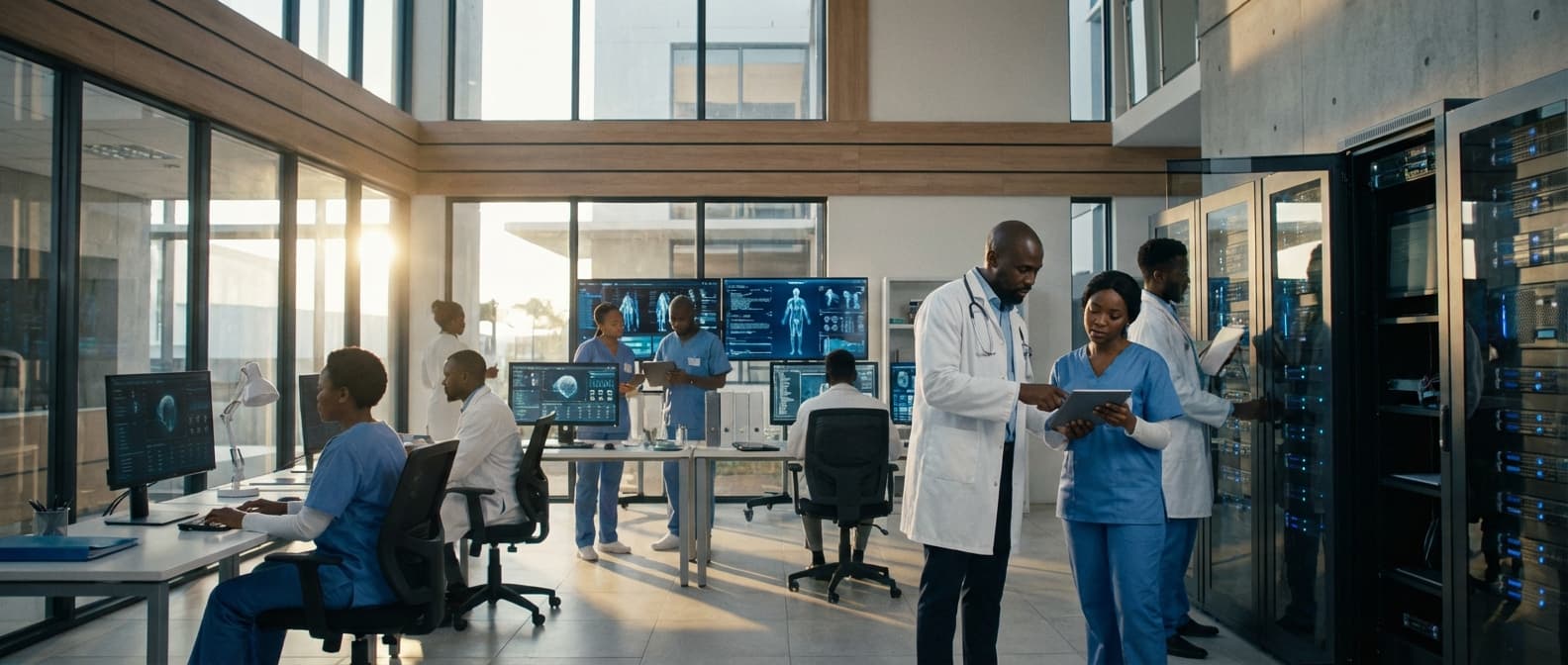
Tele-Radiology in Benin
Engineering Excellence & Technical Support
24/7 access to certified radiologists providing rapid, accurate remote interpretation of diagnostic imaging studies. High-standard technical execution following OEM protocols and local regulatory frameworks.
Rapid Diagnostic Turnaround
Leveraging tele-radiology platforms, Benin's healthcare facilities can now achieve significantly faster diagnostic turnaround times for imaging studies. Expert radiologists review scans remotely, expediting critical diagnoses and enabling timely treatment initiation, especially in remote or underserved areas with limited local radiologist availability.
Remote Expert Consultation & Subspecialty Access
Tele-radiology connects Beninese healthcare providers with a global network of subspecialist radiologists. This allows for remote interpretation of complex cases, access to specialized diagnostic insights (e.g., neuroimaging, pediatric radiology), and improved diagnostic accuracy, effectively bridging the gap in local expertise and enhancing the quality of patient care.
Enhanced Healthcare Accessibility & Network Expansion
By digitizing and transmitting medical images electronically, tele-radiology overcomes geographical barriers. This enables smaller clinics and hospitals across Benin to offer advanced radiology services, extending the reach of quality diagnostics to rural populations and strengthening the overall healthcare network by facilitating seamless collaboration between facilities.
What Is Tele-radiology In Benin?
Tele-radiology in Benin refers to the practice of transmitting radiological images (such as X-rays, CT scans, MRIs) from one location to another for the purpose of diagnostic interpretation by a radiologist. This service is crucial for extending access to expert radiological services to underserved areas and improving the efficiency of diagnostic workflows. It involves the utilization of secure digital communication networks and Picture Archiving and Communication Systems (PACS) to facilitate the remote reading of medical images.
| Typical Use Cases in Benin | Description | Impact |
|---|---|---|
| Remote Diagnostic Interpretation: | Healthcare centers in remote regions without on-site radiologists send acquired radiological images to a central hub or a network of radiologists for interpretation. This includes routine diagnostic imaging such as plain radiography (chest X-rays for tuberculosis screening, skeletal imaging) and ultrasound. | Enables timely diagnosis and treatment initiation for conditions that would otherwise require patients to travel long distances. |
| Specialized Imaging Interpretation: | When local facilities lack specialists for complex imaging modalities like CT or MRI, images are transmitted for interpretation by sub-specialty radiologists (e.g., neuroradiology, interventional radiology, pediatric radiology). | Provides access to high-level diagnostic expertise, improving the management of complex pathologies and reducing the need for international referrals for diagnostic purposes. |
| Emergency Radiology Support: | Facilitates rapid interpretation of urgent imaging studies in emergency situations, particularly in district hospitals or smaller clinics that may not have 24/7 radiologist coverage. This can include trauma imaging, stroke imaging, or acute abdominal pain evaluations. | Shortens turnaround times for critical diagnoses, leading to faster clinical decision-making and improved patient outcomes in time-sensitive scenarios. |
| Quality Assurance and Training: | Remote reading can be integrated into a system for quality control, where a senior radiologist reviews cases read by junior radiologists or trainees. It also supports continuing medical education and training of local radiology personnel. | Enhances the overall quality of radiological services and facilitates the development of local radiology expertise. |
| Public Health Screening Programs: | Supports large-scale public health initiatives, such as national tuberculosis control programs, by enabling mass screening of chest X-rays from various locations, with images being reviewed remotely. | Increases the reach and efficiency of public health interventions, allowing for broader screening and earlier detection of diseases within the population. |
Key Components and Beneficiaries of Tele-radiology in Benin
- Service Components: Digital image acquisition, secure data transmission (via internet or dedicated networks), image storage and retrieval (PACS), remote interpretation by qualified radiologists, and delivery of diagnostic reports.
- Beneficiaries: Patients in rural or remote areas with limited access to diagnostic imaging facilities and expert radiologists; healthcare facilities lacking on-site radiology departments or specialized radiologists; emergency departments requiring rapid interpretation of critical imaging studies; and public health initiatives requiring widespread diagnostic capabilities.
Who Needs Tele-radiology In Benin?
Tele-radiology, the practice of interpreting medical images remotely, presents a significant opportunity to enhance healthcare accessibility and quality in Benin. Given the country's existing challenges in medical imaging infrastructure and specialist availability, tele-radiology can bridge critical gaps and cater to a diverse range of needs across various healthcare settings and departments.
| Customer Segment | Primary Need Addressed | Key Departments Served | Potential Impact |
|---|---|---|---|
| Public Hospitals (District/Regional) | Radiologist shortage, limited equipment | Radiology, Emergency, Internal Medicine, Pediatrics, OB/GYN | Improved diagnostic speed, increased access to care, reduced referral delays |
| Private Clinics/Diagnostic Centers | Supplementing capacity, subspecialty access | Radiology, Surgery, Cardiology, Neurology | Enhanced service offerings, efficient workflow, expert consultations |
| Rural Health Centers | Limited imaging, remote access | General Practice, MCH Units | Decentralized diagnostics, reduced patient travel, early detection |
| Teaching Hospitals/Medical Schools | Education, case exposure, CPD | Radiology Training, all clinical departments | Enriched learning environment, improved radiologist training, skill enhancement |
| Specialized Medical Centers | Subspecialty expertise | Oncology, Cardiology, Neurosurgery | Access to global expertise, advanced diagnosis, optimized treatment plans |
Target Customers and Departments for Tele-Radiology in Benin:
- {"title":"Public Hospitals (District and Regional)","departments":["Radiology (for general X-rays, CT scans, ultrasounds)","Emergency Departments (for trauma, stroke, acute conditions)","Internal Medicine (for diagnosing complex pathologies)","Pediatrics (for child-specific imaging needs)","Obstetrics and Gynecology (for prenatal imaging and gynecological conditions)"],"description":"These facilities often face the most significant shortages of radiologists and advanced imaging equipment. Tele-radiology can provide immediate access to expert interpretations, improving diagnostic speed and accuracy for a wide range of conditions."}
- {"title":"Private Clinics and Diagnostic Centers","departments":["Radiology (for specialized imaging like MRI, mammography)","Surgical Departments (for pre- and post-operative imaging)","Cardiology (for cardiac imaging interpretations)","Neurology (for advanced neurological imaging)"],"description":"While better equipped than public facilities, private centers can still benefit from tele-radiology to supplement their in-house radiologist capacity, handle overflow, or access subspecialty interpretations for rare or complex cases."}
- {"title":"Rural Health Centers and Dispensaries","departments":["General Practice (for basic diagnostic imaging)","Maternal and Child Health Units (for essential screening)"],"description":"These facilities may have limited or no imaging capabilities. Tele-radiology, coupled with portable imaging devices, can enable basic screening and diagnosis in remote areas, reducing the need for patients to travel long distances."}
- {"title":"Teaching Hospitals and Medical Schools","departments":["Radiology Training Programs","All clinical departments for case review and learning"],"description":"Tele-radiology platforms can serve as invaluable educational tools, providing students and residents with exposure to a larger volume and variety of cases under the guidance of experienced remote radiologists. It also facilitates continuous professional development for existing staff."}
- {"title":"Specialized Medical Centers (e.g., Oncology, Cardiology Centers)","departments":["Oncology (for staging, treatment monitoring)","Cardiology (for advanced cardiac imaging)","Neurosurgery (for complex brain and spine imaging)"],"description":"These centers often require highly specialized radiological interpretations. Tele-radiology can connect them with subspecialists worldwide, ensuring the highest standard of care for complex conditions."}
Tele-radiology Process In Benin
Tele-radiology in Benin involves a structured workflow to facilitate remote interpretation of medical imaging. This process is crucial for expanding access to specialized radiological expertise in areas with limited on-site radiologists. The workflow typically begins with an inquiry from a healthcare facility, followed by image acquisition, secure transmission, expert interpretation, and finally, the delivery of the diagnostic report.
| Stage | Description | Key Participants | Technology/Tools Involved | Challenges & Considerations in Benin |
|---|---|---|---|---|
| Inquiry and Request Initiation | A referring physician or healthcare facility identifies the need for a radiological interpretation of an image. A formal request is made, often detailing patient history, clinical question, and urgency. | Referring Physician, Clinic/Hospital Staff | Phone, Email, Secure Messaging App, Hospital Information System (HIS) | Lack of standardized request forms, communication breakdowns due to language barriers or literacy levels. |
| Image Acquisition | Medical imaging (X-ray, CT, MRI, Ultrasound) is performed at the local healthcare facility by trained technicians. The images are then prepared for digital transmission. | Radiology Technologist/Technician | Medical Imaging Modalities (X-ray machine, CT scanner, MRI scanner, Ultrasound machine), Picture Archiving and Communication System (PACS) or local storage | Outdated equipment, inconsistent image quality, lack of trained technicians, power outages affecting imaging procedures. |
| Image Transmission | The acquired digital images are securely transmitted from the originating facility to a central teleradiology hub or directly to the interpreting radiologist's workstation. | IT Support Staff, Teleradiology Software | Secure Internet Connection (fiber optic, satellite, mobile data), Virtual Private Network (VPN), DICOM standards, encryption protocols, Teleradiology platform software | Limited and unreliable internet connectivity, high bandwidth requirements, cybersecurity risks, cost of data transmission. |
| Teleradiology Platform Access & Queuing | The transmitted images are received and logged into a teleradiology platform. They are then placed in a queue for interpretation, often prioritized based on urgency. | Teleradiology Platform Administrator, Teleradiology Software | Teleradiology Software, PACS, RIS (Radiology Information System) | Platform scalability, efficient queue management, integration with existing hospital systems. |
| Radiologist Assignment & Interpretation | A radiologist, based on their subspecialty and availability, is assigned to interpret the images. They access the images and patient information remotely and provide their expert opinion. | Remote Radiologist (Specialist) | Teleradiology Workstation, High-resolution Monitor, DICOM viewer software | Shortage of qualified radiologists in Benin, reliance on expatriate radiologists, communication challenges between local and remote teams, time zone differences. |
| Report Generation & Review | The interpreting radiologist generates a detailed diagnostic report, including findings, impressions, and recommendations. This report is often reviewed by a senior radiologist or a supervisor if required. | Remote Radiologist, Senior Radiologist (if applicable) | Teleradiology Software with reporting module, Speech Recognition software (optional) | Standardization of reporting templates, ensuring clarity and accuracy in reports. |
| Report Delivery & Communication | The final report is securely transmitted back to the originating healthcare facility. Communication channels are established for any necessary follow-up or clarification. | Teleradiology Platform, Referring Physician, Clinic/Hospital Staff | Teleradiology Platform, Secure Email, Fax, Phone, HIS/LIS integration | Ensuring timely delivery of reports, effective communication for urgent cases, feedback mechanisms for referring physicians. |
| Archiving & Follow-up | All images and reports are securely archived for future reference and legal purposes. Follow-up actions, such as repeat imaging or patient management, are initiated by the referring physician. | Teleradiology Platform Administrator, Referring Physician | PACS, Teleradiology Platform, HIS/LIS | Data privacy and security regulations, long-term storage solutions, ensuring smooth patient care pathways. |
Tele-Radiology Workflow Stages in Benin
- Inquiry and Request Initiation
- Image Acquisition
- Image Transmission
- Teleradiology Platform Access & Queuing
- Radiologist Assignment & Interpretation
- Report Generation & Review
- Report Delivery & Communication
- Archiving & Follow-up
Tele-radiology Cost In Benin
Tele-radiology services in Benin are an emerging and valuable healthcare solution, particularly for remote areas or facilities lacking specialized radiology expertise. The cost of these services can vary significantly based on several factors, making it challenging to provide a single definitive price. These factors include the complexity of the imaging study, the turnaround time required for the report, the specific subspecialty of the radiologist needed, and the platform or provider offering the service. Prices are typically quoted in West African CFA Franc (XOF).
| Service Type | Estimated Price Range (XOF) |
|---|---|
| Standard X-ray Interpretation | 15,000 - 35,000 |
| CT Scan Interpretation (Standard) | 40,000 - 80,000 |
| MRI Scan Interpretation (Standard) | 60,000 - 120,000 |
| Ultrasound Interpretation | 20,000 - 45,000 |
| Subspecialty Interpretation (e.g., Neuro, Cardiac) | 70,000 - 150,000+ |
| Rush/STAT Interpretation Fee (additional) | 10,000 - 30,000 |
Key Pricing Factors for Tele-Radiology in Benin
- Type of Imaging Study: Standard X-rays are generally less expensive than more complex modalities like CT scans or MRIs, which require more advanced imaging equipment and longer interpretation times.
- Urgency of Report: Rush or STAT (immediate) reports will incur higher fees compared to routine interpretations that have a standard turnaround time (e.g., 24-48 hours).
- Radiologist's Subspecialty: Access to highly specialized radiologists (e.g., neuro-radiologists, pediatric radiologists) can be more expensive due to their niche expertise and limited availability.
- Provider and Platform: Different tele-radiology providers may have varying pricing structures, including subscription models, per-study fees, or bundled service packages.
- Volume of Services: Larger healthcare facilities or networks that contract for a high volume of tele-radiology services might negotiate volume discounts.
- Ancillary Services: Some providers might offer additional services like preliminary reads, second opinions, or direct consultation with referring physicians, which can add to the overall cost.
- Technology and Infrastructure: The cost of the tele-radiology platform, secure data transmission, and any required on-site hardware or software can indirectly influence pricing.
Affordable Tele-radiology Options
Tele-radiology offers a flexible and often more cost-effective solution for medical imaging interpretation compared to traditional in-house departments. Affordable tele-radiology is achievable through various strategies, primarily focusing on efficient service delivery and smart procurement. Value bundles and strategic cost-saving measures are key to maximizing the financial benefits of tele-radiology services.
| Strategy/Bundle | Description | Potential Cost Savings | Considerations |
|---|---|---|---|
| Comprehensive Service Bundles | Includes a set volume of studies across multiple modalities (X-ray, CT, MRI, US) for a fixed period. | Lower per-study rate, predictable budgeting, reduced administrative overhead. | Ensure the bundle volume aligns with actual usage to avoid overpayment. |
| Subspecialty Coverage Packages | Bundles access to specialized radiologists (e.g., neuro, MSK, peds). | Avoids the high cost of recruiting and employing in-house subspecialists. | Verify the scope and availability of the specific subspecialties required. |
| 24/7 Availability & Triage | Provides continuous interpretation and preliminary reads for urgent cases. | Reduces need for on-call internal staff, faster critical results, improved patient outcomes. | Clearly define turnaround time expectations for different study types. |
| Volume-Based Discounts | Reduced cost per study as the number of interpreted studies increases. | Significant savings for high-volume facilities. | Establish clear thresholds and corresponding discounts in the contract. |
| Off-Peak Hour Pricing | Lower rates for interpreting studies during non-urgent periods (nights, weekends). | Cost-effective for managing fluctuating workloads and non-emergent studies. | Confirm the definition of 'off-peak' hours and study prioritization. |
| Technology & IT Support | Vendor provides the teleradiology platform, data transfer, and IT maintenance. | Eliminates capital expenditure on infrastructure and ongoing IT costs. | Understand the integration capabilities with existing systems (PACS/RIS). |
Key Value Bundles and Cost-Saving Strategies in Tele-Radiology
- Comprehensive Service Bundles: Instead of paying for individual reads, opt for bundled packages that cover a defined volume of studies (e.g., per month or per year) across various modalities (X-ray, CT, MRI, Ultrasound). This often comes with a lower per-study rate and predictable costs.
- Subspecialty Coverage Packages: For institutions requiring specialized interpretations (e.g., neuroradiology, musculoskeletal, pediatric radiology), look for vendors offering bundled subspecialty services. This ensures access to experts without the overhead of hiring them full-time.
- 24/7 Availability & Triage Services: Some tele-radiology providers include round-the-clock coverage and preliminary teleradiology (triage) services as part of their bundles. This can expedite critical reads and improve patient care workflows, while also offering cost savings over maintaining a constant internal team.
- Quality Assurance & Reporting Integration: Bundled solutions often incorporate robust quality assurance processes and seamless integration with your existing PACS/RIS. This reduces administrative burden and potential errors, indirectly saving costs.
- Volume-Based Discounts: Negotiate tiered pricing where the cost per study decreases as your volume of studies increases. This incentivizes higher usage and rewards loyal partnerships.
- Off-Peak Hour Pricing: Explore if providers offer reduced rates for interpretation of non-urgent studies during off-peak hours (e.g., nights, weekends). This can be a significant cost saver for facilities with fluctuating workloads.
- Technology & IT Support: Some tele-radiology vendors include the cost of their teleradiology platform, secure data transfer, and even IT support within their service agreements, eliminating the need for separate capital investments and maintenance.
- Flexible Contract Terms: Prioritize vendors offering flexible contract durations (e.g., shorter terms, evergreen contracts with termination clauses) to avoid long-term commitments and allow for adjustments based on changing needs and budgets.
- Shared Service Models: For smaller practices or hospitals, consider shared service models where tele-radiology services are pooled with other facilities, potentially leading to more competitive pricing through aggregated demand.
- Performance-Based Contracts: Negotiate contracts where a portion of the payment is tied to specific performance metrics, such as turnaround times or diagnostic accuracy. This aligns the vendor's incentives with your operational and financial goals.
Verified Providers In Benin
Finding reliable healthcare is paramount, and in Benin, Verified Providers stand out as the gold standard for quality and trustworthy medical services. This is particularly true when considering the credentials offered by Franance Health. Their rigorous vetting process and commitment to excellence ensure that patients receive the highest level of care. Choosing a Franance Health credentialed provider means opting for expertise, ethical practice, and a patient-centered approach, making them the best choice for your health and well-being in Benin.
| Credential Type | Description | Benefits for Patients |
|---|---|---|
| Certified Specialist | Doctors with verified advanced training and expertise in a specific medical field. | Access to highly skilled professionals for complex conditions. |
| Licensed General Practitioner | Healthcare professionals fully licensed and registered with Beninese medical authorities. | Reliable primary care and initial diagnosis. |
| Accredited Facility | Hospitals and clinics that meet stringent quality and safety standards. | Safe and well-equipped medical environments. |
| Specialized Training | Providers with documented training in areas like emergency care, pediatrics, or chronic disease management. | Targeted and effective treatment for specific health needs. |
Why Franance Health Credentials Matter:
- Rigorous qualification verification
- Adherence to international best practices
- Commitment to patient safety and ethical conduct
- Continuous professional development standards
- Improved patient outcomes and trust
Scope Of Work For Tele-radiology
This document outlines the Scope of Work (SOW) for the provision of Tele-Radiology services. It details the technical deliverables and standard specifications required to ensure efficient, secure, and high-quality remote diagnostic imaging interpretation. The objective is to establish a framework for seamless integration and operation of tele-radiology services within the healthcare provider's existing infrastructure.
| Deliverable Category | Specific Deliverables | Standard Specifications / Requirements |
|---|---|---|
| Image Acquisition and Transmission | DICOM-Compliant Image Transmission System | Support for DICOM 3.0 standards (SC, MPPS, Storage Commitment). Secure transmission protocols (e.g., TLS 1.2 or higher). Minimum transmission bandwidth of X Mbps per concurrent session. Support for HL7 integration for patient demographic and order data. |
| Image Acquisition and Transmission | Image Compression Standards | Support for lossless (e.g., JPEG-LS) and lossy (e.g., JPEG 2000) compression where clinically appropriate and agreed upon. Compression ratios to be defined based on image modality and acceptable diagnostic quality. |
| Image Archiving and Retrieval | PACS Integration/Cloud Storage | Seamless integration with existing PACS or provision of secure, HIPAA/GDPR compliant cloud-based archiving. Storage capacity of Y TB, with scalable options. Data retention policies to comply with regulatory requirements (e.g., 7 years). |
| Image Archiving and Retrieval | Image Access and Retrieval System | Web-based viewer with fast image loading times (< Z seconds). Advanced visualization tools (windowing/leveling, zoom, pan, measurements). Multi-modality support (X-ray, CT, MRI, Ultrasound, Nuclear Medicine). |
| Radiologist Interpretation and Reporting | Radiologist Worklist Management | Secure, role-based access to worklists. Prioritization of urgent studies. Ability to filter studies by modality, urgency, referring physician, etc. |
| Radiologist Interpretation and Reporting | Electronic Reporting System | Structured reporting templates with customizable fields. Voice recognition integration. Digital signature capabilities. Integration with EMR/EHR for report delivery. HL7 v2.x or FHIR compliance for report exchange. |
| Radiologist Interpretation and Reporting | Radiologist Availability and Turnaround Times (TAT) | Defined TAT for routine and emergency studies (e.g., routine: < 24 hours, STAT: < 1 hour). 24/7 coverage for emergency studies. Minimum number of board-certified radiologists with subspecialty expertise. |
| Quality Assurance and Performance Monitoring | Quality Control (QC) Program | Regular review of reports for accuracy and completeness. Peer review process. Adherence to ACR appropriateness criteria and relevant professional guidelines. |
| Quality Assurance and Performance Monitoring | Performance Metrics Reporting | Monthly reports on TAT, error rates, radiologist productivity, and patient satisfaction. Defined Service Level Agreements (SLAs) for all key performance indicators. |
| Technical Support and Maintenance | System Uptime and Availability | Guaranteed system uptime of 99.9%. 24/7 technical support with defined response times (e.g., critical issues: < 1 hour). Proactive system monitoring and maintenance. |
| Technical Support and Maintenance | Software Updates and Upgrades | Regular software updates and patches to address security vulnerabilities and enhance functionality. Scheduled downtime for maintenance to be communicated in advance. |
| Security and Data Privacy | Data Encryption | Encryption of data in transit (TLS 1.2+) and at rest (AES-256 or equivalent). Compliance with HIPAA, GDPR, and other relevant data privacy regulations. |
| Security and Data Privacy | Access Control and Audit Trails | Role-based access control to systems and data. Comprehensive audit trails logging all system access and actions. Regular security audits and penetration testing. |
| Security and Data Privacy | Business Continuity and Disaster Recovery (BCDR) | Robust BCDR plan ensuring minimal data loss and rapid service restoration in case of system failure or disaster. Regular BCDR testing. |
Key Service Areas
- Image Acquisition and Transmission
- Image Archiving and Retrieval
- Radiologist Interpretation and Reporting
- Quality Assurance and Performance Monitoring
- Technical Support and Maintenance
- Security and Data Privacy
Service Level Agreement For Tele-radiology
This Service Level Agreement (SLA) outlines the response times and uptime guarantees for the tele-radiology services provided by [Your Company Name] to [Client Name]. This agreement is designed to ensure timely and reliable access to diagnostic imaging interpretation.
| Service Type | Criticality Level | Response Time Target (within X hours) | Availability Target (%) |
|---|---|---|---|
| Routine Reads | Low | 24 | 99.5 |
| STAT/Urgent Reads | Medium | 4 | 99.8 |
| Critical/Emergency Reads | High | 1 | 99.9 |
Key Service Commitments
- Response Times: Defined as the time from when a complete and interpretable study is available in the client's PACS/RIS to when the final report is delivered.
- Uptime Guarantee: The percentage of time the tele-radiology platform and reporting services are accessible and operational.
Frequently Asked Questions

Ready when you are
Let's scope your Tele-Radiology in Benin project in Benin.

Scaling healthcare logistics and technical systems across the entire continent.