
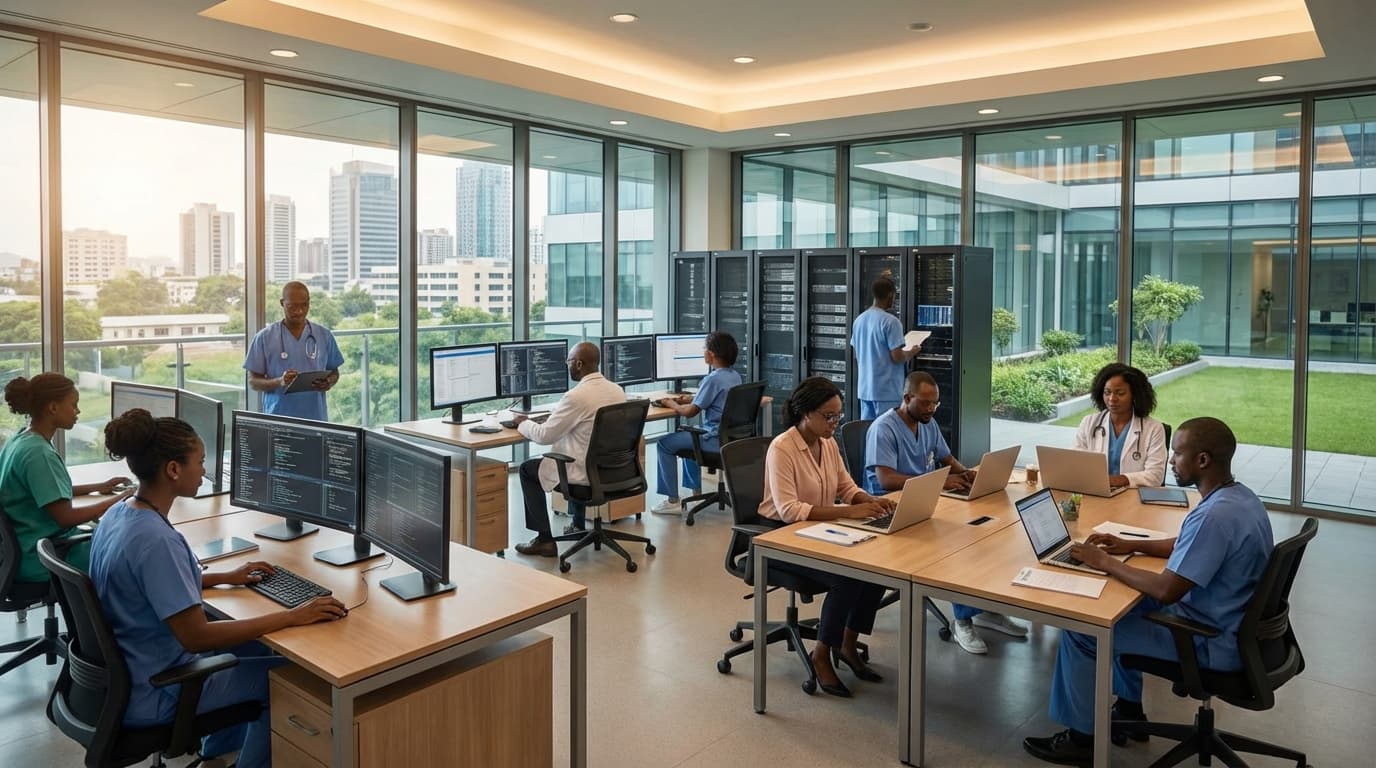
Radiology Reader & Reporting Support in Benin
Engineering Excellence & Technical Support
Remote radiology reading and reporting services High-standard technical execution following OEM protocols and local regulatory frameworks.
Cloud-Based PACS & AI Integration
Leveraging a secure, cloud-based Picture Archiving and Communication System (PACS) that seamlessly integrates with advanced Artificial Intelligence (AI) tools for enhanced image analysis, automated anomaly detection, and prioritized reporting, significantly improving radiologist efficiency and diagnostic accuracy.
Remote Consultation & Teleradiology Platform
Establishing a robust teleradiology platform enabling remote consultations and second opinions with international radiology experts, ensuring access to specialized knowledge and facilitating timely, high-quality reporting even in resource-limited settings across Benin.
Secure Data Management & Interoperability
Implementing a secure, potentially blockchain-enabled, data management system for patient imaging and reporting data, ensuring data integrity, patient privacy, and interoperability with existing healthcare information systems, facilitating seamless data flow and long-term record keeping.
What Is Radiology Reader & Reporting Support In Benin?
Radiology Reader & Reporting Support (RRRS) in Benin refers to the provision of advanced AI-powered algorithms and expert human oversight to enhance the accuracy, efficiency, and consistency of medical image interpretation and the subsequent generation of radiology reports. This service leverages sophisticated software to assist radiologists and clinicians in identifying subtle abnormalities, prioritizing urgent cases, automating parts of the reporting workflow, and ensuring adherence to standardized reporting guidelines. The objective is to augment diagnostic capabilities, reduce turnaround times, and improve the quality of patient care in a resource-constrained environment. Benin, like many developing nations, faces challenges in terms of a limited pool of specialized radiologists, particularly in remote areas, and the need for high-quality diagnostic imaging services to support a growing healthcare demand. RRRS aims to bridge these gaps by providing scalable and accessible support.
| Service Need | Target Users | Typical Use Cases | |||||
|---|---|---|---|---|---|---|---|
| Limited Radiologist Availability/Expertise: Insufficient number of highly specialized radiologists, especially in rural or underserved areas, leading to diagnostic delays and potential misinterpretations. | Radiologists (generalists and specialists), Radiographers, Clinicians (GPs, Surgeons, Oncologists, etc.), Hospital Administrators. | Emergency Department Triage: Rapid identification of critical findings like stroke, pulmonary embolism, or fractures in large volumes of imaging studies. | Screening Programs: Efficient analysis of large datasets for population-based screening (e.g., mammography for breast cancer, chest X-rays for tuberculosis). | Support for General Practitioners: Providing enhanced diagnostic assistance for primary care physicians interpreting basic imaging exams. | Complex Case Analysis: Assisting subspecialists in identifying subtle findings or performing detailed quantitative analysis in specialized areas. | Quality Improvement Initiatives: Standardizing reporting across different facilities and improving diagnostic accuracy through AI-assisted reviews. | Training and Education: Providing learning tools for junior radiologists and radiographers by highlighting abnormalities and demonstrating reporting best practices. |
| High Patient Load and Workflow Inefficiency: Overburdened radiology departments struggling with long reporting turnaround times, impacting patient management. | Radiologists (generalists and specialists), Radiographers, Clinicians (GPs, Surgeons, Oncologists, etc.), Hospital Administrators. | Emergency Department Triage: Rapid identification of critical findings like stroke, pulmonary embolism, or fractures in large volumes of imaging studies. | Screening Programs: Efficient analysis of large datasets for population-based screening (e.g., mammography for breast cancer, chest X-rays for tuberculosis). | Support for General Practitioners: Providing enhanced diagnostic assistance for primary care physicians interpreting basic imaging exams. | Complex Case Analysis: Assisting subspecialists in identifying subtle findings or performing detailed quantitative analysis in specialized areas. | Quality Improvement Initiatives: Standardizing reporting across different facilities and improving diagnostic accuracy through AI-assisted reviews. | Training and Education: Providing learning tools for junior radiologists and radiographers by highlighting abnormalities and demonstrating reporting best practices. |
| Need for Standardized and Accurate Reporting: Variability in reporting quality and adherence to international standards, hindering inter-institutional communication and research. | Radiologists (generalists and specialists), Radiographers, Clinicians (GPs, Surgeons, Oncologists, etc.), Hospital Administrators. | Emergency Department Triage: Rapid identification of critical findings like stroke, pulmonary embolism, or fractures in large volumes of imaging studies. | Screening Programs: Efficient analysis of large datasets for population-based screening (e.g., mammography for breast cancer, chest X-rays for tuberculosis). | Support for General Practitioners: Providing enhanced diagnostic assistance for primary care physicians interpreting basic imaging exams. | Complex Case Analysis: Assisting subspecialists in identifying subtle findings or performing detailed quantitative analysis in specialized areas. | Quality Improvement Initiatives: Standardizing reporting across different facilities and improving diagnostic accuracy through AI-assisted reviews. | Training and Education: Providing learning tools for junior radiologists and radiographers by highlighting abnormalities and demonstrating reporting best practices. |
| Integration with Existing Healthcare Infrastructure: Challenges in implementing advanced diagnostic tools within current IT systems and budget constraints. | Radiologists (generalists and specialists), Radiographers, Clinicians (GPs, Surgeons, Oncologists, etc.), Hospital Administrators. | Emergency Department Triage: Rapid identification of critical findings like stroke, pulmonary embolism, or fractures in large volumes of imaging studies. | Screening Programs: Efficient analysis of large datasets for population-based screening (e.g., mammography for breast cancer, chest X-rays for tuberculosis). | Support for General Practitioners: Providing enhanced diagnostic assistance for primary care physicians interpreting basic imaging exams. | Complex Case Analysis: Assisting subspecialists in identifying subtle findings or performing detailed quantitative analysis in specialized areas. | Quality Improvement Initiatives: Standardizing reporting across different facilities and improving diagnostic accuracy through AI-assisted reviews. | Training and Education: Providing learning tools for junior radiologists and radiographers by highlighting abnormalities and demonstrating reporting best practices. |
Key Components of Radiology Reader & Reporting Support:
- AI-powered Image Analysis: Utilization of deep learning algorithms for automated detection, segmentation, and characterization of pathologies across various imaging modalities (X-ray, CT, MRI, Ultrasound).
- Workflow Prioritization: Intelligent flagging of critical findings or emergent cases for immediate radiologist review.
- Automated Measurement and Quantification: Tools to perform objective measurements of lesions, volumes, and other quantitative parameters, reducing manual effort and variability.
- Standardized Reporting Templates: Guided report generation using structured templates to ensure completeness, consistency, and adherence to international reporting standards (e.g., BI-RADS, PI-RADS).
- Quality Assurance and Peer Review: Mechanisms for second reads, automated quality checks, and facilitating peer review processes.
- Remote Consultation and Teleradiology Integration: Enabling remote access to AI analysis and expert consultations for healthcare facilities without on-site radiology expertise.
- Continuous Learning and Model Improvement: Feedback loops for refining AI algorithms based on local data and radiologist input.
Who Needs Radiology Reader & Reporting Support In Benin?
Radiology reader & reporting support services are crucial for enhancing diagnostic accuracy, improving workflow efficiency, and addressing the shortage of specialized radiologists in Benin. These services can benefit a wide range of healthcare facilities and professionals across the country, particularly in areas with limited access to expert interpretation of medical images.
| Customer Type | Key Departments Benefiting | Specific Needs/Challenges Addressed |
|---|---|---|
| Hospitals (Public and Private) | Radiology Department, Emergency Room, Internal Medicine, Surgery, Pediatrics, Oncology, Neurology, Cardiology | High volume of imaging studies, need for second opinions, complex case interpretation, subspecialty reporting, bridging radiologist shortages, 24/7 coverage for urgent cases, training and quality assurance for junior radiologists. |
| Clinics and Diagnostic Centers | General Practitioners' Offices, Specialist Clinics (e.g., Orthopedics, Gynecology), Imaging Centers | Access to expert interpretation for a range of imaging modalities (X-ray, Ultrasound, CT, MRI), faster turnaround times for reports, improved diagnostic confidence, capacity building for in-house technicians. |
| Mobile Health Units | On-site diagnostic services in remote or underserved areas | Remote interpretation of images acquired in the field, timely diagnosis for patients who cannot travel to major facilities, extending the reach of diagnostic imaging services. |
| Research Institutions | Medical research projects requiring imaging analysis | Specialized image analysis for research protocols, quantitative imaging metrics, collaboration with expert radiologists for scientific publications, data management and standardization. |
| Medical Schools and Training Centers | Radiology residency programs, continuing medical education for physicians | Educational support for radiology trainees, case review for learning purposes, access to a diverse range of interpreted cases for teaching, developing standardized reporting protocols. |
Target Customers and Departments in Benin Requiring Radiology Reader & Reporting Support
- Hospitals (Public and Private)
- Clinics and Diagnostic Centers
- Mobile Health Units
- Research Institutions
- Medical Schools and Training Centers
Radiology Reader & Reporting Support Process In Benin
This document outlines the workflow for the Radiology Reader & Reporting Support Process in Benin. This process ensures timely and accurate interpretation of radiology images and generation of reports, facilitating effective patient care and clinical decision-making.
| Stage | Description | Responsible Party/System | Key Activities | Potential Challenges | Mitigation Strategies | ||||||||||||||||||||||||||||||||||||
|---|---|---|---|---|---|---|---|---|---|---|---|---|---|---|---|---|---|---|---|---|---|---|---|---|---|---|---|---|---|---|---|---|---|---|---|---|---|---|---|---|---|
| Inquiry & Request Initiation | The process begins when a clinician or healthcare provider requires a radiology examination for a patient. | Clinician/Referring Physician, PACS/RIS | Patient registration, Order placement, Specification of imaging modality and clinical indication. | Incomplete or inaccurate request details, Unclear clinical information. | Standardized order forms, Mandatory fields in RIS, Direct communication channels for clarification. | Image Transmission & Data Reception | Once the imaging is performed, the images and associated patient data are sent to the radiology department. | Imaging Technologist, PACS | Image acquisition, DICOM image transfer, Metadata association with images. | Technical issues with imaging equipment, Network connectivity problems, Incomplete metadata. | Regular equipment maintenance, Robust network infrastructure, Data validation checks. | Reader Assignment & Workflow Management | Incoming studies are triaged and assigned to an appropriate radiologist based on subspecialty and workload. | Radiology Department Manager, RIS/PACS Workflow Module | Study prioritization, Radiologist assignment, Worklist management. | Uneven workload distribution, Lack of specific subspecialty expertise for complex cases, Delays in assignment. | Automated workload balancing algorithms, Peer consultation protocols, On-call systems for urgent cases. | Image Interpretation & Preliminary Findings | The assigned radiologist reviews the images and formulates an initial interpretation. | Radiologist (Reader) | Image viewing and analysis, Identification of abnormalities, Formulation of preliminary findings. | Image quality issues, Complex or rare findings, Time constraints. | Advanced image viewing software, Access to reference libraries and databases, Structured reporting templates. | Report Generation & Review | A draft report is created based on the preliminary findings, which may be reviewed by a senior radiologist. | Radiologist (Reporter), Senior Radiologist (if applicable), Speech Recognition Software/EMR | Dictation or typing of findings, Inclusion of relevant clinical history, Comparison with prior studies. | Dictation errors, Inconsistent reporting language, Time spent on manual data entry. | Voice recognition software, Standardized reporting templates, Automated comparison tools. | Report Finalization & Distribution | The final report is approved and disseminated to the requesting clinician. | Radiologist, RIS/PACS | Final report approval, Electronic distribution via RIS/PACS, Fax or secure email for external distribution. | Report turnaround time delays, Distribution errors, Integration issues with EMR. | Streamlined reporting workflow, Automated distribution mechanisms, EMR integration protocols. | Quality Assurance & Archiving | A continuous process of quality control and secure storage of all radiology reports and images. | Radiology Department, PACS/RIS, Hospital Administration | Periodic review of reports for accuracy and completeness, Data security, Long-term storage and retrieval. | Human error in QA process, Data integrity breaches, Storage capacity limitations. | Regular QA audits, Robust cybersecurity measures, Scalable and secure archiving solutions. |
Key Stages of the Radiology Reader & Reporting Support Process
- Inquiry & Request Initiation
- Image Transmission & Data Reception
- Reader Assignment & Workflow Management
- Image Interpretation & Preliminary Findings
- Report Generation & Review
- Report Finalization & Distribution
- Quality Assurance & Archiving
Radiology Reader & Reporting Support Cost In Benin
Providing accurate radiology readings and reporting support in Benin involves several cost considerations. These are influenced by the complexity of the imaging, the specific type of radiology service required, the qualifications of the radiologist, and the administrative overhead of the service provider. The local currency in Benin is the West African CFA franc (XOF). Pricing can vary significantly between public and private healthcare facilities, as well as between specialized radiology centers and general hospitals.
| Service Type / Imaging Modality | Estimated Price Range (XOF) | Notes |
|---|---|---|
| Simple X-ray Interpretation & Report | 10,000 - 25,000 | Basic fracture, chest X-ray. |
| Ultrasound (Abdomen/Pelvis) Interpretation & Report | 15,000 - 40,000 | Standard obstetric or abdominal scan. |
| CT Scan Interpretation & Report | 50,000 - 150,000 | Depends on the region scanned (e.g., head, chest, abdomen). |
| MRI Scan Interpretation & Report | 100,000 - 300,000+ | Significantly varies by area of the body and complexity (e.g., brain, spine, joints). |
| Mammography Interpretation & Report | 20,000 - 50,000 | Screening or diagnostic mammogram. |
| Radiology Reporting Support (General) | 5,000 - 20,000 per study | Can be a service for remote reading or second opinions, often based on complexity. |
| Emergency/Urgent Reporting Surcharge | 5,000 - 20,000 | Applied to expedited requests. |
Key Pricing Factors for Radiology Reader & Reporting Support in Benin
- Type of Imaging Modality: Costs differ based on whether the imaging is X-ray, Ultrasound, CT scan, MRI, orMammography. More advanced modalities generally incur higher costs.
- Complexity of the Case: Simple, straightforward readings are typically less expensive than complex interpretations requiring detailed analysis, correlation with clinical history, or comparison with previous studies.
- Radiologist's Expertise and Specialization: Radiologists with sub-specializations (e.g., neuroradiology, musculoskeletal radiology) may command higher fees for their specialized knowledge.
- Urgency of the Report: Expedited reporting for critical cases often comes with a premium.
- Service Provider (Public vs. Private): Public healthcare facilities generally offer lower costs, often subsidized, while private hospitals and specialized centers will have higher, market-driven pricing.
- Geographic Location within Benin: Major urban centers might have slightly different pricing structures compared to more rural areas due to varying operational costs and competition.
- Administrative and Infrastructure Costs: These include the cost of maintaining radiology equipment, PACS (Picture Archiving and Communication System), IT support, and administrative staff.
- Reporting Format and Detail: The level of detail and the format of the final radiology report can influence the cost. Standard reports are generally included, but detailed descriptive reports or second opinions might be extra.
Affordable Radiology Reader & Reporting Support Options
Radiology practices and healthcare facilities are increasingly seeking efficient and cost-effective ways to manage the growing demand for radiology interpretations and reporting. This involves exploring options that provide expert reading services and robust reporting support without incurring the high overhead of full-time, in-house staff. Value bundles and strategic cost-saving measures are key to achieving this balance. These solutions can range from on-demand reading services to comprehensive managed radiology departments, all designed to optimize workflow, improve turnaround times, and reduce operational expenses. Understanding the different models and how they can be customized is crucial for making informed decisions.
| Strategy/Bundle Type | Description | Cost-Saving Mechanism | Value Proposition |
|---|---|---|---|
| On-Demand Reading (Pay-per-Study) | Access to radiologists for individual studies as needed. Ideal for practices experiencing unpredictable volume or requiring niche subspecialty reads. | Eliminates fixed overheads for underutilized staff. Only pay for services rendered. | Flexibility, access to subspecialty expertise, immediate coverage for urgent cases. |
| Volume-Based Contracts | Agreed-upon pricing for a defined monthly or annual volume of studies. Often includes preliminary and final reads with quality assurance. | Predictable costs, potential for volume discounts, economies of scale through the provider. | Consistent coverage, improved turnaround times, standardized reporting quality. |
| Subspecialty Bundles | Dedicated reading services for specific modalities (e.g., MSK, Neuro, Breast Imaging) or patient populations. Often includes specialized reporting templates. | Ensures access to highly specialized expertise without hiring multiple in-house subspecialists. Streamlined workflow for specific exam types. | Improved diagnostic accuracy for complex cases, enhanced patient care, reduced referral leakage. |
| 24/7 Coverage Packages | Continuous radiology reading and reporting services to cover all shifts, including nights, weekends, and holidays. | Avoids the significant cost and logistical challenges of staffing 24/7 in-house. Reduces burnout risk for existing staff. | Uninterrupted patient care, timely emergency department interpretations, improved operational efficiency. |
| AI-Powered Workflow Integration | Bundles that include AI tools for preliminary detection, quantification, or report generation, alongside human oversight. | Reduces radiologist reading time, improves report completeness and consistency, potentially lowers per-study costs. | Increased radiologist efficiency, faster report turnaround, enhanced diagnostic decision support. |
| Full-Service Managed Radiology | Outsourcing of the entire radiology reading function, including staffing, scheduling, QC, and often PACS/RIS integration support. | Significantly reduces administrative burden and overhead associated with managing a radiology department. Leverages provider's expertise in operational efficiency. | Focus on core clinical services, predictable operational costs, access to best practices and technology. |
Types of Affordable Radiology Reader & Reporting Support Options
- Teleradiology Services: Remote interpretation of medical images by board-certified radiologists. Can be used for overflow, subspecialty coverage, or 24/7 staffing.
- Outsourced Reading & Reporting: A third-party provider handles a defined volume or specific types of radiology studies, delivering preliminary or final reports.
- Hybrid Models: Combining in-house capabilities with outsourced services to fill gaps, manage peak loads, or provide specialized expertise.
- AI-Assisted Reporting Tools: Software that helps radiologists generate reports faster and more consistently, reducing dictation time and errors. Often integrated with teleradiology or outsourced solutions.
- Managed Radiology Services: A comprehensive outsourcing solution where a provider manages the entire radiology department, including staffing, IT, and workflow optimization.
Verified Providers In Benin
In Benin, identifying reliable and trustworthy healthcare providers is crucial for receiving quality medical care. Franance Health stands out as a beacon of excellence, distinguishing itself through its rigorous credentialing process and commitment to patient well-being. This document outlines why Franance Health credentials represent the best choice for individuals seeking healthcare services in Benin.
| Benefit of Choosing a Franance Health Verified Provider | Why it Matters |
|---|---|
| Guaranteed Quality of Care: | Franance Health verified providers have demonstrated a commitment to high medical standards, reducing the risk of substandard or negligent care. |
| Trust and Reliability: | The comprehensive vetting process ensures that you are engaging with legitimate and competent healthcare professionals, fostering trust and peace of mind. |
| Access to Specialized Expertise: | Franance Health helps identify providers with verified specializations, ensuring you get the right care for your specific medical needs. |
| Improved Patient Outcomes: | By partnering with credentialed and experienced professionals, patients are more likely to receive accurate diagnoses and effective treatments, leading to better health outcomes. |
| Ethical and Professional Conduct: | Franance Health's emphasis on ethical conduct means you can expect respectful, transparent, and patient-centered interactions. |
| Reduced Risk and Uncertainty: | Choosing a verified provider eliminates the guesswork and uncertainty associated with finding healthcare, saving you time and stress. |
What are Franance Health Credentials?
- Rigorous Vetting Process: Franance Health implements a multi-faceted vetting system that goes beyond standard licensing. This includes in-depth background checks, verification of educational qualifications, professional experience, and an assessment of ethical conduct.
- Specialized Expertise Verification: For providers specializing in particular medical fields, Franance Health ensures their credentials and ongoing training in that specialty are thoroughly reviewed and validated.
- Patient Feedback Integration: A unique aspect of Franance Health's credentialing involves actively seeking and integrating anonymized patient feedback to ensure providers consistently meet high standards of care and patient satisfaction.
- Adherence to International Standards: Where applicable, Franance Health aligns its credentialing processes with recognized international healthcare quality standards, ensuring a global benchmark for its approved providers.
- Continuous Monitoring and Re-evaluation: The credentialing process is not a one-time event. Franance Health engages in continuous monitoring of its providers, including regular re-evaluations to ensure ongoing compliance and excellence.
Scope Of Work For Radiology Reader & Reporting Support
This Scope of Work (SOW) outlines the requirements for a Radiology Reader & Reporting Support service. The service provider will be responsible for providing qualified radiologists to read medical imaging studies and generate comprehensive, accurate, and timely reports. This document details the technical deliverables and standard specifications expected for this service.
| Deliverable | Description | Technical Specifications/Standards | Timeline/Frequency | Acceptance Criteria |
|---|---|---|---|---|
| Radiology Image Interpretation | Reading of various medical imaging modalities (e.g., X-ray, CT, MRI, Ultrasound, Nuclear Medicine) as assigned by the client. | ACR Appropriateness Criteria, RadLex terminology, DICOM compliance for image access. | As per client's request and agreed-upon turnaround times (e.g., STAT, urgent, routine). | Interpretation aligned with established clinical guidelines and best practices; identification of all significant findings. |
| Radiology Report Generation | Creation of comprehensive, clear, and concise radiology reports for each interpreted study. | Standardized report templates (e.g., ACR-approved templates), inclusion of relevant clinical history, findings, impression, and recommendations. Adherence to HL7 standards for report transmission. | Within agreed-upon turnaround times (e.g., STAT: <1 hour, Urgent: <4 hours, Routine: <24 hours). | Reports are legible, accurate, grammatically correct, and contain all necessary components. Reports accurately reflect the interpreted images. |
| PACS/EHR Integration | Seamless integration with the client's PACS for image retrieval and EHR for patient data and report upload. | DICOM standards for image transfer, HL7 v2.x or FHIR for patient demographics and order data, and secure API integration for report submission. | Continuous, real-time integration. | Successful transmission of images and reports without data loss or corruption. Minimal manual intervention required from client staff. |
| Quality Assurance (QA) | Internal quality review of a percentage of reports to ensure accuracy and adherence to standards. | Peer review process, adherence to internal QA protocols, and regular performance monitoring. | Ongoing, with monthly QA reports provided to the client. | Identification and correction of any reporting or interpretation errors; continuous improvement in report quality. |
| Communication & Collaboration | Facilitation of communication with referring physicians for clarification or discussion of complex cases. | Secure communication channels (e.g., encrypted email, secure messaging platform), clear escalation procedures. | As needed, with proactive outreach for critical findings. | Timely and effective communication that resolves clinical queries and improves patient care. |
| Data Security & Compliance | Ensuring compliance with all relevant data privacy and security regulations (e.g., HIPAA, GDPR). | HIPAA-compliant infrastructure and workflows, regular security audits, role-based access control, encryption of data in transit and at rest. | Continuous compliance, with annual security certifications provided to the client. | Zero data breaches or privacy violations. Successful completion of security audits. |
Key Objectives
- Ensure accurate and timely interpretation of medical imaging studies.
- Generate high-quality radiology reports adhering to established standards.
- Provide efficient and responsive service to meet clinical needs.
- Maintain data security and patient privacy in accordance with all applicable regulations.
- Integrate seamlessly with the client's existing Picture Archiving and Communication System (PACS) and Electronic Health Record (EHR) systems.
Service Level Agreement For Radiology Reader & Reporting Support
This Service Level Agreement (SLA) outlines the guaranteed response times and uptime for Radiology Reader & Reporting Support services. This agreement ensures timely and reliable access to critical reading and reporting functions for healthcare providers.
| Issue Severity | Description | Response Time Guarantee | Resolution Target |
|---|---|---|---|
| Critical | Complete system outage, inability to read or report images. Significant impact on patient care. | 15 minutes | 4 business hours |
| High | Key functionality is severely degraded or unavailable (e.g., inability to save reports, access specific patient data). Major impact on workflow. | 30 minutes | 8 business hours |
| Medium | Minor functionality degradation, intermittent errors, or performance issues that do not prevent core operations. Moderate impact on workflow. | 2 business hours | 2 business days |
| Low | Cosmetic issues, minor bugs, feature requests, or general inquiries. Minimal or no impact on workflow. | 4 business hours | 5 business days |
Key Performance Indicators (KPIs)
- Uptime Guarantee: The service will be available 99.9% of the time, excluding scheduled maintenance windows.
- Response Time for Critical Issues: For urgent reader/reporting system outages or critical functional failures, a response will be initiated within 15 minutes.
- Response Time for Non-Critical Issues: For non-urgent issues, feature requests, or general inquiries, a response will be initiated within 4 business hours.
- Resolution Time Targets: While not a strict guarantee due to complexity, targets are set for timely resolution of issues based on severity.
- Scheduled Maintenance: All scheduled maintenance will be communicated at least 48 hours in advance and will typically occur during off-peak hours.
- Reporting of Downtime: Any unplanned downtime exceeding 30 minutes will be reported to the client within 1 hour of detection.
Frequently Asked Questions

Ready when you are
Let's scope your Radiology Reader & Reporting Support in Benin project in Benin.

Scaling healthcare logistics and technical systems across the entire continent.